
If two people take the same weight of mushrooms, have they taken the same dose? Not necessarily. Before body weight or personal sensitivity enters the picture, there's a more basic uncertainty: how much active compound was in the material they consumed?
Understanding dosing rate means separating product weight, active content, and timing. A familiar serving size can conceal unfamiliar potency, and an early impression of weak effects isn't a reliable reason to take more. The useful question isn't how much alone, but how much of what, measured how, and over what interval?
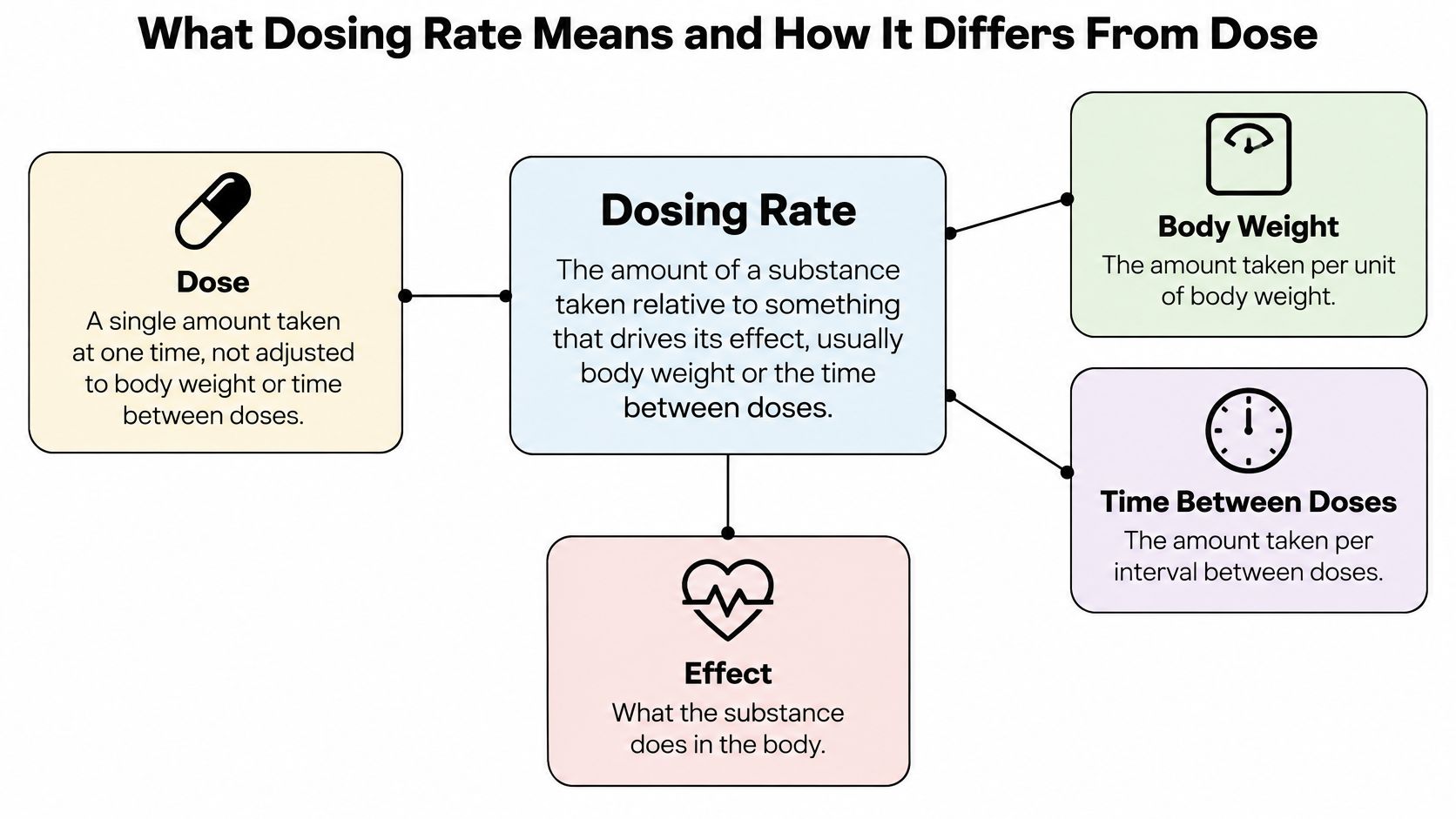
What Dosing Rate Means and How It Differs From Dose
Dosing rate describes the amount of a substance taken relative to body weight or time, while a dose is the amount taken at a particular moment. Think of a single pour from a bottle versus how much flows out per minute. The first describes an amount; the second describes delivery over time.
Strictly speaking, a rate means amount per unit time. In everyday dosing discussions, however, people also use dosing rate to mean a weight-normalized dose. Those aren't interchangeable measurements, so always read the units.
Terms readers confuse when comparing doses
The examples below distinguish terminology, not recommended amounts.
| Term | What it measures | Example |
|---|---|---|
| Dose | Amount taken at one time | 25 mg of psilocybin in a supervised clinical protocol |
| Dosing rate | Amount relative to body weight or time between doses | 0.3 mg/kg, or one dose every 3 days |
| Serving size | Product weight or count on the label | One capsule or one gummy, with no guarantee of its active content |
| Potency | Active compound per gram of material | Psilocybin content of a dried mushroom batch, tested by a lab |
| Dose response | How the effect changes as the dose changes | Rising side-effect frequency across different dose levels |
These distinctions connect the amount consumed to the conditions that influence its effects.
Paracelsus framed dose as central to toxicity, a principle discussed in this historical review of dose-response science. Modern dose-response work measures how effects change across exposure levels rather than assuming an amount behaves identically for everyone.
That distinction matters for consumer products because a serving is a labeling unit, not a biological prediction. A capsule count tells you what to measure physically; it doesn't, by itself, establish active content or predict intensity.
Before comparing numbers, check whether each label states a dose, a serving size, a potency, or a body-weight basis. If the units describe different things, the numbers aren't directly comparable.
How Effects Climb as the Amount Rises
Think of a stereo's volume knob. Turning it from 3 to 6 roughly doubles what you hear. Drug response rarely works that cleanly. A higher dose can produce a stronger version of the same experience, a qualitatively different experience, or mostly more side effects, and the outcome varies from person to person. Researchers therefore track four separate measurements: the amount administered, exposure inside the body, subjective intensity, and adverse effects. Those describe related processes, but they aren't the same outcome.
One concrete illustration comes from a randomized trial in treatment-resistant depression, which reported adverse-event figures across its dose groups. In that study, higher doses were associated with more participants reporting adverse events overall.
Adverse events by dose in a treatment-resistant depression trial
| Psilocybin dose | Participants with any adverse event | Severe adverse events, weeks 3 to 12 |
|---|---|---|
| 1 mg | 72% | 0% |
| 10 mg | 75% | 4% |
| 25 mg | 84% | 3% |
Two details shape how to read this. The severe-event column covers the period after week 3 through week 12, not just the acute dosing session, so it reflects follow-up rather than the drug's immediate effects. And an event reported after treatment isn't automatically proof the substance caused it. Timing, underlying illness, and the trial's clinical assessment all matter when interpreting safety findings.
Practical rule: Don't interpret an initially mild response as evidence that an additional amount will produce only a mild increase.
What a dose-response pattern can tell you
When evaluating a response, distinguish when effects begin, how broadly they develop, and which unwanted effects appear. A change in mood alone is different from a combination of nausea, disorientation, and anxiety, and the mixture matters as much as the magnitude.
A previous reaction can inform a clinical conversation, but it cannot precisely predict a later reaction at a different amount. Trial participants were screened and monitored, and their group-level results don't establish a personal escalation rule. Because effects build over time rather than appearing instantly, taking additional material before the first amount has fully developed stacks one uncertain response on top of another. That uncertainty about how much active compound the material delivers, combined with impatience about timing, is where dosing decisions most often go wrong.
Why Potency and Body Weight Change the Real Dose
Equal mushroom weight does not establish equal active content. Adjusting for body weight won't correct an inaccurate assumption about what the product contains.
A pharmacotherapy analysis of psilocybin dosing identified approximately 20–30 mg per 70 kg as a range most likely to produce therapeutic outcomes in clinical populations, while finding substantial person-to-person variability that body weight alone didn't explain. Clinical oral dosing is generally treated as an absolute amount rather than automatically scaled to body mass.
That means a heavier person shouldn't assume they need more. Weight is measurable, but measurability doesn't make it the strongest predictor of response.
Reported psilocybin range by dried-mushroom weight
An analysis of cultivated Psilocybe cubensis reported the following ranges even when material was described as belonging to the same strain. The table measures combined psilocybin and psilocin content, not purified psilocybin alone, and these quantities aren't recommended servings.
| Dried mushroom weight | Lowest reported content | Highest reported content |
|---|---|---|
| 3 g | 19.8 mg | 46.2 mg |
| 6 g | 39.6 mg | 92.4 mg |
| 10 g | 66 mg | 154 mg |
Multiplying mushroom weight by an assumed potency gives an estimate built on that assumption. A calculator can perform the arithmetic correctly while producing a misleading answer if its potency input doesn't represent the batch.
This is why potency uncertainty can be a larger hidden variable than body weight. A precise weight measurement doesn't compensate for an unmeasured concentration.
A strain name identifies a product description. It doesn't substitute for a batch-specific measurement of active compounds.
Read the active-content description
For capsules, gummies, and chocolates, ask what the label's weight describes: mushroom material, extract, total ingredients, or quantified active compound. An extract concentration also needs a clear basis before it can be compared with dried biomass.
Use the guide to magic mushroom potency to distinguish these labeling questions. The decisive checks are what was measured, which compounds were included, and whether the result belongs to the batch in hand. If those details are missing, body-weight calculations can create an appearance of precision without resolving the underlying uncertainty.
How Fast a Dose Acts and How Long It Lasts
Timing involves separate questions: when effects begin, when intensity fully develops, and how quickly the body eliminates the active compound. A dosing interval shouldn't be chosen by treating those clocks as interchangeable.
A pharmacokinetic study in healthy adults evaluated 12 participants receiving escalating oral doses of 0.3, 0.45, and 0.6 mg/kg. Psilocin exposure rose linearly across that twofold dose range, and the reported average elimination half-life was approximately 3 hours, with a standard deviation of 1.1 hours.
What the timing measurements mean
Half-life describes elimination, not the point at which a person becomes unimpaired or returns to their usual state. It cannot be used as a countdown to a safe second dose.
Linear systemic exposure also doesn't mean linear psychological intensity. Measuring the amount circulating in the body answers a different question from measuring the experience.
A useful timing record separates these stages:
- Administration: Record what was taken, its stated active content, and the time.
- Developing effects: Note changes without treating the earliest sensations as the final intensity.
- Established effects: Avoid adding more while intensity is still developing.
- Recovery: Don't use a fading sensation alone to judge readiness for driving or other safety-sensitive activities.
Waiting for full onset is a precaution, not permission to redose. No universal redosing cutoff can be derived from an average elimination half-life.
Effects can develop over hours, so reassessing too early can lead to overlapping exposure. The explanation of how long psilocybin lasts provides additional context for separating onset, intensity, and recovery.
A fixed milligram amount and a weight-normalized amount are different ways to specify a dose. Copying someone else's schedule doesn't account for their formulation, sensitivity, or supervision, and the pharmacokinetic study wasn't a self-dosing protocol.
Low-Dose and Microdose Ranges Compared
The familiar contrast between a microdose and a full dose leaves an important gap: a low amount isn't necessarily an imperceptible amount. Someone can experience noticeable changes even when a product is marketed for subtle effects.
A review published in 2025 described low-dose regimens of 1–3 mg per 70 kg as a single dose, or 0.1–0.2 g of dried psilocybin-containing mushrooms every three days. These are descriptions of regimens in the literature, not personalized recommendations or proof that the preparations are equivalent.
How the research categories differ
A clinical-development account of low-dose psilocybin describes oral doses of 0.5–4.0 mg as well tolerated in a Phase 1 study of healthy adults, with the strongest responses and greatest variability at 3.5 and 4.0 mg. It also describes a trial design expecting doses up to 2 mg to remain below clearly perceptible subjective effects, while acknowledging individual variation.
Those findings describe distinct questions:
- Single low dose: A measured administration intended for a particular research setting.
- Repeated mushroom regimen: A schedule involving botanical material whose potency must be established separately.
- Tolerability range: Amounts participants tolerated under study conditions, not necessarily amounts without noticeable effects.
- Expected perceptual threshold: A trial-design expectation, not a universal boundary.
Sub-perceptible should mean no noticeable sensory, emotional, or cognitive change. If perception shifts, emotions feel unusually amplified, or thinking feels different, the experience isn't sub-perceptible for that person.
Detectable effects change the decision
Don't drive or operate machinery when effects are detectable, and don't increase frequency to compensate for an uncertain response. Subtle changes can still matter when a task requires attention, judgment, or coordination.
Milligrams of purified psilocybin cannot be reliably converted into grams of dried mushrooms without tested potency. Nor does a schedule printed elsewhere establish suitability alongside a person's medications, health conditions, or responsibilities.
A research range defines what investigators examined. It doesn't define a safe personal target, and detectable changes are a reason to stop escalating rather than add more.
Dosing Examples From Controlled Clinical Research
A clinical dose becomes meaningful through the protocol surrounding it, not just the number printed in the methods.
In a randomized trial published in JAMA, 104 adults with major depressive disorder received a single 25 mg psilocybin dose with psychological support or an active placebo. The psilocybin group showed a rapid and sustained reduction in depressive symptoms over the six-week trial, while adverse events were generally mild or moderate and concentrated around the acute dosing period.
Follow the protocol, not just the amount
The investigators specified the active compound rather than a mushroom-weight serving. That removed a major measurement ambiguity: the protocol didn't ask participants to infer active content from a strain name, a chocolate portion, or a capsule's total weight.
Participants also received screening and psychological support. Those conditions were part of the treatment being evaluated, not optional extras that can be separated from the outcome.
Consider a reader holding a mushroom chocolate and trying to match a clinical dose. Before making any numerical comparison, they would need:
- Verified composition: Which active compounds are present and how they were measured.
- Serving uniformity: Whether the measured content is distributed consistently across portions.
- Clinical suitability: Whether their health history and medication use fit the conditions under which treatment was studied.
- Support and monitoring: The safeguards available if distress or physiological symptoms develop.
Even a laboratory result cannot reproduce all of those conditions. Matching an active-content number doesn't reproduce a clinical intervention.
A trial dose describes one component of supervised treatment. It isn't a recipe for recreating the trial at home.
The plain distinction is that a consumer serving does not supply the screening, standardized preparation, support, or monitoring of the clinical protocol. The trial offers evidence about supervised care, not a self-dosing rule or a guarantee of benefit.
Safety Limits and the Checks Before You Decide
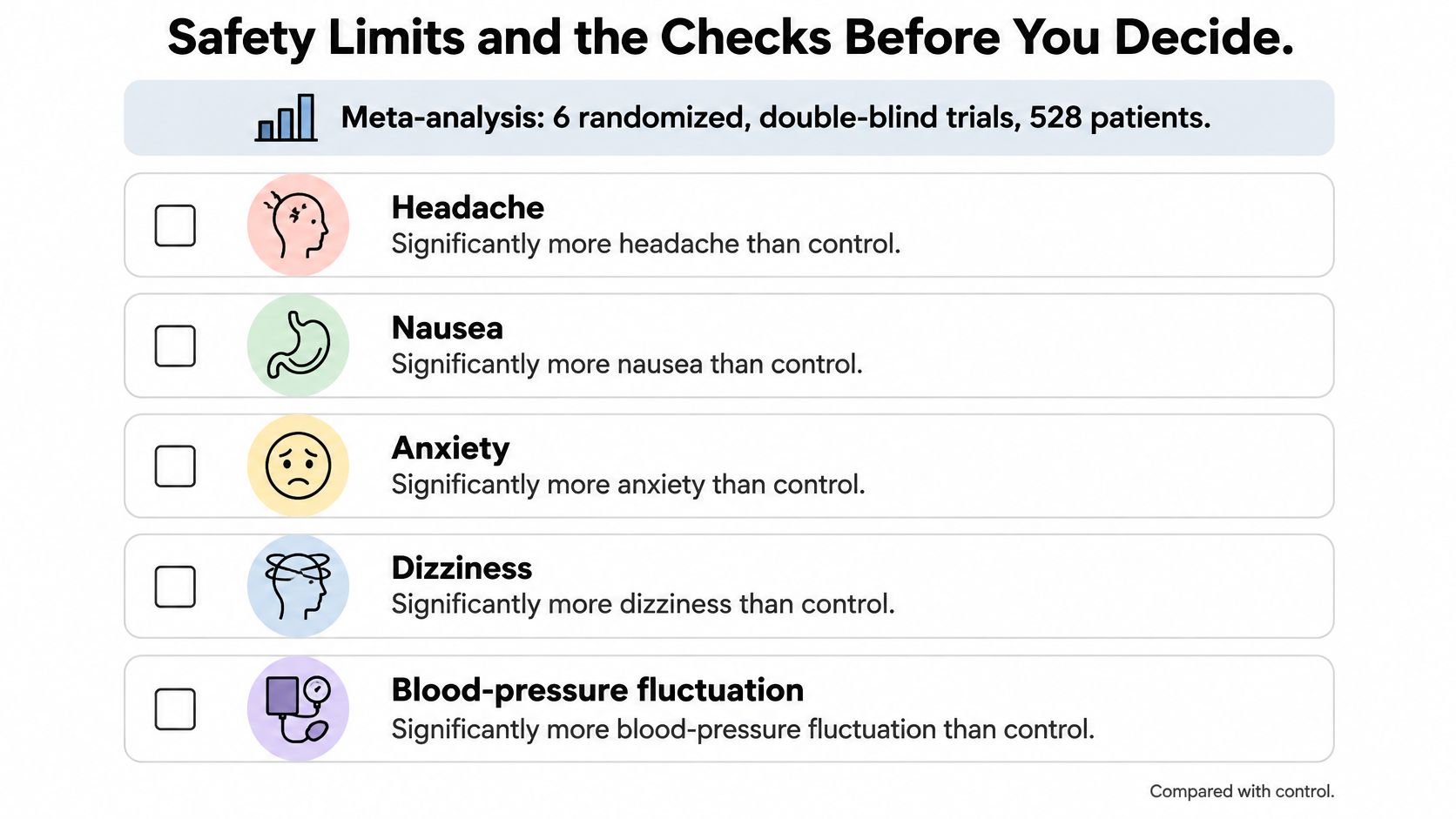
A 2024 systematic review and meta-analysis combined six randomized, double-blind trials involving 528 patients and found significantly more headache, nausea, anxiety, dizziness, and blood-pressure fluctuations with therapeutic psilocybin than with control conditions. These findings came from selected, monitored research participants, so they shouldn't be treated as predictions for every person or product.
The practical implication is to monitor physical symptoms as well as psychological intensity. The following visual summarizes the adverse effects assessed in those trials.
Set stop rules before exposure
- Stop adding material if symptoms appear. New headache, nausea, or dizziness is a reason to stop, not something to counter by changing the dose.
- Take sustained anxiety seriously. A concerning blood-pressure reading or symptoms such as chest pain, fainting, or severe headache require medical attention, not another serving. Blood-pressure changes can't reliably be identified by sensation alone.
- Don't reassess during developing onset. Avoid additional exposure while effects are still emerging. Waiting doesn't establish that another dose is appropriate.
- Review medicines and supplements first. Ask a healthcare professional about interactions and personal contraindications before use. Don't stop prescribed treatment to accommodate psilocybin without medical guidance.
Severe confusion, seizures, difficulty breathing, or loss of consciousness warrant emergency assistance. Tell responders what was taken and keep the packaging available if possible.
Make the measurement check actionable
Before deciding, identify whether the stated figure describes product weight, serving size, potency, or active-compound milligrams. Check whether the batch has been tested for psilocybin content, and whether the result distinguishes psilocybin from other measured alkaloids.
If a clinical range uses body weight, preserve that context when discussing it with a clinician rather than extracting a headline number. Don't use the comparison to calculate a personal target.
For Magic Mushroom Capsules, we recommend starting with the serving size on the product label and adjusting based on individual preferences and tolerance. That recommendation doesn't override interaction screening, stop rules, or the need to avoid rapid repeat dosing.
The psychedelic harm-reduction guide offers further preparation considerations. This accompanying video provides another format for reviewing the topic.
A smaller nominal amount from potent or uneven material can exceed a larger amount from weaker material. Dosing guidance can reduce avoidable mistakes, but it cannot guarantee an identical experience or establish a universal safe limit.
The Magic Mushroom Delivery offers mushroom products alongside educational resources on potency, duration, dosing considerations, and responsible use. Visit The Magic Mushroom Delivery to review product serving information and prepare specific questions about active content before making a decision.