
Most advice about the Frisian Duck strain opens with the same promise: put it in the garden and nobody will recognise it as cannabis. That's a sales line dressed up as a growing tip. The webbed leaf is real and it's documented in the breeding record, but it doesn't arrive identically in every seed, and it doesn't hide a plant that's pushing out heavy, aromatic flowers in September.
The useful way to read this cultivar is as a set of claims with different confidence levels. Lineage is well documented. Leaf shape is a probability. Potency and effects are figures published by sellers and reviewers, not lab results for the product in your hand. Sorting those three tiers is what keeps you from spending a season on an expectation.
Frisian Duck at a Glance Across Lineage and Seed Type
Frisian Duck is a modern cannabis strain, not a duck breed, and the name refers to foliage rather than anything agricultural. SeedFinder's strain record lists the lineage as Frisian Dew × DucksFoot, developed by the Dutch breeder Dutch Passion, suitable for both indoor and outdoor cultivation, with an approximate flowering period of 56 days. The same record lists the cultivar in feminized seed form.
| Attribute | Reported detail | Source |
|---|---|---|
| Lineage | Frisian Dew × DucksFoot | SeedFinder |
| Breeder | Dutch Passion | Breeder attribution |
| Seed form | Feminized seed | SeedFinder listing |
| Cultivation suitability | Indoor and outdoor | SeedFinder listing |
| Flowering period | About 56 days | SeedFinder listing |
| Defining trait | Webbed, paddle-like leaves | Strain profile |
The breeding logic behind that cross is straightforward. One parent was selected for outdoor behaviour, the other for an unusual leaf architecture, and the resulting plant was marketed on appearance and discretion rather than on yield records or cup results.
Why the seed format matters more than the name
Feminized seed lines are produced to give predominantly female plants, which removes most of the work of scouting for males and pulling them before they shed pollen. For a garden grower with a handful of plants, that's the single most practical feature on the list, because one missed male can seed an entire crop.
Practical rule: feminized describes the seed production method, photoperiod describes how the plant is triggered to flower, and autoflowering describes a different trigger again. Confirm all three on the actual packet before you plan a season around them.
What this profile establishes is a purpose-bred hybrid with a traceable breeding history. What it doesn't establish is how any individual seed will look, stretch or finish.
Why the Duck Look Varies From Plant to Plant
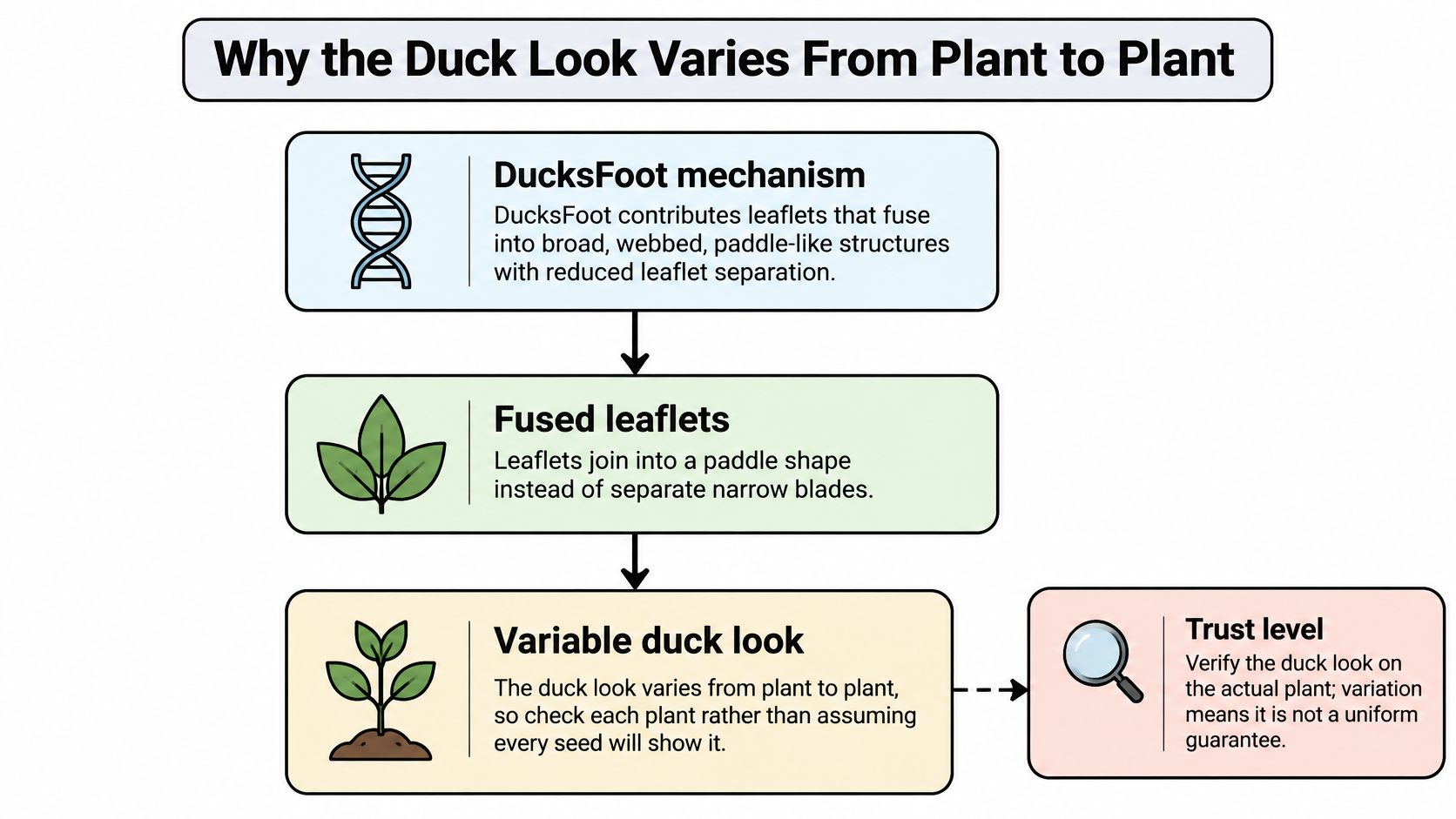
The duck-like look begins with leaf architecture. DucksFoot-type leaves can fuse into broad, webbed, paddle-like structures with reduced serration, replacing the separate narrow blades of a conventional cannabis plant. That shape is most visible during vegetative growth and early flowering, the same period when plants are easiest to identify from a distance.
The cross has a simple breeding logic. One parent contributes the unusual leaf form. The other gives the line its broader outdoor context. Dutch Passion's Frisian Duck introduction describes phenotypes within the line, including a longer-stretching, slower-flowering, sativa-dominant type. That description matters because it shows how far individual plants can sit from the neat image suggested by the name.
Here's the flow of that trait from parent to individual plant, and where the certainty drops away.
Consistency is the weak point
A strain name describes a population, not a single plant type held in every seed. Two seeds from one packet can differ in leaf shape, height and bud colour. CannaConnection's strain page reports that 50% of Frisian Duck phenotypes develop dark-purple buds, which gives a useful caution. A headline visual trait can appear in part of the population while being absent from the rest.
Leaf shape also carries environmental noise. Heat, watering and nutrient problems can deform foliage, so an odd-looking plant does not automatically confirm the duck phenotype. Reading up on leaf curl and other leaf distortions helps separate inherited webbing from stress responses before any judgement is made about the packet.
Three claims that get merged into one
- Lineage: documented and stable. The cross is recorded and the breeder is named.
- Leaf morphology: likely but variable. Expect webbing, verify it on each plant, and avoid treating an ordinary-looking seedling as proof of a mislabelled packet.
- Real-world concealment: the weakest claim. Reduced leaf recognition does not remove flower structure, smell, height or the fact that a plant is sitting in a pot on your patio.
The practical conclusion is narrow. Frisian Duck has a documented identity and a visual trait that can be checked plant by plant. Most supporting material comes from breeders and seed retailers rather than independent genetic work, so the duck look should be treated as a probability shaped by genetics, environment and selection. The label gives a starting point. The plant gives the answer.
Reported THC and What the Range Means
Marijuana Seeds listed Frisian Duck at a THC range of 16.38% to 18.5% in 2024. Turn that into weight and it becomes useful. THC percentage is expressed against dried flower weight, so one gram at 18% carries about 180 mg of THC, and one gram at 16.38% carries about 164 mg. A gram is a meaningful quantity in practice, and a spread of that size is not a rounding error when you're planning a dose.
That range is a seller's figure. It isn't a certificate, and it doesn't describe a specific batch.
What moves the number
- Phenotype: the same seed line can express different cannabinoid levels plant to plant, which is the same variability that changes leaf shape and bud colour.
- Growing conditions: light intensity, nutrition, root space and stress during flower all shift the final result.
- Harvest timing and curing: cutting early or late, then drying and storing well or badly, changes what ends up in the jar.
A published range tells you what a seller expects. A certificate of analysis tells you what you actually have.
There's a second gap worth naming: no terpene profile appears in the material reviewed for this piece, so potency alone doesn't describe the product. Two batches at the same THC percentage can smell and feel different because the aromatic fraction differs, and that fraction isn't captured by a single number.
If you're buying flower rather than growing it, ask for the batch-specific certificate of analysis and check that the batch identifier on it matches the packaging. Treat the listed range as a starting reference for comparison shopping, nothing more.
Reported Effects and What Reviewers Say
Start with the count rather than the percentage. Leafly reports that 35% of its reviewing users say Frisian Duck helps with lack of appetite, based on 20 reviews. Thirty-five percent of twenty is seven people. Seven self-selected reviewers said something helped them, with no control group, no verified product batch and no fixed dose.
That's a description of what a handful of users reported. It isn't evidence of what the cultivar does.
Review sections on strain pages generally cluster around relaxation, mood and appetite, and those categories are broad enough that almost any cannabis product will collect them. What separates a useful review from noise is context: how much was taken, in what form, by someone with what tolerance, in what setting. A reviewer vaping a small amount after work and a reviewer eating a full infused dose are not reporting on the same experience, even under the same strain name.
Read reviews the way you'd read a product review for anything else:
- Sample size first. A percentage drawn from a few dozen reviews swings wildly when two more people post.
- Dates next. Older reviews may describe a different seed line or a different grower's product entirely.
- Dose and format. If the reviewer doesn't say how much and whether it was flower, vape or edible, the report tells you very little.
Effects vary widely between people, and appetite-related use is a conversation to have with a clinician who knows your medications and history. Nothing here is a medical claim, and a strain page's review widget isn't a substitute for that conversation.
Growing Frisian Duck Outdoors and Indoors
Frisian Duck is a Frisian Dew × DucksFoot cross, but its unusual appearance does not establish how it will perform in your garden. Treat the duck-like look as a variable trait and cultivation claims as separate decisions about season length, space and canopy management. General cannabis research cannot substitute for a cultivation profile for this Frisian Dew × DucksFoot cross.
The practical question is whether the planting fits your site. Use the following go-or-hold checks before committing space.
| Trait | Planning guidance | Go or hold |
|---|---|---|
| Flowering window | Plan around photoperiod flowering | Go when the seed listing provides a cultivar-specific flowering window |
| Outdoor harvest target | Match flowering completion to local autumn conditions | Hold if the advertised harvest timing lacks a location |
| Plant height outdoors | Allow for a tall plant and training | Go when the site has sufficient vertical clearance |
| Plant width | Leave room around the mature canopy | Hold if adjacent plants would crowd it |
| Internode length | Medium to medium-long spacing may support airflow | Go only if the site also has adequate air movement |
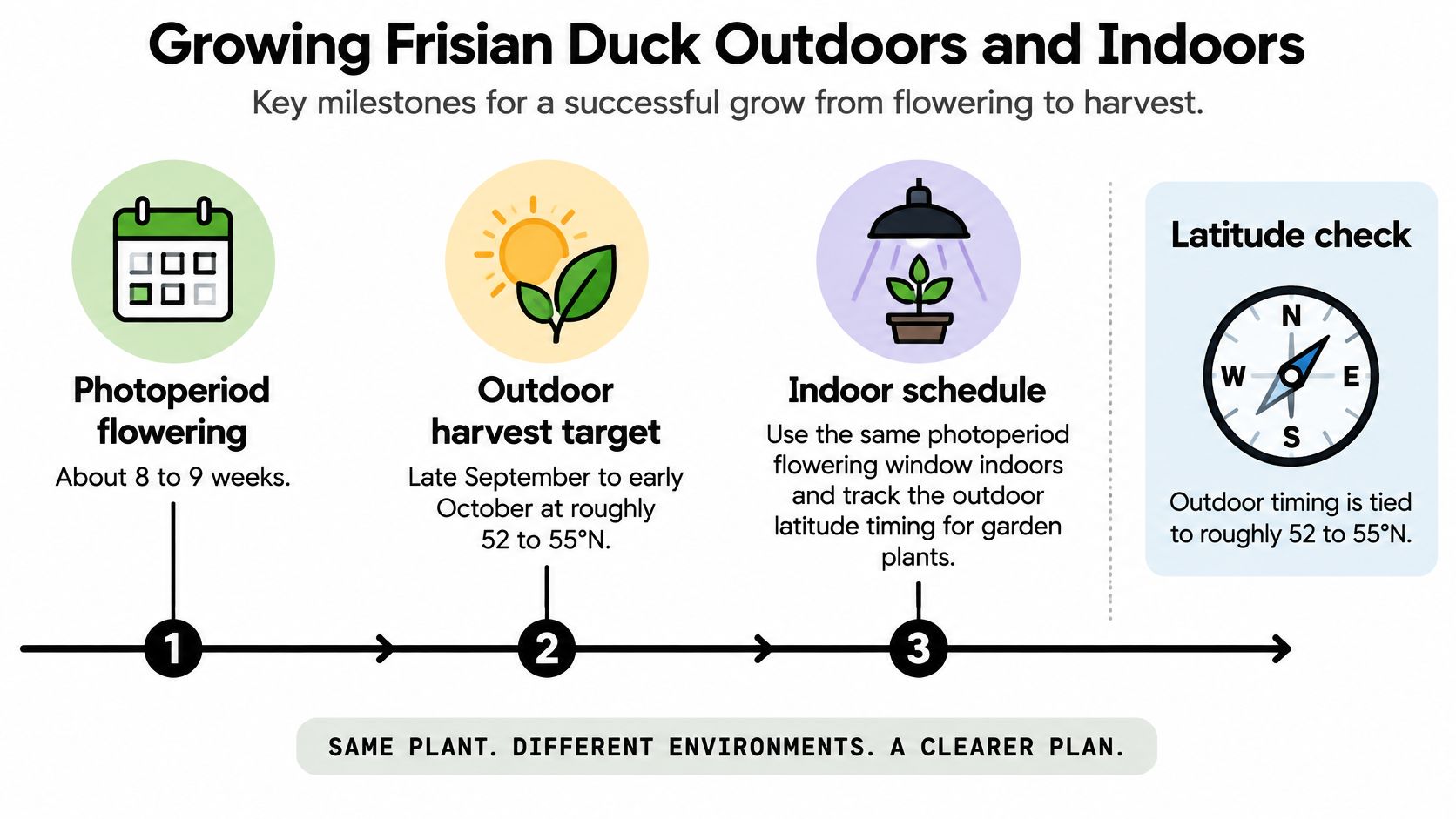
The calendar below illustrates the relationship between establishment, flowering and harvest; local conditions determine whether that sequence fits your season.
Working the harvest window backward
Start with the intended harvest period, then work backward through flowering and establishment. Plants should be hardened off and settled into their final position before the seasonal transition into flower. Starting late can leave less time to develop the frame that supports the crop.
That makes establishment time a separate constraint from flowering duration. A flowering estimate alone cannot tell you when to start.
Allow room for the larger plants rather than assuming every seed will produce a compact specimen. Height clearance matters, but lateral spacing matters too: neighboring canopies can shade each other and restrict air movement as they fill out.
Airflow, spacing and the mold question
Medium to medium-long internodes may leave a more open canopy. Any benefit still depends on plant density, irrigation and weather. A sheltered position that remains wet after rain can undermine the advantage of open branching.
Indoors, distinguish flowering time from the space needed to manage stretch. Fixed light height limits the usable canopy, while crowding changes airflow. The sea of green method involves a dense canopy of short plants, so its spacing assumptions deserve attention before choosing that approach.
The video accompanies the scheduling and site considerations.
Outdoor suitability and indoor productivity are separate claims. Environmental adaptability does not establish output under lights, and an unusual leaf shape offers no shortcut around space, scheduling or moisture management.
Check Each Frisian Duck Claim Before You Commit
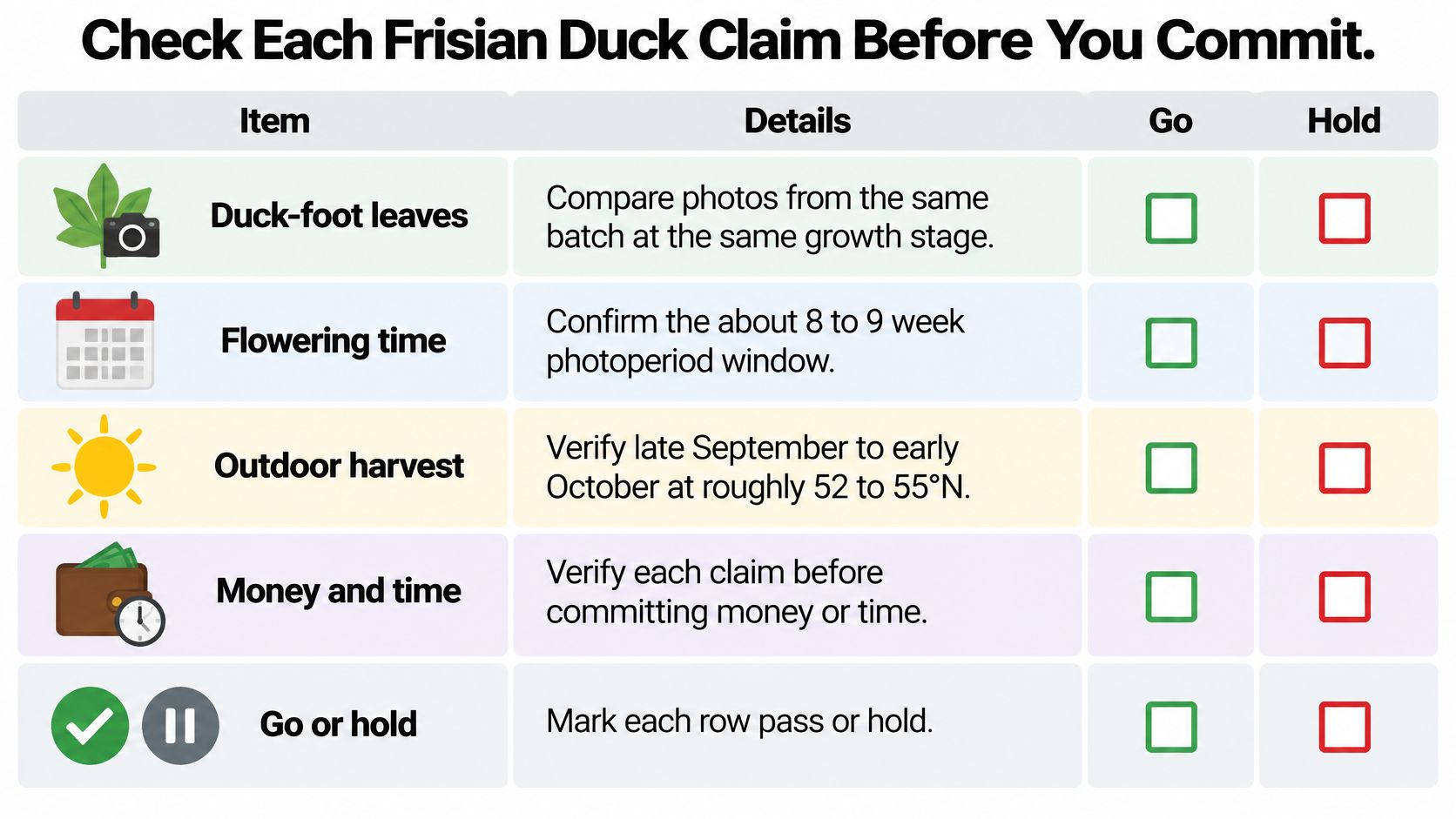
Every claim attached to this strain can be checked, and the checks cost you nothing but a message or a close look. Run them before you spend money on seed or a season on a garden bed.
| Claim | How to verify | Why it can differ |
|---|---|---|
| Duck-foot leaves | Compare batch photos at vegetative and early flowering | Expression varies by phenotype |
| THC 16.38%–18.5% | Request a lab certificate for the specific batch | Listed ranges are breeder or retailer figures |
| Dark-purple buds | Check batch photos or grow notes | Reported in about half of phenotypes |
| Appetite effects | Weigh the number and dates of reviews | Only 20 reviews, self-reported |
| Feminized seed | Confirm seed type on the packet or listing | Aims to reduce males; does not guarantee none |
The leaf check is the one people skip. Ask for photos from the same batch at the same growth stage, because a vegetative shot of a webbed plant and a flowering shot of a different plant prove nothing when you put them side by side. If a seller can only supply one glamour photo, you're looking at marketing, not evidence.
Sourcing is the other place where a direct answer beats a guess. We partner with growers to source our mushrooms, so the question of where a product came from has a named answer rather than a shrug, and that's the standard you should apply to anything you ingest. Format matters just as much as origin, which is why it's worth knowing whether edibles carry strain-specific genetics before you assume a label transfers to a finished product.
Go or hold: if batch evidence matches the claim, proceed. If the claim rests on a name, a published range or a small review set, mark it hold and treat it as an unverified expectation.
Apply that row by row rather than to the strain as a whole. A cultivar can pass on lineage and seed format while failing on potency and effects, and that's a perfectly rational reason to grow it for interest while declining to rely on it for anything else. Any appetite-related use belongs in a conversation with a clinician.
We apply the same sourcing discipline to our own catalogue at The Magic Mushroom Delivery, working with growers directly and publishing straightforward guidance on effects, dosing considerations and responsible use for adults 21+. If you want product information that reads like this rather than like a sales page, browse our categories, read the FAQs and see what's available at The Magic Mushroom Delivery.