
You must be 21 or older to buy mushroom products, and that age check applies when you place the order, again at delivery, and at every stage of a regulated program such as Oregon's. Passing it proves one thing: your age.
So if a website already confirmed you're an adult, why can the same purchase still be handled completely differently depending on where you live? Most 21 age restrictions get explained as a single wall, when they're really two separate gates standing side by side. One asks who may buy. The other asks what the rules allow where the customer lives, and an ID card only answers the first.
Who Must Be 21 to Buy Mushroom Products
Who does the 21+ rule screen? Anyone who wants to place an order. To buy mushroom products you must be over 21, and your ID is verified to confirm it. That check has one job. It isn't a background check, a credit check or a judgment about whether you're a suitable customer.
What surprises people is that the gate appears more than once. Your ID is checked when the order is placed, and it's checked again when the delivery process begins. Inside a regulated program, age is confirmed before you're allowed through the door at all. Each checkpoint answers a slightly different question, which is why a single "21+" badge on a homepage tells you little about what will happen to a specific order.
Where the age gate applies
| Purchase or access | Minimum age | Proof or check | Source of rule |
|---|---|---|---|
| Online order of mushroom products | 21 or older | ID verified when the order is placed | Retailer age policy |
| Oregon psilocybin product sale | 21 or older | Valid, unexpired government-issued photo ID | Oregon program rules |
| Oregon preparation session | 21 or older | Age confirmed before any paperwork | Oregon administrative guidance |
| Presence on licensed premises | 21 or older | Under-21 people may not be present | Oregon administrative guidance |
| Delivery to customer | 21 or older | ID verified again as delivery begins | Retailer delivery process |
Read the rows as separate situations rather than one rule repeated five times. An online order is governed by the seller's own age policy. A sale inside Oregon's program is governed by state rules that name the exact document a staff member must inspect. Two different authorities, and they can ask different things of you on the same day.
What the check does and doesn't decide
Verification confirms age and nothing else. For an online order, the ID is used only to confirm you're 21 or older; it isn't stored and it isn't shared, so the check leaves no file behind for anyone to consult later. The scope is narrow by design.
Eligibility is not authorization. Being 21 makes you old enough to be a customer. It doesn't settle what your state, city or a licensed program permits you to do next.
Before checkout, have two things ready: a valid, unexpired government-issued photo ID, and account details typed exactly as they appear on it. Middle names, apartment numbers and a recently changed address are the usual reasons a perfectly legal adult gets flagged for manual review.
Why the Age Line Sits at 21
Think of age 21 as a fence that was built, taken down in places, and then rebuilt after people watched what happened without it.
After Prohibition, nearly all states set the minimum purchase and consumption age at 21, according to a peer-reviewed history of minimum legal drinking ages. Then the fence moved. The 26th Amendment, ratified in 1971, lowered the federal voting age from 21 to 18, and the same review records that 29 states reduced their minimum drinking ages between 1970 and 1975 to 18, 19 or 20. The reasoning was straightforward: if you could vote at 18, why couldn't you buy at 18?
The answer came from the road. Researchers linked those lower thresholds to increased alcohol consumption and more traffic crashes among teenagers and young adults, and states began restoring age-21 laws in the late 1970s and 1980s. The CDC's overview of the minimum legal drinking age reports an approximately 16% decline in motor-vehicle crashes in states that adopted age 21.
Congress finished the rebuild with the National Minimum Drinking Age Act of 1984, which required states to adopt a minimum purchase age of 21 or lose a portion of federal highway funds. By 1988, all 50 states and the District of Columbia had enacted legislation meeting those funding requirements.
Two things stuck. Age 21 became a real legal boundary for adult-oriented commerce rather than a custom, and businesses built the machinery to enforce it: identity checks, restricted sales procedures, records of who was allowed to buy. Mushroom retailers inherit that machinery, not the drinking law itself.
How Online Checks Confirm Age at Each Step
A typed birth date works like a handwritten note on a form. It says the customer is old enough, but it proves little on its own. A stronger age gate compares the details entered at ordering with records that exist outside the customer's own claim, then checks again as the order moves forward.
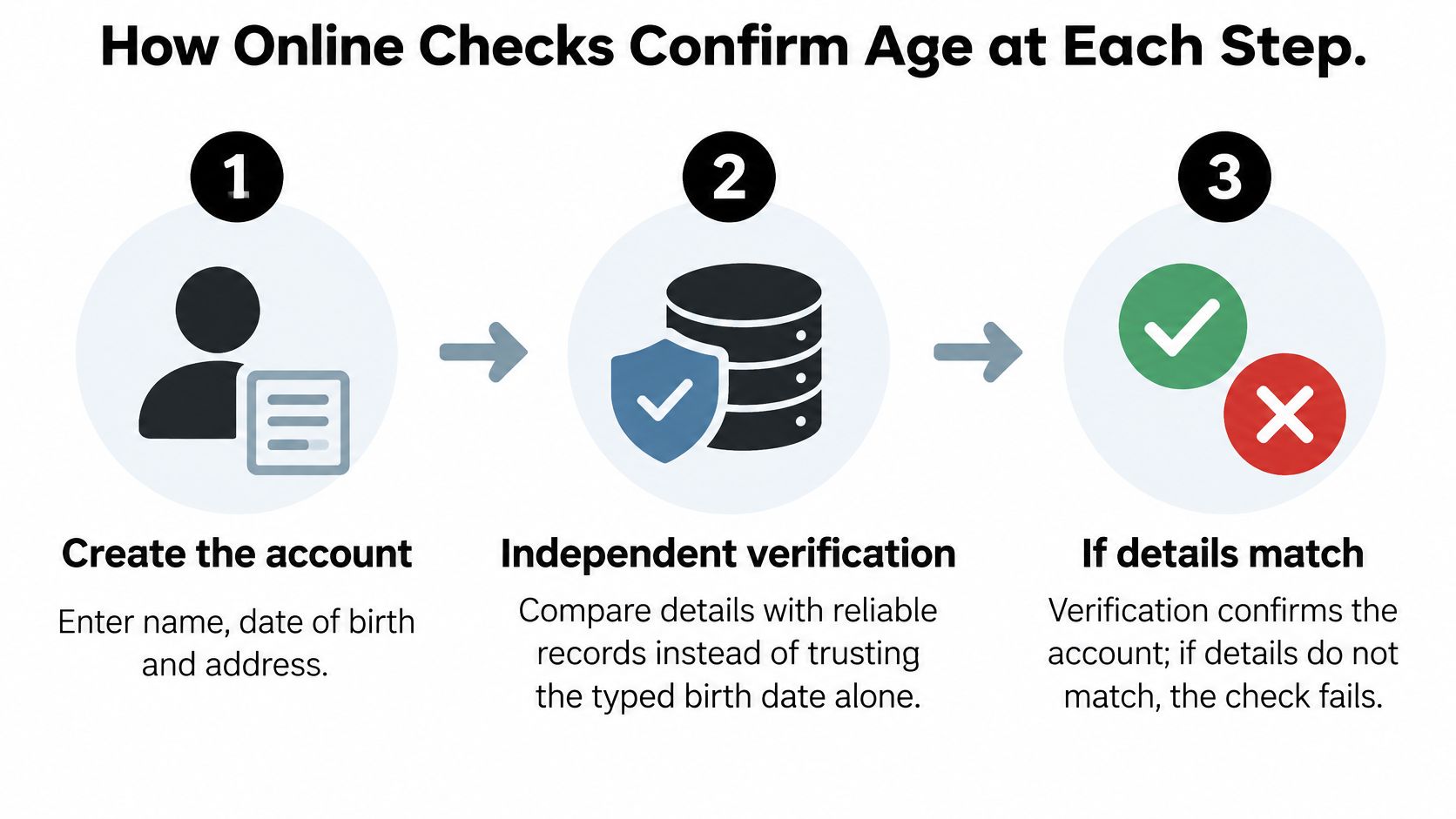
The FDA's enforcement guidance for regulated digital sales describes an architecture built around that idea: independent verification against reliable records, age verification for website access, and, in some contexts, third-party identity checks plus adult-signature delivery. Think of each step as a separate hinge on the same door. One hinge alone may hold, but the door is steadier when pressure lands across several points.
The process usually unfolds in this order:
- Create the account. The customer enters a name, date of birth and address. Those details set the baseline for later checks, so small mistakes here can cause avoidable delays.
- Independent verification runs. A verification service checks the entered details against reliable records. The birth date typed into a form is a claim, while the independent record is the reference point.
- Conflicting records trigger step-up verification. A name may match while an address is outdated. In that case, the system asks for more information, often a document image. This resolves a mismatch, it does not accuse the customer.
- The check repeats at checkout. An early approval can become stale if an account is shared or the shipping address changes. Our age verification process covers both checkout and handoff so the eligibility gate follows the order, not just the first signup.
- Delivery closes the last gap. The delivery process begins with verifying ID to confirm the customer is over 21. Where the rules call for it, an adult signature adds another confirmation at the handoff point.
- The system logs the event. A record of the decision, timestamp, vendor result and order identifier lets a disputed refusal be reviewed with context instead of guesswork.
That sequence separates two questions that often get blurred together. The age gate answers who may buy. Local rules answer what may be bought and used where the customer lives. Passing the first step never settles the second.
Operational benchmarks behind a declined order
Retailers track verification-pass rate, manual-review rate, false-rejection rate, chargeback rate and delivery refusal rate. These benchmarks show where the process is working and where it is causing needless friction.
The customer feels false rejections most directly. That benchmark captures adults who were old enough but stopped because of a typo, an old address record or a mismatch that should have been resolved. A false rejection is different from a correct refusal. One points to a matching problem, while the other shows the age gate doing its job.
A rising false-rejection rate is a signal to fix the matching logic, not to loosen the age rule.
That distinction matters because an age gate should be firm without being careless. It should confirm that customers are 21 or older, then stop there. ID verification is used only to confirm that customers are 21 or older, and the ID is not stored or shared. The goal is to close the eligibility gate at each stage while avoiding extra disclosure that the age check does not need.
What Age Checks Protect and What They Reveal
An ID check keeps minors from ordering. It also asks a law-abiding adult to hand over a document for a purchase they would rather keep quiet. That trade-off shapes how the check should feel: firm enough to protect the 21+ gate, narrow enough to avoid turning age confirmation into a full identity record. The Electronic Frontier Foundation's 2025 year in review reported that by the end of 2025, half of U.S. states mandated age verification for some adult-content or social-media access, while the EU develops a harmonized approach meant to confirm eligibility without unnecessarily revealing a user's identity or browsing history.
Think of the age check as a door lock, not a camera. It answers one question: is this customer 21 or older? It should not turn that answer into a detailed profile of what the customer buys, where they browse, or who they are beyond the age result.
Four questions customers actually ask
- Does verification store an ID image? ID verification is used only to confirm that customers are 21 or older, and the ID isn't stored or shared.
- Does it link purchase history to identity? Ask whether the system keeps an age result or a full identity profile, because those are very different records to hold about a sensitive purchase.
- Does it share data with vendors? A trustworthy policy names its third-party processors rather than saying "trusted partners."
- What if I don't have a compatible digital credential? There should be a documented fallback, such as a manual document review, not a dead end.
A clunky or opaque check creates friction for adults who meet the age rule. Clear language helps: say what is checked, what is kept, and what the result permits. That clarity also prevents a common misunderstanding. Turning 21 opens the eligibility gate, and that gate still has limits.
An age check confirms adulthood. It says nothing about whether possession or delivery is permitted where you live, so customers must verify the legality of magic mushroom possession and use in their location before placing an order.
Oregon's Age Rules as a Worked Example
Oregon runs one concrete, published framework, and it's useful precisely because it's specific. It isn't a template for anywhere else.
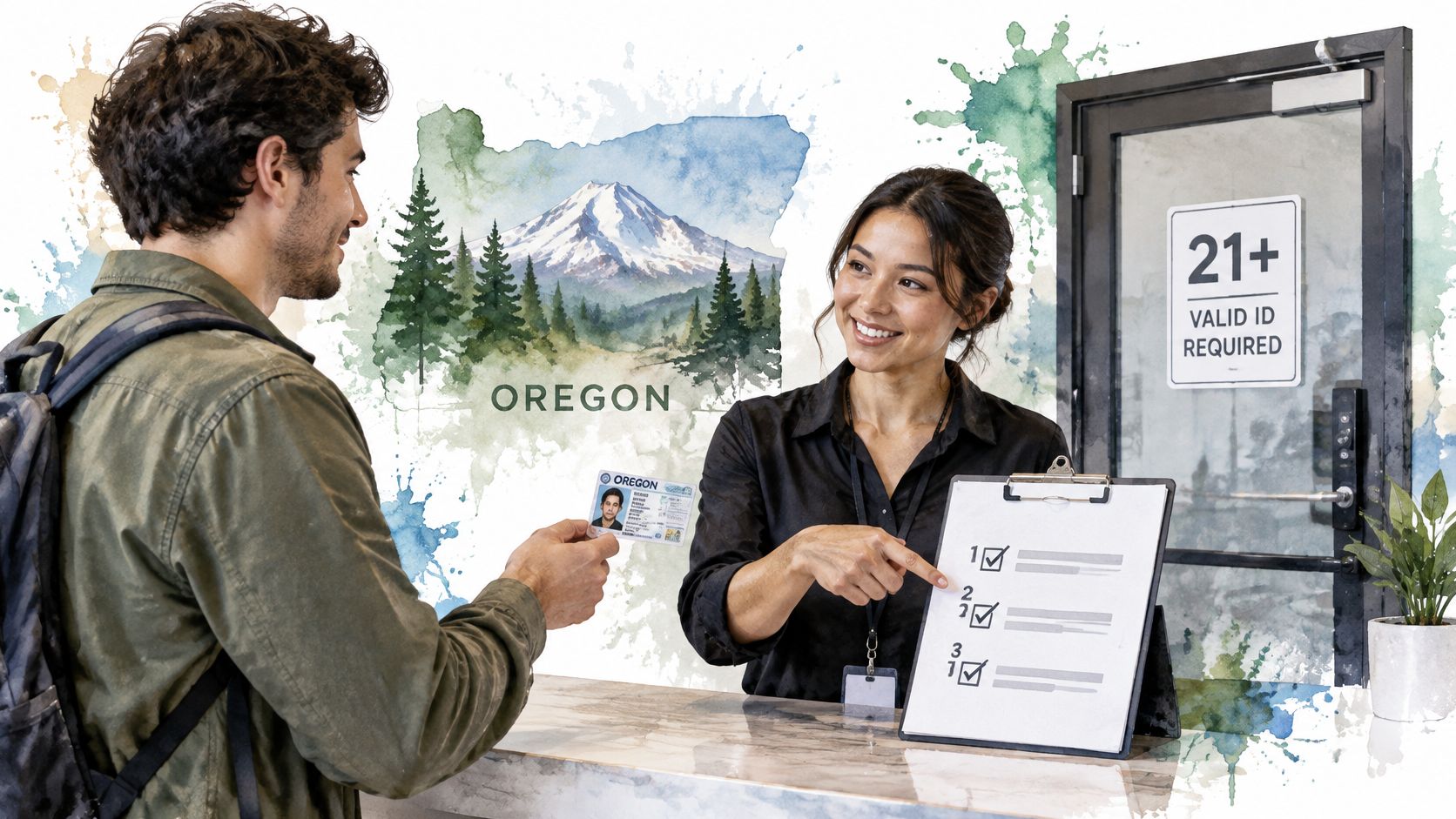
The Oregon Psilocybin Services administrative rules require a service-center representative or facilitator to verify a valid, unexpired government-issued photo ID and confirm the client is at least 21 before completing a product sale or providing services. The same rules prohibit selling, delivering, transferring or making a product available to anyone under 21, and prohibit facilitators from serving an under-21 person. Notice the reach: the prohibition covers gifting and handing over, not just ringing up a sale.
The controls stacked around the age rule
The Oregon Health Authority's psilocybin services overview sets the minimum age at 21 across the full sequence of preparation, administration and integration, with no prescription or referral required. Turning 21 qualifies you to start that sequence. It doesn't let you skip any of it.
- A preparation session comes first. At least one session with a licensed facilitator must be completed before a client receives psilocybin.
- There's a daily operating window. The service center license fact sheet states that a licensed service center may sell products and provide services to clients 21 or older between 6:00 a.m. and 11:59 p.m. local time.
- Consumption has a fixed place and format. It happens only at a licensed service center and only during an administration session.
- The premises itself is age-controlled. Oregon's guidance on administrative rules says licensed premises may not allow people under 21 to be present, clients can't complete paperwork or join a preparation session before reaching 21, and people 21 or older may be on the premises at all times, including during temporary-use events.
Age is the first layer, not the only one. Each additional control changes what a customer can actually do on a given day.
That's the lesson worth carrying: a "21+" label describes eligibility, while the surrounding rules describe access.
Why 21+ Does Not Mean Legal Everywhere
Age is a key. The jurisdiction decides which door it opens, and the same key opens different doors in different states.

A customer can clear a retailer's age gate and still meet different rules on possession, purchase, delivery, home use, sharing, transportation and product form. Think of the age check as the lock on the front door. It confirms who may enter the order process. It does not describe what that person may carry, use or give away after the door opens. The Washington Senate Bill 5201 report for the 2025-26 session describes a framework that would let adults 21 and older purchase tested psilocybin and consume it under facilitator supervision at licensed service centers, a very different arrangement from Oregon's enacted program. Legislative proposals vary by state, and a proposal can cover a narrow activity or a wider set of actions.
| Jurisdiction | Status | Age threshold | Access or use rule |
|---|---|---|---|
| Oregon | Enacted regulated program | 21 or older | Supervised administration sessions at licensed service centers |
| Washington | Framework considered, enactment not confirmed | 21 or older | Purchase of tested product and facilitator-supervised use at licensed service centers |
| New York | Bill introduced, enactment not confirmed | 21 or older | Possession, use, cultivation, gifting and sharing covered by the bill |
Three categories worth keeping separate
Enacted law is in force and has published operating rules. Introduced legislation is a proposal that may change, stall or die in committee. Retailer policy is a company's own age gate, which can be stricter than local rules and never substitutes for them. Our state-by-state psilocybin legality guide is a starting point for sorting those categories, and customers must verify the legality of magic mushroom possession and use in their own location before placing an order.
Legislative activity also creates confusing headlines. A proposal count is a count of proposals, not a map of where you can order. A bill can be introduced, amended, narrowed or left without enactment. A licensed program can set conditions that go well beyond age, such as where use happens and who supervises it. So read 21+ as an eligibility gate, then check the local rules that govern the specific act you have in mind. At The Magic Mushroom Delivery, ID verification confirms that customers are 21 and older, the ID is not stored or shared, and customers must verify local legality before ordering.
Confirm Your Eligibility Before You Order
Run these five checks before you pay. Each one exists because it's the point where an otherwise valid order gets stuck.
- Confirm your age on the purchase date. You need to be 21 or older when you order, and the check runs again at handoff, so a birthday next week doesn't help.
- Match your ID exactly. Use a valid, unexpired government-issued photo ID and enter your name, date of birth and address as printed, because mismatched fields are the most common cause of manual review.
- Check your state and city rules for the specific thing you plan to do. Possessing, carrying, gifting and using at home are separate questions, and the jurisdiction table gives you the categories to look up.
- Read the handling policy before uploading. You should know what's retained, for how long, which processors receive it and what your remedy is if verification fails.
- Choose a delivery address where you'll be present. An adult signature can't be left with a neighbor or a doorman, so pick a place where you can answer the door.
If all five pass, place your order. If one fails, fix that one first, because a rushed order with a mismatched address usually ends in a refusal rather than a delivery. Our online ordering guide for adults 21 and over walks through the checkout itself once your details line up.
These products are for adult use only, 21 and over, and should be used responsibly.
The Magic Mushroom Delivery ships raw mushrooms, chocolates, gummies, capsules and mushroom coffee to adults 21 and older, with ID verified before an order proceeds and never stored or shared. Every order moves through the same age gate described here, at checkout and again at handoff, alongside discreet packaging and tracked shipping. Browse the range and read the age and handling policies for yourself at The Magic Mushroom Delivery before you order.