

A careful night rarely starts with a product. It starts earlier, at a kitchen table, when you're still clearheaded enough to ask who'll stay sober, where you'll sit, what could feel too intense, and who you'll call if the hard part doesn't fade on schedule. That's the heart of psychedelic harm reduction. It's not a speech for or against use. It's a set of decisions you make before, during, and after so a difficult few hours are less likely to become an injury, a panic driven mistake, or a lonely problem the next morning.
Why Psychedelic Harm Reduction Starts Before the Trip
A survey of 6,379 people across 85 countries found that personal growth was the most commonly stated reason for psychedelic use. The Global Psychedelic Survey summary reports responses from 4,434 people in the United States and Canada, 771 in Europe and the United Kingdom, 864 in Australia and New Zealand, and 310 in other regions. Psilocybin, LSD, and MDMA were the substances most often reported.
A separate 2025 clinical perspective reports that approximately 9% of people using psychedelics in non-clinical settings experienced functional difficulties lasting longer than one day after acute effects ended. For some, those difficulties lasted weeks, months, or years, though estimates vary by study design.
Personal growth may be the aim, but it does not remove risk. Harm reduction lowers the chance of harm and helps limit its severity if problems arise. A mushroom, chocolate, or gummy is not automatically gentle because it comes from nature.
A trial room is not your living room
Clinical studies generally include screening, preparation, supervision, and follow-up. At home, those supports are not automatic. You decide who is present, how the evening is arranged, whether anyone remains sober, and what happens the next day.
A seatbelt reduces harm in a crash, but it cannot make every drive safe. It works alongside other precautions, and only if fastened before the car moves. Harm reduction works the same way: a test, a label, or a calm room can help, but none is a complete safety strategy.
A safety tool is harder to use once panic has started. Agree on a simple plan while everyone can think clearly.
Before the experience, decisions include whether to proceed, what is known about the product, and what the plan covers. During it, the room and the sober person's role matter. Afterward, the plan should account for rest and for what to do if anxiety, insomnia, or a sense of unreality continues to interfere with ordinary life.
Effects can last beyond the period someone expects to feel altered. By then, reading a long guide or debating next steps may be difficult. A written plan gives the sober person a clear reference and can help explain the situation to a clinician if support is needed. Preparation is a form of care, not a guarantee.
Who Should Pause and How Set and Setting Change the Night
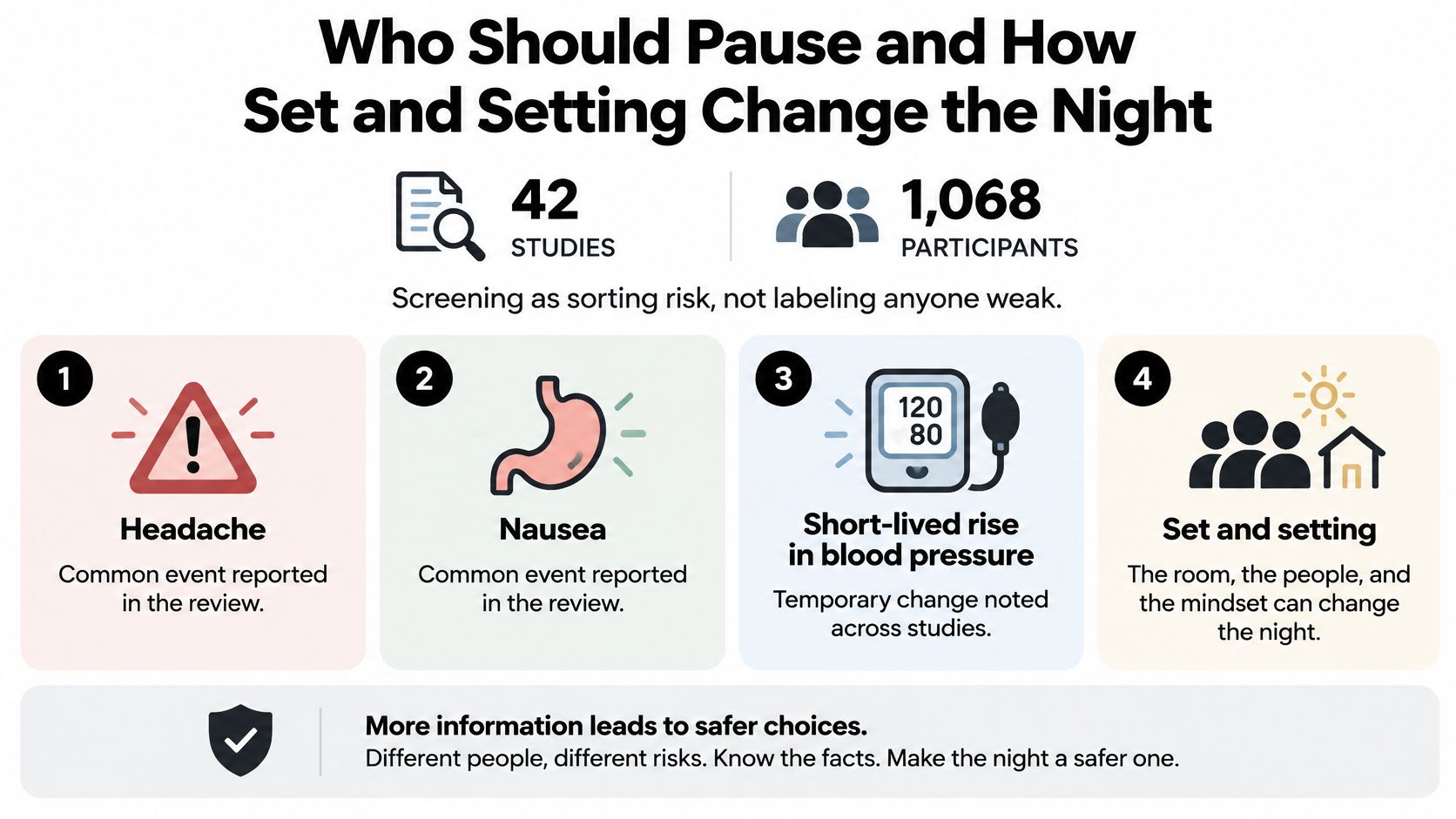
Screening is sorting risk, not labeling anyone weak. A systematic review in ScienceDirect covered 42 studies involving 1,068 participants and found common adverse events included headache, nausea, and temporary blood-pressure increases, which generally resolved without treatment. Serious events were infrequent and occurred in 2 studies, involving participants with underlying depressive disorders and outcomes such as suicidal behavior or hospitalization.
Other clinical findings in that review describe transient anxiety, dizziness, confusion, and gastrointestinal symptoms. Occasionally, people needed medical treatment when anxiety would not settle or blood pressure stayed high. That pattern should shape your decision before a product is opened. A generally manageable effect in a screened study can become a different problem for someone who is already unstable, sleep deprived, medically vulnerable, or using an uncertain amount.
This checklist turns the common effects and setting issues into a quick visual pause point.
Clear reasons to pause
- Acute psychological instability: Don't use unsupervised if you're in a crisis, severely agitated, or unable to care for yourself today.
- Significant cardiovascular concerns: Get clinical advice first, because blood pressure and heart symptoms change the risk calculation.
- Personal vulnerability to psychosis: Treat this as a stop sign for unsupervised use, not a challenge to push through.
- Alcohol or other drugs in the mix: Don't combine psilocybin with alcohol or other psychoactive substances and then hope you can sort out which effect came from what.
Set is the weather inside you. It includes sleep, mood, grief, stress, expectations, and whether you're hoping the experience will fix something urgent tonight. A tired, raw mind has less spare capacity when perceptions change quickly.
Setting is the weather in the room. Familiar people, low noise, privacy, water, a bathroom you can reach easily, and no unresolved argument hanging over the group all matter. So does freedom from surprise visitors, work calls, and responsibilities that demand a sharp mind.
The same serving, two different nights
Say someone takes a modest serving on a rested afternoon at home with one trusted friend. The room is quiet, the phone is charged, and there's nowhere to drive. The same person takes the same serving late at a loud party after poor sleep, surrounded by strangers and alcohol. The product didn't need to change for the second night to feel overwhelming. The body, the room, and the available help changed.
Trial safety findings also don't transfer neatly when a product's dose and composition are uncertain. Screening, measured amounts, and follow up are part of why a study can describe lower risk. Remove those controls and you're guessing more than the headline suggests.
If any pause reason applies, talk with a clinician before considering use at all. Bring your medicines, supplements, health history, and honest reason for asking. A short conversation while you're well is far easier than trying to explain a complicated history during a frightening reaction.
What a Test Can Prove About Mushrooms Chocolates and Gummies
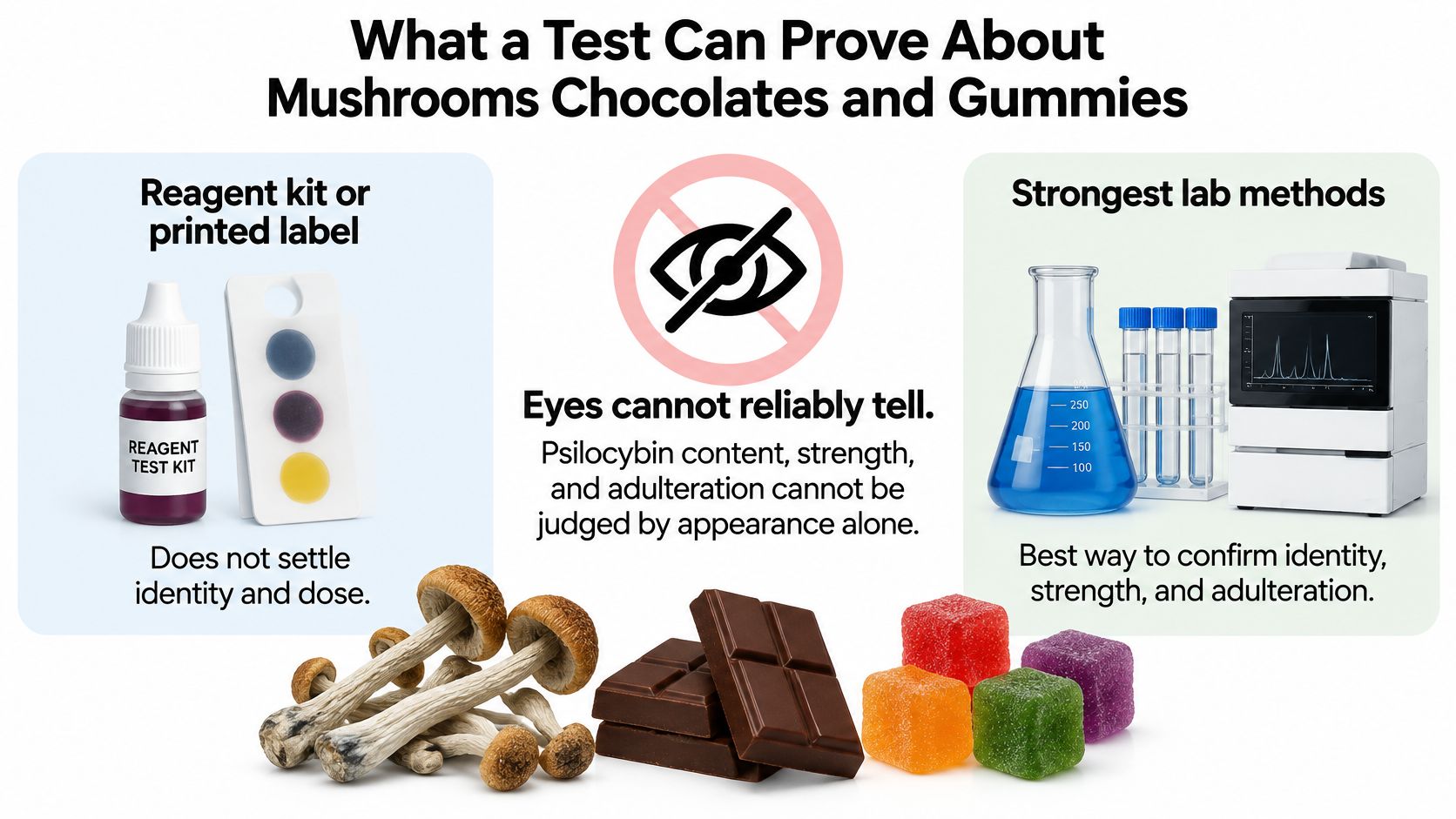
A printed label, a familiar color change, or a confident seller doesn't settle identity and dose. Your eyes can't reliably tell psilocybin content, strength, or adulteration. That's the uncomfortable starting point for honest psychedelic harm reduction.
Analytical research summarized in a Springer chapter on psychedelic drug checking describes gas or liquid chromatography combined with mass spectrometry as the most reliable methods, while noting they're relatively costly, stationary, and dependent on legal access to reference standards. Reagents and thin-layer chromatography are cheaper and faster, but presumptive tests may not definitively identify compounds, especially with potent psychedelics on blotter, diluted solutions, and complex botanical matrices. The same summary notes psychedelic samples were submitted less often than other substances, while rare samples contained adulterants including methamphetamine and fentanyl.
This comparison separates what home checks can suggest from what laboratory analysis can establish.
Identity, potency, and contamination are different questions
A test may detect a compound in the piece you sampled. That doesn't prove the active material is spread evenly through a chocolate bar or a bag of gummies. One square can be mild and the next stronger, so the first piece is not a reliable measuring cup for the second.
| Method | What it can show | Main limit | Cost and access |
|---|---|---|---|
| Gas or liquid chromatography with mass spectrometry | Identity and many compounds in a lab sample | Stationary, needs reference standards, not uniform across a bar | High; lab access required |
| Thin-layer chromatography or reagent test | Presumptive identity, faster and cheaper | May not name a compound definitively; struggles with blotter, dilute liquids, and botanical mixes | Low; field or home use |
| Fentanyl test strip | Presence or absence of fentanyl or certain analogs at the test threshold | Can miss analogs, give false positives, and threshold may behave differently than stated | Low; requires exact dilution |
| Printed label or visual check | Nothing reliable on psilocybin content, strength, or adulteration | Cannot show uneven distribution within a product | Free; not a test |
Fentanyl strips answer an even narrower question. The DanceSafe fentanyl strip instructions describe diluting a sample in water and give 5 milliliters of water for every 50 milligrams of powder, with one red line read as positive and two red lines as negative under the stated conditions. DanceSafe also reports a Johns Hopkins finding that Rapid Response strips marketed with a 20-ng/mL detection threshold showed a 200-ng/mL threshold, and some strips failed to detect analogs or produced false positives.
Follow three rules. Test the material you plan to use, follow the dilution exactly, and treat a negative result as limited evidence rather than proof of safety. Never mix an unknown product with alcohol, stimulants, opioids, or other psychoactive drugs.
Independent analysis can reduce one layer of uncertainty, which is why our explanation of third-party lab testing focuses on what a lab result can and cannot establish. A reassuring result is one control. It is not a green light to skip screening, take a large serving, or go without a sober sitter.
Dosing, Timing, and the No-Redose Rule
Dosing is where impatience causes many avoidable problems. The safest practical habit is boring. Choose the amount before the evening, write down the time, and let the first serving finish revealing itself before you decide anything else.
A simple sequence
- Start low: Use the lowest labeled serving or a small piece, especially when you're inexperienced or trying an unfamiliar format.
- Wait through onset: Magic Mushroom Gummies effects may be felt within 30 to 60 minutes after consumption, and Magic Mushroom Chocolate effects may be felt within 30 to 60 minutes and can last several hours.
- Respect uneven pieces: A mild first piece doesn't guarantee the next piece from the same bar or package contains the same amount.
- Use the no-redose rule: Don't take more until the first effects have clearly stabilized. Feeling unsure whether it worked is not evidence that it hasn't.
- Keep watching after the peak: Effects generally fade within about a day, but timing changes with dose, other substances, and your individual response.
Our practical guide on how to dose magic mushrooms returns to the same discipline because the waiting period is your dose check. If you stack another serving during a slow onset, both can arrive together. At that point, you can't subtract the extra amount.
Say you take a labeled serving at 7 p.m. By 7.40 p.m. you feel only a flutter and want more. Instead, you wait until the effects are clearly settling, keep every extra serving put away until morning, and tell your sitter if new confusion appears. That restraint may make the night less dramatic. It also prevents a delayed edible effect from turning a manageable plan into an accidental double dose.
A clinician should personalize any dosing decision when medicines or supplements are involved. Don't treat a package serving as medical advice. If your health history includes heart concerns, psychiatric instability, or vulnerability to psychosis, the relevant decision may be not to use unsupervised at all.
The Safety Plan to Write Before Anyone Takes Anything
Write the plan while everyone's judgment is clear. The Johns Hopkins Psychiatry Guide recommends preparing people for common onset effects such as tachycardia, nausea, and vomiting, avoiding high doses when inexperienced, and identifying what to do and whom to call during a crisis. It also states effects generally wear off within about a day, while timing and intensity can vary with dose, co-use, and individual response.
Copy this structure onto one page. Fill every blank before a package is opened.
| Plan item | Decide before use | Held by | Move to emergency care if |
|---|---|---|---|
| Substance record | Product name, approximate amount, time, and route | The person using, written for the sitter | Exposure details are unknown during worsening symptoms |
| Sober support | One trusted adult who stays sober and reachable | Named sitter | The sitter cannot stay or also becomes impaired |
| Space | Quiet room, water, comfortable temperature, working phone | Sitter sets the room | The space cannot be kept calm or safe |
| Transport | No driving; ride arranged in advance | Sitter or prebooked ride | Anyone impaired tries to drive or walk into traffic |
| Redose rule | Do not take more until first effects have clearly settled | The person using, enforced by sitter | Confusion leads to repeated unknown doses |
| Other substances | No alcohol or other psychoactive drugs; list medicines and supplements | The person using | Mixing is already underway or medicines are unknown |
| Crisis contacts | Whom to call and which signs end home support | Sitter | Breathing trouble, unconsciousness, severe overheating, persistent chest symptoms, seizure, or dangerous agitation |
Why each line earns its place
The substance record turns a frightening guess into useful information. Product name, approximate amount, time, and route help the sitter judge whether effects are still rising. They also help clinicians assess exposure quickly if symptoms worsen.
The sober support person is a named adult, not whoever seems least affected later. That person stays off alcohol and other psychoactive substances, keeps a phone nearby, and knows the emergency triggers. If the sitter has to leave or becomes impaired, the plan has failed and use should not continue under the old assumptions.
The space and transport lines prevent ordinary hazards. Choose a quiet room with water, a comfortable temperature, and room to sit or lie down safely. Arrange the ride before the evening, because nobody impaired should drive and nobody confused should wander into traffic looking for a car.
The other substances line should list medicines and supplements in plain names. Keep it factual and current. In an emergency, nobody should have to search cabinets or guess what a small unlabeled bottle contains.
Practical rule: Put the finished page where the sober person can reach it without asking the person who is already impaired.
Advanced decisions reduce confusion and delay. They remove debate about whether chest symptoms, unconsciousness, severe overheating, seizure, abnormal breathing, or dangerous agitation can wait. They can't. The plan should say, in ordinary words, that those signs end home support and start an emergency call.
Don't hide the page to be discreet. A plan nobody can find is only a good intention. Tape it inside a kitchen cabinet, place it under the sitter's phone, or keep it on the table where you'll be sitting.
How a Sitter Handles a Hard Experience
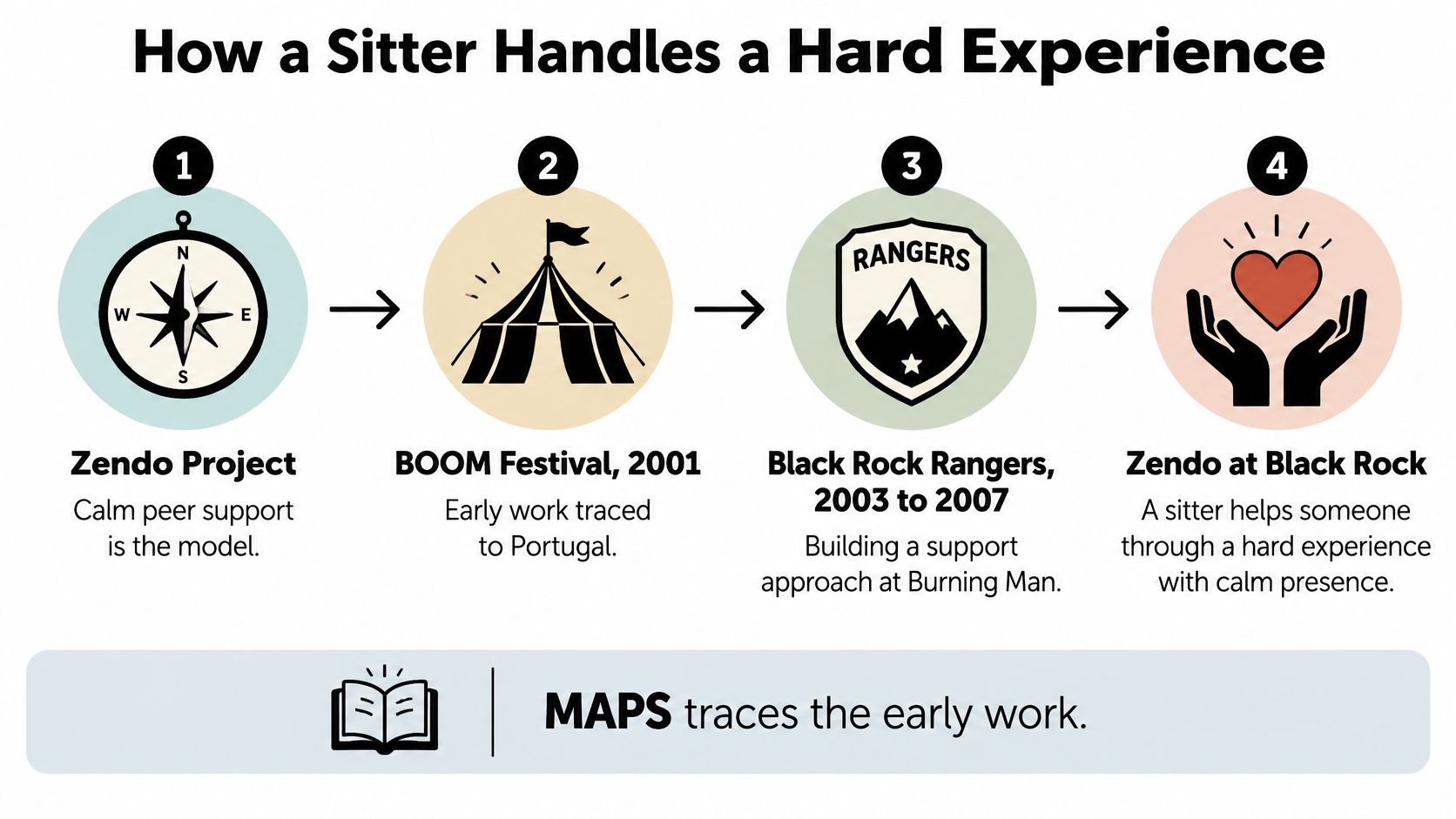
Calm peer support has a real history. A MAPS bulletin on the Zendo Project traces early work to Portugal's BOOM Festival in 2001 and collaboration with Burning Man's Black Rock Rangers from 2003 to 2007. Zendo formally began at Black Rock City in 2012 with 60 volunteers, and during its first reported week the team supported 108 guests, including 46 who had recently taken psychedelics and 62 who sought rest, information, or help integrating an earlier experience. Among recent psychedelic users, 25 reported LSD and 10 reported psilocybin, with no medical emergencies reported beyond minor cuts or scrapes treated with first aid. By 2020, MAPS stated related programs had trained more than 6,000 volunteers.
This visual follows that peer support model from early festival work to a sitter's calm presence at home.
The lesson isn't that every reaction is harmless. It's that many frightened people do better with a quiet seat, water, observation, and one steady person than with a crowd, bright lights, or an argument about what they're seeing.
What to do at home
- Lower stimulation: Dim lights, reduce noise, move onlookers away, and say the unusual thoughts, visions, and sounds are drug effects that can pass.
- Collect the exposure story: If the person can answer, ask what was taken, about how much, when, how, and what else was used.
- Watch the body: Notice breathing, color, temperature, alertness, and pulse if you know how to check it.
- Offer basics: Provide water, a comfortable seat, a blanket if they're cold, and a clear path to the bathroom.
- Stay nearby: Don't leave a confused person alone to sleep it off, drive, shower, or sort through frightening thoughts without support.
A clinical guideline for hallucinogen intoxication tells clinicians to record substance name, estimated dose, time and route, and other substances, then assess pulse, respiratory rate, blood pressure, temperature, oxygen saturation, and level of consciousness, preferably using the Glasgow Coma Scale. You don't need hospital equipment to understand the principle. Reassurance comes with monitoring, not instead of it.
The short video below offers another view of calm, nonjudgmental support during a difficult experience.
When reassurance is no longer enough
The Merck Manual hallucinogens guidance identifies hyperthermia and tachydysrhythmias as acute toxicity signs requiring immediate intervention. It explains that clinicians may use benzodiazepines such as lorazepam or diazepam for severe anxiety, while hyperthermia or dangerous cardiac rhythms require benzodiazepines together with active cooling and medical monitoring.
Do not turn that hospital information into a home medicine experiment. Your job is to recognize the red lines early. Call emergency care for rising body temperature, a racing or irregular heartbeat, chest pain, seizure, loss of consciousness, inability to protect the airway, severe agitation, dangerous behavior, or persistent confusion that's getting worse.
If vomiting is likely and the person is drowsy, a side position can help protect the airway while you wait for help. Keep the substance record ready for responders. State the facts plainly, without guessing or minimizing.
Our guide to a mushroom trip gone bad can help a sitter prepare, but reading is not the intervention. The intervention is a sober person who stays, lowers stimulation, watches breathing and temperature, and escalates early when the body, not just the mood, is in trouble.
When Difficult Effects Continue After the Trip
Most advice stops too early. It covers dose, water, set, setting, and a sober companion, then assumes the story ends when the vivid effects fade. For some people, the next day is when the practical question begins.
A 2025 clinical perspective in PMC estimates about 9% of people using psychedelics outside clinical settings report functional difficulties lasting longer than one day. Some difficulties can persist for weeks, months, or years. The review also describes major gaps in defining psychedelic-related harms, predicting vulnerability, treating post-psychedelic problems, and evaluating integration practices, noting evidence for integration models remains very scarce.
That uncertainty deserves honesty. Journaling, rest, and a supportive conversation may help someone feel less alone, but they aren't proven treatments for persistent derealization, perceptual changes, insomnia, or inability to function. Psychedelic harm reduction after the trip means knowing when reassurance fits, when to call a clinician, and when to seek urgent care.
| What is happening | How long | Reasonable first response | Get urgent or emergency care |
|---|---|---|---|
| Headache, nausea, emotional sensitivity | During the acute day | Rest, fluids, quiet, sober company | Only if paired with chest pain, fainting, or dangerous behavior |
| Anxiety or insomnia without loss of function | Settling within about a day | Reassurance, sleep routine, no more substances | If agitation becomes severe or sleep is impossible with confusion |
| Functional trouble at work, driving, or caregiving | Longer than one day | Contact a clinician and describe the exposure | If the person cannot stay safe |
| Derealization or ongoing perceptual changes | Days to weeks or longer | Non-urgent clinical assessment; do not self-medicate | If psychosis, suicidality, or unsafe behavior appears |
| Suicidal thoughts, psychosis, severe agitation, or dangerous behavior | Any time | Emergency care immediately | Yes, immediately |
Use duration and function together
During the first day, headache, nausea, poor sleep, and emotional rawness can fit an expected comedown. Keep plans small, avoid more substances, and stay with a sober person if you still feel unsteady. Don't drive while impaired, confused, or unable to judge distance and speed normally.
Past one day, pay attention to function. Can you work, sleep, care for children, drive safely, and tell what is real? If anxiety, insomnia, derealization, or perceptual changes are interfering with those tasks, contact a clinician rather than waiting for a peer conversation to solve a medical question.
Needing help after the acute effects end is not a failed mindset. It's information that the problem has outlasted the setting where reassurance alone was reasonable.
How to tell a clinician
Use ordinary words. Name the substance, approximate amount, time taken, other drugs, medicines, supplements, and the symptom that concerns you now. Say when it started, whether it's improving, and what it prevents you from doing. You don't need to apologize or build a philosophical case for the experience. A clinician needs an exposure history and a clear symptom timeline.
Seek same day urgent or emergency care for suicidal thinking, signs of psychosis, severe agitation, total inability to sleep with escalating confusion, or behavior that could injure you or someone else. Don't self medicate with leftover sedatives, alcohol, or another psychedelic in hopes of resetting your brain. That adds a second unknown exposure to the first problem.
Most acute experiences may resolve without medical treatment, but natural origin isn't a safety certificate. Post use care is substantially less evidence based than preparation advice. That's exactly why your written plan should include one follow up name and number before the trip, not after a sleepless second night.
Put the Plan on Paper Before You Choose a Product
Finish one page today. Write the sitter, room, ride, approximate serving, medicines and supplements, crisis contacts, and red flag list. If you can't fill those lines, the plan isn't ready, even if a product is already in the house.
A last check before any serving
- Adults only: Our products are for adult use only, 21 and over, and should be used responsibly.
- One substance at a time: Don't turn the evening into a stacked experiment with alcohol or extra psychoactive substances.
- Balanced routine: Magic Mushroom Gummies should be used as part of a balanced wellness routine, and a healthcare professional should be consulted for personalized recommendations.
- A named follow up: Write down the clinician, urgent care route, or trusted support contact you'll use if trouble lasts beyond the first day.
A healthcare professional should personalize the choice, especially before you combine any product with medicines or supplements. That conversation is part of screening, not an optional disclaimer. Bring the same honesty you'd want a clinician to have during an emergency, while there's still time to change the plan.
If you want a functional option cultivated so psilocybin is not present, our non-detect product line is verified by an independent laboratory batch by batch. Treat that as an identity claim about that line. It is not a promise that any psychedelic experience, product format, or night at home is risk free.
If you're already distressed, don't shop for a solution. Contact a clinician for persistent impairment, call emergency services for the red flags covered in your plan, and consider peer support such as the Fireside Project Psychedelic Support Line for a hard but non emergency experience. Peer support can help you feel less alone. It doesn't replace medical care when breathing, temperature, consciousness, chest symptoms, psychosis, or dangerous behavior are involved.
Keep the written page with the sober person. Let screening happen first, let the room and ride be real, and let the no-redose rule be settled before anyone is impaired. The decision that matters most is simple. The plan exists before the product does.
Complete your one page safety plan first, then explore adult product education, clearly labeled servings, and functional mushroom options from The Magic Mushroom Delivery. You'll find resources that pair product information with dosing caution, clinician consultation, and responsible use, so your next step starts with preparation rather than guesswork.