
Most strain guides hand you the same advice: check the THC percentage, read the effects list, and pick the one that sounds right. That advice breaks down with Cherries Jubilee. The name on the menu doesn't identify one plant with one chemistry. It's a label that several breeders have attached to genetically different products, and the numbers printed next to it vary by who grew it, when it was harvested, and which lab ran the test.
So the useful question isn't "what does Cherries Jubilee feel like?" It's "which Cherries Jubilee is in this package, and can the seller prove it?" Once you start asking that, the strain name stops being a specification and becomes what it really is: a starting point for a conversation about lineage, batch testing, and dose.
Three Different Plants Share One Name
Ask two retailers what Cherries Jubilee is and you can get two confident answers that contradict each other. Strain databases list multiple distinct versions sold under the same name, each tracing back to a different cross, and the differences are not cosmetic. Potency, aroma, flowering time, and subjective effects all depend on which version a given product is.
The Cali Connection line is the most thoroughly documented of the group. It is an indica-dominant hybrid bred from Forbidden Fruit and Pre-98 Bubba, sold as feminized seeds, and the breeder publishes a defined flowering window for it. A separate Verano product is described as GG4 crossed with Black Cherry Pie, a completely different pedigree with a different expected structure and aroma. A third, less-common entry carries undocumented parentage, and one source places it in a lower potency band than the Cali Connection line.
| Version | Reported parentage | Reported THC | Flowering window |
|---|---|---|---|
| Cali Connection | Forbidden Fruit × Pre-98 Bubba Kush | Breeder-published range; no batch-level data | Fixed window published by the breeder |
| Verano | GG4 × Black Cherry Pie | No breeder data available | No breeder data available |
| Less-common entry | Undocumented | Lower band than the Cali Connection line, per one source | No breeder data available |
The gaps in that table are the point. For two of the three versions, buyers have no published potency or flowering figures to work from at all. A product page that lists "Cherries Jubilee" without a breeder name has told you almost nothing you can act on, because the version with documentation and the version without it share nothing but the label.
Why the same name lands on different plants
Cannabis naming isn't regulated the way pharmaceutical naming is. A cultivator can attach a well-known name to a plant with no genetic relationship to the original, and consumers in legal markets routinely encounter the same name from different growers in different formats. The Weedmaps strain database entry for Cherries Jubilee illustrates the problem directly, since it has to list competing versions side by side rather than presenting one uniform product.
Practical rule: Before you compare potency, price, or effects across two products with this name, confirm they share a breeder. Otherwise you're comparing two unrelated plants.
When you open a menu or product page, note three things in this order:
- The breeder or brand, not just the strain name.
- The parent cross, which tells you which of the documented versions you're looking at.
- The batch identifier or harvest date, which is what any lab result will be tied to.
That ordering matters. The breeder and cross tell you which plant you are dealing with, and the batch identifier tells you which test results, if any, apply to the jar in front of you. Do this check before you read a single word about effects. It takes seconds, and it prevents the most common mistake buyers make with this strain: assuming a description written about one breeder's version applies to a different breeder's product sitting on the shelf.
Tracing the Cherries Jubilee Family Tree
"Cherries Jubilee" works like a surname: it tells you something about the family a plant comes from without telling you anything about the individual standing in front of you. The parent lines are the family tree underneath that name, and tracing them generation by generation is the fastest way to understand what the name really encodes.
The short walkthrough below covers the same ground visually if you prefer to watch rather than read.
For the Cali Connection version, Cherries Jubilee is documented as an indica-dominant hybrid created by crossing Forbidden Fruit with Pre-98 Bubba Kush. That's the trunk of the tree. From there, the branches split into two distinct family lines that give the cultivar its character.
Forbidden Fruit is commonly represented as Cherry Pie crossed with Tangie, which supplies the fruit-forward side of the background. Pre-98 Bubba contributes the older Bubba Kush branch, the structural side that shows up in dense flower formation and a heavier aromatic profile. Put together, you get a three-line genetic background rather than a simple two-parent cross, which explains why the reported aroma notes lean toward cherry, chocolate, hash, and musk rather than clean fruit alone. Each of those notes traces back to a specific branch: the cherry and fruit tones descend through Cherry Pie and Tangie, while the chocolate, hash, and musk character runs down the Bubba Kush side.
Here's the same lineage laid out as a diagram, one generation at a time.
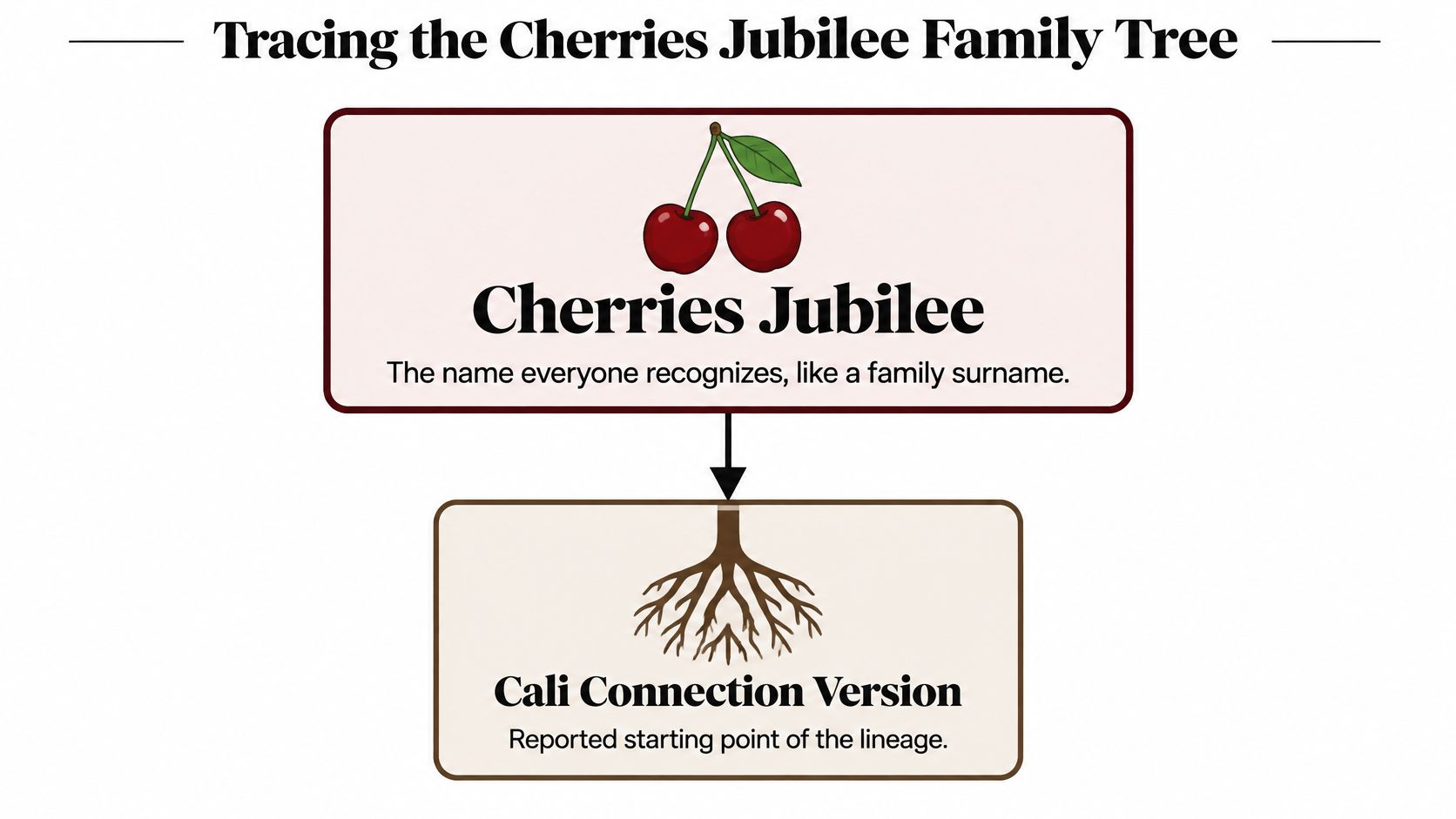
Strain references agree on the Forbidden Fruit × Pre-98 Bubba cross for the Cali Connection version, as the CannaConnection strain profile documents, while other versions sold under the name carry different parentage. Even within the Cali Connection line, what varies is classification: some references describe the exact indica-to-sativa balance differently. Treat the indica-dominant label as a reported classification, not a fixed measurement. The same discipline applies to any cultivar where lineage is doing identification work, and comparing documentation across less-documented genetics, such as the Frisian Duck strain, makes the point clearly: the pedigree identifies the product, not the experience.
That distinction is the practical takeaway. A documented family tree lets you confirm which of the plants sharing this name a breeder grew, and a jar whose parentage contradicts every published cross is telling you something important before you ever open it. What the tree cannot do is predict the evening, because the same genotype grown, harvested, and cured differently produces different chemistry. Use the family tree to identify the plant. Batch-level testing is the only thing that identifies what's inside it.
Cultivation Traits for Growers and Harvest Comparison
For growers, the Cali Connection version has a reasonably documented profile. It's a feminized, photoperiod cultivar, which means the seed population is intended to produce female flowering plants rather than a mixed-sex population you'd have to sex out. The published flowering window sits at approximately 64 to 68 days, and the line is described as having very high resin production. Indoor yield estimates reach roughly 280 to 300 g/m² under suitable conditions, according to the Azarius listing for the Cali Connection Cherries Jubilee.
Reading the yield figure correctly
Those numbers are breeder or retailer estimates. They are not independently replicated agronomic benchmarks, and they assume suitable conditions, which is doing a lot of work in that sentence. Light intensity, canopy management, substrate, VPD control, and how long you veg all move the final number more than the genetics do. Use 280 to 300 g/m² to plan your space and your harvest window. Don't use it to promise yourself a result.
The reported parent combination plausibly explains the emphasis on dense, resinous flowers. Forbidden Fruit × Pre-98 Bubba brings a structure-forward Bubba line together with fruit-heavy genetics, and dense flower holds resin well. But aroma intensity depends heavily on phenotype selection, drying speed, curing duration, and storage. Two growers running the same seeds can end up with noticeably different aromatic expression.
Resin-rich flower also tends to produce higher extract yields, which sounds like an unqualified positive and isn't. A higher yield per gram of input doesn't mean a safer or more consistent product, and concentrates deliver substantially more THC per inhalation than flower does, so they need their own serving guidance rather than a scaled version of flower advice. Growers running tight, uniform canopies to maximize that yield figure should look at the Sea of Green method for how plant count and timing interact with a fixed flowering window.
Keep four things separate in any product description: cultivar identity, production method, cannabinoid concentration, and serving recommendation. Keep harvest, cure, and storage records for each lot. That record set is what lets you answer a customer question six months later.
Reported Effects and What Shapes Them
Two buyers pick up Cherries Jubilee from different shops on the same weekend. The first reports feeling uplifted and functional, able to work through a project. The second describes heavy relaxation, effects that fade faster than expected, and a delayed "creeper" intensity that arrived twenty minutes after they'd decided nothing was happening. Both are telling the truth about their own experience. Neither report describes the strain in general, because there is no strain in general.
The reported range for this name runs from functional uplift to heavy sedation, with duration complaints in both directions and creeper effects showing up often enough to be worth planning around. That spread isn't noise. It's the predictable output of several variables moving at once.
| Factor | What it changes | What to check |
|---|---|---|
| Dose and tolerance | Intensity and duration | Start with a small dose and wait before taking more |
| Flower or concentrate | THC delivered per inhalation | Follow the serving guidance for that format |
| Batch chemistry | Potency and terpene profile | Batch certificate of analysis |
| Phenotype or breeder cross | Reported character | Breeder or parent cross on the label |
| Alcohol or other intoxicants | Intensity and predictability | Avoid combining them |
Why the same name produces different reports
Dose is the variable people underestimate most. A single inhalation and three inhalations of the same flower are different experiences, and tolerance shifts the curve between sessions, not just between people. Format matters just as much. Say the same person takes a small flower dose on a Saturday and a concentrate carrying the same name a week later. The THC delivered per inhalation is substantially different, so the second session isn't a repeat of the first even though the label matches.
Batch chemistry sits underneath all of it. Two harvests of the same clone can differ in cannabinoid concentration and terpene profile depending on when they were pulled, how they dried, and how long they sat in storage. Phenotype selection adds another layer when a breeder works from seed rather than a single retained mother.
Effects reports are individual data points, not product specifications. Read them as a range of possibilities, then find out where you personally sit.
What you can control
You can't control which phenotype a shop received or how the batch was cured. You can control your starting dose, your format, and whether you're mixing cannabis with alcohol or other intoxicants, which makes intensity harder to predict and harder to manage. You can also control your own record keeping.
Keep a short note each time: product name, breeder, format, approximate dose, time to onset, peak, and duration. Three or four entries and you'll see your own pattern, which is worth more than any strain description. Adjust slowly, one variable at a time, so you know which change produced the difference.
Common Questions About Cherries Jubilee
Is Cherries Jubilee the same as Cherry Pie?
They share ancestry, not an identity. In the Forbidden Fruit line, Cherry Pie appears as a grandparent, through Forbidden Fruit's described Cherry Pie × Tangie parentage.
The Verano version is built on GG4 × Black Cherry Pie, so it carries Cherry Pie-family genetics through a different route. A menu grouping these products by name or ancestry can obscure that distinction. Identify the breeder version before treating either pedigree as relevant to a purchase.
Does an indica label mean heavier relaxation?
An indica label doesn't reliably predict heavier relaxation. Descriptions differ on this cultivar's indica-to-sativa balance, making the classification a poor basis for comparing products.
The practical distinction is between a broad category and a specific batch. Neither the category nor the strain name establishes whether that product will feel sedating or functional to you.
Does a high-yield or high-resin claim mean a stronger product?
Yield describes cultivation output; resin production describes how much resin a plant produces. Neither directly measures cannabinoid concentration or establishes safety. Those claims answer growing questions, not product-testing questions.
For a purchase comparison, separate the grower's output claim from the batch's test results. Cannabinoid testing measures concentration, while contaminant testing addresses the substances included in that screen. A high-yield description cannot substitute for either.
Can past experience predict the next product?
Past experience offers a limited reference point. Its relevance depends on whether the breeder version, format, dose, tolerance, and batch chemistry remain comparable.
A familiar name alone doesn't establish that continuity. Treat a previous response as information about the product you used, and compare the next product's identity and batch results before assuming it will behave similarly.
Potency, Chemistry and Batch Verification
The reported potency for the Cali Connection phenotype sits around 19 to 22% THC with less than 1% CBD, while a separate source lists a version of unknown origin at 18 to 20%. Those aren't competing claims about one plant. They're measurements of different products, taken at different times, possibly by different labs. Commercial descriptions also vary because phenotype, harvest timing, curing, and the testing laboratory all move the number, as the Kind Green Buds strain description notes.
What the reported numbers actually cover
At under 1% CBD, there's no meaningful CBD content to soften a high-THC dose. That makes titration more consequential, not less. Consumers with low tolerance should begin with a small inhaled dose, wait for effects to develop fully, and avoid combining it with alcohol or other intoxicants. The same caution applies whether the label says 18% or 22%, because the difference between those figures is smaller than the difference between one inhalation and three.
Terpene data is thinner. The available strain descriptions don't establish a universal cannabinoid or terpene panel, so myrcene and beta-caryophyllene should be read as reported tendencies rather than guaranteed specifications. The cherry, chocolate, hash, and musk aroma notes belong to the same category: plausible given the pedigree, variable in practice.
There's a broader problem with the name itself. Strain names are often inconsistent indicators of genetic identity, cannabinoid content, and terpene content, which is why the conflicting entries across strain databases describe different products. Descriptions conflict because the underlying products conflict.
A buyer's checklist for verifying a batch
- Confirm the breeder or parent cross on the label. A jar that says only "Cherries Jubilee" without a breeder hasn't identified the product.
- Request the batch certificate of analysis. Check total THC, total CBD, minor cannabinoids, pesticides, residual solvents, heavy metals, and microbial results. If you're new to reading these documents, this guide to what a certificate of analysis contains walks through each panel.
- Check harvest and test dates. A recent harvest with an old test date tells you the material has been sitting. A recent test on an old harvest tells you the same thing.
- Compare the terpene profile with the reported tendencies. If the lab reports a profile that looks nothing like myrcene and beta-caryophyllene dominance, believe the lab, not the strain page.
- Treat the 19 to 22% range as a reference, not a promise. It describes a documented phenotype, not the jar in your hand.
If a seller can't produce batch-level testing, treat the Cherries Jubilee name as unverified. Start with a small inhaled dose, wait for effects to develop, and don't stack it with alcohol or other intoxicants.
That standard isn't unique to cannabis. The same principle applies to The Magic Mushroom Delivery's non-detect product line, which is cultivated so that psilocybin is never present in the product and verified batch by batch by an independent laboratory. A claim about a product category is worth very little. A result tied to a specific lot is worth a lot.
The name will keep appearing on menus, and it will keep meaning different things in different shops. The lab result is the only part of the package a buyer can compare across purchases.
If you want to see what batch-level documentation looks like in practice, The Magic Mushroom Delivery publishes product details and independent lab verification for its non-detect line, alongside educational guides on dosing, effects, and reading a certificate of analysis. Visit The Magic Mushroom Delivery to browse the catalog, review the verification standards, and check discreet nationwide shipping options before you order.