A certificate of analysis is a lot-specific laboratory report confirming that a batch meets its defined specifications, and it must show the batch, the tests, and the results. But if the report doesn't match the product in your hands, what does its reassuring pass mark prove?
The useful question isn't whether a certificate exists. It's whether you can follow the evidence from your package to the tested sample, understand what the laboratory measured, and see how someone decided the result was acceptable.
What a Certificate of Analysis Is in Plain Terms
You're holding a bag of mushroom chocolate, wondering whether its label accurately describes what's inside. The seller provides a certificate of analysis, usually shortened to COA. Rather than reading the logo or signature first, start by asking which batch of chocolate the document describes.
A COA is a quality-control document issued for a specific batch to confirm whether it meets defined specifications. A manufacturer's quality team may issue it using laboratory results, or a testing laboratory may prepare the analytical report supporting the batch's release. The FDA's pharmaceutical quality guidance describes COAs as reporting actual results from testing an individual batch or product, with measurement uncertainty where applicable.
Think of it as a school report card. A report card records a particular student's marks for a particular assessment period. It doesn't merely announce that the school teaches excellent students.
The target and the measured result
The specification is the target: what the material must contain, or what it must stay below. The result is what the laboratory found in the tested sample. Reading only the result is like seeing a mark without knowing the grading scale.
For your chocolate, the document might address the identity of a mushroom constituent, its concentration, or a contaminant limit. Those are separate questions, and the specification should make the acceptance criteria understandable.
Practical rule: Treat a COA as a batch-level evidence record, not a badge attached to a brand.
A general lab-tested claim doesn't provide that evidence by itself. A useful COA identifies the batch, testing date, laboratory, methods, results, limits, and responsible reviewer. Those details let you check an actual quality decision rather than accept a marketing assurance.
What a COA Lists, Field by Field
Use the following checklist while the package and report are both in front of you. Start with identification, then read the analytical details, and finish with authorization. There's little value in interpreting an impressive result before establishing which product it describes.
The FDA's requirements for laboratory analytical reports specify laboratory identity and street address, contact information, a unique report identifier, and identification of the owner or consignee for whom the analysis was performed. That regulatory context matters: the checklist below is a practical reading guide, not a claim that every product category follows an identical reporting template.
COA fields and what to check on each
| Field | What it tells you | What to check |
|---|---|---|
| Lot or batch number | Ties the result to one production run | Matches the number printed on your package |
| Test date and release date | Shows when testing and release occurred | Timing makes sense for manufacture and shelf life |
| Expiry or retest date | Identifies the stated period for use or reassessment | Present when applicable; distinguish expiry from retesting |
| Laboratory name and address | Identifies who ran the tests | Named, located, and reachable through contact details |
| Unique report number | Identifies the report associated with the analysis | Consistent across pages, with clear page identification |
| Test method | Shows how each result was measured | A named method or compendial reference for each test |
| Numerical result with units | Gives the measured value | Units stated, such as percent, mg per g, or ppm |
| Specification limit | Defines what passing means | An acceptance criterion for every listed test |
| Detection limit | Helps define what not detected means | A stated detection limit for each contaminant reported as undetected |
| Pass or fail conclusion | States whether the batch conforms | Consistent with the limits and results shown |
| Authorized reviewer | Shows who approved or released the result | A named authorized person, signature, or identifiable approval |
Also check the product description and customer identity. A report commissioned by an ingredient supplier may be genuine without describing the retail chocolate you're buying. Receipt dates, sample collection details, and manufacturing dates, where available, help establish the sequence between production, sampling, testing, and release.
Don't treat an expiry or retest date as proof that composition suddenly changes on that day. An expiry date identifies the stated usable period; a retest date calls for reassessment. Neither replaces appropriate storage or explains what happened after sampling.
Warning signs worth stopping for
- Missing batch identification: You can't establish that the report belongs to your package.
- Numbers without units: You can't reliably interpret the measured amount.
- Only a pass statement for quantitative testing: You can't inspect the actual result against its acceptance range.
- No reachable laboratory: You have no straightforward way to authenticate the report.
Keep analytical evidence separate from other credentials. Understanding organic certification standards can help you evaluate a different kind of claim, but an organic designation doesn't substitute for batch-specific analytical results.
How Labs Test for Identity, Potency and Contaminants
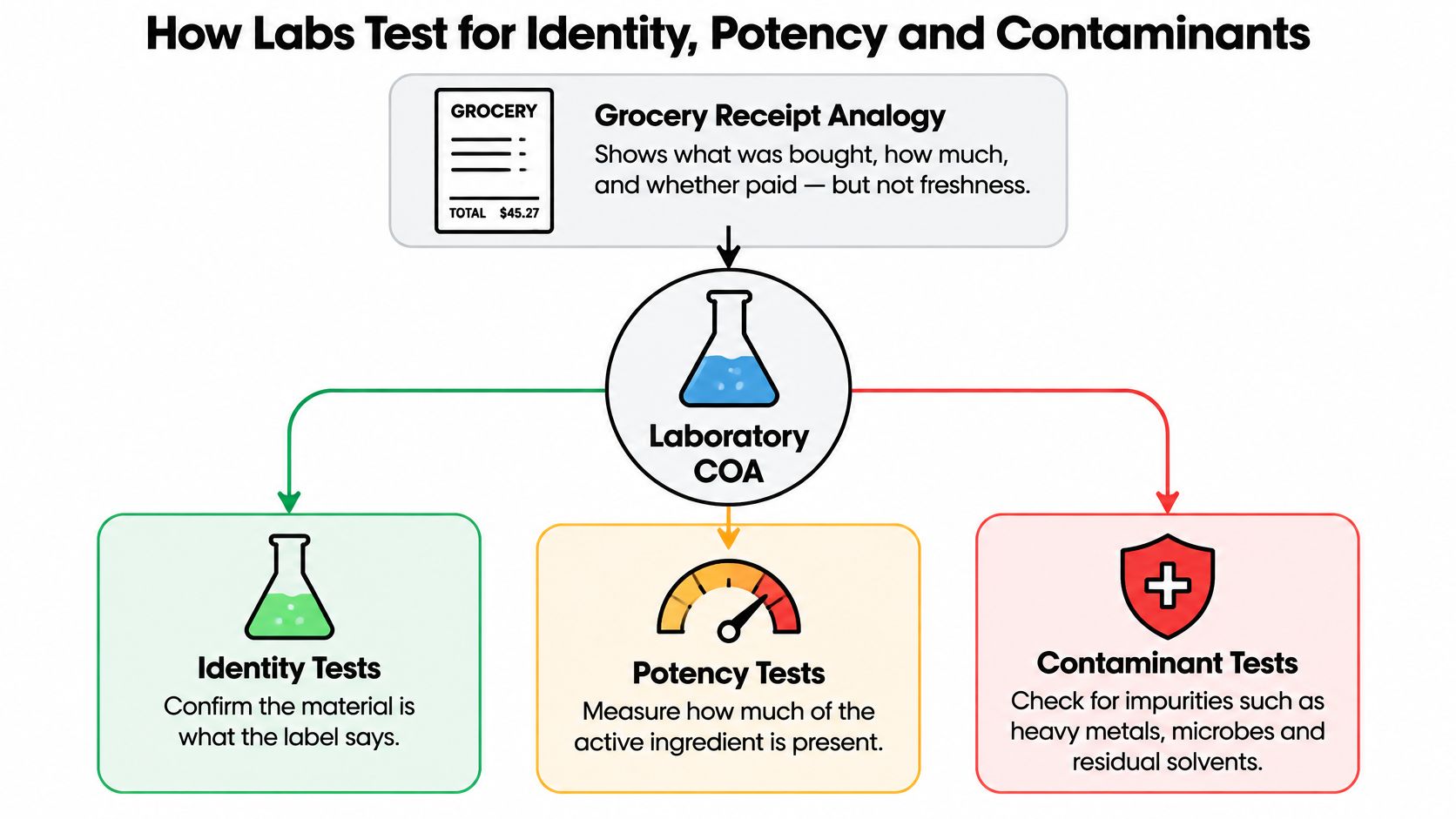
A grocery receipt tells you what you bought, how much you bought, and whether you paid. It doesn't tell you whether the food is fresh. A COA has a similar boundary: each listed test answers a particular question, not every possible question about the product.
The United States Pharmacopeia's ingredient verification manual provides a framework for lot-specific documentation, methods, acceptance criteria, numerical results, and quality authorization. For mushroom-derived products, separating identity, potency, and contaminants makes those analytical questions easier to understand.
The testing categories fit together like this:
Identity and potency answer different questions
Identity testing asks whether the expected material or analyte is present. A laboratory may compare a sample's chromatogram or spectrum with a reference. Think of a chromatogram as a separated chemical pattern and a spectrum as a characteristic analytical signature.
Potency testing, or a quantitative assay, asks how much of a named compound is present. A result expressed in milligrams per gram describes concentration by sample mass. It doesn't automatically describe the amount in a serving unless the serving mass and relationship to the tested sample are established.
High-performance liquid chromatography, commonly called HPLC, separates compounds before measuring them. The Washington Liquor and Cannabis Board's psilocybin research brief describes HPLC-based methods for measuring psilocybin and psilocin. Seeing the instrument name, however, isn't enough: the method must suit the compound and the material being tested.
Contaminant testing needs its own coverage
Contaminant panels address hazards such as heavy metals, microbes, residual solvents, pesticides, or undeclared compounds. Different hazards require appropriate analytical methods. A successful potency assay doesn't establish that a separate metal or microbial test was performed.
For a mushroom gummy, an identity result might confirm a named constituent, while a quantitative assay measures its concentration. A microbial panel answers another question entirely. None should stand in for the others.
Check the coverage before interpreting the overall conclusion:
- Identity: What material or analyte did the laboratory identify?
- Quantity: Which named compounds did it measure, and in what units?
- Contaminants: Which hazards did it investigate, and which weren't included?
A long report isn't necessarily a broad report. Several potency results can still leave contaminant coverage unaddressed.
How to Read a Result Against Its Limit
A result means little until you compare it with its acceptance criterion. A concentration can be measured accurately and still fall outside the product's specification. Conversely, a low-looking number isn't automatically acceptable if the relevant limit is lower.
The FDA's analytical-method guidance explains that validation establishes whether analytical and sampling procedures are suitable and reliable for their intended use. Accuracy, precision, selectivity, and sensitivity all affect how much confidence you can place in the comparison.
Follow the result through the decision
Find the specification. Locate the acceptable range, maximum limit, or identity criterion beside the test. If the report gives a measured concentration but no acceptance criterion, you can read the measurement, but you can't independently confirm its pass decision.
Align the units. Compare like with like. Percent, milligrams per gram, and parts per million use different scales. If conversion is necessary, ask for a clearly documented comparison rather than guessing from the size of the printed numbers.
Interpret not detected carefully. This means the laboratory didn't detect the analyte above the stated detection limit under that method. It doesn't establish absolute absence. Also distinguish a detection limit from a quantitation limit: detecting a signal and reliably assigning it a numerical amount aren't the same task.
Check the conclusion. Read across the row from result to limit to pass or fail. If the value falls outside the stated range but the conclusion says pass, the discrepancy needs an explanation, not an assumption that the label must be right.
Not detected is a statement about a method's capability, not a promise of zero.
Read qualifications near the boundary
A result close to a limit deserves attention to measurement uncertainty and any stated decision rule. The laboratory reporting principles in ISO/IEC 17025 emphasize clear interpretation, relevant uncertainty, and the fact that results relate to the items tested.
Uncertainty doesn't mean the laboratory made a mistake. It describes the limits of measurement knowledge. Likewise, an out-of-specification result calls for investigation; it shouldn't disappear because another measurement looks more convenient.
Check qualifications, footnotes, and sample dates before accepting the conclusion. They may narrow what initially looks like an uncomplicated pass.
Why the Lab Behind a COA Matters
A number on a page is only as dependable as the laboratory work behind it. Attractive formatting can't compensate for unsuitable methods, poor sample handling, or an unverifiable laboratory identity.
ISO/IEC 17025 is the international standard for testing and calibration laboratories. An overview of its development and laboratory competence requirements explains its focus on competence, impartiality, and consistent operation. Its relevance extends beyond individual measurements to quality management, measurement validity, and traceability.
Verify the system, not just the logo
Accreditation is evidence that a laboratory operates under recognized competence requirements. It isn't proof that every claim made by a seller is correct. The scope of accreditation matters because recognition for one type of testing doesn't automatically cover every other method or sample material.
Run these checks:
- Search the accreditor's listing. Find the laboratory by name, confirm its accreditation status, and read the scope. Look for the relevant testing activity rather than stopping at a familiar accreditation symbol.
- Inspect the report's identity details. Confirm that it names the laboratory's street address, a contact person with email and telephone details, and a unique report identifier.
- Compare independently published details. Check whether the address and contact information agree with the laboratory's own published information. If something conflicts, use independently located contact details to resolve it.
An unfamiliar laboratory name isn't automatically evidence of fraud. Small or specialized laboratories may perform legitimate work. The meaningful question is whether you can verify who performed the analysis and whether their capabilities fit the testing reported.
Authentication check: A recognizable logo is less useful than a laboratory that can confirm the report's identity and scope.
Strong supply-chain transparency helps connect the sample to its production lot and finished product. Follow the chain: sample to lot to report to laboratory. If a connection is missing, the document provides weaker evidence about the item you intend to buy.
Scope Limits and a Pre-Purchase Check
A COA is evidence, not a guarantee. Laboratories analyze samples, and a batch-level conclusion depends on how those samples represent the lot. A report doesn't automatically establish that every chocolate square, gummy, or capsule has identical composition.
Keep the physical product and its paperwork connected throughout your review.
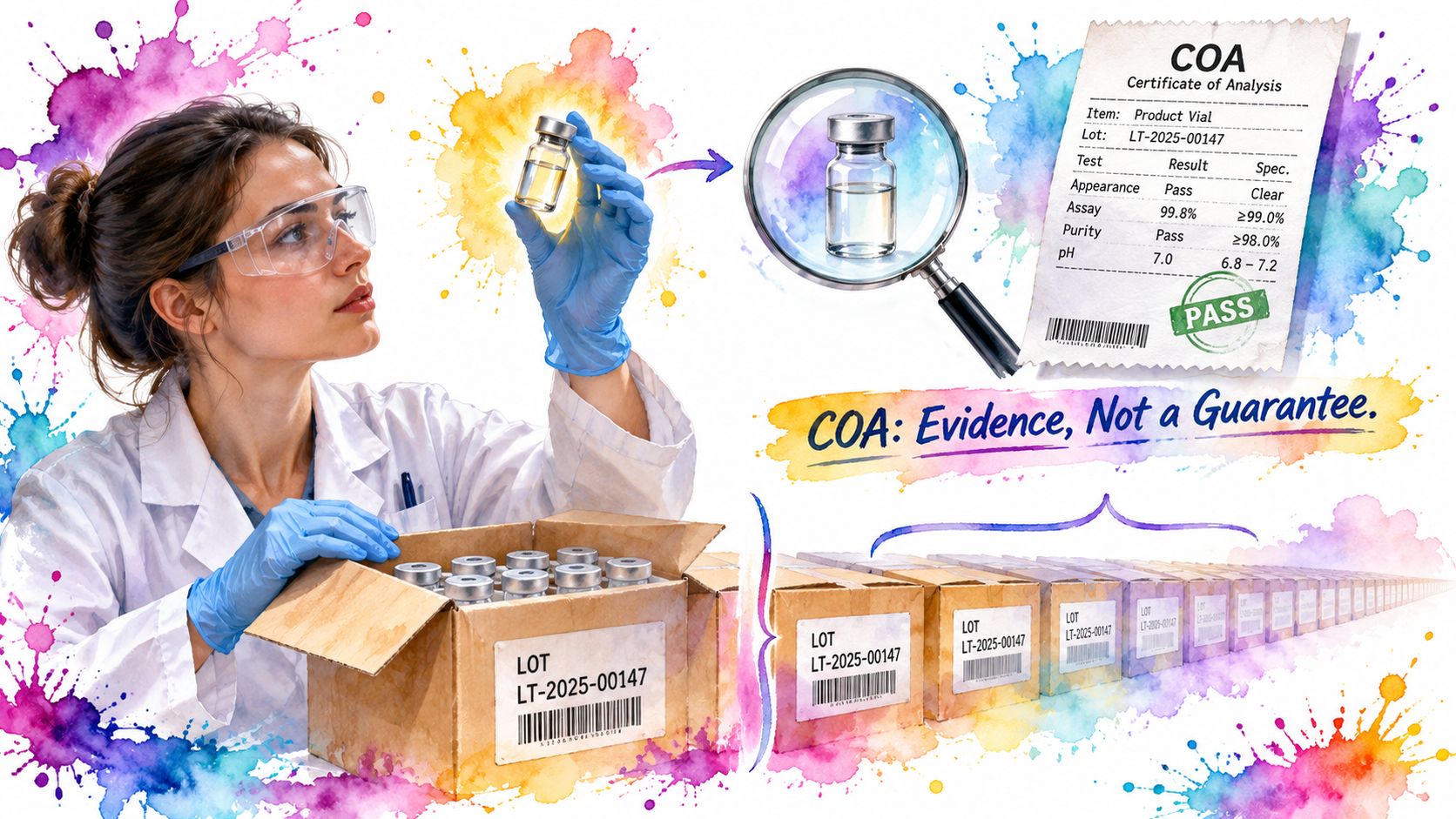
An ingredient report can leave a significant gap. Testing raw mushroom material doesn't resolve what happened during extraction, chocolate production, gummy manufacture, or packaging. The finished product may require evidence addressing those later stages.
The FDA's dietary supplement manufacturing guidance explains that reliance on a supplier's COA requires supplier qualification and confirmation of testing reliability; the agency also states that it doesn't routinely test dietary supplements before sale and has found undeclared pharmaceutical ingredients in products marketed as supplements. A document's existence therefore isn't government approval or an automatic safety finding.
Make the purchase decision from the evidence
Use the field checklist to complete these checks before buying:
- Match the lot. Compare the package identifier directly with the report, including letters and suffixes.
- Confirm the laboratory. Verify its identity, contact details, and relevant accreditation scope.
- Review the timing. Check testing and release dates against manufacture, shelf life, and any expiry or retest information.
- Inspect test coverage. Look for identity, potency, and relevant contaminant results. Don't let a potency panel substitute for missing hazard testing.
- Read each analytical row. Confirm a method, interpretable result, units where applicable, and acceptance criterion.
- Identify the tested material. Establish whether the report describes the finished retail product or only an ingredient.
- Check authorization. Confirm that responsible personnel approved or released the results.
For additional context, this video accompanies the document review:
At The Magic Mushroom Delivery, our products are verified by an independent laboratory, batch by batch. That process matters because useful verification must connect to an identifiable production lot, rather than a general brand claim.
A genuine report can still be attached to the wrong item, so use document checks alongside practical guidance on identifying counterfeit products. If a check fails, request the lot-matched finished-product report and clarification of the missing detail. Pause when the lot doesn't match, and treat COA availability as the beginning of due diligence, not its conclusion.
The Magic Mushroom Delivery offers mushroom products verified by an independent laboratory, batch by batch, alongside educational resources for evaluating testing documentation. Visit The Magic Mushroom Delivery to explore the range, and use the lot, testing scope, and finished-product checks above when reviewing a product's COA.