Peruvian Torch is not reliably stronger than San Pedro: published mescaline measurements across related cacti range from 0.053% to 4.7% of dry weight, and their common names don't map to fixed chemistry. Those overlapping measurements undermine the popular advice to choose Peruvian Torch because its name supposedly promises greater strength.
The more useful comparison starts with plant identity, then asks what a chemical measurement describes. A nursery label, a documented clone and a laboratory-tested sample provide different kinds of information. Confusing them is how a botanical comparison becomes an unsupported promise about effects.
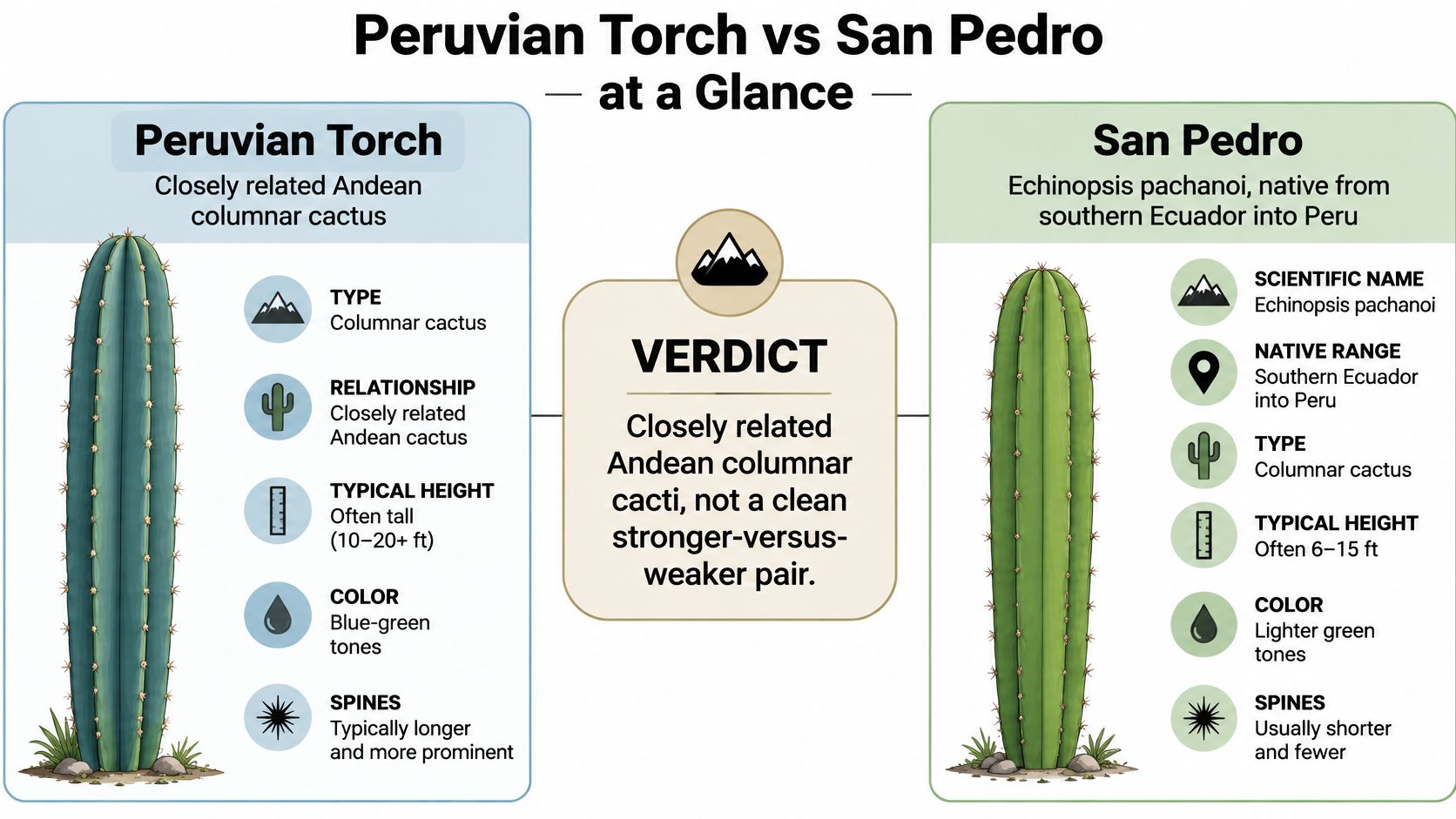
Peruvian Torch vs San Pedro at a Glance
These are closely related Andean columnar cacti, not a dependable stronger-versus-weaker pair. San Pedro usually means Echinopsis pachanoi, while Peruvian Torch usually means Echinopsis peruviana. Both names also circulate in the older genus Trichocereus, which helps explain why nursery tags and botanical references don't always match.
The distinction is useful, but it isn't perfectly tidy. Sellers sometimes use San Pedro as an umbrella name for several Andean cacti, while Peruvian Torch has its own overlapping scientific synonyms. A common name can orient you without conclusively identifying the plant.
Peruvian Torch and San Pedro side by side
| Point of comparison | San Pedro | Peruvian Torch |
|---|---|---|
| Common name | San Pedro, sometimes San Pedro Hembra in traditional usage | Peruvian Torch, sometimes linked to San Pedro Macho |
| Usual Latin name | Echinopsis pachanoi | Echinopsis peruviana |
| Former genus | Trichocereus (T. pachanoi) | Trichocereus (T. peruvianus); also treated near T. macrogonus and E. macrogona |
| Range or form | Southern Ecuador to Peru | Often described as branching from the base and mature columns into clumps |
| Cultural record | Longer documented archaeological trail, with its historical context discussed below | Narrower commercial and horticultural label, not a separate pharmacological class |
| Does the name predict potency | No | No |
What the comparison actually tells you
For a collector, these names help organize questions about origin, growth form and lineage. For someone studying ceremonial history, San Pedro identifies a more extensively documented tradition. Neither use makes the retail name a chemical specification.
The visual comparison below is best read as an orientation guide, not an identification certificate or strength chart.
Say a nursery offers a cutting tagged San Pedro and another tagged Peruvian Torch. The tags give you starting points for botanical questions, but they don't establish that the cuttings came from authenticated parent plants. They also don't tell you whether either plant has undergone chemical analysis.
A careful comparison separates those questions:
- Identity: What scientific name does the seller assign, and what supports that identification?
- Lineage: Is the plant associated with a documented clone, locality or parent plant?
- Chemistry: Does a valid result describe this particular sample or batch?
A geographic name can sound precise while leaving the important details unanswered. Likewise, a dramatic spine pattern may make a cactus recognizable to a grower without revealing its alkaloid content. Published measurements, rather than appearance-based rankings, explain why the familiar strength hierarchy fails.
Names, Appearance and Identity Checks
Start with the information you can record: the scientific name, locality if known, clone or cultivar name, and authenticated provenance. A tag containing those fields is more useful than one that says only Peruvian Torch. Provenance means a traceable account of where the plant came from, not a confident identification in a sales description.
The naming problem isn't just careless retail labeling. The iNaturalist taxonomic entry for Echinopsis peruviana reflects a history involving names such as Echinopsis macrogona and Trichocereus macrogonus. Different references may organize related plants differently, so a familiar synonym doesn't automatically mean a seller has identified a different cactus.
Build a useful identity record
Keep the seller's original name rather than replacing it with the name you prefer. If you later revise the identification, add the revision and its basis. That preserves the distinction between what was sold and what you subsequently concluded.
Useful records include:
- Scientific identification: Record the full Latin name and any synonym printed on the original label.
- Locality: Distinguish a documented ancestral locality from the nursery's shipping address.
- Clone or cultivar: Preserve the exact designation, including whether the seller describes it as confirmed or uncertain.
- Provenance: Keep the nursery invoice, collector information and photographs of the parent plant when available.
- Acquisition date: Date your label and photographs so later observations remain attached to the right specimen.
San Pedro Hembra and San Pedro Macho illustrate another trap. These traditional names are associated with E. pachanoi and E. peruviana, respectively, but they shouldn't be read as a verified weaker-and-stronger classification. A name can carry cultural meaning without functioning as a laboratory result.
Use appearance as supporting evidence
San Pedro is generally discussed as an upright columnar cactus native from southern Ecuador into Peru. The Rare Cactus horticultural description of Peruvian Torch emphasizes branching from the base and mature columns, producing multi-stemmed clumps. These are useful growth-form clues, not exclusive traits that settle every identification.
Count the stems and note where branches begin. Photograph the whole plant, its ribs and its spines, then compare those features with an authenticated reference specimen. A named reference with documented locality is more useful than an unsourced forum photograph chosen because it looks similar.
Practical rule: Treat a single visible trait as evidence to investigate, not permission to certify the species.
A cutting can resemble a textbook example while arriving with an incomplete or mistaken label. Conversely, an unusual-looking plant doesn't necessarily invalidate a well-documented lineage. Consider the record and the appearance together rather than letting either substitute for the other.
Finish by putting the suspected Latin name, source and acquisition date on the plant tag. Keep uncertainties visible in your notes. That modest habit makes future botanical comparisons more meaningful and prevents an uncertain identification from hardening into an unsupported chemistry claim.
Measured Mescaline Ranges That Overlap
The published numbers overlap so broadly that a species label predicts less than most buyers assume. In the 2010 study by Ogunbodede and colleagues, every one of 14 tested Echinopsis taxa and cultivars contained measurable mescaline, ranging from 0.053% to 4.7% of dry weight, roughly an 89-fold difference between the lowest and highest results. For scale, 4.7% of dry weight is 47 milligrams of mescaline in each gram of dried tissue. That range describes specific tested plants, and a retail label cannot reveal where an untested cutting falls inside it.
Within that study's San Pedro specimens alone, identically processed dried green subepidermal tissue from five plants ranged from 0.54% to 4.7%, about an 8.7-fold spread inside a single species label. The same study measured a Peruvian Torch specimen at 0.24% and another related species at 0.47%. Pick a convenient specimen and either species appears to win, which is exactly why a single data point makes a poor ranking.
Published mescaline measurements by label
| Source context | Plant label | Reported result |
|---|---|---|
| Ogunbodede et al. 2010 study, 14 Echinopsis taxa and cultivars | Mixed San Pedro, torch and related plants | 0.053% to 4.7% mescaline of dry weight |
| Ogunbodede et al. 2010 study, five specimens | San Pedro, Echinopsis pachanoi | 0.54% to 4.7% mescaline of dry weight |
| Ogunbodede et al. 2010 study, one specimen | Peruvian Torch, Echinopsis peruviana | 0.24% mescaline |
| Ogunbodede et al. 2010 study, related sample | Another related species | 0.47% mescaline |
| Historical analyses cited in a 2023 ceremonial report | San Pedro | Values described as high as 5%, an upper report rather than a typical figure |
Read the measurement before comparing it
Total alkaloids and mescaline are not interchangeable measures. A total-alkaloid figure counts mescaline alongside the plant's other alkaloids, while a mescaline-only figure counts one compound. Two percentages can sit side by side in a table and look comparable while describing different quantities, so check what a paper actually measured before ranking plants by it.
Likewise, a 2023 report on ceremonial San Pedro use cites historical San Pedro analyses describing values as high as 5%. An upper report marks what one analysis once found. It tells you little about a typical plant and nothing about an untested cutting.
Fresh-weight and dry-weight figures answer different questions. Water contributes to fresh mass, so drying raises the percentage without adding any mescaline, the way a raisin carries more sugar per gram than the grape it came from once the water leaves. A dry-weight result cannot be compared directly with an unspecified fresh-weight claim.
Why matching names isn't enough
To interpret laboratory results, account for the variables that can change the plant's chemistry or the reported measurement:
- Genetics: Different lineages and individual plants needn't produce identical alkaloid profiles.
- Growing conditions: Temperature and water availability are relevant environmental variables.
- Age and tissue: A sampled outer green layer isn't equivalent to an unspecified whole-plant sample.
- Processing: Drying and sample handling affect the basis of comparison.
- Laboratory method: Extraction efficiency, analytical technique and reporting conventions affect comparability.
Specimen-level variability can exceed any presumed species-level difference.
The conclusion that follows is that a species average cannot describe an unknown specimen, much less predict a person's experience. Concentration describes an analyzed material under stated conditions; it is a laboratory measurement, a dose figure for no one, and a guarantee of nothing.
Ceremony Gardens and What Each Name Is For
People compare these cacti for different reasons: cultural study, interest in contemporary ceremonies, or an ornamental collection. Those goals call for different evidence. A historical record, a retreat questionnaire and a nursery description shouldn't be treated as interchangeable endorsements.
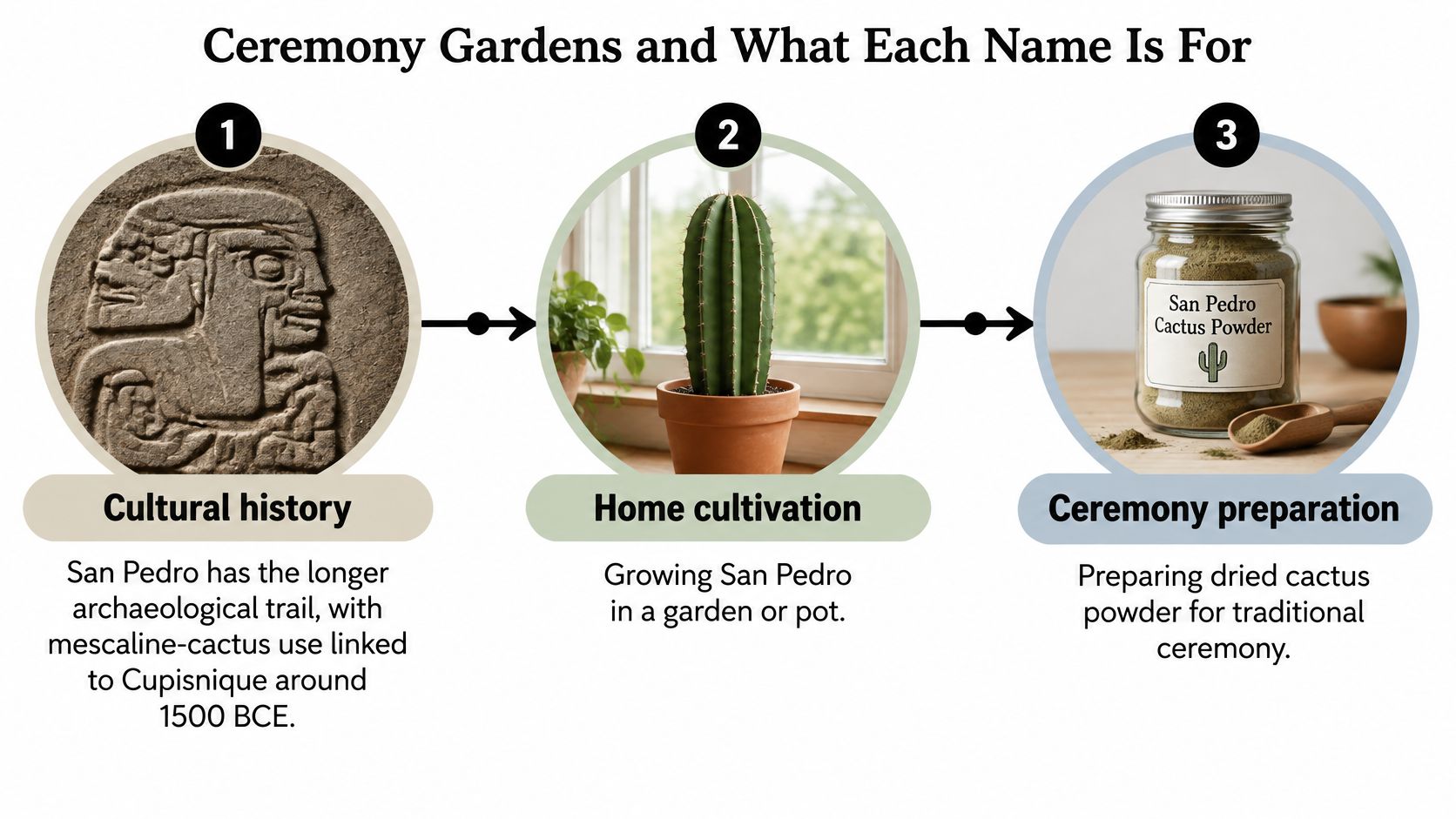
The following visual places those uses alongside one another; ceremonial preparation is a cultural context, not a preparation recommendation.
Cultural history requires cultural context
The archaeological and ethnographic account archived by Radboud University links mescaline-cactus use to Cupisnique around 1500 BCE, Chavín around 1000 BCE, Moche approximately 100–750 CE, and Lambayeque about 750–1350 CE. It also records continued ceremonial healing and diagnostic practices among shamans in northern Peru.
That gives the San Pedro tradition a substantial documented history. It doesn't establish that every modern nursery cutting has a direct, documented connection to those practices. Nor does it turn Peruvian Torch into a separate pharmacological class.
The term entheogen concerns a context of use, rather than a botanical rank. Our explanation of what entheogens are helps distinguish spiritual and ceremonial terminology from plant identification.
Retreat findings describe retreat participants
A peer-reviewed study of San Pedro retreats in the Netherlands examined 42 participants and assessed 11 dimensions of altered states of consciousness, alongside ego dissolution, mystical experiences, challenging experiences and adverse reactions. The researchers studied a particular ceremonial-retreat group, not a representative sample of every person or every cactus preparation.
That distinction matters when someone uses a retreat account to describe what either species will feel like. Participant expectations, setting and the material used belong to that particular experience. The findings don't support standardized labels such as reliably gentler or consistently more intense for either retail name.
For additional cultural context, the accompanying video offers another presentation of the topic.
A garden comparison asks different questions
For a collection or greenhouse, ask about the actual specimen's branching habit, anticipated mature footprint and documented clone. A plant that develops several columns may suit a spacious collection differently from a specimen selected for an upright silhouette. Ask for photographs of mature related plants rather than relying on a close-up of a young cutting.
Lineage and batch can matter more than the retail label.
For the historian, lineage helps establish a defensible connection. For the grower, it helps explain what plant is being maintained. For anyone interpreting chemistry, a batch record identifies which material was tested.
These goals can coexist without being collapsed into a strength contest. Studying ceremonial history doesn't require preparation instructions, and growing an ornamental cactus doesn't establish any intention to consume it.
Safety Testing and Legal Limits
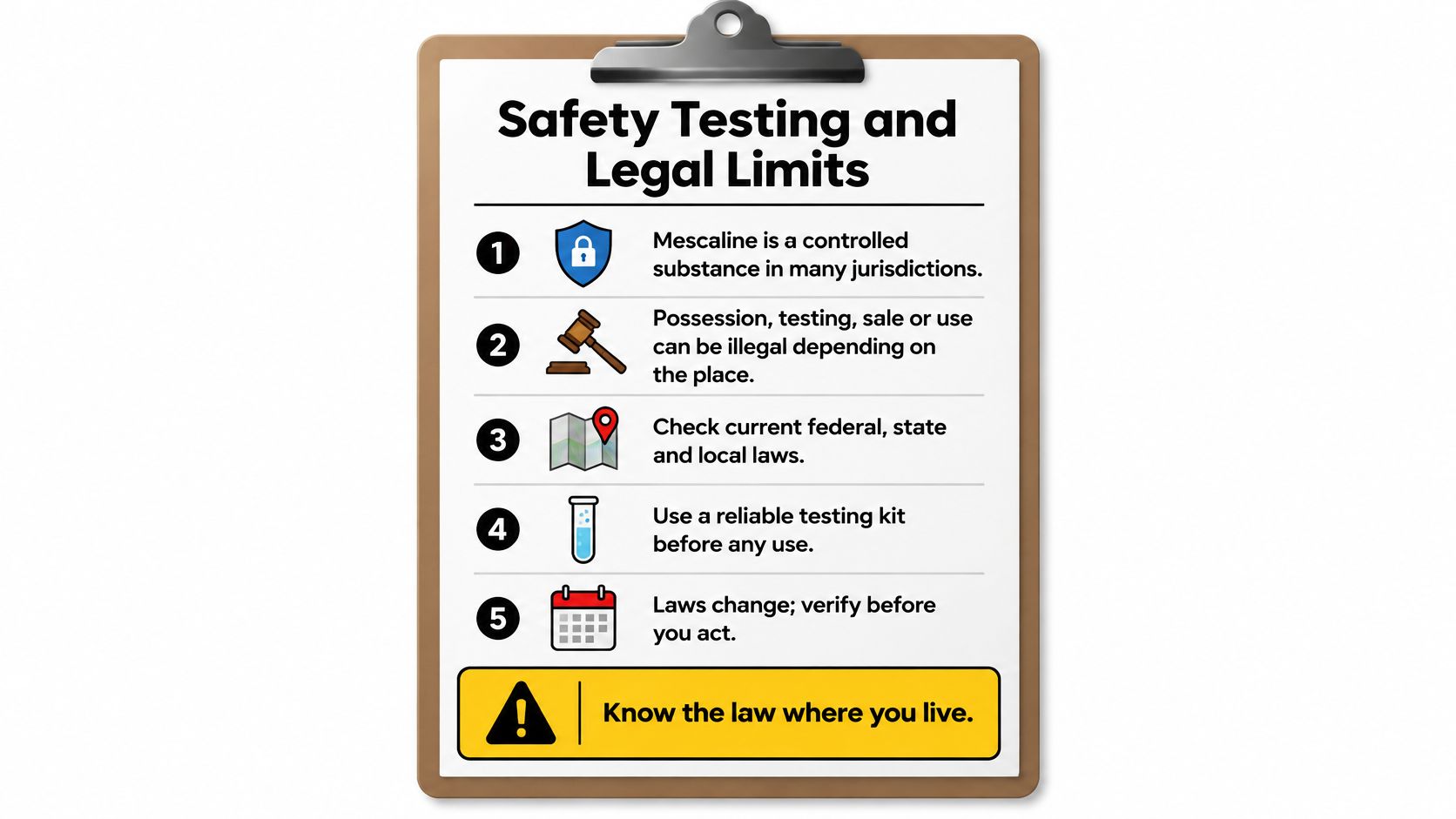
Mescaline is a controlled substance in many jurisdictions, and possession, testing, sale or use can be illegal depending on location. The chemical-neuroscience review Dark Classics in Chemical Neuroscience: Mescaline supports the need to verify legal handling requirements and the importance of specimen-level chemical variability. Check current federal, state and local rules before acquiring a plant for any psychoactive purpose or arranging analysis.
Don't assume a nursery listing answers the legal question. Ornamental cultivation and an intention to consume or process a plant are distinct situations, and a botanical name alone doesn't establish what your jurisdiction permits.
The checklist below highlights the need to verify both legal status and testing claims.
Require a record that matches the material
For lawful research or quality control, validated laboratory analysis is the defensible way to compare concentration. A consumer screening kit should not be treated as a quantitative mescaline result, a safety clearance or proof that handling is legal. Our guide to third-party lab testing explains why documentation matters when evaluating product claims.
A useful analytical record should identify:
- Scientific identification: The assigned taxon and the basis for that assignment.
- Sampled tissue: The part of the plant represented by the result.
- Reporting basis: Whether the result uses dry mass or another explicitly stated basis.
- Validated measurement: The mescaline result and the analytical method used.
- Detection limits: What the method can reliably detect or quantify.
- Batch and uncertainty: The material's identifier and the uncertainty attached to its measurement.
A result for a parent plant isn't automatically a result for a later cutting or processed batch. Similarly, a screenshot without a sample identifier doesn't establish that the advertised material was tested. Match the report to the material rather than accepting a laboratory logo as sufficient evidence.
Chemical information isn't a safety guarantee
Individual cacti can differ, and those differences carry through into processed materials. Equal amounts of material don't establish equal active content. Even a valid concentration result cannot guarantee an uncomplicated or predictable subjective experience.
Challenging experiences and adverse reactions belong in any responsible discussion of ceremonial use. Don't interpret a familiar plant name, a traditional setting or a favorable testimonial as assurance that either cactus is harmless.
Before acting, complete a short verification check:
- Confirm the law: Check the rules governing your location and intended activity.
- Separate identification from potency: Keep the botanical record distinct from analytical claims.
- Reject implied servings: Don't accept a species average as a serving size or personal-use recommendation.
Choose by Goal Not by Strength Myths
The useful answer to Peruvian Torch vs San Pedro depends on what you want to learn or grow. You can make a defensible choice without declaring a universal winner. The strongest decision is usually the one supported by the clearest plant record.
Choose the evidence that matches your purpose
For a documented cultural plant, choose the San Pedro tradition as your starting point. Its archaeological and ethnographic record gives you a substantial basis for studying Andean ceremonial practice. Keep the historical tradition distinct from claims about the identity or effects of a particular modern cutting.
For a clumping columnar specimen, consider Peruvian Torch descriptions that specify basal and columnar branching. Then evaluate the actual plant, its documented clone and the space available in your collection. A seller who can describe the mature parent plant gives you more useful horticultural information than one who leads with an alleged strength advantage.
For a predictable psychoactive effect, neither label qualifies. A retail name cannot resolve the uncertainties involved in plant chemistry and individual response. Our psychedelic harm-reduction resources provide broader context for questioning claims of predictable experiences, but they don't replace professional guidance or jurisdiction-specific legal advice.
Make a purchase decision from the record
If you're considering a lawful ornamental purchase, request the Latin name, clone designation and provenance. If the seller makes chemical claims, ask whether a laboratory result exists and whether it corresponds to the offered material. An ornamental seller needn't provide a potency report, but shouldn't make unsupported potency promises.
Walk away when a seller substitutes confidence for documentation. A premium nickname, impressive photograph or geographic story doesn't repair an uncertain identity. You're choosing a plant, not buying proof of a promised experience.
Buy or study the plant for its identity and history, not because a nickname promised a stronger experience.
Check mescaline's legal status locally before any activity involving psychoactive use or testing. This comparison is botanical and educational, not a dosing guide. There's no defensible universal strength ranking between the names Peruvian Torch and San Pedro.
We offer educational resources on psychoactive substances, responsible use and laboratory testing, alongside our mushroom product range. Visit The Magic Mushroom Delivery to explore those guides and practice the same evidence-first approach when evaluating product labels and claims.