Grain samples contained 46–74% alpha-glucans, compared with less than 2% in authentic chaga canker, in a comparative study of chaga materials. That difference reframes the fruiting body vs mycelium debate: a product's carbohydrate numbers can reflect its growth medium, not just its fungal material.
Naming the fungal part is necessary, but it isn't enough. To judge a mushroom ingredient, you also need to know the species, what remained from cultivation, and exactly what the laboratory measured. Neither a fruiting-body label nor a high polysaccharide percentage answers all those questions.
Fruiting Body and Mycelium at a Glance
Fruiting body and mycelium compared on core criteria
| Criterion | Fruiting body | Mycelium |
|---|---|---|
| What it is | Above-ground fleshy cap and stem | Vegetative network of thread-like hyphae |
| Where it sits in the life cycle | Emerges from mature mycelium when conditions trigger it | Grows continuously through the substrate |
| How it is harvested | Cap and stem picked at maturity | Biomass harvested and dried, with substrate retention determined by the process |
| Typical growth medium | Solid substrates such as wood, sawdust or grain | Liquid culture or grain-based substrate |
| Label term FDA guidance expects | Mushroom | Mushroom mycelium |
| Common product forms | Whole dried mushrooms and cap extracts | Mycelium powders, capsules and grain-based products |
The table describes typical patterns, not every species or commercial product.
The FDA guidance on mushroom mycelium distinguishes the above-ground, fleshy fruiting body from mycelium, the vegetative network of thread-like hyphae. In everyday terms, the fruiting body is the mushroom you recognize, while mycelium grows through the material that supports the fungus.
An apple-and-root-system analogy helps: the fruiting body is like the apple, and mycelium is like the root system that produces it. Fungi aren't plants, so the analogy isn't anatomically exact. Its value is showing how the same species can produce two distinct structures.
Different structures, different harvested ingredients
A fruiting-body harvest separates the visible mushroom from its growing substrate. A mycelium harvest requires another question: did the producer collect isolated fungal biomass, or process the colonized growing medium along with it?
Those ingredients shouldn't share an assumed composition just because both contain mycelium. Liquid-culture biomass and mycelium grown through grain represent different production matrices. The word mycelium identifies a biological structure, not the proportion of fungal material in the finished powder.
Consider a jar labeled only with a species name. It could contain milled caps and stems, isolated cultivated mycelium, or a powder containing mycelium and fermented grain. The species name could be correct in each case, yet it wouldn't tell you which ingredient you're buying.
Buyer's distinction: Identify both the fungal structure and the harvested material. They aren't always the same description.
What the naming rule actually means
FDA guidance considers mushroom mycelium suitable for food when grown in acceptable media, but says products containing it should clearly identify mushroom mycelium and shouldn't imply that they contain mushrooms. That's an identity distinction, not a declaration that one form is nutritionally superior.
It also prevents a misleading shortcut in the opposite direction. Calling an ingredient mycelium doesn't establish that it's nutritionally empty, just as calling it fruiting body doesn't establish a particular concentration of desirable compounds.
For a meaningful comparison, separate these questions:
- Identity: Which species and fungal structure are present?
- Composition: What nutrients and target compounds were measured?
- Preparation: What cultivation, harvesting and processing steps produced the ingredient?
The forms are related, but they aren't interchangeable. Nutrient, compound and cultivation differences become useful only when you know which structure and preparation the laboratory tested.
How Nutrient Profiles Compare Across Species
A 2011 nutritional review compared 38 fruiting-body samples and 19 mycelial samples across 32 culinary and medicinal mushroom species, finding both forms generally low in fat and relatively rich in protein and dietary fiber. Its estimated energy ranges were 46.96–292.37 kilocalories per 100 grams of dry fruiting body, versus 195.84–373.22 kilocalories for mycelium.
Ranges that wide, and that heavily overlapped, leave no room for a universal ranking. Species differences matter, and so does whether a preparation carries more soluble polysaccharides or more structural fiber.
The following species-specific values are reported in the comparative edible-fungi study and associated nutritional discussion. Energy values summarize the review cited above.
Nutrient values for fruiting bodies and mycelium
| Measure | Fruiting body | Mycelium |
|---|---|---|
| Crude protein, Morchella esculenta, dry basis | 11.31% | 39.35% |
| Fat or crude lipid, Morchella esculenta, dry basis | 2.54% | 17.17% |
| Carbohydrates, Morchella esculenta, dry basis | 78.33% | 38.96% |
| Energy per 100 g dry, 32-species review | 46.96–292.37 kcal | 195.84–373.22 kcal |
| Metabolite change, Hypsizygus marmoreus | Reference level | Carbohydrate metabolites up 72%; amino-acid metabolites up 84% |
Why the largest difference isn't a universal verdict
The Morchella comparison looks decisive until you inspect the production conditions. In the same reported comparison, the fresh fruiting body contained 89.41% moisture, while the nutrient figures describe dry material, and the cultivated mycelium came from a different production environment. These aren't equivalent ingredients differing only in fungal structure.
The metabolomic result needs equal care. An increase in measured carbohydrate metabolites isn't interchangeable with an increase in total dietary carbohydrate. An amino-acid metabolite change doesn't directly establish the usable protein in a finished serving either.
Controlled cultivation comparisons have at times found higher crude polysaccharide and protein contents in mycelia than in fruiting bodies. That pattern supports the nutritional potential of cultivated mycelium, without establishing that every mycelium product outperforms every mushroom product.
Compare matched preparations
Protein quantity alone can't stand in for the entire nutritional profile. Protein concentration and biological value can run similar between the forms even while polysaccharide types, concentrations and structures diverge.
Use a matched comparison wherever possible:
- Same species: Don't compare a morel mycelium result with a shiitake fruiting-body label.
- Comparable substrate and cultivation: Separate tissue differences from production differences.
- Same moisture and weight basis: Compare dry with dry, or fresh with fresh.
- Same analytical measure: Keep crude protein, amino-acid metabolites and biological value distinct.
Either form can supply valuable nutrients. The defensible claim attaches to a matched, measured preparation rather than to mycelium or fruiting bodies as categories.
How Cultivation Method Shapes Each Form
Cultivation changes what reaches the testing laboratory. Choosing a fungal structure also means choosing a production pathway, and those pathways don't necessarily produce comparable materials.
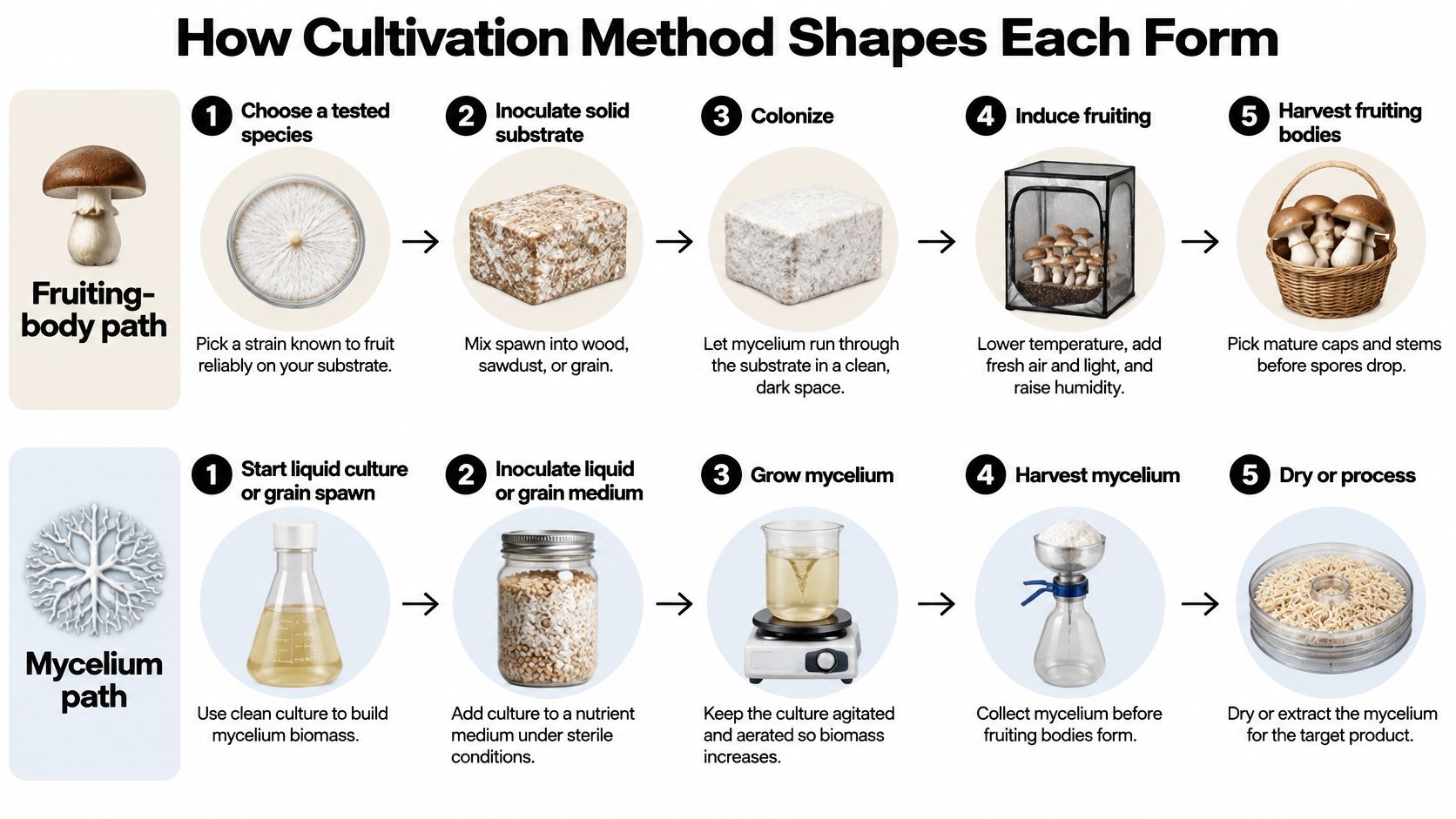
The diagram separates the main operations involved in each route.
The fruiting-body pathway
Start with a tested species and strain suited to the intended substrate. That choice establishes which organism you're growing and whether the cultivation method is appropriate, rather than assuming all mushroom species respond alike.
Next, inoculate a solid substrate such as wood, sawdust or grain. Mushroom spawn provides the cultivated mycelium used to colonize that material. Substrate selection establishes the nutritional environment in which the fungus develops.
Allow colonization, then apply species-appropriate fruiting conditions using fresh air, humidity, light and temperature management. These conditions support development of cap-and-stem tissue rather than increasing vegetative biomass. Harvest the mature fruiting bodies, then dry and test the actual material intended for sale.
The mycelium pathway
For a biomass product, cultivate mycelium in liquid nutrient medium or through a solid medium such as grain. Liquid cultivation offers a controllable route to biomass without waiting for cap-and-stem development, but it produces a different matrix from a fruiting-body harvest.
The harvesting step is critical. Filtering mycelium from liquid medium is not equivalent to drying and milling an entire colonized grain mass. When grain remains, its starch contributes to the finished material's carbohydrate background.
The video provides additional cultivation context.
Drying or extraction then defines the preparation that should be tested. Results for freshly harvested biomass shouldn't be treated as a specification for a differently processed retail ingredient.
A comparison between solid-grown fruiting bodies and liquid-grown mycelium tests both tissue and production method. It doesn't isolate tissue alone.
That's why the morel and Hypsizygus comparisons don't establish inherent superiority. Differences in substrate, physical growth environment and harvesting can accompany the biological difference between forms.
Before selecting a culture or ingredient, establish:
- Which substrate: Identify the nutrient medium and whether it remains in the product.
- Which culture method: Distinguish liquid biomass from solid-substrate cultivation.
- Which batch testing: Confirm that results describe the harvested preparation you'll use.
Beta-Glucans and Triterpenoids Behind Label Claims
A higher compound percentage isn't a universal quality score. It answers a narrower question: how much of a specified substance did a particular method detect in a particular material?
For shiitake, a technical review summarizing comparative beta-glucan testing reported approximately 29–56% beta-glucans in fruiting-body stipe and pileus samples, versus 15–27% in cultured mycelium. That supports a tissue-specific difference in those samples, not a benchmark every mushroom product must meet.
A USDA Agricultural Research Service comparison examined 35 fruiting-body samples from four Ganoderma species and eight commercial mycelium-biomass samples, tentatively identifying 93 compounds, including 88 triterpenoids, in fruiting bodies; no triterpenoids were detected in the mycelium-biomass samples under the same analytical conditions.
Beta-glucan and triterpenoid results by form
| Compound | Fruiting body | Mycelium | Study note |
|---|---|---|---|
| Beta-glucans, shiitake (Lentinula edodes) | 29–56% | 15–27% | Stipe and pileus samples versus cultured mycelium |
| Triterpenoids, Ganoderma species | 88 tentatively identified across 35 samples | None detected in eight commercial mycelium-biomass samples | Same analytical conditions; detection depends on material and method |
What detection can and can't establish
The Ganoderma finding gives a reishi formulator a reason to investigate fruiting-body chemistry when triterpenoids are the target. It doesn't prove that every fruiting-body product contains a specified amount, or that all mycelium lacks these compounds.
Species, substrate, extraction, sample preparation and analytical sensitivity can affect detection. Not detected describes the result under the method used, rather than an absolute statement about every possible preparation.
Likewise, compound identification isn't a clinical outcome. Neither a beta-glucan percentage nor a chromatographic profile alone demonstrates that a finished product will deliver a particular health benefit.
Keep polysaccharides separate from beta-glucans
A generic polysaccharide percentage groups together substances that buyers may want to distinguish. Starch and other alpha-glucans can contribute to that result, so it shouldn't substitute for a validated beta-glucan assay.
Understanding 1,3-beta-D-glucan helps clarify the terminology, but the product's own test still needs to identify its measured analyte. A detailed educational description isn't evidence of a particular bottle's composition.
Apply these quality-control checks:
- Disclosed fungal material: Look for fruiting body, isolated mycelium or mycelium grown on grain.
- Named target compounds: Require beta-glucans or specific triterpenoid markers, rather than an undefined active-compound claim.
- An appropriate validated method: Use a validated beta-glucan assay for glucans and a validated chromatographic method for target compounds such as triterpenoids.
The useful question isn't which label displays the biggest number. It's whether the measurement answers the reason you're buying the ingredient.
Which Form Fits Which Product Need
Choose the form after defining the intended use. A cap-and-stem harvest, a protein ingredient and a triterpenoid specification are different purchasing problems, even when sellers place them under the same mushroom category.
This visual summarizes common uses, but its form labels are starting points rather than universal recommendations.
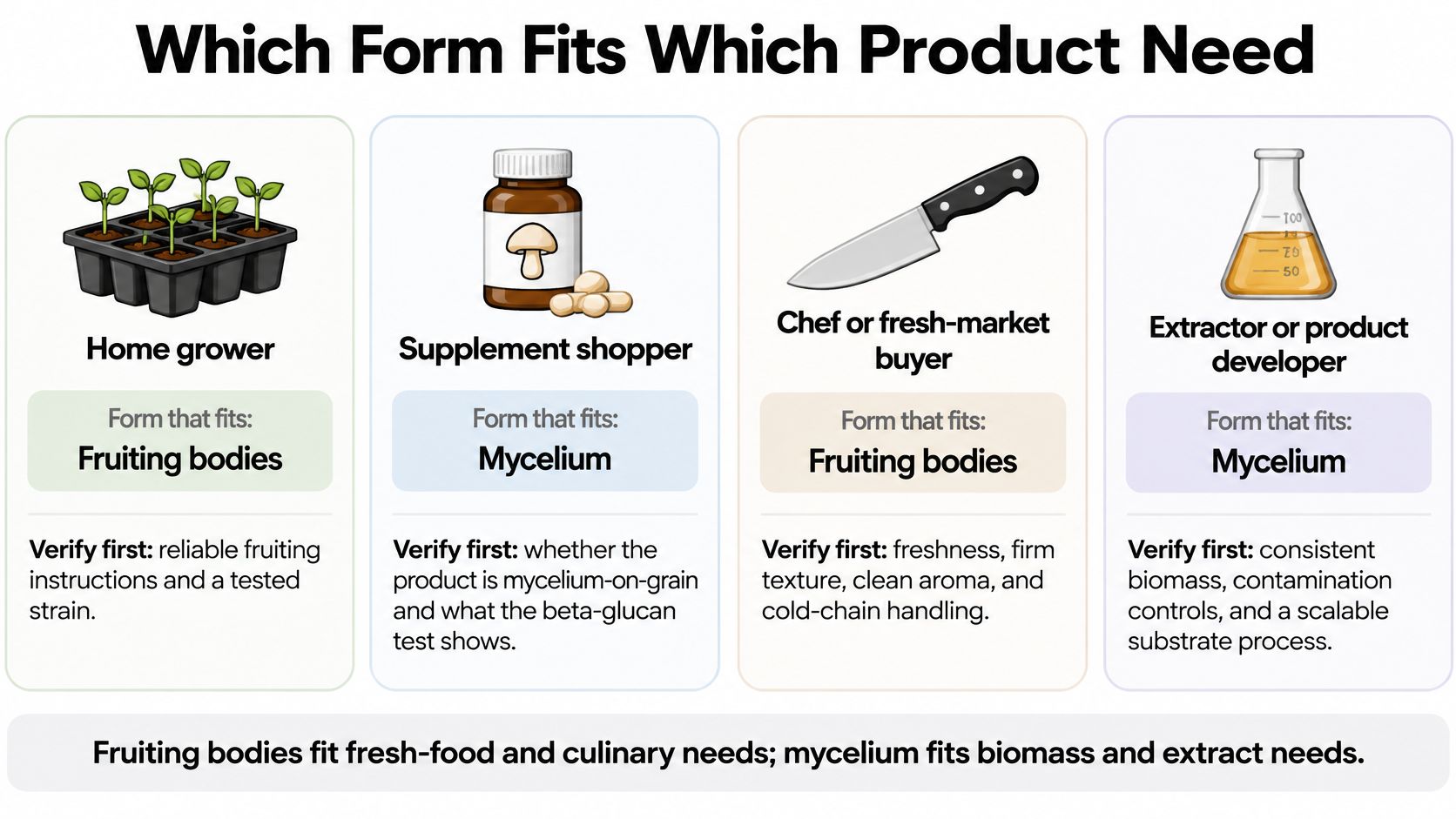
Buyer situations and what to verify first
| Buyer need | Form that tends to fit | Verify first |
|---|---|---|
| Home grower choosing a culture | Fruiting body for cap-and-stem harvest; mycelium for faster biomass production | Species, substrate and colonization method |
| Supplement shopper seeking reishi triterpenoids | Fruiting body, supported by the tested Ganoderma comparison | Fungal part named and analytical method disclosed |
| Food developer comparing protein | Species-matched material; mycelium is higher in some comparisons only | Same species, comparable substrate and dry or fresh basis |
| Shopper reading beta-glucan claims on a grain product | Fruiting body or pure cultured material when fungal composition is the priority | Beta-glucans reported separately from starch and alpha-glucans |
Match the evidence to the purchase
For a home grower, buying a viable culture isn't the same as buying a culture suited to reliable fruiting. If you want edible caps and stems, choose a tested fruiting strain and instructions matched to its substrate. If you want vegetative biomass, evaluate the colonization and harvesting process instead.
For a reishi supplement shopper, a fruiting-body ingredient is the stronger starting point when the purchasing target is triterpenoids. Still, the fungal-part name doesn't replace a compound specification. Seek a result for the actual preparation rather than assuming all reishi powders reproduce a laboratory profile.
For a food developer, mycelium deserves consideration as a protein ingredient, but the decision needs more than a headline protein percentage. Compare matched analytical bases, then evaluate how the supplied ingredient performs in the intended recipe. A laboratory biomass result doesn't automatically describe a grain-containing retail powder.
Separate grain fermentation from fungal concentration
For a shopper evaluating glucan claims, pure liquid-culture mycelium and mycelium-on-grain shouldn't be treated as equivalent. The chaga comparison distinguished authentic canker, pure cultured mycelium and cereal-associated materials, making substrate disclosure central to interpreting the result.
Authentic chaga canker is also a distinct material, not a generic stand-in for all mushroom fruiting bodies. Its comparison helps identify grain contributions; it doesn't establish a universal ranking of fungal tissues.
Organic cultivation, fungal identity and measured composition answer different questions. A product can satisfy one without documenting the others.
At The Magic Mushroom Delivery, we use only organic mushrooms, cultivated with organic farming practices free from synthetic pesticides, herbicides and fertilizers. That describes our sourcing and cultivation standard, not a substitute for identifying fungal material or measuring a target compound.
No form is better for every need. Select the preparation whose documented composition matches the task, and treat substrate information as part of that composition.
Check the Label Before You Buy
Start with identity, not the largest percentage on the front panel. A label that leaves the material ambiguous makes every subsequent comparison less reliable.
SupplySide's coverage of a 2023 mushroom-labeling petition describes FDA's distinction between mushrooms and mushroom mycelium and discusses 21 C.F.R. § 101.4(h), which requires disclosure of the plant part for botanical dietary ingredients. The petition argued that the regulation wasn't explicit enough about fungal parts such as mushroom, mycelium or spore.
Run the label through these checks
- Confirm the form. Find fruiting body, mushroom mycelium or an explicitly described mixture. Don't infer the ingredient from the photograph on the package.
- Check the species. Require a specific identity rather than treating mushroom as a sufficient ingredient description.
- Identify the substrate. Look for grain disclosure and establish whether growing medium remains in the finished powder.
- Separate the glucan measurements. Distinguish beta-glucans from alpha-glucans, starch and total polysaccharides.
- Find the target and method. Match the named compound to an appropriate assay. Don't treat a general carbohydrate test as a triterpenoid measurement.
- Confirm batch documentation. Review a certificate of analysis tied to the product lot, with clear analytes and results.
- Check the reporting basis. Establish whether values describe fresh or dry material and whether the tested sample matches the product being sold.
Keep safety testing and composition testing distinct
Contaminant testing answers a different question from nutrient or compound testing. We test our mushrooms to ensure they're free from DMT and any other contaminants. That testing purpose shouldn't be confused with evidence of a particular beta-glucan, protein or triterpenoid concentration.
Read each laboratory result for what it establishes. A species-authentication result doesn't quantify starch, and an organic cultivation statement doesn't identify the fungal part.
Compare products only when their identity, preparation and measurements are sufficiently clear. An unexplained percentage is incomplete information, even when the label correctly names fruiting body or mycelium.
The Magic Mushroom Delivery offers mushroom products and educational resources to help adults make more informed choices about ingredients and preparation. Visit The Magic Mushroom Delivery to explore the range, then use the label checklist to evaluate fungal identity, cultivation information and the testing relevant to your purchase.