
At 7 PM, the kettle clicks off. You pour hot water over ground mushrooms, watch the liquid turn amber, and wonder whether the first change will be a flutter in your stomach or a shift in the room. You might also be checking the clock: How soon will it start, how strong will it feel, and will you be able to sleep later?
There isn't one dependable answer for every cup. The magic mushroom tea effects depend on the amount of active compound that reaches your body, the mushrooms and preparation, what you've eaten, and your own response. This guide walks through the likely timeline and the less obvious uncertainty behind homemade tea, with practical safety points for anyone trying to understand what to expect.
A Cup of Magic Mushroom Tea at 7 PM
The first few minutes after drinking may feel uneventful. That can be confusing if you expected an immediate shift, but oral psilocybin has to be absorbed and converted by the body before its main psychoactive effects become noticeable. A quiet start doesn't tell you exactly how strong the experience will become.
Some people first notice a change in their body or mood. Others may feel nausea, heightened attention to sounds, or an altered sense of time as the experience develops. Those reactions aren't a schedule or a promise; the same person can respond differently on different occasions, and a homemade cup can vary in strength.
The questions behind the clock
A first-timer might be asking whether to wait, whether the tea will feel gentler than eating mushrooms, and whether a 7 PM start means the evening will be over by bedtime. The grounded answer is that oral effects commonly build over the first part of the experience and remain active for several hours, but an exact finish time can't be guaranteed.
The useful starting point is to separate timing from predictability. Tea may be absorbed without the same amount of solid mushroom material in the stomach, but that doesn't make its strength easy to estimate. How the mushrooms were grown and stored, how much active compound they contain, how the tea was prepared, and individual metabolism all matter.
A careful approach prioritizes a calm environment, no need to drive or do hazardous tasks, and enough time free of responsibilities. The sections ahead explain what happens after ingestion, how the experience tends to unfold, and why two cups made from the same recipe can still feel very different.
How Psilocybin Becomes the Experience
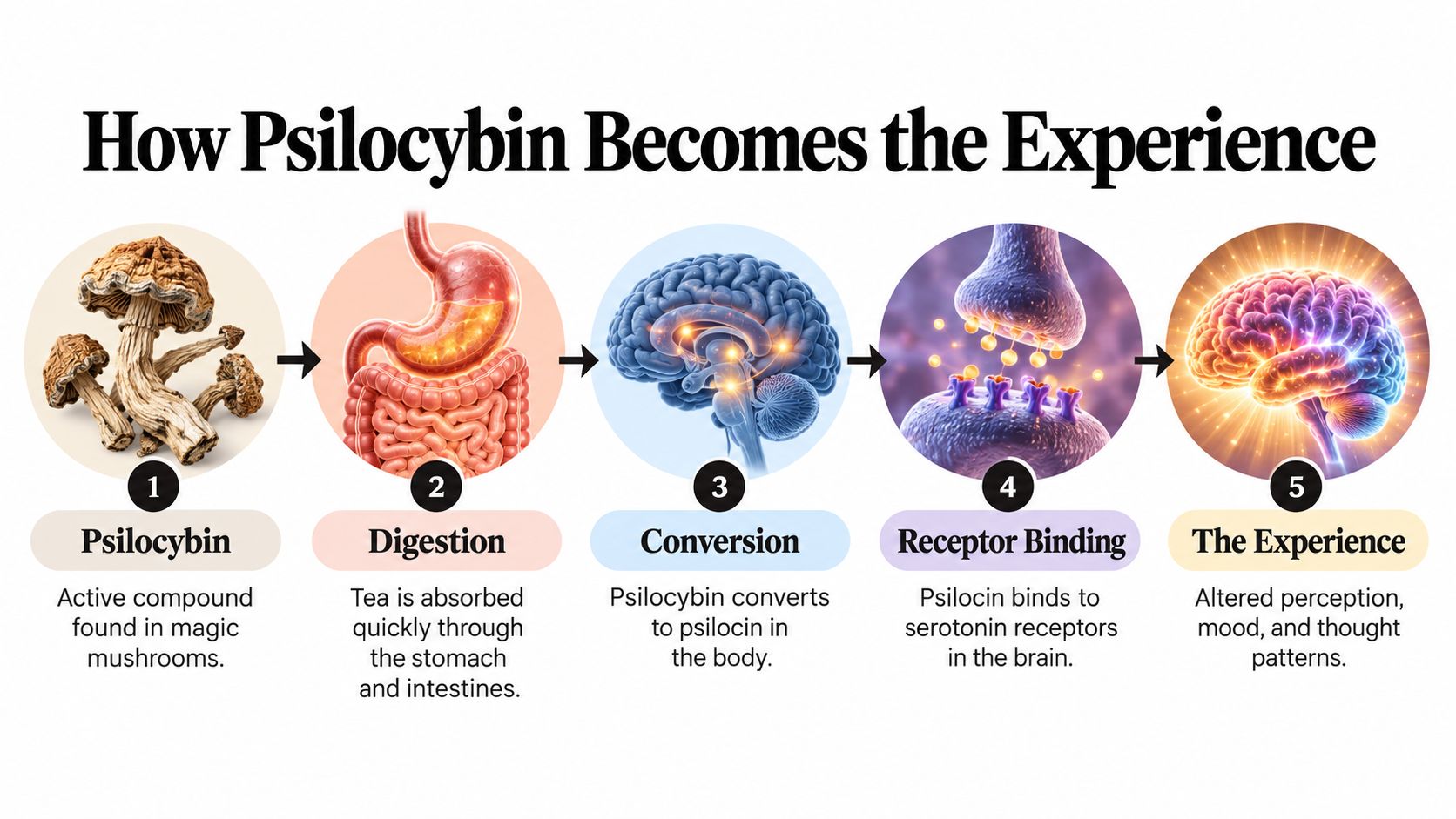
The main chemical sequence is simple: psilocybin becomes psilocin, and psilocin is primarily responsible for psychedelic activity. Think of the conversion like reshaping a key so it can fit a lock. Once absorbed, psilocin interacts with serotonin receptors involved in perception, mood, and thought.
From cup to bloodstream
A useful kitchen-to-blood analogy is to think of the digestive system as the route from a prepared ingredient to the rest of the body. The drink is swallowed, its contents are absorbed through the digestive tract, and psilocybin is converted into psilocin. Tea still has to pass through this process, so it doesn't remove the delay that comes with oral ingestion.
In a controlled oral-administration study, psilocin became measurable in plasma within roughly 30 minutes and reached its highest concentration at about 2 hours. At the studied doses, its elimination half-life was generally near 1.4–1.8 hours. These measurements describe standardized oral psilocybin, not every homemade tea, so they help explain the biology without predicting an individual cup precisely. (Oral psilocybin pharmacokinetics and psilocin levels)
As the body absorbs and processes psilocin, subjective effects can rise, reach a high point, and then fade. The conversion and clearance timeline is part of why a gradual beginning can still lead to stronger effects later. For a plain-language comparison of the two compounds, see how psilocin and psilocybin differ.
Onset, Peak, and Duration of Magic Mushroom Tea
Oral psilocybin studies offer a practical timing guide, but they don't establish a precise clock for unstandardized tea. Subjective effects commonly begin 20–40 minutes after ingestion, peak around 60–90 minutes, and remain active for approximately 4–6 hours. Psilocin blood concentrations generally peak at about 2 hours, while subjective effects can last roughly 6 hours. (Oral psilocybin timing and duration review)
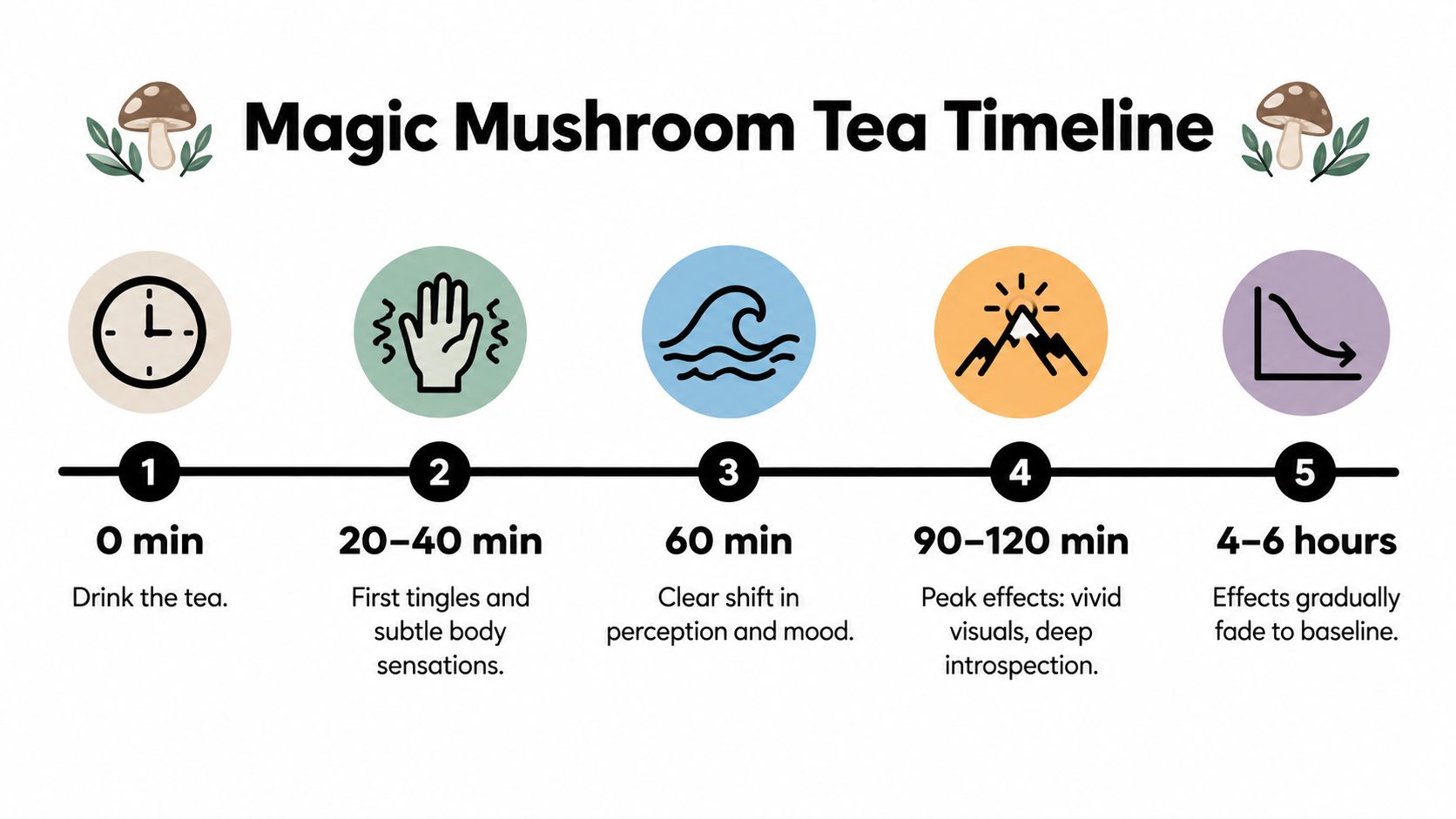
At a glance: First changes may appear within 20–40 minutes. The experience often builds toward a peak in the first part of the session, then gradually eases over several hours.
How the phases can feel
At the beginning, a person might notice a body sensation, mild nausea, or a subtle change in mood. The early effects can be easy to mistake for anticipation, and they don't reliably reveal how intense the experience will become.
Near the stronger part of the experience, changes in perception, emotional intensity, and thought patterns may become more noticeable. Later, the effects usually soften rather than switching off at once. A person may feel tired or reflective as the most intense effects fade, but this varies.
The numbers are a planning baseline, not a countdown. Meal composition, individual metabolism, mushroom potency, and preparation can affect timing and intensity; tea-specific comparisons with standardized whole-mushroom dosing remain limited. Because effects can continue to intensify after subtle first changes, an early onset isn't a sound reason to take more. For additional timing context, see how long psilocybin effects may last.
This video offers another visual overview of the general timeline.
Tea vs Eating Shrooms Whole or Capsules
The main difference between tea, whole dried mushrooms, capsules, and tea with the solids is not a guaranteed change in strength. Each method changes what you swallow and how easily you can estimate what reaches your body. None makes an unmeasured amount reliably predictable.
| Method | Typical onset | Stomach comfort | Dose predictability |
|---|---|---|---|
| Tea, strained | Oral effects commonly begin in about 20–40 minutes, but tea-specific timing varies | Less solid mushroom material may be easier for some people | Low when potency and extraction are unknown |
| Dried mushrooms, eaten whole | Oral effects commonly begin in about 20–40 minutes | Chewing and digesting more mushroom material may feel uncomfortable for some | Low when potency varies |
| Powdered mushroom capsules | Oral timing can vary; the capsule still has to dissolve and be absorbed | Avoids chewing, but the mushroom powder is still swallowed | The amount of powder can be measured, but active compound content may remain uncertain |
| Tea with soaked solids | Oral timing varies with the drink and swallowed material | Includes the solids, which may bother some stomachs | Uncertain, especially if extraction and distribution are uneven |
Tea can be appealing to someone who wants to avoid chewing dried mushrooms or swallowing all the solids. But faster-feeling onset is not automatically an advantage, and straining doesn't make the remaining liquid uniform or accurately dosed.
Capsules can simplify measuring the mushroom material itself, although that still doesn't establish the psilocybin content. Eating whole mushrooms includes the solid material, while drinking tea and consuming the solids leaves less behind. Those are trade-offs, not a ranking.
Decision rule: Choose only a method whose uncertainty you understand and whose onset you can accommodate. If you can't estimate the delivered amount, don't treat a familiar recipe as a reliable dose.
Why the Same Tea Can Hit Two People Differently
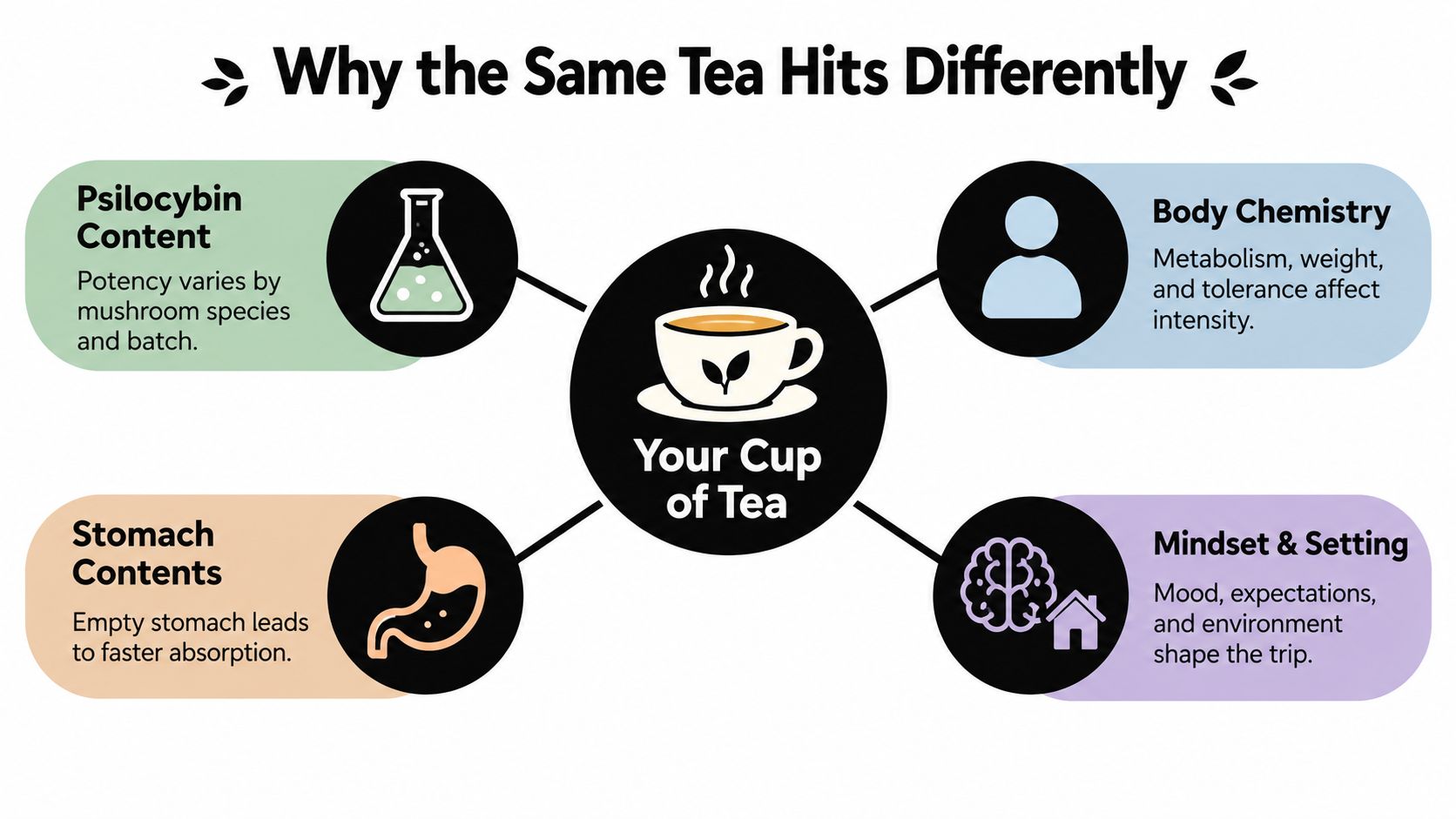
A recipe describes the process, not the amount of psilocybin in the finished cup. Mushroom potency can differ between specimens and batches, while grinding, steeping, straining, and dividing the liquid can affect how much active compound ends up in each serving. The same jar and the same instructions don't guarantee identical cups.
Dose is not the same as mushroom weight
Controlled oral studies show why small changes in the amount absorbed can matter. At 15, 25, and 30 mg of psilocybin, mean peak psilocin concentrations were approximately 11, 17, and 21 ng/mL, respectively. Maximal reported drug effects rose from 58% to 73% to 80% across those doses. These results come from controlled psilocybin dosing, not homemade tea, but they show that higher exposure can produce stronger subjective effects. (Controlled psilocybin dose and response study)
With tea, extraction adds another layer. How finely the material is ground, steeping conditions, degradation, filtration, whether the solids are consumed, and whether the liquid is mixed before pouring can all influence the delivered amount. A cup's volume or color can't reveal its psilocybin content.
What you can influence, and what you can't
You can choose a calm environment, avoid combining substances, and make sure you have no driving or other hazardous tasks to do. You can also recognize that food in the stomach and individual metabolism may change how an oral experience unfolds.
You can't reliably infer the potency of a mushroom batch from its appearance or assume that a repeated recipe will produce the same effect. Mindset and setting also shape how sensations are experienced, but they don't cancel the pharmacological effects or make an unpredictable dose precise. That distinction is central: planning can reduce some risks, but it cannot standardize a homemade cup.
Preparing and Dosing a Cup of Mushroom Tea
Preparation can change how much mushroom material goes into the drink, but a home method can't tell you exactly how much psilocybin you have extracted. Grinding increases the material's exposed surface area; steeping transfers compounds into water, while straining removes some of the solids. None of those steps verifies the final concentration.
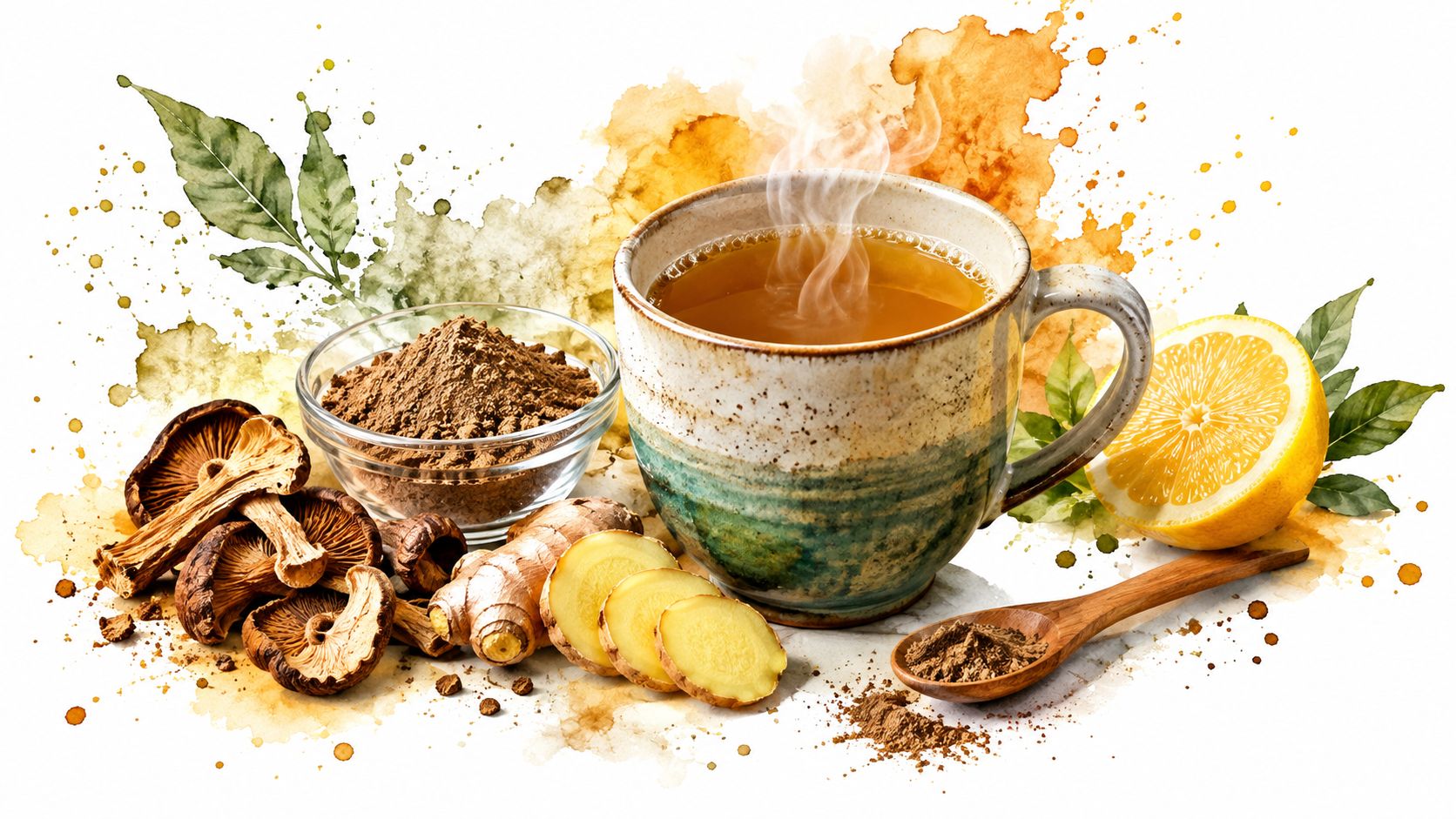
A commonly described preparation approach is to grind dried mushrooms, add them to hot water, steep, and strain. Lemon or ginger may be added for taste, but don't assume either ingredient makes the drink more predictable or reliably prevents nausea. Choosing whether to consume the soaked solids changes how much mushroom material you swallow, yet still doesn't reveal the amount of active compound.
Think in terms of uncertainty, not a recipe guarantee
A “start low” approach is often suggested in consumer advice, but there is no dependable way to translate a measured weight of unstandardized mushrooms into a precise psilocybin dose at home. That makes it important not to use a familiar recipe, a previous cup, or a small-looking serving as proof that the next serving will feel the same.
Avoid taking another serving because the first effects seem slow or subtle. Oral effects can continue to build, and an early impression may not reflect the eventual intensity. Since tea strength can vary, waiting for a clearly established experience is safer than trying to adjust it while effects are still developing.
Some companies sell products in formats such as capsules, chocolates, or gummies, but a product format alone doesn't establish dose consistency or medical suitability. The Magic Mushroom Delivery offers mushroom products and educational material about effects and dosing considerations; whatever the format, product labeling and the limits of potency estimates deserve careful attention. Keep the focus on reducing uncertainty rather than trying to intensify the experience.
Safety, Interactions, and Who Should Pause
“Natural” doesn't mean mild, predictable, or free of interactions. Psilocin has inhibited some drug-metabolizing enzymes, including CYP3A4 and CYP2D6, in laboratory studies. The clinical importance of those findings hasn't been established in humans, so people taking prescription medicines shouldn't assume a homemade tea is too mild to matter. (Review of possible psilocybin drug interactions)
A practical pause-and-check list
- Medication review: If you take prescription or non-prescription medicines, speak with a qualified healthcare professional before considering use. Laboratory interaction signals are a reason for caution, not proof of a specific outcome for every medicine.
- Mental-health history: A personal or family history of psychotic or bipolar disorders, prior mania, severe anxiety, or suicidality calls for particular caution and professional guidance. Findings from supervised studies don't guarantee the same safety in unsupervised settings.
- Heart and circulation: Controlled studies have measured temporary increases in blood pressure and heart rate during peak effects. A review of those findings reports systolic and diastolic blood-pressure increases of approximately 10–20 mmHg and a heart-rate increase of about 10 beats per minute, supporting careful consideration of cardiovascular history. (Psilocybin cardiovascular effects summary)
- Other personal factors: Pregnancy, age, and significant medical conditions are reasons to pause and seek qualified advice rather than relying on general online guidance.
Risk conversations should stay honest about what research can and can't tell us. Clinical findings often come from screened participants receiving controlled doses and supervision. They don't establish that an unstandardized tea is safe for everyone, and a lack of a known interaction outcome isn't proof of no interaction. Before deciding, consider what is known about psilocybin and medication interactions.
Bringing It All Together Before You Brew
A cup of tea doesn't come with a reliable built-in schedule or a verified dose. The body converts psilocybin to psilocin, absorbed exposure shapes the strength of the experience, and preparation affects how much of the compound may reach you. That is why onset, intensity, and duration should be treated as estimates rather than promises.
Before making a decision, consider whether you have a calm place to stay, whether anyone will need you to drive or handle a risky task, and whether your health history or medicines raise concerns. If you proceed, don't combine psilocybin with alcohol or other psychoactive substances, and don't take more just because the first changes seem slow. Arrange sober support and leave the rest of the day clear.
A useful measure of preparation is how much uncertainty you've reduced, not how intense you expect the experience to be.
Afterward, give yourself time to rest and return to ordinary responsibilities only when you feel fully clear. If an experience becomes distressing or you develop concerning physical symptoms, seek appropriate medical help. Understanding the likely timeline can make the experience easier to plan around, but it can't replace screening, a known dose, or professional guidance.
The Magic Mushroom Delivery provides mushroom products alongside educational resources on effects, duration, and dosing considerations. If you're comparing formats or looking for more information before making a decision, visit The Magic Mushroom Delivery and review the product details carefully.