
“Mushroom capsules are natural, so they're interchangeable” is the most popular shortcut in this category, and it's the wrong place to start. A capsule might contain lion's mane extract, a multi-mushroom blend, or psilocybin. Those products don't share the same evidence, intended effects, or conditions of use.
The useful question isn't whether mushroom capsules benefit people. It's which mushroom, for which outcome, at what verified dose, and under what conditions? The answer depends as much on species identity and product testing as on the capsule itself.
Why Mushroom Capsules Are Not One Thing
“Mushroom capsules” describes a format, not a single intervention. Functional supplements may contain lion's mane, reishi, Cordyceps, chaga, or turkey tail. Psilocybin capsules belong to a different category: clinical studies of psilocybin examine a psychoactive compound in structured settings, not the general effects of functional mushroom supplements.
That distinction matters because evidence doesn't transfer between categories. A finding about psilocybin and depression can't substantiate a lion's mane claim, and evidence about a functional mushroom blend can't establish the effects of psilocybin. Even within functional products, two capsules labeled with the same mushroom may differ in the part used, preparation, dose, and composition.
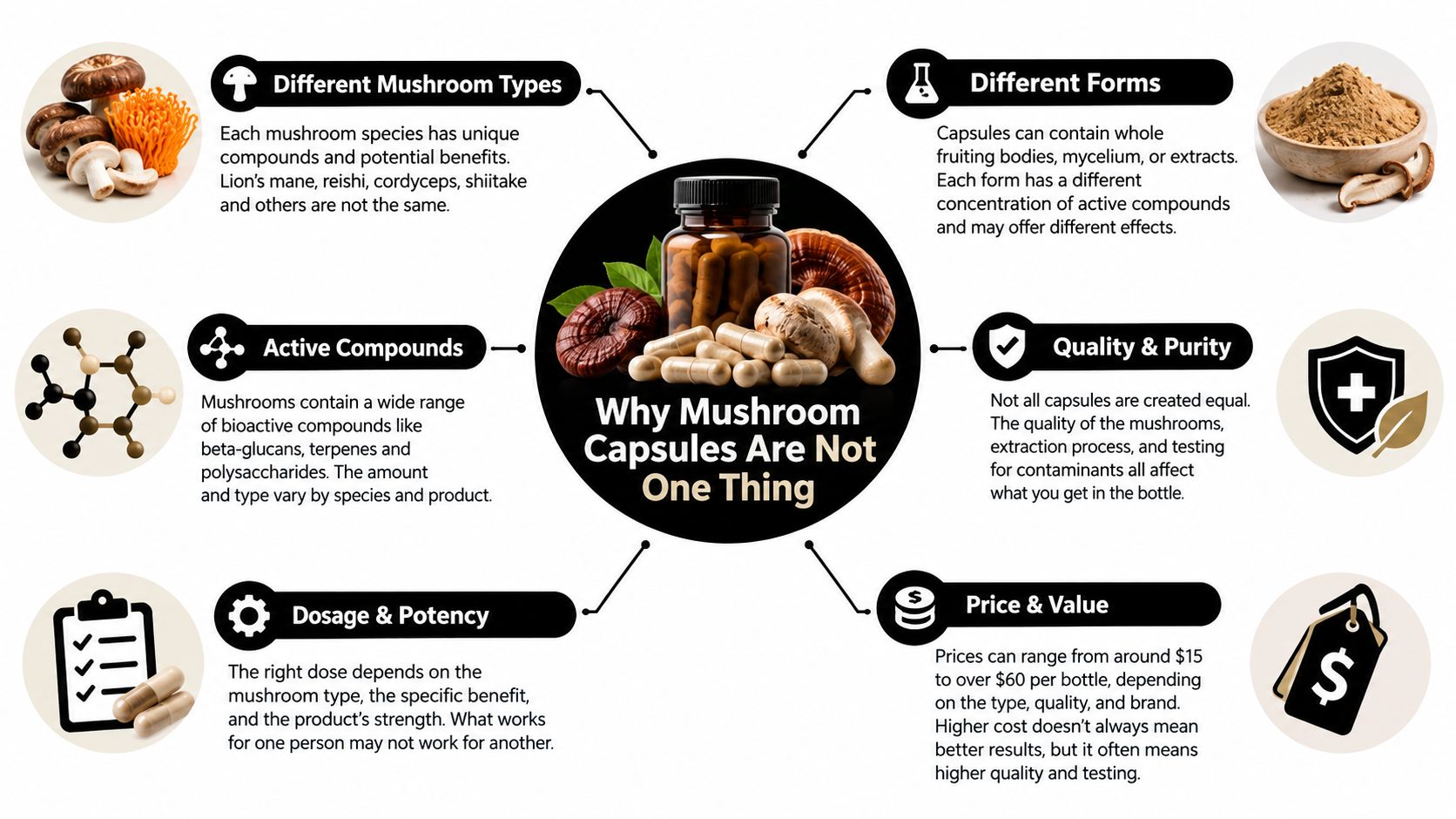
Four questions make the evidence easier to read
For cognitive effects, ask which species and preparation were tested, and whether the study measured a task, a self-reported change, or a clinical outcome. For mood and stress, separate early signals from evidence that a product treats a diagnosed condition. For immune effects, look for the specific immune markers measured rather than broad promises to “boost” immunity.
The fourth question is about the product itself. Does the label identify the species, the mushroom part, the dose, and the testing behind the product? If those details are missing, a study on a precisely defined preparation may tell you little about the capsule in front of you.
The practical distinction: The capsule is a container. The evidence depends on what's inside it and how that preparation was studied.
That's the less convenient, but more useful, answer to searches for mushroom capsules benefits. A standardized product with a clear identity may be easier to evaluate than an unspecified blend, but convenience alone doesn't demonstrate effectiveness.
How Functional Mushroom Compounds Are Supposed to Work
Functional mushroom marketing often starts with a biological mechanism. The idea is plausible: compounds in mushrooms may interact with pathways in the body. But a plausible pathway is a reason to investigate a product, not proof that taking a capsule produces a meaningful benefit.
Beta-glucans illustrate the distinction. They're discussed as signals that may interact with immune cells, a little like training prompts that tell a system to respond. Yet evidence for one immune marker doesn't establish broad protection against illness. A review of human studies reported that a shiitake extract was safe in a placebo-controlled crossover trial in healthy older adults and increased circulating B-cell numbers, while other measured immune parameters didn't change. The same review described longer survival when lentinan was added to standard chemotherapy for advanced gastric cancer, but those findings don't establish that a retail capsule can replace or improve cancer treatment on its own (review of human mushroom beta-glucan studies).
Mechanism isn't a result
Lion's mane is often discussed in connection with hericenones and erinacines, compounds proposed to affect nerve-growth pathways. The common analogy is fertilizer for pathways involved in nerve growth. But even a plausible effect on a pathway doesn't tell us whether a particular capsule contains the relevant compounds in a usable form, or whether taking it changes cognition in people.
Reishi products are often promoted for stress or sleep in connection with triterpenes and adaptogenic ideas. That framing can help explain why manufacturers make such claims, but it doesn't establish that a capsule improves sleep. Clinical outcomes depend on the tested preparation and the actual dose, not just the name of a compound on a product page.
Extraction method and capsule composition also matter. Processing may affect which compounds are present, while a label's total weight doesn't say how much of a particular compound reaches the body. The review also found that mushroom beta-glucans didn't appear to improve lipid levels or glycemic responses in the way oat and barley beta-glucans can. That's a useful corrective to labels that imply one type of fiber or polysaccharide behaves like another.
Cognitive, Mood, and Stress Evidence by Species
Lion's mane has the most specific human cognitive findings in the evidence summarized here, but those findings don't support a blanket claim that every lion's mane capsule improves memory. Trials tested different preparations, groups of participants, and outcomes. Their results are better read as signals tied to particular formulations than as proof of a uniform effect.
In a randomized, double-blind, placebo-controlled trial, 30 adults aged 50–80 with mild cognitive impairment took lion's mane at 3 g per day for 16 weeks. Scores on the Revised Hasegawa Dementia Scale improved during treatment, then declined after supplementation stopped. A separate randomized trial in adults aged 40–75 with self-reported cognitive difficulty tested 2 g daily for eight weeks of lion's-mane fruiting body plus mycelial biomass. Participants showed modestly greater improvement in visual attention and working memory, alongside improvements in subjective sleep, morning restedness, and mood. Neither result automatically applies to a lower-dose capsule or a differently prepared extract.
Evidence snapshot by species
| Species | Main studied outcome | Representative dose and duration | Strength of evidence |
|---|---|---|---|
| Lion's mane | Cognitive measures, attention, working memory | 3 g daily for 16 weeks in adults with mild cognitive impairment; 2 g daily for eight weeks in adults with self-reported cognitive difficulty | Human trials offer preliminary, formulation-specific signals; persistence and generalizability are uncertain |
| Reishi | Stress and sleep are common marketing claims | No representative human dose and duration established in the cited evidence | Claims aren't established by the evidence summarized here |
| Cordyceps | Endurance | No representative human dose and duration established here | Possible endurance benefits have been reported, but the full benefit–risk balance remains uncertain |
| Chaga | Antioxidant claims | No representative human dose and duration established here | The cited material doesn't provide a defined human dose and outcome |
A pilot randomized, double-blind, placebo-controlled study in healthy young adults found faster performance on the Stroop task 60 minutes after a single lion's-mane dose. After 28 days, the trend toward lower subjective stress was weaker, and the same research reported reduced immediate word-recall accuracy after the acute dose (pilot study of lion's mane and cognition). Those mixed results argue against presenting an acute attention signal as a reliable everyday effect.
The practical takeaway is that a species name alone isn't enough to match a product to a study. For a closer look at the kinds of cognitive claims made about lion's mane, see this overview of lion's mane and cognitive benefits. Check the preparation and serving size before treating a marketing claim as comparable to a trial.
Psilocybin Capsules and What the Trials Really Showed
The capsule format explains little about whether a depression finding applies to a product. Psilocybin trials test a measured psychoactive compound alongside psychological support, a different intervention from functional-mushroom supplementation. Their results depend on what was administered and under what conditions, rather than the fact that it could fit inside a capsule.
In a randomized trial involving 24 adults with major depressive disorder, two psilocybin sessions paired with psychological support produced clinically significant responses in 17 participants, or 71%, at both one and four weeks, with remission in 14 participants, or 58%, at one week and 13 participants, or 54%, at four weeks (2021 clinical trial in major depressive disorder). The small sample limits how confidently those outcomes can be generalized. Psychological support was part of the intervention, so these results don't establish what a consumer capsule taken alone would achieve.
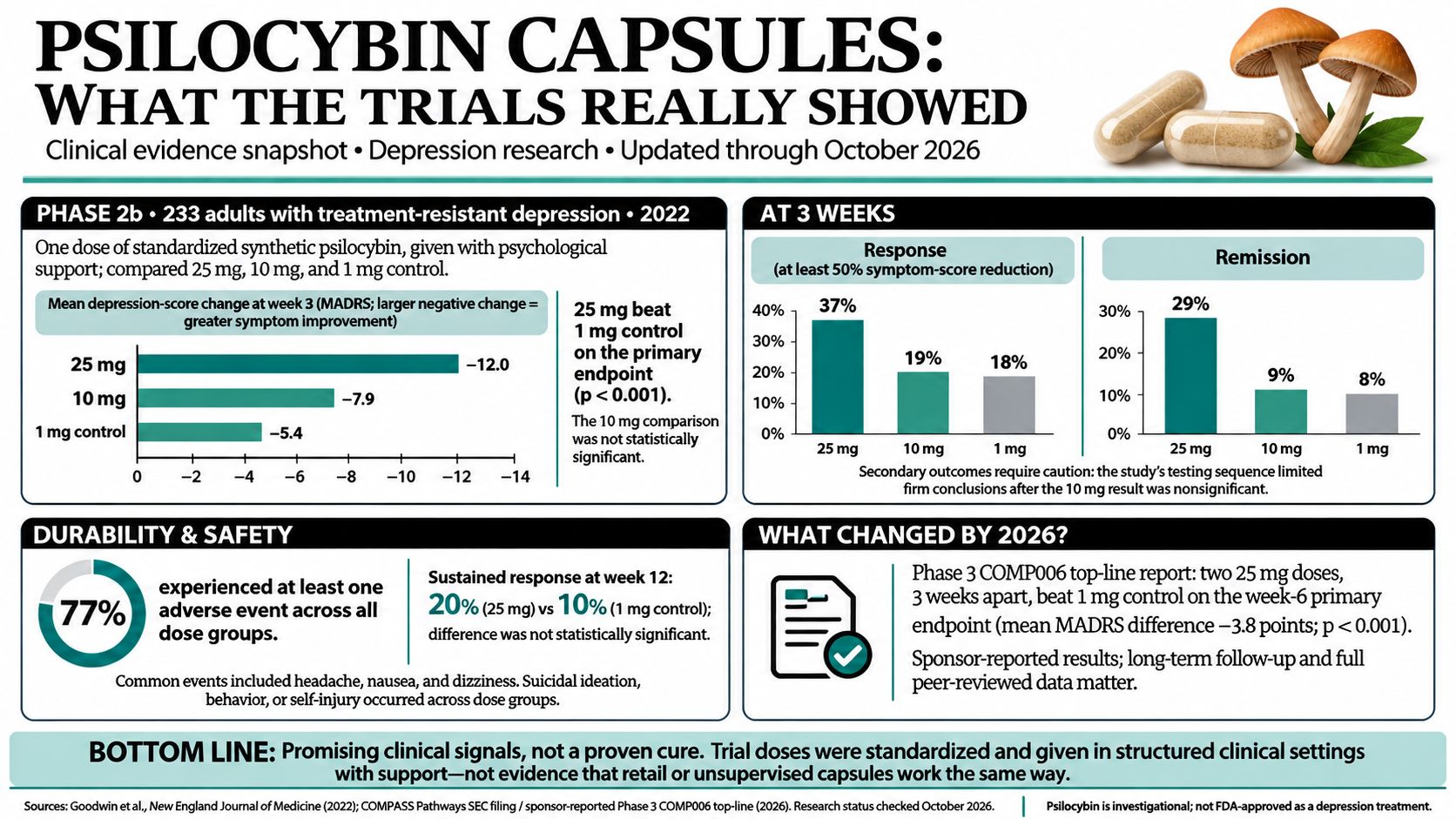
The dose and setting are part of the evidence
A randomized trial in treatment-resistant depression compared single oral doses of 25 mg, 10 mg, and 1 mg with psychological support: response rates at three weeks were 37%, 19%, and 18%, and remission rates were 29%, 9%, and 8%, respectively (phase 2 trial in treatment-resistant depression). The higher-dose group had better outcomes at that endpoint, but most participants in every group met neither threshold. A group-level benefit therefore leaves substantial uncertainty about any individual's outcome.
Supervision also limits how safety findings transfer. Clinical screening, trained support, and monitoring are part of the conditions under which researchers assess adverse events. An absence of serious events in supervised studies cannot establish the safety of unsupervised retail use.
Capsule count is not a potency measurement.
For psilocybin, the relevant comparison is a defined dose of the compound, not a mushroom-weight serving or a functional-mushroom composition claim. An unverified label leaves that comparison unresolved, even when the clinical evidence is promising. This guide to psilocybin research for depression provides further context for separating treatment research from expectations about retail products.
Reading the Label Like a Lab Report
A supplement label is a claim about identity and composition. It isn't independent proof that the capsule contains the stated species, the advertised compounds, or a consistent amount from batch to batch.
A 2025 report on functional mushroom products sold in Italy found that only 6 of 19 products contained the species stated on their labels. Nearly all contained contaminants, and one exceeded a European Commission limit. The expert analysis also warned that extraction ratios and beta-glucan percentages, common label selling points, may not reflect the bioactive compounds relevant to a product's effects (report on mushroom supplement quality and transparency). Those results concern products sold in Italy, so they shouldn't be treated as a direct estimate of the U.S. market. They do show why labels deserve scrutiny.
What to check before weighing the claims
- Species identity: Look for the Latin species name, not just a broad term such as “mushroom complex.”
- Mushroom part: Check whether the product uses fruiting body, mycelium, or both. These aren't interchangeable descriptions.
- Compound information: Distinguish beta-glucans from total polysaccharides. A total-polysaccharide figure doesn't, by itself, establish the amount of a specific active compound.
- Extraction details: Treat an extraction ratio as a description of processing, not proof of potency.
- Testing: Look for a certificate of analysis (CoA) that identifies the tested product or batch and reports identity and contaminant testing.
More milligrams don't necessarily mean more of the compounds relevant to a particular claim. A heavy capsule could contain material that hasn't been well characterized, while a smaller serving could be more clearly standardized. A CoA is most useful when it's specific to the product and batch, and when it reports what was tested rather than displaying a quality seal.
Read the evidence trail, not just the front label. If a product doesn't identify its mushroom or provide meaningful testing details, you can't confidently compare it with a clinical study.
For a practical explanation of what third-party testing can establish, consult this guide to third-party lab testing. Testing doesn't guarantee a benefit, but it can help answer the prior question: what's in the capsule?
A Framework for Choosing the Right Capsule
A capsule can have a credible label and still lack evidence for your goal. “Better focus” narrows the buying question, but it does not establish that a particular species, extract, or retail product has been tested for attention.
Match the purchase to the evidence
Use the evidence snapshot above for study doses and designs. The comparison below addresses a different question: how much confidence should each finding contribute to a purchase?
| Goal | Evidence anchor | Buying implication |
|---|---|---|
| Cognitive measures | Lion's mane trials involving cognitive impairment or difficulty | Consider whether the studied population resembles your situation before expecting the same benefit. |
| Focus or attention | Lion's mane pilot testing a single dose | Treat this as preliminary evidence, not an established daily-use recommendation. |
| Stress or sleep | No well-established species-specific dose in the evidence summarized here | A targeted promise has limited support; paying a premium does not resolve that uncertainty. |
| Immune support | Shiitake extract finding for circulating B-cell numbers | A measured immune marker does not establish broad protection against illness. |
| Endurance | Possible cordyceps signal in a meta-analysis of fungal supplementation | Evidence across supplements may not apply to the capsule being sold. |
Choose an outcome and look for a studied preparation that plausibly matches it. If none exists, treat the purchase as an uncertain experiment or defer it rather than substituting a “high strength” claim for evidence.
Compare value only after comparability
The cheapest bottle may offer poor value if its contents cannot be meaningfully compared with another product.
When comparing two certificates of analysis, check whether they report the same compound on the same basis. A beta-glucan result and a total-polysaccharide result cannot support a like-for-like price comparison. Neither can results for fruiting body and mycelium automatically establish equivalent preparations. Where comparable batch results and serving amounts are available, price per verified milligram of the measured compound can clarify cost. It does not measure clinical benefit.
The Magic Mushroom Delivery offers functional and psilocybin capsule products alongside educational material. Apply the same purchasing scrutiny to any retailer, while keeping those evidence categories separate: psilocybin research cannot substantiate a functional-mushroom benefit claim. Label trust is the first purchasing bottleneck; evidence that the identified preparation helps your chosen outcome remains a separate requirement.
Dosing, Stacking, and What to Expect
A noticeable first-day effect is a weak basis for judging a mushroom capsule. A lion's-mane pilot study reported a short-term Stroop-task result after a single dose, alongside reduced immediate word-recall accuracy. Those mixed findings offer little basis for promising dependable focus (trial details on lion's mane and cognitive vitality).
Dose comparisons also depend on preparation. The mass printed on a capsule label cannot establish equivalence between species, fruiting body and mycelium, or products reporting beta-glucans versus total polysaccharides. Increasing the serving cannot resolve uncertainty about what it contains.

Keep the experiment simple
Use one clearly defined outcome and a repeatable tracking routine. For example, record your usual attention-task performance or sleep measure before starting. During use, log the product, serving, timing, outcome, and changes in sleep or other supplements. Review the record weekly rather than treating an unusually good day as proof of benefit.
Choose an evaluation point before starting, informed by research on the matching preparation where available. At that point, compare the overall pattern with your baseline. If there is no discernible benefit, avoid escalating the dose or adding products to chase an effect. Stop the experiment if unwanted effects emerge.
Starting lion's mane, reishi, and other supplements together makes any change harder to attribute.
Functional capsules marketed for repeated use and psilocybin administered in supervised research sessions require separate interpretations. A clinical psilocybin dose cannot be translated into retail capsule counts without verified potency; the capsule format itself establishes neither safety nor benefit.
Even careful tracking cannot prove causation. It can help distinguish a sustained personal pattern from a dramatic first impression, but unclear contents remain a limit that a dosing diary cannot overcome.
Safety, Contraindications, and an Evidence-Based Checklist
Safety depends on both the capsule's contents and the person taking it. Functional-mushroom supplements and psilocybin products require separate assessments; sharing a capsule format doesn't make their risks interchangeable.
If you're pregnant or taking immunosuppressants, discuss any proposed mushroom product with a qualified clinician. For psilocybin, disclose SSRI use and any personal or family history of psychosis before considering use. These circumstances need individual assessment, rather than reassurance from general supplement claims. Bring the product information and your medication list.
Label trust is also a safety issue.
A certificate of analysis, or CoA, should cover contaminant testing, including heavy metals, yeast, and mold, and identify the relevant product or batch. A generic quality badge cannot establish what was tested. Species and preparation details help interpret evidence, but they don't replace contaminant results.
Use a safety-focused checklist:
- Testing: Does the CoA identify the product or batch, show a clear date, and report contaminant testing?
- Dose: Can a clinician assess the proposed serving alongside your medications, including SSRIs or immunosuppressants?
- Purpose: Are you seeking an effect that requires medical assessment rather than self-directed supplementation?
Keep expectations within the evidence. Mushroom beta-glucans haven't been shown to improve lipids or glycemic responses as oat and barley beta-glucans can. The dose-related findings in the phase 2 psilocybin trial concern supervised treatment-resistant depression research; they don't establish consumer-product safety or benefit.
A product may offer a specific benefit while still being unsuitable for an individual.
The Magic Mushroom Delivery offers functional and psilocybin products, including capsules, and educational information. Apply these safety checks when reviewing products at The Magic Mushroom Delivery; retail information cannot substitute for clinical assessment.