


For most healthy adults, lucid dreaming isn't dangerous, but sleep-disrupting induction methods and certain mental health conditions can make it risky. The advice to keep practicing until you can control your dreams misses an important limit: becoming lucid isn't worth losing restorative sleep or feeling less grounded while awake.
Lucidity means recognizing that you're dreaming while the dream continues. It doesn't guarantee control, and it doesn't make every dream pleasant. To answer “Can lucid dreaming be dangerous?” use a more useful test than whether you've managed to become lucid: examine your method, your dream experiences, and how you function afterward.
Who Faces Real Risk From Lucid Dreaming
Occasional, spontaneous lucid dreams aren't a known cause of lasting damage in otherwise healthy adults. The meaningful concerns involve disrupted sleep, distressing dreams, and vulnerabilities that make deliberate induction a poor fit.
Start by identifying which situation resembles yours. These evidence ratings are practical summaries, not a validated clinical scoring system.
Lucid dreaming risk areas at a glance
| Risk area | Most affected | Evidence strength | First response |
|---|---|---|---|
| Sleep disruption from induction | People using wake-back-to-bed or repeated alarms | Moderate, findings mixed | Drop repeated awakenings first |
| Lucid nightmares and distress | People with trauma or frequent nightmares | Moderate | Stop if dreams feel trapped or frightening |
| Sleep paralysis | People prone to paralysis, especially after induction | Limited | Avoid induction and see a clinician if it recurs |
| Reality confusion or dissociation | People with psychosis, bipolar risk or severe dissociation | Limited, precautionary | Avoid unsupervised induction |
| Spontaneous lucid dreams | Most healthy adults | Largely reassuring | No change needed |
The first row concerns something you deliberately do to your sleep. If an alarm-based routine leaves you exhausted, you don't need to establish whether lucidity itself caused the problem before dropping that routine.
The nightmare row concerns the experience rather than the technique. Knowing that you're dreaming doesn't cancel fear, particularly when you can't change what's happening. Paralysis and reality confusion deserve separate attention because feeling unable to move near waking isn't the same as struggling to distinguish dreams from waking life.
A pleasant dream isn't automatically evidence that the method used to produce it is healthy.
Place yourself on the scale by asking: How am I inducing lucidity? How do my dreams feel? Does my mental health history warrant clinical guidance? A spontaneous, enjoyable dream after uninterrupted sleep belongs in a different category from a frightening experience following repeated awakenings.
Why Sleep Disruption Matters More Than Lucidity
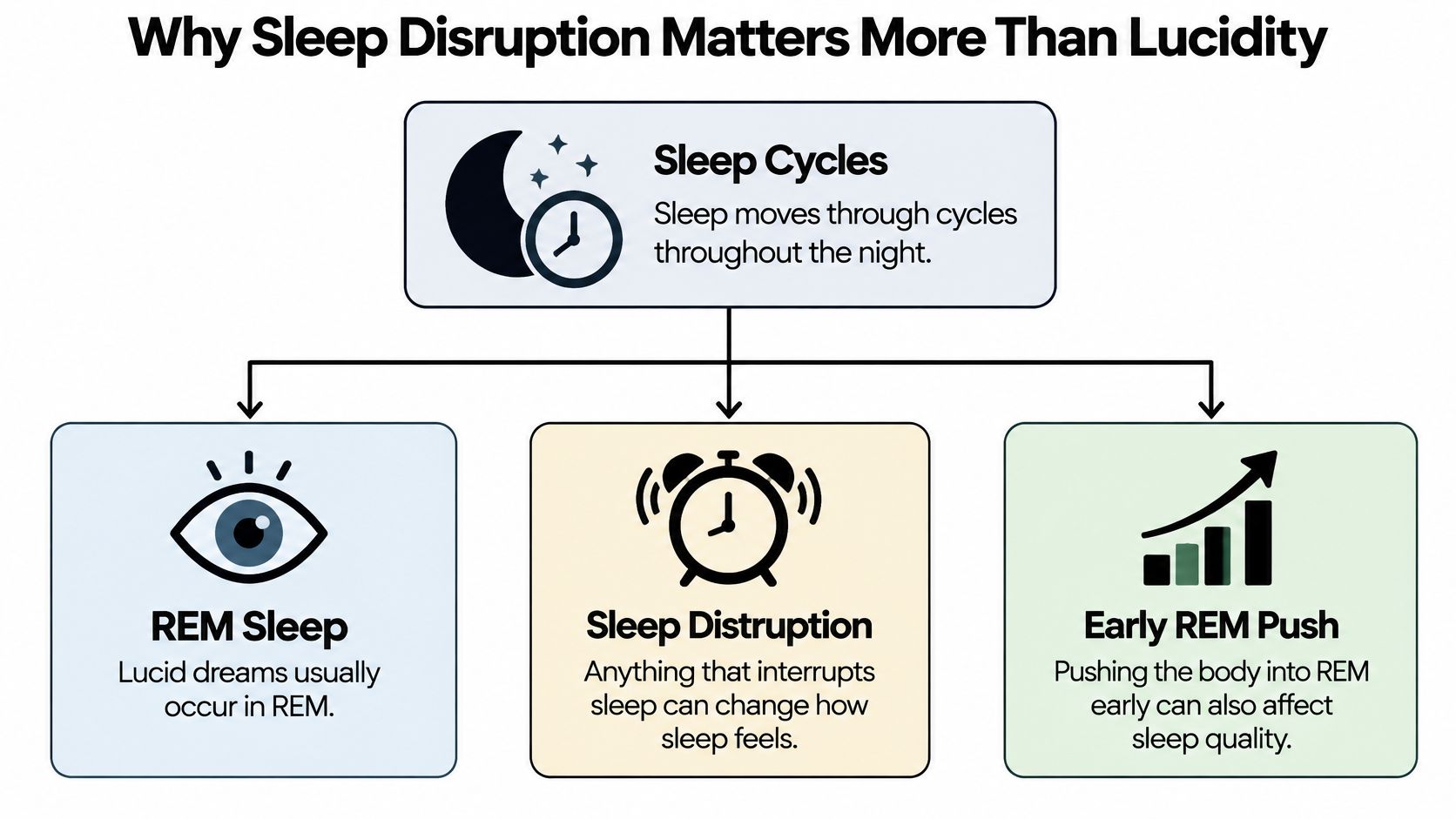
Sleep moves through cycles, and lucid dreams usually occur during rapid eye movement, or REM, sleep. Interrupting those cycles can change how rested you feel, even if you remember an exciting dream.
Wake-back-to-bed deliberately breaks sleep before you return to bed. Repeating that interruption can reduce sleep depth, shorten total sleep time, or alter the normal arrangement of REM periods. Trying to force a faster return to REM isn't a substitute for allowing a full night's sleep.
The distinction is easier to see when sleep continuity comes first.
Compare methods by what they interrupt
These rankings describe the potential burden on sleep, not measured probabilities of harm. A technique's name matters less than whether it keeps you awake.
Induction methods and their sleep impact
| Method | How it works | Sleep impact | Risk level |
|---|---|---|---|
| Spontaneous lucid dreams | Occur during normal REM sleep | None added | Low |
| Reality checks | Brief checks during the day | None when limited to daytime | Low |
| MILD | Intention set before sleep | Minor if you don't wake or prolong bedtime effort | Low to moderate |
| Wake-back-to-bed | Wake during the night, then return to sleep | Fragments sleep and may alter REM patterns | Moderate to high |
| Repeated nighttime alarms | Several wakings across the night | Repeated fragmentation | High |
| Prolonged wakefulness | Stay awake while trying to enter a dream consciously | Sleep loss and next-day impairment | High |
A review of lucid-dreaming concerns warns that training methods may matter more than occasional lucidity, citing an observational study of 1,824 participants that linked lucid-dream frequency with poorer sleep quality, alongside an online study of 489 respondents that found no association with poorer sleep quality, dissociation, or reduced mental well-being. Those conflicting results don't support a simple claim that lucid dreams damage sleep.
They do support taking sleep disruption seriously. Repeatedly interrupted sleep can affect alertness, memory, stress regulation, and cardiometabolic health, regardless of whether the intended dream occurs.
Don't turn a disappointing night into a more complicated experiment involving additional alarms or supplements. If you're comparing sleep-related supplements, treat the 5-hydroxytryptophan versus L-tryptophan guide as background reading, not a reason to self-prescribe a solution to induction-related sleep loss.
Avoid methods that require repeated alarms or prolonged wakefulness, especially when insomnia or daytime impairment appears.
Lucid Dreams Versus Lucid Nightmares
A link between lucid dreaming and poor sleep doesn't establish that lucidity caused the poor sleep. Nightmares may explain much of that relationship.
The contrast isn't just vivid versus ordinary dreaming. It's whether awareness comes with comfort or distress.

A 2025 study in Behavioral Sleep Medicine found that lucid dreaming statistically predicted poorer sleep quality, stress, anxiety, and depressive symptoms, but nightmares explained the sleep, stress, and anxiety associations; nightmares together with lucid dreaming were linked with depressive symptoms. Earlier work also found that the lucid-dream frequency and poor-sleep relationship disappeared after accounting for nightmare frequency, while another study found no reduction in morning refreshment after lucid dreams compared with non-lucid dreams.
Look for the source of distress
Think of a smoke alarm sounding because something is burning in the kitchen. Blaming the alarm without checking the kitchen confuses the signal with the source.
Apply that distinction to your nights:
- Neutral or pleasant content: Occasional lucidity without sleep loss is less concerning.
- Recurring frightening content: Examine nightmare frequency and emotional distress rather than counting lucid dreams.
- Effortful induction: Notice whether bedtime pressure or nighttime awakenings preceded the problem.
For an additional introduction to the experience, watch with that distinction in mind.
Correlation isn't causation, but distress still deserves action. Persistent nightmares, worsening anxiety, or impaired daytime functioning justify pausing induction and seeking professional advice, even when the precise cause remains uncertain.
When Reality Boundaries Blur During Dreams
You recognize the hallway as a dream. You try to fly away, but the scene won't change; you try to wake, yet the dream continues. When you finally awaken, your heart is racing.
That scenario illustrates awareness without control, not permanent entrapment. In its reporting on potential lucid-dreaming harms, BBC Future describes research in veterans with PTSD in which lucid nightmares commonly involved anxiety, feeling trapped, and failed attempts to change the dream or awaken.
Awareness doesn't guarantee an exit
Lucid dreaming and sleep paralysis can overlap with dissociative REM experiences. Auditory or visual hallucination-like phenomena can occur around these states, but that doesn't establish that lucid dreaming causes psychosis.
The important distinction is what happens after you're fully awake. Brief dream-related uncertainty isn't equivalent to persistent difficulty identifying waking reality.
Stop signal: Continuing derealization, panic, insomnia, or confusion is a reason to stop induction and consult a clinician.
Derealization means that your surroundings feel unreal or strangely distant. You don't need to decide whether that sensation meets a diagnostic definition before asking for help.
Respond without escalating the struggle
If a dream feels trapped, try disengaging rather than repeatedly fighting the scene. You can gently focus on a finger or toe movement, steady breathing, or opening your eyes; these are coping attempts, not guaranteed wake-up switches.
Avoid forcing your breathing or treating a failed attempt as evidence that you're stuck. Once awake, orient yourself to your room and ordinary surroundings before deciding whether to return to sleep.
If the trapped feeling recurs, stop deliberate induction entirely rather than practicing harder to gain control.
Who Should Avoid Induction and When to Stop
People with schizophrenia-spectrum disorders or psychosis, bipolar disorder during mania, severe dissociation, trauma-related nightmares, or recurrent sleep paralysis should avoid unsupervised deliberate induction. This is a precautionary recommendation, not proof that lucid dreaming causes psychiatric illness.
For example, someone experiencing mania might begin late-night induction sessions to pursue creativity. The useful response isn't to optimize the technique. It's to pause and contact their care team, especially if sleep is shrinking while energy or agitation increases.
An online study of lucid-dreaming experiences found that most respondents reported positive experiences, but approximately 10% of lucid dreams were negatively toned, and the authors emphasized the need for longitudinal work to establish causality. Reassuring averages don't remove the need to respond to an individual's symptoms.
Act on the symptom, not the dream count
Confusion about waking reality, manic symptoms, or hallucinations while fully awake need prompt professional help. If you can't stay safe, seek emergency assistance rather than waiting for a routine appointment.
Warning signs, possible meaning and action
| Warning sign | What it may signal | Action |
|---|---|---|
| Recurrent sleep paralysis | Sleep paralysis, possibly triggered by induction | Stop induction and see a clinician |
| Cannot tell dream from waking reality | Reality-monitoring problem | Stop and seek prompt help |
| Persistent derealization or panic | Dissociation or anxiety | Stop the practice and consult a clinician |
| Manic symptoms or psychosis history | Risk of mood or psychotic relapse | Avoid induction and contact the care team |
| Nightmares most nights for weeks | Sleep disturbance or trauma-related content | Pause induction and review with a clinician |
| Daytime sleepiness or insomnia | Sleep loss from disruptive methods | Stop sleep-disrupting methods first |
Review what happens afterward
Check for these signs after an attempt and again during the following day. Record symptoms plainly rather than explaining them away as progress.
- For sleepiness or insomnia: Remove disruptive methods immediately and watch whether normal sleep restores your daytime functioning.
- For persistent or combined symptoms: Contact a clinician rather than waiting for a particular symptom count.
- For frightening recurrence: Don't add herbs, supplements, or stronger stimulation to overcome it.
A student who develops daytime sleepiness and paralysis after nightly wake-back-to-bed should stop that method first and arrange medical review if paralysis continues. They shouldn't assume exhaustion is a necessary stage of learning.
The lucid-dream herbs guide can inform questions about additional substances, but it isn't a substitute for medication and supplement review. If any of these vulnerabilities apply to you, talk with your clinician before trying an induction technique.
Lower-Risk Ways to Explore Lucid Dreaming
Begin with practices that fit around sleep rather than interrupting it. Lower intensity doesn't guarantee a lucid dream, but it gives you a clearer way to notice whether exploration is affecting your rest.
These options keep the emphasis on observation and intention.

Start without waking yourself
- Daytime reality checks: Briefly observe your surroundings and confirm where you are. Keep this bounded and ordinary; stop if it encourages obsessive doubt or distress.
- Morning dream journal: Write after your usual waking time. Don't set an alarm just to capture dream details.
- Bedtime intention: Use a gentle, MILD-style intention to recognize a future dream, then let yourself fall asleep. Drop the exercise if concentration keeps you awake.
Keep journal entries practical: record hours slept, dream tone, and next-day alertness. A longer dream description is optional; evidence that you're functioning well matters more than elaborate recall.
Treat cue-based tools as experiments
In a 2024 experiment described by Northwestern Medicine, involving 120 app users, 17% experienced a lucid dream on the first night after a targeted sound cue, compared with 5% of controls on the second night. Those differently timed results shouldn't be treated as a simple same-night comparison or proof of long-term safety.
Cue-based approaches may offer an alternative to repeated intentional awakenings, but induction success doesn't establish preserved sleep quality. Use the lucid-dream app guide to consider settings and warning signs, not to justify increasing stimulation when sleep deteriorates.
Practice like a musician using short sessions, not someone rehearsing through the night before an important day.
Change only one part of your routine at a time, avoid sleep deprivation, and take a rest night after a distressing dream. Gentle methods are the baseline, not a hurdle you need to outgrow.
Decide Whether Lucid Dreaming Is Worth the Risk
Continue deliberate exploration only when your method is gentle, your sleep remains restorative, you feel safe during and after dreams, and you don't have a vulnerability that calls for clinical guidance. Enjoyment alone isn't enough if the following day brings exhaustion or confusion.
If any part of that test fails, pause induction and return to your normal sleep routine before deciding whether to try again. Don't use a waiting period to postpone help for reality confusion, manic symptoms, or other serious warning signs.
Make the pause informative
A pause isn't failure. You can still enjoy a spontaneous lucid dream without turning bedtime into a performance task or attempting to reproduce the experience.
Use your journal to compare ordinary nights with induction nights. Look for concrete differences in sleep continuity, emotional tone, and your ability to work, study, drive, and interact normally.
- If problems resolve: Consider whether returning to deliberate induction offers enough benefit to justify another trial.
- If problems persist: Book a clinician appointment and bring your notes about sleep duration, dream tone, and daytime symptoms.
- If symptoms feel urgent: Seek prompt care rather than collecting more journal entries.
The most useful decision isn't whether lucid dreaming is universally safe or dangerous. It's whether your particular approach leaves you rested, comfortable, and grounded.
Protect your sleep and waking stability first; lucidity is optional.
The Magic Mushroom Delivery offers educational guides on lucid-dreaming apps, herbs, and responsible use, alongside mushroom products for adults. Visit The Magic Mushroom Delivery to explore those resources and prepare informed questions for your healthcare provider, without assuming a product is necessary or proven to make lucid dreaming safer.