

You're checking out online, the product is restricted to adults, and a small box asks you to confirm your age. It takes a second to click, but it doesn't establish who you are or whether you meet the threshold. For a retailer, the challenge is building a check that's reliable without collecting more personal information than the sale requires.
The practical answer to how to verify age is to set the threshold, choose evidence that fits the risk, and give the retailer only the eligibility result. A customer may need to prove they're 21 or older, but that doesn't mean the retailer needs to keep a full birth date or a copy of their ID.
Choose an Age Check Method for Your Risk Level
An age gate that asks for a full birth date, a selfie and a billing address collects far more than the sale depends on: whether the customer clears 21. The retailer needs a yes or no answer at the threshold. The method you choose should produce that answer with the least identity data the risk allows. A checkbox records a claim. Verification requires evidence that the claim is true.
| Method | What It Proves | Customer Friction | Best Use |
|---|---|---|---|
| Self-declared date of birth or checkbox | Customer's claim only, no evidence | Very low | Initial screen, never sufficient alone for 21+ |
| Card or bank account check | Holder has a payment account; adulthood isn't guaranteed | Low | Secondary signal alongside another check |
| Photo ID match with selfie and liveness | Document is genuine and matches the person presenting it | Medium to high | Primary check for 21+ purchases |
| Digital ID or reusable age token | Trusted source confirms over-21 status without sharing birth date | Low to medium | Returning customers and privacy-first flows |
| Facial age estimation | Estimated age with an error margin of several years near thresholds | Low | Supporting signal with a document check or appeal path |
Self-declaration remains common because it is cheap and low friction. Treat it as an initial screen, not the 21+ decision. A card or bank check can add evidence that a customer has access to a payment account. It does not necessarily prove the account holder is an adult, so use it as a supporting signal, not a stand-alone check.
Photo ID matching gives stronger evidence when the document is validated and matched to the person presenting it. Digital ID or a reusable age token can be more privacy-preserving, provided a trusted source has verified the age claim and returns only the result. Facial estimation is convenient, but near the threshold it produces an estimate with an error margin rather than a precise birthday. Pair it with a document check or a clear appeal path.
Decision rule: Choose the least intrusive combination that meets the risk. For a first-time customer buying a restricted product, a strong document or trusted identity check may be appropriate. A returning customer whose account already carries a verified result may need a lighter confirmation, tied to the current order.
A payment card alone proves a payment method, not adulthood. Use a second signal only when it adds real evidence, not as a box-ticking exercise. If delivery eligibility depends on where the order is going, build that check into the same flow with an address verification system.
How to Build a 21+ Check Step by Step
Put the age question before the rest of checkout. A customer shouldn't have to enter a name, address, and payment details before learning whether they can proceed.
Ask a yes-or-no question first. Ask, “Are you 21 or older?” before requesting names, addresses, or payment details. Collecting those details first creates records you may not need; putting the age gate after checkout is a common sequencing mistake.
Collect the threshold result, not a full birth date. If the decision is whether the customer is at least 21, a yes-or-no eligibility result is generally more useful to the retailer than the exact date of birth. A common slip is asking for extra personal details just because the form can.
Check an authoritative document. Request a driver's licence or passport, then validate that it's genuine, current, internally consistent, and associated with the person presenting it. Compare the barcode with the printed information and check the expiry date. A picture of an ID isn't enough by itself if nobody checks those features.
Match the person to the document where appropriate. A selfie and liveness check can help confirm that the person presenting the document is the person shown on it. Send unclear results to manual review rather than rejecting every imperfect image. Skipping liveness controls can leave the process open to screenshots or other still images.
Return and bind only the result. Send the retailer an eligibility outcome, then bind a successful check to the account, session, and order. Otherwise, a customer might use the back button to reset the gate and try another age.
Add a handoff check for higher-risk orders. At delivery, have the courier check the recipient's ID against the order's passed verification result, release the parcel only to that verified adult, and log the outcome without copying the ID.
The Federal Trade Commission advises that a neutral age screen should come before collecting personal information from a visitor. A question that merely tests whether someone knows an answer isn't enough to establish age, since a child may guess or find the answer; the flow needs an appropriate age-screening mechanism (FTC guidance on complying with COPPA).
For a U.S. delivery retailer, a concrete sequence is ID verification first, then item and payment selection, then shipping, with a tracking number and estimated arrival time provided. The passed check should leave a compact record: a verification token, a timestamp, and a pass result, not an image of the ID.
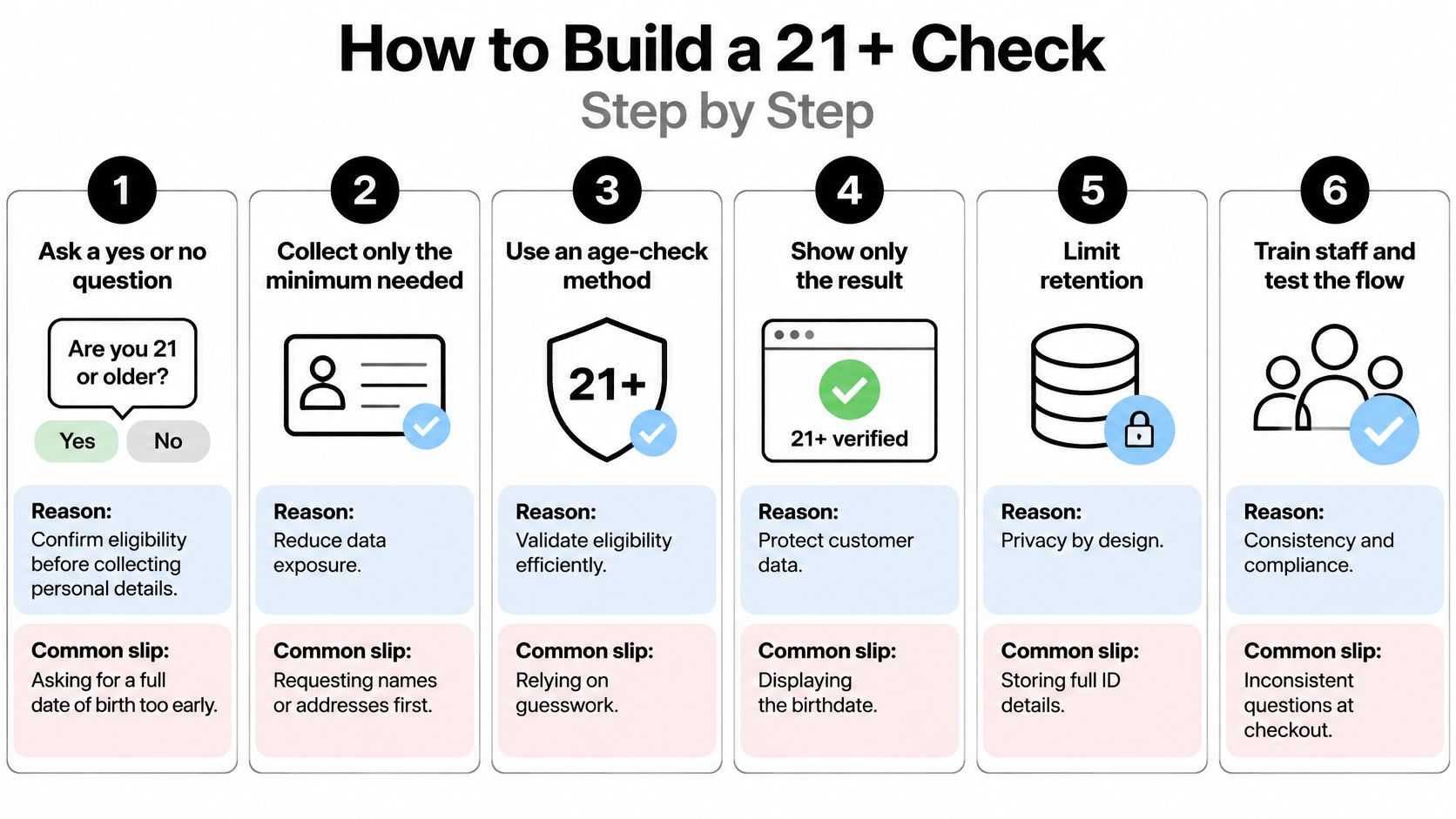
The sequence matters because each step should answer one operational question: may this customer proceed, does the evidence support that answer, and will the result stay attached to the right order? For more on the handoff itself, review practical considerations for discreet shipping.
Protect Customer Data During the Check
The retailer usually needs to know one thing: does this customer meet the age threshold? A full birth date or stored ID image may reveal more than the transaction needs. NIST describes age attributes that can assert whether someone is over a specified age without sharing the complete birth date, supporting a simple “21 or older: yes or no” result (NIST's digital identity guidance on evidence and identity validation).
Age-assurance systems also create privacy risks. The European Data Protection Board identifies concerns including identification, location, profiling, tracking, and discrimination, and recommends disclosing only whether a person meets the threshold while avoiding unnecessary retention (the EDPB's statement on age assurance). Design for that outcome: don't use the age check to build customer profiles, retain location data that isn't needed for the transaction, or expose the result to more staff or vendors than necessary.
Set a retention policy you can verify
Use written rules that your vendor arrangement and system logs can support:
- Keep a verification token and audit event instead of raw ID images whenever possible.
- Encrypt information you must retain, and restrict access to staff who need it.
- Delete raw documents immediately after the result is returned if your process and vendor setup permit that.
- Set a short, fixed window for failed-attempt logs, such as 30 days, and delete them when that window ends.
- Record the vendor and its retention period so you know who processes the check and what happens to the data.
A sample policy could say: the token stays for the life of the account; raw documents are deleted immediately after the result; failed-attempt logs are kept for a fixed short window. Publish a plain-language statement such as, “ID is used only to confirm you are 21 or older, and it is not stored or shared,” only if the vendor contract and deletion logs make that statement true.
That's also the standard The Magic Mushroom Delivery states for its age check: ID verification is used only to confirm customers are 21 or older, and the ID isn't stored or shared. A clear delivery and privacy process helps customers understand how the transaction is handled, but the actual statement should always match the retailer's practice.
Collecting more personal data doesn't automatically make a check safer. If a retailer keeps ID images it doesn't need, a breach can expose customers to harm without showing that the retailer needed the full document in the first place.
Test Accuracy Before Customers See It
A check that works in a clean vendor demonstration can still fail when customers use older phones, take a photo under poor lighting, or upload a cropped document. Before launch, compare at least two independently evaluated methods, such as photo ID matching and a digital identity, banking-based check, or facial age estimation. Choose the least intrusive combination that meets the risk, rather than relying only on a vendor's general accuracy claim. Ofcom's guidance emphasizes test performance and notes that some facial age-estimation methods have an error margin of several years near age thresholds (Ofcom's guidance on age checks).
Measure whether the check rejects people who shouldn't pass, accepts eligible adults, and works quickly enough to avoid needless abandonment. Record:
- False-accept rate: how often an under-21 user passes.
- False-reject rate: how often an eligible adult fails.
- Completion rate and latency: how many customers finish and how long the check takes.
- Subgroup performance: results across document types, geography, and lighting conditions.
Test realistic failures, not just neat sample images. Use genuine documents from several states, poor lighting, glare, cropped photos, spoofed screenshots, shared accounts, repeat attempts from one device, and weak connectivity. For facial estimation, focus tests near the 21 threshold: a system that performs well across a broad adult age range may still be wrong where the decision matters most.
A practical test is one that tries to break the whole customer journey, not just the document scanner.
Before launch:
- Test each method alone and in combination. A second signal may catch failures the primary check misses.
- Record results by subgroup. A strong overall result can hide uneven outcomes.
- Set the threshold and appeal route from your own test results. Don't let a vendor's headline claim determine how close calls are handled.
If an adult gets a result they believe is wrong, offer a clear path to document review or another suitable check. Don't make facial estimation the only route when its uncertainty near the threshold can block an eligible customer.
Fix Failed or Stuck Age Checks
An adult's ID gets rejected at the scan step, and they're left wondering whether the problem is the document or the person. Often the issue is the photo: glare obscures details, the frame crops an edge, or the card has expired. Make the first retry specific and actionable.
| Symptom | Likely Cause | Fix |
|---|---|---|
| Adult's ID rejected at the scan step | Glare, cropped edges, or expired document | Request a flat photo with all four corners visible and offer a guided retry |
| Facial estimate blocks an adult near 21 | Error margin at the threshold | Route to a document check or manual review with an appeal path |
| Customer goes back and changes the age | Gate not bound to the session | Lock the eligibility result to the session and order |
| Card accepted but adulthood unclear | Card doesn't confirm the holder is an adult | Add a document or digital ID check as the second signal |
| High drop-off at the upload step | Webcam capture or slow connection | Allow phone camera upload and save progress between attempts |
For scan failures, show customers how to flatten the document, avoid glare, and keep all four corners inside the frame. Offer a guided retry, and let them upload from a phone camera if a webcam is unreliable. These are often same-day changes to instructions or checkout settings; an expired document, by contrast, needs a valid replacement.
If a facial estimate blocks an adult close to the threshold, don't keep asking for another selfie. Route the customer to a document check or manual review, and provide an appeal path. Changing the system's threshold or replacing a primary method may require a vendor or policy change, rather than a quick checkout edit.
A card-only pass also needs a second check if adulthood remains uncertain. And when a customer can return to the gate and change the age, bind the result to the active session and order rather than letting the back button restart the decision.
Set a retry limit and a clear escalation route. Repeated attempts shouldn't become a way to guess the age threshold or cycle through different details until one passes. If a customer remains stuck, direct them to a staffed support channel, such as the retailer's customer support options, rather than leaving them in an endless retry loop.
Confirm Your Age Check Before You Launch
Choose one primary check and one secondary signal based on the risk of the sale and the experience your customers can reasonably complete. Write down what “21+” means in your workflow, how long each record is retained, how a customer can appeal a failed result, and whether delivery requires a second check. If those choices aren't clear to staff, they won't be clear to customers either.
Before opening the flow to customers, confirm each item:
- Method tested: the primary check and any supporting signal have been tested together.
- Result bound: a successful result is attached to the session and order.
- Raw ID not stored: retention settings match the privacy statement.
- Failure route defined: customers know when to retry and when to request review.
- Vendor disclosed: the privacy notice explains who processes the check.
- Delivery rule decided: staff or couriers know what to confirm at handoff.
Check the adult-sale and privacy rules that apply where you sell. COPPA sets an under-13 threshold for children's privacy obligations; it doesn't set the standard for a 21+ adult purchase. The FTC explains that the rule covers child-directed services that collect personal information and general-audience services with actual knowledge that they're collecting it from a child under 13. Asking for and receiving age information can create that knowledge, but the rule doesn't generally require a general-audience service to investigate every user's age (FTC guidance on COPPA and general-audience services).
For a retail team, a staff-first rollout is the most useful final check. Run the flow on staff accounts for a week, review pass and fail results by subgroup, fix the confusing screens and escalation steps, and only then open it to customers.
The Magic Mushroom Delivery offers adult customers a 21+ ordering process that begins with ID verification and includes tracked delivery. Visit The Magic Mushroom Delivery to learn about its ordering and age-check process.