

You're at home, waiting for a sensitive order. A delivery alert appears on your phone, and your first thought isn't only whether the parcel will arrive on time. You're wondering whether a neighbor, roommate, family member, or delivery driver will be able to guess what's inside.
That concern explains why discreet shipping has expanded beyond a niche service for adult products. Brands in wellness, beauty, healthcare, luxury goods, and subscription commerce increasingly treat privacy as part of the fulfillment experience. In major markets, plain packaging also has a security role. Package theft affected 58 million Americans in 2024, with approximately $12 billion in losses, according to industry commentary on discreet shipping and delivery privacy.
What Discreet Shipping Actually Means
Discreet shipping is a complete set of privacy practices, not a special type of box. The retailer tries to prevent people who handle, scan, deliver, or briefly see a parcel from inferring its contents, sender, or purpose.
That usually means a plain box or mailer, a neutral return address, limited sender information, and no product names or category-specific branding on the outside. The privacy standard should also extend to tracking messages, billing descriptors, packing slips, and delivery arrangements. A package can look anonymous while a notification still displays a revealing retailer name.
The working definition
Think of discreet shipping as a privacy screen placed across the whole order journey. The outer packaging is the most visible layer, but it's only one layer.
A retailer using this approach may provide:
- Plain outer packaging: An unbranded box or mailer that doesn't display logos, product images, or category language.
- Neutral labeling: A generic sender name or abbreviated business name, with a return address that doesn't identify a specialty store.
- Minimal paperwork: An invoice or packing slip that avoids sensitive product terms, or a digital receipt sent separately.
- Careful tracking language: Updates that identify movement and delivery without naming the product.
- Controlled delivery choices: Options such as a PO box, hold-at-location pickup, locker delivery, or signature service.
The outside of a parcel is a privacy boundary. By 2018, major carriers were explicitly acknowledging that they couldn't be responsible for private information placed on the exterior of packages, including shipping-label content, as reflected in UPS legal and privacy terms. That makes label design a practical safeguard, not a decorative detail.
What discreet shipping can't promise
Discreet shipping doesn't make an order invisible. Carriers still need accurate information for routing, delivery, customs, and compliance. It also doesn't bypass age checks, signature requirements, prohibited-item rules, or address verification.
If you're comparing retailers, review their information about where to get shrooms online alongside their shipping policy. Look for an explanation of the box, label, tracking, and handoff process. A trustworthy promise should describe what the retailer controls and what still depends on your carrier and delivery setting.
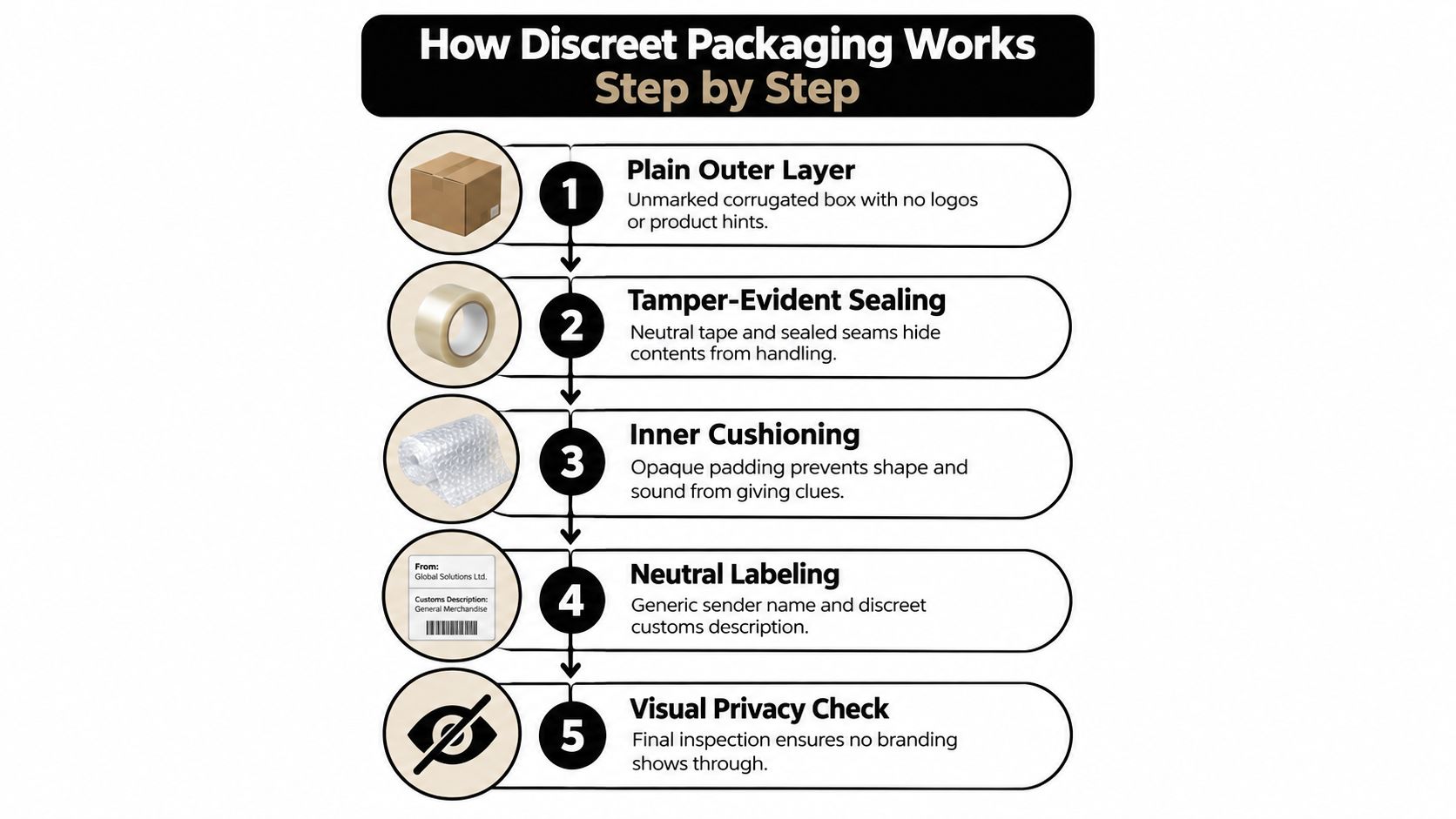
How Discreet Packaging Works Step by Step
A plain brown box offers a useful analogy. Each layer removes another clue, so a person seeing or handling the parcel has less information to interpret.
Start with the outer layer
The first step is a plain corrugated box or unmarked mailer. It shouldn't show retail branding, product photography, category terms, or a distinctive design that identifies the store. Neutral brown, white, or black materials can work, provided the exterior doesn't offer visual hints.
The goal isn't to make the parcel look suspiciously secret. It's to make it look ordinary enough that an observer can't distinguish it from routine household or office mail.
Remove clues from the label
The label should use only the information needed for delivery. A generic sender name, abbreviated business name, or neutral fulfillment address is less revealing than a descriptive brand name that identifies a product category.
The return address still needs to support carrier requirements and returns handling. Discretion means reducing unnecessary information, not omitting required information.
Hide shape, color, and sound
Inner protection matters when the product's shape or packaging could provide a clue. An opaque sleeve, black poly bag, sealed pouch, or plain paper wrap can block color and form. Cushioning also prevents movement and noise from making the contents obvious during sorting or delivery.
A retailer should inspect the parcel from different angles, not just from the top. Tape, seams, and gaps can reveal more than the box itself if inner materials show through.
Repack combined orders
Several products shipped in their original retail boxes may create an accidental clue through package size, shape, or movement. Repacking multiple items into one neutral carton helps prevent the outside dimensions from suggesting a quantity or product combination.
The carton still needs adequate protection. A smaller, well-fitted box often supports both privacy and material efficiency better than excessive empty space.
Keep the inside paperwork neutral
Void fill, tissue, and sealing tape should also be unbranded. Packing slips and invoices deserve the same review as the label. Sensitive keywords can expose the order if a roommate opens the parcel, a building employee handles it, or a return is processed.
Some retailers omit printed invoices, while others provide them digitally. The practical test is simple: nothing visible during ordinary handling should identify the category or purpose of the purchase.
For a visual walkthrough of the process, this discreet shipping video can reinforce how the separate layers work together.
Privacy Risks Beyond the Box
A parcel can leave the warehouse in a plain carton and still reveal information through its data trail. Privacy weak points often appear in systems people don't physically see, including notifications, tracking pages, customs records, and shared household devices.
Four common leak points
| Leak Point | What Gets Exposed | How It Happens |
|---|---|---|
| Shipping label | Sender identity, return location, or product category | A descriptive DBA name or overly detailed label text appears on the exterior |
| Customs paperwork | Item description and shipment details | International documentation uses product-specific language |
| Tracking updates | Retailer name, status, delivery window, or package details | Carrier apps, SMS messages, and emails display more information than the box |
| Household handoff | The existence and timing of the order | Shared inboxes, doorbell cameras, visible deliveries, or another person receiving the parcel |
The label deserves special attention because multiple parties can see it during transit. Logistics guidance recommends that the exterior reveal neither contents nor branding, using a neutral return address and minimal label data as core privacy controls, as described in guidance on discreet packaging for customers.
Tracking can undo the packaging
A carrier notification might show the shipper's full name, a recognizable fulfillment location, or a package description. Even when the message doesn't name the product, a retailer-specific sender line can tell a shared-account user what kind of order is arriving.
Customers should review notification settings before placing an order. Use a private email account where appropriate, disable unnecessary lock-screen previews, and check whether the carrier app displays item names, images, weight, or sender information.
Practical rule: Treat every screen connected to the order as part of the package exterior.
Carrier employees need operational data to sort and route parcels. That doesn't mean every internal record is visible to the public, but it does mean privacy depends on limiting unnecessary exposure wherever the retailer has control. A strong workflow uses generic language in labels, customs descriptions where permitted, tracking updates, and customer communications, as outlined in end-to-end discreet shipping guidance.
Tracking, Delivery Windows, and the Full Fulfillment Chain
Privacy begins before the warehouse seals the carton. At checkout, the billing descriptor, confirmation email, account name, and delivery address can all create exposure if other people share access to the customer's devices or accounts.
Follow the parcel's path
The warehouse pick-and-pack stage should separate product handling from outward-facing branding. Staff select the items, use plain materials, and check the final parcel for visible clues before applying a label.
The retailer then chooses how the sender appears. A neutral return address can protect privacy better than a recognizable brand name, while still giving the carrier a usable location for returns and routing.
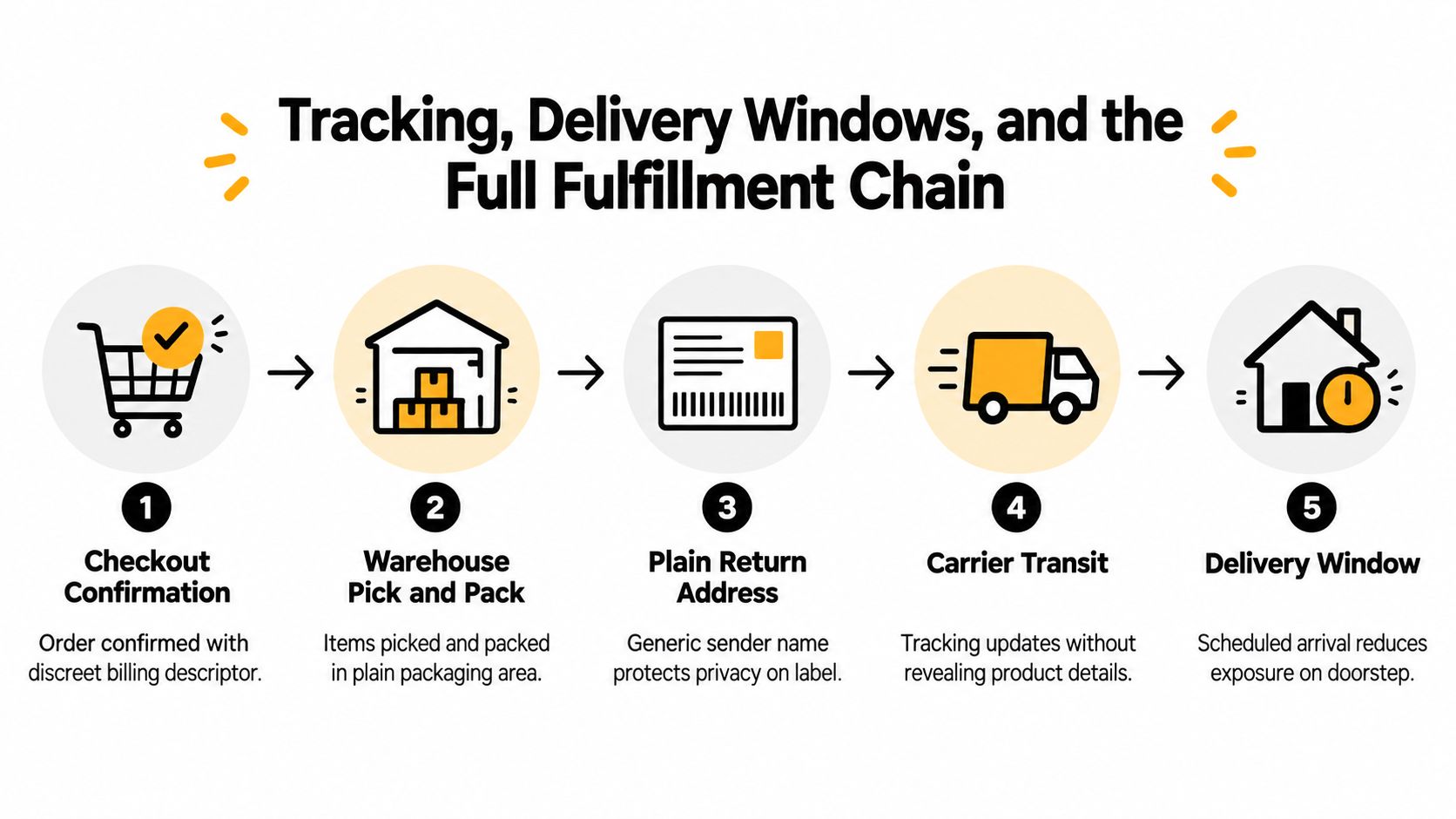
Tracking updates may reveal origin cities, carrier hubs, delivery attempts, or timing information. Those details help customers manage an order, but they should avoid product-specific wording. Customers can also choose a private email address, turn off detailed previews, and avoid linking sensitive orders to shared household accounts.
Control the final arrival
Delivery timing changes who can see the parcel. A scheduled window, workplace address, trusted pickup point, or secure locker can reduce the chance that a roommate or neighbor encounters the package first. Hold-at-location services and PO boxes can also limit home-address exposure, depending on the carrier and shipment type.
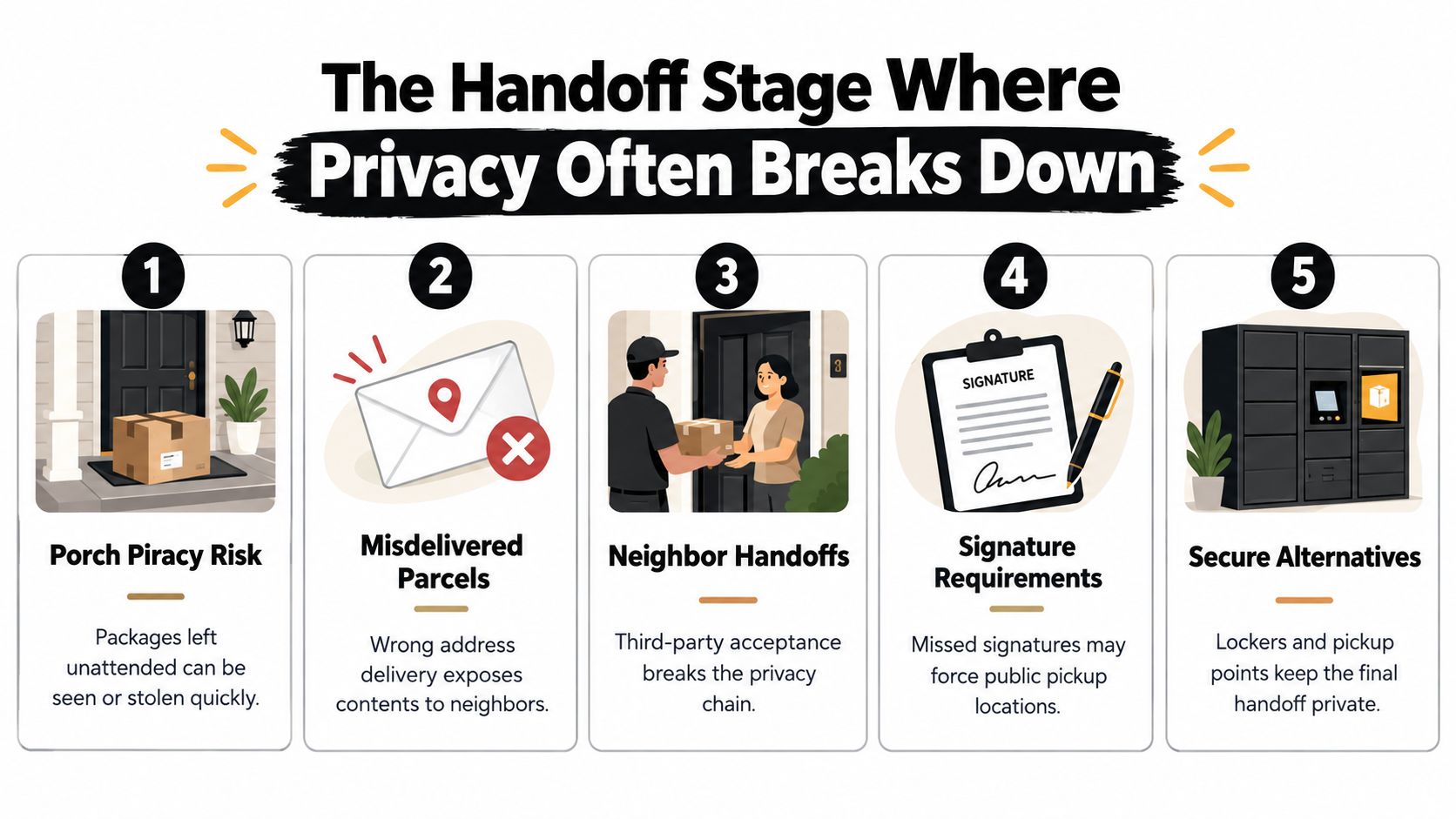
Signature requirements create a different tradeoff. They prevent an unattended drop-off, but a missed signature may lead to another attempt or a public pickup visit. The right choice depends on whether the bigger concern is porch visibility, household access, or convenience.
Carrier services offer useful controls. Royal Mail's delivery options include end-to-end tracking, customer notifications, optional Age and ID verification, signature availability, and photo on delivery for selected shipments. For customers using The Magic Mushroom Delivery, the retailer's shipping and tracking information should be read together with the carrier's own delivery controls.
A discreet order succeeds only when checkout, fulfillment, tracking, timing, and handoff support the same privacy goal.
How Age Verification Fits Into Discreet Shipping
Age verification can feel like the point where privacy disappears, but the process serves a different purpose. The carrier must confirm that an eligible adult receives the shipment, while the retailer and carrier should limit the personal information exposed or retained.
The exact process depends on the service and country. A buyer may need to show photo identification, confirm age, match the recipient name, and sign on a handheld device. An adult signature requirement can also affect whether a roommate or another adult at the address may accept the parcel.
Carrier comparison
| Carrier | ID Required | Data Stored | Decline Policy |
|---|---|---|---|
| FedEx | ID scanning can verify age; manual age verification may apply | FedEx states that its electronic process stores the recipient's name but not extra information such as a driver's license number, birth date, or home address | If scanning is declined, the driver manually verifies age by date of birth and records the first initial and last name |
| USPS | Photo identification is required for Adult Signature Required service | USPS provides tracking and can provide a Proof of Delivery letter containing a signature copy | The adult signature process remains required for eligible delivery |
| Canada Post | Photo ID is requested when the receiver appears under 30 and must prove the selected age requirement | The signature and signatory name are recorded | The item is handed over only to a person with acceptable ID; its Signature option must be selected at shipping time |
| Royal Mail | Optional Age and ID verification may be available | The service includes customer notifications and delivery tracking | The retailer or service configuration determines the verification path |
The FedEx signature service description explains that electronic verification captures the recipient's name without retaining additional identity fields listed above. That distinction matters. A carrier can confirm eligibility without turning every identity document detail into a long-term shipment record.
USPS Adult Signature Required is designed to confirm that the recipient is at least 21 and requires photo identification. USPS Tracking and Proof of Delivery can document the delivery event.
Canada Post's parcel services guide states that Proof of Age requires acceptable photo identification and records the signer's name and signature. Customers should ask the retailer how reports are handled, how long records are retained, and whether the retailer receives only a completion status or more detailed verification data.
Age verification is a compliance safeguard, not automatically a privacy failure. The strongest setup explains the check in plain language and limits collection to what the carrier needs.
The Handoff Stage Where Privacy Often Breaks Down
A plain box doesn't protect a parcel that sits exposed on a porch, goes to the wrong address, or gets handed to someone else. The final handoff is where retailer-level privacy controls meet the physical reality of a home, apartment building, workplace, or pickup counter.
Independent consumer guidance reported that 15% of Americans who receive packages had at least one item stolen in the prior year, according to Consumer Reports package-theft guidance. The figure shows why anonymous packaging and theft prevention solve different problems. A thief may not know what's inside, but the parcel can still disappear.
Common handoff failures
In a multi-unit building, a package may sit in an open lobby where residents, staff, and visitors can see the label. In a house, a delivery may remain visible for hours. A neighbor could accept it, a roommate could bring it indoors, or a misdelivery could expose it to someone at another address.
The delivery driver's interaction can also reveal more than the carton. A signature request, age check, or repeated delivery attempt may attract attention even when the packaging remains neutral.
Match the remedy to the risk
- Unattended porch: Choose a signature, scheduled window, locker, or pickup point.
- Shared household: Use a private delivery location and notifications that don't appear on a shared screen.
- Apartment lobby: Select building-managed package storage or a secure locker when available.
- Misdelivery: Keep the address precise and monitor tracking alerts so you can respond quickly.
- Unknown delivery timing: Use carrier controls, delivery alerts, or a trusted workplace address.
A porch camera can help document arrival, but it doesn't stop a parcel from being visible. A secure handoff works better because it prevents the package from waiting in public view.
A retailer's privacy promise is only as strong as the moment someone else takes possession of the parcel.
What to Look for as a Privacy-Focused Buyer
Privacy-focused buying is an active verification process. Before checkout, confirm how the retailer handles the box, label, billing descriptor, tracking page, age check, returns, and final delivery.
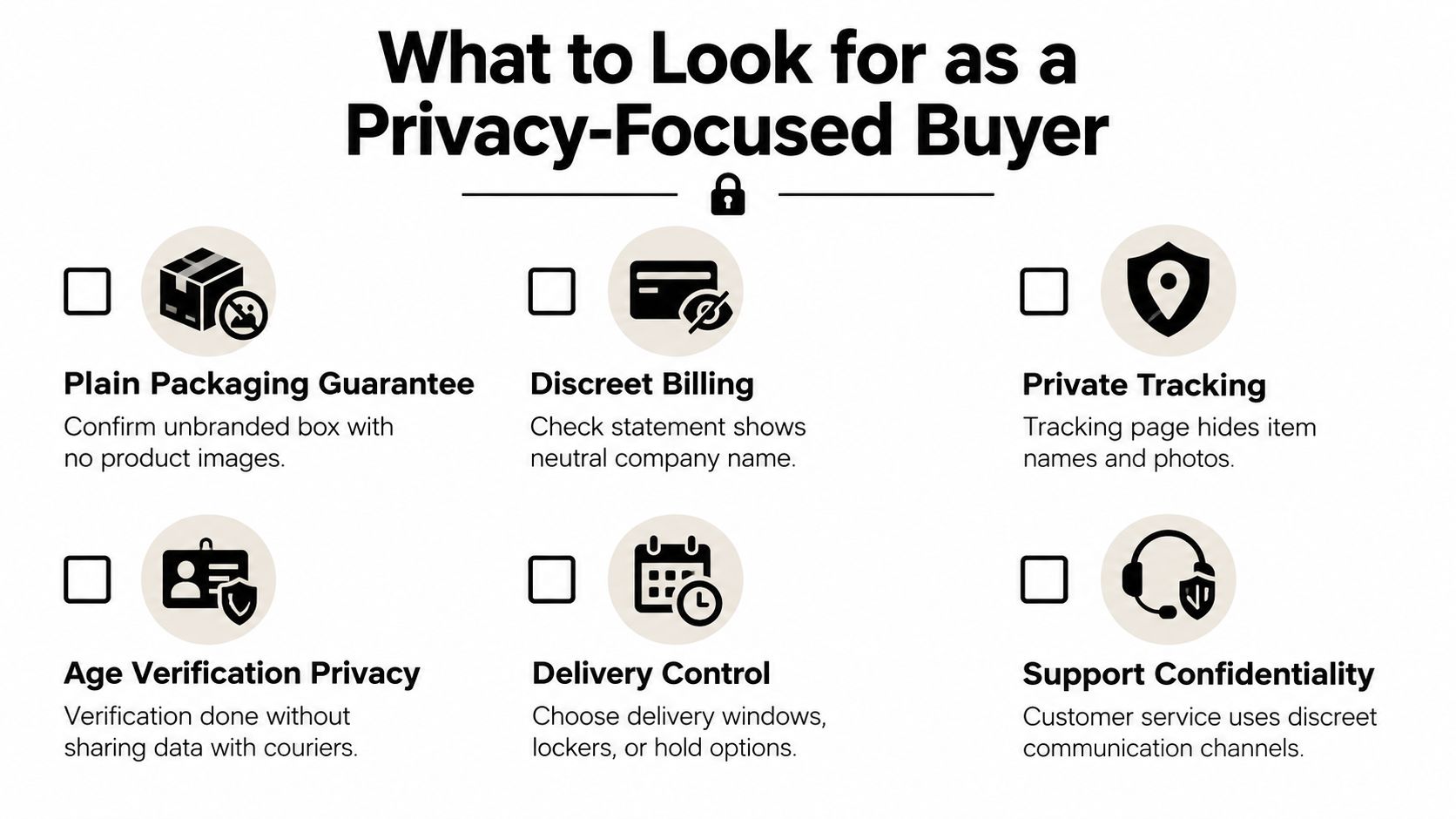
The buyer's privacy checklist
- Plain packaging guarantee: Look for a clear statement that the exterior has no product images, category terms, or recognizable branding.
- Neutral billing: Check whether the payment statement uses a neutral company descriptor rather than a sensitive store name.
- Private tracking: Confirm that tracking updates hide product names, images, and unnecessary descriptions.
- Age-verification clarity: Find out what identification is checked, what information the carrier stores, and what happens if scanning is declined.
- Delivery control: Look for delivery windows, hold-at-location options, lockers, pickup points, and signature services.
- Confidential support: Check whether customer service can communicate through a private email address or another discreet channel.
A reliable privacy policy should identify who fulfills the order, whether a third-party warehouse handles packing, how returns and reships are packaged, and what customer data is retained. It should also explain the limits of discretion. No retailer controls a neighbor's behavior, a shared inbox, a carrier's required paperwork, or an unattended porch.
Use a simple trust rubric
Transparency comes first. A retailer that explains its procedures gives you something concrete to evaluate. Label neutrality follows, because the outside of the parcel remains visible throughout transit. Carrier flexibility matters when you need a locker, signature, or pickup option.
Then assess age-verification privacy and handoff safety. Those two factors determine whether a carefully packed order remains private after it leaves the warehouse. For a closer look at delivery-speed choices and their privacy tradeoffs, review this guide to expedited shipping versus standard shipping.
A well-protected order should feel ordinary from click to closet. You should receive useful updates without revealing product details, complete any required verification without unnecessary data exposure, and choose a final handoff that doesn't leave the parcel waiting for curious eyes.
The Magic Mushroom Delivery offers adults 21+ discreet packaging, neutral shipping labels, and tracked nationwide delivery for its mushroom product range. Visit The Magic Mushroom Delivery to review the available products, shipping information, and privacy-focused ordering options.