Choosing mushroom coffee by the mushroom name on the front is a poor buying strategy. Lion's mane or cordyceps may sound specific, but neither tells you how much you'll drink, how the ingredient was prepared, or how much caffeine comes with it. Start with the serving-level label, not the wellness promise.
A useful packet makes its contents understandable before you open it. Look for a disclosed mushroom amount, caffeine per serving, and testing that applies to the finished product. Those details won't guarantee a health benefit, but they'll let you make a more informed comparison.
What Mushroom Coffee Packets Are Made Of
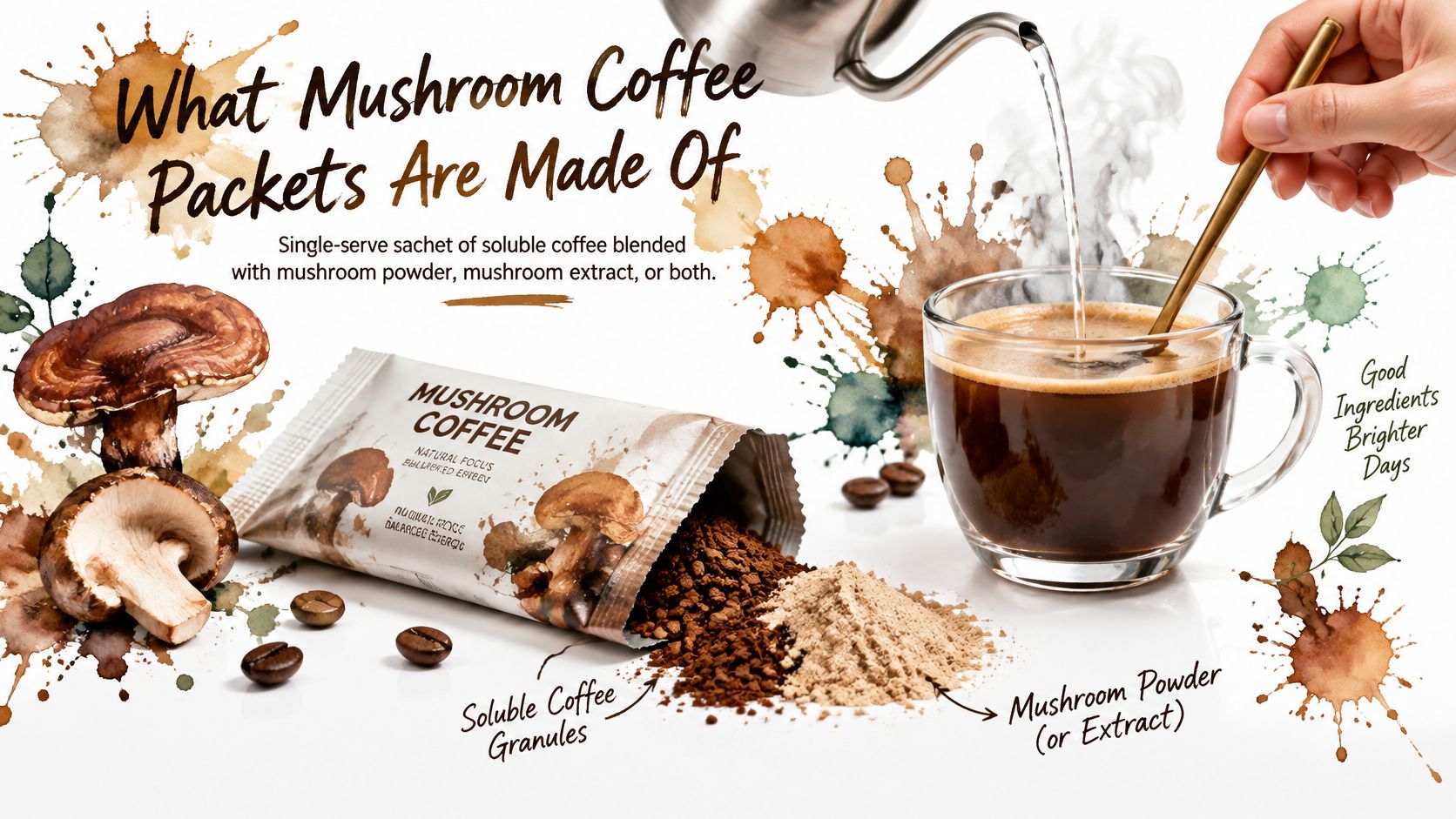
A mushroom coffee packet is a single-serve sachet of soluble coffee blended with mushroom powder, mushroom extract, or both, prepared by adding hot water and stirring. Shoppers commonly encounter lion's mane, chaga, cordyceps and reishi on the front label. Turn the packet over to check for creamers, sweeteners and flavorings before treating it as plain coffee.
Say you're comparing two lion's mane coffees. One lists whole mushroom powder; the other lists an extract. You haven't established that either is better, because you still need the amount, preparation method and composition of that ingredient.
Separate the Coffee From the Additions
The sachet itself is a convenience format, not a new brewing technology. The Smithsonian's history of instant coffee describes soluble coffee's established history, which helps put today's mushroom additions in perspective: portability and easy preparation aren't evidence of a health effect.
Think of the contents as separate parts:
- Coffee base: Establish what kind of coffee is included and whether caffeine is disclosed.
- Mushroom ingredient: Identify the species, material and form rather than relying on the front-label name.
- Other ingredients: Creamers and sweeteners can change the drink's sugar and calorie content without clarifying its mushroom or caffeine dose.
The mushroom coffee ingredients guide provides another way to examine those components individually. Don't mistake the total packet weight for the mushroom weight, especially in a flavored latte blend.
This is a consumer product category with wellness positioning, not a medically defined beverage. The useful questions are concrete: How much mushroom is in the serving, how much caffeine does it deliver, and what can the manufacturer substantiate?
Read the Label to Find the Real Dose
Packet label items and what to look for
| Label item | What to look for | Why it matters |
|---|---|---|
| Serving size | Grams or packets per serving, and whether one packet equals one serving | Every other number depends on it |
| Caffeine per serving | Milligrams stated directly, not only coffee included | Mushroom content doesn't lower caffeine by itself |
| Mushroom species | Each species named, such as lion's mane, chaga, cordyceps or reishi | Mushroom blend alone doesn't identify the contents |
| Mushroom amount per serving | Milligrams or grams for each species | Total blend weight cannot show the per-species dose |
| Form | Powder or extract, with the extraction method stated | Extraction can concentrate selected constituents; powder mass isn't equivalent |
| Standardized marker | Beta-glucan or another named marker with a stated value | Raw-material values don't establish finished-cup values |
| Proprietary blend | Total blend weight shown, ingredients listed by weight | Individual amounts can remain undisclosed |
| Third-party testing | Certificate covering identity, heavy metals and microbes | Shows what the laboratory actually tested |
Start with serving size. A figure printed prominently on a pouch may describe its entire contents rather than the amount intended for a mug. Match every caffeine and mushroom figure to the same serving before comparing products.
Next, look for caffeine stated directly, followed by each mushroom's name and amount. Under FDA dietary supplement guidance, a product marketed as a dietary supplement should carry a Supplement Facts panel stating serving size, servings per container and dietary ingredient amounts, with an exception for individual amounts within proprietary blends. Don't assume every coffee product is marketed as a supplement or uses the same panel.
Why a Blend Total Isn't a Species Dose
Consider a hypothetical packet displaying 1,000 mg of mushroom blend. That tells you the combined weight, not how much lion's mane or chaga it contains. It also doesn't tell you whether the ingredients are powders or extracts.
The FDA's supplement nutrition-labeling guide explains that proprietary blends can disclose total weight while listing their ingredients in descending order by weight. Ingredient order helps you understand relative predominance, but it won't let you calculate each ingredient's dose.
For form, look beyond the word extract. A water extraction and a dry mushroom powder don't necessarily deliver the same mix of constituents. An extract ratio can describe preparation, but it isn't a clinical effectiveness score.
Check What Was Measured
In a peer-reviewed analysis of Cordyceps coffee, beta-glucan concentration was 3.79% in the raw Cordyceps material and 2.03% in the finished coffee. That comparison shows why raw-ingredient composition shouldn't be copied onto expectations for a diluted, processed drink.
Ask whether a marker value describes the mushroom ingredient or the finished blend. Then check whether the testing certificate identifies the product, batch, laboratory and tests performed. Identity, microbial limits, heavy metals, moisture and marker consistency answer different quality questions; a generic tested badge doesn't answer them all.
Buying rule: Compare disclosed mushroom mass and caffeine per serving first. Use form, marker measurements and finished-product testing to understand those amounts, not to manufacture a promise of benefit.
Caffeine Per Packet Compared With Your Daily Total
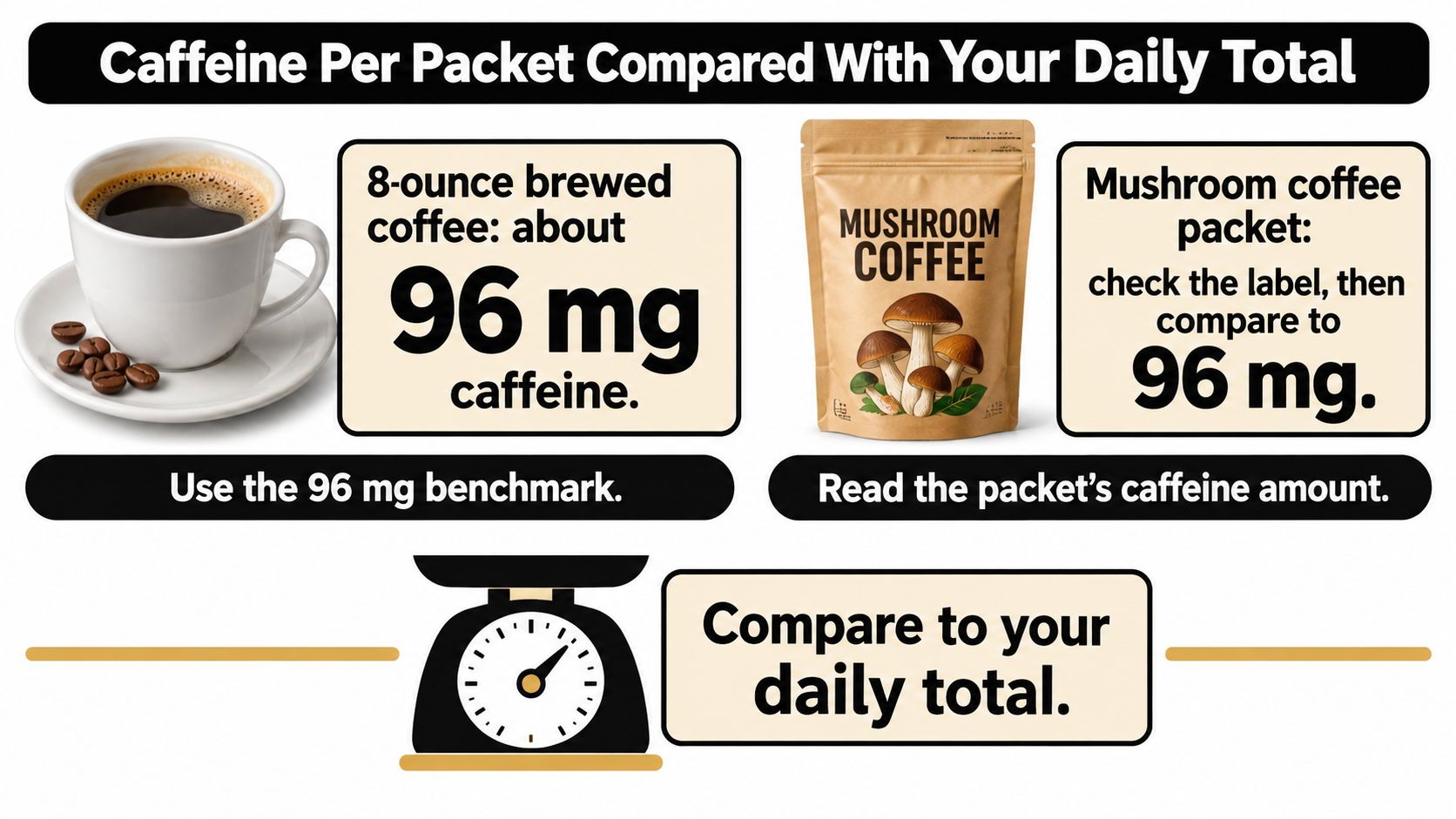
An 8-ounce brewed coffee contains about 96 mg of caffeine, according to Mayo Clinic's caffeine comparison. That's a useful benchmark for a packet, unlike the word mushroom, which doesn't establish its stimulant content.
Use the visual comparison to distinguish the reference cup from a product-specific measurement.
Typical caffeine in common sources
| Source | Typical caffeine | Notes |
|---|---|---|
| 8 oz brewed coffee | About 96 mg | Reference cup for comparison |
| 1 oz espresso | About 63 mg | A double shot doubles the amount |
| 8 oz brewed black tea | About 47 mg | Changes with steep time and leaf amount |
| 8 oz green tea | About 28 mg | Lower per cup, but repeated cups add up |
| 12 oz cola | About 34 mg | Easy to overlook in a daily tally |
| FDA guidance for healthy adults | Up to 400 mg per day | A general reference, not a target; sensitivity differs |
The beverage figures use the Mayo Clinic comparison linked above. The FDA states that up to 400 mg daily is not generally associated with negative effects for most healthy adults, while emphasizing substantial individual differences in sensitivity and caffeine elimination.
Count the Day, Not Just the Mug
Mushroom ingredients don't neutralize caffeine. A blend can contain less caffeine when it contains less coffee, but coffee type, extraction and serving weight still affect the result. The packet's measured amount is more useful than a category average.
Compare two hypothetical choices: Packet A declares caffeine per serving; Packet B only lists instant coffee. If you also drink two cups of tea and a cola that day, you can add Packet A's declared amount to those drinks. With Packet B, you can't complete the calculation without more information.
Check the coffee quantity and preparation instructions, but don't treat coffee weight alone as a precise caffeine measurement. The mushroom coffee caffeine guide can help you identify the questions a missing figure leaves unanswered.
Make Timing Part of the Decision
A daily total doesn't describe everything about how you'll feel. Nervousness, headaches or disrupted sleep can occur at amounts another person tolerates comfortably. Count tea, energy drinks, supplements and caffeine-containing medicines, not just products called coffee.
The video offers another format for considering the beverage.
Before another packet, total the caffeine already consumed and consider your response to it. A missing caffeine figure is a reason to resolve the uncertainty, not permission to assume a low dose.
What the Evidence Supports and What It Does Not
The gap between mushroom coffee marketing and clinical evidence is substantial. In 2023, Cleveland Clinic explained that research on mushroom coffee itself was limited and didn't substantiate the broad health claims surrounding it, while noting that these drinks generally contain less caffeine than ordinary coffee.
A study of an isolated mushroom doesn't automatically validate a sachet containing that mushroom. The species, extract, dose and serving size must be comparable. Even then, evidence for an ingredient isn't necessarily evidence for the complete coffee formulation.
Put Each Claim in an Evidence Tier
Use these categories when a product promises focus, calmer energy or immune support:
- Relevant human evidence: The claim identifies a human study, the mushroom species, preparation and measured dose. Check whether the packet matches those conditions and whether the reported outcome matches the promise.
- Laboratory or animal evidence: The work may explain a possible biological mechanism. It doesn't establish that drinking the packet produces the same outcome in people.
- Unsupported product language: Broad promises appear without an identifiable study of a comparable product or preparation. Treat them as marketing, not a demonstrated result.
A 2025 review of Pleurotus mushroom research described clinical investigations of metabolic parameters but concluded that study variability and a lack of standardized nutraceutical formulations prevented definitive conclusions about therapeutic efficacy. It also characterized clinical evidence as more limited than preclinical evidence.
That finding isn't a verdict on every mushroom species. It illustrates why an appealing biological explanation and a proven benefit are different things.
Ask four questions: Which species, what dose, what form, and was that same form studied in people?
Match the Evidence to Your Actual Goal
For steadier energy or focus, identify the evidence tier before crediting the mushrooms. Your controllable starting points are caffeine amount, timing and the routine surrounding the drink. Don't interpret feeling more alert after coffee as proof that its mushroom ingredient worked.
For stress, distinguish a pleasant beverage ritual from a demonstrated effect of an extract. For immunity, look for a clearly defined human outcome rather than assuming that a laboratory marker means fewer illnesses.
For sleep, don't let calming language distract you from stimulant exposure. Caffeine per packet and when you drink it are more actionable than a mushroom name.
A realistic expectation is coffee with mushroom content, not a treatment. Judge whether its taste, caffeine and transparency suit you without requiring it to solve a health problem.
Safety Checks Before You Start Daily Use
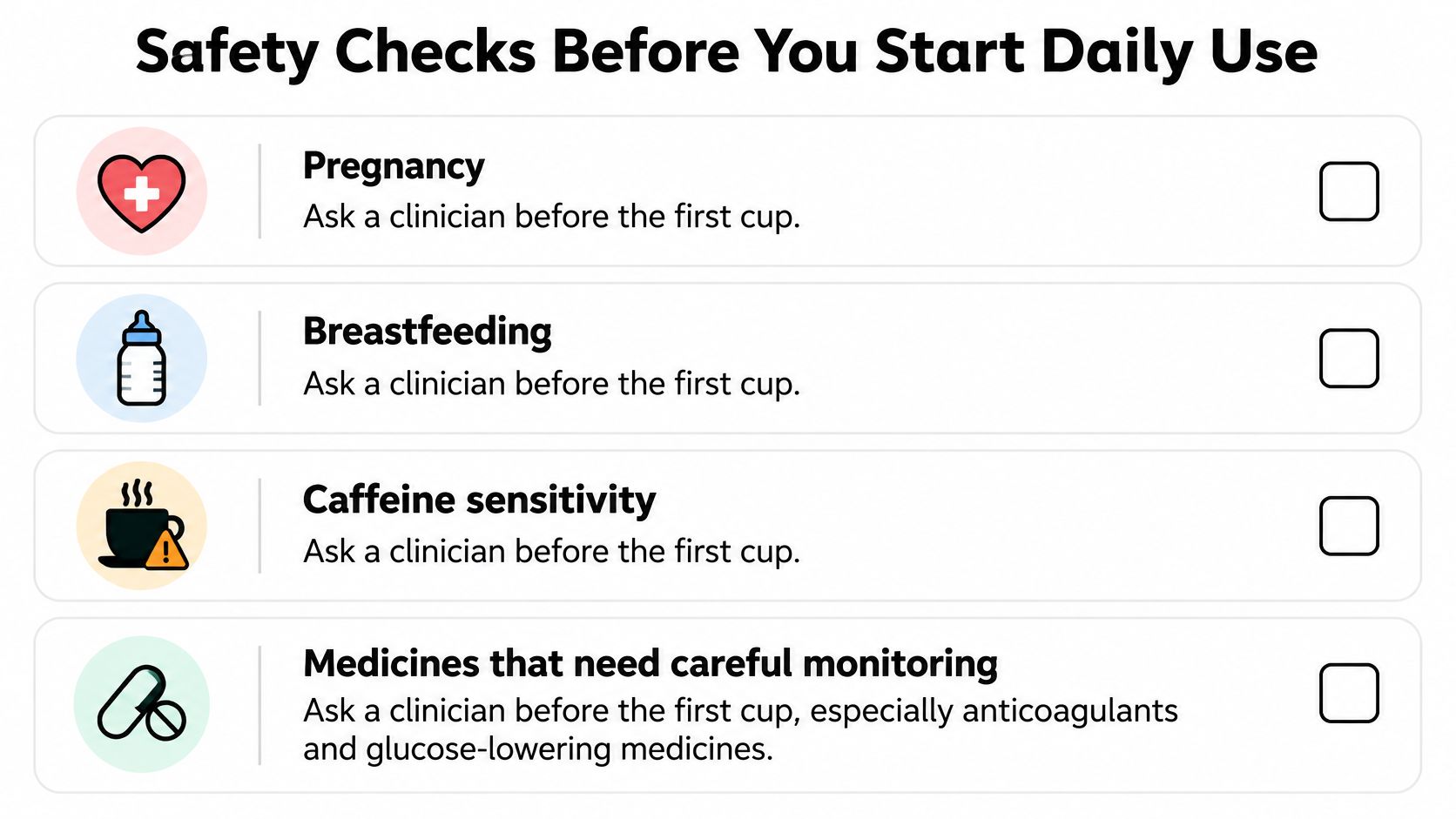
Consult a clinician before the first cup if you're pregnant, breastfeeding, unusually sensitive to caffeine, or taking medicines that require careful monitoring. Anticoagulants, glucose-lowering medicines and immunosuppressants deserve particular attention when reviewing concentrated mushroom ingredients. This is a reason for an ingredient-specific review, not a claim that every mushroom interacts with every medicine.
The FDA's supplement safety guidance warns that supplements can cause harm at high amounts, with long-term use, or when combined with drugs or foods. Bring the actual label to the conversation rather than asking only whether mushroom coffee is safe.
Use this checklist to identify when that review should happen before use.
Make the Review Species-Specific
The Minnesota Department of Agriculture's mushroom product safety guidance says more research is needed on mushroom products' effects, safety and dosage. It also explains that dietary supplements don't undergo FDA approval for safety or effectiveness before sale.
The relevant questions concern species, dose, extract and personal health. A concentrated extract deserves its own assessment rather than an assumption based on eating culinary mushrooms. Likewise, a natural label isn't a safety certification.
For anyone taking medicines, include the full day's caffeine and other supplements in the review. The coffee component is generally the more predictable active ingredient; mushroom-specific effects are harder to assess when formulations aren't clearly disclosed.
Know When to Stop
Stop using the product and seek appropriate medical advice if you develop:
- Heartbeat changes: A racing or irregular heartbeat.
- Sleep disruption: Trouble sleeping after starting or increasing the drink.
- Digestive symptoms: Persistent stomach upset rather than a passing dislike of the flavor.
- Headaches: New or recurring symptoms associated with use.
- Possible allergy: Rash, swelling or another suspected allergic reaction.
Severe symptoms need urgent medical care. Trouble breathing, swelling affecting the mouth or throat, chest pain or fainting shouldn't be managed by reducing the serving.
The mushroom coffee side effects guide offers a place to organize further questions, but it doesn't replace individualized care. Keep the packaging and batch information if you need to discuss a reaction.
Don't increase use to overcome an unwanted effect or to chase a promised benefit. If any clinician-review trigger applies, have the packet's ingredients and dose assessed before the first cup.
How to Brew, Dose and Store a Packet
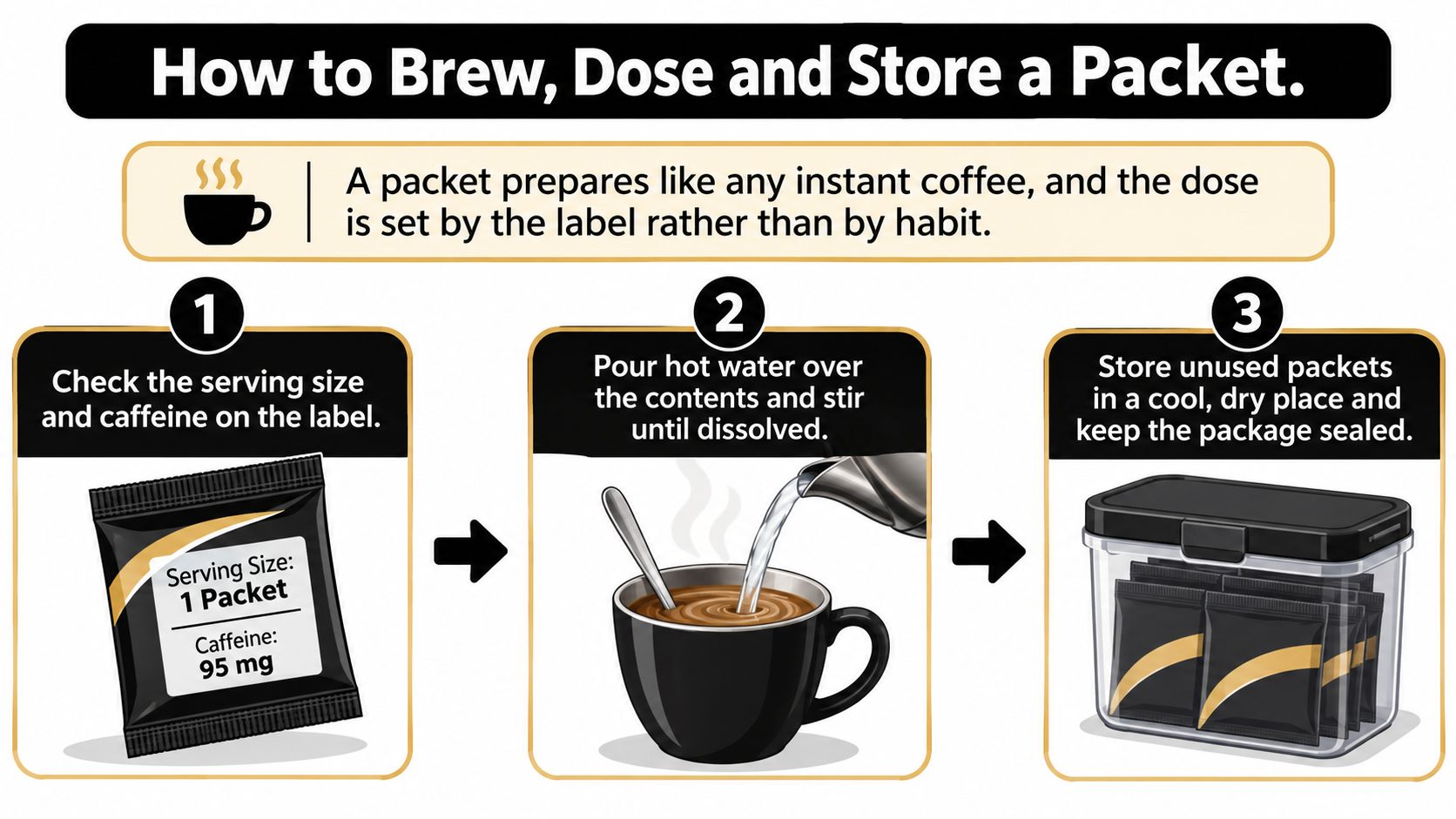
A packet prepares much like instant coffee, but the serving is set by its label rather than your usual mug size. Adding more water changes concentration and taste, not the amount of caffeine or mushroom material you've emptied into the cup.
This routine is for clearly identified, non-intoxicating functional-mushroom coffee. Don't apply an everyday coffee routine to a product containing psilocybin or another psychoactive ingredient; the shared word mushroom doesn't make those products interchangeable.
The preparation overview keeps checking, mixing and storage separate.
Prepare the Serving Deliberately
Check serving size and caffeine before opening. Confirm that a packet is the intended serving and that you recognize every mushroom ingredient. Don't use a familiar package shape as a substitute for reading a new formulation.
Empty the labeled serving into a mug. If the instructions differ from a full packet, use the specified portion. Avoid estimating a partial dose from a mixture unless the manufacturer provides a reliable way to measure it.
Add hot water and stir thoroughly. As a practical starting point when the label gives no mixing direction, use hot rather than actively boiling water, around 80–90°C, and roughly 200–250 ml. These are preparation suggestions, not clinically established conditions; adjust the water for taste and stir until the soluble ingredients dissolve.
Taste before deciding whether you need anything else. Add milk or a preferred alternative if it suits the product. Don't add another packet merely to make the flavor stronger, because that also increases exposure to every ingredient.
Record when you drink it. A short note on your phone can include the product, serving and time. Before another serving, check both the product's directions and your day's caffeine intake.
Some mushroom powders may leave sediment even after the coffee dissolves. Persistent particles don't give you a reliable way to judge potency, extraction quality or the amount absorbed.
A larger mug can make the drink weaker-tasting without making the serving smaller.
Keep Moisture Out
Storage is straightforward, but damaged packaging deserves attention:
- Keep unopened packets sealed: Store them somewhere cool and dry, away from a stove, kettle or humid cupboard.
- Close opened packaging tightly: Follow any instructions for an opened packet or outer pouch.
- Check the printed date: Don't assume an individually wrapped serving keeps indefinitely.
- Discard suspect contents: Avoid packets that are moisture-clumped, musty or off-smelling, especially when the seal is damaged.
For a healthy adult who has cleared the safety checks, a cautious observation routine is no more than a labeled serving daily for a week, provided the label permits that frequency. Note sleep, jitteriness and stomach comfort before considering a change. This isn't an established therapeutic regimen, and there's no need to continue through symptoms to complete it.
Choose a Packet by Its Label Before You Buy
Use the packet checklist as a purchase filter, not something to investigate after checkout. Set a firm standard: visible caffeine per serving, mushroom amounts by species, Supplement Facts or equivalent serving-level disclosure, and an accessible third-party test certificate. Missing information means you can't make the comparison, even if the packaging looks reassuring.
Compare cost per serving, not price per gram alone. Divide the purchase price by the number of labeled servings, then consider what each serving discloses. A gram of finished latte mixture isn't a gram of mushroom extract.
Make the Price Calculation Meaningful
Our Magic Mushroom Instant Coffee 22 Grams, Vanilla Latte, costs $65.00. Dividing that price by the listed weight gives about $2.95 per gram, but the calculation doesn't establish serving value until the label confirms the serving arrangement and the caffeine and mushroom contents.
The product name also isn't enough to establish that a coffee belongs in a non-intoxicating functional-mushroom routine. Verify the actual ingredients before applying ordinary coffee preparation or daily-use advice.
A cheaper packet with incomplete disclosure isn't necessarily better value. You're buying a consumable serving, not a weight of flavored powder.
Before checkout: If you can't identify what a serving contains, skip the product rather than treating the uncertainty as a discount.
Take three practical actions today: compare the label against the checklist, total caffeine from every source before brewing another serving, and bring the label to a clinician if a safety trigger applies. You don't need the most impressive mushroom name. You need enough information to decide what you're drinking.
The Magic Mushroom Delivery offers mushroom coffee alongside educational resources about mushroom products and responsible use. Visit The Magic Mushroom Delivery to review the available product information, and use the label checklist to confirm ingredients, serving details and suitability before choosing a coffee.