Mushroom coffee contains caffeine from its coffee base, so an 8-ounce cup made with a standard coffee share lands near 95 mg, while a blend with about 50% coffee delivers roughly 48 mg. The mushroom on the front of the bag doesn't reset that number.
What you're holding is a coffee dose with a mushroom label. The University of Illinois Extension stated in 2024 that mushroom coffee made with roughly 50% coffee grounds has about 50% less caffeine than a regular cup. That gap comes from how much coffee is in the blend, not from lion's mane, cordyceps, or any other species name. Brew strength and the ounces you pour move the dose again. Tea, chocolate, energy drinks, and caffeine pills sit on the same daily tally, so one "calm" mug can still be a large slice of your total.
How Much Caffeine Mushroom Coffee Really Contains
Read a mushroom coffee label as a coffee product first. The caffeine in the cup scales with the coffee share of the blend and the size of the pour, and the rows below show how wide that spread runs.
| Drink | Serving | Caffeine | Basis |
|---|---|---|---|
| Regular brewed coffee | 8 fl oz | 95-96 mg | FDA and AARP reference values |
| Regular brewed coffee | 12 fl oz | 113-247 mg | FDA typical range for non-specialty coffee |
| Instant coffee | 8 fl oz | about 62 mg | FDA caffeine reference |
| Mushroom coffee with about 50% coffee grounds | 8 fl oz | about 48 mg | Half the 95 mg FDA reference; University of Illinois Extension reports about 50% less caffeine |
| Mushroom coffee, machine brew with Cordyceps | 200 mL | 1.77 mg | 2024 Pharmaceuticals study, lab-prepared sample |
| Mushroom coffee, brewed with Cordyceps | 200 mL | 3.76 mg | 2024 Pharmaceuticals study, lab-prepared sample |
| Mushroom coffee, instant with Cordyceps | 200 mL | 1.74 mg | 2024 Pharmaceuticals study, lab-prepared sample |
| Mushroom coffee, machine brew with Hericium erinaceus | 200 mL | 1.15 mg | 2024 Pharmaceuticals study, lab-prepared sample |
The U.S. Food and Drug Administration states that a typical 8-fluid-ounce cup of ground coffee contains approximately 95 milligrams of caffeine, and lists 113-247 milligrams as the typical range for a 12-ounce serving of regular brewed, non-specialty coffee. AARP reported in 2024 that an 8-ounce cup of brewed coffee contains approximately 96 mg. An FDA caffeine reference places instant coffee near 62 mg for that same 8-ounce size. For a blend built on about 50% coffee grounds, halving the FDA's 95 mg reference gives roughly 48 mg per 8-ounce cup, consistent with the University of Illinois Extension's figure of about 50% less caffeine for blends at that ratio.
Why the tiny lab cups don't describe your mug
A 2024 Pharmaceuticals study measured 200 mL preparations at 1.77 mg for machine coffee with Cordyceps, 1.15 mg for machine coffee with Hericium erinaceus, 1.74 mg for instant coffee with Cordyceps, and 3.76 mg for brewed coffee with Cordyceps. Even inside one lab, method mattered: the brewed Cordyceps sample held more than twice the caffeine of the instant Cordyceps sample. These were small, controlled preparations. A 200 mL pour runs smaller than an 8-ounce mug, and no kitchen scoop went into them.
What the lab rows mark is a boundary. A preparation built with very little coffee lands in single-digit milligrams, whatever the species on the label. For the pouch in your kitchen, the shortcut stays simple: match the coffee share and your pour size to the nearest row, and treat the milligrams as a question about the blend's ratio rather than its mushroom name.
Why the Coffee Base Sets the Caffeine Dose
The common myth is that the word mushroom means low caffeine, or none. Words like adaptogenic, calm, and non-jittery describe how a drink is supposed to feel. They don't state milligrams.
Think of the coffee as the engine and the mushroom ingredients as passengers. Adding passengers doesn't change how much fuel the engine burns. In a standard blend, caffeine comes from brewed or powdered coffee. Functional mushroom ingredients generally don't replace that naturally occurring caffeine.
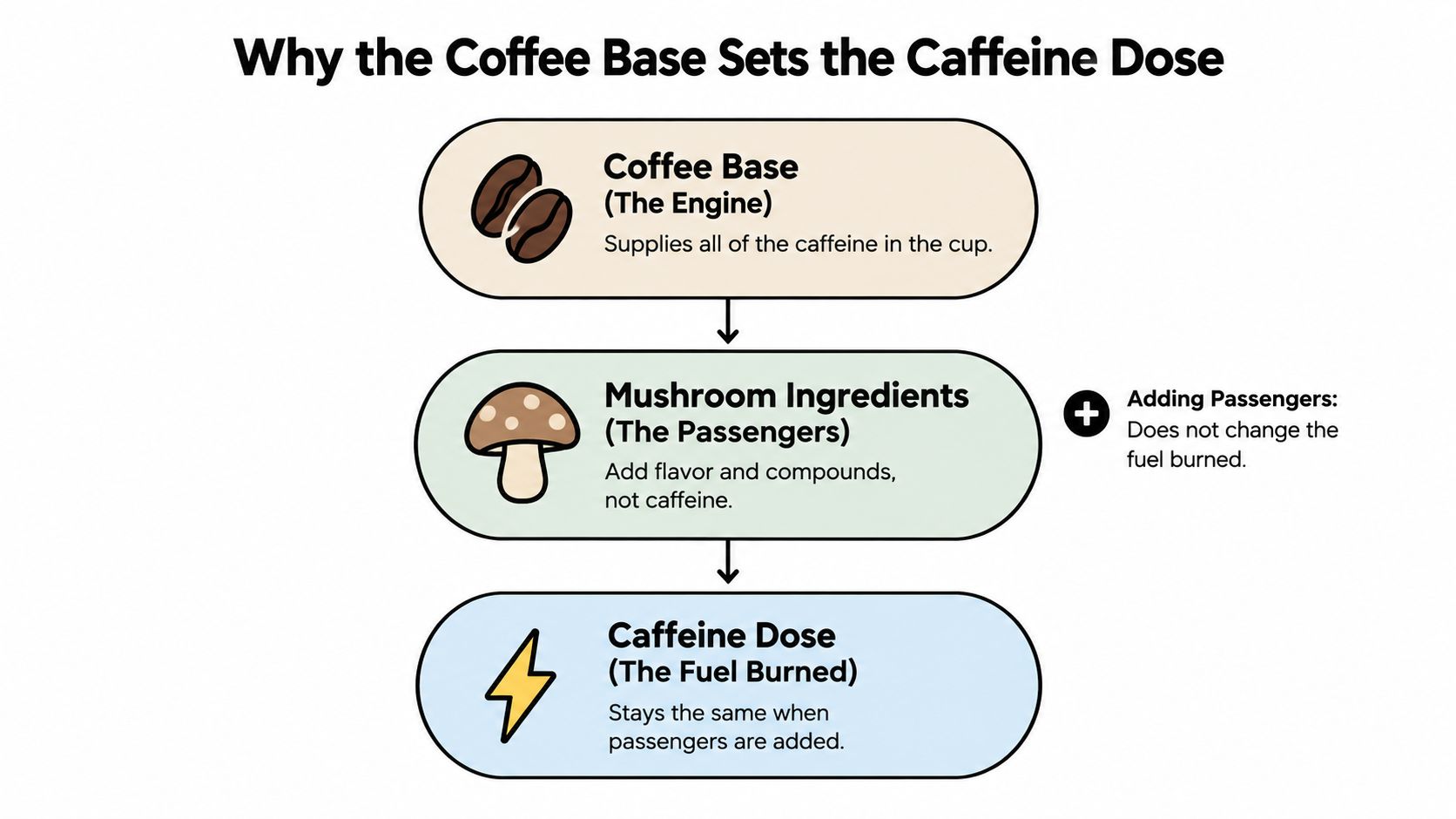
Take one 8-ounce mug as the worked case. Made from a full coffee share, it sits near 95 mg. Made from a blend with about 50% coffee, it sits near 48 mg. Same cup size, same mushroom story on the label, half the engine. The passengers didn't do that. The coffee share did.
What one growing experiment does and doesn't prove
A 2018 peer-reviewed study cultivated the edible oyster mushroom Pleurotus ostreatus on substrates that contained coffee residues, then measured caffeine with high-performance liquid chromatography. Mushrooms grown directly in those coffee-based substrates absorbed 589.6 to 975.0 micrograms of caffeine per gram of tissue, about 0.590 to 0.975 mg per gram. At those concentrations, a 100-gram portion would hold roughly 59 to 98 mg.
That result applies only to mushrooms cultivated on caffeine-containing coffee residues. It doesn't carry over to dried culinary powders, extracts, or the commercial mushroom-coffee blends on a store shelf. Caffeine can move from a growth substrate into mushroom tissue under those conditions. Ordinary functional blends don't get their stimulant that way. They get it from the coffee in the jar.
Practical rule: Trust the formulation and a verified label, not the species name. The coffee share and a lab result per serving are the numbers that count.
Bean, Roast and Brew Factors That Change the Number
The same coffee can hand you very different caffeine once you change the bean, the roast, or the pot. Mushroom coffee caffeine still comes from that coffee base, so these levers apply to the blend the same way they apply to a plain mug.
Bean variety: Check the bean type on the label before you estimate a dose. Robusta and Arabica don't carry the same caffeine, and a pouch that hides the bean leaves you guessing before you even boil water.
Roast level: Darker isn't automatically stronger. In a 2024 Scientific Reports study, researchers brewed 10 grams of coffee in 150 grams of water (a 15:1 ratio) and measured caffeine by high-performance liquid chromatography. Under otherwise identical conditions, dark roasts produced generally lower caffeine concentrations than light and medium roasts. When extraction yields were held equal, dark roasts showed higher concentrations instead. Yields generally declined in roast batches that lost more than about 12-14% of their mass, and caffeine in 10-minute brews decreased when roast drop temperatures passed about 400-420°F. Roast changes both how much mass is left and how easily caffeine comes out.
Steep time and grind: A peer-reviewed cold-brew study found caffeine extraction was fastest in the first 180 minutes, then slowed, and approached a near-steady concentration after about 400 minutes. The authors concluded that roughly 400 minutes was enough to extract most available caffeine from medium- and dark-roast beans at medium and coarse grinds. Coarse-ground medium and dark roasts also produced substantially higher concentrations than their hot-brew counterparts under the tested conditions. A long-steep cold brew of mushroom coffee isn't the same drink as a hot cup of the same grounds.
Serving size before any of that
An 8-ounce pour and a 12-ounce pour of the same blend differ by 50% in volume before roast or steep time enters the picture. If you change the scoop, the ratio, or the minutes, you've changed the dose again. The steps for making mushroom coffee only predict milligrams when you keep the water, the coffee weight, and the time fixed.
What Caffeine Does at Mushroom Coffee Doses
Say you finish an 8-ounce cup at 2 p.m. The lift you feel is from the caffeine in that coffee share. The mushroom powder doesn't rewrite the clock.
Effects typically begin about 30 to 60 minutes after you drink, and blood levels tend to peak around an hour after that. In healthy adults, caffeine's half-life averages about five hours and often falls somewhere between three and seven. A 2 p.m. cup can still leave roughly half its caffeine in you around 7 p.m. That's why a "gentle" afternoon blend still shows up at bedtime.
From alert to too much
At moderate amounts, roughly 50 to 200 mg, many people notice alertness, easier focus, and less fatigue. Push higher and the same compound can bring jitteriness, a faster heartbeat, stomach upset, or broken sleep. A sudden drop after daily use can bring a headache. Genetics, body weight, pregnancy, and a habit that builds tolerance all change how one number feels. Some antibiotics and oral contraceptives slow clearance, so the same milligrams last longer.
Nothing in the caffeine research reviewed here shows mushroom ingredients blunting those effects. A mushroom label isn't a softer hit. If sleep or heart rate shifts after a cup, that dose is too high for you, whatever the pouch promises. A closer look at mushroom coffee side effects helps you separate the stimulant from everything else in the blend.
The afternoon cup is easier to judge on a clock than on a slogan. Watch the hours, not the adjectives.
How Many Cups Fit a Safe Daily Limit
For most healthy adults, up to 400 mg of caffeine a day is an amount not generally associated with negative effects. That's roughly two or three 12-ounce coffees, and only if you know which coffee you're counting.
A mushroom-coffee serving doesn't have a fixed caffeine amount just because functional mushrooms are in it. A peer-reviewed brewing analysis found an average of 1,044 ± 26 mg per liter for moka-brewed Robusta, 1,371 ± 16 mg per liter for espresso pod coffee ( 56 ± 0.6 mg in a 40 mL serving), and only 13.4 mg in a 240 mL iced-coffee sample. Bean, ratio, grind, and method move the cup that far. Read the label or the prep instructions. Don't infer the dose from the mushroom name.
| Product | Caffeine per serving | Servings to reach 400 mg |
|---|---|---|
| Regular brewed coffee, 8 fl oz | 95 mg | about 4 |
| Regular brewed coffee, 12 fl oz | 113-247 mg | about 2 to 3 |
| Instant coffee, 8 fl oz | about 62 mg | about 6 to 7 |
| Mushroom coffee with about 50% coffee, 8 fl oz | about 48 mg | about 8 |
| Decaf coffee, 8 fl oz | 2-15 mg (general reference) | about 27 to 200 |
One 8-ounce regular cup uses about a quarter of that 400 mg ceiling. Two large or strongly brewed servings can approach it on their own.
A stacked afternoon that still fits
Say you drink two 8-ounce cups of a 50% blend, about 48 mg each, plus one 8-ounce black tea at about 40 mg. That's about 136 mg, still well under the ceiling. Tea, energy drinks, chocolate, and supplements count toward the same 400 mg. The daily total matters more than any single mug.
Caffeine-sensitive people, pregnant people, anyone on medicines that slow clearance, and people prone to anxiety or insomnia should stay lower than that adult benchmark. Keep the last cup several hours before bed, and cut back if a serving starts to change your sleep.
Lower-Caffeine Options and a Label Checklist
Cutting caffeine does not require giving up the mushroom ritual. Four formats get you there, and they are not interchangeable, because a mushroom on the label never sets the caffeine number. The coffee share does.
| Option | Typical caffeine | Best for | Verify before buying |
|---|---|---|---|
| Decaf mushroom coffee | 2-15 mg per 8 fl oz | Evening drinkers and caffeine-sensitive users | Decaf status and lab result |
| Half-coffee mushroom blend | about 48 mg per 8 fl oz | Cutting intake while keeping the daily ritual | Coffee percentage printed on the label |
| Instant-base mushroom coffee | about 62 mg per 8 fl oz for the instant base | Quick preparation and predictable dosing | Milligrams per serving stated on the label |
| Mushroom-only blend with no coffee | Near zero when the blend contains no coffee | Customers who want to avoid caffeine | Lab test confirming near-zero caffeine |
Decaf suits evening drinkers and people who want the cup more than the stimulant. A half-coffee blend suits someone stepping down while keeping a morning ritual. An instant base is easier to dose because the scoop is fixed, though you still need milligrams on the label. The Magic Mushroom Delivery carries mushroom coffee in its coffee category, and an instant format like that still needs a milligram figure before you treat it as a light cup. A mushroom-only blend is the right lane only when a lab report shows the caffeine is near zero, since coffee extract, instant coffee, or green tea on the ingredient list means it isn't.
Six checks before you buy
Terms like "calm," "adaptogenic," or "non-jittery" describe a marketing position, not a dose. A useful label prints caffeine in milligrams per serving, ties that figure to a stated serving size, and shows the coffee share of the blend. The number should come from testing the finished product, not from assuming the mushroom species changed anything.
- Caffeine in milligrams per serving, not the phrase "one cup."
- Serving size in fluid ounces or grams. Without it, a milligram figure has nothing to attach to.
- Coffee share as a percentage of the blend.
- Coffee type, stated as regular, instant, or decaf.
- Lab testing or batch variability, so one jar isn't a guess about the next.
- Preparation instructions for water ratio, temperature, and steep time. A bigger scoop or a longer steep gradually raises the dose.
Decaf isn't zero. The small range in the table still adds up across several cups, and it matters if you're very sensitive.
Drop the dose in steps. Move from one full-strength cup to a half-coffee blend for a week, then watch sleep and focus before you cut again. Pick the product that states milligrams per serving, and count those milligrams against the 400 mg day. The mushroom coffee ingredients list is where you confirm whether coffee is even in the pouch.
The Magic Mushroom Delivery carries mushroom coffee alongside its other functional mushroom products, with organic, non-synthetic ingredients and discreet nationwide shipping for adults 21 and older. If you're choosing a cup by caffeine, start with the milligrams on the label and match them to the coffee share you'll realistically drink. Visit The Magic Mushroom Delivery to see the current coffee options and read the product details before you order.