
The popular advice to take cordyceps for more energy skips the most important question: which cordyceps, tested in whom, for what outcome? A runner's exercise test, an older adult's oxygen uptake and a laboratory immune marker aren't interchangeable evidence. Neither are a cultivated mycelium extract and a scoop of mushroom powder.
A useful way to evaluate a cordyceps mushroom supplement is to match the product against four details: species, preparation, dose and study population. Add the duration, and you can separate a plausible purchase from a bottle borrowing credibility from a different ingredient.
What Cordyceps Supplements Are and Which Species to Choose
Cordyceps describes a family of ingredients, each with its own chemistry and evidence base. The NIH LiverTox review describes a genus containing more than 400 species, with traditional use extending beyond 300 years, formal recording in Wang Ang's Ben-Cao-Bei-Yao in 1694, and accounts of Ophiocordyceps sinensis in Chinese and Tibetan medicine reaching at least the 15th century.
A long history of use explains the ingredient's reputation. It says little about whether the capsule on a shelf today contains the same material, grown the same way, at the dose researchers studied. Species, growing conditions, fungal material and extraction all change what ends up in the product.
Wild O. sinensis is a caterpillar-fungus complex: the fungus infects a caterpillar, consumes it from within and grows out of the body. The fungus is a parasite of its host, which is why wild material depends on a narrow, hard-to-source supply chain rather than anything resembling an ordinary crop. That scarcity, plus the difficulty of collection, pushed the market toward cultivated alternatives, including Cordyceps militaris.
Cordyceps species and preparations at a glance
| Species or preparation | Origin | Typical product | Marker compound | Human evidence depth |
|---|---|---|---|---|
| Wild Ophiocordyceps sinensis | Naturally scarce caterpillar-fungus complex | Rare premium extracts | No universal marker established for comparing products | Historical use; little modern trial data |
| Cultivated Cordyceps sinensis mycelium, Cs-4 | Cultivated mycelium | Extracts and capsules | Polysaccharides and cordycepin, with amounts requiring verification | Preparation used in many established human exercise trials |
| Cordyceps militaris | Cultivated fungus grown on substrate | Fruiting-body powders, capsules and fermented drinks | Cordycepin | Small trials; direct head-to-head comparisons with C. sinensis are lacking |
The fruiting body is the visible mushroom structure; mycelium is the network of fungal threads. On its own, either term describes anatomy. It does not confirm the product matches a successful trial.
Species identity and preparation identity are separate questions. A bottle labeled C. sinensis does not automatically reproduce Cs-4, the cultivated mycelium preparation behind much of the exercise research. A C. militaris powder does not automatically match the fermented beverage a small trial may have tested.
First purchase filter: If the manufacturer won't identify the species and fungal material, you can't meaningfully compare the product with clinical evidence.
Wild origin isn't a shortcut to effectiveness, and cultivation isn't a guarantee either. The useful starting point is an identifiable ingredient, followed by a preparation that can be compared with what researchers tested in people.
What Human Trials Show for Energy and Endurance
Human evidence is real, but narrow and inconsistent. A systematic review and meta-analysis of randomized trials covered 14 trials published from 2004 through 2024 involving 528 athletes, with eight studies and 288 participants entering the quantitative synthesis; pooled results favored endurance, ventilatory threshold and VO₂peak.
Those outcomes describe different aspects of exercise. VO₂peak concerns peak oxygen uptake during testing. Ventilatory threshold marks the point where breathing rises disproportionately as effort increases. Time to exhaustion measures how long someone sustains a prescribed task rather than how quickly they finish a race. A pooled advantage across these measures doesn't mean any single trial showed all three.
A favorable pooled result therefore supports a specific possibility: some tested preparations may improve some endurance measures in athletic populations. Whether a given product fits that possibility depends on whether its species, dose and user match the trials that produced the signal.
How much confidence does each claim deserve?
- Endurance in trained athletes: moderate but conditional confidence. Positive pooled results justify interest, but differences between preparations and trial designs prevent a universal recommendation.
- Endurance in trained cyclists: mixed evidence. A controlled trial in endurance-trained cyclists found no significant advantage in peak oxygen uptake, ventilatory threshold or time-trial performance, which shows the pooled signal doesn't hold in every design.
- Aerobic fitness in older adults: weak evidence. In a 12-week trial published in the Journal of Pharmacy and Pharmacology, 15 healthy adults aged 50–75 showed maximal oxygen uptake and metabolic-threshold changes that were similar between groups.
- Everyday energy or fatigue: little direct support. Exercise-test outcomes don't establish treatment for persistent tiredness.
- Immune function: preliminary evidence. Changes in immune-cell measurements require a different interpretation from improvements in health.
- Anti-aging and hormone claims: not established. The available human evidence doesn't justify promises about reversing aging or correcting hormonal problems.
Why the population matters
A review of cordyceps and performance evidence emphasizes that participants have generally been young and active, while aerobic-fitness findings remain inconsistent and evidence for older or sedentary adults is limited. A sedentary beginner's afternoon fatigue is a poor match for an athlete's laboratory exercise test.
The same standard applies to any guide to cordyceps and athletic performance: look for the tested task, the tested species and the tested duration, not just a favorable headline. A statistically significant result in trained athletes taking an extract for weeks says little about a different preparation taken for general tiredness.
The defensible verdict is a possible endurance aid for selected trained users, not a proven general energy booster.
Dosing Based on the Amounts Studied
There's no established universal daily dose for cordyceps. A trial amount is a reference point for one species, one preparation and one group of participants; copying the milligrams to a different powder or blend changes the experiment.
The useful question is whether amount, material and intended outcome belong to the same evidence base. A 3 g athlete-extract protocol and a 2.85 mg cordycepin beverage are different measurements, even when both sit under the same supplement name.
Studied cordyceps doses by trial
| Study | Form and daily dose | Duration | Population |
|---|---|---|---|
| Pooled endurance analysis | C. sinensis extract, 2–3 g daily; individual trials also used 10 mg/kg | 6–12 weeks for the pooled endurance association; individual protocols differed | Trained athletes |
| Runner crossover trial | C. sinensis extract, 3 g daily | 2 weeks | 12 trained male runners |
| Cyclist trial | C. sinensis extract, 3 g daily | 5 weeks | 22 endurance-trained male cyclists |
| Older adult trial | Cs-4, 333 mg three times daily, totaling 999 mg daily | 12 weeks | 15 healthy adults aged 50–75 |
| Long-distance runner study reported in the review table | C. militaris mycelium extract, 1,800 mg daily | 16 weeks | 22 male university-level long-distance runners |
| Immune beverage trial | Fermented C. militaris drink, 2.85 mg cordycepin per serving | 8 weeks | 20 healthy adults |
The table also shows why dose summaries need context: an amount used in a study is not automatically an amount shown to work. The cyclist trial used the same 3 g daily extract amount but found no significant advantage in peak oxygen uptake, ventilatory threshold or time-trial performance. The long-distance runner row documents a protocol, not a stand-alone recommendation.
How to use a trial amount responsibly
First, choose the outcome. An endurance protocol is relevant to an exercise goal; an immune-marker protocol is evidence about immune cells and cytokines, so it cannot be converted into an energy dose.
Next, match the preparation. C. sinensis extract, Cs-4, C. militaris mycelium and a fermented drink are distinct materials. Mushroom weight and measured cordycepin are different units of information, so a capsule's total mushroom weight cannot reveal the beverage's constituent exposure.
Finally, match the timeline. The protocols above ran from 2 to 16 weeks, so judge repeated use over weeks rather than expecting an on-demand stimulant effect. A quiet first week is a weak reason to escalate.
A studied dose belongs to a studied preparation. Copying the number without matching the ingredient doesn't reproduce the experiment.
For non-athletes seeking everyday energy, there's no well-supported dosing target. For trained users, the endurance rows offer the closest reference, provided the product matches the species, form, daily amount and duration closely enough to make the comparison honest.
How Cordyceps Might Work and Where Immunity Claims Stop
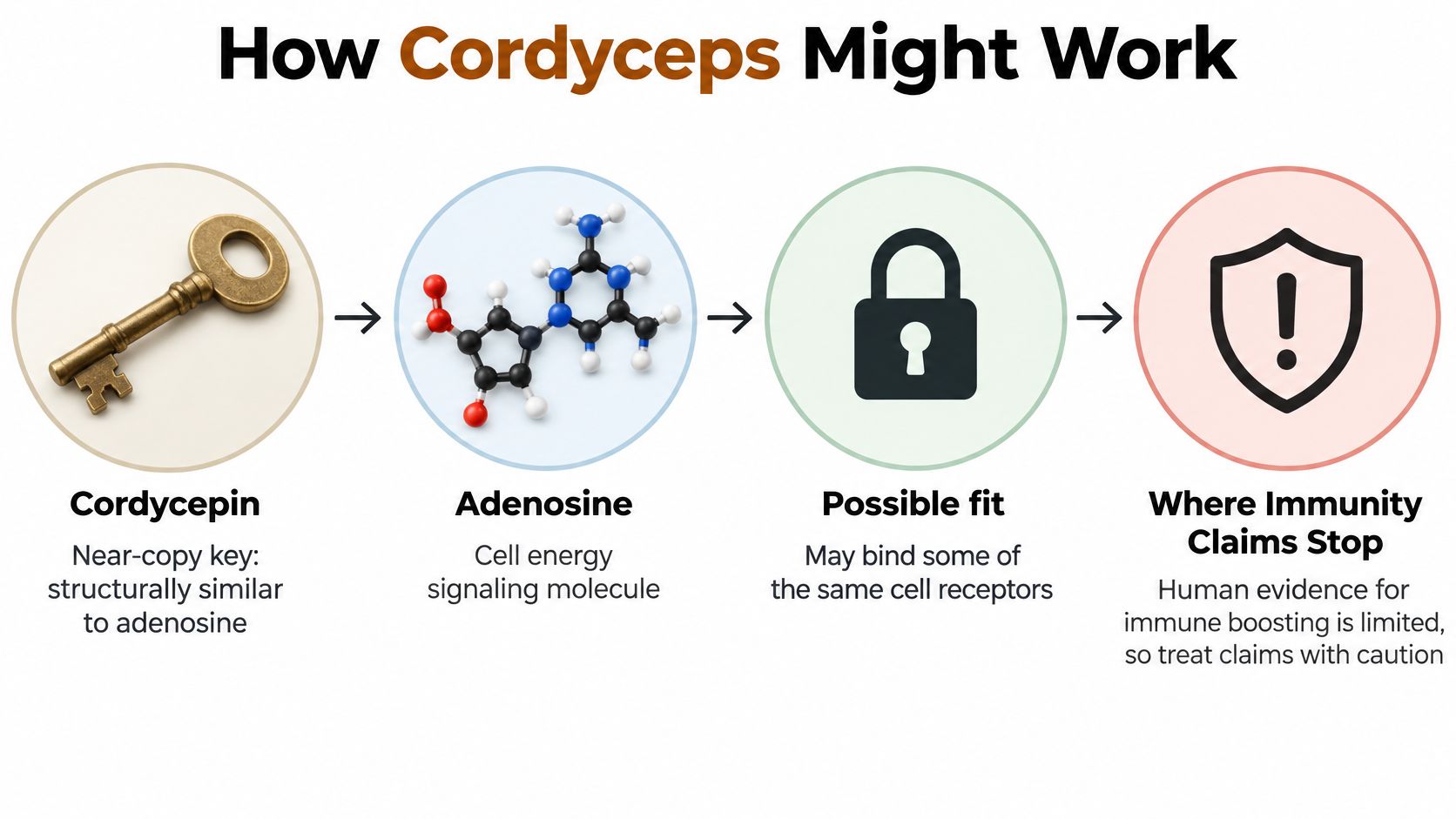
Cordycepin resembles adenosine, a molecule involved in cellular signaling and energy-related processes. Think of it as a near-copy key: structural similarity gives researchers a reason to investigate possible interactions, but it doesn't prove that swallowing an extract produces a useful effect.
Fungal polysaccharides can be understood through a different analogy, a doorbell that may prompt immune-cell responses. Both analogies explain scientific interest, not clinical certainty. Laboratory and animal work on cellular energy and oxygen-use pathways cannot establish how much benefit a person will experience.
What the immune trial actually measured
An eight-week randomized, placebo-controlled trial published in Scientific Reports tested a fermented C. militaris beverage containing 2.85 mg cordycepin in 20 healthy adults, finding increased natural-killer-cell activity and monocyte concentrations alongside reduced secretion of selected inflammatory cytokines. Blood glucose, lipids and safety indices didn't differ significantly from placebo.
These are interesting biological findings. Natural-killer-cell activity concerns how those cells behave in an assay; monocyte concentration concerns circulating immune cells. Neither tells a shopper whether they'll catch fewer respiratory infections or recover faster from illness.
Changing an immune marker is not the same as preventing an illness.
The study's small sample also limits confidence, and its fermented liquid cannot be treated as evidence for any generic capsule. Different cultivation and processing methods may produce a different mixture of constituents.
For buyers, the useful conclusion is about traceability, not immune boosting. A manufacturer that identifies the species, fermentation method and quantified cordycepin gives you something concrete to compare with the trial. A broad immune-support statement doesn't.
Even a quantified compound is only a marker of composition. It isn't a validated score of how much disease protection the supplement provides.
Capsules, Powders and Extracts Compared
The number on a label means different things in different forms. A capsule may contain raw dried mushroom, an extract or a mixture of ingredients, so equal capsule weights don't necessarily mean equal constituent exposure.
Consider a hypothetical 10:1 extract label. That ratio describes the claimed relationship between starting material and finished extract, not a demonstrated tenfold clinical benefit. It doesn't reveal how much cordycepin survived processing or prove superiority over a well-characterized powder.
Cordyceps supplement forms compared
| Form | What it contains | Label clue | Best for | Main limitation |
|---|---|---|---|---|
| Capsules | Dried powder or standardized extract in measured units | Milligrams per capsule and extraction details | Consistent dosing and travel | Weight may describe raw powder rather than extract |
| Powders | Ground fruiting body or mycelium | Amount per serving and fungal material | Flexible dosing and mixing | Taste and measurement precision |
| Hot-water or dual extracts | Constituents extracted using water or water and alcohol | Extraction method, ratio and measured compounds | A smaller serving of extracted material | Ratio alone doesn't establish potency |
| Tinctures | Liquid extract in alcohol or glycerin | Serving volume and measured compound per serving | People who avoid capsules | Carrier content and drop-based measurement |
| Fermented drinks | Fermented C. militaris liquid | Cordycepin amount per serving | Matching a beverage-based protocol | Limited trial evidence and restricted availability |
Compare the contents, not the container
For capsules, distinguish the amount per capsule from the amount per daily serving. For powders, use a scale rather than assuming every scoop holds an identical weight. With liquids, look for a serving volume and constituent amount instead of relying on a drop count alone.
A concentrated extract may be convenient, but concentration isn't the same as clinical validation. Ask whether the manufacturer measures cordycepin or specified polysaccharides and whether those measurements refer to the finished product.
Use third-party lab-testing guidance to assess what a test sheet really verifies. Identity, contaminants and constituent amounts answer different questions; a clean contaminant panel doesn't establish the dose of an active compound.
Compare products by identified material and measured composition, never total mushroom weight alone. If that information is missing, choosing a different delivery form won't solve the evidence gap.
Safety, Side Effects and Medication Interactions
Cordyceps extracts have generally been well tolerated in clinical studies, but that reassurance has boundaries. The NIH LiverTox safety review describes occasional abdominal discomfort, diarrhea, dry mouth, nausea, reduced appetite and rash, without consistent liver-enzyme elevations or an established pattern of clinically apparent acute liver injury.
Medication review belongs alongside product selection, not after symptoms appear.

Medication combinations that need review
Memorial Sloan Kettering's cordyceps guidance warns of potentially enhanced glucose-lowering and anticoagulant or antiplatelet effects. These are specific reasons to consult your clinician or pharmacist, not evidence that every combination causes harm.
- Insulin and other diabetes medicines: Additional glucose lowering could intensify treatment effects. Don't change prescribed medication to accommodate a supplement.
- Warfarin and antiplatelet medicines: Possible added bleeding risk matters with anticoagulants and drugs such as aspirin or clopidogrel.
- Immunosuppressants and autoimmune conditions: Discuss use with the clinician managing your condition, especially when a product is marketed for immune effects.
- Multiple supplements: Bring the complete list, including blends, so the review doesn't miss overlapping ingredients.
Safety observations from a defined extract don't automatically apply to a highly concentrated product, poorly characterized material or multi-ingredient formula. Normal liver tests in monitored participants also don't prove effectiveness.
The accompanying video provides another format for reviewing cordyceps information.
When to pause or avoid starting
Ask your surgical team about stopping supplements before an operation or dental procedure. During pregnancy or breastfeeding, or before giving cordyceps to a child, seek clinical advice rather than extrapolating from adult exercise trials.
Stop use and seek medical advice for persistent gastrointestinal symptoms, rash, yellowing skin or eyes, or unusual bleeding or bruising. Serious or ongoing bleeding requires urgent assessment.
Persistent fatigue also deserves evaluation rather than repeated dose escalation. A supplement trial shouldn't become a reason to postpone investigating a symptom.
Choosing a Cordyceps Supplement Step by Step
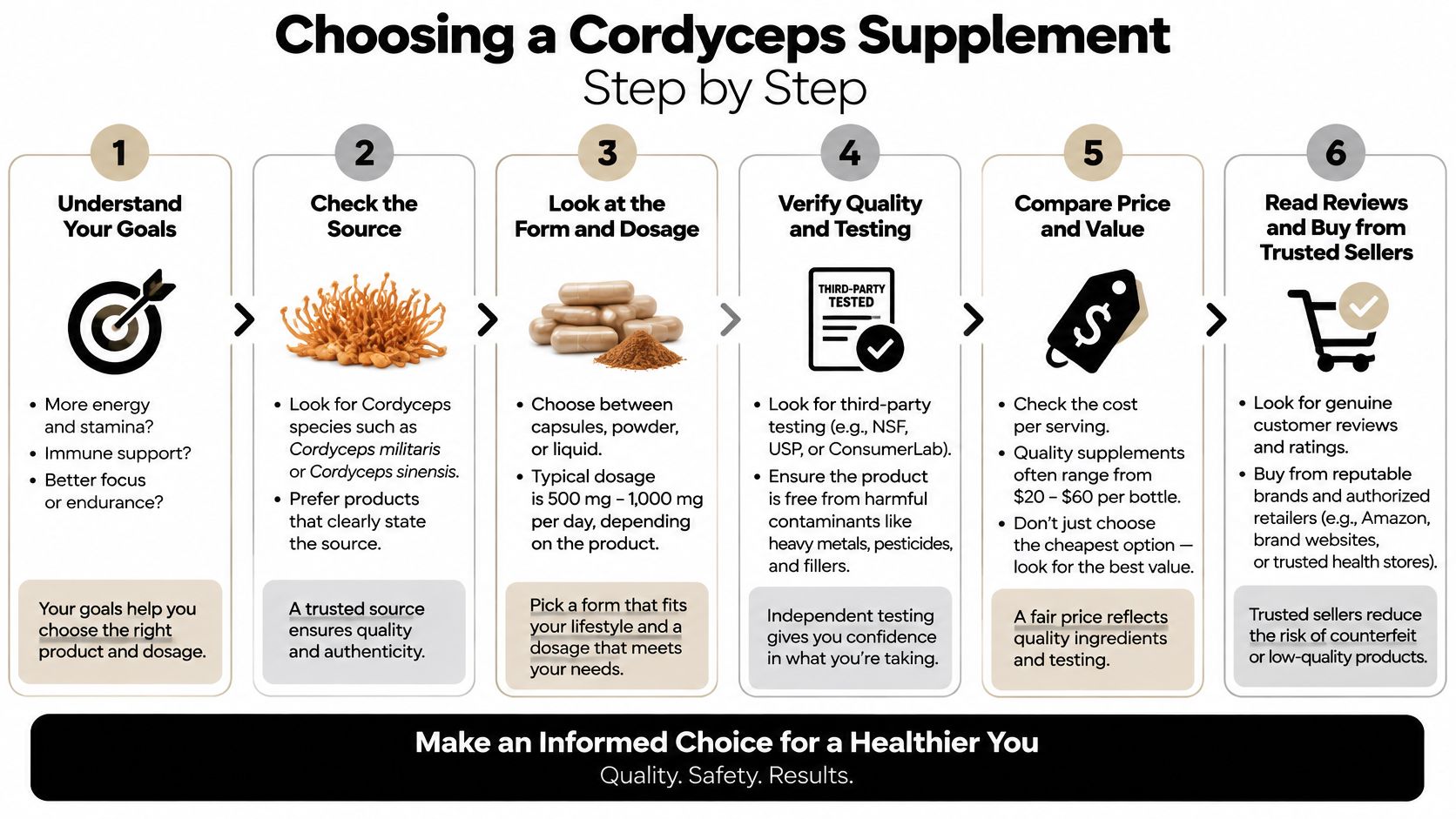
A sound purchase leaves you with three things: a traceable ingredient, a defined serving and expectations sized to what was tested. The label's job is to give you enough information to judge whether the product resembles the preparation a trial used, at a comparable amount. Everything beyond that is marketing.
The FDA's dietary supplement consumer guide explains that the agency doesn't approve dietary supplements for safety or effectiveness and doesn't test them before sale.
That gap makes verification the buyer's job.
Identify the ingredient and exposure
Confirm the scientific name and fungal material. Look for Cordyceps militaris, Cordyceps sinensis or Ophiocordyceps sinensis, then identify mycelium, fruiting body or a mixture. If the seller claims a specific preparation such as Cs-4, ask for documentation, since the species name alone doesn't establish which material a study used.
Find a measured constituent. Use the form-specific label checks to identify extraction details and cordycepin or specified polysaccharides per serving. A ratio describes processing; a constituent result describes something measured. Ask which laboratory method the manufacturer uses and whether the result applies to the finished product.
Match the serving to a relevant protocol. Choose the study population and goal before comparing amounts. If a blend lists only its combined mushroom weight, you can't determine the cordyceps exposure, and taking more of the whole blend won't fix that gap.
Verify the batch, not just the brand
Request the certificate of analysis. Match its lot number to the package. Check the report date, product identity, heavy-metal results and microbial results, along with the laboratory's name. A generic sample report from another product or batch doesn't verify the bottle you're purchasing.
Examine independent certification when available. Confirm what the certification covers. Identity testing, contaminant screening and verification of labeled amounts measure different things, and none establishes that the supplement will improve your performance.
Separate descriptive terms from proof. Organic describes a production claim; fruiting body identifies fungal material; full spectrum needs a clear explanation. Each term can be accurate while telling you nothing about measured constituents or contaminants. Ask for evidence relevant to the particular claim being made.
Decide whether a trial makes sense for you
Review medications before the first dose. Bring the label and your prescription, over-the-counter and supplement list to a pharmacist or clinician. Include upcoming procedures and the symptom or performance goal motivating the purchase. That context separates a reasonable optional experiment from a situation that needs medical evaluation first.
Set a stopping rule before starting. If your clinician agrees a trial is appropriate, choose a conservative amount compatible with the relevant preparation rather than defaulting to the highest label dose. Record the serving, tolerance and a repeatable outcome, such as the same workout under similar conditions. Escalating because you feel nothing raises exposure without adding evidence, so stop if warning signs develop.
A functional mushroom supplement comparison can help organize options, though the same checks apply regardless of retailer. Keep the label and batch report together so you can identify exactly what you used if a question arises later.
Choose the product with a named species, a dated batch test and a stated constituent amount over a cheaper bottle with vague labeling. When neither option provides those basics, declining both is a sound decision.
The Magic Mushroom Delivery offers functional mushroom products and educational resources on mushroom supplements. Visit The Magic Mushroom Delivery to browse its range, then check each label for species, serving details and batch testing information before you buy.