
You're probably doing what most buyers do. You've got five tabs open, every bottle says “focus,” “immune,” or “full spectrum,” and the only obvious difference is that one costs a lot more than the next. The label says 500 mg. Another says 10:1. A third says fruiting body. None of that helps if you don't know what predicts quality.
That's the problem with most “best mushroom capsules” guides. They rank brands before they teach you how to judge one. That's backwards.
A good mushroom capsule earns its price by answering four questions clearly. What species is in it. How concentrated it is. How the actives were verified. Whether that profile fits your goal. If a label ducks any of those, move on. You don't need more hype. You need a clean way to separate a real extract from expensive filler.
What Buyers Really Want from the Best Mushroom Capsules
Shopping for the best mushroom capsules isn't about novelty. It's about finding a product you can take daily without guessing whether the capsule contains meaningful mushroom material or a vague blend built for marketing.
The four questions that matter
Use this filter every time:
What mushroom is it, exactly
- You want the full species name on the label, such as Hericium erinaceus or Ganoderma lucidum.
- “Mushroom complex” is not an answer.
- “Functional blend” is worse.
What kind of material are you getting
- Raw powder, hot-water extract, and dual extract are not interchangeable.
- A capsule filled with raw powder can look impressive on milligrams and still deliver less usable material than a smaller extract dose.
Did the brand verify active content
- For functional mushroom capsules, the practical benchmark is a fruiting-body extract standardized to about 20 to 30 percent beta-glucans, with products above 25 percent and low alpha-glucans generally indicating less grain-derived starch dilution. The useful verification standard is a third-party Certificate of Analysis using the Megazyme enzymatic method, as outlined by Advanced MycoTech on beta-glucan quality.
Does the capsule match your goal
- Lion's mane for cognitive support is a different buying decision from reishi for evening use or turkey tail for immune-focused routines.
- “Ten mushrooms in one capsule” usually helps the seller more than the buyer.
What a serious buyer should ignore
Stop getting distracted by front-label claims.
- Proprietary blends hide weak per-species dosing.
- Polysaccharides without beta-glucan detail can mean very little.
- Huge extract ratios without assay data are not proof of potency.
- Wellness language doesn't substitute for a lot number, species identity, or a COA.
Practical rule: If a brand can't show you the mushroom species, the part used, the extraction style, and a test for actives, it hasn't earned your trust.
The best mushroom capsules aren't defined by branding. They're defined by disclosure.
Why Capsules Now Lead the Mushroom Supplement Market
You're standing in front of a shelf with powders, tinctures, gummies, and capsules. If you want the format that gives you the cleanest shot at verifying what you're paying for, capsules usually win.
That is the reason capsules now lead this category. They fit daily use, travel well, and make dosing easier to repeat. More important, they give serious brands a better format for putting extract details, serving size, and testing claims into a product spec that buyers can check.
Market growth helps explain the flood of options. In 2025, the mushroom supplements market reached USD 5.42 billion, and it's projected to reach USD 8.83 billion by 2031, implying an 8.66% CAGR from 2026 to 2031, according to Mordor Intelligence's mushroom supplements market report. For buyers, the practical takeaway is simple. Capsules are mainstream, and mainstream categories attract both careful manufacturers and lazy ones.
| Format | Dosing Control | Label Verification | Portability | Typical Buyer Friction |
|---|---|---|---|---|
| Capsules | Strong | Usually easiest to compare | Excellent | Low |
| Powders | Depends on scoop accuracy | Often decent, but serving size is easier to misuse | Fair | Medium |
| Tinctures | Fair | Active-content comparison is often less clear | Good | Medium |
Capsules also create a false sense of quality. A clean bottle and a precise milligram count can make a weak formula look disciplined. That is why smart buyers should stop treating capsules as automatically better and start using them as a verification exercise.
Ask a harder question: does the capsule make the product easier to audit?
A good capsule product usually gives you a defined serving size, a stated mushroom species, a declared part used, and some clue about extraction. A weak one hides behind broad terms like “mushroom complex” and hopes the format itself does the selling.
Why capsules win on compliance and routine
Capsules are easier for buyers to stick with. No scoops. No earthy taste. No measuring drops before work. That matters because a supplement only has a chance to work if the buyer uses it consistently.
They also reduce manufacturing sloppiness in ways buyers should appreciate. With powders, underfilled scoops and serving inconsistency are common user errors. With tinctures, concentration and extraction details are often harder to compare across brands. Capsules narrow the range of confusion.
That convenience has a cost. It makes low-grade products easier to mass-market.
The market got bigger. The noise got worse.
As the category expanded, brands learned that mushroom capsules sell best when they promise broad outcomes like focus, immunity, stress support, and energy in one bottle. That is good marketing. It is usually bad product design.
The better buying approach is narrower and stricter. Instead of asking which capsule is most popular, ask which one gives you enough information to verify four things: species identity, beta-glucan content, extract ratio, and third-party testing. Capsules lead the market because they are convenient. They deserve your money only if they are transparent.
In this category, convenience is common. Verifiable quality is not.
So yes, capsules lead for good reasons. They are practical, stable, and easy to use. But the best mushroom capsules are not the ones that made the format popular. They are the ones that give you enough label detail to check whether the contents justify the price.
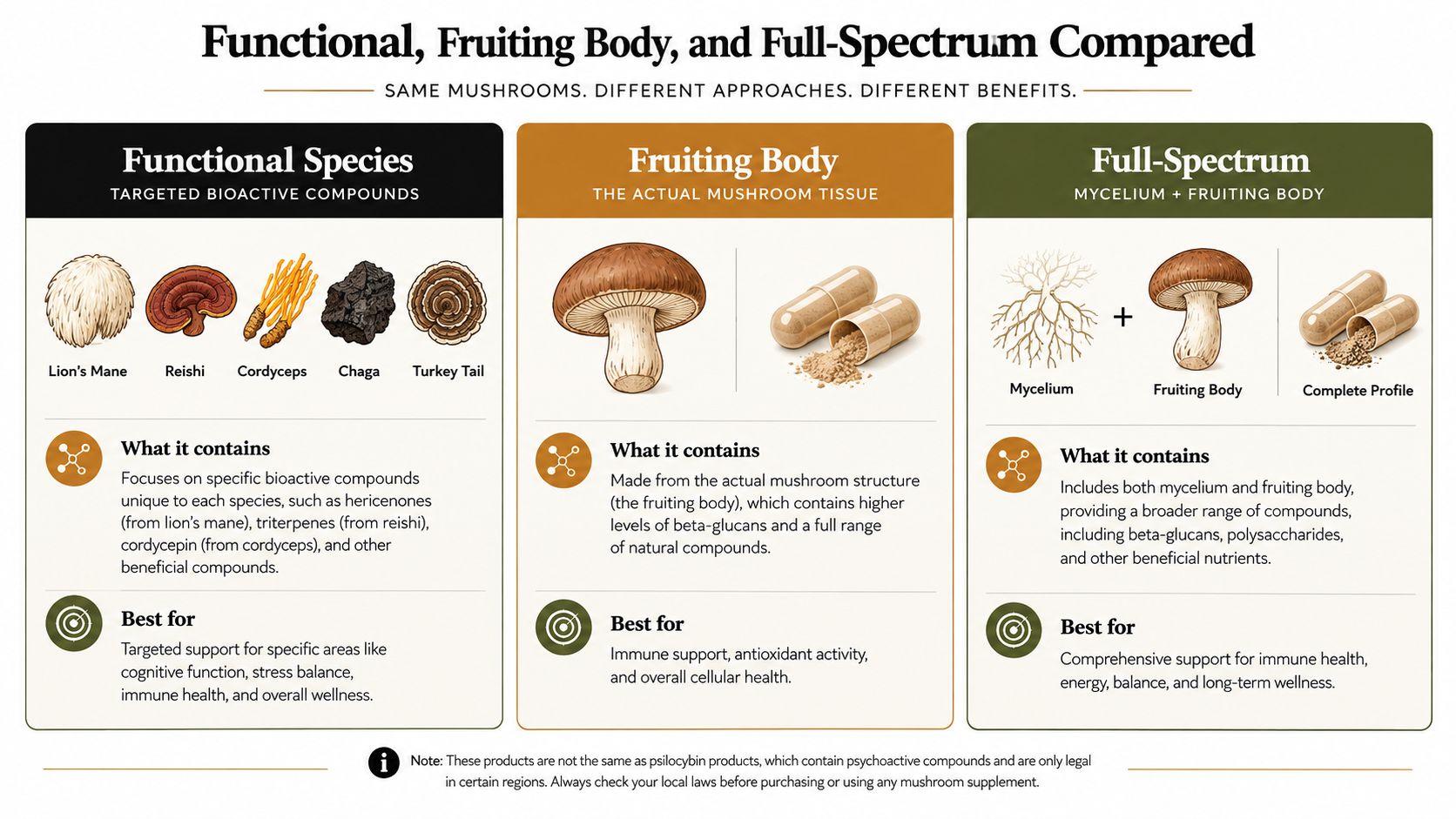
Functional, Fruiting Body, and Full-Spectrum Compared
Most buyers lump all mushroom capsules together. That's sloppy. Species choice, mushroom part, and formula style can change the whole product.
Functional species are not interchangeable
If you're shopping the functional mushroom products category, treat each species as a different tool.
- Lion's mane fits buyers focused on cognition.
- Reishi usually attracts stress and evening-routine buyers.
- Cordyceps tends to appeal to performance and daytime users.
- Chaga and turkey tail often show up in immune-focused formulas.
Those categories are useful. But species alone doesn't tell you whether the capsule is good.
Fruiting body versus full-spectrum
Fruiting body means the actual mushroom structure. In practice, that usually gives buyers a cleaner shot at the beta-glucan content they're trying to pay for.
Full-spectrum sounds broader, but it can mean several things. Sometimes it means a thoughtful combination of fruiting body and mycelium. Sometimes it means a formula that's less transparent about how much of each is present. If a brand uses “full-spectrum,” it should still tell you the species identity, the part used, and the active content.
Here's the blunt version:
- Fruiting-body extract is usually the easiest format to evaluate.
- Full-spectrum can be fine, but only if the testing is equally clear.
- Raw powder is the hardest to justify at premium prices unless the brand gives unusually strong documentation.
Extract versus powder
This is where buyers get fooled.
Two capsules can both say 500 mg and mean completely different things. Extraction metrics matter as much as dose. Hot-water extraction is the right process for beta-glucan-rich species, while dual extraction is preferred when both water-soluble polysaccharides and alcohol-soluble compounds are wanted. In practice, 8:1 to 10:1 extract ratios are common, but ratios above roughly 15:1 to 20:1 should be backed by measured beta-glucan data because ratio alone doesn't prove potency, as explained in this mushroom supplement extraction guide.
A note on oral capsule-style research
Capsule-style oral dosing has become central to modern mushroom research. One controlled study in healthy adults tested six oral doses of psilocybin-containing mushroom powder ranging from placebo to 10 mg, and a separate randomized, double-blind, placebo-controlled lion's mane trial used three 350 mg/g EAHE capsules over 49 weeks, reporting better CASI, MMSE, and IADL scores plus improved contrast sensitivity in patients with mild Alzheimer's disease, while describing the extract as safe and well tolerated, as summarized in the Mori and Inatomi paper record.
That doesn't mean every capsule on a store shelf deserves scientific credibility. It means capsule format itself is no longer the weak point. Verification is.
How to Read a Mushroom Capsule Label Like a Practitioner
A mushroom label is either evidence or decoration. Most are decoration.
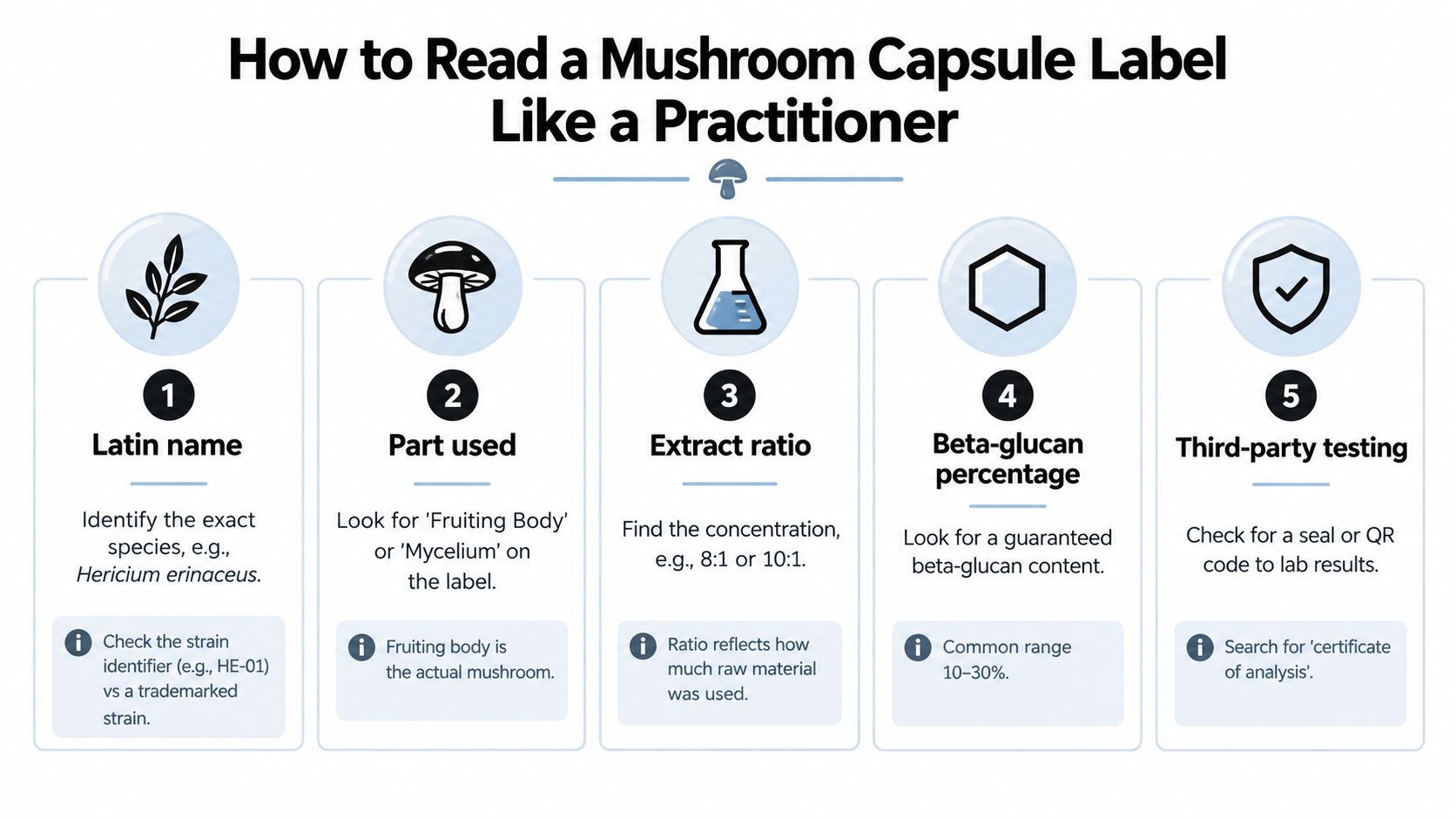
Start with species and part used
If the label doesn't name the exact species, stop there.
You want the Latin name, not just “lion's mane” or “reishi.” You also want the part used. If a brand says fruiting body, that's straightforward. If it says mycelium, the brand needs to explain it clearly. If it says neither, assume the label was written to avoid scrutiny.
A good next step is checking whether the seller explains its testing standards openly, like a page focused on third-party lab testing. Brands that care about verification usually don't bury that information.
Then check extraction and active content
Look for two separate things:
- The extraction method
- The measured actives
The best labels tell you whether the capsule uses hot-water extraction or dual extraction. Then they tell you what that process produced. For many functional mushrooms, the number worth chasing is beta-glucan content.
A practical benchmark is simple:
| Label Feature | What You Want to See | Why It Matters |
|---|---|---|
| Species | Full Latin name | Confirms identity |
| Part used | Fruiting body or clearly defined mycelium | Tells you what the capsule actually contains |
| Extract ratio | Often 8:1 to 10:1, with context | Signals concentration, not potency by itself |
| Beta-glucans | Standardized percentage, ideally around 20 to 30 percent for quality functional extracts | Better marker than vague “mushroom content” |
| COA | Third-party, batch-specific if possible | Verifies the label |
Don't pay premium pricing for “500 mg mushroom blend.” That phrase hides more than it reveals.
Red flags that should kill the sale
Some labels tell you they're weak without saying it directly.
- “Proprietary blend” means you can't judge per-species dose.
- “Mushroom matrix” usually means branding won over transparency.
- No batch number means poor traceability.
- No country-of-origin disclosure isn't an automatic rejection, but it lowers confidence.
- No active-content standardization means you're buying a story.
Match label language to human research
The serious move is comparing the label to the way mushrooms are studied.
A systematic review of fungal beta-glucans found that supplementation studies used daily doses ranging from 2.5 mg to 1 g over durations from 4 days to 26 weeks, with capsules being the typical delivery format for products such as Imunoglukan®, Wellmune WGP®, Yestimun®, Lentinex®, and Imuneks®, according to the RSC review on fungal beta-glucans. That review also identified beta-glucan sources from Saccharomyces cerevisiae, Aureobasidium pullulans, Pleurotus ostreatus, Lentinula edodes, and Ganoderma lucidum.
That's why “mushroom capsule” isn't specific enough. A buyer should ask what organism the beta-glucans come from before comparing products.
Matching Capsule Profiles to Real-World Goals
Buy from the goal backward. Don't start with a brand and then try to force it into your routine.
Buyer profiles that make sense
If your goal is focus and mental clarity, a single-species lion's mane capsule is the cleanest place to start. If you want a concrete example of that style of product, see organic lion's mane mushroom capsules. What matters more than the sales page is the profile: single species, disclosed extract form, and transparent testing.
If your goal is immune support, I'd lean toward a capsule built around reishi or turkey tail rather than a broad blend. Immune-focused formulas live or die on active-content transparency. Beta-glucan disclosure matters most.
For sleep or stress support, an evening reishi capsule makes more sense than a daytime blend loaded with “energy” species. The best product on paper is still the wrong product if you'll end up taking it at the wrong time or skipping it because the routine doesn't fit.
Comparison by use case
| Goal | Primary Mushroom | Key Active Threshold | Suggested Timing |
|---|---|---|---|
| Focus and clarity | Lion's mane | Verified actives and clear extraction matter more than broad blends | Earlier in the day |
| Immune support | Turkey tail or reishi | Standardized beta-glucans matter | Consistent daily use |
| Stress or evening routine | Reishi | Dual-extract logic is useful when the species calls for it | Evening |
| General wellness beginner | Single-species capsule | Start with a simple, transparent label | Same time daily |
| Experienced stacker | One core capsule plus one targeted add-on | Avoid overlap and hidden blends | Depends on stack |
My advice for beginners and experienced users
Beginners should not start with a ten-mushroom formula. Start with one species. Learn how you respond. That makes troubleshooting possible.
Experienced users can stack, but only if they know what each capsule contributes. Most functional mushroom research uses single-species protocols, not kitchen-sink blends. If you combine products, make sure you're not paying twice for the same species in two different “complex” formulas.
A smaller, cleaner single-species capsule usually beats a dramatic blend if you care about a specific outcome.
Dosing, Cycling, and Safety the Clinical Way
Most mushroom dosing advice online is sloppy because it treats all mushroom material as equivalent. It isn't. Raw powder, standardized extract, and isolated beta-glucan are different substances for practical purposes.
What clinical-style dosing actually looks like
One useful reality check comes from cancer-related mushroom research. A review summarizing clinical trials reported that mushroom powder and extract doses varied widely, with some trials using less than 6 g of breast-cancer powder, less than 3 g of extract, less than 14 g of prostate-cancer powder, less than 5 g of prostate-cancer extract, and less than 5.4 g of lung-cancer extract. The same review also noted a breast-cancer trial using two 10 mg capsules of soluble D-beta-glucan daily for 21 days between chemotherapy courses, according to the Cancers review on clinical mushroom trials.
That range tells you something important. “Dose” only means something when you know the form.
How I'd approach dosing in practice
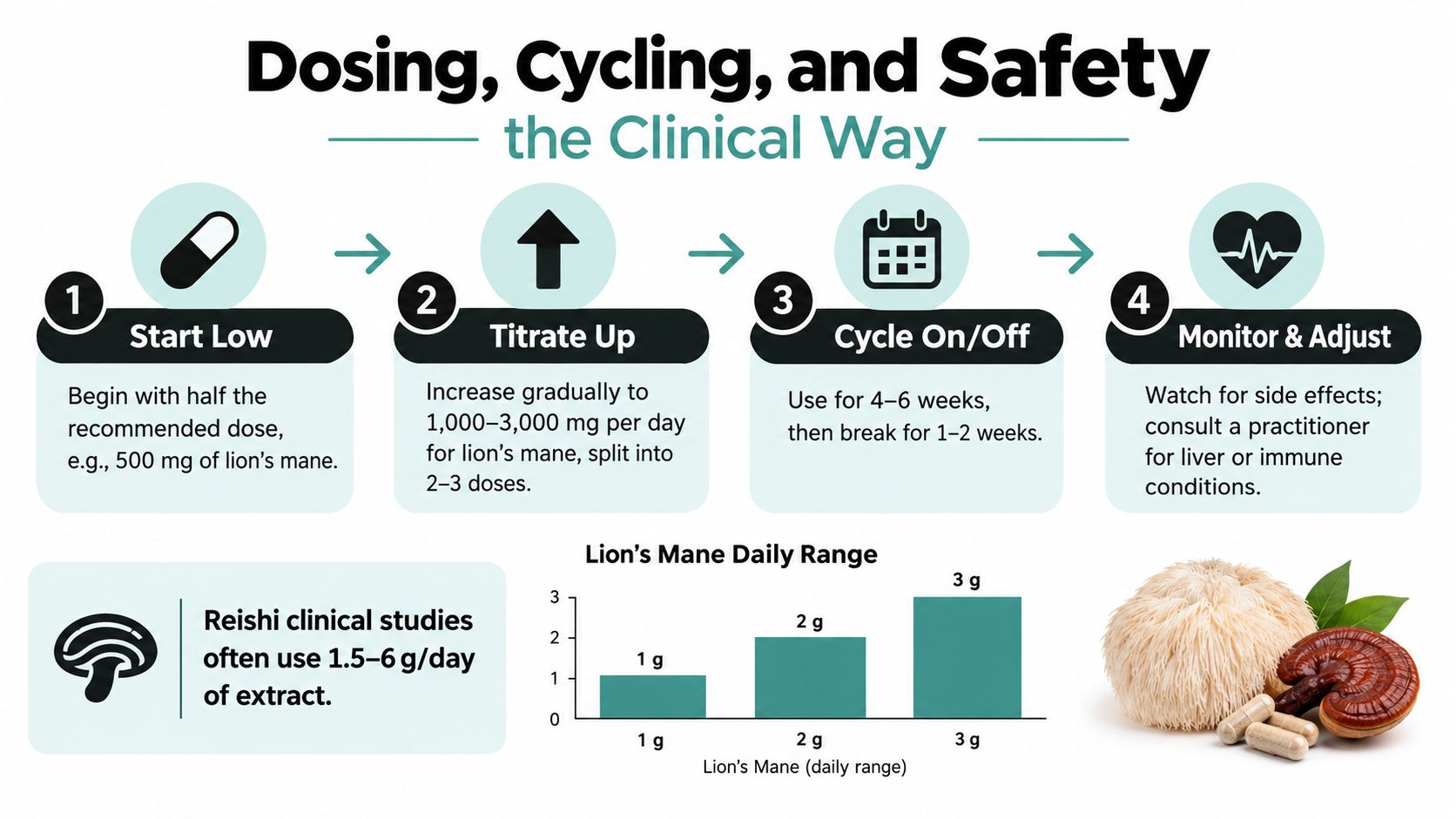
Use a conservative ramp-up:
- Start low with a simple daily dose from a single-species capsule.
- Hold steady long enough to notice tolerance and routine fit.
- Increase only if needed, and only if the product discloses what it contains.
- Don't stack blindly just because the bottle says natural.
A practical middle ground is to use a product consistently for a block of time, then reassess. Buyers often do better with planned breaks than with random on-and-off use.
Here's a helpful visual summary:
Safety and interaction rules worth taking seriously
Mushroom supplements are often well tolerated, but “natural” doesn't mean interaction-free.
Be more careful if you use:
- Anticoagulants or antiplatelet drugs
- Immunosuppressants
- Diabetes medications
Also use extra caution with pregnancy, breastfeeding, autoimmune conditions, or a known mushroom allergy. In those cases, the right move is simple. Don't freelance your supplement stack.
If a product hides the dose form or active verification, you can't manage safety intelligently. That alone is a reason not to buy it.
A Short Buyer's Checklist Before You Click Add to Cart
A good buying decision should take less than a minute once you know what to scan for.
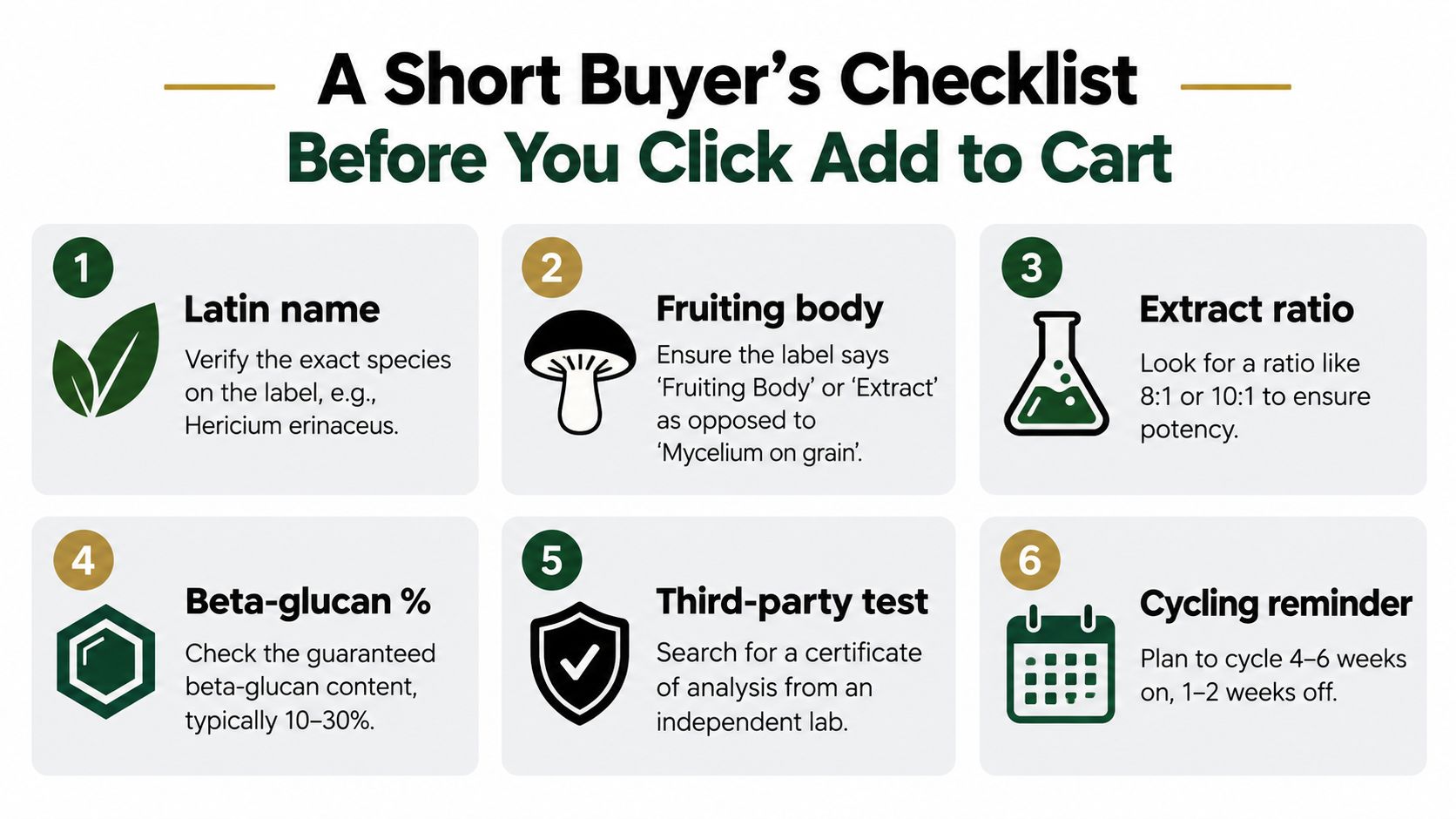
Six checks that matter
Latin name on the label
If the species isn't named precisely, you can't compare it to anything.Part used is declared
Fruiting body, mycelium, or a clearly defined combination. Not vague “full-spectrum” language by itself.Extract ratio is shown sensibly
A ratio like 8:1 or 10:1 is common. On its own, it is not proof.Beta-glucan content is disclosed
For quality functional products, this is one of the few numbers that helps.Third-party testing is available
A real COA should be easy to request or view.The price matches the transparency
A premium bottle without premium disclosure is just expensive marketing.
The fast gut-check
If a brand spends more space talking about vibes than verification, skip it.
If the label hides species amounts in a proprietary blend, skip it.
If the capsule claims broad, dramatic effects without naming the mushroom part, the extraction method, or active content, skip it.
The best mushroom capsules aren't mysterious. They're documented.
Stacking, Side Effects, and Smart Verification Habits
Buyers usually get lazy. They finally find a decent capsule, feel good about it, and stop checking details. That's a mistake.
Stacking without creating overlap
If you stack mushroom capsules, keep it clean.
Don't combine three formulas that all contain reishi and then pretend you know what's doing what. Don't buy a lion's mane product and then add a “brain blend” that hides more lion's mane inside a proprietary formula. Keep one base product and one targeted add-on at most, unless you have a very clear reason to do more.
One factual benchmark is useful here. A peer-reviewed review of edible mushrooms and beta-glucans reported 38 clinical trials involving 3,117 total participants. In that review, lentinan was given intravenously at 1 to 1.5 mg/day for two to eight weeks and was associated with improved quality of life and a higher overall response rate in chemotherapy patients, 56% versus 43.3% with chemotherapy alone, according to this PMC review on edible mushrooms and beta-glucans. That isn't an oral capsule protocol, but it shows how specific clinically studied mushroom bioactives can be.
That's the standard you should keep in mind. Specific compound. Specific route. Specific dose. Most consumer stacks are nowhere near that disciplined.
What side effects usually look like
Expected issues are usually mild:
- GI upset
- Dry mouth
- Occasional intolerance or allergy symptoms
Red-flag reactions are different. If you get symptoms that feel clearly wrong for you, stop. A capsule isn't worth powering through a bad reaction just because the internet called it a nootropic.
Verification habits that separate smart buyers from repeat victims
Build a simple routine:
- Save the lot number
- Keep the COA if the brand provides one
- Recheck labels when packaging changes
- Watch for silent shifts in extract style or species breakdown
The category is growing fast, and quality standards are still being defined. One industry report says the functional mushroom market reached USD 13.20 billion in 2026 and is projected to reach USD 20.74 billion by 2031, according to Mordor Intelligence's functional mushroom market report. Growth attracts serious manufacturers and opportunists alike.
A final practical note. Capsules aren't the only format anymore. A 2026 industry summary said powders and capsules capture about 44% to 48% of the medicinal mushroom market while food and beverage account for about 42%, and the same trade coverage noted the launch of a Functional Mushroom Council with a multi-year research program focused on quality standards, bioactive profiles, and health impacts, as reported by FoodNavigator's coverage of the functional mushroom category. Buyers should take the hint. “Best” still depends on what's verified, not what's trending.
If you want one example of a retailer carrying capsule formats in this space, The Magic Mushroom Delivery offers mushroom capsule products alongside other mushroom categories, with educational content that helps buyers compare formats before ordering. If you already know the verification questions to ask, that kind of catalog becomes easier to use because you can judge the label instead of trusting the hype.