
You're standing in front of a crowded supplement shelf, comparing powders, capsules, coffees, and gummies that all promise focus, calm, energy, or immune support. One label highlights “total polysaccharides,” another says “fruiting body,” and a third hides every ingredient inside a proprietary blend. The packaging looks polished, but the technical details determine whether you're buying a meaningful extract or an expensive mushroom-flavored product.
Functional mushroom products become easier to evaluate once you separate three questions: what the mushroom is intended to do, how it's delivered, and whether the label proves what it claims. Species selection matters, but so do beta-glucan content, extraction conditions, batch testing, and the format you'll use consistently.
Understanding Functional Mushroom Products and Psilocybin Differences
Functional mushroom products contain non-intoxicating mushroom ingredients used in everyday wellness routines. Common examples include Lion's Mane, Reishi, Cordyceps, and Chaga. People usually choose them for goals such as cognitive support, stress balance, immune support, or physical endurance, rather than for an altered state of consciousness.
The word “functional” describes the intended wellness role of the ingredient. It doesn't mean the product is a medicine, and it doesn't guarantee that every marketing claim has been demonstrated in human trials. A responsible buyer should treat the category as evidence-informed but still evolving. The distinction between traditional use, laboratory findings, and clinically demonstrated outcomes matters.
A useful overview of the category appears in this guide to what functional mushrooms are, but the practical definition is simple: these products are designed for regular use and physiological support, not an acute psychedelic experience.
The species are different tools
Lion's Mane is commonly associated with cognition and mental clarity. Reishi is generally selected for calm, recovery, and stress-related wellness routines. Cordyceps is often used around energy and exercise, while Chaga appears in products positioned around antioxidant and immune support.
Those descriptions represent common wellness applications, not promises to diagnose, treat, or prevent a disease. The mushroom species alone also doesn't tell you whether a product is high quality. A poorly identified powder may be less useful than a clearly documented extract from a less fashionable species.
Functional products and psilocybin products serve different purposes
Functional mushrooms and psilocybin mushrooms both belong to the fungal world, but consumers seek them for very different experiences. Functional products are intended to fit into ordinary routines such as morning coffee, a workout plan, or an evening wind-down. They're generally non-intoxicating and aren't expected to produce visual hallucinations or a psychedelic state.
Psilocybin products are sought for profound psychedelic experiences that can involve major changes in perception, emotion, and thought. That's not the same goal as taking Lion's Mane in a capsule for cognitive support or Reishi in an evening beverage.
Practical rule: Identify the intended experience before comparing brands. A functional supplement should be judged by species identity, extraction, active compounds, and testing, not by expectations associated with psychedelic mushrooms.
This distinction prevents a common buying mistake. A customer may purchase a “mushroom blend” expecting immediate stimulation, then feel disappointed when a functional extract works more subtly, or doesn't produce an obvious sensation at all. Functional mushroom products are better approached as measured additions to a wellness routine, with realistic expectations and careful label reading.
Comparing Powders, Capsules, Coffees, and Gummies
The best format is the one you'll use correctly and consistently. Powders offer flexibility, capsules simplify measurement, coffees attach the ingredient to an existing ritual, and gummies make the experience approachable for people who dislike earthy flavors. None is automatically superior because the mushroom extract still determines the product's quality.
| Format | Convenience | Taste Profile | Best Use Case |
|---|---|---|---|
| Powders | Flexible, but require measuring and mixing | Earthy flavor can remain noticeable | Smoothies, oatmeal, broths, and customized blends |
| Capsules | Portable and pre-measured | Little to no mushroom taste | Structured routines and travelers |
| Coffees | Easy to add to a familiar morning habit | Roasted coffee can soften earthy notes | Morning rituals and coffee replacements |
| Gummies | Highly portable and simple to take | Usually flavored and sweeter | People who avoid capsules or mushroom taste |
Powders suit flexible routines
Powders make sense if you already prepare smoothies, tea, soups, or other foods at home. You can adjust the serving to your routine and combine more than one species, although measuring becomes your responsibility. A powder also gives you a chance to notice whether the product dissolves cleanly or leaves a heavy, gritty residue.
That flexibility comes with a trade-off. A scoop isn't always a precise measure, and taste can become a barrier. If you find yourself skipping a powder because it changes the flavor of breakfast, the theoretical versatility won't matter.
Capsules favor consistency
Capsules work well for people who want a repeatable, low-friction routine. They're discreet, travel-friendly, and easier to pair with a written supplement schedule. They also avoid the flavor problem that affects many raw powders.
Capsules can hide useful information if the label only provides a total blend weight. Look for the amount of each species, the extraction type, and whether the company identifies the source material as fruiting body, mycelium, or both.
Coffees connect function to habit
Mushroom coffee is convenient because it uses a ritual many people already follow. The coffee flavor can make earthy notes more acceptable, but you should still inspect the mushroom ingredient panel rather than assuming the beverage contains a meaningful extract.
Before choosing a blend, review the ingredients commonly used in mushroom coffee and check whether the label names each mushroom separately. A coffee can be enjoyable and still provide little information about potency if it relies on an unnamed blend.
Gummies prioritize accessibility
Gummies are often the easiest format for people who dislike swallowing capsules or mixing powders. They work well in a desk drawer, travel bag, or other setting where preparation is inconvenient. Their main limitation is that flavor systems, sweeteners, and serving size can distract from the actual extract details.
Choose gummies only after confirming the mushroom amount per serving. “Mushroom complex” tells you much less than a label that identifies the species, extraction method, and quantity of each ingredient.
Evaluating the Benefits and Scientific Evidence
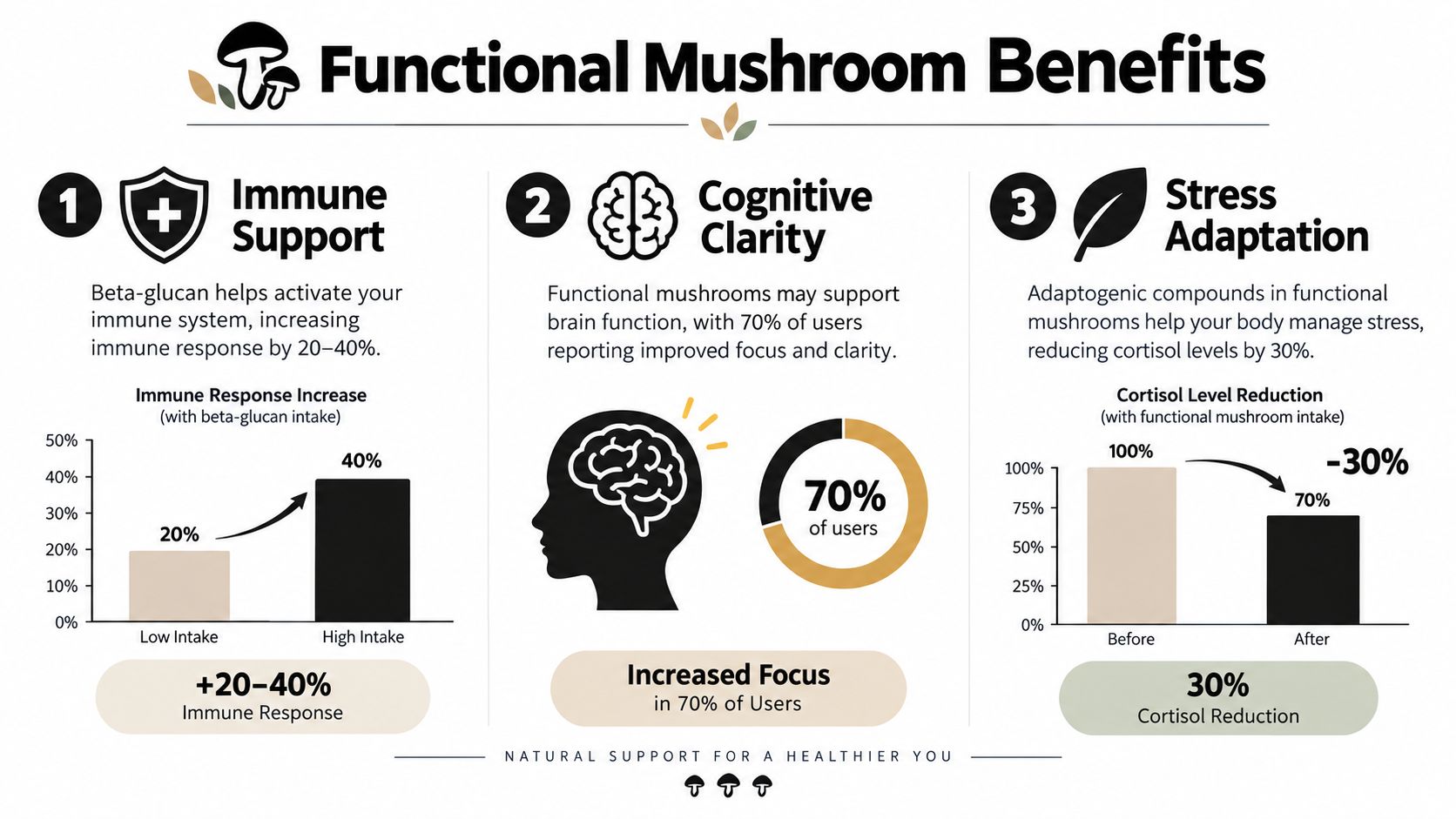
A product may promise immune support, clearer thinking, or better stress adaptation, yet those promises can rest on very different kinds of evidence. Researchers study functional mushrooms as bioactive food ingredients, examining properties such as anti-inflammatory, neuroprotective, and cardioprotective activity. This research is summarized in an industry overview of the functional mushrooms market.
Laboratory experiments can reveal biological mechanisms worth investigating. Human trials provide a stronger test of whether a particular mushroom, extract, dose, and outcome translate into a noticeable effect. Read a claim by asking which type of evidence supports it, and whether the study used the same species and preparation found in the product.
Market growth reflects demand, not proof
One independent estimate valued the global functional mushroom category at USD 16.90 billion in 2024 and projected it to reach USD 45.66 billion by 2034, implying a 10.45% CAGR from 2025 to 2034. The figures appear in Zion Market Research's functional mushroom market report.
A separate estimate placed the U.S. market at USD 8.83 billion in 2025 and projected nearly USD 22.08 billion by 2035, with a stated 9.6% CAGR from 2026 to 2035, according to Precedence Research. These estimates show commercial momentum. Sales growth, however, cannot confirm that every capsule, coffee, or gummy performs as advertised.
Use evidence to set expectations
A major 2023 article discussed estimates that the global category could rise from about USD 8 billion in 2020 to USD 19.3 billion by 2030, while also emphasizing that many health claims lacked strong clinical support. The practical conclusion is measured: functional mushrooms have a substantial research foundation, but evidence varies by species, extract, dose, and outcome.
Treat wording as a quality signal. “Supports,” “is being studied for,” and “may help maintain” reflect uncertainty more accurately than cure claims. These products fit best as possible additions to sleep, nutrition, movement, and stress-management habits, not as overnight solutions.
How to Choose Quality Organic Mushroom Extracts
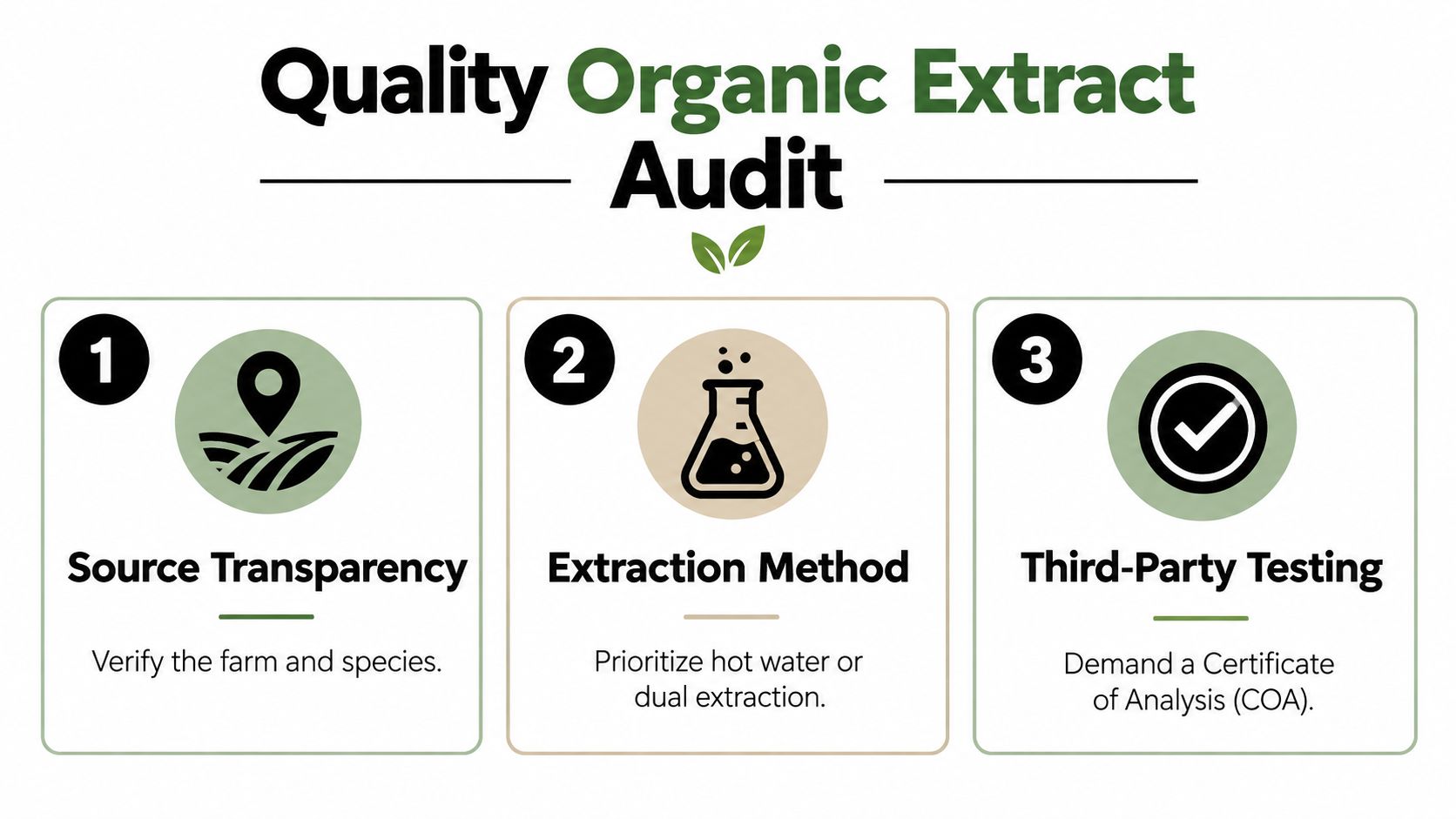
A polished label can't replace a Certificate of Analysis, or COA. This laboratory document should connect the product in your hand to a tested batch and show whether the manufacturer verified species identity, active compounds, and contaminants.
Start with the mushroom name and source. The document should identify the species clearly and distinguish fruiting body material from mycelium or a growth substrate. “Mushroom blend” isn't enough for a serious quality review.
Read beta-glucans separately
The most important technical distinction is beta-glucans versus total polysaccharides. Beta-glucans are the primary fungal cell-wall bioactive fraction, while total polysaccharides can include starch, grain fillers, and other non-fungal carbohydrates. A high total-polysaccharide number can therefore look impressive without proving that the product contains a comparable amount of fungal beta-glucans.
Quality guidance recommends checking beta-glucans separately and seeking third-party batch testing for species identity, beta-glucans, and contaminants. Many premium fruiting-body extracts target beta-glucan levels above 20% dry weight, while heavy metals should remain below established safety limits, as explained in this guide to reading a mushroom COA.
COA checkpoint: A label that reports only “total polysaccharides” leaves a major question unanswered. Ask how much of that figure comes from beta-glucans and whether the result belongs to the batch being sold.
Inspect extraction details
Mushroom cell walls contain chitin, which can make raw material difficult for the digestive system to access. Extraction helps make selected compounds more available, but the method matters. Hot-water extraction is commonly used for water-soluble functional compounds, while alcohol-based processing can target other compound groups.
Peer-reviewed research reports that hot-water extraction conditions can peak around 100 to 110 degrees Celsius for two to three hours for some functional compounds. A split-gill mushroom study found the highest yield at 121 degrees Celsius for two to three hours, with optimal polysaccharide extraction near 103 to 106 degrees Celsius, depending on the measurement, according to this peer-reviewed extraction study.
These findings don't mean every product must use one identical temperature. They show why a manufacturer should document processing conditions rather than treating extraction as a decorative label term.
Confirm contaminant testing
Ask whether the COA checks lead, mercury, arsenic, and cadmium. Mushrooms can interact with their growing environment, so transparent sourcing and batch-specific testing matter. Organic certification may provide useful information about agricultural practices, but it doesn't replace a COA.
For a practical explanation of laboratory documentation, review the third-party lab testing information before purchasing. A trustworthy manufacturer should make the report understandable, current, and connected to the product batch.
A deeper visual explanation can help you recognize the key fields before you compare brands:
Dosing Considerations and Daily Integration
Functional mushroom routines work better when they're simple enough to maintain. Start with one product, follow its serving directions, and track how you respond before adding a second or third mushroom. This approach makes it easier to identify both benefits and unwanted effects.
Choose the species according to the time of day and your primary objective. Lion's Mane fits naturally into a morning or daytime routine for people interested in cognitive support. Cordyceps may suit a daytime or pre-workout window, while Reishi often fits an evening routine focused on relaxation and recovery.
Build a routine around an existing anchor
Attach the product to something you already do. Take a capsule with breakfast, mix powder into the same smoothie, or prepare mushroom coffee after setting out your mug. A familiar anchor reduces the number of decisions required and makes missed servings easier to notice.
If a product contains ingredients that are better taken with food, pair it with a meal rather than taking it on an empty stomach. Follow the product label, especially when the formula combines several extracts or includes additional ingredients beyond mushrooms.
Consistency is more useful than intensity. A routine you can maintain gives you a clearer basis for evaluating the product than occasional, oversized servings.
Add complexity slowly
“Stacking” means combining products or species for different purposes, such as Lion's Mane in the morning and Reishi later in the day. It can be reasonable, but adding several products at once makes it difficult to identify the source of an effect, digestive discomfort, sleep changes, or other reactions.
Keep a brief record of the product, serving time, and noticeable changes. Don't interpret a single day as proof of success or failure. Functional mushrooms aren't the same as an immediate stimulant, and many users evaluate them by broader patterns such as routine adherence, perceived focus, recovery, or evening calm.
Anyone who is pregnant, nursing, taking medication, or managing a medical condition should discuss supplementation with a qualified healthcare professional. A supplement can interact with an individual's health situation even when the ingredient is natural.
Common Misconceptions About Functional Fungi
The first misconception is that every product labeled with a mushroom name contains an equivalent amount of mushroom material. Mycelium on grain can include the fungal network plus the grain substrate used to grow it. If the manufacturer doesn't disclose the material clearly, you can't assume the listed weight represents concentrated fruiting-body extract.
That doesn't make every mycelium product automatically worthless. It does mean you should compare like with like. A fruiting-body extract, a mycelium biomass, and a grain-based powder aren't interchangeable, so the label needs to identify which one you're buying.
Raw powder isn't automatically effective
Another assumption is that raw mushroom powder is equivalent to an extract. Raw material may retain the mushroom's original compounds, but the chitin-rich cell wall can limit access during digestion. Extraction uses controlled processing to make selected compounds more available and can concentrate the material into a more consistent ingredient.
The word “dual” also deserves scrutiny. Dual extraction usually refers to using both water and alcohol to capture different compound groups. If a label says “dual extracted,” look for supporting details about the source material, method, and testing rather than accepting the phrase by itself.
Functional doesn't mean psychedelic
Functional mushroom products aren't expected to cause visual hallucinations, profound perceptual changes, or the psychological integration associated with a psychedelic experience. A product marketed for focus, stress support, or daily nutrition belongs to a different category of use.
Marketing sometimes places many mushroom terms on one package, which can make the categories appear interchangeable. Read the actual ingredient panel, identify the species, and match the product's intended use to your expectations.
Building Your Personalized Mushroom Wellness Routine
A personalized routine starts with a goal, not a trend. Decide whether you're primarily interested in cognitive support, daytime energy, evening calm, general wellness, or a convenient way to add mushroom extracts to food and drinks. Then choose a species whose common use aligns with that goal.
Use this decision sequence:
- Define the job. Choose one primary reason for taking the product so you can evaluate it fairly.
- Match the format. Select capsules for measured convenience, powders for food flexibility, coffee for a morning ritual, or gummies for portability and flavor.
- Audit the label. Look for species identity, fruiting-body or mycelium disclosure, extraction details, and amounts for individual mushrooms.
- Verify the COA. Check beta-glucans separately from total polysaccharides, then review species identity and contaminant results.
- Start with one product. Follow the serving directions and avoid introducing several new supplements at the same time.
- Review your routine. After consistent use, decide whether the format, flavor, and product transparency justify continuing.
The market's scale gives consumers more choice, but it also makes comparison more important. North America represented 43.8% of the global functional mushroom market in 2024, equivalent to about USD 10.9 billion, according to FoodNavigator's market coverage. In the United States, shiitake held the largest species segment in 2023, with a 35.41% revenue share, as reported by Grand View Research.
Those figures show a broad category, not a reason to buy blindly. Choose transparent brands that identify their ingredients, explain their extraction process, and provide batch testing. The strongest purchase is the one you understand well enough to use consistently and evaluate.
The Magic Mushroom Delivery offers functional mushroom products alongside educational resources that help shoppers compare formats, ingredients, and testing information. Visit The Magic Mushroom Delivery to explore its available selection and choose a product that fits your wellness routine.