
A lot of adults start with the same assumption: if a substance is being studied in therapy, the everyday version must be fairly low risk. Real-world data pushes back on that. In poison-center surveillance summarized by UVA Health, psilocybin-related calls among teens ages 13 to 19 more than tripled from 152 to 464 between 2018 and 2022, and calls for adults ages 20 to 25 more than doubled from 125 to 294 over the same period. The same report found that about 75% of youths and 72% of young adults needed some type of medical attention after psilocybin-only exposure, with hallucinations or delusions, agitation, fast heart rate, and confusion leading the list of effects in those calls (UVA Health poison-center summary).
That doesn't mean every use ends badly. It does mean the phrase magic mushrooms risks has to include more than “bad trips.” The useful questions are narrower and more practical. What happens to blood pressure and heart rate? Who's at higher psychiatric risk? How much does product variability change the picture? What happens when mushrooms are combined with medications, or when the product isn't what the label claims?
What People Are Actually Searching For
A small emergency-treatment rate in surveys can sit next to a much heavier poison-center burden, because those sources are measuring different things. That split explains why search results about magic mushrooms can feel strangely inconsistent.
A curious adult usually starts with practical questions, not abstract ones. How often do people end up in the ER? What does a normal dose do to heart rate or blood pressure? Can mushrooms interact with antidepressants? How much risk comes from the drug itself, and how much comes from the product someone bought?
Those are the right questions. They separate two very different settings.
In clinical trials, participants are screened in advance, doses are measured, staff are present, and researchers record side effects in a controlled environment. In the real world, people may combine substances, misjudge potency, have an undisclosed health condition, or take a product that is mislabeled, contaminated, or not psilocybin at all. A street product works less like a pharmacy vial and more like an unverified food item with an unknown ingredient list.
Why the search results clash
A large survey of past-year magic mushroom users found that a small share reported seeking emergency medical treatment after use. In that sample, 19 of 9,233 respondents, or 0.2%, reported emergency treatment, and the authors estimated about 0.06% per event, roughly 1 in 1,800 past-year intakes (survey of 9,233 past-year users).
That figure is useful, but it does not cancel out what emergency physicians and poison specialists see. It answers a different question. A user survey gives a broad population snapshot. Poison-center and emergency-department reports are concentrated at the sharp end, where things have already gone wrong.
The same split applies to clinical trial evidence. Earlier in the article, the supervised-trial and poison-center findings were discussed side by side. Read together, they point to a simple conclusion: risk is shaped as much by screening, product certainty, and coexisting health factors as by psilocybin itself.
The questions underneath the search
People who type magic mushrooms risks are usually trying to solve four uncertainties:
- How strong is the cardiovascular load? A temporary rise in heart rate or blood pressure may be minor for one person and more concerning for someone with hypertension, arrhythmia history, chest-pain symptoms, or stimulant use.
- Could my medications change the experience or danger level? Serotonergic antidepressants, certain migraine drugs, stimulants, and other psychiatric medications can complicate the picture in different ways.
- Do I even know what I am taking? Species differences, storage conditions, extraction methods, and processed products such as gummies or chocolates can make the label a weak guide to actual contents.
- Could this be something else entirely? Look-alike wild mushrooms, adulterated edibles, and mislabeled products create risks that do not show up cleanly in supervised psilocybin studies.
That last point is easy to miss. Clinical papers describe pharmaceutical-grade or carefully characterized psilocybin under observation. Real-world incidents often involve uncertainty before the first symptom even starts.
So the useful frame is specific, not general: What are the risks for this person, with this health history, taking this product, in this setting?
How Psilocybin Affects the Body
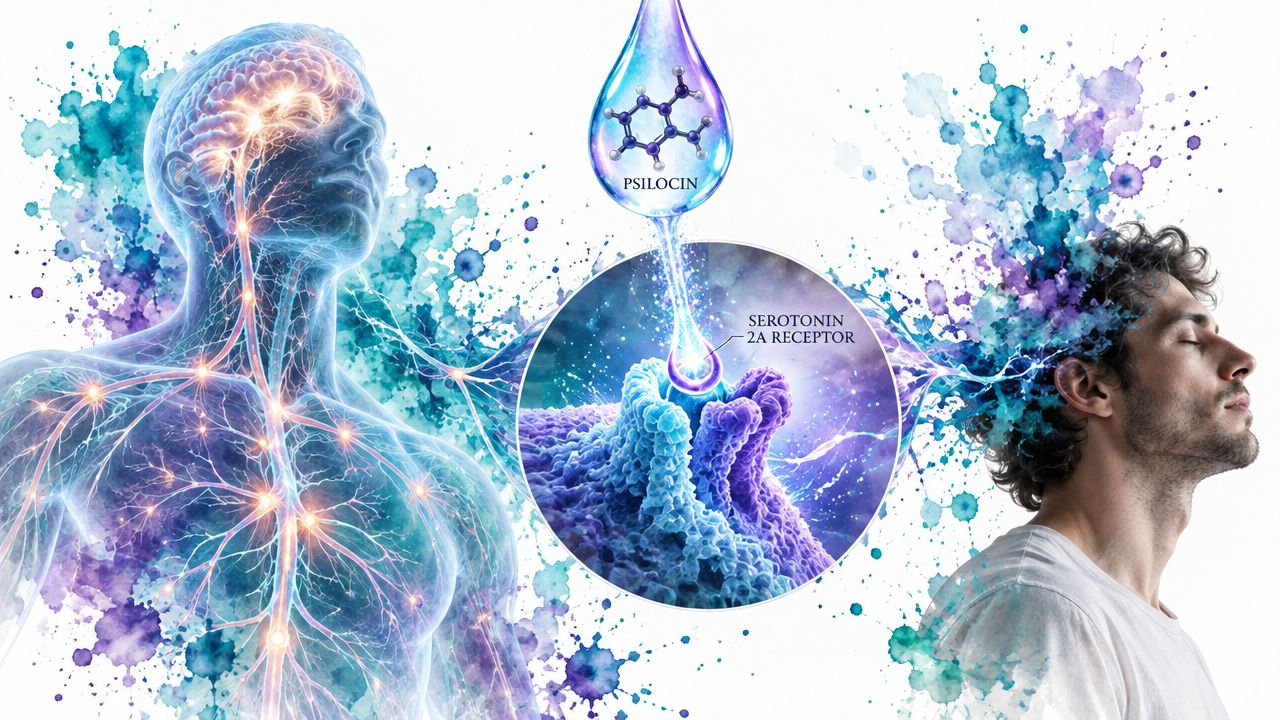
Psilocybin is converted in the body to psilocin, which acts as a 5-HT2A receptor agonist. That receptor action is part of why perception, mood, and thinking can shift so strongly. It's also why the experience isn't “just psychological.” The body responds too.
What the body does during onset
Many adults expect mushrooms to work only on visuals and emotions. In practice, the body often shows a stimulant-like pattern during onset and peak effects. Heart rate may rise. Blood pressure may rise. Some people feel flushed, shaky, or physically “amped up” even if they took mushrooms hoping for introspection.
The easiest way to picture it is a stress-and-stimulant response. Think of the body reaction some people get from a strong coffee on an empty stomach: butterflies, slight nausea, a racing pulse, dry mouth, and a sense that the system has been pushed upward. Psilocybin can produce a version of that pattern, then layer altered perception on top of it.
Why nausea shows up so often
The gastrointestinal side is easy to underestimate. Some people experience nausea, stomach cramping, or vomiting early in the session. Part of that is the body's general autonomic response. Part of it may reflect the fact that mushroom products themselves are variable, and some people are sensitive to the material they ingest even before the psychoactive effects fully develop.
The “trip” is only part of the experience. For many people, the first effects are physical.
Why two people can react very differently
Confusion starts. A dose that feels manageable for one person can feel intense for another. Body size, metabolism, recent food intake, current stress, sleep, and the mushroom species all change the response. Processed products add another layer, because the stated amount on a label may not tell you much about what's in the product or how evenly it's distributed.
That's why magic mushrooms risks can't be reduced to one generic timeline or one universal dose story. The brain effects and the body effects arrive together, but they don't land the same way in every person.
The Most Common Physical Side Effects in Clinical Trials
Across controlled psilocybin studies, the short-term physical side effects show up in a fairly consistent pattern. A pooled clinical safety review found higher relative risks for headache (RR 1.99), nausea (RR 8.85), anxiety (RR 2.27), dizziness (RR 5.81), and increased blood pressure (RR 2.29), with these effects typically starting during the session or within the first day and usually settling within 48 hours (pooled clinical safety review).
That pattern matters because it gives a clean baseline. In trials, the substance is known, the dose is measured, and participants are monitored. So the question is not whether psilocybin can cause physical side effects. It clearly can. The more useful question is what those effects usually look like, and how much confidence you should place in trial data if your reference point is real-world mushroom use.
What these side effects usually feel like
The common reactions are usually uncomfortable rather than medically dramatic.
A headache often shows up later in the session or the next day. Nausea tends to appear earlier, sometimes with stomach cramping or vomiting. Dizziness may be more noticeable during the come-up or when standing. Anxiety can feel partly mental and partly physical, with chest tightness, shakiness, or a sense that the body is running too fast. Blood pressure can rise during the peak, which may not matter much for a healthy screened volunteer but matters more for someone with hypertension or an unrecognized heart problem.
A simple way to read this list is to separate nuisance effects from risk amplifiers. Headache and nausea are common nuisance effects. Blood-pressure elevation and strong physical anxiety are the ones that can become more significant when another vulnerability is already present.
| Adverse Event | Approximate Incidence | Typical Duration | Relative Risk vs. Control |
|---|---|---|---|
| Headache | Not quantified in the verified data | During the session or within 24 hours, often resolving within 48 hours | RR 1.99 |
| Nausea | Not quantified in the verified data | During the session or within 24 hours, often resolving within 48 hours | RR 8.85 |
| Anxiety | Not quantified in the verified data | During the session or within 24 hours, often resolving within 48 hours | RR 2.27 |
| Dizziness | Not quantified in the verified data | During the session or within 24 hours, often resolving within 48 hours | RR 5.81 |
| Increased blood pressure | Not quantified in the verified data | During the session or within 24 hours, often resolving within 48 hours | RR 2.29 |
What clinical trials clarify, and what they miss
Clinical trial data are useful for one narrow job. They show the physical effects of psilocybin under relatively controlled conditions.
That leaves out a lot.
Trial participants are screened ahead of time. People with unstable medical or psychiatric conditions are often excluded. Staff can respond if someone becomes panicked, vomits repeatedly, or develops a concerning spike in blood pressure. The product is also known in identity and dose, which removes a major source of real-world risk.
So these findings are best treated as a floor, not a ceiling. They describe what happens when psilocybin itself is used in a more controlled setting. They do not capture the added hazards seen in poison-center calls and emergency departments, where the problem may involve higher-than-expected doses, mixed substances, serotonergic medications, cardiovascular strain, or products that are not psilocybin at all.
That distinction is easy to miss. Clinical trials help answer, “What does pure psilocybin commonly do to the body?” Emergency cases often answer a different question: “What happens when a person takes an uncertain product in an uncertain context?”
Psychological Risks Beyond the Bad Trip
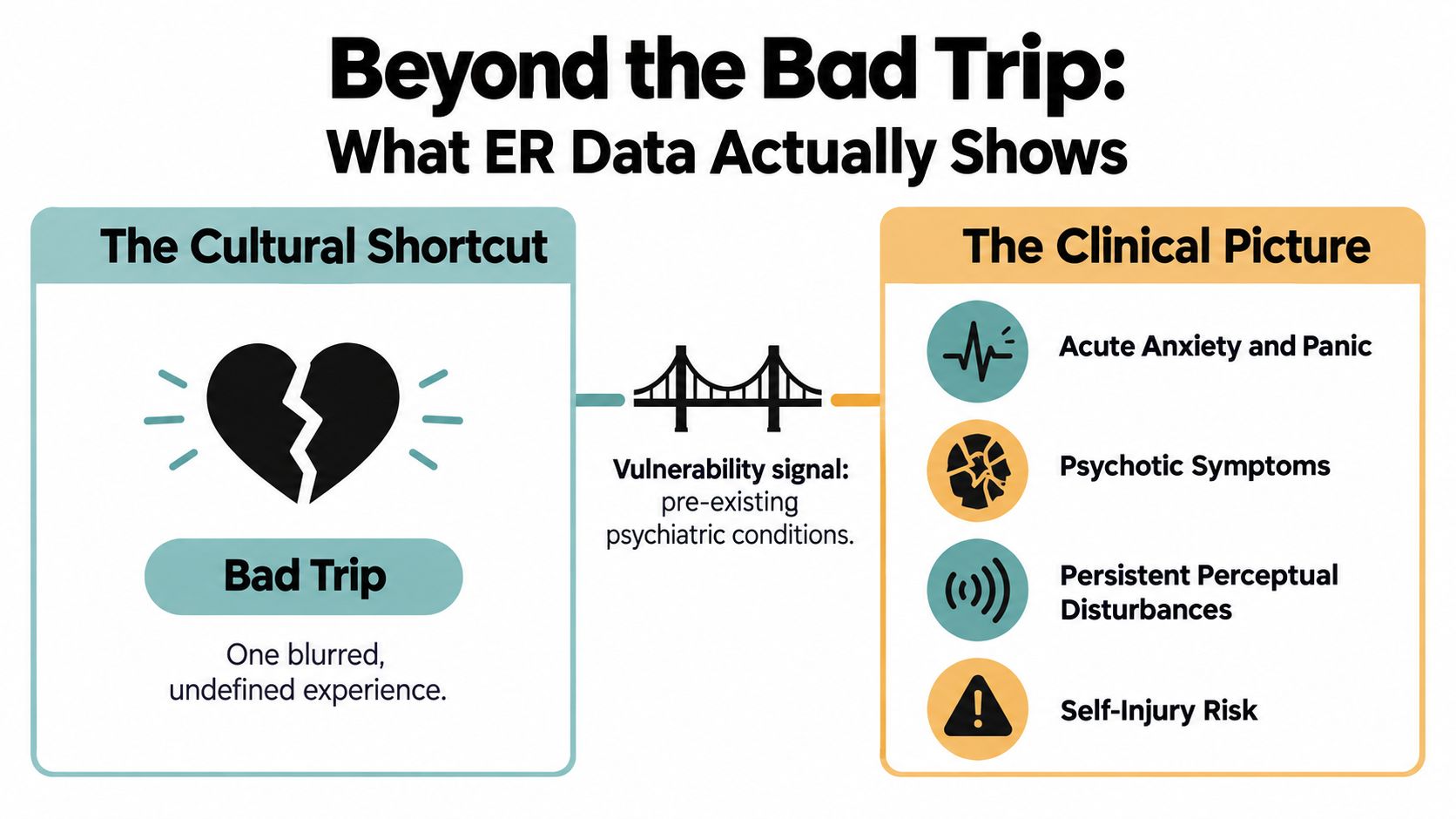
“Bad trip” is popular language because it's simple. It's also too vague to be useful. It blurs together panic, confusion, psychotic symptoms, self-harm risk, and longer-lasting psychiatric fallout as if they were one thing.
What emergency data actually signals
The clearest warning sign in the literature is not that everyone who uses hallucinogens faces the same psychiatric danger. It's that a subgroup appears much more vulnerable. In a population-based cohort of 9,244,292 people, an emergency department visit involving hallucinogen use was associated with a 21-fold higher 3-year risk of schizophrenia spectrum disorder versus the general population (3.99% vs 0.15%), and the excess risk remained 3.5-fold higher after adjustment for sociodemographic factors and comorbid mental and substance use disorders (population-based emergency cohort study).
That doesn't prove mushrooms cause schizophrenia in every case. It does show that severe hallucinogen-related emergency presentations can act as a strong vulnerability signal. For adults with a personal history of psychosis, a first-degree family history of schizophrenia, bipolar I disorder, or repeated severe reactions to psychedelics, this is a serious caution flag.
More precise than “bad trip”
A better mental model is to separate several different experiences that often get lumped together:
- Acute panic or terror during intoxication
- Psychotic symptoms such as delusional thinking or marked detachment from reality
- Depersonalization or derealization that can linger after the peak
- Behavioral risk when judgment and perception become unreliable
For readers thinking beyond the immediate experience, this overview of long-term effects of psychedelic mushrooms is a useful companion to the acute-risk picture.
If you already know you're vulnerable to psychosis or mania, the question isn't whether someone else handled mushrooms well. The question is whether your own risk profile is different.
Who should treat screening as essential
Some people shouldn't rely on reassurance from friends. Screening matters more for:
- People with personal or family history of psychosis
- People with bipolar-spectrum symptoms, especially mania history
- Anyone in an unstable mental state
- People who've had prior severe psychedelic reactions
- Adults with cognitive decline or major confusion risk
For these groups, magic mushrooms risks are less about a rough evening and more about the possibility of crossing into territory that needs medical care.
Product Quality, Cardiovascular Load, and Look-Alike Danger
One of the biggest gaps in public discussion is that clinical safety numbers apply to known psilocybin, not to random mushroom products. Once whole mushrooms, homemade edibles, retail gummies, or unlabeled chocolates enter the picture, risk stops being only about psilocybin and starts being about identification, composition, and dose.
The cardiovascular piece most people skip
Recent reviews report average acute increases of about 19.0 mmHg systolic and 8.7 mmHg diastolic blood pressure during supervised psilocybin sessions, with peak effect usually 60 to 90 minutes after dosing and resolution within 4 to 6 hours. The same review notes that serious acute events are uncommon in selected participants, but risk changes with cardiovascular disease, interacting medications, repeated exposure, and non-standardized mushroom products whose alkaloid content can vary by more than an order of magnitude (cardiovascular safety review).
That's the under-discussed issue. A healthy person may ride out a temporary blood-pressure rise without much trouble. Someone with uncontrolled hypertension, arrhythmia risk, or recent cardiac problems may not.
Why retail and street products change the equation
A public-health review highlights expanding use of unregulated mushrooms, high variability in composition, and common co-use with other substances as urgent harm-reduction concerns. It also notes adulteration risk, including possible contamination with fentanyl, and warns that poisonous look-alike mushrooms can cause fatal poisoning (public-health review on unregulated mushrooms and adulteration).
If you're evaluating packaged products rather than whole identifiable mushrooms, independent verification matters. Resources on third-party lab testing for mushroom products can help adults understand what to look for before they trust a label.
| Risk Factor | Clinical-Grade Psilocybin | Street/Retail Products |
|---|---|---|
| Dose certainty | Known dose under supervision | Often uncertain or inconsistently distributed |
| Product identity | Verified compound | May be misidentified mushrooms or mixed ingredients |
| Cardiovascular monitoring | Screening and observation are built in | Often none |
| Composition variability | Standardized | Alkaloid content may vary by more than an order of magnitude |
| Adulteration risk | Controlled manufacturing context | Meaningful concern in chocolates, gummies, capsules, and powders |
| Look-alike poisoning | Not the core issue | Major risk with misidentified wild mushrooms |
The bottom line is simple. Clinical reassurance doesn't transfer cleanly to unverified products.
Medication Interactions and Health Conditions That Raise Risk
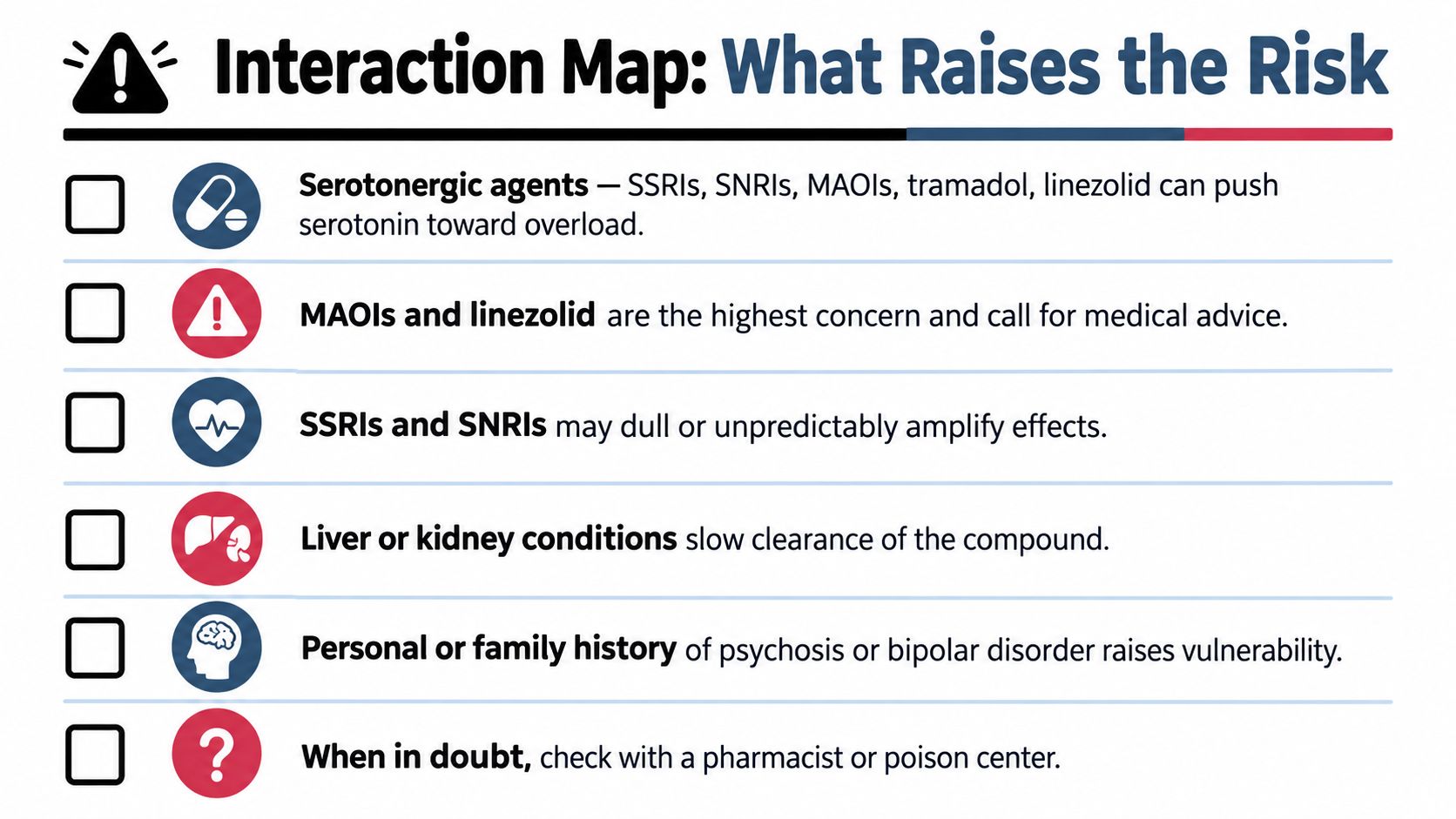
Medication questions deserve more attention than they usually get. Psilocybin acts on serotonin systems, so the interaction question isn't hypothetical. A review of serotonin toxicity risk found that psilocybin's 5-HT2A agonism creates a theoretical mechanism for serotonin toxicity, but published literature suggests the risk is generally low when psilocybin is used alone. Risk may rise when it's combined with other serotonergic agents, and documented cases are uncommon (review of psilocybin and serotonin toxicity).
Medications that deserve a pause
The most important principle is not memorizing a single forbidden list. It's recognizing when another drug may raise serotonin activity, alter blood pressure, or destabilize mood.
Examples that call for extra caution include:
- SSRIs and SNRIs, because effects may be blunted or become less predictable
- MAOIs and linezolid, because they raise more serious interaction concerns
- Tramadol, which adds serotonergic complexity
- Lithium, because mood stability matters as much as chemistry
- Stimulants and some tricyclics, because cardiovascular strain can stack
For a deeper medication-specific overview, see this guide to psilocybin drug interactions.
Health conditions that raise the stakes
Some conditions make the usual short-term effects harder to tolerate safely:
- Uncontrolled hypertension
- Recent cardiac events
- Known arrhythmia history
- Active seizure disorders
- Pregnancy
- Psychosis or bipolar-spectrum vulnerability
Bring a real checklist to a clinician or pharmacist. “I'm thinking about using mushrooms” is much more useful than guessing on your own about one medication at a time.
Harm-Reduction Practices That Actually Lower Risk
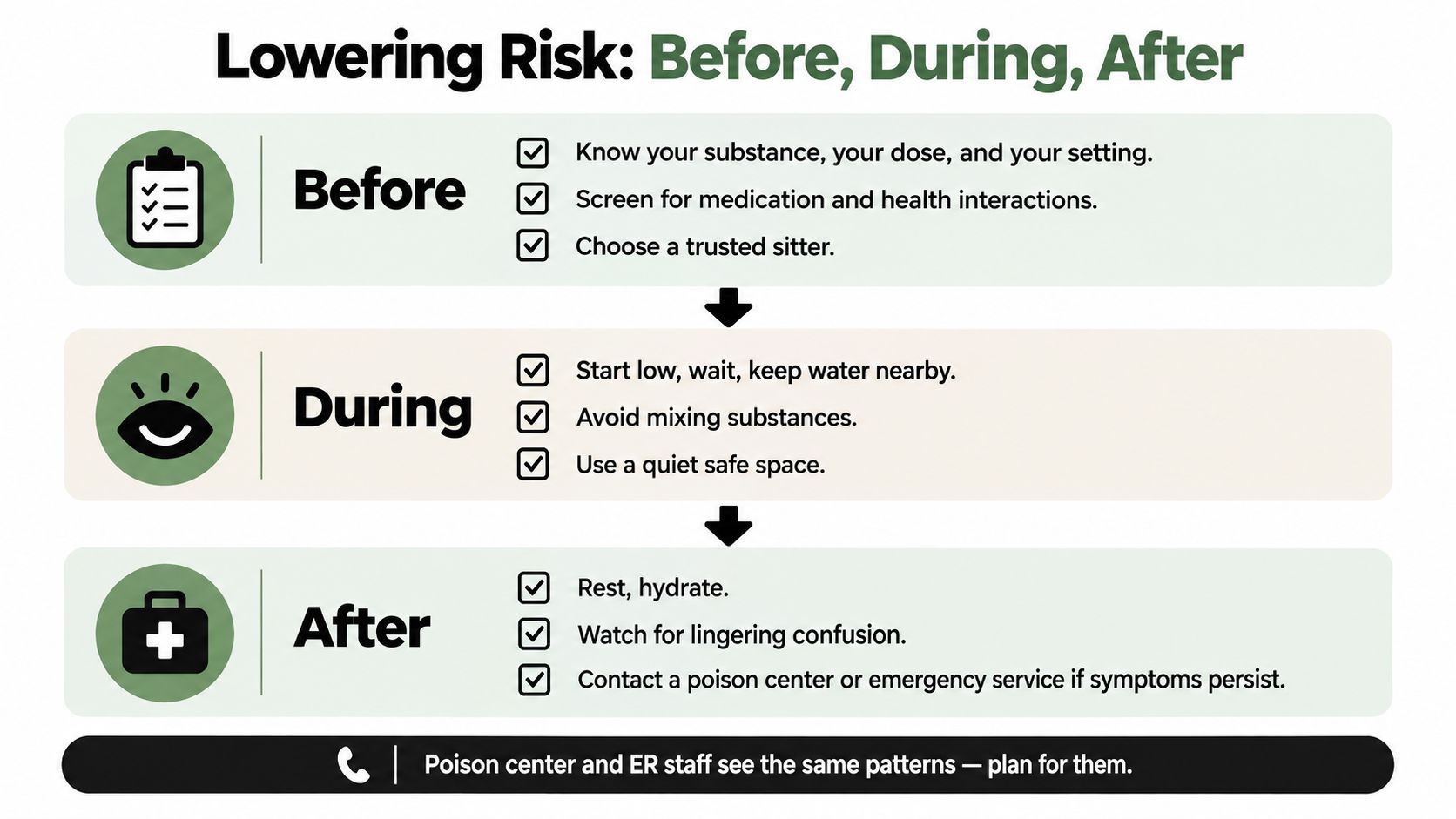
A large share of serious mushroom-related problems are not caused by psilocybin alone. They happen because the dose is unclear, the product is misidentified, other substances are added, or no one has a plan when the experience turns confusing. That gap matters because clinical trials screen participants, measure doses, and monitor vital signs. Real-world use often does none of those things.
Harm reduction works like adding guardrails before a sharp curve. It does not make use risk-free. It lowers the chance that a predictable problem becomes a crisis.
Before, during, and after
Before use: Reduce uncertainty first. Verify what the product is, avoid casual use of unlabeled edibles or powders, measure the amount with a scale rather than estimating by eye, and choose a day when sleep, stress, and mood are reasonably stable. A basic pre-check helps: when did you last eat, are you already anxious, and is there any realistic way you could need to drive or make important decisions later?
During the session: Keep the setting simple and controlled. A sober sitter lowers risk because they can notice overheating, panic, vomiting, chest symptoms, or unusual confusion earlier than the person who is intoxicated. Use one substance only. Mixing in alcohol, stimulants, or cannabis can make the experience harder to read and harder to manage.
After the session: Give recovery its own time block. Drink fluids, eat if tolerated, sleep, and avoid driving or trying to "push through" lingering impairment the next morning. Some people feel emotionally open or mentally tired for hours after the main effects fade, which is another reason not to stack obligations around the experience.
This short video is a good companion to the checklist approach:
The avoidable mistake: shared, unmeasured dosing
One of the most common real-world errors is group splitting. A bag, chocolate bar, or gummy package gets divided casually, and each person assumes the pieces are equal. That assumption often fails. Mushrooms are biological material, not manufactured tablets, and infused products may be mixed unevenly or contain something other than what the label suggests.
A safer approach is boring on purpose. One person keeps track of what the product is supposed to be, how much each person took, what time it was taken, and whether anything else was used. If a medical problem develops later, that record helps far more than vague memory.
Adults trying to reduce product uncertainty may also look for sellers that separate products clearly and include safety reading. The Magic Mushroom Delivery is one example. That kind of information can help people ask better questions before use, but it does not solve the bigger risks of mislabeling, adulteration, look-alike species, cardiovascular strain, or drug interactions.
A short practical checklist
- Know the source as well as you can. Unknown foraged mushrooms and unlabeled edibles carry a different risk profile than a product with at least some traceable description.
- Measure, don't guess. Eyeballing dried mushrooms is like pouring medicine without reading the line on the cup.
- Keep one sober person available. Calm supervision is often the difference between a manageable scare and an emergency visit.
- Stay in a familiar place. Simple surroundings reduce panic and reduce accident risk.
- Keep your phone charged and accessible. If symptoms become physical, speed matters.
- Do not redose just because the onset feels slow. Delayed effects are a common setup for taking more than intended.
- Treat unusual chest symptoms, collapse, seizure activity, or severe overheating as medical problems, not part of the trip.
The practical theme is consistency. Clinical settings lower risk by controlling dose, screening participants, and monitoring what happens. Harm reduction in the world aims for the same logic, even when the setting is far less controlled.
When the Risk Becomes a Medical Emergency
Most unpleasant reactions don't become emergencies. Some do. The line is crossed when symptoms suggest cardiovascular strain, dangerous agitation, severe dehydration, seizure activity, or ingestion of the wrong product.
Red flags that need urgent care
Seek urgent medical help for:
- Chest pain or shortness of breath
- Seizures
- Loss of consciousness
- Persistent vomiting with signs of dehydration
- Severe agitation, violent behavior, or self-harm risk
- Marked overheating
- Suspected look-alike poisoning or adulterated product exposure
These are not “wait and see” symptoms. They point to mechanisms already discussed above: cardiovascular stress, toxic misidentification, severe psychiatric decompensation, or a mixed-substance problem.
A simple decision framework
Risk is always a mix of probability and context. The same compound can present one level of risk in a screened, supervised setting and a very different level in solo use with an unknown product and an unreviewed medication list.
If someone needs medical help, honesty helps clinicians help faster. Tell poison-center staff or emergency clinicians what was taken, when it was taken, how much is known about the product, and whether other substances were involved. The common mistake is assuming that because supervised psilocybin research exists, a street or retail product must behave the same way. It might not.
The Magic Mushroom Delivery offers psilocybin and mushroom products alongside educational guides that help adults think more carefully about dosing, duration, interactions, and product choices. If you want to keep learning with a harm-reduction lens, visit The Magic Mushroom Delivery and use its resource library to ask better questions before you make any decision.