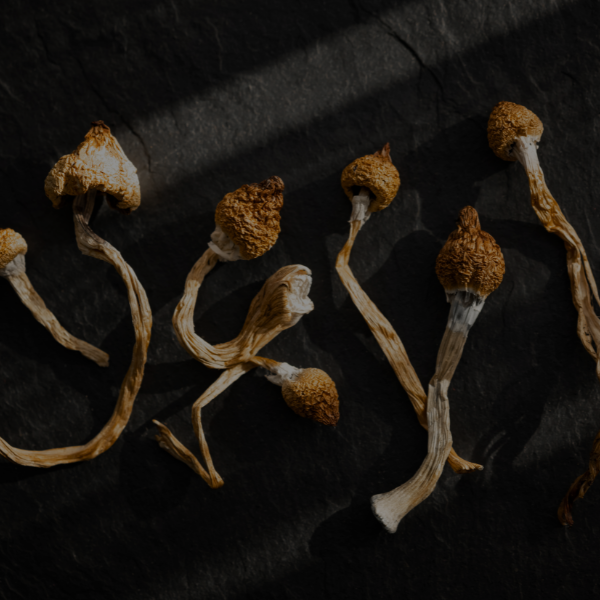

Magic mushrooms are fungi that contain the natural psychoactive compound psilocybin, which the body converts into psilocin and which acts mainly on serotonin receptors to change perception, mood, and thought. They aren't one single mushroom, either. They're a broad group of mushrooms, and that simple fact is where a lot of beginner confusion starts.
Hearing “magic mushrooms” often brings the trip to mind first. That misses some of the most useful beginner knowledge. If you're asking what is magic mushrooms, you probably also need to know why one mushroom can feel very different from another, why accidental exposure has become a bigger public-health issue, and why these mushrooms aren't the same thing as lion's mane, reishi, or mushroom coffee.
A clear answer starts with the basics and then adds the parts people usually skip.
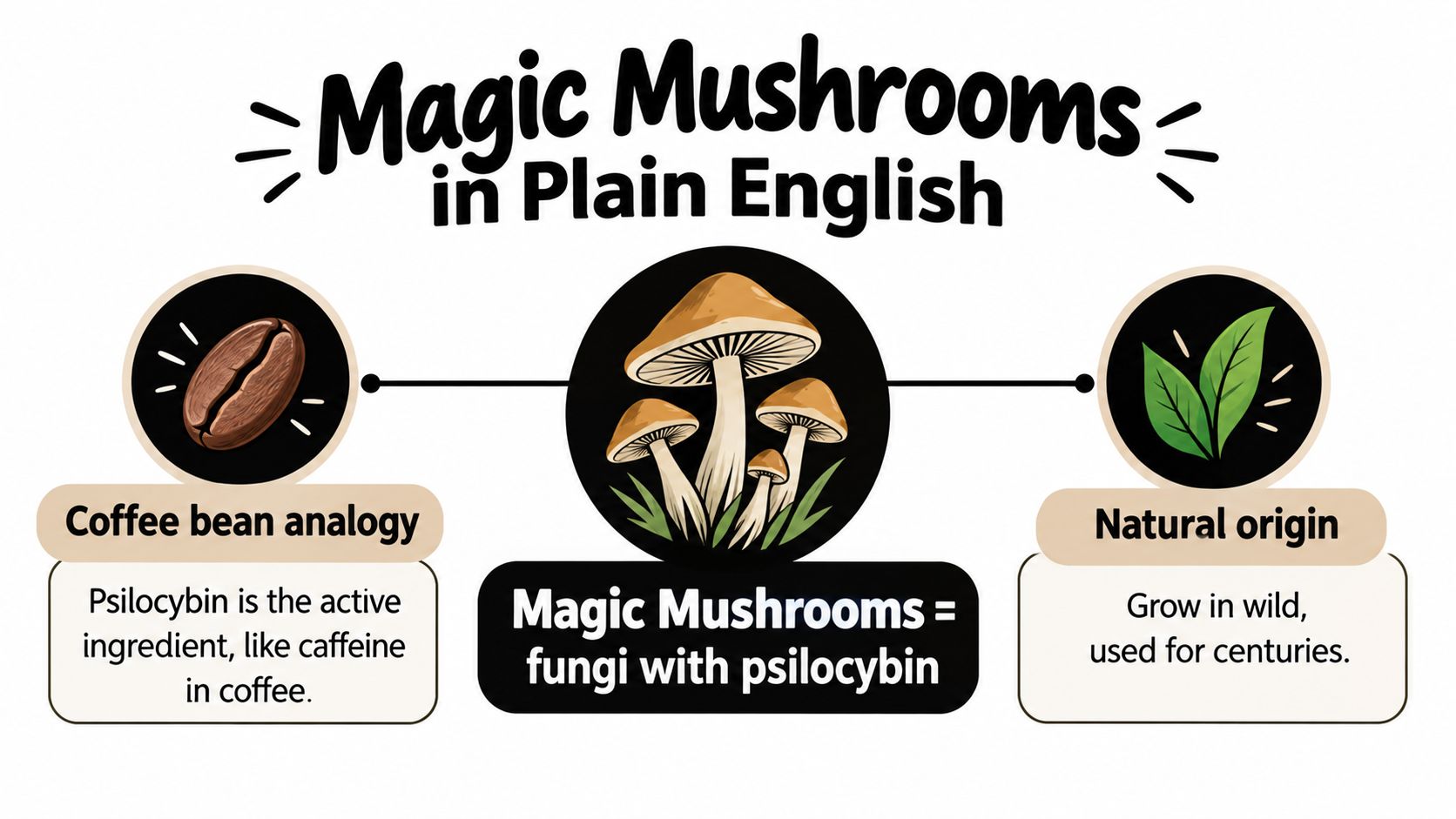
Magic Mushrooms in Plain English
What are people talking about when they say “magic mushrooms”?
At the simplest level, they mean mushrooms that naturally contain psilocybin. That is the key label for beginners. “Magic mushrooms” is the common nickname, while psilocybin mushrooms is the more precise term.
The easiest way to sort this out is to separate the organism from the compound inside it. Coffee beans contain caffeine as their active compound. In the same way, certain mushrooms contain psilocybin. People often use the mushroom's nickname to refer to the effects, but the effects are tied to the compound the mushroom carries.
They're a category of mushrooms
A lot of first-time confusion starts here. “Magic mushrooms” does not refer to one standard mushroom that always looks, acts, or tests the same.
It refers to a broad group of fungi. Different species can contain psilocybin, and those species can differ in strength, appearance, and typical use. That helps explain why two mushrooms sold or described under the same casual label may not produce the same experience.
Names like Psilocybe cubensis and Psilocybe azurescens are examples of species within that larger group. For a beginner, the practical takeaway is simple. The nickname sounds singular, but the category is not.
Why beginners should care about that distinction
This matters for more than vocabulary.
First, potency can vary. One species may be much stronger than another, and even mushrooms from the same batch may not be identical. That is one reason beginner articles that focus only on “the trip” leave out useful real-world context.
Second, accidental exposure is a real issue. Wild mushrooms can be misidentified, and edible, toxic, and psychoactive species do not come with labels. For someone new to the topic, “it's a mushroom” is nowhere near enough information to judge what it is or what it might do.
Third, psilocybin mushrooms are different from wellness mushrooms. Lion's mane, reishi, cordyceps, and chaga are usually discussed for food, supplement, or functional-use purposes. Psilocybin mushrooms belong in a different category because they can alter perception, mood, and thinking.
A short version to keep in mind:
- Magic mushrooms are fungi that contain psilocybin
- They are a group of species, not one uniform product
- Strength can vary more than beginners often expect
- They are not interchangeable with functional mushrooms like lion's mane or reishi
How Psilocybin Works Inside the Body
Psilocybin itself isn't the final actor. After oral ingestion, the body converts it into psilocin, and psilocin is the compound that crosses the blood-brain barrier and acts mainly as a partial agonist at serotonergic 5-HT2A receptors. That receptor activity is tied to changes in perception, cognition, and emotion rather than a simple “upper” or “downer” effect (review of psilocybin pharmacology and kinetics).
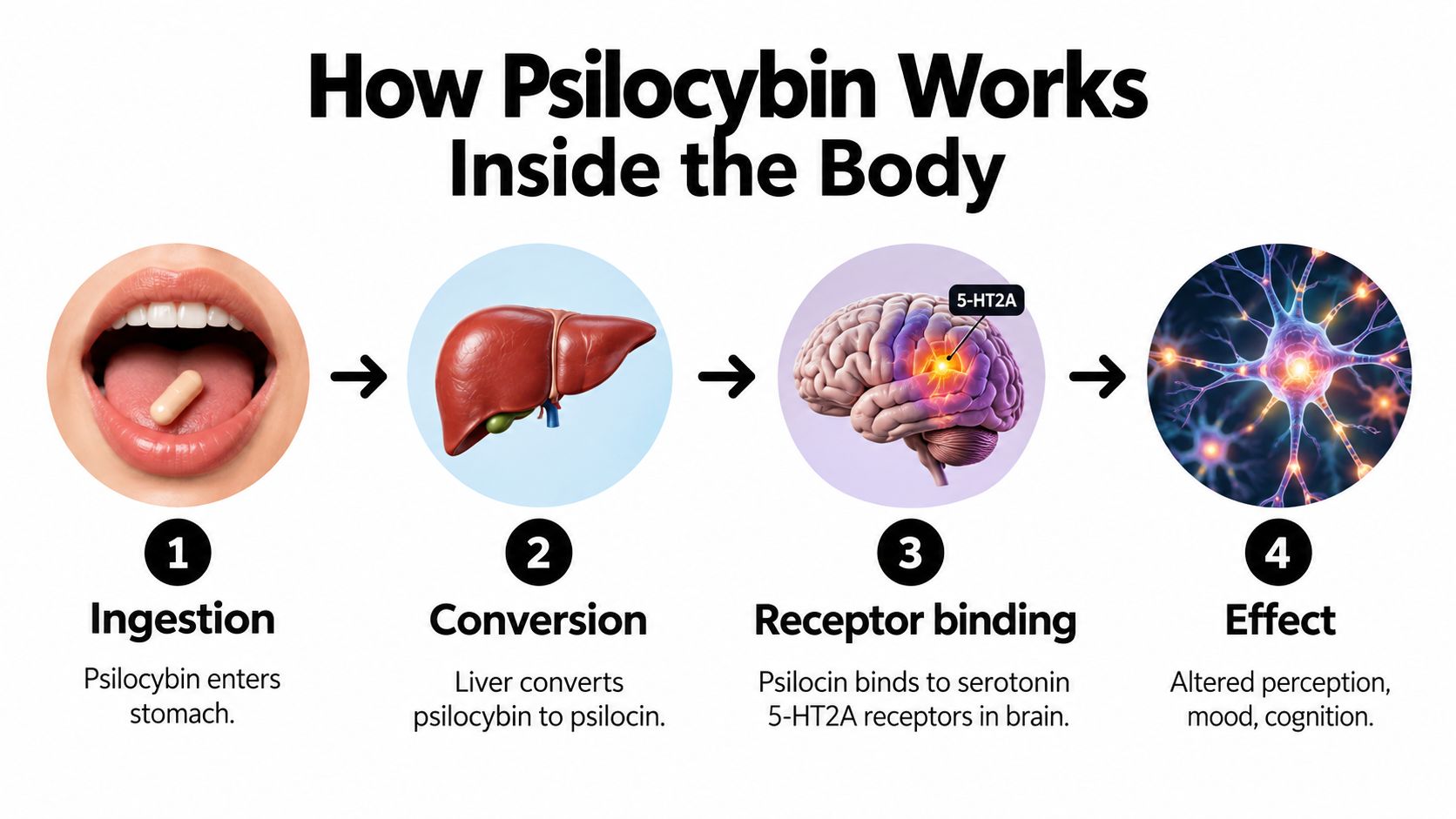
What that means in everyday terms
A simple way to picture it is this. Psilocybin is like a packaged form that the body opens. Once converted to psilocin, the active compound interacts with serotonin-related signaling in the brain. Because serotonin systems are involved in multiple kinds of mental activity, the effects don't arrive in just one lane.
That's why people don't report only one change. They may notice shifts in:
- Perception: colors, patterns, sound, or a sense of space can feel altered
- Mood: feelings may become more fluid, intense, or emotionally open
- Thought: attention, associations, and self-reflection can change together
For a deeper plain-language overview, this guide on psilocybin effects on the brain can help connect the biology to the lived experience.
Why timing matters
This same pharmacology helps explain the timeline people notice. The onset is typically 20 to 40 minutes after oral ingestion, peak subjective effects are around 60 to 90 minutes, and the active duration is about 4 to 6 hours according to the pharmacology review linked above.
Food intake, timing, and individual metabolism can all change how this feels in practice. Two people can consume what seems like the same amount and still have noticeably different experiences. One may feel effects fairly quickly on an empty stomach. Another may have a slower rise and a different intensity.
The mechanism matters because it explains the whole arc. You're not watching a switch flip on. You're watching a compound get absorbed, converted, distributed, and then gradually cleared.
That also helps explain why redosing can create confusion. A person may think “nothing is happening yet,” take more, and then end up stacking effects as the first amount begins to fully come on.
Common Psilocybin Species and Why Potency Varies
A beginner can hear the phrase "magic mushrooms" and assume it refers to one fairly consistent thing. It does not. "Magic mushrooms" is closer to saying "dogs" than saying "golden retrievers." The group includes different species, and those species can differ in strength, growing habits, and the way people talk about them.
That matters for a practical reason. Two dried mushrooms can look similar enough to a new user, yet carry very different amounts of psilocybin and psilocin. That gap is one reason accidental overexposure happens. A person may assume they are taking a familiar amount when they are working with a stronger species or a stronger batch.
Four names you'll hear often
These are some of the names that come up often in beginner conversations:
| Common Psilocybin Species at a Glance | Typical Psilocybin Range | Relative Potency | Setting |
|---|---|---|---|
| Psilocybe cubensis | Variable across samples | Often treated as a common reference point | Frequently discussed in cultivated contexts |
| Psilocybe semilanceata | Varies by specimen and growing conditions | Often described as stronger than its small size suggests | Commonly associated with wild temperate grasslands |
| Psilocybe azurescens | Reported as potent in comparative discussions | High | Often discussed as a potent wild species |
| Panaeolus cyanescens | Variable | Often regarded as strong | Commonly discussed in tropical and subtropical settings |
If you want a species-by-species orientation, this overview of types of Psilocybe mushrooms is a useful starting point.
Why one batch can feel unlike another
Weight sounds simple. Potency is not.
A gram is only a measure of mass. It does not tell you how much active compound is packed into that mass. Mushrooms are living organisms, not factory-made tablets, so the chemistry can shift in ways that are invisible to the eye.
Species is one part of the story. Strain, growing conditions, harvest timing, storage, and even which part of the mushroom is used can also affect strength. Cap and stem are not always identical. Two mushrooms from the same bag are not guaranteed to match each other closely either.
A PubMed-indexed article that summarized testing from decriminalized regions found wide variability in psilocybin potency across mushrooms, with differences greater than twenty-fold in the samples reviewed (PubMed summary of mushroom potency variability). Published analytical work on Psilocybe cubensis also found measurable variation across five dried strains (PubMed study on strain variation in Psilocybe cubensis).
That helps explain a common beginner mistake. Someone hears that a friend took "one gram" and treats that number like a universal setting, the way you might copy a coffee order. Mushrooms do not work that way. One gram of a milder sample can be a very different experience from one gram of a stronger species or a better-preserved batch.
Practical takeaway: The same weight can produce different effects.
This is also a good place to separate psilocybin mushrooms from wellness mushrooms such as lion's mane or reishi. Lion's mane products are usually discussed in terms of routine supplementation and functional effects. Psilocybin mushrooms bring intoxication, altered perception, and a much higher consequence for potency mistakes or accidental exposure. That difference is basic, but beginners often blur the categories because both are sold and discussed under the broad label of "mushrooms."
For a first-time reader, the safest mental model is simple. Start by asking, "Which species is this, and how certain is that identification?" Then ask, "How much does anyone know about this batch?" Those two questions matter more than the mushroom's appearance alone.
What the Experience Actually Feels Like
For many people, the mushroom experience makes more sense as a timeline than as a list of effects. It usually unfolds in phases.
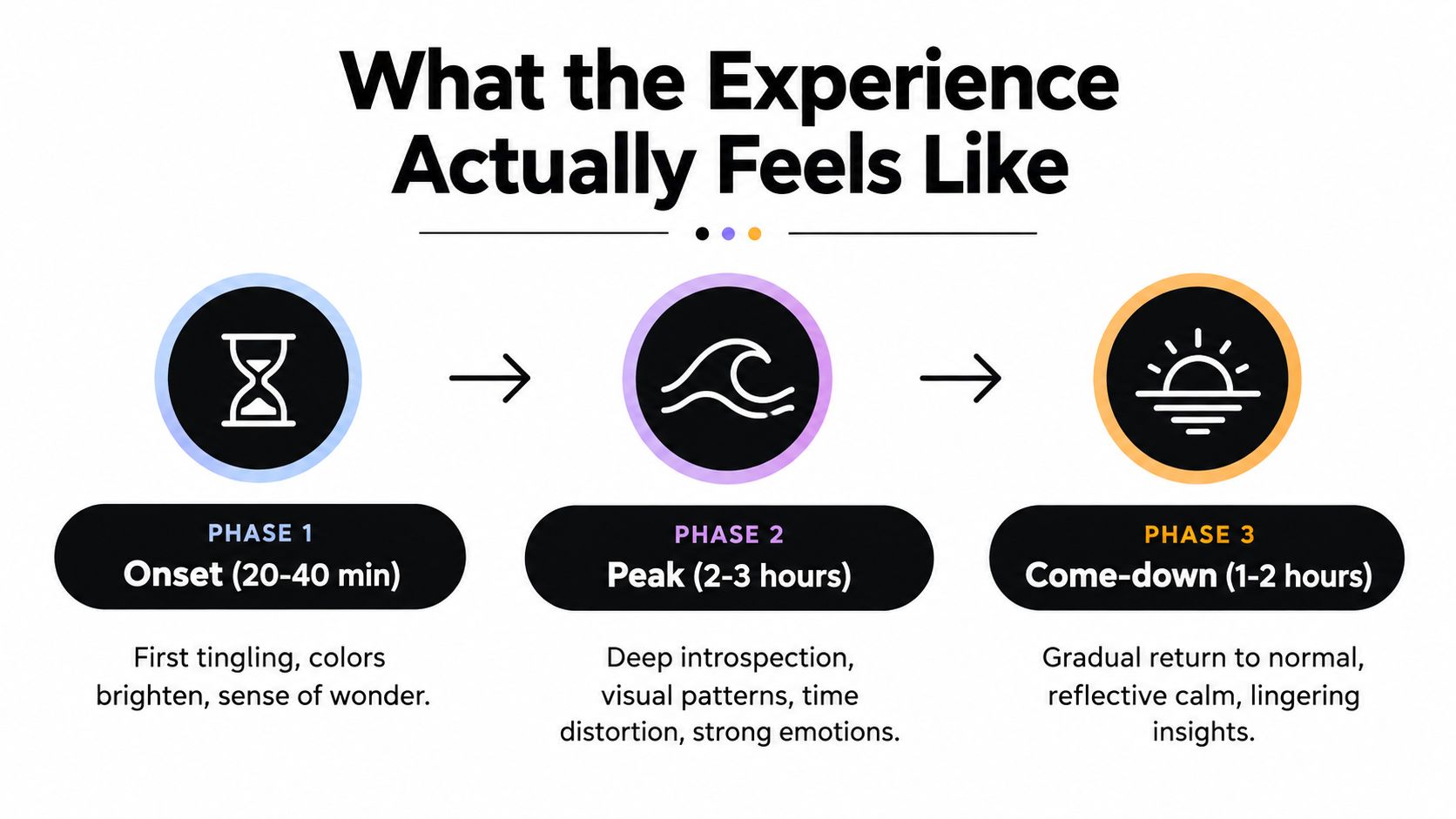
The beginning
The first phase is the onset. Oral psilocybin typically begins working within about 30 to 50 minutes, with reported onset ranging from 5 to 90 minutes depending on the source and situation, and the main effects usually last about 4 to 6 hours with some descriptions extending wider (Wikipedia overview of psilocybin timing).
In real life, the start can feel subtle. A person might notice a slight body buzz, a growing sensitivity to music, or the sense that ordinary visual details suddenly feel more vivid. It's a bit like the early moments after strong coffee, except the shift isn't just alertness. It's a broader change in how attention and perception land.
The middle
The peak is where the experience often becomes unmistakable. Colors may seem brighter. Patterns may look more alive. Music can feel textured, almost physical. Thoughts can move in unusual directions, with memories, feelings, and big-picture reflection surfacing all at once.
Set and setting matter a lot here. A calm room, a trusted person, and a settled mindset can shape the experience very differently from noise, conflict, or anxiety. The same mushroom can feel inviting in one context and overwhelming in another.
- Dose changes intensity: More material doesn't just “add a little more.” It can shift the whole character of the experience.
- Mindset changes interpretation: Nervous anticipation can amplify confusion, while preparation can make unusual sensations easier to tolerate.
- Environment changes comfort: Lighting, sound, company, and familiarity all matter.
The return
The last phase is the gradual comedown. The strongest distortions fade, thinking becomes more linear again, and many people feel reflective, mentally tired, or emotionally open.
That return isn't always dramatic. Often it feels more like a dimmer switch than a hard stop.
Many beginner misunderstandings come from expecting a clean, movie-style trip. In practice, the experience usually swells, crests, and slowly settles.
That's why timeline awareness matters. Knowing that the experience rises and falls in stages can make it feel less mysterious and more understandable.
A Short History of Magic Mushrooms
Magic mushrooms have a much longer history than modern internet culture suggests. According to the National Institute on Drug Abuse, they are not one species but a group of mushrooms containing psilocybin, and there is evidence of indigenous use in Central America as far back as 3000 B.C. Later history includes 16th-century Spanish accounts and a 1957 Western public introduction that helped spark modern scientific interest in psilocybin (NIDA overview of psilocybin and magic mushrooms).
A long human relationship
That timeline matters because it changes the frame. These mushrooms didn't suddenly appear in modern wellness culture. People in earlier societies already treated them as meaningful, powerful, and worthy of ritual context.
In many beginner conversations, history gets flattened into “people used them spiritually.” That's true, but it leaves out the continuity. Across very different cultures and centuries, people kept returning to the same basic idea. Certain mushrooms could alter consciousness in ways that felt important.
From traditional use to modern curiosity
The 1957 Western public introduction was a turning point because it brought wider attention to something that had already existed for a very long time. That helped launch modern scientific and cultural interest in psilocybin.
A short chronological view helps:
- Ancient use in Central America: Evidence reaches back to 3000 B.C.
- Colonial-era written accounts: Spanish observers documented mushroom use in the 16th century
- Modern public awareness: A 1957 introduction brought the topic to much wider Western attention
That repeated reappearance is part of why the subject keeps resurfacing. It sits at the intersection of culture, ritual, curiosity, and altered states of mind.
Why Magic Mushroom Use Is Rising and What That Means
A lot of beginner content still treats psilocybin mushrooms like a fringe topic. Current use patterns suggest something broader is happening.
Rising use is part of the story
A 2025 multi-source observational study reported that U.S. adult lifetime psilocybin use rose from 10% in 2019 to 12.1% in 2023, and past-year use rose among adults 30+ by 188% over the same period. The same study reported poison-center exposure calls increased 201% in adults and 723% in children under 12 (Denver Health summary of the 2025 psilocybin study).
NIH also reports that in 2022, 11.3% of people age 12 or older in the United States said they had ever used psilocybin, while law-enforcement seizures increased from 402 in 2017 to 1,396 in 2022 (NIH infographic on psilocybin seizures and use).
| Past-Year Psilocybin Use Among U.S. Adults | Past-Year Use (Adults 18+) |
|---|---|
| 2019 | Not specified in the verified data |
| 2023 | Not specified in the verified data |
The useful point isn't just “more people are interested.” It's that more households, friend groups, and social circles are likely to encounter these products or hear about them firsthand.
Why public-health literacy matters
As exposure rises, basic mushroom literacy matters more. One problem is simple confusion. People often use the word “mushroom” as if all mushroom products belong in the same bucket. They don't. Another problem is accidental exposure, especially when children encounter products adults didn't secure properly.
There's also the issue of wild mushroom confusion. Not every mushroom that looks vaguely similar is safe, and visual identification by amateurs can go wrong fast.
- Potency isn't obvious by sight: Two mushrooms can look similar and differ a lot in active compounds.
- Household exposure is real: Rising poison-center calls suggest more accidental contact, not just more intentional use.
- Wild foraging adds another layer of risk: Misidentification isn't a small mistake when the wrong species is involved.
The beginner question isn't only “what do magic mushrooms feel like?” It's also “how do I avoid confusing them with other mushroom products, or with unknown wild mushrooms?”
That's a much more practical place to start.
Psychedelic Mushrooms Versus Functional Mushrooms
One of the easiest beginner mistakes is mixing up psychedelic mushrooms with functional mushrooms. They may both be sold under the broad label “mushroom products,” but they are not interchangeable in chemistry, purpose, or effect.
Same kingdom, different category
Psilocybin mushrooms contain psilocybin and related tryptamine compounds. Their defining feature is psychoactive effect. Functional mushrooms such as lion's mane, reishi, cordyceps, and chaga are usually discussed for non-intoxicating wellness uses, often in teas, powders, capsules, or coffee blends.
If you want a basic orientation to that second category, this explainer on what functional mushrooms are gives the beginner version.
| Psychedelic vs Functional Mushrooms | Active Compounds | Primary Use | Regulation (US) | Effect |
|---|---|---|---|---|
| Psychedelic mushrooms | Psilocybin, psilocin, related tryptamines | Altered perception, mood, and thought | Federally controlled substance category in the U.S. | Intoxicating, psychoactive |
| Functional mushrooms | Compounds such as beta-glucans, hericenones, and triterpenes | Wellness-oriented use in foods and supplements | Commonly sold as dietary supplements or food products | Non-intoxicating |
Where people get tripped up
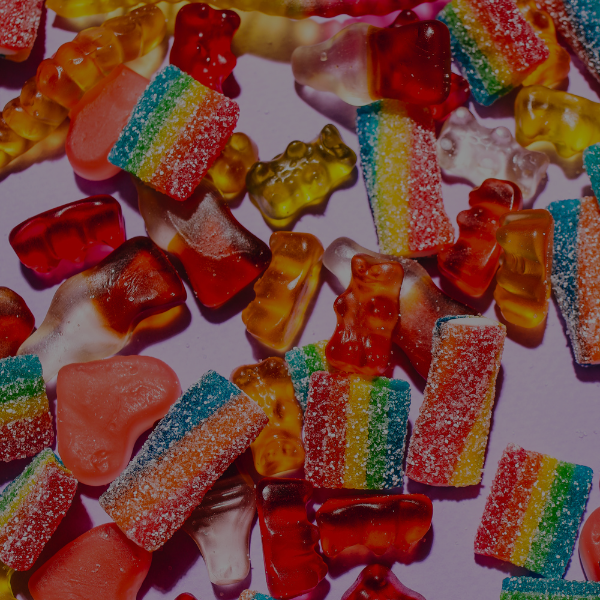
The confusion usually comes from marketing language. A shopper sees “mushroom gummies,” “mushroom coffee,” or “mushroom capsules” and assumes these products all sit on one spectrum. They don't.
Lion's mane coffee won't produce the same category of effect as Psilocybe cubensis. Reishi tea isn't a low-dose version of a psychedelic mushroom. Cordyceps capsules aren't “basically the same thing but milder.”
One practical example is The Magic Mushroom Delivery, which carries both psilocybin and functional mushroom product categories. That kind of catalog can be useful for comparison because it shows, in one place, that mushroom products can serve very different purposes depending on the ingredients.
A good beginner rule is to ask one question first: “Is this product meant to be psychoactive or non-intoxicating?” That clears up most of the confusion immediately.
Key Takeaways for Curious Beginners
What should a beginner remember after reading all of this, especially when mushroom products can look similar on a shelf but do very different things in the body?
Start with a simple two-step check.
The short version
- Check the label for the purpose first. If a product contains psilocybin, it belongs in the psychedelic category. If it lists lion's mane, reishi, cordyceps, or chaga without psilocybin, it belongs in the functional mushroom category.
- Treat grams as an incomplete measure. Weight tells you how much material you have, not how strong that material is. If potency information or lab testing is available, that gives a clearer picture than weight alone.
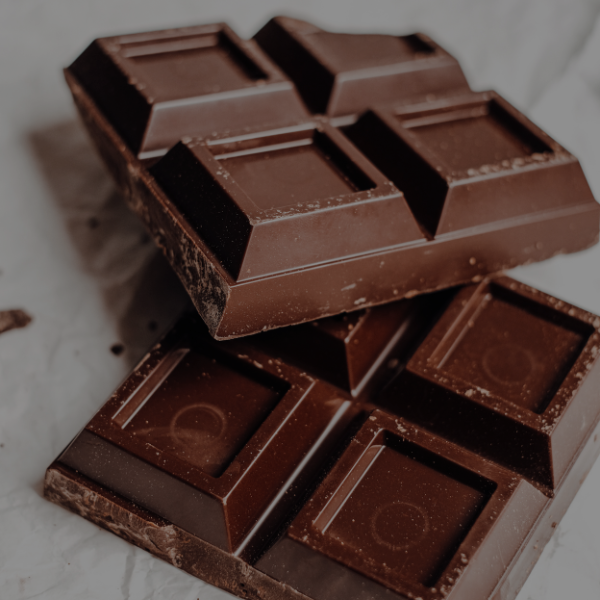
- Assume product form can hide important differences. A gummy, capsule, chocolate, tea, or dried mushroom can look easier to understand than it really is. The format does not tell you whether the contents are psychoactive.
- Accidental exposure is a real beginner risk. Shared kitchens, loosely stored edibles, and vague packaging can create confusion for adults, teens, and pets.
- Use extra caution with anything homemade or unlabeled. Two items that look alike can have very different contents, just like two unmarked spice jars can hold sugar in one and salt in the other.
- Keep identification and sourcing in the serious-details category. Curiosity is common. Guesswork is a bad tool for mushrooms.
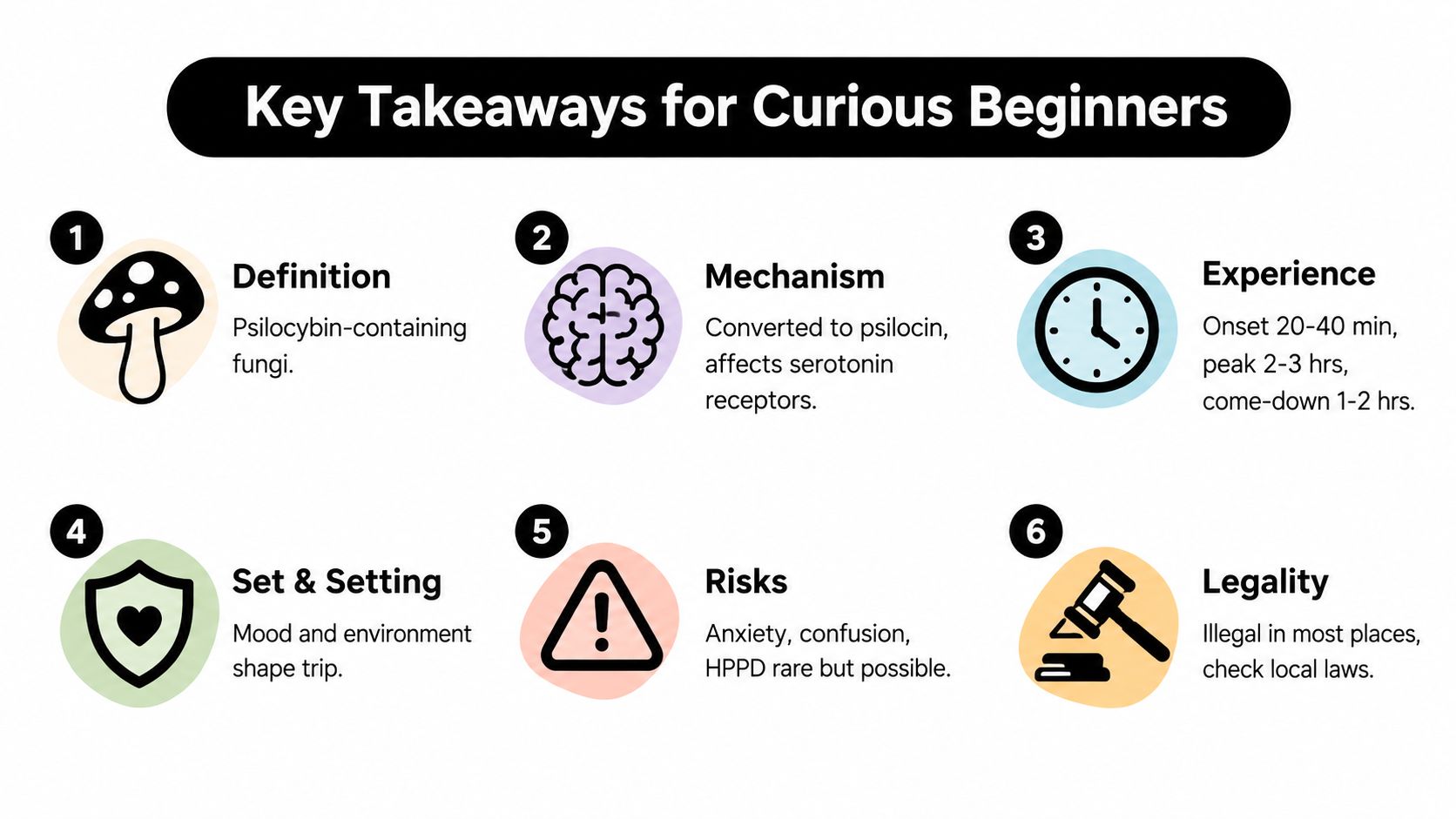
A helpful beginner rule is to separate three questions that often get blurred together: What is it, how strong is it, and how is it packaged? A lion's mane coffee product answers the first question clearly. An unlabeled chocolate does not. Dried mushrooms in the same weight can still differ in strength. Packaging can make two products look equally casual even when one is psychoactive and the other is not.
That is why the practical beginner mindset is less about hype and more about verification. Read the ingredient list. Check whether the product is meant to intoxicate or not. Treat potency claims carefully. Store anything psychoactive in a way that reduces mix-ups.
If you want to compare psilocybin products with functional mushroom options in one place, The Magic Mushroom Delivery offers raw mushrooms, chocolates, gummies, capsules, and mushroom coffee alongside educational guides for adults 21+. To explore those product categories and learn more about effects, timing, and mushroom basics, visit The Magic Mushroom Delivery.