
You're standing in the kitchen, short on time, watching a familiar pod drop into the brewer. The coffee is convenient, but the label raises new questions: How much caffeine is in it? Which mushroom species are present? Is the extract tested, or is “mushroom blend” doing all the marketing work?
Mushroom coffee pods can make a functional coffee routine easier, but convenience doesn't prove quality. The meaningful differences sit inside the details many product pages omit, including mushroom identity, fruiting body versus mycelium, extraction method, oxygen control, caffeine quantity, batch testing, and pod materials.
This guide evaluates those variables without treating wellness language as clinical evidence. It also separates what a pod can reliably deliver, such as a documented caffeine amount and repeatable brewing, from what it can't establish on its own, such as improved cognition or disease treatment.
Why Mushroom Coffee Pods Changed the Game
Your morning routine probably already has a place for a single-serve brewer. You add water, insert a capsule, press a button, and get a measured cup without weighing grounds or cleaning a filter. Mushroom coffee pods fit into that established behavior, which is why they're more than a novelty format.
Single-serve coffee's mainstream expansion accelerated around 2005 as pods, pads, cups, and capsules gained household adoption. A global single-serve coffee analysis estimated that these formats represented approximately 15% of at-home coffee retail volume in the United States, with adoption also reaching about 12% in Germany, 11% in Spain, 23% in France, 6% in Italy, 33% in the Netherlands, and 14% in Switzerland.
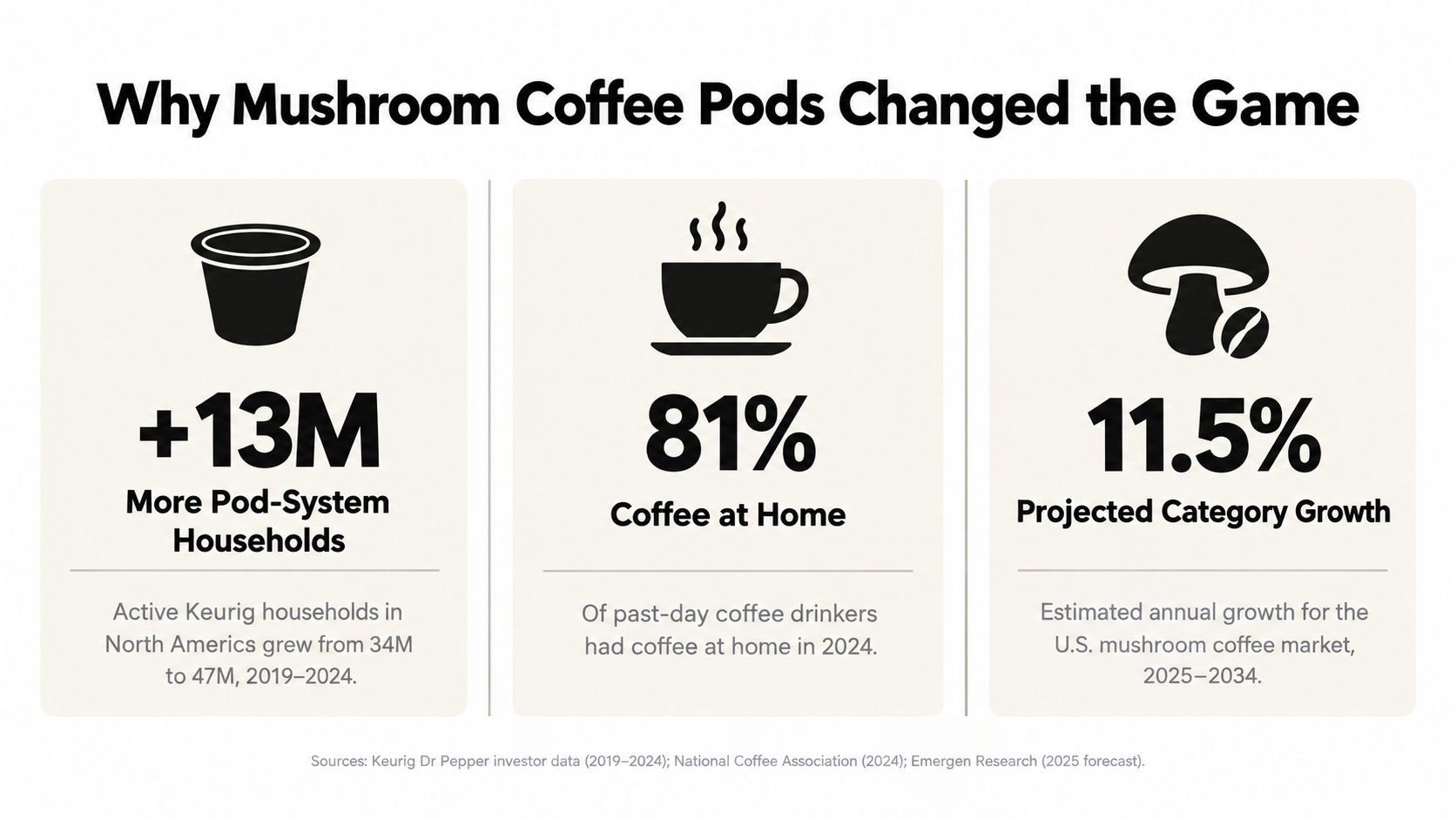
That history matters for two reasons. First, the pod is already a familiar preparation method, so buyers don't need to learn a new ritual. Second, the format creates expectations around portion control, speed, consistency, and machine compatibility. A functional product has to meet those expectations while making its mushroom formula verifiable.
Convenience is only the first filter
Lion's mane, reishi, chaga, and cordyceps can differentiate a pod from ordinary coffee, but a long ingredient list isn't proof of a meaningful serving. The coffee contributes the caffeine. The mushroom material contributes compounds such as beta-glucans. Those are separate functional components, and a quality label should let you evaluate both.
Use the category foundation as context, not as direct evidence of mushroom-pod sales. The cited figures describe single-serve coffee generally, but they show why mushroom coffee pods have a ready-made route into home brewing.
Practical rule: Treat convenience as the entry requirement. Treat transparent formulation and testing as the quality test.
Pod Types and Machine Compatibility
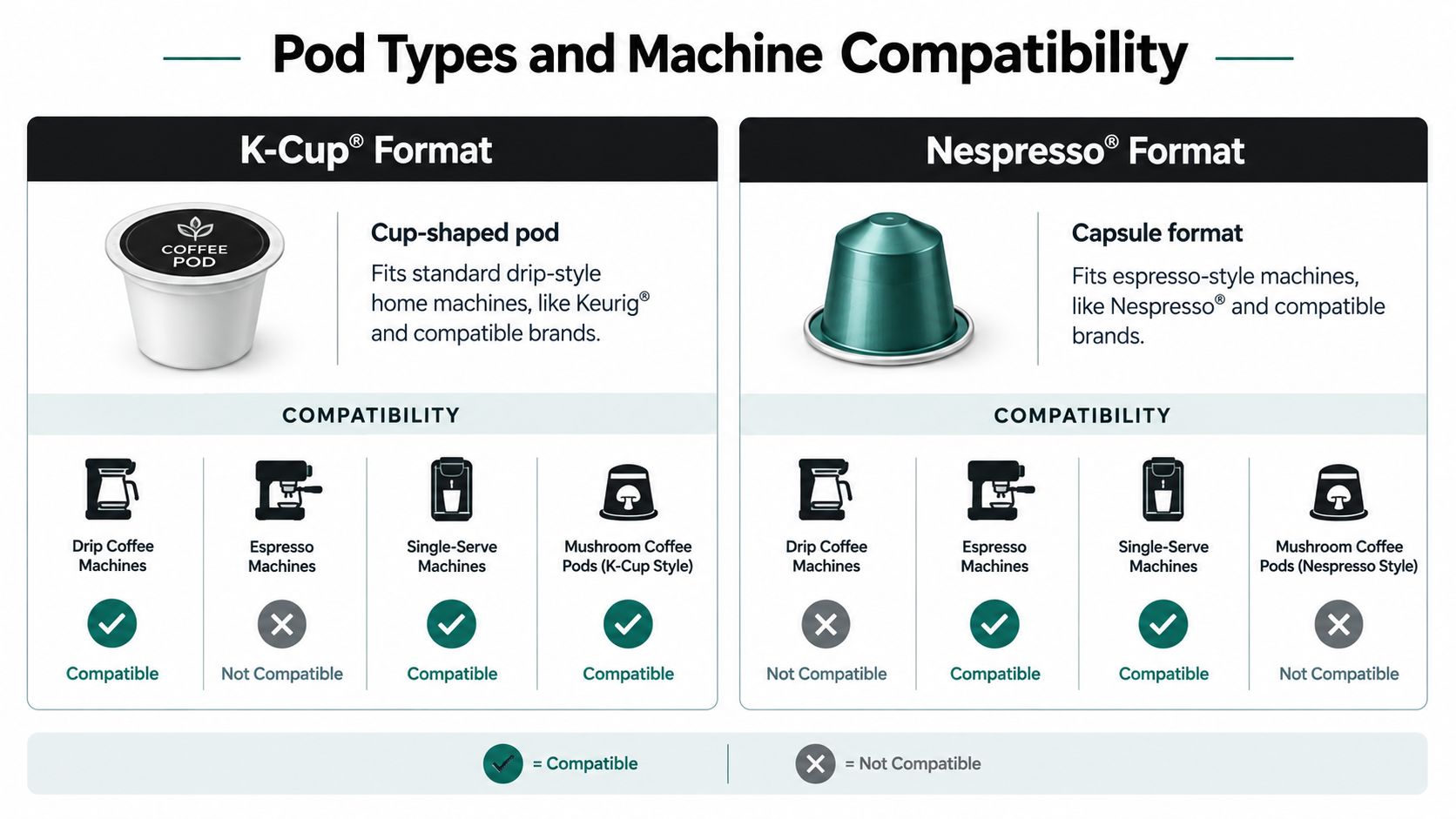
A pod can contain an excellent coffee blend and still be useless if it doesn't fit your brewer. Compatibility is determined by the machine ecosystem, not by the phrase “single serve” on a product page.
| Pod ecosystem | Typical brewing experience | What to verify |
|---|---|---|
| K-Cup style | Drip-style coffee in a familiar cup format | Whether the pod fits your specific Keurig brewer |
| Keurig 2.0 | More restrictive proprietary system | Whether third-party capsules are accepted |
| Nespresso OriginalLine | Smaller capsule designed for espresso-style brewing | OriginalLine compatibility, not VertuoLine compatibility |
| Nespresso VertuoLine | Larger formats and centrifusion brewing | Vertuo-specific capsule design |
| Reusable pods | Fill-your-own flexibility | Correct reusable capsule shape and machine fit |
| Tassimo or Dolce Gusto | Proprietary system | Brand-specific compatibility only |
Read the machine name, not just the pod name
K-Cup style products generally offer the broadest selection of mushroom coffee pods, but “K-Cup compatible” still deserves scrutiny. Some listings refer to standard Keurig brewers while excluding more restrictive systems. If your machine is a Keurig 2.0 model, check the product description for explicit acceptance of third-party pods rather than assuming a standard capsule will work.
Nespresso creates a separate compatibility problem. OriginalLine capsules and VertuoLine capsules aren't interchangeable, and the brewing systems produce different beverage styles. A capsule designed for an espresso-style extraction won't automatically work in a Vertuo machine, even if both products carry the Nespresso name.
The same caution applies to Tassimo and Dolce Gusto. These systems use their own proprietary formats, so a pod marketed as universal may not include them. Reusable pods offer more control over the coffee and mushroom blend, but they add measuring, filling, and cleaning, which removes much of the convenience advantage.
Make the purchase decision in three checks
- Find your machine's exact model or product family.
- Match it to the pod's stated ecosystem.
- Confirm whether the listing excludes newer or proprietary versions.
For buyers comparing options, a K-Cup mushroom coffee guide can help narrow the search, but the brewer's exact compatibility statement remains decisive. A compatible pod should lock into place, puncture correctly, and brew at the intended volume without forcing the machine.
Ingredient Standards and Label Literacy
The most important label question isn't whether a pod contains mushrooms. It's which mushrooms, which material, how much, and what testing supports the claim.
Mushroom coffee pods usually combine coffee grounds with mushroom material. Coffee supplies caffeine, while the mushroom ingredient supplies compounds such as beta-glucans. A product that names five species but gives no quantity, plant part, extraction method, or assay result is difficult to compare with a simpler formula that discloses one species clearly.
Audit the mushroom panel
Look for these fields:
- Exact species: Lion's mane, reishi, chaga, or cordyceps should be named rather than hidden behind “mushroom complex.”
- Plant part: Fruiting body and mycelium aren't interchangeable descriptions.
- Amount per pod: A list of species without quantities doesn't establish dose.
- Extraction method: Hot-water extraction is relevant to water-soluble beta-glucans. Dual hot-water and ethanol extraction may capture additional alcohol-soluble constituents.
- Standardized compounds: Quantified beta-glucans provide more useful comparison than a vague “high potency” claim.
- Caffeine: The exact amount per pod should be stated.
- Added ingredients: Check sweeteners, creamers, flavors, and fillers.
U.S. labeling rules require a dietary supplement's Supplement Facts panel to identify the plant part from which each dietary ingredient is derived, according to the FDA dietary supplement labeling guide. Minnesota consumer guidance also says mushroom-containing dietary supplements should clearly use the word “Supplement” and display a Supplement Facts panel. A product marketed as coffee may instead be treated as a conventional food, so the regulatory presentation can differ.
Packaging belongs on the ingredient checklist
Oxygen control is an overlooked quality variable because oxygen accelerates oxidation and flavor loss in ground coffee. A capsule study found that a roughly 7 micrometer pullulan/silicon-dioxide coating reduced oxygen permeation across empty polypropylene capsules from 496.91 to 14.01 mL per package per 24 hours at 40°C and 25% relative humidity, approximately a 35-fold improvement. With coffee loaded inside, measured permeability fell to 1.87 mL per package per 24 hours. The capsule packaging study also found weaker performance at 66% relative humidity because swelling and coating fractures reduced barrier effectiveness.
That doesn't prove a mushroom extract remains potent in every high-barrier pod. It does establish why packaging specifications matter. Prefer products that disclose oxygen-barrier performance, nitrogen flushing or low residual oxygen, and storage guidance limiting heat and humidity.
For a practical ingredient reference, review this mushroom coffee ingredient guide, then compare its terminology with the product's actual label and certificate of analysis.
Strength Levels and Caffeine Dosing
Mushroom coffee isn't automatically low-caffeine, and “smooth energy” doesn't replace a milligram amount. The coffee base, serving size, extraction method, and mushroom-to-coffee ratio all affect the final dose.
Available nutrition reporting places a typical mushroom-coffee serving at roughly 30 to 60 milligrams of caffeine per 8 ounces, compared with approximately 90 to 100 milligrams in a similarly sized regular coffee serving. Another comparison reports about 96 milligrams for brewed coffee, versus approximately 48 milligrams for one branded mushroom-coffee cup and 50 milligrams for one packet, as described in AARP's reporting on mushroom coffee.
| Use case | Useful reference point | Buying implication |
|---|---|---|
| Lower-stimulation routine | 30 to 60 mg per 8 ounces | Check the pod's actual serving size |
| Regular brewed coffee comparison | About 90 to 100 mg per similar serving | Don't assume every mushroom pod is a major reduction |
| Branded mushroom cup example | About 48 mg | Treat branded examples as product-specific |
| Branded packet example | About 50 mg | Confirm the label rather than relying on category averages |
Match the dose to your tolerance
If you're caffeine-sensitive, begin with the smallest documented serving and avoid judging strength by roast color. A dark roast may taste intense without containing more caffeine than a lighter roast. If you're replacing a full-strength morning coffee, a pod in the lower range may feel noticeably gentler, but it may also seem underpowered if you expect the stimulation of regular brewed coffee.
The central boundary is scientific, not semantic. Lower caffeine doesn't demonstrate that mushroom ingredients improve cognition, energy, or caffeine absorption. Research specifically examining mushroom coffee remains limited, and many mushroom studies involve isolated ingredients, laboratory models, or products other than coffee.
Dose before claims: The pod label is authoritative for caffeine. Marketing language about focus or sustained energy isn't a substitute for a measured amount.
Loose blends can make dosing less predictable because the amount of coffee and mushroom mixture depends on your scoop and preparation. Pods improve repeatability when the manufacturer discloses the serving amount, but they don't guarantee mushroom potency without ingredient quantities and batch documentation.
Pros and Cons Versus Loose Blends
Pods solve a real problem: they make the morning cup repeatable. They also create trade-offs that loose blends avoid, particularly around material exposure, waste, and purchasing flexibility.
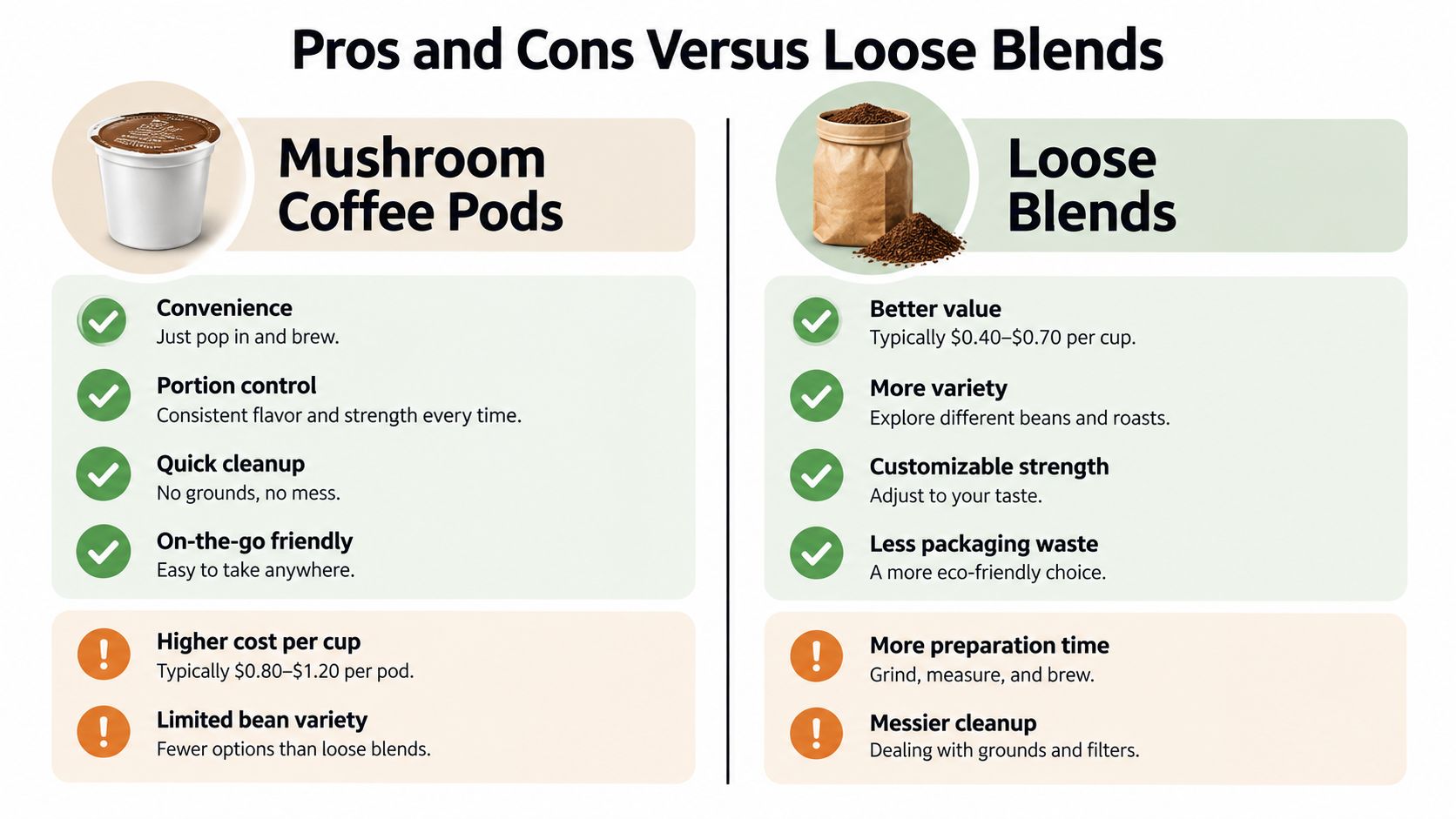
| Factor | Mushroom coffee pods | Loose mushroom coffee blends |
|---|---|---|
| Speed | Fast, measured preparation | Requires scooping and brewing |
| Portion control | Consistent when the label is accurate | Depends on the user's measuring |
| Customization | Usually limited to the prepared formula | Easy to adjust coffee and mushroom amounts |
| Machine dependence | Requires a compatible brewer | Works with more brewing methods |
| Packaging | Individual capsule and wrapper materials | Usually fewer individual components |
| Freshness protection | Can benefit from sealed, oxygen-controlled packaging | Depends heavily on bag design and repeated opening |
| Cleanup | Minimal | More grounds, utensils, or filters |
The packaging exposure question
The assumption that pods are automatically the cleaner choice deserves scrutiny. A 2025 analysis of 45 coffee brands conducted more than 7,000 tests for pesticides, heavy metals, plasticizers, and mold toxins. Its reported phthalate levels were highest in canned coffee, followed by pods and then bags, according to UPI's report on the analysis.
Separate 2025 research on single-serve systems reported microplastics originating from pods and machines, while researchers emphasized that measurement methods differ and long-term exposure evidence remains limited. University of Connecticut research also reported that high heat and pressure in pod systems can release chemicals including benzophenone and BPA from plastic components, although detected levels were within current safety guidelines.
That isn't evidence that all pods are unsafe, and switching materials doesn't eliminate every exposure pathway. Risk depends on pod construction, machine components, brewing temperature, storage, and testing. Ask manufacturers for material specifications and third-party contaminant results, especially if you use pods daily.
Choose the format you'll use correctly. A loose blend offers more control, but a pod that gets brewed consistently may be more practical than a flexible blend that sits unopened.
The mushroom coffee side-effects guide is useful when evaluating your tolerance for both caffeine and added functional ingredients. Pods suit time-pressed drinkers who value speed and repeatability. Loose blends suit people who want to adjust roast, serving size, and mushroom ratio, and who accept the extra preparation.
Brewing Optimization and Packaging Quality
A good formula can still produce a disappointing cup if the extraction is weak, rushed, or inconsistent. Evaluate the beverage separately from the mushroom claim. A pod can brew balanced coffee without proving that its mushroom compounds are bioavailable.
A practical espresso-style benchmark reported for tested DIY coffee-pod configurations is 1.15% to 1.35% total dissolved solids, with soluble extraction yield near 19.4%. Those figures sit within the Specialty Coffee Association's commonly cited 18% to 22% extraction-yield range, according to the DIY coffee-pod brewing reference.
Use brew quality as a separate test
You don't need a laboratory to identify obvious brewing problems. Taste the pod at its intended serving volume, then note whether it is watery, sharply bitter, hollow, or balanced. If you dilute an espresso-style pod into a larger cup, the beverage may become thin even when the capsule performs correctly.
For serious product evaluation, record:
- Brew volume: Use the manufacturer's intended setting.
- Flow behavior: A sudden stall or unusually fast flow can indicate a fit or fill problem.
- Taste: Look for roast clarity rather than masking bitterness with sweeteners.
- TDS and extraction yield: Use them when comparing testable pod configurations.
- Certificate of analysis: Confirm mushroom identity, contaminants, and active compounds separately from coffee performance.
Hot-water extraction is relevant for water-soluble beta-glucans. A dual hot-water and ethanol process may capture additional alcohol-soluble constituents, including triterpenes. A label that says only “mushroom powder” without extraction or assay data is technically difficult to compare.
Protect the capsule before brewing
Packaging quality starts before the machine. Store pods in a cool, dry place away from direct sunlight, heat, and humidity. Moisture can affect aroma, powder flow, and consistency, while oxygen can degrade ground-coffee flavor.
Look for documented oxygen-barrier specifications, nitrogen flushing, or low residual oxygen. The capsule study described earlier also shows why humidity matters. Barrier performance can weaken when polymer swelling and coating fractures occur under high relative humidity.
Do not treat an oxygen barrier as proof of mushroom potency retention. It supports coffee freshness and packaging evaluation, while the certificate of analysis supports ingredient identity and contaminant control. Those are related quality questions, not the same one.
Making Your Final Recommendation
There isn't one best mushroom coffee pod for every buyer. The right choice depends on whether you prioritize speed, caffeine reduction, flavor customization, or ingredient verification. Use the following profiles to turn a broad category into a short buying list.
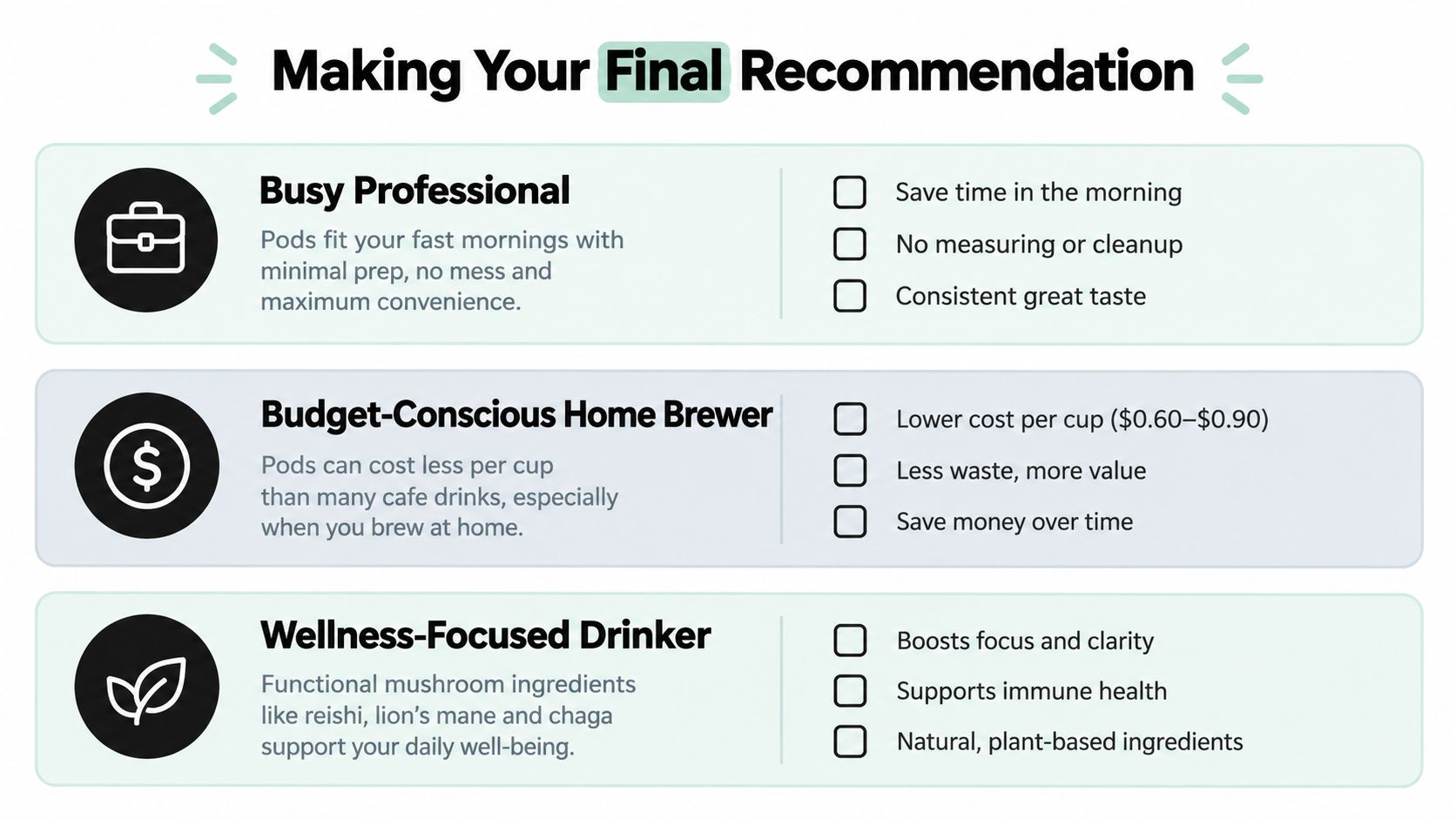
For the busy professional
Choose pods if your priority is a repeatable cup with minimal cleanup. Start with a machine-compatible product that states its serving volume, caffeine amount, mushroom species, and extraction method. A shorter formula with clear quantities is more useful than a long list of unnamed mushroom ingredients.
Your checklist:
- Confirm exact machine compatibility.
- Record caffeine per pod.
- Prefer sealed packaging with storage guidance.
The convenience advantage is strongest when you don't need to measure loose powder or adjust the recipe every morning. It disappears if the pod produces a weak cup, fails to fit your brewer, or leaves you guessing about the contents.
For the budget-conscious home brewer
Loose blends usually offer more control over serving size and preparation, while pods can impose a format premium and lock you into a machine ecosystem. Compare the actual amount of coffee and mushroom material per serving rather than comparing package size alone.
A reusable pod can lower packaging waste and let you customize the blend, but it also adds filling and cleaning. That may be a good exchange for someone who already enjoys a hands-on brewing ritual. It may be a poor one for someone buying pods specifically to remove that work.
For the wellness-focused drinker
Insist on measurable ingredient information. The Minnesota consumer guidance on mushroom product safety recommends checking that every mushroom species appears in the ingredient statement and that supplements carry a Supplement Facts panel. Look for plant part, grams per serving, extraction process, beta-glucan data, caffeine, sweeteners, and testing for heavy metals and microbes.
Dietary supplements in the United States don't receive routine FDA premarket approval. Illinois Extension notes that manufacturing consistency isn't formally reviewed in the same way as approved drugs, so ingredients may vary from lot to lot unless appropriate quality controls support the label. Its guidance on mushroom supplements also states that medicinal mushrooms haven't been FDA-approved to treat cancer or another medical condition.
That makes restrained wellness language a positive sign. Claims such as “supports focus” should not be presented as proven treatment outcomes, and a premium appearance doesn't demonstrate a clinically effective dose.
The final buying sequence
- Start with the brewer. Eliminate incompatible formats before comparing formulas.
- Check caffeine. Use the stated milligram amount, not a promise of smooth energy.
- Audit the mushrooms. Verify species, plant part, quantity, extraction, and beta-glucans.
- Ask for testing. Look for batch-specific certificates covering identity and contaminants.
- Inspect packaging. Prefer oxygen-control details, low residual oxygen or nitrogen flushing, and sensible storage instructions.
- Evaluate materials. Ask about pod construction and machine components without assuming any material is risk-free.
- Taste the coffee separately. Brewing balance doesn't prove functional efficacy, but poor coffee can make the routine unsustainable.
The strongest product is the one whose claims you can verify and whose taste, caffeine level, machine fit, and preparation demands match your actual routine. Mushroom coffee pods can be a useful delivery format, but their value comes from transparent specifications, not from a mushroom illustration on the box.
For a more convenient way to explore functional mushroom products and mushroom coffee options, visit The Magic Mushroom Delivery. Review the product details, compare formats, and choose a clearly labeled option that fits your brewing routine and quality standards.