

It's 11:40 p.m., the kitchen light is off, and you're rereading a short message from a coworker. The delay feels pointed. You've checked the lock, then the street, then the phone again. Part of you thinks this is stress. Another part is already building a case. If that's where you are, how to stop paranoia starts by sorting a passing spike from a belief that needs a clinician, not by arguing with yourself in the dark.
How Serious Your Paranoia Is Right Now
Place yourself on a three-tier scale before you try any calming trick. Passing suspicion can be worked on at home. Persistent paranoia needs a booked assessment within days. New or worsening paranoia, especially with hallucinations or confusion, needs a clinician the same day. If you might hurt yourself or someone else, or you can't manage basic care, that row is an emergency, not a coping exercise. Score the last two weeks against the table and pick one row before you read on.
| Level | Typical signs | What to do |
|---|---|---|
| Passing suspicion | Brief unease that eases with rest or new information | Use the calming steps and note the episode in a log |
| Persistent paranoia | Fixed suspicion lasting weeks that disrupts sleep, work or relationships | Book a GP or mental-health assessment within days |
| New or worsening paranoia | Hallucinations, new confusion or rapid escalation | Contact a clinician the same day or an urgent mental-health service |
| Emergency | Risk to self or others, or inability to care for basic needs | Call emergency services now (see the final section) |
What separates the rows
Intensity and impact set the tier, not the topic of the fear. A worry about a neighbor that fades after sleep sits in the first row. The same worry, held for weeks and cutting into work or relationships, sits in the second.
A peer-reviewed clinical review in Advances in Psychiatric Treatment estimated that approximately 10-15% of the general population regularly experience paranoid thoughts, while about 1-3% experience delusional beliefs at a severity comparable to clinical psychosis, and an additional 5-6% report less severe delusional ideas. Those ranges are why paranoia isn't the same thing as schizophrenia. The review identified cognitive behavioral therapy (CBT) as the strongest psychological evidence base for persistent suspicious or persecutory beliefs. In one comparison with routine care, CBT produced almost eight times greater odds of at least a 50% reduction in psychotic symptoms. Home steps can steady you and build a clearer record. They don't replace assessment when a belief stays fixed or safety is involved.
Calm Your Body and Senses in the Moment
Run this sequence while you feel watched, at home or in a shop. It lowers arousal. It does not decide whether the belief is true.
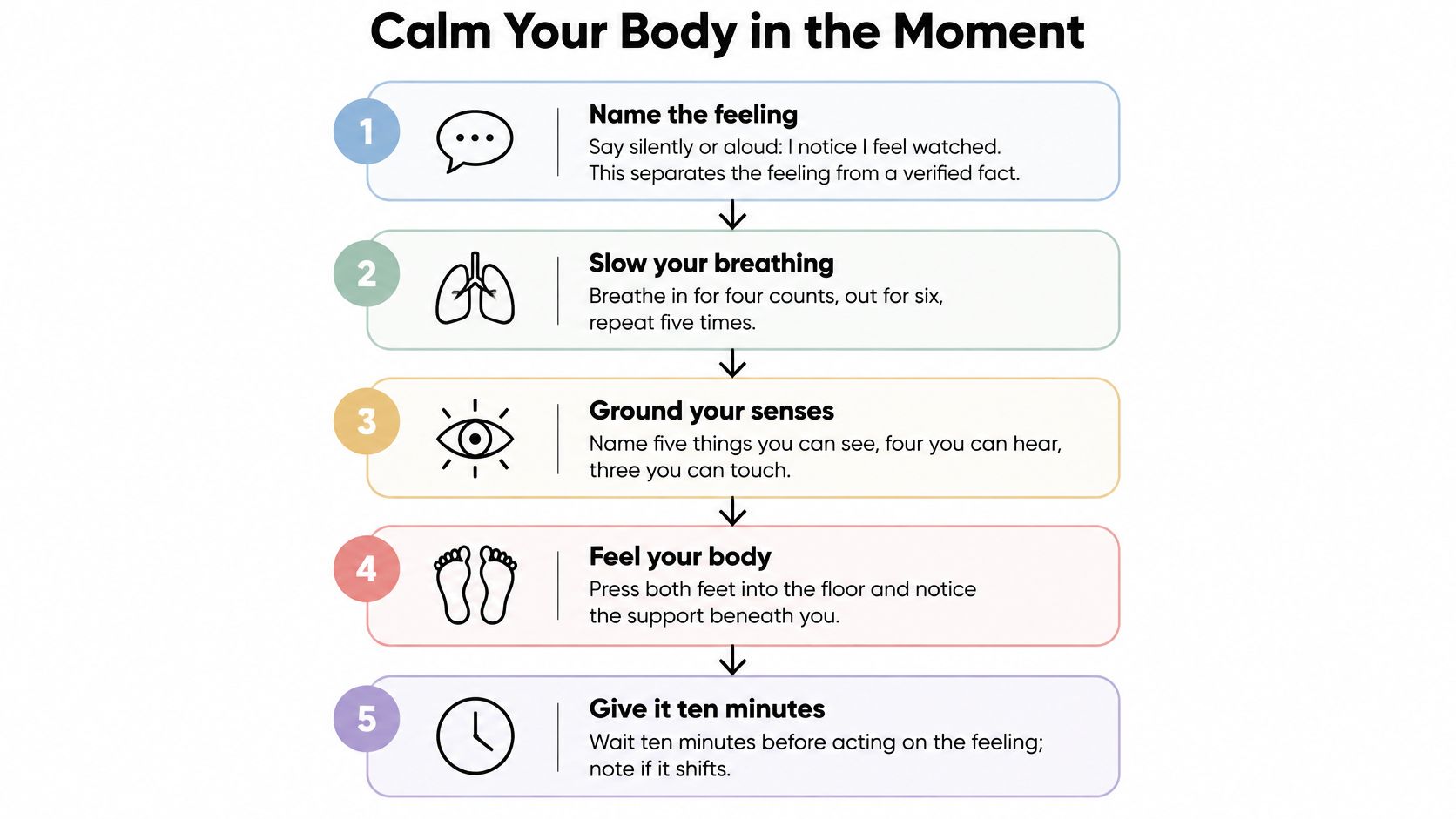
- Name the feeling. Say aloud, "I notice I feel watched." Naming splits the sensation from a verified fact and takes some heat out of the alarm.
- Slow the breath. Aim for about six breaths a minute, with a longer exhale than inhale. A quieter body makes threat signals less loud, so the next step is easier to do.
- Cut stimulation. Step away from a crowd, switch off a loud television, dim the lights, and put the phone face down. Noise and screens keep you scanning.
- Ground your senses. Name five things you can see and four you can touch. Concrete detail pulls attention into the room you're in.
- Sit somewhere familiar. Move to a place you already trust and sit down. Standing and pacing keeps the body in a search mode.
- Pause decisions. Don't confront anyone, hunt online for proof, or drive until the spike drops. Those actions lock the fear in place.
- Send one message. Text a trusted person what is happening and ask them to check in. One contact beats a spiral of unanswered questions.
How you know it helped
Breathing slows, the thought loses its urgency, and you can answer, "What is one small thing I can do next?" If you still can't answer that, or the fear is climbing, stop the sequence and use the urgent steps at the end.
Practical rule: Calming the body is first aid for the moment. It is not a verdict on whether anyone is actually watching you.
How to Test a Feared Belief Without Arguing
Fighting the thought head-on usually backfires. A quieter test works better, and you can run it on paper in about ten minutes when you're calmer, not at the peak.

Say your manager didn't reply to a 4 p.m. email and by 9 p.m. you're sure you're being set up to be fired.
- Validate the fear, not the conclusion. "It makes sense I feel unsafe after that silence, and I still need to check what happened." You stay honest about the feeling without treating the firing story as fact.
- Write the thought in one sentence. "My manager is building a case against me." Feelings don't go on this line. Only the claim does.
- List evidence for and against, using events. For: no reply by evening. Against: they were in back-to-back meetings, and last month a late reply was just a busy day.
- Name at least two alternatives. They were busy. The message was unclear and they're waiting to ask you tomorrow.
- Run one low-risk test. Predict what happens if you send a neutral follow-up: "Did you need anything else on the draft?" Then send it and write what happened.
- Rate belief strength from 0 to 100 before the test and again after. Repeat across several days. One result rarely moves a strong belief.
What should be on the page
You should finish with the feared thought, two alternatives, one test result, and two ratings. A clinician can use this same structure inside cognitive behavioural therapy for psychosis (CBTp). If the belief won't bend, or testing makes you more certain and more distressed, that result belongs in an assessment, not in another night of solo detective work.
Sleep, Substances and Stress That Feed Paranoia
Sleep is a lever many people can move first. A systematic review and meta-analysis from the University of East Anglia identified 45 studies, with 14 in a meta-analysis. Among the seven studies using the strongest measures, the association between sleep problems and paranoia was small to moderate (r = 0.30, 95% CI 0.16-0.40). The review also found a partly causal loop: disrupted sleep can increase paranoid thinking, and paranoia can worsen sleep. Track bed and wake times for two weeks. Treat better sleep as risk reduction, not a cure, because the studies varied a lot.
| Trigger | Why it matters | Change to try |
|---|---|---|
| Sleep loss | Disrupted sleep can feed suspicious thinking, and paranoia can worsen sleep | Fixed wake time and a dimmed, screen-free hour before bed |
| Caffeine and stimulants | Raise arousal and make ambiguous cues feel threatening | No caffeine after noon; avoid energy drinks |
| Alcohol and cannabis | Can trigger or worsen paranoia, especially with poor sleep | Pause use while symptoms last and tell your clinician |
| Other drugs | Can cause or intensify paranoia and complicate assessment | Do not self-treat with psychedelics or intoxicants; disclose any use |
| Isolation | Leaves unchecked beliefs untested | Schedule one low-stakes social contact each day |
| Stress peaks | Increase threat sensitivity | Log stressors and plan lighter days around known pressure points |
A log you can actually keep
Once or twice a day, note hours slept, caffeine, substances, medication doses taken, stressors, and paranoia intensity from 0 to 10. Say the spikes land after four hours of sleep and two evening energy drinks. The plan becomes a fixed wake time and no caffeine after noon. If you're weighing psychoactive products while this is active, read about magic mushroom risks and pause use until a clinician has the full picture. Our non-detect line is cultivated so psilocybin is never present, and an independent laboratory verifies it batch by batch. Bring the two-week log to the first appointment.
Habits That Keep Paranoia Going
The habit that backfires most often is confrontational reassurance. Saying "that is impossible" over and over tends to make someone more guarded, not more convinced.
- Reassurance fights: Swap "that's impossible" for one question about the evidence. Curiosity keeps the conversation open. A verdict shuts it.
- Isolation: Pulling back from friends removes the chances to test a belief against ordinary life. Put one weekly check-in on the calendar, even a short walk.
- Covert investigation: Secretly checking a neighbor's car, reading every forum, or recording people feeds the case file. Stop the stakeout and write the claim in one sentence instead.
- Checking loops: Rechecking locks, messages, or social media dozens of times a day teaches the brain that danger is close. Cap online searching at a fixed 20 minutes.
- Delaying care because it feels certain: Certainty is not proof. Book the assessment while the feeling is strong, not after you've "confirmed" it.
Sleep loss, caffeine, alcohol, cannabis, and other drugs belong on the trigger log, not on this habit list. Mixing the two makes it harder to see which behavior you're repeating on purpose.
Subjective certainty is a symptom to report to a clinician, not evidence that the belief is correct.
Getting Assessed and Starting Structured Therapy
Start with a GP or a mental-health service. Bring a short note: when it began, how long it has lasted, and any substances or medicines, including dose and timing if you know them.

The early pathway
- Arrange prompt assessment, especially when paranoia is new, worsening, or includes hallucinations.
- Review immediate risk, sleep, substance or medication triggers, mood symptoms, and whether work or relationships are slipping.
- Write a relapse plan this week: warning signs, trusted contacts, coping actions, and emergency numbers.
- Start individualized CBTp when it's indicated. NICE guidance says CBT should be individual, manual-based where possible, and delivered over at least 16 planned sessions, aimed at fewer symptoms and better day-to-day functioning.
Format matters less than a qualified therapist. A 2025 assessor-masked trial in Nature Medicine included 254 participants with schizophrenia-spectrum disorders in the intention-to-treat analysis, 126 in virtual-reality CBT for paranoia and 128 in standard CBTp, both with usual treatment, across 10 sessions. Virtual-reality CBT showed no statistically significant advantage over standard CBTp. NHS guidance on psychosis also points to one-to-one CBT and family interventions, and says early treatment can be more effective, so contact a GP promptly.
A Washington State behavioral-health guide notes that recovery from an initial psychotic episode may take 6-24 months even when the most dramatic symptoms ease quickly. In 2024, 57% of people who received a positive mental-health screen through Mental Health America's online program, which screened 1,728,957 people, reported never having received prior treatment. An early appointment is how you avoid joining that wait. Questions about psilocybin therapy belong with a clinician, not as a self-experiment while paranoia is active. Write the relapse plan and book the first visit this week.
Emergency Signs and What to Do Immediately
It is 2 a.m. A friend is sure someone is in the walls, talking in fragments, and soaked in sweat after a strong mushroom dose. That is not a home coping exercise. Acute paranoia with confused thinking, hallucinations, or suspected intoxication or overdose needs urgent medical help.
Match the signs at a glance:
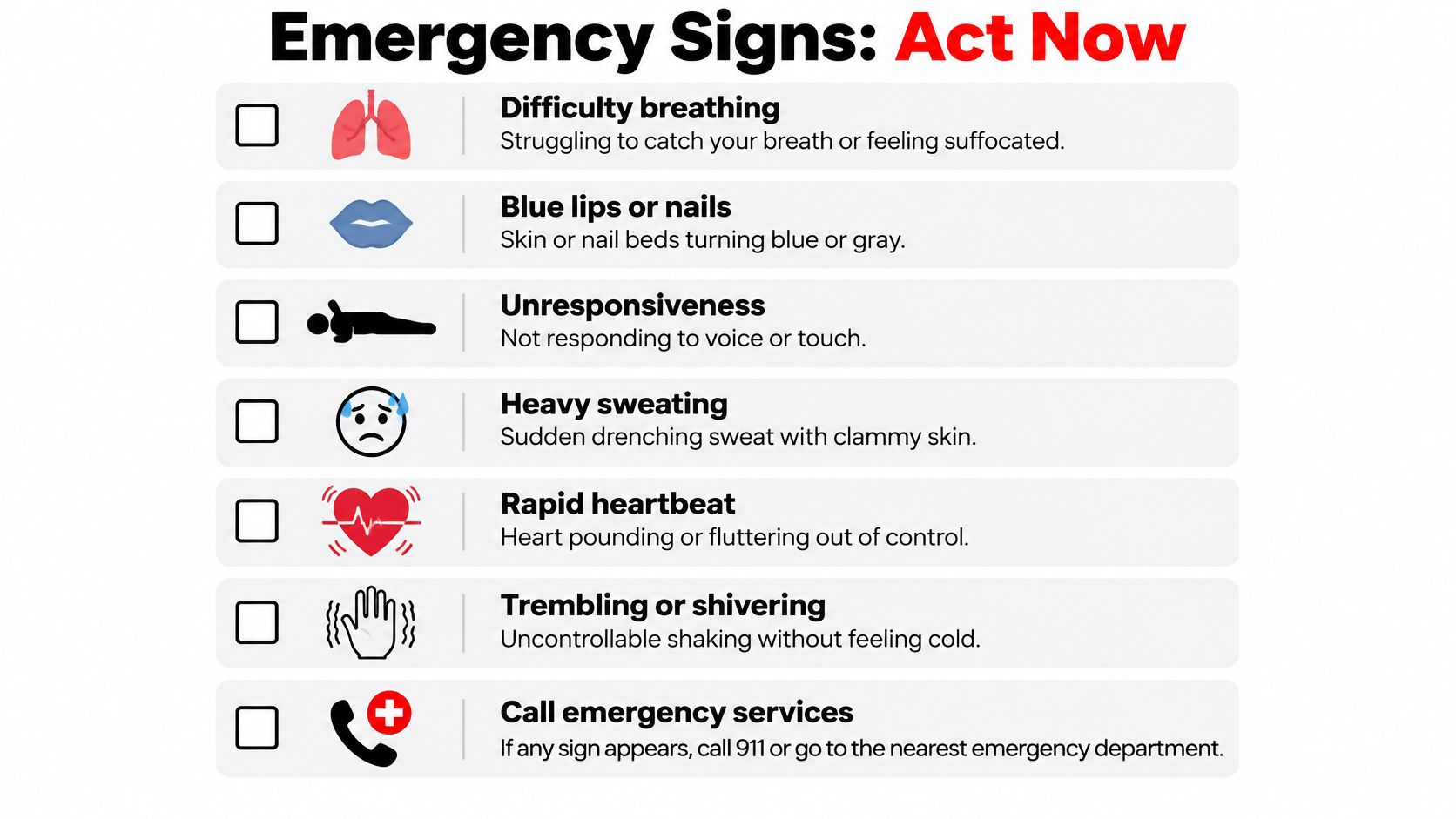
- Difficulty breathing
- Blue lips or nails
- Unresponsiveness
- Sudden changes in strength
- Heavy sweating or hot skin
- Vomiting, or facial or neck swelling
- Signs of head or spinal injury
- Suspected alcohol or drug overdose
- Markedly disturbed or illogical thinking
When those signs are present, if you are restraining someone, ease off and step back so they can be assessed, then call emergency medical help, and give appropriate first aid. Then follow this order: reduce stimulation and keep physical distance, use short calm statements and do not argue the belief, involve a trusted person if it is safe, remove access to weapons, intoxicants, and other hazards without a confrontation, and call emergency services or go to an emergency department.
Frightening thoughts you can still reality-test, with a clear mind and no physical danger, can wait for a planned visit. Confusion, overdose signs, or a person who cannot stay safe needs a clinician within hours, not days. Waiting those out treats an emergency like a practice drill.
For urgent but not immediate danger, use the local urgent mental-health pathway or a GP out-of-hours service. Tell responders when symptoms started, any substances and doses, and current medication. If a mushroom experience turned frightening, see what to do when a mushroom trip goes bad and still get clinical care. Save your local emergency number and a crisis line in your phone now.
The Magic Mushroom Delivery offers discreet, age-verified shipping of organic mushroom products for adults 21 and older, alongside plain-language guides on effects, duration, and responsible use. If paranoia, poor sleep, or a frightening experience is in the picture, get clinical help first and treat any product questions as secondary. Visit The Magic Mushroom Delivery when you want product details and practical reading after you have handled safety.