

In a 2021 randomized study, 71% of participants achieved clinically significant depression relief after structured psilocybin-assisted therapy, and 58% were in remission one week after treatment. Those results are promising, but they describe a supervised clinical protocol, not an ordinary mushroom product or an unsupervised session.
You may be searching for help after months of depression, reading one page that calls psilocybin therapy a breakthrough and another that warns about unpredictable experiences. A search for treatment can quickly turn into a search for products, providers, research studies, and conflicting dosing advice.
The central distinction is simple but easy to miss. Clinical psilocybin therapy combines a measured dose with screening, preparation, professional support during the experience, and follow-up care. A consumer product may provide none of those safeguards. Understanding that difference helps you interpret the research without dismissing its potential or assuming that a retail product will reproduce a clinical outcome.
Understanding Psilocybin Therapy Access
Consider someone with major depressive disorder who hasn't improved enough with previous treatment. They find a hospital research program describing psychological preparation and monitored dosing. A few results later, they see products marketed for mood, insight, or wellness. Both pages use familiar terms, but they describe very different experiences.

What supervised therapy includes
In a clinical protocol, the substance is only one part of treatment. Before dosing, clinicians review a person's medical and psychiatric history, assess potential risks, explain what may happen, and establish a plan for support. During the session, trained staff remain available in a controlled environment. Afterward, therapy or integration conversations help the participant process the experience and connect it to ongoing care.
That structure matters because the experience can involve strong emotional, perceptual, and physical effects. A professional team can distinguish expected temporary reactions from warning signs, respond to distress, and document changes using standardized assessments.
Practical rule: When a claim cites clinical research, ask whether the same preparation, measured compound, supervision, and follow-up were present.
Why access questions require caution
The evidence supports continued investigation of psilocybin-assisted therapy, particularly for depression that hasn't responded adequately to other approaches. It doesn't prove that an edible, capsule, dried mushroom, or product with uncertain active-ingredient content will produce the same result. The research participant and the retail customer aren't receiving the same intervention.
A useful first step is to separate three questions:
- Is the treatment being studied? Research participation usually involves formal eligibility screening and defined clinical procedures.
- What exactly is being administered? Trials specify psilocybin in milligrams, while consumer descriptions may use product names or mushroom weight.
- Who provides support? Therapy requires more than taking a substance. Preparation, monitoring, and follow-up shape the intervention.
That framework keeps hope connected to evidence. It also prevents a common mistake, treating a promising clinical result as a guarantee about an entirely different setting.
Clinical Evidence Behind Psilocybin Treatment
The strongest evidence comes from randomized trials in which researchers define the dose, select participants carefully, provide psychological support, and measure symptoms with established clinical scales.
In a 2021 randomized clinical trial, 24 participants completed psilocybin-assisted therapy with psychological support. At both one week and four weeks, 17 participants, or 71%, achieved a clinically significant response, defined as at least a 50% reduction in GRID-HAMD depression scores. Remission, defined as a GRID-HAMD score of 7 or lower, occurred in 14 participants, or 58%, at week one, and 13 participants, or 54%, at week four. These findings are reported in the JAMA Psychiatry randomized trial.
The sample was small, so the results should be read as encouraging clinical evidence rather than a universal prediction. The comparison with delayed treatment also showed improvements in clinician-rated depression severity and self-reported secondary outcomes, but the intervention included psychological support rather than an isolated dose.
Comparing the trial results
A later phase 2 randomized, placebo-controlled trial enrolled 104 adults with major depressive disorder. Participants received either a single 25-mg dose of psilocybin with psychological support or niacin as an active placebo. At six weeks, sustained depressive symptom response occurred in 42% of the psilocybin group versus 11% of the niacin group, according to the PubMed record for the trial.
| Study | Participants | Response Rate | Remission Rate |
|---|---|---|---|
| 2021 randomized trial | 24 | 71% at weeks one and four | 58% at week one, 54% at week four |
| Phase 2 randomized trial | 104 | 42% at six weeks | 25% with psilocybin, 9.1% with niacin |
The results explain why researchers continue to investigate psilocybin therapy. They don't establish that every person will respond, that benefits will last indefinitely, or that a commercial product is equivalent to pharmaceutical-grade psilocybin delivered in a therapeutic protocol. Readers comparing claims about psilocybin for depression should look for those details, not just a headline percentage.
How Psilocybin Works in the Brain
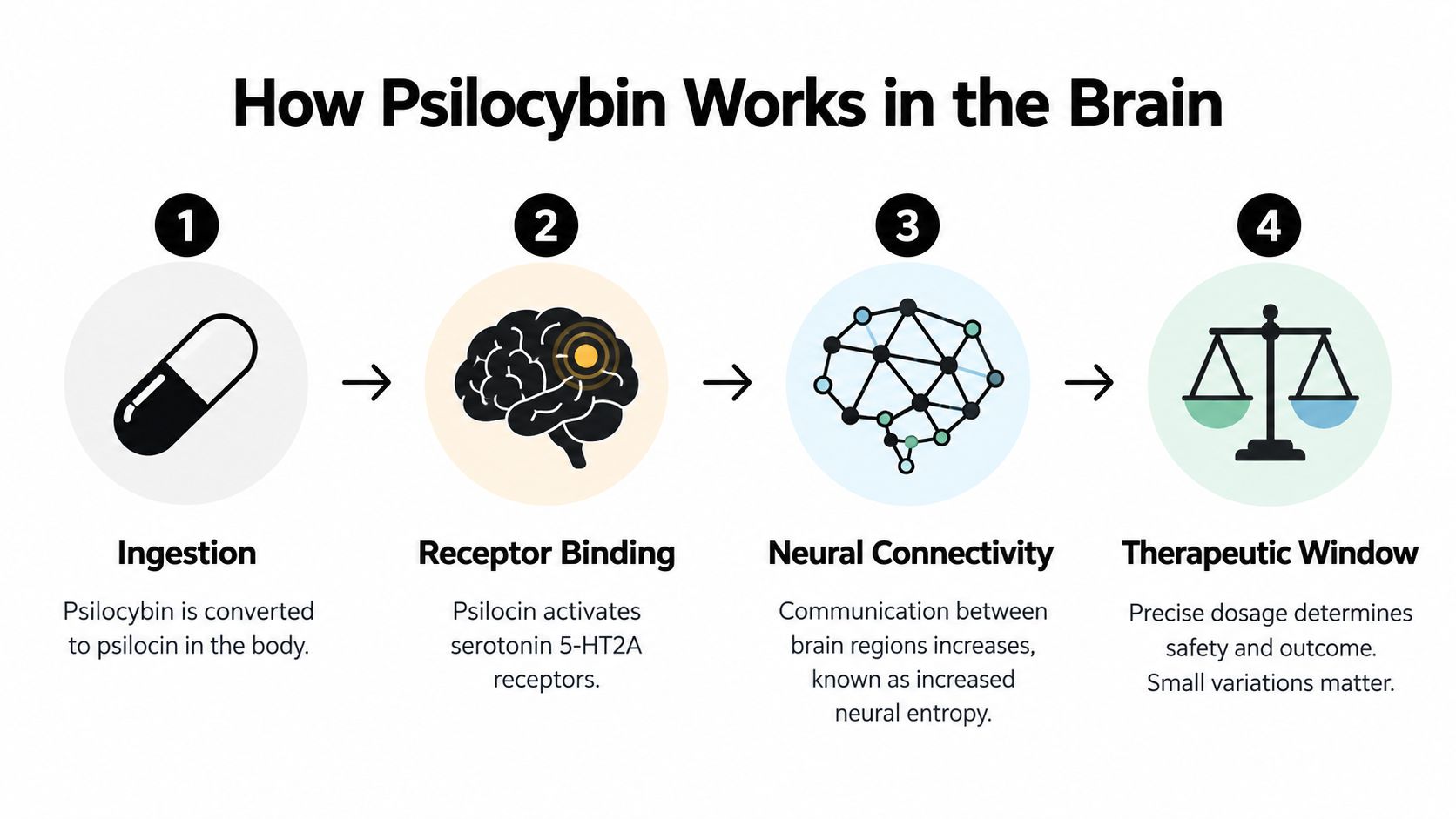
Psilocybin doesn't remain the main psychoactive compound for long. The body converts it into psilocin, whose effects are primarily associated with partial agonism at the serotonin 5-HT2A receptor. These receptors are especially relevant in the neocortex, where their activation is linked with changes in perception, cognition, and subjective experience.
Why the dose matters
Human imaging and pharmacology findings indicate that plasma psilocin concentration correlates with neocortical 5-HT2A receptor occupancy and with the intensity of the subjective drug effects. In one review of these findings, single doses from 3 to 30 mg produced dose-dependent receptor occupancy reaching as high as 72%. The pharmacology and safety review explains why a modest increase in active ingredient can materially change the experience.
This is also why mushroom mass is a poor substitute for measured psilocybin. Concentration can vary across species, cultivation conditions, storage, and preparation. Two products with the same stated weight may not contain the same amount of active compound.
Why clinical milligrams aren't retail equivalents
Clinical researchers can specify purified psilocybin in milligrams. They also control the environment, screen participants, monitor the session, and provide psychological support. A label expressed only as grams of dried mushroom, or a product described by type without verified active-ingredient content, doesn't provide the same dosing information.
The practical lesson isn't that a particular dose is right for everyone. It's that dose precision is a safety feature, and clinical doses shouldn't be treated as interchangeable with ordinary mushrooms, chocolates, gummies, or capsules. For a plain-language explanation of the experience, psilocybin effects on the brain should be considered alongside professional medical guidance rather than used as a personal dosing plan.
Clinical Setting Versus Consumer Use
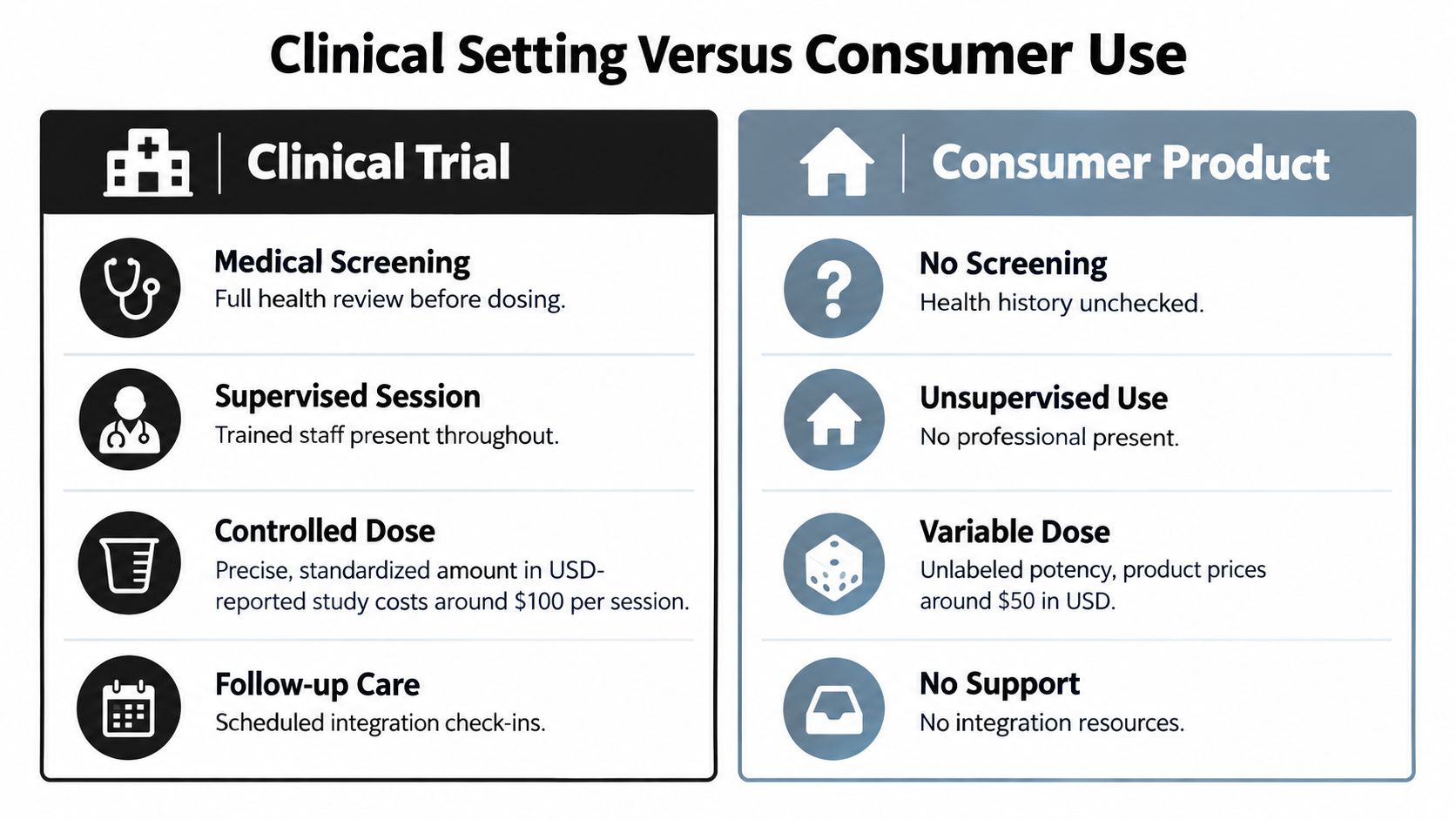
Clinical therapy and consumer use differ before the substance is taken. A trial team evaluates health history, psychiatric symptoms, medications, and potential risks. A consumer may have no equivalent review, even when the product description uses therapeutic language.
| Factor | Clinical Setting | Consumer Use |
|---|---|---|
| Screening | Medical and psychiatric review before dosing | Health history may remain unchecked |
| Preparation | Planned explanation and psychological preparation | Guidance may be general or absent |
| Dose | Standardized amount specified by researchers | Potency may vary by product and preparation |
| Supervision | Trained staff present during the session | No clinician may be present |
| Outcome tracking | Standardized assessments and documented follow-up | Personal impressions may be the only measure |
| Integration | Scheduled conversations after dosing | Support may not be available |
The missing pieces change the meaning of the result
A clinical participant doesn't receive a compound and wait for an outcome. The team prepares them for possible emotional intensity, remains available throughout dosing, and evaluates what happens afterward. Researchers can also record adverse events and symptom changes instead of relying only on memory.
A consumer product may be convenient, but convenience isn't the same as therapeutic structure. An unlabeled or variable dose makes it harder to predict intensity. An unsupervised setting can leave a person alone with panic, confusion, or physical symptoms. Without follow-up, there may be no plan for understanding difficult material or deciding what happens next.
A product can contain the same general type of active substance while still representing a different intervention from the one tested in a clinical trial.
Why trial safety can't be transferred automatically
Researchers commonly use highly screened samples. People with certain cardiovascular conditions, bipolar-spectrum symptoms, psychosis risk, substantial substance-use histories, or complex medication regimens may be excluded. That means reassuring findings from a controlled group may not apply to someone with a different health profile.
The same caution applies to outcome claims. A study can show benefit under defined conditions without proving that retail products, variable doses, or independent use provide the same response. Anyone evaluating a claim should ask what was measured, who participated, what support was provided, and whether the product matches the studied intervention.
Who Is Represented in Research Data
A trial result describes the people who entered the trial. It doesn't automatically describe everyone who may be interested in treatment.
Psilocybin research often relies on small, carefully screened samples. That design protects participants and helps researchers interpret results, but it also narrows generalizability. Adults with cardiovascular disease, bipolar-spectrum symptoms, psychosis risk, significant substance-use histories, or multiple medications may not be represented in sufficient numbers to answer whether the intervention is appropriate for them.
The safety question is personal
Suppose two people both read that a study found psilocybin therapy tolerable. One has a health history similar to the screened participants. The other takes several medications, has experienced possible manic symptoms, or has a close family history of psychosis. The sentence may sound relevant to both, but the evidence doesn't carry the same weight for each person.
A recent clinical overview emphasizes that the reassuring safety profile mainly applies to highly controlled trial settings and that important uncertainties remain around psychiatric complexity and broader populations. The review on representation and generalizability also identifies limited evidence across race, age, socioeconomic status, disability, and cultural setting.
This isn't a reason to dismiss the field. It's a reason to ask better questions:
- Eligibility: Were people with your medical and psychiatric history included?
- Medications: Did the study evaluate combinations similar to yours?
- Monitoring: What would happen if your symptoms intensified?
- Representation: Do the participants resemble the population being discussed?
Absence of evidence isn't proof of safety
People who are most eager for relief may also be the people least represented in trials. Exclusion criteria can remove precisely those with complex, treatment-resistant, or overlapping conditions. As a result, the strongest safety claims may apply least clearly to the patients who need the most individualized assessment.
A clinician can help distinguish a research-supported question from a personal medical decision. Online anecdotes and product descriptions can't determine whether a person's risk profile matches the evidence base.
Beyond the Session Long-Term Outcomes
A person may leave a supervised session feeling lighter within days, then face the harder question a few weeks later. What helps that change last in ordinary life, outside the clinic room? That is where long-term outcomes matter most, because a short-term response and a stable recovery are not the same thing.

A recent review identifies limited evidence beyond 12 months and also notes limited data on repeated or maintenance dosing schedules. The review of long-term outcomes and safety reporting explains why durability still needs confirmatory research. If you want a patient-focused overview of what may happen over time, including questions about persistence and relapse, our guide to long-term outcomes expands on that gap.
That distinction matters for a practical reason. In clinical trials, follow-up usually includes structured support, symptom checks, and a defined treatment frame. Unsupervised product use often removes those guardrails, so it cannot be assumed to produce the same staying power or the same safety profile.
Side effects deserve careful follow-up
Safety reporting also varies across studies. In a systematic review discussed by the same source, side-effect reporting was rated low or very low quality in 14 of 24 assessed studies. This does not mean every study was poorly done. It means a statement such as “no serious adverse events” should be read carefully, especially when reporting methods are inconsistent.
Reported effects can include headache, nausea, dizziness, temporary anxiety, blood-pressure changes, and psychological distress. Good care includes a plan for monitoring symptoms, identifying warning signs, arranging urgent support, and handling medication changes if problems arise.
Timing matters too. The oral psilocybin pharmacokinetic study found that psilocin reached maximum blood concentrations after an average of about two hours. Mean subjective-effect durations were 5.6 hours for 15 mg, 5.5 hours for 25 mg, and 6.4 hours for 30 mg, with intensity increasing as dose increased. A supervised session is designed around that arc. Consumer use often is not.
Long-term care may include symptom assessments, psychotherapy, medication review, and a relapse response plan. A single experience should be treated as one part of continuing care, not a replacement for it.
Making Informed Treatment Decisions
Return to the person who began by comparing a research hospital with a wellness shop. The most useful decision isn't based on which page makes the strongest promise. It starts by asking whether the proposed experience includes the elements that produced the clinical evidence.
A practical review can focus on four questions:
- What is being treated? Clinical trials studied defined psychiatric conditions, not every form of stress, sadness, or general wellness concern.
- Who has assessed the risks? A qualified clinician should review medical history, psychiatric symptoms, medications, and factors that may make the evidence less applicable.
- What exactly is the dose? Purified milligrams in a trial aren't automatically equivalent to mushroom weight or a product with uncertain potency.
- What happens afterward? Ask about symptom monitoring, integration, medication management, relapse planning, and urgent support.
The person in this scenario may decide to ask a healthcare professional about treatment options, seek a legitimate research opportunity, or pause before acting on a product claim. That pause isn't indecision. It's a way to compare the proposed intervention with the actual conditions under which researchers observed benefit.
Psilocybin therapy remains a developing clinical approach. The evidence shows meaningful promise, while the limits are equally important: small or selective samples, uncertain applicability to complex patients, incomplete long-term data, and safety concerns that require professional oversight. Good decisions respect both sides.
The Magic Mushroom Delivery offers adults educational resources alongside a range of psilocybin and functional mushroom products, including mushrooms, infused items, capsules, and mushroom coffee. Visit The Magic Mushroom Delivery to learn more about its product categories, responsible-use information, and discreet delivery options.