Harm reduction reduces health, social, and economic harms from drug use without requiring abstinence before help.
If someone isn't ready to stop using a substance, should they have to wait to receive care? That question exposes a gap in the idea that stopping use must always come before protecting health.
A person can need infection testing, emergency medication, or honest guidance today, even if their longer-term choices remain unsettled. Harm reduction starts with that immediate need without pretending the substance itself is harmless.
What Harm Reduction Is and Where It Came From
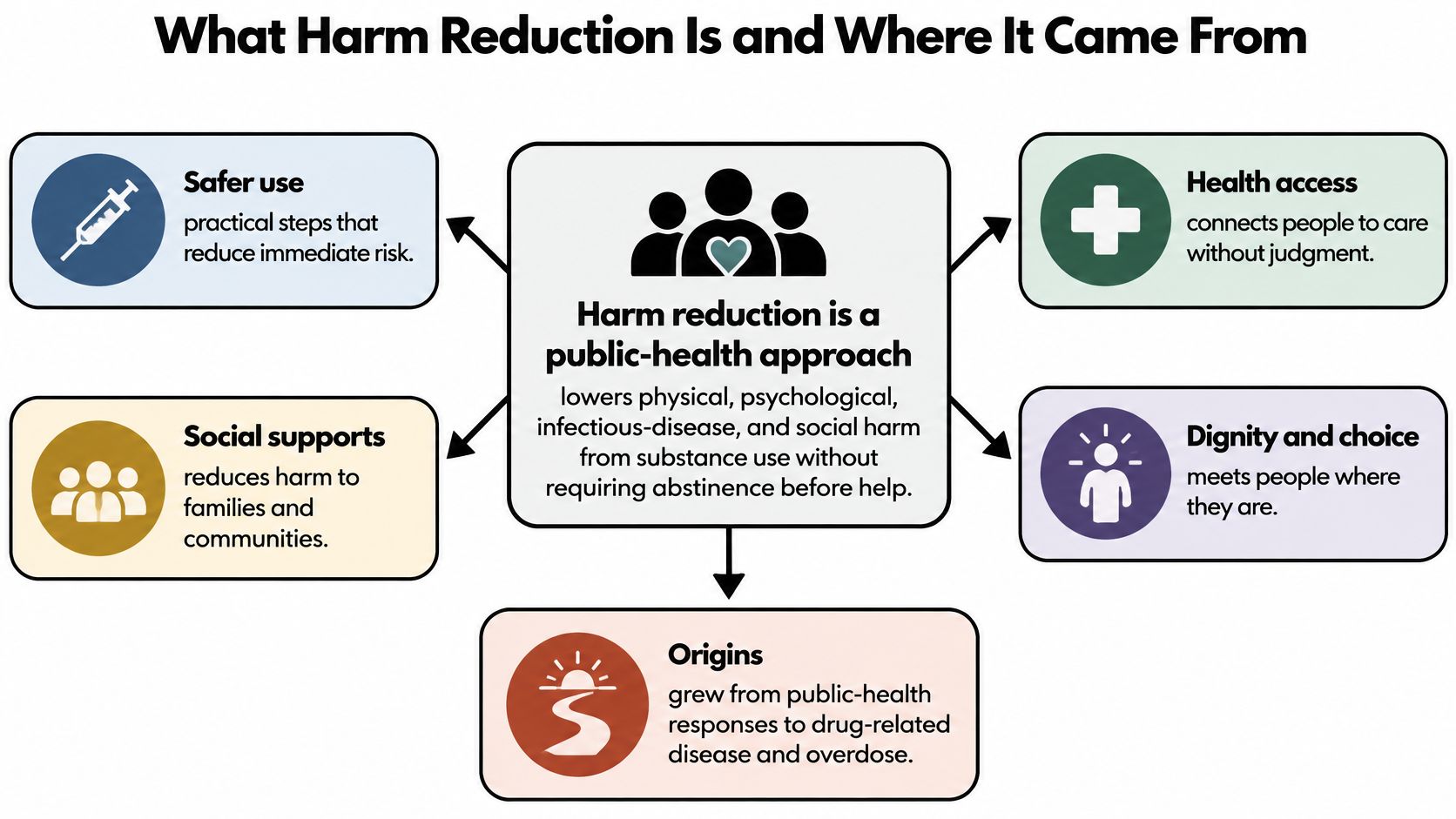
Harm reduction is a public-health approach that lowers physical, psychological, infectious-disease, and social harm from substance use without requiring abstinence before someone can receive help. It combines practical protection with access to care, rather than making a person prove they've stopped using first.
A seat belt offers a useful comparison. It doesn't make driving risk-free, and wearing one doesn't tell the driver to stop traveling. It protects against a particular pathway to serious injury.
Harm reduction works through similarly specific actions. Sterile equipment interrupts exposure to contaminated blood; medical care addresses infections; and treatment can help someone change their substance use.
Harm reduction compared with nearby ideas
| Approach | Precondition | Main goal | What success looks like |
|---|---|---|---|
| Abstinence-first care | Stop using before full help | End substance use | No further use |
| Harm reduction | None; help starts now | Cut health, social, and economic harm | Fewer infections, overdoses, and exclusions, with or without abstinence |
| Safe use as a claim | Assumes risk can be removed | Promise a harmless experience | Not achievable; risk can be reduced, not erased |
The abstinence-first row describes services that make stopping use a condition of receiving full help. It doesn't mean every treatment program operates that way, or that abstinence is an inappropriate goal. Choosing not to use a substance can fit comfortably within harm reduction.
The harm-reduction row changes the starting point. Someone can receive sterile equipment, testing, counseling, treatment referrals, and nonjudgmental education while still using drugs. A successful visit might mean treating an infection or helping the person connect with ongoing care.
The final row identifies an overclaim. Calling an experience safe suggests that its risks have been removed, which is different from reducing them.
Meet people where they are, keep them alive and healthier, and keep the door to care open.
This concept map brings the practical actions and broader supports together.
A response to preventable disease
The historical account in this public-health review traces the milestones in order: AIDS was first reported as a clinical syndrome in the United States in 1981, the Netherlands began its first needle and syringe programs in 1984 after hepatitis B outbreaks, and by 1993 published evidence showed that these programs were effective and safe for preventing HIV transmission, although U.S. implementation remained limited in many jurisdictions. The review also describes an Amsterdam cohort in which needle and syringe programs combined with opioid agonist therapy reduced hepatitis C acquisition by 85%, HIV by 44%, and hepatitis B by 71%, compared with no or incomplete participation.
Those findings make the mechanism easier to understand. Providing clean equipment addresses one exposure route, while treatment addresses patterns of use that create further exposure. Combining services can protect people in ways that a leaflet alone cannot.
The World Health Organization's harm-reduction guidance explains that large-scale coverage can prevent or slow HIV epidemics among people who inject drugs while also reducing overdose deaths, criminality, and social exclusion. Its approach includes testing and treatment for HIV, hepatitis B and C, tuberculosis, and sexually transmitted infections, alongside opioid agonist treatment such as methadone or buprenorphine.
So, what is harm reduction in everyday practice? It's a service that answers the health problem in front of the person, provides useful protection, and offers a next step without judgment. Education matters, but people also need access to the tools and care that make the advice possible.
Tools That Cut Overdose and Infection Risk
The strongest toolkit uses linked protections, not a single fix. Emergency medication, sterile equipment, and drug checking address different problems, so their limits matter as much as their benefits.
What major harm-reduction tools can and cannot do
| Tool | Best-supported result | Hard limit |
|---|---|---|
| Community naloxone plus training | A 2025 systematic review and meta-analysis of 44 studies published from 2003 through 2018 found 98.3% survival after reported overdoses in programs serving people who use drugs, with a 95% confidence interval of 97.5% to 98.8%; the same review found 95.0% survival in family or community programs and 92.4% in police-focused programs. | Doesn't reverse non-opioid emergencies; its effect can wear off, so emergency care is still needed |
| Family or community naloxone programs | High survival after reported overdoses in the same review | A trained person must be present and able to respond |
| Police-focused naloxone programs | High survival after reported overdoses in the same review | Not a substitute for community access |
| Syringe services | Sterile equipment, used-gear collection, care linkage, and often naloxone | Don't remove overdose risk from the drug itself |
| Fentanyl test strips | The National Institute on Drug Abuse's drug-checking explanation describes one assay with 98.5% sensitivity and 89.2% specificity, detecting fentanyl at 200 nanograms per milliliter and 13 additional analogs, but not reliably carfentanil or furanyl fentanyl at concentrations at or below 1,000 nanograms per milliliter. | A negative result isn't proof of safety or dose; the assay misses some analogs at low concentrations |
These are reported outcomes and laboratory measures, not guarantees for an individual emergency or product. The naloxone review found no statistically significant survival differences by dose, administration route, location, or study year, supporting distribution beyond clinical settings.
Responding to an opioid overdose
Naloxone displaces opioids from receptors involved in slowed breathing. The NIDA guidance on naloxone explains that it can be administered through the nose or into muscle with limited training, but it doesn't reverse non-opioid intoxication.
- Call emergency services immediately. Say the person may be overdosing and describe their breathing.
- Give naloxone. Use the nasal or injectable product as directed, and repeat it if breathing doesn't return according to the product instructions.
- Support breathing and stay. Follow the dispatcher's rescue-breathing or CPR instructions if the person isn't breathing normally. Once they're breathing, place them on their side in the recovery position and remain until help arrives, because naloxone can wear off before the opioid does.
Syringe services also provide repeated contact with healthcare workers through equipment distribution, used-equipment collection, and referrals. That contact creates opportunities to address problems before they become emergencies.
Drug checking adds information rather than permission. In a study of a supervised-consumption facility's checking service, clients conducted 1,411 checks, and 1,121 samples, or 79.8%, tested positive for fentanyl; the study recorded 120 overdoses associated with checks, with 94% occurring after consumption.
People may respond to a positive result by using a smaller amount more slowly or avoiding solitary use. A prepared watcher, naloxone, and emergency access still belong in the plan. For a different substance-specific concern, psilocybin drug interactions are questions to review with a clinician, not problems an opioid-reversal medication can solve.
Myths That Make Harm Reduction Sound Safer Than It Is
Calling harm reduction permission to use drugs misses its purpose. It's a decision to address preventable damage when use is already happening or firmly planned, not an endorsement of every choice someone makes.
The opposite misunderstanding is just as important: a precaution doesn't transform a risky substance into a harmless one. A test result, careful mindset, or reassuring label can become dangerous when someone treats it as a guarantee.
A test strip isn't a green light
A multisite cohort study and accompanying evidence discussion described a 2025 study of 732 people who use drugs in which baseline fentanyl-test-strip users were more likely to report carrying naloxone, checking strength, arranging monitoring, and discarding unexpectedly potent or different drugs; nevertheless, mean daily self-reported nonfatal overdose risk was 0.02 in both groups, with a risk ratio of 1.20 and a 95% confidence interval of 0.70 to 2.06. The evidence discussion also noted that a separate scoping review found no randomized controlled trials establishing that fentanyl-test-strip use alone reduces overdose mortality.
The distinction is behavior change versus demonstrated protection against overdose. People may take useful precautions after testing without the study establishing that testing itself lowered their overdose risk.
That doesn't make checking pointless. It means its information needs to be acted on within a broader response plan, rather than treated as a final verdict.
Practical rule: Do stack a plan, a sober person, and a medical exit. Don't treat one precaution as a shield.
Confidence isn't the same as preparation
Personal caution can't resolve misleading labels or unknown strength. Someone may follow their plan carefully and still encounter a substance that isn't what they expected.
For psychedelics, the matching myth is that a good mindset guarantees a good experience. Feeling calm may help, but it doesn't replace health screening or establish what a product contains. A person who expects a pleasant evening can still have a distressing psychological or physical reaction.
The discussion of magic mushroom risks is useful preparation for asking health questions, not a substitute for individualized advice. Confidence based on familiarity, friends' experiences, or packaging should never outweigh symptoms that need medical attention.
Risk reduction also includes deciding not to proceed. Postponing an experience because support is unavailable or a health question remains unresolved is an active safety decision, not a failure to prepare.
If a tip promises zero risk, it's marketing, not harm reduction.
Why Access Changes the Risk
A person can understand every precaution and still lack the services needed to follow it. Knowing about naloxone doesn't help enough if it's unavailable nearby, and a referral isn't useful when the clinic can't accommodate the person.
The European Union Drugs Agency's harm-reduction overview places programs and policies alongside individual actions, notes that evidence is strongest for needle-and-syringe and take-home naloxone programs, and describes recent U.S. overdose declines of nearly 25% from 2023 to 2024 as associated with expanded naloxone, medications for opioid-use disorder, and syringe services. The overview also describes a 2025 six-state U.S. analysis finding major differences in overdose patterns, harm-reduction laws, prevention infrastructure, naloxone distribution, and opioid-settlement spending transparency, with significant racial and ethnic disparities.
An association doesn't establish that a particular service caused the entire decline. It does show why a population-level response requires more than advice directed at individuals.
What usable access looks like
When regulated care, testing, or emergency support feels far away, useful assistance must address the obstacle rather than repeat the recommendation.
- Privacy-preserving education: People should be able to learn about risks without unnecessary disclosure of personal information.
- Nonjudgmental staff: A person needs to describe what they took openly, without expecting humiliation.
- Language access: Instructions must be understandable, particularly during an emergency.
- Disability access: Physical spaces, written materials, and communication methods should accommodate different needs.
- Rural support: Travel distance, transport, and limited service hours need practical solutions.
Fear can also delay help. Someone who expects stigma or punishment may hesitate to call emergency services or may hide information that responders need.
Share responsibility for prevention
Say someone lives far from a clinic and relies on a friend for transportation. Telling them to obtain testing without addressing travel, privacy, or appointment availability leaves the hardest part unresolved.
Healthcare organizations and community services can make care easier to reach by offering understandable instructions, flexible entry points, and respectful referrals. Families and peers can help with transportation and accompaniment without taking over the person's decisions.
A careful personal plan can't identify unknown potency or replace a nearby emergency response. Harm reduction asks both the individual and the service system to do their part.
Set Setting and Dose for Psilocybin
A favorable clinical psilocybin safety profile doesn't automatically apply to an unsupervised product experience. Clinical participants receive screening, measured doses, controlled environments, and monitoring, while a chocolate, gummy, capsule, or dried mushroom used at home may vary in potency and composition.
A clinical safety synthesis found headaches, nausea, temporary blood-pressure increases, and anxiety were common, while serious adverse events were uncommon and occurred in only 2 of 42 reviewed studies, primarily among participants with underlying depressive disorders. That finding describes screened clinical settings, not a promise about retail products or an individual's health.
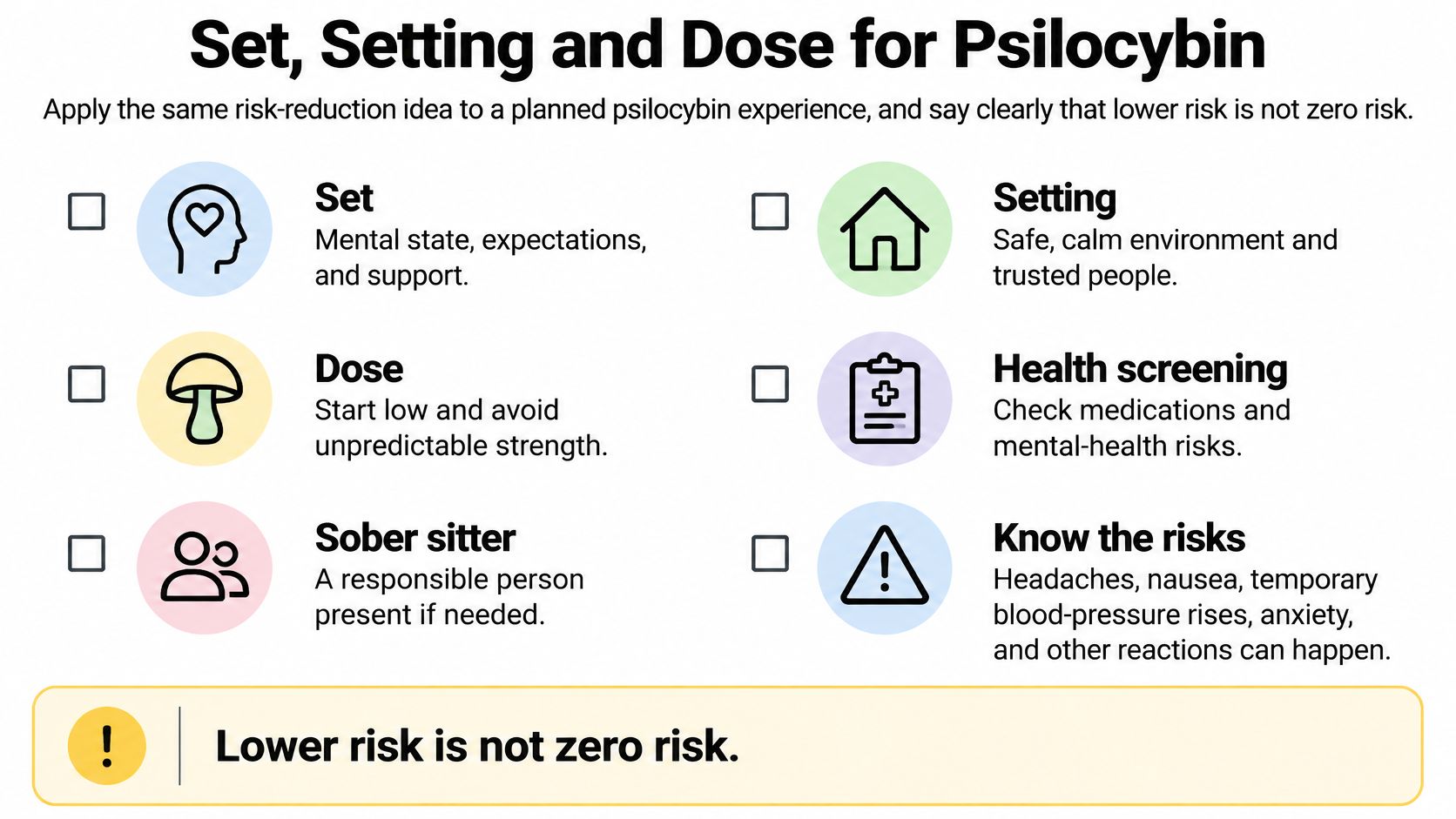
This checklist highlights the preparation questions that deserve attention before an experience.
The mind and the room
Think of set and setting like preparing a house for a guest. Set is the state you bring with you: sleep, mood, expectations, and emotional concerns. Setting is the room, the people present, and what happens if something goes wrong.
A comfortable room can't compensate for a health concern that hasn't been assessed. Likewise, an optimistic outlook won't make an unfamiliar environment easier to manage if the person becomes confused or overwhelmed.
The video offers another way to approach preparation.
Prepare in a deliberate order
- Confirm adult eligibility and consent. Our products are for adults 21 and over and should be used responsibly. No one should be pressured into an experience.
- Review health questions with a professional. Discuss medicines and supplements, depression, panic, heart issues, and past difficult experiences. Don't stop prescribed medication to make room for a mushroom product.
- Skip alcohol and other drugs. Avoid adding another substance that could complicate reactions or make symptoms harder to interpret.
- Choose a trusted sober support person. They should stay present, know the plan, and be willing to call for help.
- Use a conservative amount rather than stacking products. Don't assume equal-sized pieces or similar-looking mushrooms contain equal amounts. If strength or composition is unclear, postponing is the more cautious choice.
- Store products securely. Keep them away from children, pets, visitors, and anyone who might mistake them for ordinary food.
- Prepare a calm, familiar space. Remove driving and risky tasks from the plan, keep the phone accessible, and agree on how the support person will respond to distress.
A trip preparation checklist can help organize those decisions, but it can't provide medical clearance or establish an unknown product's potency.
Know when to seek urgent care
Chest pain, severe agitation, confusion that doesn't pass, or suicidal thoughts require urgent medical help. Don't dismiss these symptoms as a difficult trip that must be endured.
The support person should describe what was taken and stay with the person while help is arranged. Reflection and integration can wait; an afterglow isn't proof that a troubling reaction was harmless, and meaningful reflection works best after the body is safe.
Plan the Next Step and Find Help
Before any purchase, write a one-page plan that someone else could understand. If a critical answer is missing, pause rather than fill it in during an altered state.
Put the decisions in writing
- Name the sober support person and location. Confirm that they've agreed to stay, rather than assuming a friend will be available.
- Define the first-amount decision. Record the product identity and the basis for a conservative amount. If that basis is uncertain, write postpone instead of guessing.
- List medicines and supplements for review. Include prescriptions, over-the-counter medicines, and supplements, then take the list to a clinician.
- Write the emergency triggers. Make the warning signs easy for the support person to find, and decide how they'll contact emergency care.
- Choose secure storage. Set aside a place that prevents accidental access and keeps product information available.
A written plan isn't a contract requiring you to proceed. You can change your mind if your health, support arrangements, or comfort level changes.
A useful support person also needs a role beyond just being nearby. Agree that they can remove hazards, seek help, and communicate with responders without debating whether that will spoil the experience.
Use public resources for the right questions
The CDC's overdose-reversal guidance explains naloxone's role in reversing opioid overdose and the importance of timely emergency response. It's a practical resource for people who may encounter an opioid emergency, including families and peers.
NIDA's drug-checking explanation covers fentanyl test strips and more advanced methods such as infrared spectrometry. Those resources answer opioid-response and drug-testing questions; neither can determine whether a particular mushroom product fits your medical history.
Before buying: If the plan relies on guessing about a medication, product strength, or who will help, the next step is clarification, not checkout.
For product-specific wellness decisions, our Magic Mushroom Gummies should be used as part of a balanced wellness routine, with a healthcare professional consulted for personalized recommendations; our Magic Mushroom Chocolate offers wellness benefits including stress relief, mood enhancement, and cognitive support; and we advise consulting a healthcare provider before consuming Raw Magic Mushrooms with any medications or supplements. Those wellness descriptions aren't individualized medical clearance or a reason to bypass screening.
A clinician can help you distinguish a wellness goal from a condition that needs assessment or treatment. Bring specific questions about your health and intended product rather than asking only whether mushrooms are generally safe.
Curiosity is fine; improvising the safety plan is not. Set the plan before any purchase, and give yourself permission to postpone.
The Magic Mushroom Delivery offers raw mushrooms, chocolates, gummies, capsules, and educational resources for adults considering responsible use. Visit The Magic Mushroom Delivery to explore the product categories and preparation guidance, with your health questions and support plan settled before ordering.