
You're lying awake, replaying a difficult conversation, scanning tomorrow's calendar, and wondering whether a “natural” option could quiet the constant internal alarm. Searching for magic mushrooms and anxiety can feel especially confusing because online discussions often jump from promising clinical findings to sweeping claims about everyday stress, panic, or generalized anxiety.
The honest answer is narrower. Psilocybin, the primary psychedelic compound in magic mushrooms, has shown meaningful anxiety reductions in several controlled studies, especially among people facing life-threatening illness. Those studies used carefully selected participants, trained clinicians, psychological preparation, supervision, and follow-up support. They don't automatically predict what will happen with an unstandardized product, an unsupervised experience, or a different anxiety diagnosis.

This guide separates what researchers have studied from what remains uncertain. It starts with the brain processes scientists think may be involved, then reviews clinical results, the populations represented in the evidence, dose and support variables, mixed findings, risks, and possible next steps. The aim isn't to prescribe psilocybin or promise relief. It's to give you a clearer way to read the research and discuss your own situation with a qualified healthcare professional.
Introduction to Magic Mushrooms and Anxiety
Anxiety rarely arrives as one neat symptom. One person may feel a tight chest and racing thoughts before work. Another may spend hours anticipating illness, rejection, or financial trouble. Someone facing a serious diagnosis may experience a deeper form of distress, with fear, sadness, uncertainty, and questions about identity or meaning all tangled together.
That difference matters because clinical research doesn't treat “anxiety” as one interchangeable condition. A study involving people with cancer-related anxiety and depression is answering a different question from a study involving generalized anxiety disorder, panic symptoms, or ordinary day-to-day stress. The population, diagnosis, dose, support, and follow-up period all shape what a result means.
Psilocybin is being studied as part of a therapeutic process, not just as a mood-lifting ingredient. In controlled trials, participants typically receive preparation, monitored sessions, and help making sense of what they experienced afterward. That structure gives researchers a way to examine whether changes persist beyond the acute effects, while also helping participants manage difficult emotions that may arise.
A promising clinical signal isn't the same as a universal anxiety treatment.
You'll also see an important distinction between full-dose psychedelic research and newer lower-dose or micro-dose research. Full-dose studies ask whether a carefully supported psychedelic experience can produce lasting psychological change. Micro-dose studies ask a different practical question, whether lower exposure might influence anxiety without producing a full hallucinogenic experience. Neither research direction has settled the broader question for everyone.
The most responsible interpretation is cautious but not dismissive. Some findings are encouraging, especially in end-of-life distress. Other studies are small, mixed, or still being planned for diagnosis-specific conditions. That combination makes curiosity reasonable, but it also makes careful context essential.
How Psilocybin Is Thought to Influence Anxiety Pathways
Anxiety can behave like a mental filter that keeps selecting the same threatening possibilities. You notice the email that might contain criticism, the physical sensation that could signal illness, or the future event that could go wrong. Once the loop starts, your attention keeps returning to it, even when no new information appears.
Researchers study psilocybin because it may temporarily alter the brain systems involved in self-focused thought, emotional meaning, and perception. Psilocybin acts through serotonin 2A receptors, which are involved in mood and perception. Scientists also examine changes involving the default mode network, a set of connected brain regions associated with self-referential thinking and internally focused mental activity.
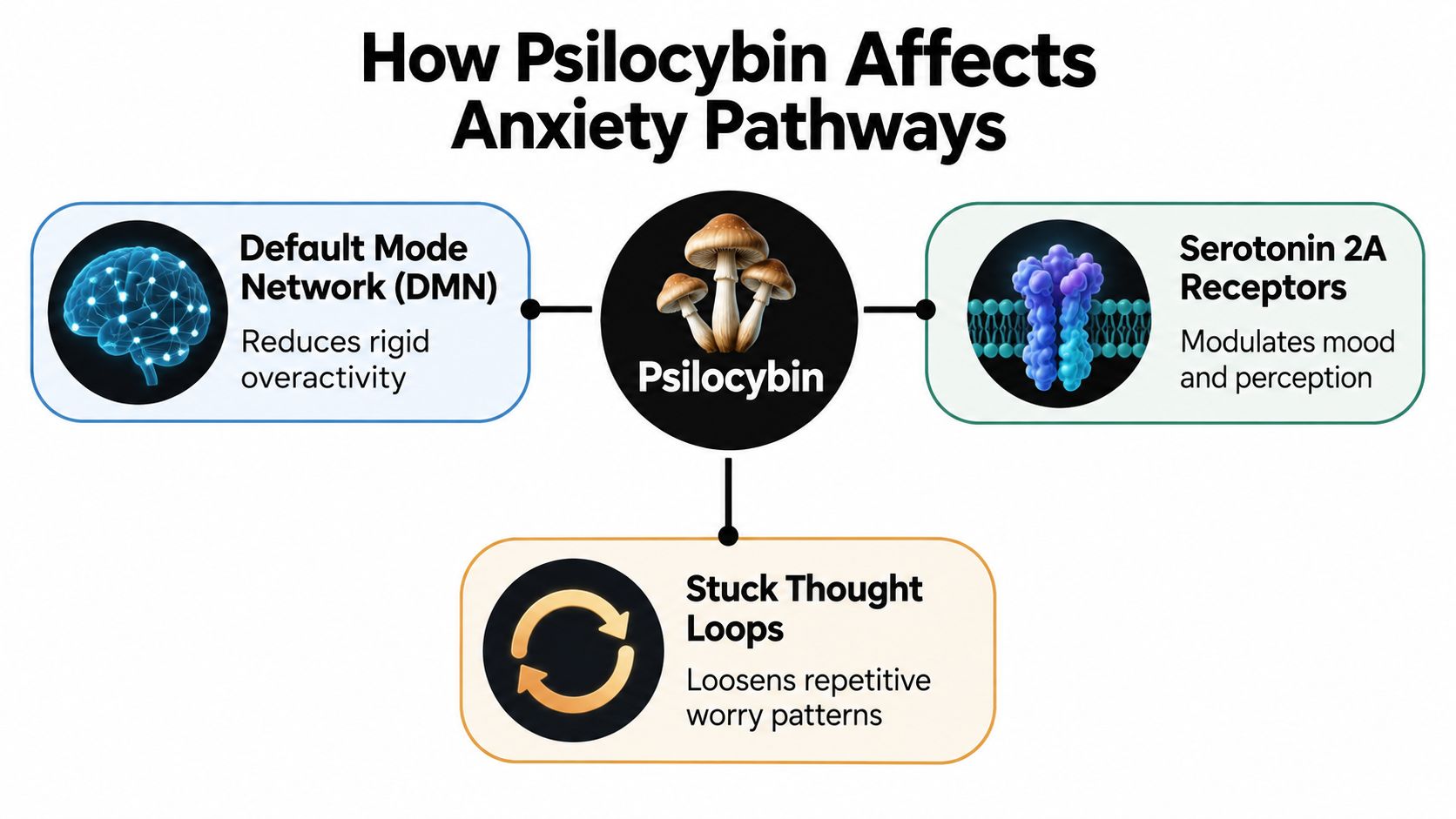
A simple way to understand the proposed process is to think of anxiety as a rigid route through a familiar neighborhood. The brain keeps taking the same turn, worry, prediction, physical alarm, more worry. Psilocybin may temporarily loosen the usual traffic pattern, allowing thoughts, memories, sensations, and emotions to connect in less predictable ways.
That doesn't mean the experience is automatically pleasant. A flexible mind can notice new perspectives, but it can also encounter difficult feelings that were previously avoided. The surrounding therapeutic environment therefore matters. Preparation can help a participant understand that unusual sensations or emotions may occur, while skilled support can reduce panic during the session and help translate insights into ordinary life afterward.
You can explore a plain-language discussion of related brain processes in this guide to psilocybin's effects on the brain.
From thought loops to psychological flexibility
The key idea isn't “more happiness.” Researchers are interested in whether a person can relate differently to fear, grief, uncertainty, or self-criticism. Someone may still recognize a serious problem, but feel less trapped inside one automatic interpretation of it.
This is sometimes described as psychological flexibility. In everyday terms, it means having more room to notice a thought without treating it as an unquestionable fact, or to approach an emotion without immediately escaping it. Psilocybin may create a temporary opening, but therapy, reflection, and supportive follow-up help determine whether that opening becomes useful change.
The model remains a hypothesis rather than a guarantee. Brain-network findings can help explain why researchers are interested, but they can't predict an individual response on their own. Anxiety is shaped by biology, history, environment, health, expectations, and current support, so no single pathway explains every outcome.
What Clinical Research Has Found So Far
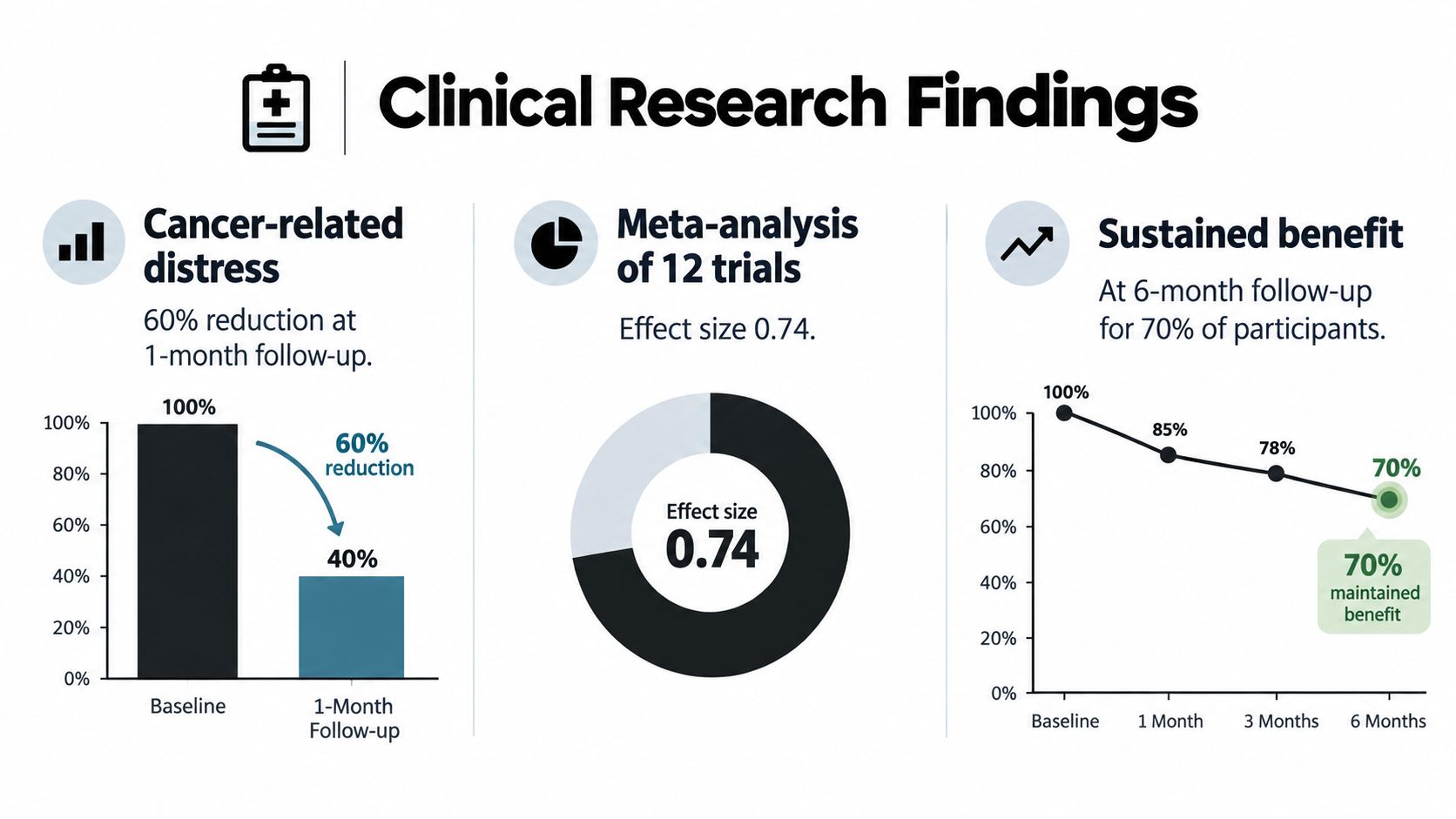
The strongest historical evidence for psilocybin and anxiety comes from controlled work with people experiencing cancer-related distress. In a 2016 study of psilocybin-assisted psychotherapy, clinician-rated anxiety scores on the HAM-A measure showed large improvements across participants assigned to the low-dose-first and high-dose-second sequence. The study's outcome table reported reductions reaching 83% and 82% at later assessments. At six months, the overall clinical response rate for anxiety was 83%, while symptom remission was 57%, according to the published results in the controlled cancer-related anxiety study.
Those findings matter for two reasons. First, the changes extended beyond the immediate psychedelic experience. Second, the study helped establish a modern research program focused on whether psilocybin could ease anxiety connected to serious illness, rather than merely create a temporary shift in mood.
What pooled evidence adds
A 2021 meta-analysis of five studies examined anxiety near the end of life and found psilocybin superior to placebo for both state and trait anxiety at several follow-up points. State anxiety improved with Hedges' g of -0.70 at one day and -1.03 at two weeks. Trait anxiety improved with g values of -0.71 at one day, -1.08 at two weeks, and -0.84 at six months, as reported in the end-of-life anxiety meta-analysis.
Effect size can feel abstract. In this context, it describes the separation between treatment and comparison groups, adjusted so researchers can compare results across studies. A larger absolute value generally indicates a stronger difference, but it doesn't mean every participant improved equally or that the treatment will work the same way outside the study.
The review also highlights a major limitation. The mean sample size was only 26.4 participants per study, with individual samples ranging from 12 to 56. Small trials can produce important early signals, but they're less able to capture the full range of responses, uncommon risks, or differences among diagnoses and backgrounds.
A separate randomized, double-blind crossover study compared very low doses of 1 or 3 mg per 70 kg with high doses of 22 or 30 mg per 70 kg. The high-dose condition produced large decreases in clinician-rated and self-rated anxiety, and about 80% of participants continued to show clinically significant reductions in anxiety and depressed mood at six months, according to the crossover trial record.
The research story is therefore encouraging, but precise. It supports a durable anxiolytic signal under structured conditions. It doesn't establish a universal dose, a guaranteed outcome, or a broad answer for every form of anxiety.
Who Research Has Studied and Who Remains Understudied
A reader with panic attacks, generalized anxiety disorder, social fear, health anxiety, or persistent daily stress may look to psilocybin research for an answer. Much of the clinical evidence, however, comes from people facing life-threatening illness, especially cancer-related anxiety, depression, and existential distress.
That focus is understandable. A serious diagnosis can create intense psychological suffering, while a defined medical setting lets researchers carefully organize treatment and support. The results still may not transfer directly. Someone with generalized anxiety disorder can share patterns of worry with a person facing cancer, yet have a different symptom history, risk profile, treatment goal, and relationship with uncertainty.
Evidence outside oncology remains limited. A 2024 Cochrane review found lower anxiety than with active placebo among people with life-threatening disease, but rated the evidence low-certainty, according to the summary included in the recent clinical-trial record. A 2026 PubMed trial also reported significant short-term reductions in state anxiety after psilocybin-assisted psychotherapy for depression and anxiety linked to life-threatening illness. These findings strengthen the evidence for that population. They do not answer whether the same approach helps panic disorder, generalized anxiety, or everyday stress.
The move toward diagnosis-specific research
Researchers are beginning to ask narrower questions. A Phase 2a placebo-controlled study in the 2025 to 2026 clinical-trial pipeline is examining a 3 mg oral psilocybin solution for generalized anxiety disorder, including diagnosis-specific dosing, safety, and tolerability. That focus matters because anxiety is an umbrella term. A dose and treatment plan studied for illness-related distress may not suit chronic worry or panic symptoms.
Micro-dose research asks a different question. Queen's University launched a Health Canada-approved Phase 2a home-use study of daily micro-dose psilocybin for generalized anxiety disorder. The study aims to examine anxiety reduction without hallucinogenic effects, as described in the systematic review and emerging research discussion.
| Research direction | Main question | Current interpretation |
|---|---|---|
| Supported full-dose therapy | Can an intensive psychedelic experience help change distress? | Most developed in life-threatening illness |
| Diagnosis-specific trials | Does the approach fit generalized anxiety disorder? | Emerging and still under evaluation |
| Micro-dose protocols | Can lower exposure affect anxiety without hallucinations? | Early research direction, not an established answer |
These categories should not be treated as interchangeable. Full-dose therapy has been studied more in structured clinical settings, while micro-dose protocols remain an early research direction.
People with common anxiety diagnoses, younger adults, and diverse ethnic communities remain less represented. Until studies include these groups, claims about who will benefit, and at what dose, remain uncertain rather than settled evidence.
Dosing Considerations Set and Setting and Support
Dose is only one variable in psychedelic research, and it's easy to give it too much attention. In the randomized crossover study discussed earlier, researchers compared very low exposure with substantially higher exposure, and the high-dose condition produced the larger anxiety signal. That supports a possible dose-response relationship in that study, especially when the experience was paired with structured support.
Other evidence complicates the picture. A systematic review of psilocybin in life-threatening disease found reductions in Beck Depression Inventory scores and State-Trait Anxiety Inventory trait anxiety at all tested doses, but the reduction was not dose-dependent, according to the systematic review of psilocybin in life-threatening disease. In plain language, higher exposure didn't consistently produce a clearly stronger anxiety benefit across that review.
Why the room and the relationship matter
Set and setting describe the participant's mindset and the surrounding environment. A calm clinical room, careful preparation, trusted support, and a plan for follow-up create very different conditions from an unpredictable setting with unfamiliar people or competing demands.
Support also helps researchers separate the acute experience from the therapeutic work around it. Participants may discuss expectations before dosing, receive monitoring during the session, and revisit emotions or insights afterward. Those elements don't prove that therapy causes every improvement, but they're part of the treatment package being tested.
In clinical research, dose is never the whole intervention. Context helps shape what the experience means and how a person responds to it.
The practical takeaway is not a dosing recommendation. It's a warning against treating a number from a trial as a universal formula. Products can vary, people can differ, and a dose that was tolerated in a screened study participant doesn't establish safety or suitability for someone else.
Readers who want to understand why dose is discussed alongside preparation and context can review this guide to dosing considerations, while keeping in mind that educational material isn't a substitute for individualized medical advice.
Risks Mixed Results and Harm Reduction Perspectives
Promising findings can make psilocybin appear more consistent than the evidence supports. A 2026 systematic review found improvement in only 3 of 5 anxiety-related studies, while 2 showed no significant change. As noted earlier, that variation challenges the assumption that every product, dose, diagnosis, and setting will lead to the same result.
Earlier pooled research was more encouraging. Across four clinical studies that paired psilocybin with behavioral interventions for high anxiety or depression symptoms, a 2020 meta-analysis found large within-group improvements in anxiety, with Hedges' g values ranging from 1.16 to 1.47. Placebo-controlled effects ranged from 0.82 to 0.83, and those studies reported no serious adverse events, according to the 2020 meta-analysis abstract.
Both patterns can be true. Carefully supported studies may show strong average improvement, while another group finds no significant change. Average effects describe a group, not every participant. Likewise, no serious adverse events in a small clinical sample does not establish safety in unsupervised or different circumstances.
Psychological risk deserves attention
A psychedelic experience can intensify fear, confusion, distressing memories, or the feeling of losing control. Anxiety may increase before it decreases, and unusual perceptions can be difficult to interpret. Psychiatric history, current medications, physical health, expectations, and surroundings all shape the risk.
Screening and supervision reduce avoidable problems. So do avoiding impulsive decisions during an altered state, having trusted support nearby, and seeking professional help if distress continues or becomes unmanageable. Online guidance cannot review your medical history or identify every contraindication.
If someone has already had a frightening experience, practical support matters more than blame. Move to a quieter environment, remain with a trusted sober person, reduce stimulation, and seek urgent medical help for severe or persistent symptoms. Guidance on what to do after a difficult mushroom experience can help organize those immediate steps.
The balanced conclusion is simple. The evidence suggests potential, not certainty. Mixed findings belong in the assessment, especially when results may differ by population, dose, and level of support.
Exploring Alternatives and Making an Informed Next Step
Psilocybin research belongs inside a wider anxiety-care conversation, not above it. Established options can include cognitive behavioral therapy, other forms of psychotherapy, clinician-guided medication, sleep and exercise routines, stress-management skills, and practical changes to reduce avoidable triggers. Functional mushrooms such as reishi are also discussed in wellness settings, but they shouldn't be treated as interchangeable with psilocybin or assumed to have the same evidence.
A useful discussion with a healthcare professional might begin with questions such as:
- What kind of anxiety am I experiencing?
- Is it connected to a medical condition, medication, trauma, depression, or another mental health concern?
- What treatments have I tried, and what happened?
- What risks might matter given my history?
- Am I looking at a controlled clinical protocol or an unverified consumer claim?
When evaluating information, look for the participant population, comparison group, dose description, psychological support, follow-up period, and limitations. A headline about anxiety relief means much less if it leaves those details out.
The clearest takeaway is that psilocybin has produced meaningful anxiety reductions in carefully supported studies, with the strongest evidence concentrated in life-threatening illness. Research for generalized anxiety disorder and micro-dose approaches is emerging, while findings remain mixed. Your diagnosis, health history, support system, and treatment goals matter more than any single result.
The Magic Mushroom Delivery provides educational resources alongside a selection of psilocybin and functional mushroom products, including raw mushrooms, infused chocolates, gummies, capsules, and mushroom coffee. Visit The Magic Mushroom Delivery to compare product information and continue learning about responsible, informed mushroom use.