The most repeated advice about this strain is that Huautla is a landrace with fixed character: Mexican genetics, moderate strength, a warm visual arc, and a label you can shop by. Very little of that survives contact with the evidence.
Psilocybe cubensis Huautla is a name attached to a cultivated line of a pan-tropical species. It bundles three things buyers routinely treat as one: a place with documented ceremonial mushroom use, a trade label printed by cultivators, and a claim about genetic ancestry. Only the first has records behind it, and those records describe a region, not the contents of a jar.
What follows separates those three, sets out what the species history says, and names the documents that would turn a Huautla claim from marketing into something checkable. Where the record runs thin, this says so instead of filling the gap.
What Huautla Means for Psilocybe cubensis
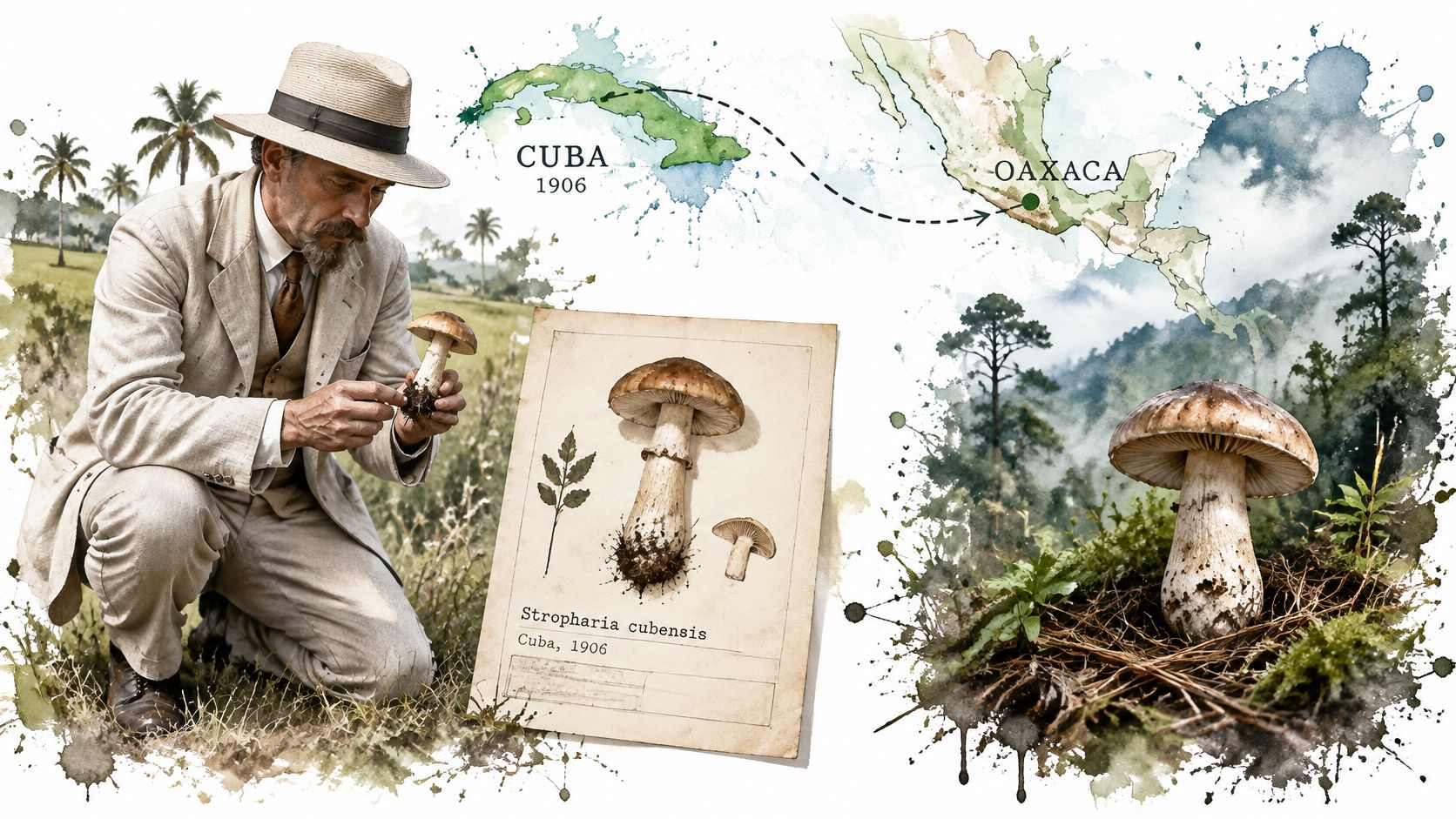
The short answer is that Huautla is an informal name for a cultivated line of Psilocybe cubensis tied by geography and culture to Huautla de Jiménez in Oaxaca, Mexico. It isn't a recognized species. It isn't a formally published botanical variety either. The species underneath was described from Cuba in 1906 as Stropharia cubensis by Franklin Sumner Earle and only later moved into Psilocybe.
The place association is documented. R. Gordon Wasson, a banker and amateur ethnomycologist, attended a Mazatec velada in Huautla with the curandera María Sabina in 1955, and his account ran in Life magazine on May 13, 1957. Historical sources name P. cubensis, known locally as "San Isidro," as one of the region's mushrooms, and a 1975 Mexican mycological publication listed it among species commonly sold by mestizos in Huautla. That is evidence of local presence, not of descent. As the strain reference for Huautla states, no documented collector, voucher specimen, or continuous chain connecting modern trade lines to historic Oaxaca material has been established.
Three claims the label blends
- Geographic association: a real place with a documented ceremonial tradition and a named local mushroom.
- Trade name: whatever a cultivator or vendor decided to print, applied to a line that may have been circulating for years.
- Genetic identity: an assertion about ancestry, which needs records that almost no listing carries.
Test each claim against what the name alone can answer.
| Question | Does the label answer it? | What to check instead |
|---|---|---|
| Is it a recognized species? | No, an informal trade or lineage name | Species identity as Psilocybe cubensis |
| Does it show geographic origin? | Only a cultural association with Huautla de Jiménez, Oaxaca | Documented collector, voucher specimen, accession records |
| Does it prove genetic lineage? | No | Molecular authentication or sequencing, plus breeder records |
| Does it predict potency? | No | Measured alkaloid results for the specific batch |
| Does it guarantee consistent effects? | No | Batch-to-batch results and contaminant testing |
One more layer of confusion: a 2024 DoubleBlind article on the Huautla mushroom strain calls it a landrace variety. That's a descriptive phrase in a single article, not a formal classification, and it still needs a voucher or a breeder record behind it before a reader treats it as settled.
The working rule: treat Huautla as a cultural and market label until a seller documents more, and describe the product as a P. cubensis lineage sold under the Huautla name with batch-level identity testing behind it, rather than a genetically uniform landrace, which is the defensible specification one strain profile aimed at cultivators arrives at.
How the Species History Reaches Oaxaca
The species has a dated paper trail, and its earliest entries have nothing to do with Oaxaca. Earle described Stropharia cubensis from Cuban material in 1906, and the modern combination Psilocybe cubensis (Earle) Singer was published in 1948, as the taxonomic summary accompanying the species record sets out. Between those dates, the same fungus kept being described again from far-apart places under different names.
Narcisse Théophile Patouillard reported a similar fungus from Tonkin, now northern Vietnam, in 1907 as Naematoloma caerulescens, and William Alphonso Murrill described material from near Gainesville, Florida, in 1941 as Stropharia cyanescens. Both sit in the GBIF biodiversity records for the species, which also place it across the Gulf Coast and southeastern United States, Mexico, Central America, the Caribbean, much of South America, Southeast Asia, India, Australia, New Zealand, and Pacific islands. A recent ecological-modeling study cited there estimated ancestral populations spread discontinuously across the Americas, Africa, Southeast Asia, and Australasia between about 0.71 and 2.55 million years ago, though the species' precise origin stays debated.
Laid out by date, the gap between the taxonomy and the town becomes obvious.
| Year | Event | Relevance to Huautla |
|---|---|---|
| 1906 | Earle describes Stropharia cubensis from Cuba | Original species description |
| 1907 | Patouillard reports a similar fungus from Tonkin as Naematoloma caerulescens | Shows early wide distribution |
| 1941 | Murrill describes Florida material as Stropharia cyanescens | Similar material described under another name |
| 1948 | P. cubensis (Earle) Singer published | Modern combination used today |
| 1955 | Wasson attends a Mazatec velada in Huautla with María Sabina | First documented Western link to Huautla |
| 1957 | Wasson's account appears in Life on May 13 | Introduces Huautla practice to a large Western audience |
The Oaxaca association enters this timeline in 1955 and reaches a mass audience in 1957. Neither event is a collection record in the sense a taxonomist would accept. No specimen was deposited, and nothing in the sequence ties a cultivated line to that valley. The species lives at species level, and the guide to psilocybe types is where that comparison belongs. A strain name is a thinner layer sitting on top of it.
Why the Name Cannot Predict Genetics
A strain name is a label, and a label doesn't carry a genome. When researchers surveyed commercial P. cubensis cultivars, they found a consistent pattern: narrow genetic diversity, high homozygosity, reduced heterozygosity, increased linkage disequilibrium, and low allelic diversity at mating-compatibility loci, as reported in the genomic analysis of commercial cultivars published through the Oregon Health Authority.
What that pattern means
Those signals describe a cultivation history rather than a wild one. The same analysis reads them as consistent with repeated selfing, clonal propagation, and few founding populations. Many commercial lines are therefore close relatives that have been inbred and copied, which produces two awkward outcomes. Two cultivars wearing different names can be near-identical on paper. Two cultures wearing the same name can come from unrelated starting points.
The psilocybin biosynthetic gene cluster tells a similar story. Most examined cultivars share highly similar coding sequences there, yet unique alleles in some cultivars may affect production of psilocybin and related analogs. The machinery is broadly conserved, and the small differences are exactly the part a name can't communicate.
A surname tells you which family someone belongs to. It doesn't tell you how tall each sibling is.
That's the whole difficulty with buying by name. Huautla is the surname. Potency, alkaloid ratio, and batch behavior are the siblings, and you meet them one at a time.
What to ask for instead
The quality-control benchmark is unglamorous and specific. Authenticate the organism molecularly where that's feasible, then quantify each finished batch using validated analytical methods, and report the measured alkaloid content rather than an assumed potency. A seller quoting numbers tied to a specific batch is handing you information. A seller quoting the reputation of a strain is handing you a story with a familiar shape.
None of this argues that genetics are irrelevant. Biosynthetic capacity is real and it's heritable. The point is narrower: capacity sets a ceiling and a floor, and the name doesn't tell you where inside that range any given jar landed.
Why Potency Swings Between Batches
One number should change how you read every strain label: more than 7.8-fold. A Journal of AOAC International study of 14 P. cubensis strains grew, dried, extracted, and analyzed all of them under standardized conditions, and total tryptamine concentrations still ran from 2.62 to 20.65 mg/g. Same protocol, same lab, same species.
Psilocybin was the dominant compound in every one of the 14 strains, and it still ranged from 2.03 ± 0.56 mg/g to 19.60 ± 2.93 mg/g. That spread isn't a rounding artifact. A dose that feels moderate from a low batch could be several times stronger from a high one, which makes the name on the pack a weak predictor of what happens on the night.
| Measure | Reported range | What it means |
|---|---|---|
| Total tryptamines, 14 strains | 2.62 to 20.65 mg/g | Spread of more than 7.8-fold |
| Psilocybin, same 14 strains | 2.03 ± 0.56 to 19.60 ± 2.93 mg/g | Dominant compound in every strain |
| Huautla-specific range | None published | Any Huautla figure describes one batch only |
What moves the number
- Genetics: sets the biosynthetic capacity of the line, within the range described above.
- Cultivation conditions: substrate, temperature, humidity, and air exchange shift how much of that capacity gets used.
- Developmental stage at harvest: the mushroom's chemistry isn't static across a flush, so timing changes the result.
- Drying and storage: moisture and handling alter what a lab measures later, which is why dry-weight reporting exists.
- Extraction method: the same material can yield different measured totals depending on how it was prepared for analysis.
What doesn't exist is a published, standardized potency range for Huautla. Every Huautla figure you'll encounter is a single-batch observation. A December 2024 Huautla grow report from Miraculix Lab measured 1.13 percent psilocybin, about 11.3 mg/g, which sits comfortably inside the range the 14-strain work reported and still describes exactly one batch grown by one cultivator.
Ask for the batch, not the legend: a figure without a batch identifier, a stated material, and a clear unit is a marketing sentence, not a measurement.
If you want the wider picture on measured strength across products and forms, the breakdown of magic mushroom potency covers how doses compare. Treat every unmeasured potency claim as unverified until a number arrives with a method attached.
Where Alkaloids Concentrate in the Mushroom
A Huautla label cannot tell you which part of a mushroom was tested. That distinction matters: a stability study published in a pharmaceutical journal measured dried caps at approximately 1.03 wt.% total tryptamine alkaloids and stipes at about 0.52 wt.%, roughly half the caps value. These figures describe the materials tested, not every Huautla specimen.
| Material | Reported result | What it means |
|---|---|---|
| Dried caps | About 1.03 wt.% total tryptamines | Highest value among parts compared |
| Stipes (stems) | About 0.52 wt.% total tryptamines | About half the caps value |
| Basidiospores | No tryptamines detected | Spore material is not chemically like caps |
| Mycelium | Only psilocin detected | Mycelium results do not describe fruiting bodies |
| Fresh whole mushroom | About 90% water; 0.54 wt.% psilocybin and 0.25 wt.% psilocin across the material examined | Compare dried results with dried results |
In the same study, the material examined contained 0.54 wt.% psilocybin, 0.25 wt.% psilocin, 0.05 wt.% baeocystin, 0.02 wt.% norbaeocystin, and 0.01 wt.% aeruginascin. Fresh mushrooms were roughly 90% water. Because percentages depend on the material's weight, a fresh-weight result cannot be directly compared with a dry-weight result. The preparation and tissue named alongside a figure are part of its meaning.
Why spores and mycelium don't substitute
The study detected no tryptamines in basidiospores and only psilocin in the mycelium sample. Those findings distinguish the sampled materials from fruiting-body tissue. They do not establish the composition of every spore, mycelium, or mushroom sample, and they cannot identify a specimen as Huautla.
Consider two listings for mushrooms sold under the same strain name. One reports a percentage, while the other gives milligrams per gram, and neither specifies the material. Those figures cannot be ranked reliably. First establish whether each measurement concerns dried caps, fresh whole mushrooms, or mycelium. Then put comparable results into the same unit and weight basis.
A geographic association, a trade name, and a genetic identity are separate claims. Tissue-specific measurements can describe what was tested, but they do not substantiate the label's origin or genetics. For that, the evidence would need to identify the specimen and explain how its identity was established.
Match each number to the material it describes. Cap and mycelium results are not interchangeable, and a result without a named material cannot support a meaningful comparison.
Responsible Use Before, During and After a Session
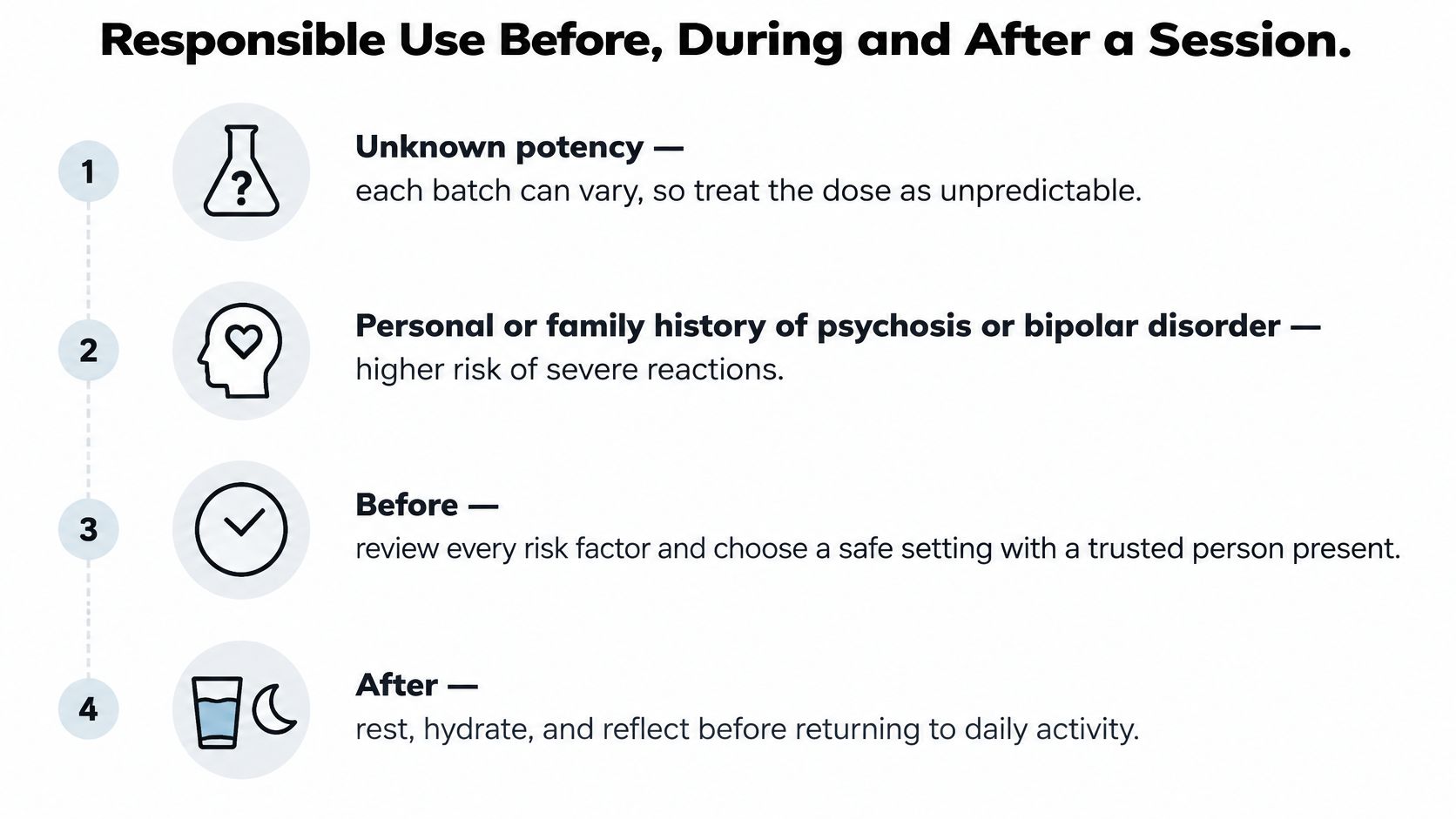
The most useful safety fact about this strain is one the potency data already supplies: you can't dose from the name. Everything below follows from treating each batch as unknown until it's measured.
Screen yourself first
- Treat the dose as unpredictable: start lower than you think you need, because a batch can land anywhere inside a wide range.
- Weigh your psychiatric history: personal or family history of psychosis or bipolar disorder raises the risk of a severe reaction, and that's a conversation for a clinician rather than a forum.
- List every medication and supplement: MAOIs and SSRIs interact with psilocybin, and so do plenty of over-the-counter products, so bring the actual list to a professional.
- Check for a heart condition: cardiovascular problems are a reason to get medical clearance first, not a detail to sort out later.
Set and setting are logistics, not vibes
Choose a calm, familiar place where you won't be interrupted or have to manage strangers. Have one sober, trusted person present who knows what you've taken and can call for help. Put the car keys away before anything begins, and skip alcohol and other substances entirely, because mixing them muddies the effects and complicates any medical response.
For a fuller picture of how a supervised session is structured, this walkthrough is worth twenty minutes before you plan anything.
Identify before you ingest
Wild mushrooms that resemble Psilocybe species include dangerous Galerina species, and the differences are easy to miss in poor light. Never eat a wild fungus you haven't identified with certainty, and never rely on a photo match alone.
After the session
Rest, drink water, and give yourself a quiet day rather than scheduling something demanding. If confusion or distress persists well past the expected duration, contact a medical professional and describe what was taken and when. Integration support helps too, whether that's a therapist, a trusted friend, or writing down what came up.
Confirm the Evidence Before You Trust a Huautla Label
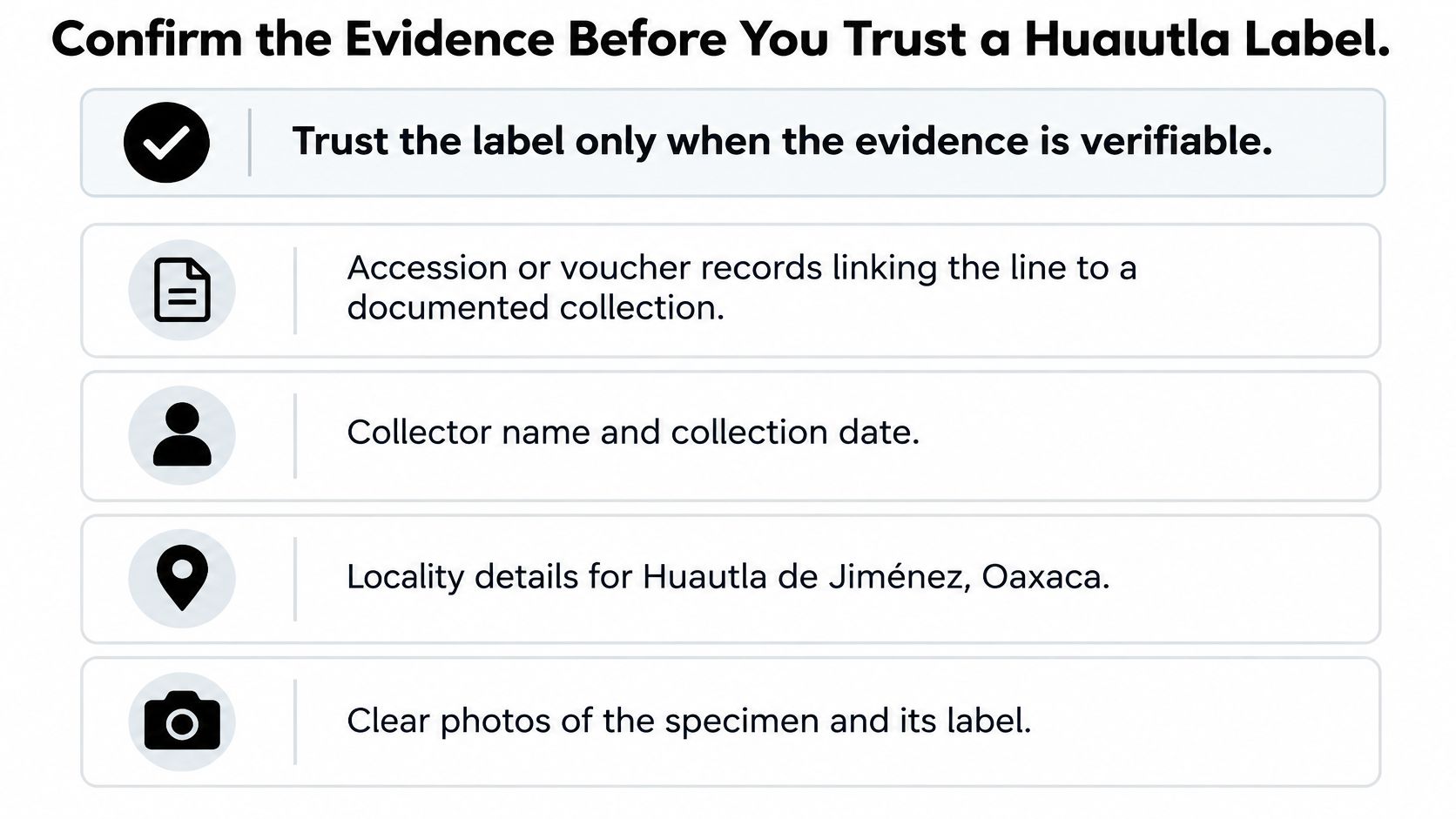
The decision is binary enough to state plainly. A Huautla label earns trust when the seller can show documents for the batch in hand, and it earns nothing when they can't.
What to request from any seller
- Accession or voucher records that link the line to a documented collection, which is the only thing that turns a place name into provenance.
- Identity testing or sequencing naming the method, so you know the material was confirmed as P. cubensis rather than assumed.
- Batch-level alkaloid results with the analytical method stated and the material named, because a number without those isn't comparable to anything.
- A breeder account of cultivation, drying, and storage, since those steps shift the final figure as much as genetics does.
- Contaminant testing with the lab name and the test date, not a badge that says "clean."
Reading a batch claim without getting fooled
Say a seller tells you a batch is tested and clean. Ask for the report, then check which material was measured. Dried caps, stems, and mycelium produce different numbers, and a mycelium result says nothing about a cap. Then check the units: mg/g and wt.% express the same kind of concentration, while a milligram-per-package total depends on package weight and won't compare across products of different sizes.
That standard applies here too. We test our mushrooms to confirm they're free from DMT and other contaminants, and a report attached to a specific batch is the format worth demanding from anyone. The explainer on what a certificate of analysis contains walks through the fields a real one carries.
The limit is worth stating without hedging. No label establishes geographic origin, genetic uniqueness, potency, or effects on its own, which is the same conclusion an analysis of commercial strain naming in the Journal of Illicit Economies and Development reaches: informal names can carry cultural and market meaning while saying nothing verifiable about what's inside the package.
Decision rule: if the seller can produce measured results for the batch in hand, the Huautla name is a starting point worth keeping. If they can't, treat it as marketing and plan your dose around the uncertainty rather than around the label.
The checklist in this article works on any listing, including ours. The Magic Mushroom Delivery carries raw magic mushrooms in seven-gram packs alongside capsules, gummies, and chocolate bars, ships with tracking nationwide, and verifies age for customers 21 and older, so the batch questions above have somewhere concrete to land. Bring the same skepticism to our labels that you'd bring to anyone's, and ask for the details behind whatever you order.