

You've filled a cart, picked a shipping speed, and typed in a card number. Then checkout stops. A panel asks for your date of birth, and in some stores it asks you to photograph a driver's licence. Until that finishes, the order sits there.
That pause is an age verification system at work, and it's a process rather than a popup. Understanding the machinery matters whether you're the customer holding the licence or the person who has to choose a vendor and defend the choice later.
Why Online Retailers Check Age and What a Check Means
A checkout that stops to ask your age is running a decision, not collecting trivia. The system decides whether a customer meets an age threshold before a sale is granted, and it has three parts.
- The rule is the threshold itself, such as 21 and older, scoped to specific products or to the entire storefront.
- The evidence is whatever the customer supplies to show the rule is met, from a typed birth date to a passport scan to a credential issued by a bank or a digital wallet.
- The decision is the output: allow, deny, or send the case to review.
A bouncer with a door list is the closest everyday comparison. The bouncer doesn't need your biography, only whether your name is on the list, and the decision happens at the door rather than at the bar. A digital check works the same way, except the list is confirmed against evidence and the decision lands before payment clears.
Age eligibility is not identity
Most confusion about these systems comes from mixing two questions. Are you over 21? is an eligibility question. Are you who you say you are? is an identity question. A store selling age-restricted goods needs a defensible answer to the first. It doesn't automatically need the second, and it certainly doesn't need to archive a copy of your licence to answer either.
A typed birth date is a self-declaration. It records what someone claims, with nothing behind it. That isn't automatically worthless, but it's a different product from a document check, a database match, or an estimate built from a live face.
The business cost of getting it wrong
Retailers check age for three reasons that reinforce each other. The first is legal, because a sale to someone below the threshold can breach the rules governing the product, the state, or the payment channel. The second is financial, since fines, chargebacks and losing a payment processor cost more than most merchants expect. The third is reputational, because a single purchase by a minor travels faster than any correction.
U.S. federal rules don't hand retailers one universal method. The Federal Trade Commission's Children's Online Privacy Protection Rule, or COPPA, covers services directed to children under 13 and general-audience services with actual knowledge they're collecting data from under-13s. The FTC states plainly that COPPA doesn't require operators to ask every visitor's age, and a general-audience service that uses neutral age screening may rely on what a user enters, even when that entry is inaccurate.
Scale is the second argument. The OECD's 2025 review of 50 online services used by children found that only 2 services systematically assured users' ages at account creation, although 26 had some age-assurance mechanism. Having something in place and having it work are different achievements.
The design questions that decide whether a check holds up are what it collects, what it keeps, and what it does for the adult it turns away by mistake.
How an Age Verification System Works, Step by Step
A working system is a sequence, and each step exists to stop a specific failure. Here's the flow, along with the mistake that usually creeps in at each stage.
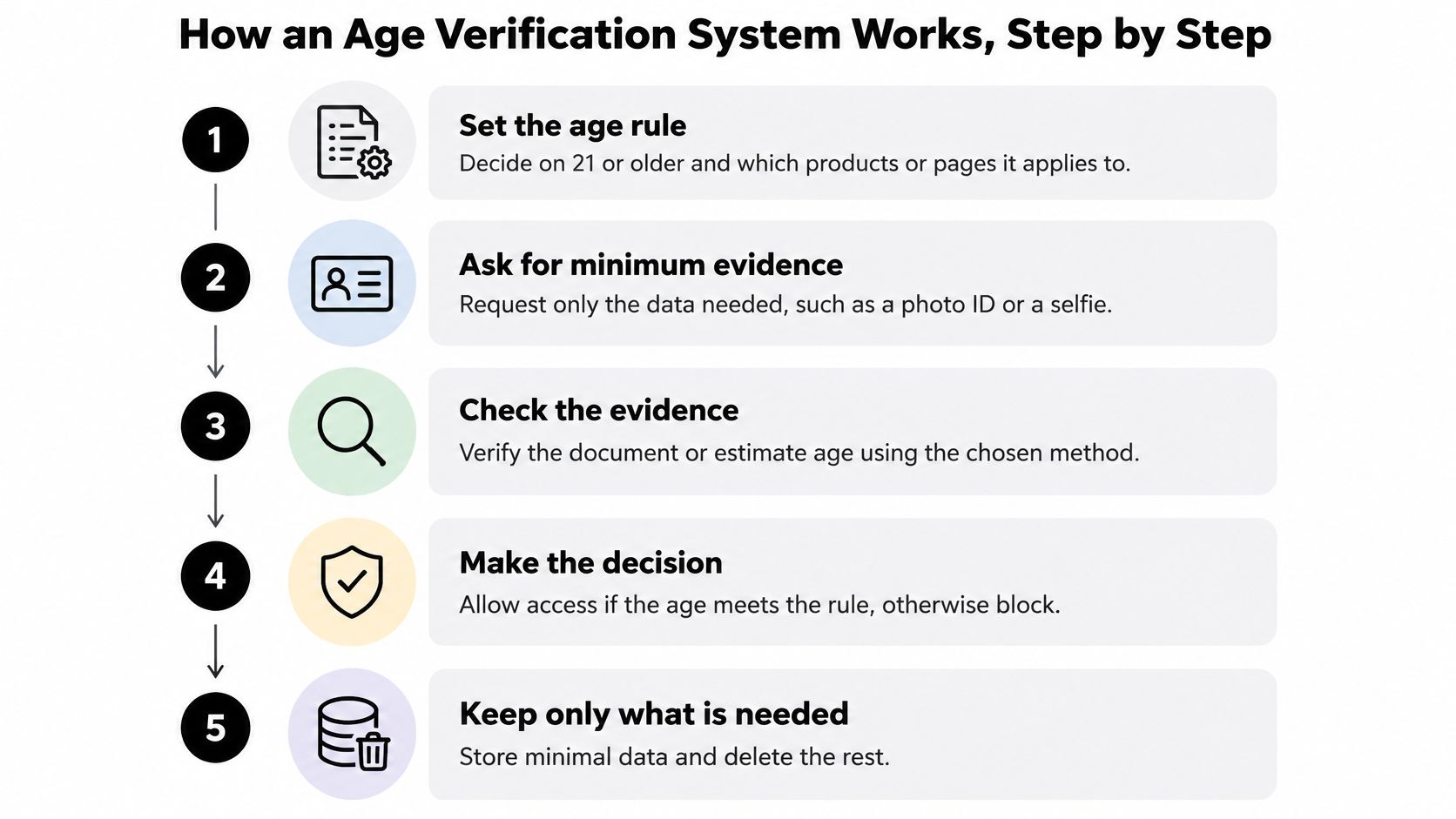
1. Set the rule and its scope. Write down the threshold and the products or pages it covers. "21 and older across the whole checkout" is a rule you can audit; "we know it when we see it" isn't. The common slip is applying the check to the homepage but not to a saved cart link that jumps straight to payment.
2. Ask for the minimum evidence. Decide whether the decision needs a date of birth, a document, or a trusted credential, then request nothing else. The slip is bolting on a phone number and billing address because the form was already open, which leaves you defending why a birth year required a street address.
3. Check the evidence for authenticity. A document has to be genuine, current, and show an age above the threshold. Accepting an uploaded image without verifying it turns a document check into a slower version of self-declaration.
4. Match the evidence to the person present. Comparing the photo on a licence with a live capture answers the second question, namely that the person at the keyboard is the person on the document. Skipping liveness controls lets someone hold up a screen or a friend's ID.
5. Return a decision. Allow, deny, or review. Review needs an owner, a queue and a stated turnaround, or it becomes a denial. Treating a system timeout as a pass is the failure to watch for here.
6. Keep only what the policy requires, then delete. Write the retention period down and automate the deletion. Keeping raw documents and selfies "just in case" converts a thirty-second check into a permanent record.
What a repealed law still teaches. The UK's Digital Economy Act 2017 received Royal Assent on 27 April 2017 and proposed fines of up to £250,000 or 5% of a company's turnover for commercial sites without robust age checks. The mandate was delayed, abandoned in 2019 and repealed in 2023, yet the model it sketched, age checks bundled with audit records and a defined denial path, is the one regulators still assume.
A short walkthrough helps if you're explaining the flow to a team that has never seen it end to end.
Verification doesn't stop at age. Delivery details get the same treatment, which is why a dedicated address verification system catches mismatches before a parcel ships. In our own process, delivery begins with verifying the customer's ID to confirm they're over 21, and the order only moves forward once that check clears.
The one test that exposes a weak setup
Point at the last decision a system made and ask three questions. Which rule applied? What evidence did the decision rest on? And what data was kept afterward? If nobody can answer the second question with a named method and the third with a deletion date, the setup is decoration.
Age Check Methods Compared
Methods differ less in intelligence than in evidence. The table lines up the options a 21+ retailer is likely to weigh, with the data each one leaves behind and what happens to a customer who fails.
| Method | What the customer provides | Data the verifier keeps | What happens when the check fails |
|---|---|---|---|
| Self-declared date of birth | A typed birth date | The birth date only | The customer retypes or is blocked; there is no real check to fail |
| Document check | A passport or driver's licence upload | Document details, held only until the deletion date | Manual review or an alternate method |
| Photo-ID matching | A document plus a live capture | The pass or fail result and capture status; document data per policy | Routed to an alternate method or a human review |
| Facial age estimation | A live face scan | An age estimate; raw images deleted once the decision is made | Near the threshold, routed to a stronger method |
| Third-party digital identity or age token | A credential from a trusted provider | A yes or no age assertion, with no document copy | The provider's own fallback, then a second token or a document check |
| Bank or database check | An account or record match | The lookup result only | Unavailable to anyone without a file; offered a document or review path |
Where each method breaks
Self-declared date of birth costs nothing and takes two seconds. It also leaves you with a record instead of evidence, which is fine for a newsletter signup and thin for a restricted product.
Document checks confirm that a passport or licence is genuine and shows an age above the threshold. They're strong on eligibility and silent on the person holding the document, which is exactly the gap the next row closes.
Photo-ID matching is the two-part comparison Ofcom describes among methods capable of "highly effective age assurance", capturing information from a passport, driver's licence or comparable photo ID and comparing the document photo with a live image of the person completing the check, as set out in Ofcom's guidance on how age checks can work. It tests eligibility and document-to-user consistency at once. It also needs a fallback for customers without a qualifying document or who can't complete a biometric capture.
Facial age estimation is the lowest-friction strong method and the one that most needs a second line of defence near the threshold. Treat the output as an estimate with performance limits, not a fact.
Digital identity and age tokens return a yes or no to the relying party, which is the most privacy-friendly shape a strong check can take. The trade-off is dependency: when the provider is down or the customer isn't enrolled, you need somewhere else to send them.
Bank and database checks reuse a record that already exists, so there's no upload and no selfie. They exclude anyone without a matchable file, including plenty of lawful adults.
Read the rows as a ladder of confidence. The cheapest rung also leaves you the least to show if a payment processor or a journalist asks how you knew.
Accessibility and Recovery When Checks Fail
Every method in that table has a failure mode that isn't fraud. A technically accurate system can still block a lawful adult, and that's the failure most explanations skip.
The Congressional Research Service has documented the barriers in its work on age assurance: some people don't hold government-issued identification at all, and mobile-only verification disadvantages people who mainly use a computer or laptop, as the CRS product on age verification and access sets out. Add the cases that appear in practice: an older customer whose licence expired, someone whose name changed after marriage or transition, a photo that won't focus in a dim room, a rural connection that drops mid-upload.
The question to design around isn't "does this stop minors?" It's "which lawful adults does it block, and how do they get through without handing over more data each time?"
A recovery path that holds up
1. Keep a non-document alternative at checkout. A bank or database match, a trusted credential or a third-party age token keeps the order alive for someone without a qualifying ID.
2. Let a failed live capture switch methods instead of dead-ending. A customer who can't complete a biometric step should see the document route, not a wall.
3. Route borderline results to a named human queue with a stated turnaround. Senate testimony on age assurance lists privacy, transparency, accuracy, accountability and accessibility as core design characteristics, which makes usability a requirement rather than a courtesy.
4. Publish an appeal route and log the outcome. A customer who is wrongly denied needs one clear place to say so, and you need the record to spot a pattern.
5. Set a deletion schedule for failed submissions. A rejected customer's documents shouldn't linger, because failure is exactly when people abandon and forget.
Our team handles these escalations through defined customer support channels, so a blocked customer reaches a person instead of a loop.
Track two numbers afterward: appeal outcomes, and abandonment by verification method. A method with a high pass rate and a high abandonment rate is protecting you from customers, not from minors.
How to Judge Accuracy and Fairness
Vendors quote accuracy figures. Those figures come from controlled conditions, and a checkout is not a controlled condition.
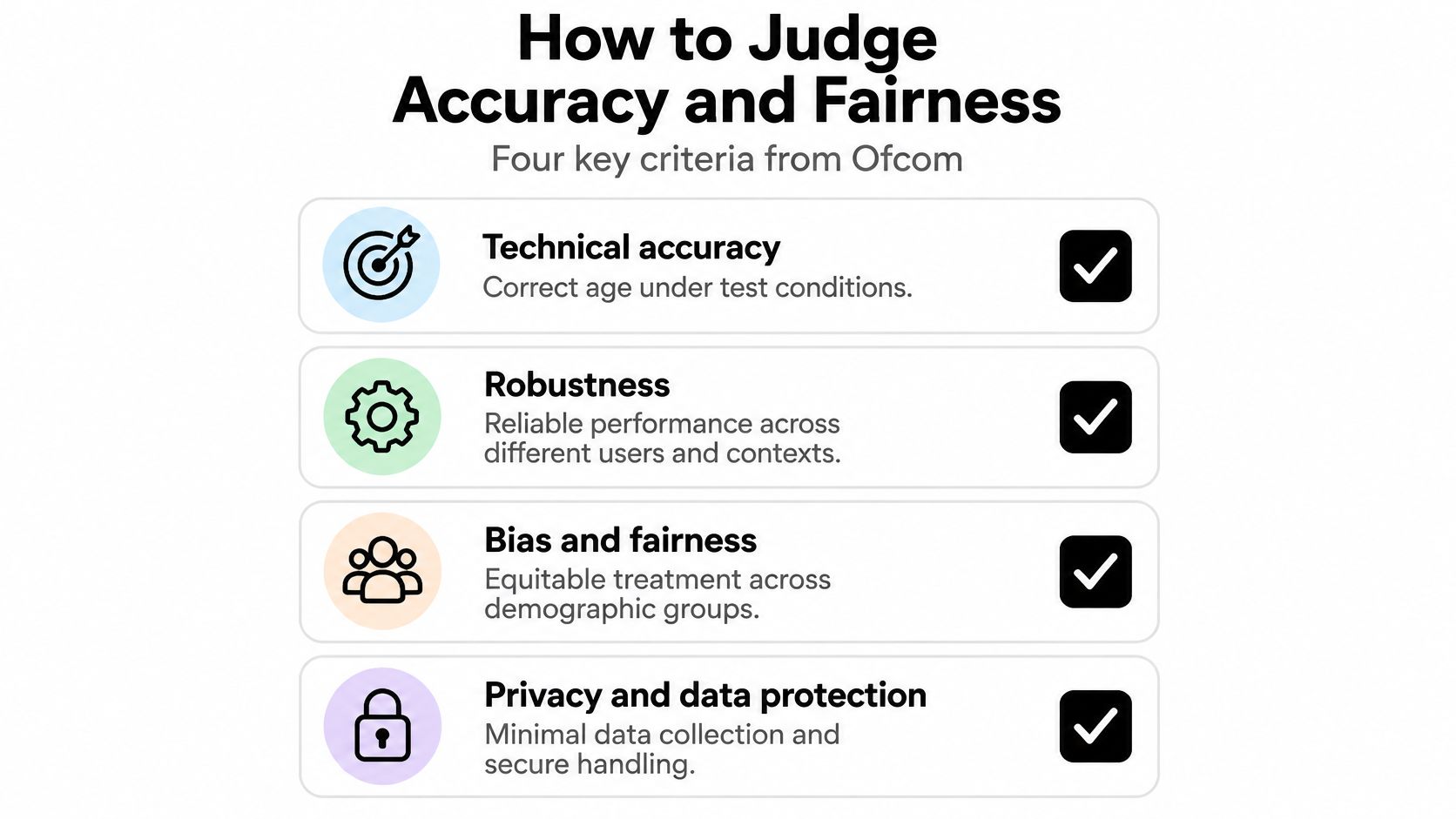
Ofcom's age assurance guidance treats the system as an end-to-end process rather than a single component and names four operational criteria. Technical accuracy means correctly determining age under test conditions. Consistency means maintaining performance in real deployment. Reliability means producing reproducible results from trustworthy evidence. Fairness means minimizing bias and discriminatory outcomes.
The four criteria fit on one card, and they're worth keeping where a product team can see them.
Test the conditions, not the brochure
A system that passes in a lab can fail on a phone. Build a test pass that includes dim lighting, motion blur, screen glare, a cropped or angled frame, a low-quality front camera and a photo held up to the lens. Then add the adversarial cases: someone presenting another person's ID, a document that has been tampered with, a face that is partially obscured.
A deliberate assault on the gate matters most. Lab accuracy says nothing about a determined 19-year-old with an older sibling's licence and good lighting.
Watch four numbers after launch
False accepts are the minors who got through, and they're the number that ends up in a headline. False rejects are the adults you blocked, and they're the number that kills revenue. Completion rate tells you how many customers finish the flow at all rather than abandoning at the upload screen. The fourth is spread, meaning whether results differ across groups of users, which is where fairness stops being an abstraction.
Repeat the testing on a schedule. Fraud techniques, device cameras and verification technology all change, and a check validated eighteen months ago is a different product today.
Stricter checks cut uncertainty about age and raise the number of legitimate customers who can't finish. Every change to the flow should be measured against both risks at once, because a system optimised only for exclusion will eventually exclude the people you want.
Protecting Privacy While Checking Age
Here's the question most explainers dodge. Can a business confirm that someone is 21 or older without keeping identity documents, names, addresses or browsing history?
Yes, and the design choice is simpler than it sounds: collect only what the age decision needs. Data minimization in plain language means the birth year, not the full document; the yes or no answer, not the file it came from; a result that expires, not a record that follows the customer into the next purchase.
Four questions separate a careful policy from a careless one.
- What data is collected? A birth date, a document image, a live capture, or nothing beyond an assertion from a trusted provider.
- Can the result be linked to a purchase? If the verification vendor hands back an identifier that sits next to an order history, the customer is effectively named even when the document was deleted.
- How long is evidence kept? A retention period with an automated deletion beats a policy that says data is kept "as long as necessary".
- What happens after a failed check? Failed submissions are the ones most likely to be forgotten and least likely to be deleted.
Why more proof isn't automatically more trust
Collecting a full ID can improve confidence in age while increasing the damage of a breach, and it exposes details that have nothing to do with the threshold. NIST's digital identity guidance says personally identifiable information should be limited to the minimum necessary for validating a claimed identity, and its authentication guidance asks providers to assess the privacy risks of retaining records. The Congressional Research Service likewise notes that ID-based verification can raise privacy concerns depending on how data is shared and stored.
That's the rule we follow. ID verification is used only to confirm a customer is 21 or older, and the ID is not stored or shared. Discretion belongs in the whole transaction, not only in the parcel, which is why packaging decisions get their own discreet shipping policy.
For a first-time customer ordering something personal, the difference between a check that vanishes and a check that files them away is the difference between buying comfortably and not buying at all.
Choose the Right Age Check Before You Launch
Pick a method by working through three inputs in order. The legal age threshold sets the floor: 21 is not 18, and a system tuned for one will misjudge the other. The product's risk decides how much evidence is proportional, since a low-risk check can live with a verified credential or a database match while a higher-risk catalogue is better served by a document check with live capture and a manual-review path. The confidence required settles the rest, and it should be a written decision rather than a feeling.
Facial age estimation belongs in the mix only with a fallback attached. Ofcom recognizes facial-age estimation as a method capable of being highly effective when deployed under appropriate conditions, and it notes that it has not imposed a universal numerical accuracy threshold such as 99%. That's the practical point: results near the threshold should pause and route to something stronger, whether a document, a digital identity or a banking check.
The pre-launch checklist
- A written age rule naming the threshold and the exact products and pages it covers.
- A hard stop at checkout so no order completes before the decision returns.
- A non-document alternative for customers without a qualifying ID.
- A deletion schedule that covers failed submissions as well as successful ones.
- A named list of every party that receives verification data, including the vendor and any carrier checking ID at the door.
- Reporting on pass rate, abandonment and appeal outcomes by verification method, never by sensitive demographics.
Take the product you sell, match its threshold to one row of the comparison table, then read that vendor's retention and fallback terms against the four privacy questions before you accept them. If the answers aren't specific, the system isn't ready.
If you'd rather not hand your documents to a checkout that treats age checks as an afterthought, The Magic Mushroom Delivery verifies every customer's ID to confirm they're 21 or older before an order proceeds, and that ID is never stored or shared. Adults 21 and over can browse the full mushroom range and place an order at The Magic Mushroom Delivery.