The usual advice is to choose matcha for calm focus and mushroom coffee for broader wellness benefits. That's too confident on both counts. The better comparison is label versus label: what's in the serving, how much caffeine it supplies, and whether the evidence applies to the drink you're buying.
A transparent cup of plain coffee can be a more evidence-grounded purchase than a proprietary mushroom blend. Matcha has a stronger case for certain attention outcomes, but neither its green color nor its L-theanine content guarantees a jitter-free morning.
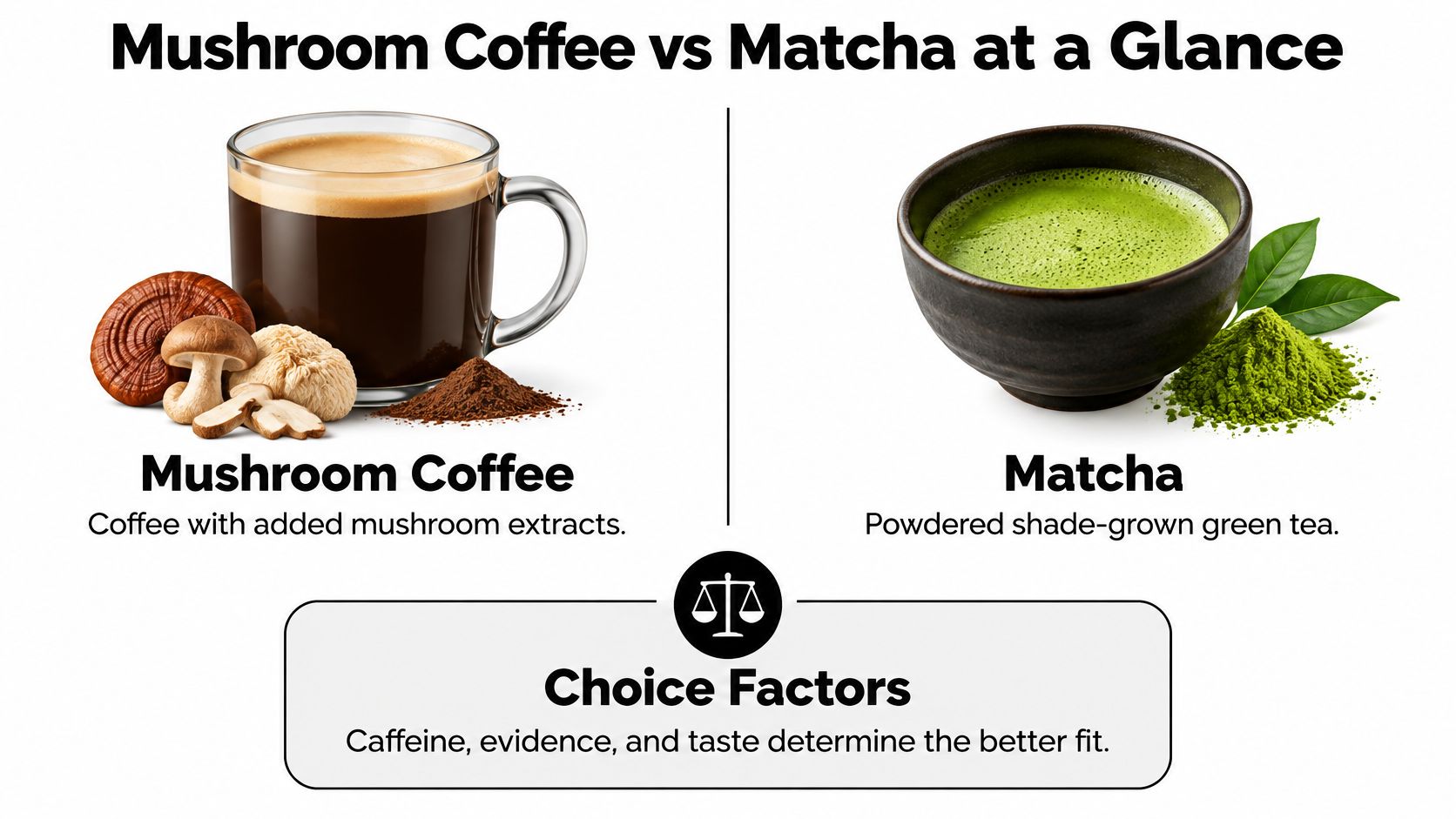
Mushroom Coffee vs Matcha at a Glance
Mushroom coffee is coffee with added mushroom extracts, while matcha is powdered shade-grown green tea, so the choice turns on caffeine, evidence and taste rather than the word functional. They're different beverage formats, not interchangeable wellness treatments.
Mushroom coffee and matcha side by side
| Factor | Mushroom coffee | Matcha |
|---|---|---|
| Base ingredient | Coffee with added mushroom extracts | Powdered shade-grown green tea |
| Functional ingredients | Lion's mane, chaga, reishi or cordyceps extracts | L-theanine and catechins, naturally present |
| Strength of human evidence | Preliminary; few trials on finished blends | Several randomized trials, mostly small |
| Taste profile | Coffee-forward, often sweetened or flavored | Grassy, vegetal and slightly sweet |
| Preparation time | About one minute for an instant version, stirred into hot water or milk | About two minutes for a simple whisked preparation |
Preparation times are practical estimates for these methods, not measured product benchmarks. A ground-coffee blend needs brewing, while an instant powder needs mixing.
Each row answers a different question. Someone buying a familiar morning drink might prioritize flavor and convenience; someone hoping to improve task performance should put more weight on direct human evidence. Neither preference establishes that a beverage is healthier overall.
What the ingredients actually tell you
Common mushroom additions include lion's mane, chaga, reishi and cordyceps. Adding them doesn't remove the underlying coffee or establish that the finished blend produces the effects advertised for its individual ingredients.
Matcha is consumed as whole-leaf tea powder rather than as an infusion with the leaves discarded. Its defining compounds belong to the tea itself, which makes its ingredient identity more consistent than a category encompassing many mushroom combinations. That consistency doesn't mean every matcha powder contains identical amounts of caffeine or L-theanine.
The visual comparison captures those basic differences.
Choose the factors that matter to your routine before comparing brands. A convenient preparation, an acceptable caffeine dose and credible evidence are separate advantages. Don't let an appealing flavor or a long ingredient list stand in for all three.
Caffeine, Sleep and Anxiety Per Serving
Serving size decides this comparison more than the ingredient list does. A randomized placebo-controlled trial used 2.7 grams of matcha daily, containing 71.5 mg caffeine, 50.3 mg L-theanine and 301.4 mg catechins, according to the published trial in Nutrients. That figure describes one measured powder, and it gives you a reference point for reading every other label.
The matcha rows below use the trial's composition. Coffee-based servings have no equivalent category-wide measurement, so those cells describe how to read the label rather than quoting an average that no single product is guaranteed to match.
Caffeine and L-theanine per serving
| Serving | Caffeine | L-theanine | Evidence basis |
|---|---|---|---|
| 8 oz brewed coffee | Set by bean, roast and brew strength | None supplied by coffee itself | Read the brewer's declared milligrams per cup |
| 2.7 g matcha | 71.5 mg | 50.3 mg | Measured in the randomized trial cited above |
| Half serving of the trial matcha, approximately 1.35 g | About 36 mg, estimated | About 25 mg, estimated | Arithmetic estimate from half the trial dose |
| One cup of mushroom coffee | Determined by the coffee base in the blend | Usually none unless added | Read the declared milligrams per prepared cup |
| One cup of decaf mushroom coffee | Residual caffeine remains after decaffeination | None unless added | Reduced caffeine, not a zero-caffeine guarantee |
The half-serving calculation assumes the same powder and composition as the trial product. It is arithmetic, not a laboratory measurement of the powder in your cupboard.
Brewed coffee sits in a different position. Caffeine scales with the mass of grounds and the extraction, so a weak 8 oz cup and a strong one can differ enough to change how the same person sleeps. Mushroom coffee narrows the question: the mushroom component contributes no caffeine of its own, so the declared figure for one prepared cup is the only number that matters for that row.
Measure the powder, not the impression
Use a kitchen scale to weigh matcha. A teaspoon measures volume, and a loosely filled spoon doesn't reliably reproduce the mass of a tightly packed one.
For mushroom coffee, find caffeine per prepared serving, then check how much powder that serving requires. A large mug built from two scoops delivers roughly twice the labeled dose. Our guide to mushroom coffee caffeine provides a useful starting point for understanding that distinction.
A mushroom ingredient isn't evidence of reduced caffeine. Neither is earthy flavor, lighter color or a smaller package.
Does matcha actually mean gentler energy?
The trial described above found no significant differences from placebo in objectively measured total sleep time, sleep latency, nighttime waking or sleep efficiency. No significant difference isn't proof that matcha improves sleep, and it doesn't guarantee that every caffeine-sensitive person will tolerate it.
A review of matcha and related cognitive evidence describes small or inconsistent effects across outcomes, including studies without clear improvements in fatigue, mood, concentration or perceived energy. Feeling calmer and performing better on a particular attention test aren't the same outcome.
There is a plausible attention-related reason to consider the caffeine-theanine combination. A trial summarized by the Alzheimer's Drug Discovery Foundation's Cognitive Vitality review found that 100 mg L-theanine combined with 50 mg caffeine improved target detection and discrimination in 16 healthy adults, while L-theanine alone didn't improve attentional focus. That finding concerns a specific combination at specific doses. It doesn't prove that any matcha serving prevents anxiety or a later crash, and it says nothing about proprietary mushroom blends at all.
Practical rule: Compare declared caffeine per prepared cup before comparing promises about how the energy will feel.
Keep a one-week log with a consistent serving and preparation:
- Record the drink: Include powder mass or scoop size and the declared caffeine.
- Record the timing: Note every caffeinated beverage, not just the drink being tested.
- Record the response: Track sleep quality, bedtime, perceived anxiety and whether you could complete the intended task.
- Move the cutoff earlier: As a conservative personal experiment, aim to finish caffeine at least eight hours before bed, without treating that interval as a guarantee.
Pregnant people, those with anxiety disorders or heart rhythm conditions, and people taking medication should discuss the specific beverage and serving with a clinician before experimenting.
What the Evidence Shows for Focus and Health
The stronger trial record belongs to matcha, but the margin is narrower than the marketing suggests.
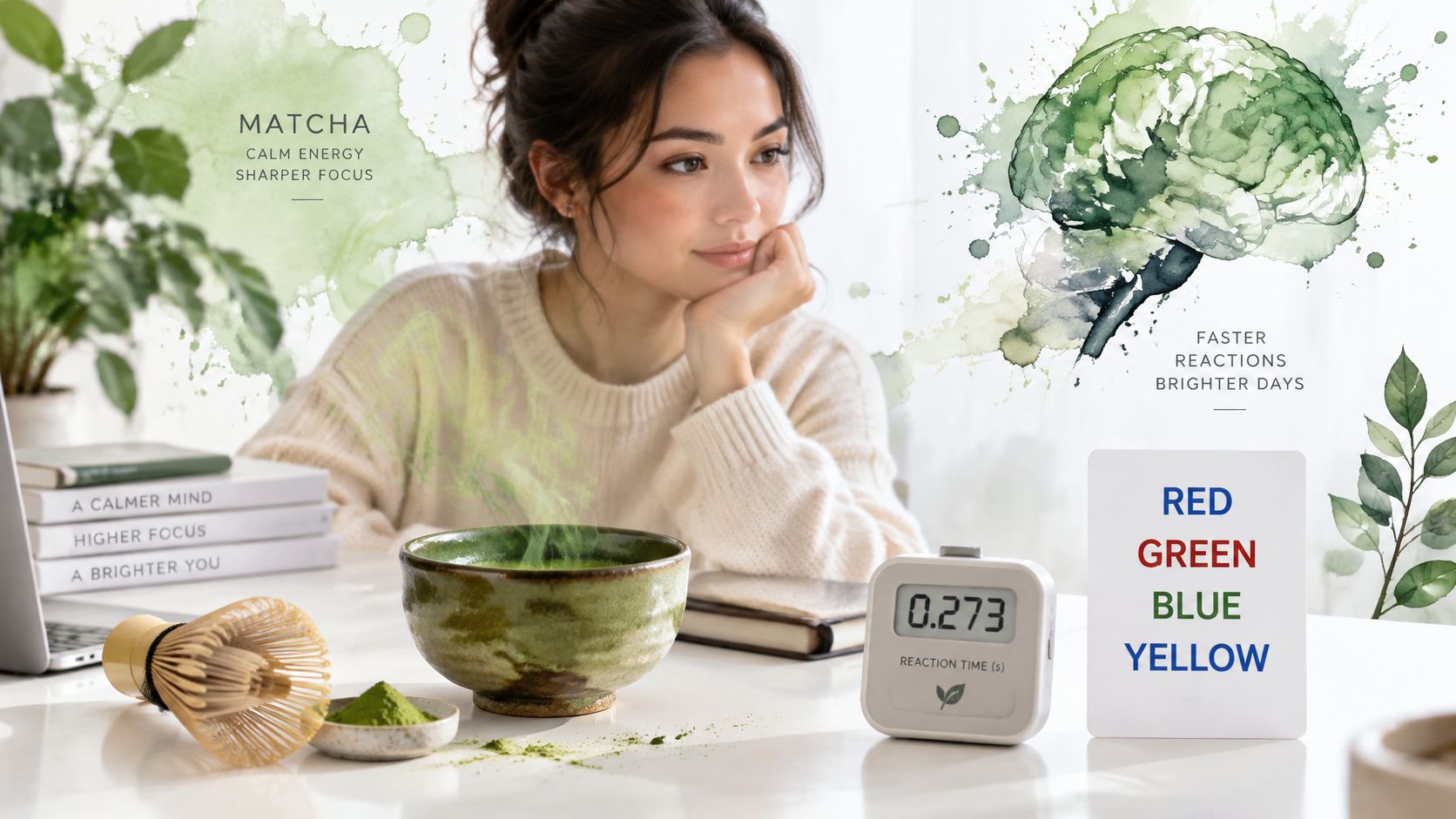
A randomized placebo-controlled study of 42 young adults found that 2 g of matcha daily for two weeks produced faster Stroop-test reaction times and more correct emotion-perception responses after mild psychological stress, although subjective fatigue didn't improve. That is a measured task outcome in a defined population. It does not establish better work output, treatment of attention disorders or long-term protection against cognitive decline.
The distinction between a measured task and a general brain-health promise matters.
Where the mushroom evidence stops
The harder question is the label: which preparation, dose and extract form are in the cup.
Harvard Health's assessment of mushroom coffee describes human research on medicinal mushrooms as very limited and reports that the research it discusses hadn't tested mushroom coffee itself as a finished beverage. Small extract trials exist, but their preparations and doses are not automatically present in a proprietary blend.
An academic review of mushroom coffee also describes preliminary findings from a four-week lion's-mane pilot, including faster cognitive processing and trends toward lower stress. A pilot finding is a reason for further testing, not an established performance benchmark for mushroom coffee.
Evidence for an ingredient is not evidence for the finished cup.
For a reader comparing mushroom coffee for focus, the defensible starting point is the coffee component and the disclosed formula. A plain cup with a known caffeine load can be more evidence-grounded than a blend that lists mushrooms while leaving extract dose, standardization or serving mass unclear. Any added cognitive benefit from the mushroom portion remains uncertain unless the evidence matches the actual preparation.
Reasonable expectations
Choose matcha if you value its modest, task-specific human evidence and enjoy drinking it. Choose mushroom coffee for an appealing coffee-based beverage whose ingredients you can identify, rather than because a label promises extensive brain support.
Avoid interpreting antioxidant content, beta-glucan content or an ingredient's proposed mechanism as proof of a clinical benefit. Neither drink should be positioned as treatment for anxiety, depression, memory loss or another medical condition.
Taste and Daily Preparation for Each Drink
Say you're making a drink before starting work. Matcha asks you to handle the powder carefully and whisk it; instant mushroom coffee asks you to measure, add liquid and stir. That difference may matter more to daily adherence than another ingredient on the package.
For tasting, expect mushroom coffee to remain coffee-forward, with possible earthy, woody or cocoa-like notes from the particular blend. Lion's mane can contribute mild bitterness, but added creamers, vanilla and sweeteners may be more noticeable than the mushroom component. Use the ingredient list alongside our mushroom coffee taste guide rather than assuming all blends share a flavor.
A simple matcha routine
Matcha is typically grassy and vegetal, sometimes with a slightly sweet finish. Better drinking powders may offer more savory umami depth, while powders sold for cooking can be more assertively astringent. Grade descriptions aren't a substitute for tasting.
For a practical starting recipe:
- Sift 2 g, approximately a teaspoon, into a bowl. Use the scale rather than the spoon if you want a repeatable serving.
- Add 60 ml water at 70–80°C.
- Whisk briskly in a W motion until the surface becomes frothy.
- Drink as prepared or pour over milk.
These are preparation instructions, not a clinically established dosing recommendation. Adjust water and milk for texture without assuming that dilution changes the amount of caffeine already added.
A quick instant mushroom coffee routine
For an instant product whose directions allow this preparation:
- Add the labeled scoop to 240 ml hot water or milk.
- Stir for approximately 30 seconds, checking that the powder has dispersed.
- Taste before adding sweetener, especially if the blend already contains sugar or creamer.
A bamboo whisk adds a one-time equipment purchase to a traditional matcha setup. Instant mushroom coffee needs no specialized equipment beyond a cup and spoon, although ground-coffee versions still need their usual brewer.
Matcha fits a seated preparation ritual; instant mushroom coffee fits a quick desk or travel cup. Buy the routine you'll maintain, not just the flavor description that sounds most appealing.
Reading Mushroom Coffee Labels and Prices
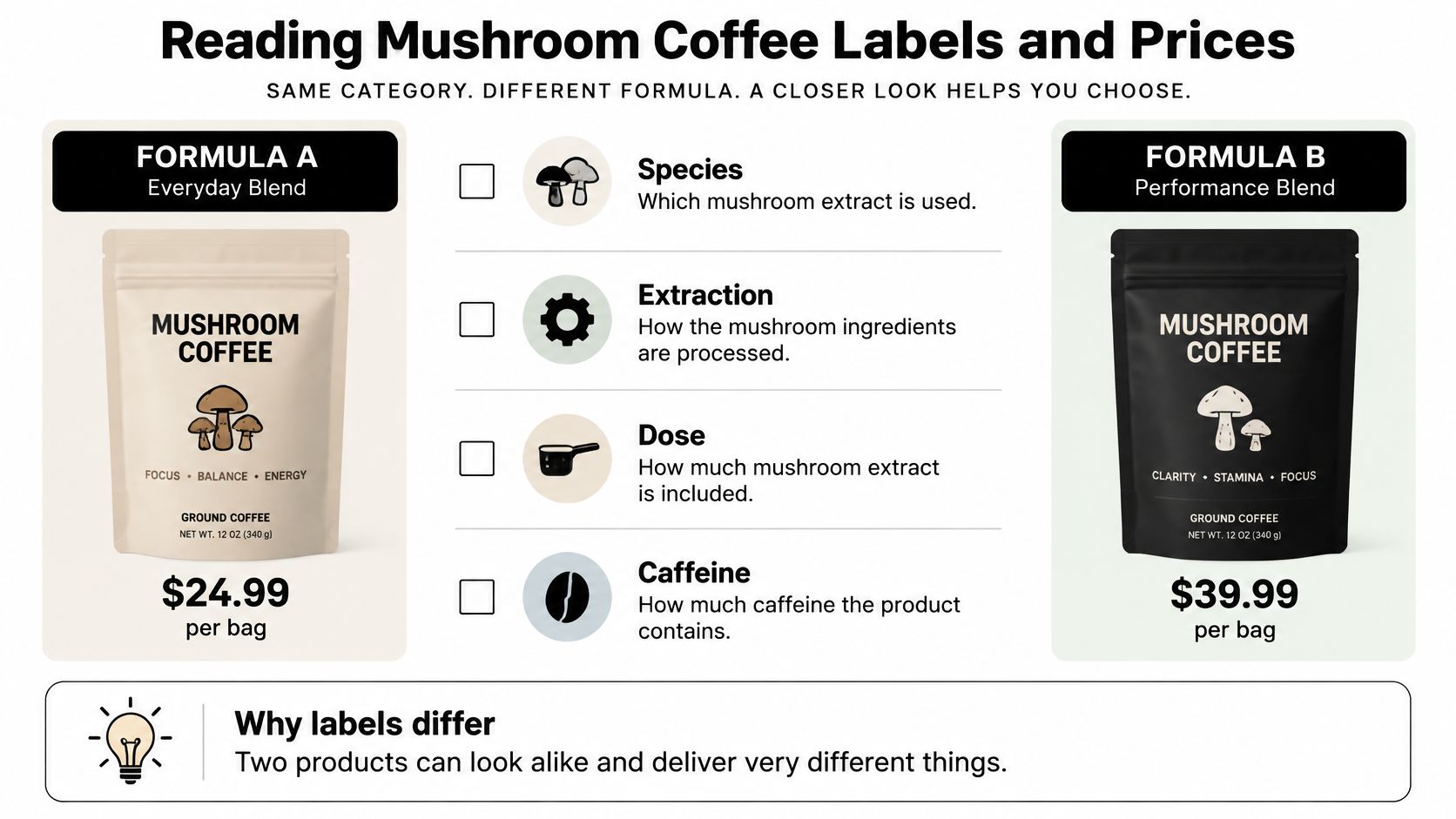
Audit the formula before calculating its value. Two packages can display the same mushroom names while leaving you with very different information about what's inside.
Label checks before buying mushroom coffee
| Label item | What good looks like | Red flag |
|---|---|---|
| Mushroom species | Named species such as lion's mane, chaga or reishi | Vague term such as mushroom blend |
| Extract form | Fruiting-body extract stated clearly | Mycelium listed with no supporting data |
| Amount per serving | Milligrams per cup, with extract ratio where relevant | Proprietary blend with no individual amounts |
| Caffeine per serving | Milligrams stated on the label | Energy claims without a number |
| Beta-glucan percentage | Stated for each extract | Not disclosed |
| Independent testing | Third-party certificate of analysis available | No test report available on request |
An extract ratio describes processing concentration, not necessarily the amount in your cup. For a useful comparison, you still need serving mass and extract mass, plus enough preparation information to judge whether an ingredient study is relevant.
This checklist highlights the main differences to resolve before purchase.
Don't confuse disclosure with proven efficacy
Fruiting-body extracts and mycelium products aren't interchangeable without supporting evidence. A mycelium-only product needs evidence for its own preparation; the label alone doesn't establish either effectiveness or ineffectiveness.
A critical review of mushroom-coffee benefits and formulation emphasizes species, preparation, amount, caffeine and independent testing, while flagging potential oxalate concerns with high-chaga products. Readers with kidney concerns should consult a clinician before using a chaga-heavy formula.
Ask what a certificate tested and whether it corresponds to the purchased product. A test report can answer composition or quality questions within its scope, but it doesn't prove that drinking the blend improves cognition.
Coffee already has an established beverage identity, with a much larger documented global consumption base than specialized tea products such as matcha, as illustrated by the Food and Agriculture Organization's coffee overview. There's no nutritional requirement to upgrade that familiar drink with an undisclosed blend.
Calculate the cup, not the tin
Consider a hypothetical tin priced at $30, containing 150 g, with a 3 g serving. It would provide 50 servings, making the powder cost $0.60 per cup.
The calculation is straightforward:
- Servings: Net package mass divided by serving mass.
- Cost per cup: Package price divided by servings.
- Comparable cost: Include milk, sweetener or other additions if you use them consistently.
Our Magic Mushroom Instant Coffee 22 Grams – Vanilla Latte costs $65.00 and is sold in a 22-gram Vanilla Latte format. Package size and price alone don't establish its serving count, caffeine amount, extract dose or whether it matches the functional-mushroom formulas discussed here.
Don't assume a product called magic mushroom coffee is equivalent to a non-intoxicating lion's-mane blend. Confirm the actual ingredients and intended effects before treating any product as an everyday coffee alternative.
Compare your calculated cup price against plain coffee and a weighed matcha serving. Before buying, resolve both cost per serving and milligrams of each extract per cup; if either is missing, you haven't completed the comparison.
Choose Between Them by Situation
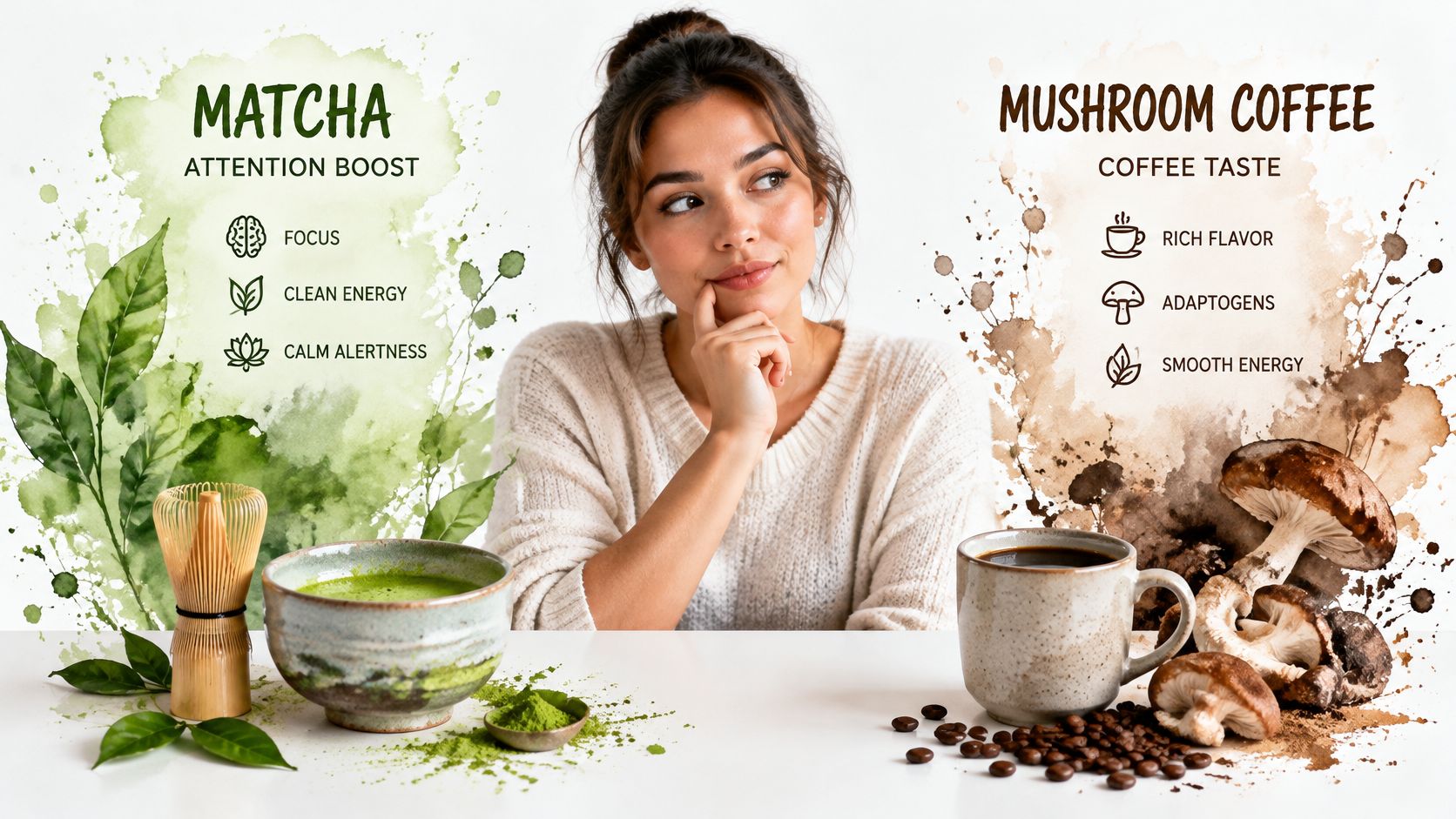
Matcha is the stronger pick when your priority is evidence for measurable attention. Mushroom coffee fits better when you want a familiar coffee taste with added ingredients and a transparent label. Neither verdict overrides caffeine sensitivity, medication concerns or uncertainty about a product's actual contents.
Use your main reason for changing drinks as the deciding criterion.
Which drink fits which situation
| Situation | Better fit | Why |
|---|---|---|
| Measurable focus before a demanding task | Matcha | Caffeine plus L-theanine has trial support for attention |
| Familiar coffee taste with added ingredients | Mushroom coffee | The coffee base retains a familiar flavor |
| Sensitive to caffeine or prone to jitters | A smaller matcha serving or decaf mushroom coffee | Choose by disclosed caffeine, not the category name |
| First-time mushroom user | A fully disclosed, non-intoxicating functional-mushroom coffee | Clear ingredients and intended effects make the experience easier to evaluate |
| Lowest cost per cup | Plain coffee or matcha, after calculating serving cost | Don't pay a premium without knowing the dose or receiving value you want |
| Pregnant, taking medication or managing a condition | Talk to a clinician first | Caffeine exposure and mushroom-specific uncertainties need individual review |
A budget-conscious buyer doesn't need to prove that mushroom ingredients are useless before declining a premium blend. An uncertain benefit can be a sufficient reason not to pay extra, particularly when the manufacturer withholds the amount being sold.
Likewise, a satisfying taste is a legitimate reason to buy a beverage. You don't need to convert that preference into a claim about immune function, gut health or long-term brain support.
Matcha has the stronger trial record, while mushroom coffee's value depends on label transparency.
For another way to consider the choice, this video can accompany your product-label review.
Pick the drink that matches your most important situation and keep the preparation consistent for a week. Log caffeine, timing, sleep and anxiety for seven days rather than changing drinks and doses simultaneously.
Switch if the log identifies a problem, and stop the experiment if you develop concerning symptoms. If the drink tastes good, fits your budget and doesn't disrupt your routine, you don't need a broader wellness promise to justify it.
We offer mushroom coffee, including our Vanilla Latte instant product, alongside educational resources about mushroom products. Visit The Magic Mushroom Delivery to explore the selection, then confirm the ingredients, intended effects and serving information before choosing a product for your routine.