
If a plant turns red, has it become a weed, or are you looking at the same plant in a different color? A photograph can show the blush while hiding the details that matter: stem hairs, flower shape, growing conditions, and whether animals can reach it.
Red weed plants aren't one botanical group. The name can point to a fictional invader, a crop parasite, an ordinary garden weed, or a cultivated plant showing red pigment. Getting the name right comes before pulling, spraying, feeding, or tasting.
What Red Weed Plants Usually Means
What people mean by red weed
| Phrase in use | What it actually is | Where you find it | Main concern |
|---|---|---|---|
| Fictional red weed | Martian plant in The War of the Worlds | Novel, linked by scholars to a real aquatic invader | Story of biological invasion, not a garden specimen |
| Canadian waterweed | Elodea canadensis | Temperate ponds, ditches, and slow waterways | Mats that crowd native plants |
| Red witchweed | Striga asiatica | Sugarcane and other crops; detected in Mackay, Queensland | Parasite plus a persistent soil seedbank |
| Redroot pigweed | Amaranthus retroflexus | Tilled fields, gardens, and disturbed soil | Competition, seed, livestock toxins, herbicide resistance |
| Ornamental red foliage | Chosen plants such as coleus or red-leaf amaranth | Beds and containers | Color is intentional, not a weed diagnosis |
| Stress or season red | Same crop or cannabis plant making anthocyanin | Pots and fields after cool nights, drought, or nutrient strain | Pigment change, not a new species |
Start with habitat, not shade. A submerged plant in a ditch belongs on a different identification path from an upright volunteer beside your tomatoes. A red-leaved plant growing exactly where you planted an ornamental may not be an unwanted arrival at all.
Regional nicknames blur these distinctions. Someone may call almost any ruddy volunteer red weed, just as several unrelated plants get called wild spinach. Keep only the row that matches your setting, then examine the plant's physical features.
The fictional plant has a real ecological background
H. G. Wells introduced fictional red weed in the 1898 novel The War of the Worlds, and scholarship published in Victorian Literature and Culture connects its invasive behavior to Canadian waterweed, likely noticed in Britain during the 1830s after arriving from North America and regarded as introduced by the late nineteenth century.
That connection concerns behavior, not a claim that Canadian waterweed is the Martian plant. The aquatic invader could establish in temperate waterways, crowd existing vegetation, and change how people used and understood those waterways. Wells's fictional growth made that kind of ecological disruption vivid.
A likely arrival through timber or wood-raft shipments also gives the story a practical edge. People can transport an organism accidentally, long before they recognize what it will do in its new habitat.
Keep the nickname separate from the identification
For a plant on dry ground, look beyond the literary association. Red witchweed belongs in a crop-parasite investigation; redroot pigweed belongs in a broadleaf-weed identification check. An ornamental belongs in a care assessment unless other evidence suggests otherwise.
Field rule: Where a plant grows and how it's built tell you more than how red it looks.
You don't need to investigate every possible meaning. Choose the matching setting first, and leave the unrelated meanings behind.
Why a Green Plant Turns Red
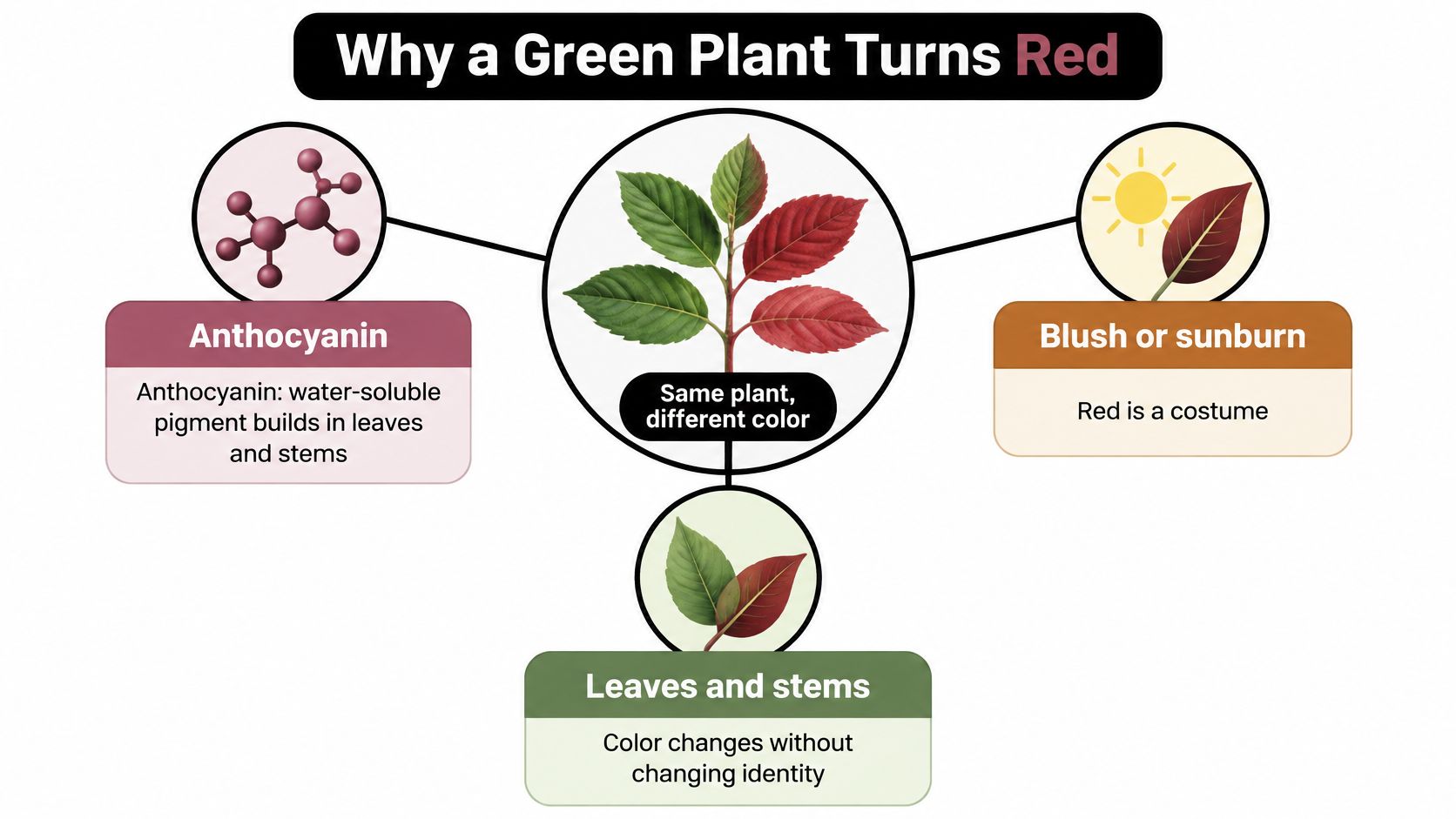
Red can be a costume rather than an identity. Like a blush, a color change can alter appearance without changing what you're looking at. The sunburn comparison is useful too, provided you don't assume that every red leaf is damaged.
Anthocyanins are water-soluble pigments that can build up in leaves and stems. Their color becomes more noticeable when green chlorophyll fades, and plants may produce more under conditions such as cool nights, strong light, drought, or nutrient strain.
Breeders also select plants for this appearance. Coleus, Japanese maple, and some amaranths can have red foliage as their normal cultivated look, not as a warning that you've neglected them.
Separate a normal look from a new change
A vegetable or cannabis plant that began green can develop crimson or purple tones later in the season. Cooler nights or difficulty obtaining phosphorus can contribute, but color alone doesn't diagnose a deficiency. Adding fertilizer because a leaf looks red can send you toward the wrong treatment.
Look at the plant's history. Was it red when you bought it, or did the change follow a move into stronger light? Did several plants change after a cold spell, or is an unfamiliar volunteer the only red plant in the bed?
Use this visual reminder to separate pigment from identity.
Check the timing, then the structure
- Trace when the color arrived. Did reddening follow cold, drought, brighter exposure, or a late-season flush?
- Compare older and newer leaves. Are the newest leaves still green while older ones redden? That pattern helps distinguish a developing response from an unfamiliar plant's usual appearance.
- Check identifying structures. Do stem hairs, flower clusters, or a suspected attachment to crop roots support a named weed identification? Don't dig up a suspected regulated parasite just to test the idea.
If the timing and leaf pattern fit an environmental response, and the structures don't match a weed, investigate care rather than reaching for a spray. If curling accompanies the color change, the guide to cannabis leaf curl offers a separate symptom to assess rather than treating redness as the whole diagnosis.
Some plants carry reddish features as part of their usual description. Redroot pigweed may have reddish leaf undersides, while red witchweed's name relates to its flowers, not a cold-night blush. A color change is evidence to interpret, not a species name.
How to Recognize Redroot Pigweed
In a garden or cultivated field, redroot pigweed is a useful identification candidate, but don't confirm it from the red root alone. You want several features that agree, like matching a face by its eyes, nose, and outline rather than by hair color.
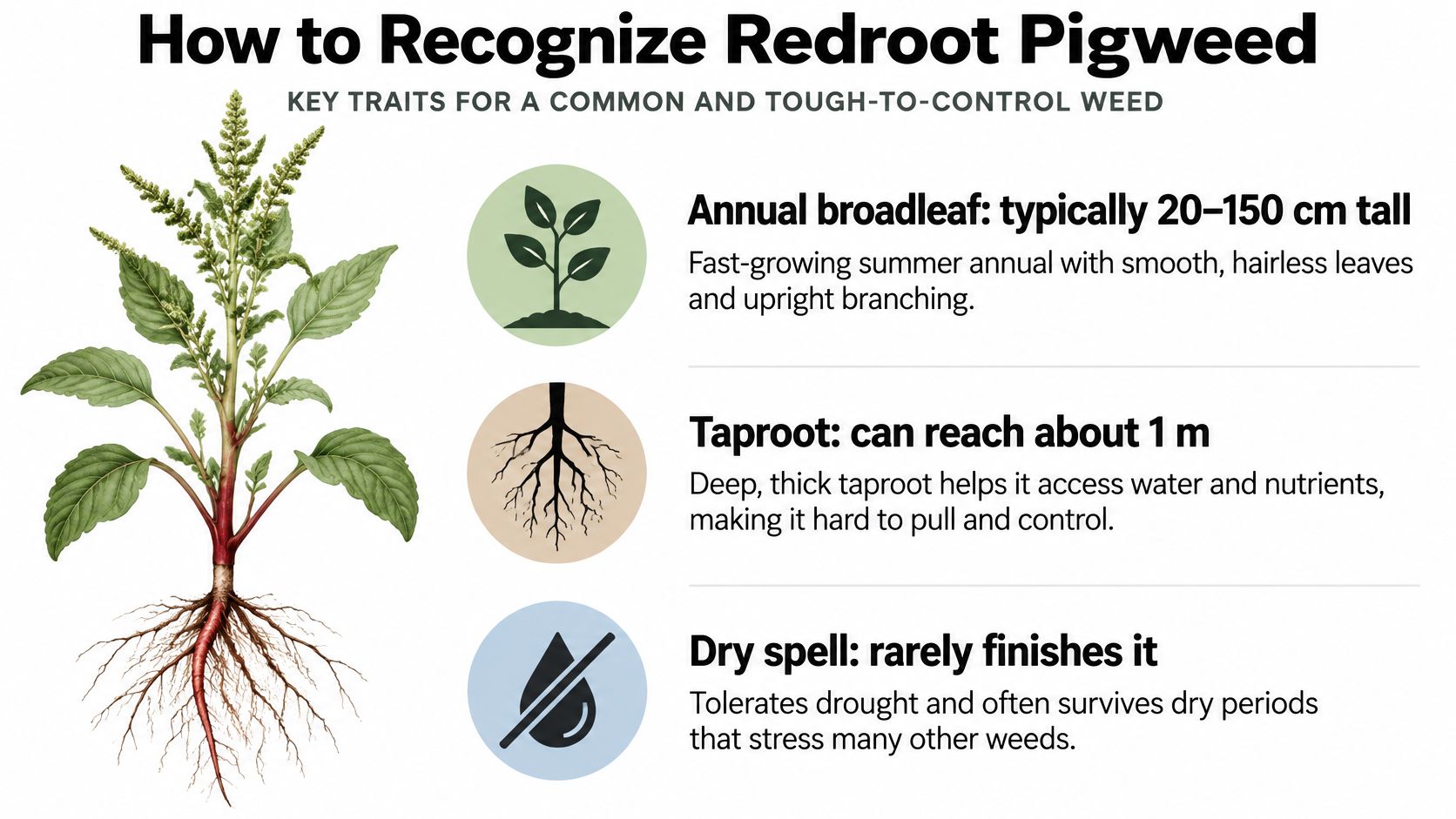
According to Cornell's redroot pigweed identification guide, Amaranthus retroflexus is an annual broadleaf that typically grows 20–150 cm tall, with a taproot capable of reaching approximately 1 m into soil.
The root helps it obtain moisture below the dry surface. That's why a brief dry spell isn't a dependable control method, especially once the plant is established.
Use the illustration to orient yourself before inspecting a living specimen.
Work upward from the stem
Inspect a plant where it stands before disturbing it. A phone camera with close-focus capability or a hand lens will help you see the hairs, particularly against a contrasting background.
- Stem texture: Look for visible hairs rather than relying on stem color. Examine an uninjured section below the growing tip.
- Leaf shape: Check for egg-shaped leaves, then turn a leaf over to inspect the underside. A reddish underside supports the description but doesn't establish the identity.
- Flower cluster: Look for a compact terminal spike with dense bracts, the small structures surrounding the flowers. The head looks crowded rather than airy.
- Whole-plant agreement: Confirm that the stem, leaves, and flower cluster fit together. A convincing match needs more than a single attractive feature.
Redroot pigweed is monoecious, meaning a plant carries both male and female flowers. An isolated plant therefore isn't harmless because you can't see another pigweed nearby.
Compare the lookalikes carefully
Smooth pigweed is less hairy. Waterhemp and Palmer amaranth tend toward longer, looser seedheads, and Palmer amaranth often has a notably long leaf stalk.
Those comparisons are useful clues, not shortcuts that replace a complete identification. Young plants may not yet have the flower structures that make the differences easiest to see, and damage can distort a mature seedhead.
For a second visual reference, compare the specimen with the plant shown in this video.
Before seeking identification help, photograph the stem hairs, leaf underside, and entire flower cluster. Add a whole-plant view showing its growth habit and surrounding habitat; a close-up of a red patch alone leaves too much unanswered.
Remove it before reproduction
Mechanical removal works best before flowering and seed production. For a small garden plant, loosen the soil with a hand fork and lift the root rather than snapping the stem at ground level.
For young seedlings, a hoe can sever growth before the plants become firmly established. Inspect the patch again after soil disturbance, because cultivation can expose conditions suitable for another flush of seedlings.
Deep cultivation by itself isn't a complete plan. If replacement seedlings keep growing and eventually reproduce, you've disturbed the soil without stopping the replenishment of its seedbank.
When Red Pigweed Is Dangerous to Eat
The foraging question needs more than a yes or no. Species, maturity, plant condition, amount eaten, and the animal involved all affect the risk, so neither a red stem nor a fresh green leaf serves as a safety label.
Redroot pigweed can accumulate nitrates and oxalates. These aren't visible deposits you can judge by looking closely at the leaf, and a healthy-looking specimen doesn't tell you what concentration it contains.
Appearance doesn't reveal the load
Purdue's redroot pigweed toxic-plant guidance reports nitrate concentrations ranging from 0.04% to 2.9% and oxalate content reaching up to 30% of dry weight, with substantially more oxalate in leaves than stems.
Purdue also notes that wilted mature plants can contain more nitrate than green growth. That makes plant condition important when you're assessing a pasture edge, harvested material, or a patch animals can browse.
Think of the difference between a tender kitchen green and mature, drought-wilted growth. They may belong to the same species, but their condition isn't interchangeable. That analogy explains why context matters; it isn't permission to eat young pigweed.
Keep the distinction between identification and safety in view.
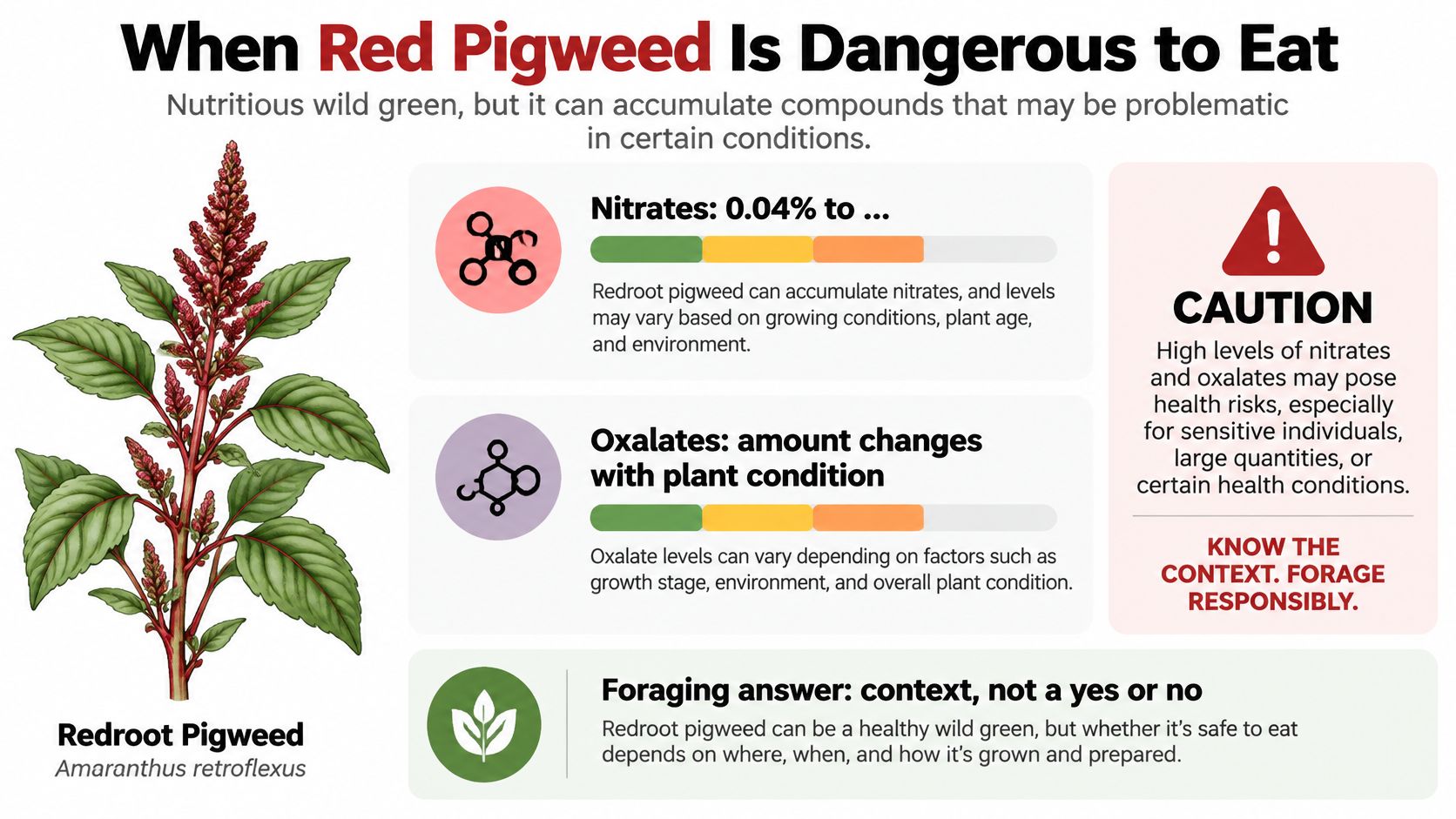
A correct plant name is the beginning of a safety assessment, not the end of it.
Put livestock exposure first
Livestock access and contaminated hay deserve prompt attention. A weed that seems merely untidy beside a fence becomes a different problem when animals can reach it or when it enters their feed.
- Keep animals away from wilted mature growth. Fence off the patch or move animals to an unaffected area while you arrange an assessment.
- Inspect hay and feed before feeding. Look for pigweed material rather than assuming that a harvested or dried plant is no longer relevant.
- Call a veterinarian if an animal has eaten it. Describe the suspected plant, its condition, the likely amount, and when exposure occurred. Don't substitute a home remedy for veterinary advice.
- Don't use the nickname as permission to forage. Human food decisions require a confirmed species and reliable, species-specific safety guidance.
If exposure has already happened, save photographs and, when you can do so safely, a representative specimen for identification. Keep questionable feed separate so another animal doesn't encounter it while you're seeking help.
For people, a common name such as red weed is especially inadequate because it can refer to unrelated organisms. Don't taste a leaf to settle an identification, and don't assume that preparation removes an unknown risk.
The danger window is about exposure to potentially toxic growth, especially wilted mature plants within animals' reach. Whether that growth looks red, green, or ornamental doesn't answer the safety question.
Why the Last Herbicide Missed
A living pigweed after treatment doesn't automatically prove resistance. A mistaken identification, poor coverage, unsuitable growth stage, or a later-emerging seedling can also explain what you see. First distinguish plants that survived the application from plants that appeared afterward.
Still, herbicide resistance is a real possibility, not an excuse for a disappointing result. Resistant plants can survive a chemistry that controls susceptible plants of the same species.
Recognize what resistance changes
In the ALS inhibitor row below, the substitutions describe changes at the herbicide's target site. Think of a key that no longer fits its lock: an altered enzyme can reduce herbicide binding without the plant necessarily producing more of that enzyme.
Herbicide groups redroot pigweed has resisted
| Herbicide group | Status | Reported detail | Field implication |
|---|---|---|---|
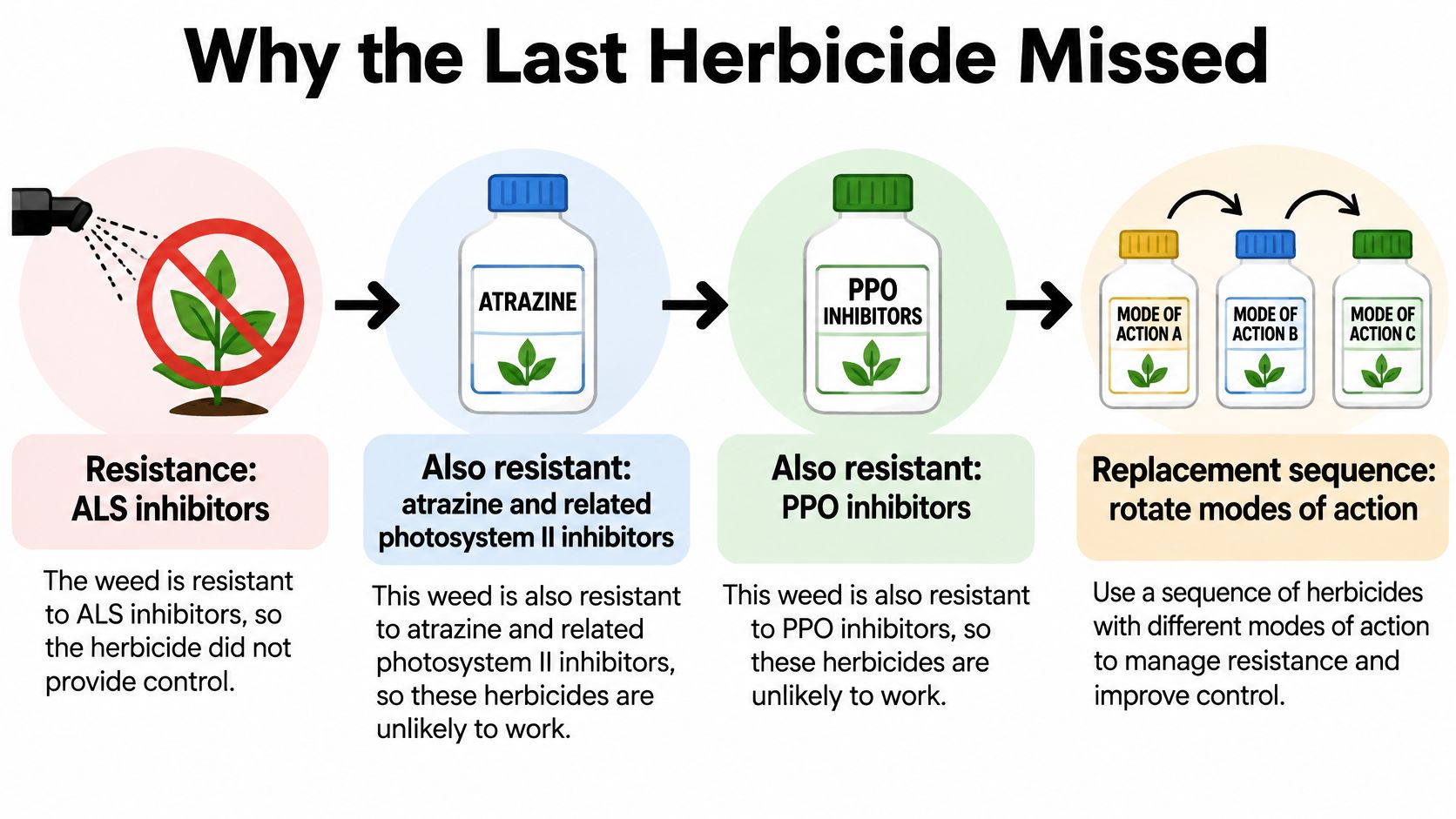
| ALS inhibitors | Confirmed | The International Herbicide-Resistant Weed Database case summary describes Ala-205-Val, Trp-574-Leu, and Ser-653-Thr substitutions and a 19.16-fold resistance ratio to imazethapyr in one reported population | Don't keep using the failed ALS product |
| Atrazine and other PSII inhibitors | Confirmed | Resistance includes atrazine and related photosystem II chemistry | A photosystem II spray alone is unreliable against a resistant population |
| PPO inhibitors | Confirmed | Resistant redroot pigweed populations have been documented | Avoid repeating the same PPO chemistry |
| HPPD inhibitors | Confirmed | Resistance has been confirmed within this mode of action | Choose an effective alternative mode of action |
| Three groups together | Some North Carolina populations | Multiple modes of action resisted in the same population | Combine crop rotation, residuals, cultivation, and escape removal |
These are documented resistance patterns, not a claim that every pigweed resists every listed group. A replacement product needs to suit the crop, site, weed, and local resistance situation.
The diagram summarizes why changing the control strategy matters more than changing the bottle's branding.
Replace repetition with a sequence
- Confirm the species. Use the stem, leaf, and seedhead checks under How to Recognize Redroot Pigweed before choosing a replacement treatment.
- Rotate crops where practical. Different crops allow different planting schedules and control opportunities, so the same chemistry isn't your only tool.
- Plan an appropriate pre-emergence residual. Choose an effective, crop-labeled option with a different mode of action from the failed product. A residual treatment addresses emerging seedlings, not an already established survivor.
- Cultivate or hand-weed before seed set. Match the tool to the site: a hand fork in a bed, a hoe for small seedlings, or suitable cultivation equipment in a field.
- Remove escapes before they flower. Treat surviving patches as a priority, not as an acceptable cosmetic imperfection.
Don't repeat the same failed ALS or PPO chemistry on the plants that survived it. A different trade name can still contain an active ingredient with the same mode of action.
Keep watching through summer
A clean patch immediately after treatment isn't proof of season-long control. USDA Agricultural Research Service guidance describes extended summer germination and recommends preventing herbicide escapes from producing seed through cultivation, hand-weeding, or an herbicide with a different mode of action.
Management priority: Judge success by whether survivors reproduce, not just whether the patch looks cleaner after spraying.
Record the product, application conditions, and locations of survivors. Those details help an extension specialist or crop adviser distinguish a likely resistance problem from an application or emergence-timing problem.
Match the Plant and Choose the Next Step
A red plant becomes a regulatory concern because of its identity and location, not because red foliage is suspicious by nature. Red witchweed, Striga asiatica, shows why the distinction matters: it's a root parasite of crops such as sugarcane, not merely a colorful competitor growing between rows.
A parasite can affect its host while leaving another problem underground. Removing the visible growth doesn't necessarily remove the seeds already present in soil.
What the Queensland response demonstrates
The Queensland red witchweed eradication report records its first Australian detection on a sugarcane property in the Mackay region in July 2013, surveillance identifying 8 infested properties, comprising 6 cane properties and 2 cattle enterprises, and a nationally coordinated eradication program beginning in 2015; after 8 years, detections fell by 99%, the soil seedbank declined by 94%, 51% of paddocks were released from quarantine, and the net infested area contracted by 24.5% to 5.42 hectares.
The important distinction is between suppressing visible plants and reducing the hidden seedbank. The Queensland response required treatment, surveillance, and decisions about when land could leave quarantine, rather than a single round of weeding.
For a home gardener, that doesn't mean every unfamiliar red flower warrants alarm. It means you shouldn't move a suspected regulated parasite, its roots, or surrounding soil around the property while trying to identify it.
Agricultural weeds include many unrelated species, and red rice is another name that can appear in a red-weed search. Color is a useful observation to record, but a scientific name and local identification are what make the next action defensible.
Match the action to the actual problem
- A suspected red witchweed or other regulated parasite needs containment and reporting. Stop home composting of the suspect material and contact your local agriculture authority. Send photographs and location details before transporting a specimen or moving soil.
- A confirmed garden or crop pigweed needs a reproduction-prevention plan. Use its maturity and any surviving treated patches to decide how urgently you need physical removal or specialist control advice.
- A patch accessible to livestock needs an exposure decision. Keep animals away from questionable growth, separate suspect feed, and involve a veterinarian if ingestion has occurred.
- An established ornamental or crop showing an environmental blush needs a care check. Review watering, root conditions, light exposure, and recent weather before changing anything. Don't spray a plant just because its color changed.
If nutrient supply is a plausible concern, learn what the fertilizer supplies before applying it. The guide to 10-15-10 fertilizer can help you interpret the formulation, but a fertilizer label can't establish why a particular leaf turned red.
Make identification easy to verify
Photograph the plant where it stands, with enough surrounding ground to show the habitat. Then capture the stem surface, leaf underside, and flowers or seedhead in focus; include a size reference without touching an unfamiliar plant unnecessarily.
Choose a single matching row from the opening comparison rather than borrowing advice from several unrelated cases. If nothing fits confidently, send the images to a local extension service or agriculture authority and leave eating, moving, and spraying off the agenda until you have a reliable identification.
Your next step is concrete: take those photographs, match the plant rather than its nickname, and act only on the problem that match establishes.
We offer mushroom products and educational resources at The Magic Mushroom Delivery, with an emphasis on understanding what you're choosing and using it responsibly. Visit our learning resources and clearly labeled product categories to keep the same identification-first approach when exploring mushrooms.