

The popular advice to take a few drops of chaga every day for immunity gets ahead of the evidence. Concentrated doesn't mean clinically proven, and a convenient dropper bottle doesn't establish either an effective dose or long-term safety. Understanding chaga mushroom tincture benefits starts with separating what researchers can measure in a laboratory from what a person can reasonably expect after taking an extract.
What Chaga Tincture Is and Why People Take It
Think of tea as a light broth, dried mushroom powder as the dried bone, and tincture as a reduced stock. That kitchen analogy helps explain concentration, but it has a limit: a tincture isn't automatically stronger in every useful compound. The solvent and preparation determine what ends up in the bottle.
Chaga, Inonotus obliquus, is the dark, cracked fungal growth commonly found on birch trees in cold climates. People have long brewed it as tea in Siberian and Northern European folk traditions; tinctures are a more recent wellness format. An alcohol-based tincture uses a liquid solvent to extract compounds from the harvested material.
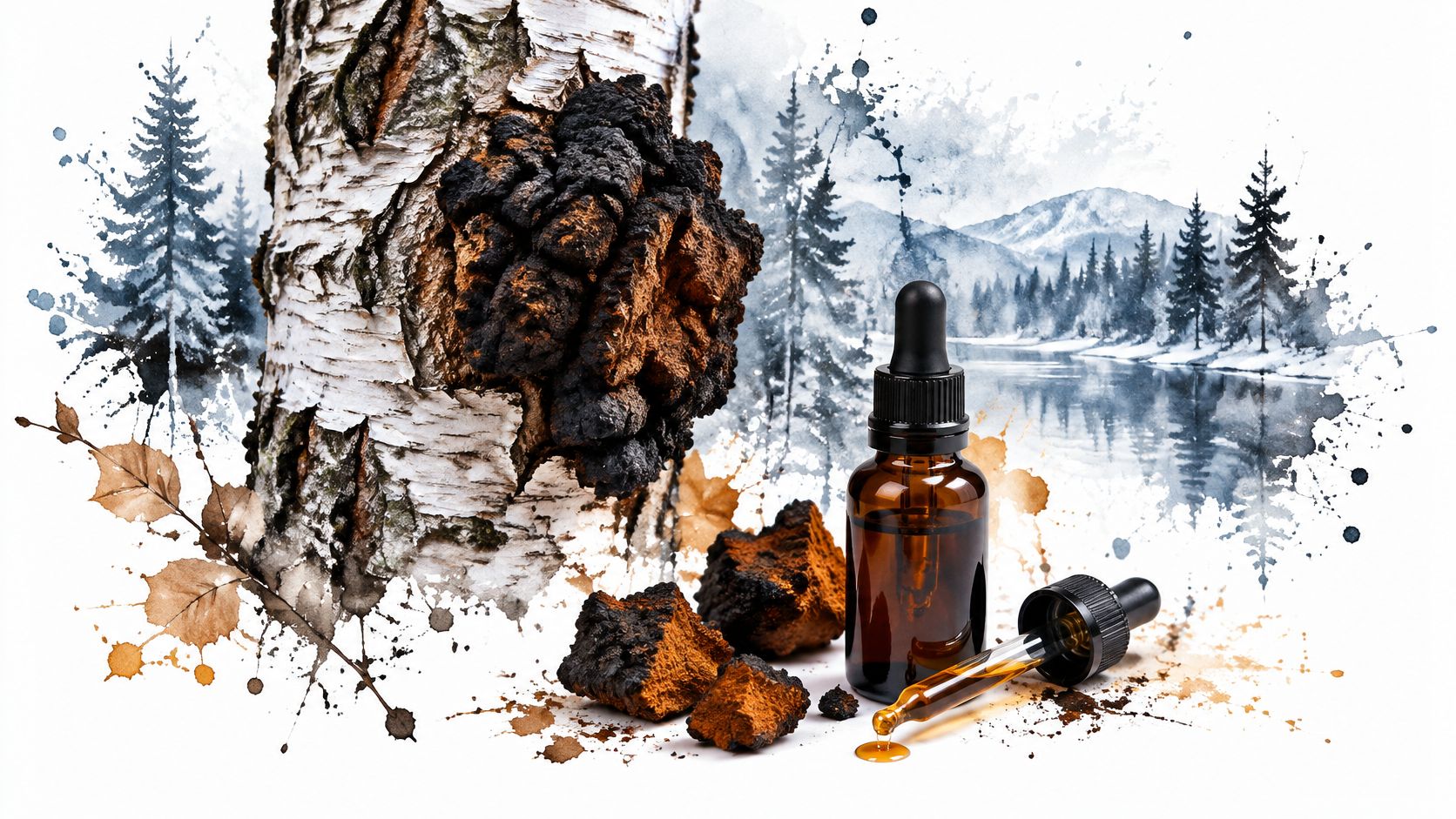
The bottle below shows the liquid format alongside raw chaga.
Why the preparation matters
Say you're comparing two brown bottles labeled chaga extract. One manufacturer uses more mushroom material relative to liquid; another uses a different alcohol-water mixture or filters the finished extract differently. Identical dropper sizes won't make those products equivalent.
Three groups of substances matter particularly when evaluating these products:
- Polysaccharides, complex carbohydrates investigated for effects on immune and inflammatory signaling.
- Antioxidant compounds, investigated for their ability to react with unstable molecules.
- Oxalates, compounds that become important when assessing kidney risk.
Products described as alcohol-free tinctures require the same attention to composition and serving information. Removing alcohol changes a formulation choice, not the standard of evidence needed to support a health claim.
A tincture is a preparation method, not a guarantee of effectiveness.
People choose liquids for convenience and flexible measurement. Those practical advantages are separate from clinical benefits, especially when most chaga investigations concern laboratory preparations rather than the exact product someone buys.
Chaga Tincture Benefits Ranked by Evidence
Chaga benefit claims compared with the strength of evidence
Read the evidence column before the verdict: a change in isolated cells isn't the same as an improvement in someone's health.
| Benefit claim | What the research found | Evidence level | Verdict |
|---|---|---|---|
| Antioxidant activity | Maximum free-radical-scavenging rates of 64.1%, 65.7% and 34.1% in polysaccharide assays, summarized in a peer-reviewed chaga review | Laboratory only | Promising; not proven in people |
| Anti-inflammatory effects | Reduced inflammatory signaling through TLR4/NF-κB in experiments | Cell and animal studies | Plausible mechanism; no human trial proof |
| Immune support | Methanol extract reduced histamine-induced TNF-α by more than 90% in macrophages, according to a mycological review | Laboratory only | Interesting; not a symptom-relief figure |
| Blood sugar and cholesterol | Extract at 500 mg/kg produced effects comparable to metformin in one animal model summarized in the review linked above | Animal only | Not a substitute for glucose-lowering medicine |
| Anticancer activity | Reduced viability and proliferation of HSC-4 human oral-cancer cells in a 2024 laboratory study | Cell culture | Not a treatment; no human evidence |
| Inflammatory markers in people | One small human study suggested changes, as described in the mycological review | Small human study | Limited; needs larger controlled trials |
| Mood, stress or pain | No reliable human outcome data established in these clinical and mycological sources | None established | Unsupported |
Laboratory activity is an early finding
The antioxidant percentages describe performance in different chemical assays. They don't tell you what percentage of oxidative damage a person would avoid, how much healthier someone might feel, or which tincture serving would reproduce the experiment.
The review also examined antioxidant, anti-inflammatory, antidiabetic, liver-protective, antiviral, antibacterial and anticancer activity. Most of that evidence came from cell cultures and animal models, not controlled trials of commercially available tinctures.
Cancer-cell experiments need especially careful interpretation. Human cells grown in a dish are still a laboratory model, not a human treatment trial. Researchers can expose those cells directly to an extract without answering whether swallowing it would deliver an effective, tolerable concentration to a tumor.
Animal findings don't establish a human dose
In the metabolic experiment summarized by the review, chaga extract improved blood glucose and insulin resistance, increased liver glycogen and HDL cholesterol, and reduced total cholesterol, triglycerides and LDL cholesterol. Its comparison with metformin applies only to that experimental model.
That doesn't make chaga an alternative prescription. A body-weight-based animal dose can't be converted into a dropper recommendation because extraction, absorption and product composition may differ.
Human evidence remains the missing step
The small human inflammatory-marker finding is a signal worth investigating, not proof of symptom relief or disease control. Other commonly promoted benefits haven't been established in human clinical trials, and Memorial Sloan Kettering's chaga guidance states that safety and efficacy haven't been evaluated in clinical studies.
The defensible verdict: chaga contains compounds with promising antioxidant and immune-modulating activity. No chaga tincture is proven to treat diabetes, cancer, inflammation or infection.
How Chaga Compounds Work in the Body
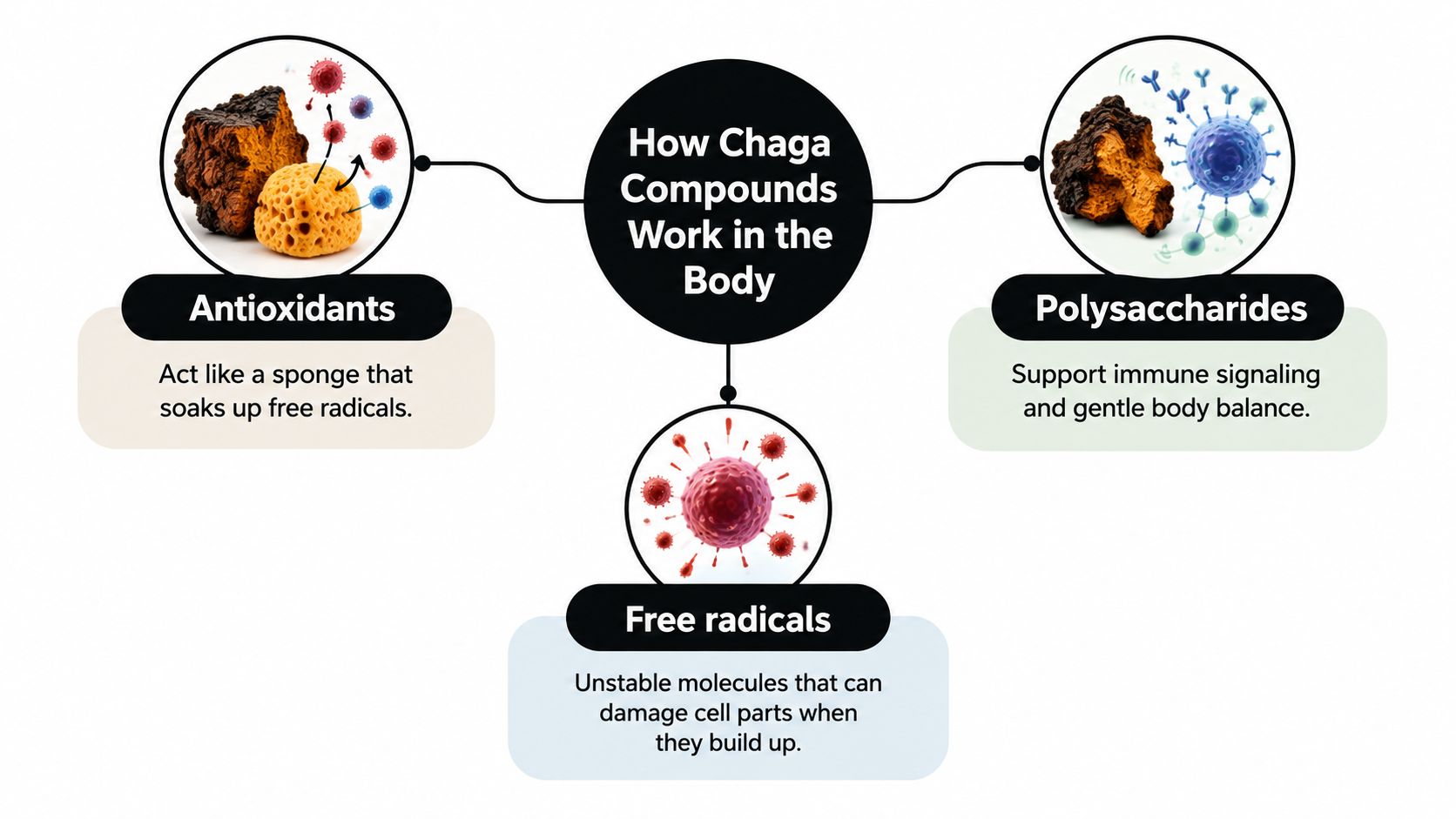
The proposed mechanisms are easier to understand with two everyday comparisons. Antioxidants act somewhat like a sponge that soaks up free radicals, unstable molecules that can damage cell components when they accumulate. Polysaccharides may act more like a dimmer on an alarm, changing inflammatory signaling rather than turning immunity on or off.
This illustration introduces those proposed relationships, not demonstrated benefits from taking a tincture.
Sensors, switches and inflammatory messages
TLR4 is a sensor involved in detecting threats. NF-κB helps control the activation of inflammatory genes, rather like a central switch in a signaling network.
A review of chaga polysaccharide mechanisms describes experiments in which these compounds downregulated TLR2 and TLR4 and limited over-phosphorylation of NF-κB p65, IκBα, p38 and c-Jun N-terminal kinase. In plain language, researchers measured less activation along pathways that help cells produce inflammatory responses.
Macrophages are immune cells that respond to threats and release chemical messages. Experiments using RAW 264.7 macrophages found changes in TNF-α production, while hot-water and ethanol-water preparations also suppressed nitric oxide, interleukin-6 and interleukin-1β generation. These findings describe altered cellular messages, not measured relief of allergies, pain or infection.
A compact concept map keeps the scope clear:
- [Chaga compounds] → Antioxidant effects: free-radical reactions, laboratory or animal evidence only.
- [Chaga compounds] → Inflammatory signaling: changes in cellular sensors and switches, laboratory or animal evidence only.
- [Chaga compounds] → Immune-cell effects: altered production of signaling molecules, laboratory or animal evidence only.
Why a mechanism isn't a treatment
A plausible mechanism gives researchers something specific to test. It doesn't show whether a swallowed extract survives digestion, gets absorbed, changes during metabolism, or reaches the relevant tissue in sufficient amounts.
Extraction adds another complication. A methanol research extract isn't a consumer alcohol tincture, and an isolated polysaccharide preparation isn't the same mixture as a retail bottle. The identity of the tested preparation matters as much as the mushroom's name.
Use the accompanying video as additional context, while keeping those experimental limits in mind.
Side Effects and Medication Interactions to Check
A 72-year-old woman with liver cancer developed oxalate nephropathy after consuming approximately 4–5 teaspoons of chaga powder daily for six months, according to The ASCO Post's clinical overview. The case involved a powdered supplement. It still shows what heavy, prolonged chaga exposure can do to a vulnerable person.
Oxalate can bind calcium and form crystals that injure kidney tissue. The mechanism works like grit accumulating inside a filter: small deposits build up where the kidneys process blood until flow and function suffer. That makes kidney history and total exposure two of the first questions to ask before using any concentrated chaga product.
Who should be careful with chaga tincture, and what to do
| Concern | Why it matters | What to do |
|---|---|---|
| Kidney disease or past kidney stones | Oxalate can form crystals that damage kidney tissue | Avoid, or get clinician approval first |
| Diabetes or glucose-lowering medicine | Experimental animal evidence suggests glucose-lowering activity | Tell the prescriber and agree on blood-sugar monitoring |
| Blood thinners, including antiplatelet or anticoagulant drugs | The clinical overview warns of possible interactions | Obtain clinician review before any dose |
| Immunosuppressants or nephrotoxic drugs | Interaction safety isn't established; immune effects and kidney risk warrant caution | Obtain clinician review before any dose |
| Pregnancy or breastfeeding | Reliable human safety information is lacking | Avoid unless a clinician approves |
| Children | Safety and suitable dosing aren't established | Don't give without pediatric advice |
| People avoiding alcohol | Conventional tinctures have an alcohol base | Check the formulation and alcohol content |
Possible interactions deserve a medication review
The blood-sugar concern is a potential additive effect: a substance with glucose-lowering activity might strengthen the effect of diabetes treatment, the way two people pushing the same door make it swing open harder. That possibility is a reason to let the prescriber decide whether the supplement is appropriate, and to keep any prescribed doses unchanged until they do.
Combining chaga with medicines that reduce clotting raises a parallel bleeding concern. These warnings rest on experimental activity and clinical caution, and human studies have yet to measure the interaction outcomes directly.
Changing formats changes none of this. If you're weighing a liquid extract against a capsule product such as organic mushroom capsules, compare the actual ingredients and the total exposure each serving delivers, because swallowing chaga in a different shape doesn't remove chaga-related risks.
Symptoms that should interrupt use
Watch for digestive upset and possible allergic reactions. Human safety evidence is too limited to say how often either occurs, so treat your own response as the earliest reliable data.
Stop if a rash appears. Difficulty breathing or swelling involving the mouth or throat requires emergency care, while reduced urine or flank pain warrants prompt medical assessment.
Medication rule: if you take a prescription medicine, have the first conversation with your prescriber, and treat the supplement label as background reading rather than clearance.
How to Judge a Chaga Tincture Label Before You Buy
Chaga tincture label checklist
| Label item | What good looks like | Red flag |
|---|---|---|
| Species name | Inonotus obliquus stated on the label | Generic mushroom blend or no species named |
| Mushroom-to-liquid ratio | A stated ratio, such as the hypothetical 1:5 example below | No ratio given |
| Extraction method | Alcohol and water extraction described clearly | Method undisclosed |
| Serving in mushroom equivalent | Milligrams of mushroom represented per serving | Only drops or scoops listed |
| Oxalate status | Tested and disclosed, with a meaningful result | Silence on oxalates |
| Third-party batch testing | Certificate of analysis tied to the batch number | No batch number or test report |
| Sourcing | Wild-harvested or organically cultivated origin stated clearly | Vague natural claims only |
The same product name can conceal different extraction, dosing and contamination profiles. A published report of chaga-associated kidney injury supports caution about prolonged, high-dose exposure and the need to assess oxalates rather than infer safety from the product format.
Alcohol extraction doesn't automatically guarantee low oxalate exposure. Filtration, concentration and dosing differ, so a clear liquid isn't evidence of a low-oxalate product. A manufacturer needs testing to support that claim.
Compare information, not bottle appearance
Consider a hypothetical pair of equally priced bottles. One identifies a 1:5 mushroom-to-liquid ratio, gives a mushroom-equivalent milligram serving and supplies a batch certificate. The other says proprietary blend and measures the serving only in drops.
The first gives you a basis for comparison; the second leaves important questions unanswered. Even the more transparent bottle hasn't proven a health benefit, and its ratio alone doesn't establish how much of any particular compound was extracted.
Ask for a certificate of analysis matching the bottle's batch number. Check what was measured, including relevant contaminants and oxalates, rather than accepting a general statement that a product was tested.
Read a test report critically
A useful explanation of third-party lab testing should help distinguish a batch-specific result from a general quality claim. Check the laboratory identification, sample details and whether the reported units let you understand exposure per serving.
Compare cost per milligram of mushroom equivalent only among reasonably comparable preparations. That calculation can help evaluate price transparency, but it can't rank clinical effectiveness or substitute for compound testing.
Buying boundary: no batch number is a reason to walk away, not a point to negotiate.
Sourcing information also deserves attention, but wild-harvested and organic aren't synonyms for low oxalates, contaminant-free material or demonstrated efficacy.
How to Take a Chaga Tincture Day to Day
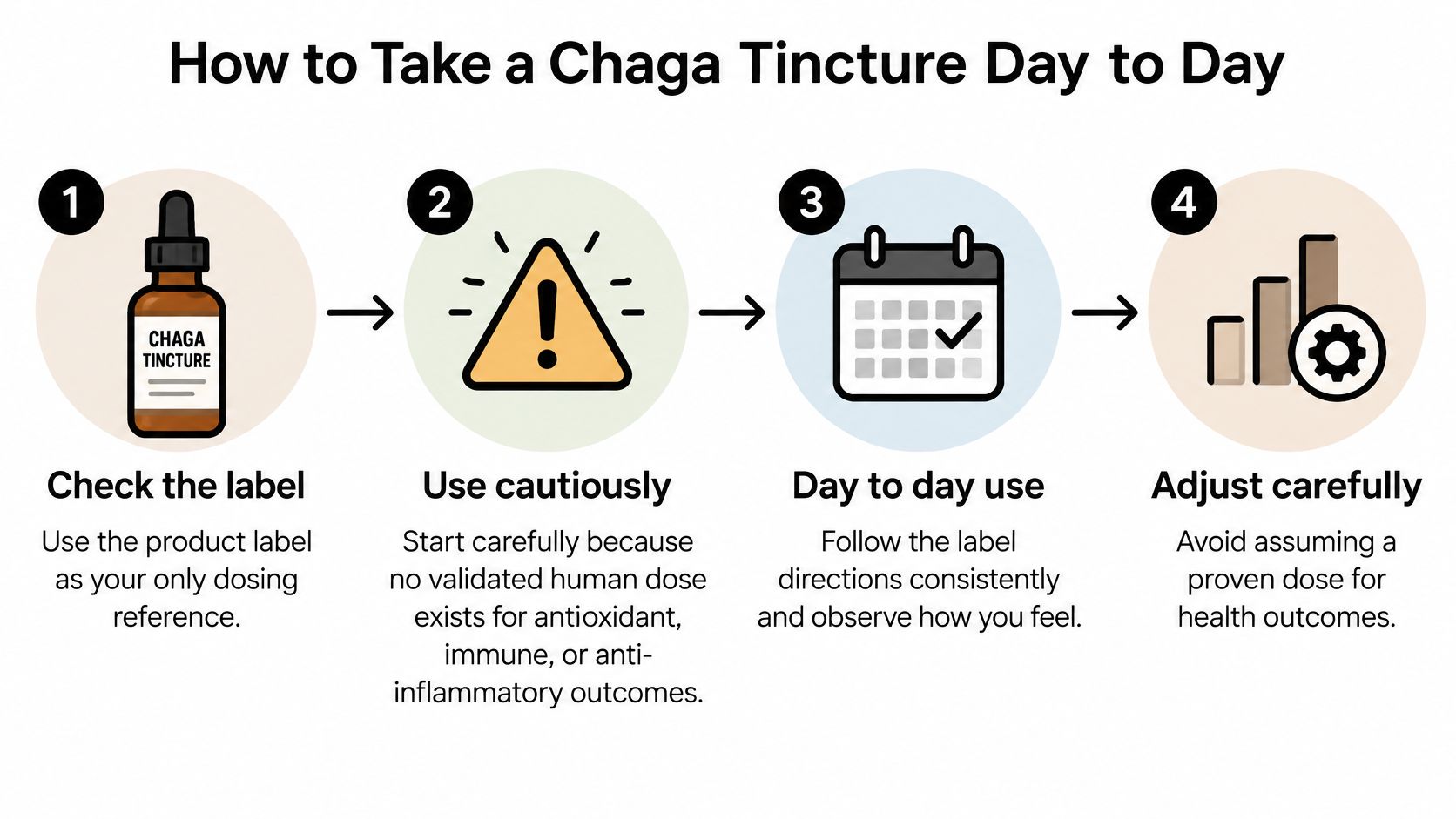
There's no validated human dose for antioxidant, immune or anti-inflammatory outcomes. A product label is a formulation-specific reference, not a clinically established prescription. Choosing not to use chaga remains reasonable, particularly when the intended benefit is uncertain.
If you and your clinician decide a cautious trial is appropriate, use a routine that makes the serving, observations and stopping decision explicit.
A cautious routine with a defined endpoint
Read the complete serving information. Identify the serving volume and mushroom-equivalent amount, not just the bottle size. Use a marked measuring device when the directions specify a liquid volume.
Screen your health history and medicines. Check for kidney disease, kidney stones, diabetes treatment and blood thinners before opening the bottle. If any concern applies, obtain clinician sign-off before the first dose.
Begin conservatively if cleared to proceed. Use the low end of the labeled serving during the first several days rather than increasing immediately. This is a tolerance precaution, not a validated dosing schedule or proof that delayed problems won't occur.
Keep the routine consistent. Follow the labeled administration directions and never exceed the stated serving. Don't compensate for a missed serving by doubling the next one.
Set a short review period. Write down an endpoint within a few weeks and decide what observation would justify stopping. This practical limit isn't a proven safe duration, and continuing automatically because the bottle isn't empty is poor dose control.
Record what changes. Log digestion, sleep, rash and changes in urination each day, alongside the amount taken. A symptom diary can support a clinical conversation, but it can't prove that chaga caused an improvement.
Stop at warning signs. Reduced urine, flank pain or a rash should interrupt use and prompt medical advice. Difficulty breathing requires emergency care rather than waiting to see whether symptoms settle.
This visual summarizes the basic label-checking and observation routine; the warning signs above take priority over any routine.
Don't combine formats to chase an effect
Tea, powder and tincture servings aren't interchangeable. Using chaga tea alongside capsules and a liquid extract increases total exposure, even if each product appears modest on its own.
Avoid adding several new supplements during the trial. Keeping other changes limited makes it easier to describe what happened and gives your pharmacist or prescriber a clearer medication and supplement history.
Confirm Your Choice Before You Start
Choose among three outcomes: proceed cautiously, obtain clinician sign-off first, or skip the product. The right decision depends on both the bottle's transparency and your health status, not on how strongly its marketing promises immune support.
Proceed cautiously only if you're a healthy adult, the label passes every buying-checklist item, and you have no kidney condition or relevant medication concern. Even then, acceptable labeling isn't evidence that the supplement will improve your health.
When the answer should be clinician first or no
Use the safety table to identify situations that require a clinician's assessment. Bring the actual bottle label, the batch report and your full medicine list, including nonprescription products, so the conversation concerns the preparation you would take.
Skip a product that hides its species, ratio or mushroom-equivalent serving, or lacks a matching batch certificate. If kidney symptoms appear, stop taking it and seek assessment rather than switching brands.
Keep expectations proportionate. Antioxidant and immune-cell findings don't establish reliable improvements in how a person feels, functions or recovers from illness. Chaga shouldn't displace prescribed treatment or delay evaluation of persistent pain, fatigue or other symptoms.
You don't need to take a supplement simply because its chemistry is interesting.
Make the decision concrete
- Check the label against the buying checklist, including the batch-specific test report.
- Write down your serving and stop point before beginning, without treating either as a proven therapeutic regimen.
- Book the clinician conversation if any risk group applies, and wait for that assessment before use.
Confirm the product and your health status before the first drop.
We offer mushroom products and educational resources to help adults compare formats and understand responsible-use considerations. Visit The Magic Mushroom Delivery to review product information, and keep the chaga label checklist and your clinician's advice beside you before choosing a supplement.