
Age verification is the process of deciding whether someone meets a set age threshold before they can access a restricted product, service, or website. Typing a birth date alone isn't a strong check because it's easy to enter a date without proving it's accurate.
You might meet an age gate while checking out online, just as you're ready to place an order. A small box asks you to confirm you're 21 or older, and you pause: is that the whole check, or will the shop ask for something else? The answer depends on the retailer's process and the rules that apply to the purchase.
The useful distinction is simple: a retailer needs to decide whether you clear the age line, not necessarily collect your entire identity. That difference matters when you're shopping for age-restricted products and want a checkout that's clear about what it checks and what happens to your information.
Why a Birth Date Box Is Not Enough
You reach checkout, enter your delivery details, and see a birth-date field. It feels like a door with a sign asking you to be old enough to enter. But typing a date into a box doesn't, by itself, show that the date belongs to you or is correct.
That's the difference between self-declaration and age verification. Self-declaration asks you to state your age or birth date. Age verification is the broader process of deciding whether you meet the threshold set for access. A self-declared date can be a first step, but it's easy to falsify, so it's a weak control on its own.
Think of the age line like a ticket check at a venue. The staff member may need to confirm that you meet the entry requirement. They don't necessarily need to learn your full history or keep a copy of every document you've ever carried. For an online retailer, the corresponding question is whether you're eligible for that purchase, and what evidence is needed to make that decision.
This matters to adult shoppers and retailers alike. A clear age gate can tell you what's expected before you spend time choosing products, while a retailer needs a process suited to its products and responsibilities. Customers buying mushroom products may expect a 21+ check, discreet handling, and a straightforward path through checkout. Those expectations don't mean every store should collect the same data or use the same technology.
As you compare age checks, ask three practical questions: what age line does the retailer apply, what does the check establish, and what information does it need to make that decision? Those questions help you distinguish a simple prompt from a stronger check without assuming that stronger always means more personal information.
How Age Verification Entered U.S. Law
U.S. law developed age checks in response to different concerns, from online speech to children's privacy and access to adult material. That history explains why there is no single check that fits every product or age threshold.
The Communications Decency Act of 1996 sought to limit minors' access to indecent material online. In 1997, the Supreme Court struck down major parts of the law in Reno v. American Civil Liberties Union, ruling that the restrictions placed an unconstitutional burden on protected speech. Congress later passed the Child Online Protection Act, which listed possible age-check methods, including credit cards, adult access codes, digital certificates, and other reasonable technology-based measures. (The age-verification legal history)
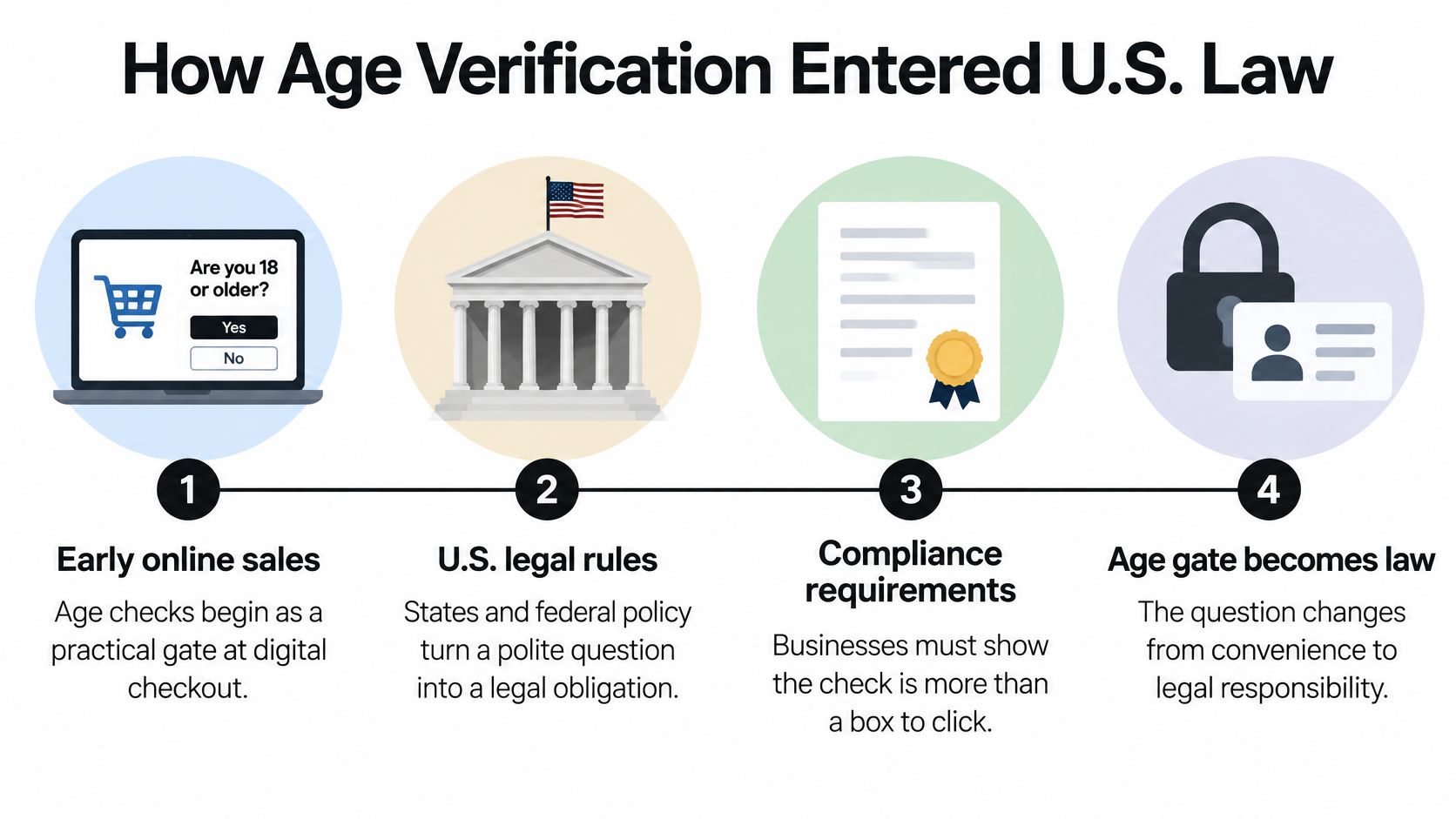
The Children's Online Privacy Protection Act (COPPA) took effect federally in 2000. It requires covered websites and online services to address how they collect personal information from children under 13. COPPA focuses chiefly on parental consent and children's information. It does not require every website to prove that every visitor is an adult. (The Federal Trade Commission's COPPA guidance)
Why the rules vary
Since 2022, age-verification policy has become a prominent U.S. issue, especially for online services offering adult content. Louisiana became the first state to require pornography websites to use more than simple self-attestation, with the law taking effect on January 1, 2023. In 2023, Arkansas, Mississippi, Montana, North Carolina, Texas, and Virginia passed similar laws. More than 60 state and federal bills introduced that year addressed age restrictions, parental consent, or safety-by-design measures. (Congressional Research Service background on state age-verification laws)
Some laws apply when a “substantial portion” of a site contains material considered harmful to minors, often defined as more than 33.3% of its content. That legal threshold does not prescribe one tool for every retailer. Courts and policymakers continue to weigh child protection against privacy, anonymity, free expression, accuracy, exclusion, and data retention. For product-specific context, see this overview of psilocybin laws.
For you as a shopper, the legal history points to a threshold decision: a business needs to establish whether you qualify, while the evidence and rules can differ by product. A self-declared age, a document check, facial estimation, or a privacy-preserving yes-or-no proof can each serve different purposes. A retailer selling products for adults 21 and older must account for the applicable federal, state, product, payment, and delivery rules. The right approach depends on those requirements, not on a universal device or a need to collect every detail about you.
What a Reliable Age Check Must Do
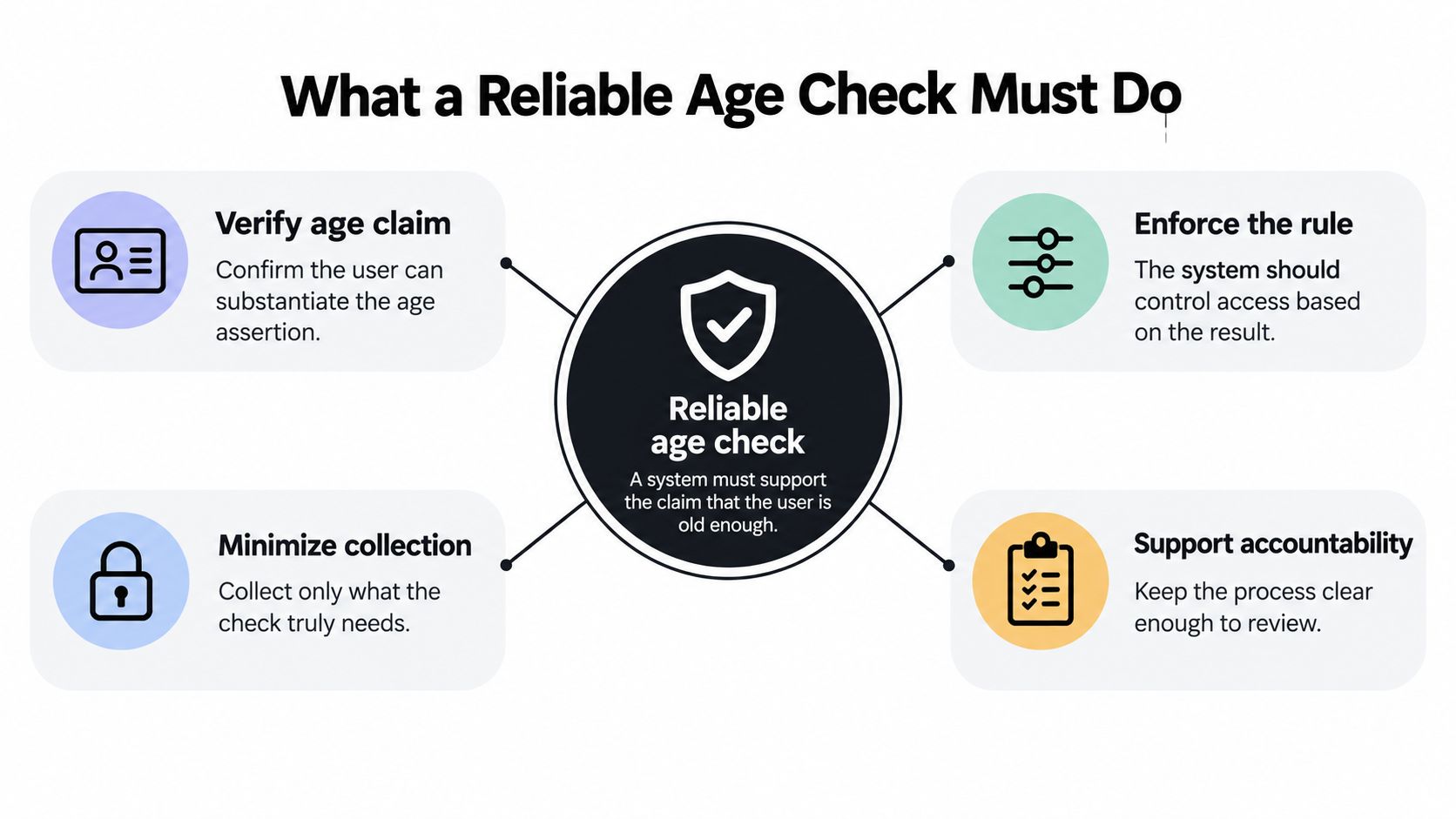
A reliable age check should support a real decision about access, not collect a statement and treat it as proof. The threshold might be 18 or 21, depending on the service and the rules that apply. An unchecked declaration is easy to make without evidence; stronger methods can include photo-ID matching, facial age estimation, digital identity services, open banking, and certain regulated payment or mobile-network checks. (Ofcom's age-assurance guidance)
Four tests to apply
Ofcom assesses age-assurance systems against four operational qualities. In shopper terms, they're a useful way to judge whether a check is designed to work beyond the screen where you first encounter it.
- Technical accuracy: Does the system classify people correctly around the age line? A check that struggles to tell whether someone meets the threshold can wrongly approve or block a customer.
- Resistance to manipulation: Can a person defeat the check with a spoofed image, a misleading claim, or repeated attempts to create accounts?
- Reliability: Does the process behave consistently across the devices and groups of customers it supports, or does it fail unpredictably?
- Fairness: Can customers who are incorrectly rejected get a reasonable alternative, such as manual review, rather than being left with no way to challenge the result?
Privacy belongs in the design from the start. Age checks handle personal data, so a retailer should consider limited retention, encryption, access controls, clear disclosures, and oversight of any verification provider. These measures support the eligibility decision while limiting the amount of sensitive information exposed.
A good age gate measures eligibility, resists tricks, works consistently, and offers a human path when automation fails.
You can use those four tests when a retailer asks you to complete a check. Look for an understandable explanation of what the process verifies, an option for resolving a failed check, and a clear account of how the retailer or its provider handles your data.
Comparing Age Verification Methods Side by Side
At checkout, an age check is a threshold decision: does the customer qualify, or not? The methods differ in how they support that answer and how much information they expose. A birth date typed into a box is a claim. A document check, facial age estimate, or privacy-preserving proof works differently.
| Method | What it can establish | What it reveals | Main limitation |
|---|---|---|---|
| Self-declared birth date | The customer says they meet the age threshold | The date or age entered | Easy to falsify, with no independent support for the claim |
| Government ID upload | A document displays a birth date that can support an age decision | An image with identity details | The retailer or provider must protect the image and limit retention |
| Third-party identity service | A provider checks documents or other permitted signals and returns a result | The provider may receive detailed information; the retailer may receive only an eligibility result | Customers need to understand the provider's role and data handling |
| Knowledge-based challenge questions | The respondent knows answers tied to claimed information | Answers that could reveal personal or account-related details | It checks knowledge, not a shopper's exact birth date |
| Payment or database signals | A supported account or payment signal may help indicate an adult user | Transaction or account-related information | It may not independently establish identity or exact age |
| Facial age estimation | A face image appears consistent with an estimated age or range | A face image or information inferred from it, depending on the system | It estimates apparent age instead of checking a birth date |
| Privacy-preserving age proof | A valid credential confirms that the customer meets the threshold | Potentially only the eligibility result | Its privacy depends on how the proof is issued and checked |
Matching the method to the purchase
A third-party provider can check a document or database and send the shop an eligibility result. This can keep the original document out of the retailer's hands, much like a ticket checker confirms that a ticket is valid without collecting the details used to buy it. The provider still handles information, so its collection and retention practices matter.
Knowledge-based questions serve a different purpose. They test whether someone can answer questions tied to claimed knowledge, as in some parental-consent processes. For a mushroom purchase, that does not establish the shopper's exact birth date or directly prove they meet the required age.
A retailer can also use different checks at different points. A simple age gate might appear first, with a stronger check at account creation or checkout. If an automated result is uncertain, manual review can provide another route. That is more useful than repeatedly asking a customer to upload the same sensitive document.
For example, The Magic Mushroom Delivery is a U.S. online retailer offering psilocybin and functional mushroom products, including raw mushrooms, infused chocolates, gummies, capsules, and mushroom coffee. It supports age verification for customers 21 and older and describes next-day, 2-day, and tracked nationwide shipping with discreet packaging.
No single method suits every purchase. Compare what it can establish, what information it exposes, and whether it checks the threshold itself or only offers supporting evidence. A clear distinction helps you understand whether a checkout is asking for a full identity record or only a decision about eligibility.
Keeping Only a Yes or No After the Check
At checkout, the key question is whether you meet the required age threshold. A privacy-preserving check aims to give the retailer a yes-or-no result, such as “21 or older,” instead of your exact birth date, identity document, or full identity profile. The European Commission's overview of age verification describes approaches that can confirm eligibility while limiting the personal information shared.
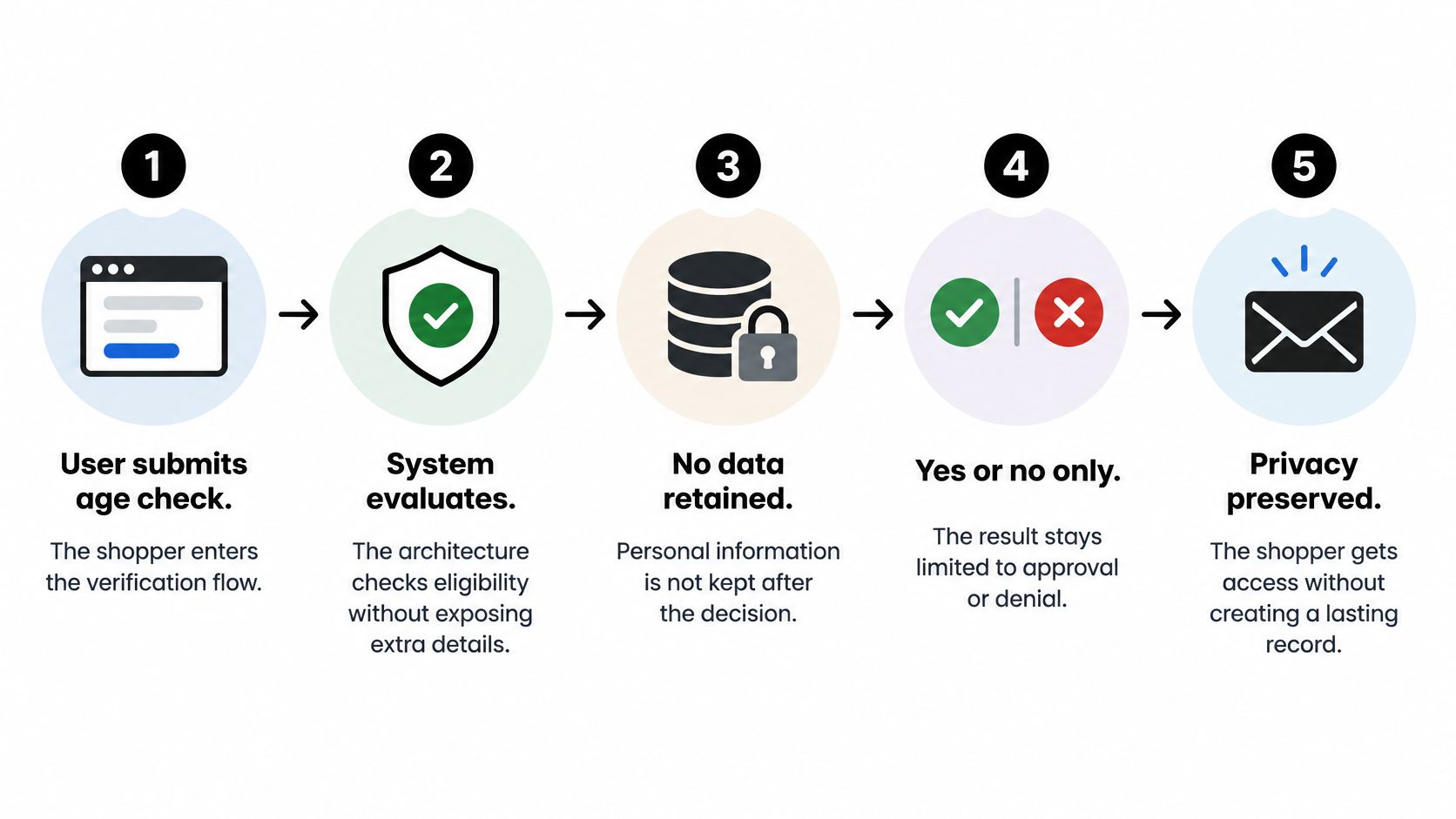
A useful way to picture the process is as a ticket check at a door. A trusted provider examines the necessary identity details and issues a credential confirming that you meet the age threshold. You present that credential to the retailer, which verifies the proof rather than asking to see your original ID again. The decision is about eligibility, not collecting your whole identity.
Selective disclosure and zero-knowledge techniques can let you prove you meet an age line without revealing your precise age. A single-use credential may reduce repeated use, while separating the provider from the retailer may make it harder for either party to track where the credential is presented. These are possible system designs, not features every age-check service offers.
Questions to ask before uploading
For an online order, a privacy-minded setup might request a 21+ assertion during account creation or checkout, send a document or biometric review to a specialist, then return only a signed result. The retailer could avoid storing raw identity images and use a fresh check or fraud controls if a high-risk account detail changes. European data-protection guidance on age checks discusses safeguards relevant to age-check systems.
Before submitting sensitive information, ask how long it will be kept, whether it is deleted after the check, whether it may be used to train a model, and which vendor processes it. You should also be able to understand the steps and what happens if the check fails.
Privacy rule: More verification doesn't always mean better protection. Requiring a full identity document for every purchase can increase the amount of sensitive data at risk without improving age assurance.
You can also review the retailer's explanation of discreet shipping options. A clear process tells you what information the check needs, what the retailer keeps, and how to raise a concern.
Why a Face Scan Is Not Proof of 21
A facial-age system estimates how old someone appears. It doesn't, by itself, prove a date of birth or establish that a person is 21. That distinction can be easy to miss when an app presents an automated result as a simple pass or fail.
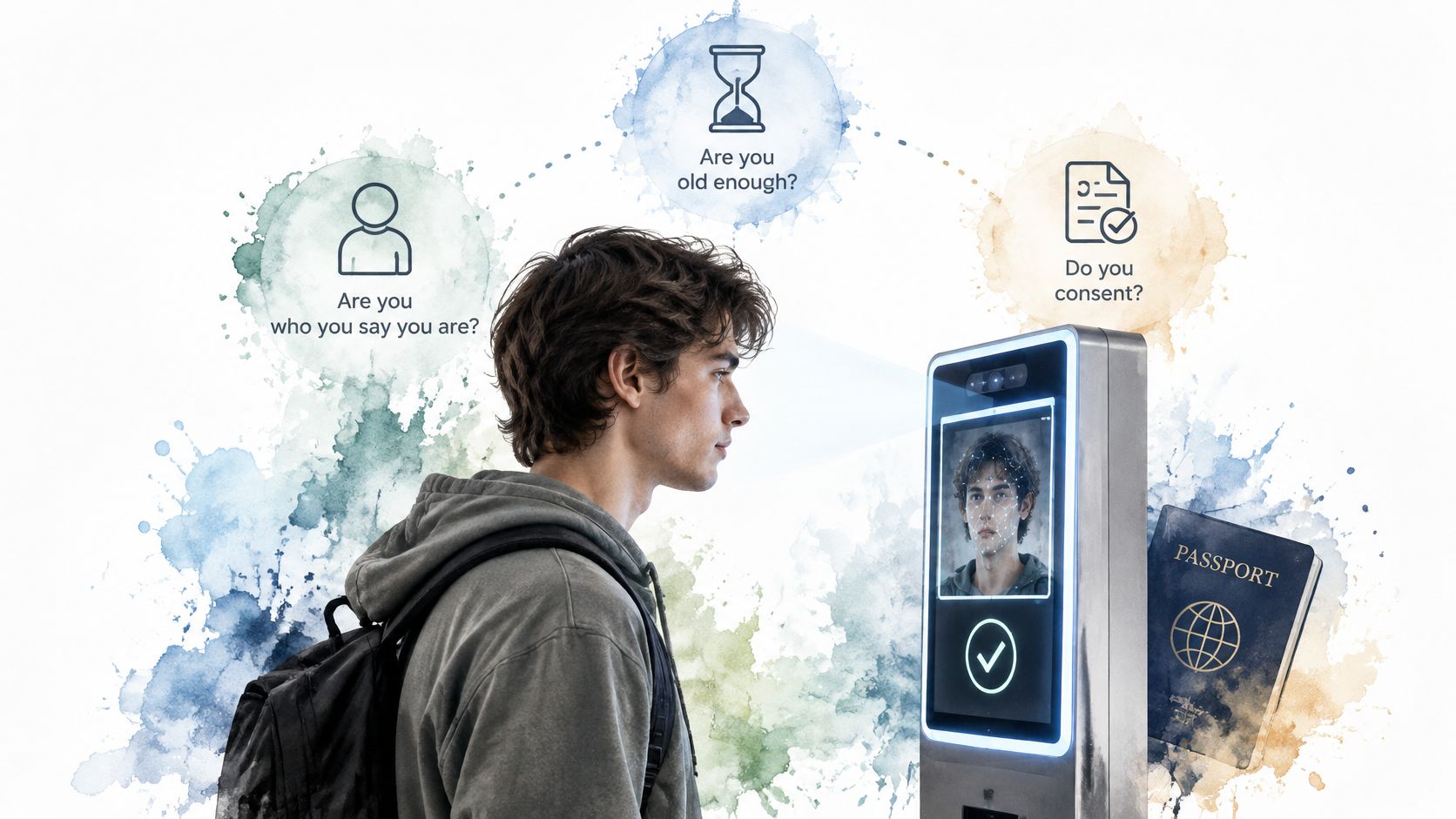
It helps to separate four different tasks. Age estimation guesses apparent age from signals such as a face image. Age-range classification places someone into a broad category. Document authentication checks whether an identity document appears genuine. Identity matching compares a person with the image or details on a document. A face estimate and a document-based date-of-birth check don't answer the same question.
Research reports typical adult age-estimation errors of roughly 3–5 years. One study found that only 12% of observers estimated age within one year, while some estimates differed by as much as 20 years. (Research on age-estimation accuracy) At a 21+ checkout, that uncertainty can matter: an adult who meets the age requirement may be rejected because they look younger, while a minor may be incorrectly estimated as old enough.
What changes the estimate
Makeup, masks, lighting, camera angle, facial expression, and image quality can all affect a facial estimate. Demographic differences can also influence performance. Research finds that AI can be less accurate and more biased than human observers, with particularly sharp declines in accuracy for older adults, smiling faces, and women.
A failed estimate isn't necessarily evidence that the customer is underage. It may reflect the limits of the image, the model, or the conditions in which the picture was taken. A retailer should explain what customers can do if they believe an automated result is wrong.
A reasonable fallback includes a way to challenge a false rejection, an accessible alternative for people who can't use a camera check, and a review process that doesn't require repeated uploads of sensitive images. That's a practical standard to look for before you treat “the system said so” as the final word.
If a face-based check blocks your order, ask what alternate verification or manual review is available and whether you can resolve the issue without submitting the same image again. A system that makes an estimate should be clear about its limits and provide a route to correct a decision.
Ordering 21+ Products with a Clear Next Step
At checkout, an age check should work like a threshold: it confirms whether you qualify, without turning the step into a request for your full identity. Before placing a 21+ order, check the age requirement and see what happens if the result is uncertain. If the retailer asks for a sensitive document, review its explanation of how the information is retained, deleted, and handled by any verification provider.
For a practical starting point, browse the online mushroom product range. The Magic Mushroom Delivery is based in Oakland, California, and describes its products as organic and non-synthetic. Its categories include raw mushrooms, infused chocolates, gummies, capsules, and mushroom coffee. The retailer lists next-day, 2-day, and tracked nationwide shipping, discreet packaging, phone customer service, and offers such as Buy 3, Get 1 Free where shown.
If you meet the retailer's 21+ requirement, complete the age step presented during checkout. A self-declared birth date, document check, facial estimate, and privacy-preserving yes-or-no proof are different ways to handle that gate; they do not all require the same information. If a check fails or you have a shipping question, call customer service. The site's educational resources, FAQs, and blog cover topics including effects, duration, dosing considerations, and responsible use.
Choose a tracked delivery option that fits your timing, and proceed only if you meet the age requirement. The next step should be clear before you submit an order.