The strongest evidence for magic mushrooms' health benefits concerns measured psilocybin administered in supervised clinical protocols: in a trial of 233 adults with treatment-resistant depression, response rates were 37% with 25 mg versus 18% with 1 mg, not a guarantee of comparable benefits from retail mushrooms. If a wellness product borrows the language of that research, are you buying the treatment researchers tested, or something associated with it?
That question matters more than whether a package promises better mood, less stress, or greater mental flexibility. The useful distinction is between evidence for a particular intervention and an appealing claim attached to a mushroom product.
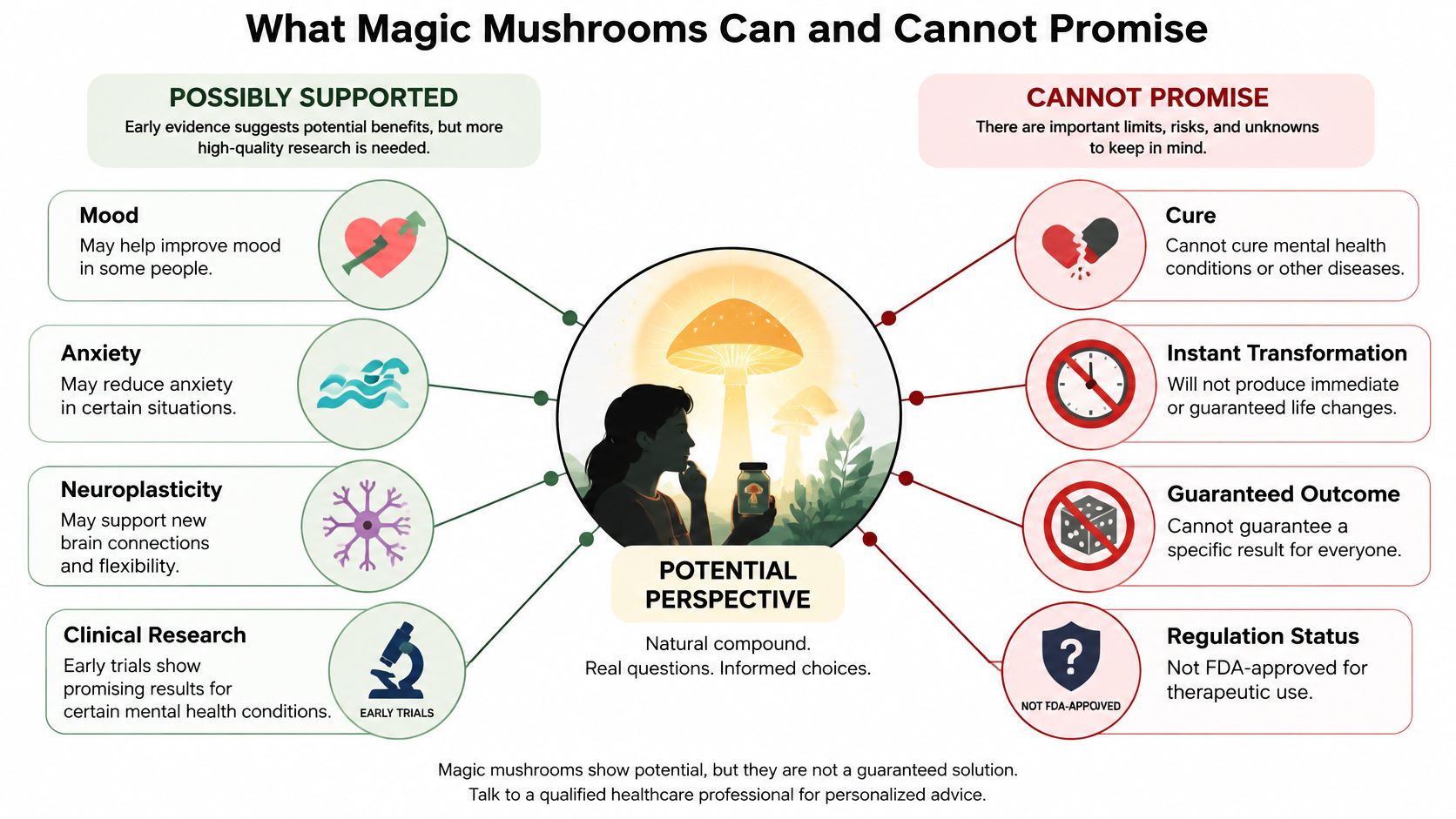
What Magic Mushrooms Can and Cannot Promise
You're considering a mushroom chocolate after seeing a description about emotional well-being. Perhaps you're curious rather than unwell, or perhaps persistent low mood has made ordinary wellness advice feel inadequate. Either way, the product description and the clinical question aren't necessarily asking the same thing.
Researchers study defined outcomes in selected participants. A consumer may instead want to feel calmer, think more clearly, or cope with a difficult week. Those goals deserve separate evaluation rather than a blanket answer that mushrooms are beneficial.
The concept map below separates promising research themes from outcomes no product can guarantee.
What the Evidence Can and Cannot Answer
| Question | What research supports | What remains unestablished |
|---|---|---|
| Can depressive symptoms improve? | A therapeutic signal in supervised patient research | Equivalent improvement from ordinary retail products |
| Does an intense experience guarantee recovery? | Clinical outcomes can be measured after treatment | A reliable relationship between subjective intensity and personal benefit |
| Can findings guide healthy adults? | Questions worth investigating | General wellness benefits for people without the studied conditions |
| Can a label establish effectiveness? | Identification of a claimed ingredient or purpose | Proof that the finished product reproduces a tested intervention |
Even the clinical evidence requires scrutiny. A review covering 15 randomized psilocybin trials identified meaningful antidepressant effects while highlighting functional unblinding: participants can often recognize whether they received psilocybin, potentially inflating apparent treatment effects.
That doesn't make improvement imaginary. It means investigators must distinguish the compound's contribution from expectations and other features of the experience.
Evidence-first question: Which benefit, for which person, under which conditions?
Searching for “magic mushrooms health benefits” becomes more useful when you replace the broad phrase with a specific outcome. Relief from diagnosed depression, ordinary stress management, and improved concentration aren't interchangeable goals, and evidence for one doesn't automatically answer the others.
Understanding Psilocybin and Functional Mushrooms
Psilocybin mushrooms and functional mushrooms belong in different evidence categories. The former contain the psychedelic compound under investigation in the clinical trials discussed here. The latter describes non-psychedelic mushrooms and extracts marketed for other wellness purposes.
The distinction is like comparing a named active ingredient with an entire pantry category. Knowing that both come from fungi doesn't establish that they have the same composition, intended effects, or supporting research.
The category map below helps separate the ingredient from the format in which it's sold.
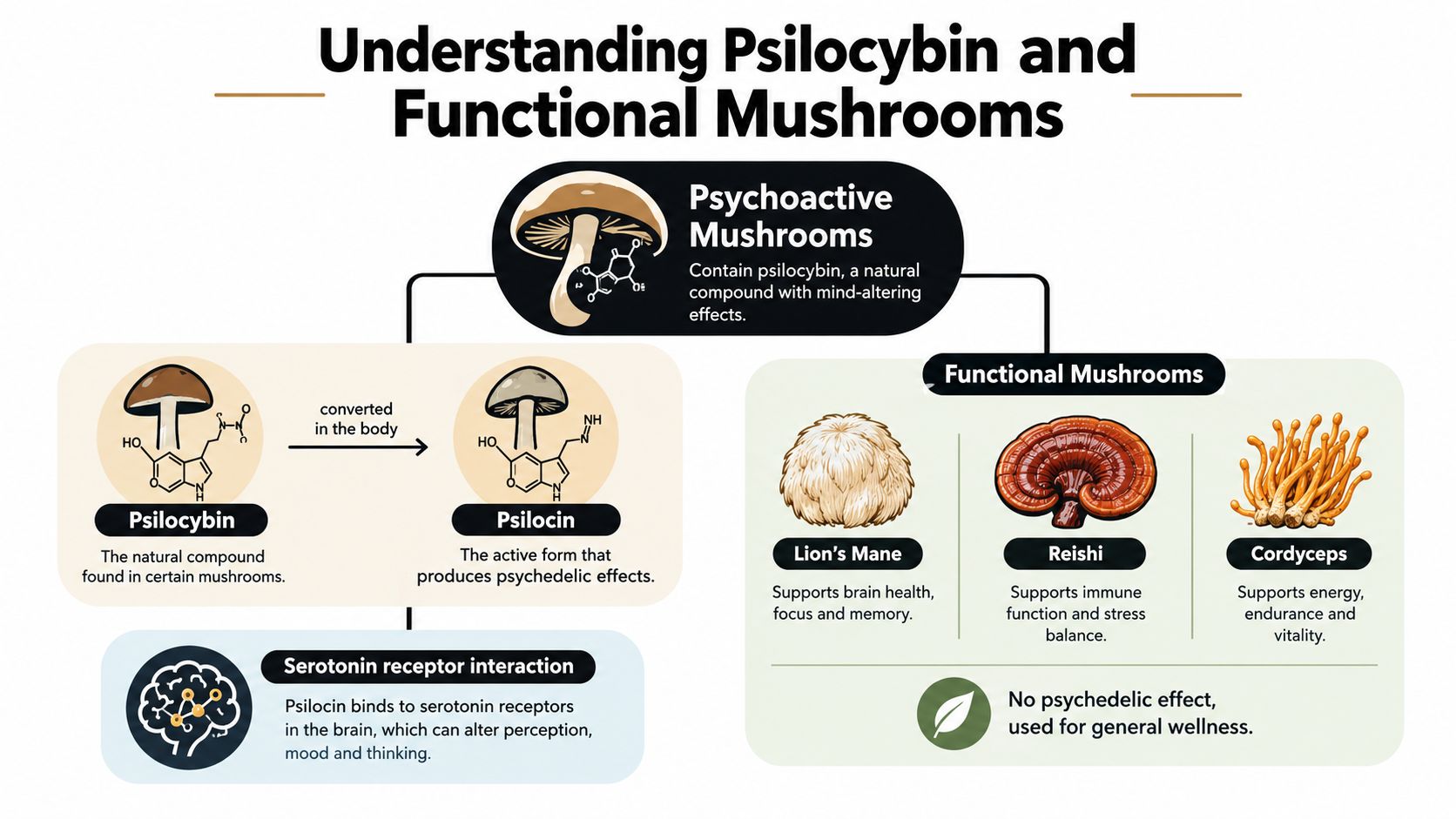
Read the Ingredient Before the Format
A capsule is a container, not a scientific category. Mushroom coffee, infused chocolates, gummies, and raw mushrooms likewise describe presentations rather than a shared therapeutic intervention.
Use these distinctions when reading a label:
- Substance: Does the description identify psilocybin, a functional mushroom species, or an unspecified blend?
- Preparation: Is the item a raw mushroom, an extract, or an infused food?
- Claim: Is the seller discussing an experience, general wellness, or treatment of a diagnosed condition?
- Evidence match: Did researchers evaluate that ingredient and preparation, or something materially different?
A guide to what functional mushrooms are can help clarify the vocabulary. It shouldn't substitute for examining the evidence behind a particular health claim.
The practical error to avoid is category borrowing. A functional-mushroom product doesn't inherit the antidepressant findings from psilocybin research. A psilocybin product doesn't inherit every immunity claim made about other fungi, either.
For a consumer, the most useful description names what the product contains before explaining what it might do. Words such as natural, botanical, mushroom-based, or wellness-oriented don't answer the central research question: what exactly was tested?
That distinction also prevents a packaging shortcut. A familiar format may make something easier to recognize or consume, but convenience isn't evidence of clinical equivalence.
How Psilocybin May Affect Mood and Anxiety
A plausible mechanism isn't a demonstrated health outcome. Researchers can identify a biological interaction without proving that a consumer product will improve someone's emotional life.
Psilocin, psilocybin's active metabolite, primarily engages serotonin 2A receptors and may affect downstream signaling associated with neuronal plasticity. Emerging evidence also implicates TrkB and other targets, according to a clinical review of psilocybin's proposed mechanisms.
The following process diagram is best read as a set of proposed connections, not a guaranteed sequence of benefits.
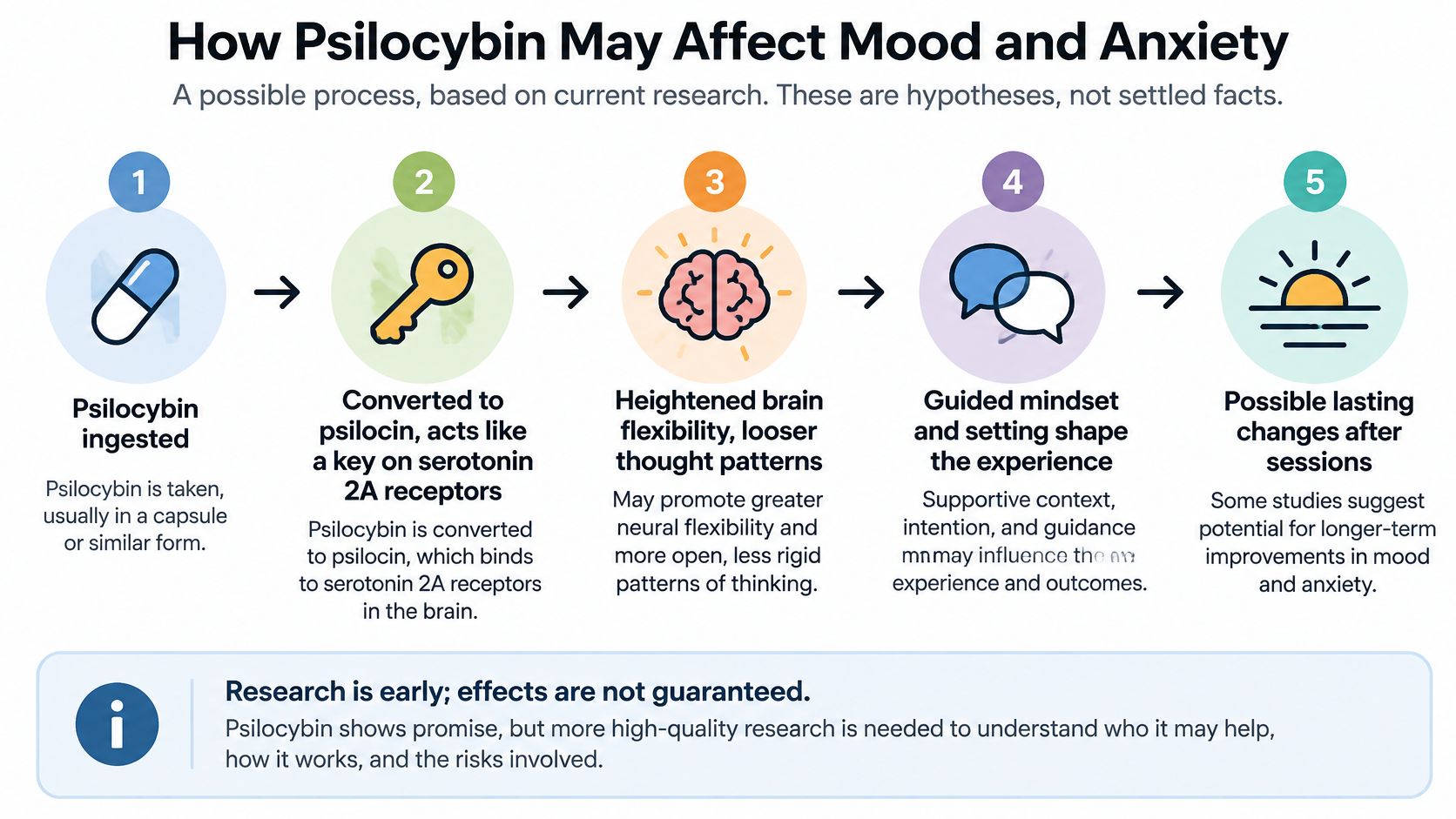
A Key Can Open a Door Without Choosing the Destination
Think of receptor engagement as a key turning a biological lock. That interaction may help explain why researchers investigate changes in mood and patterns of thinking, but it doesn't tell us which person will improve or how long improvement will last.
Neuroplasticity refers broadly to the nervous system's capacity to change. In this context, it offers a possible explanation worth testing, not a synonym for better focus, emotional resilience, or permanent recovery.
The same caution applies to an emotionally significant session. An acute experience, a later change in depression scores, and someone's interpretation of that experience are different observations.
A proposed pathway explains why a benefit might occur. A clinical outcome measures whether a defined benefit actually occurred.
Researchers must consider the experience as a whole rather than treating receptor activity as the entire explanation. Preparation, psychological support, expectations, participant selection, and follow-up complicate attempts to isolate what contributes to improvement.
Why “May” Matters
An account of feeling emotionally open isn't the same as evidence that anxiety has remitted. Likewise, describing possible changes in brain flexibility doesn't establish that daily use improves cognition.
For visual context, the embedded discussion can accompany the distinctions above; the clinical evidence remains the basis for judging health claims.
Immunity requires a separate line of inquiry. Nothing about serotonin receptor engagement alone establishes immune support, and functional-mushroom claims need evidence about their own ingredients and outcomes.
The analytical takeaway is simple: biological plausibility narrows a research question; it doesn't finish the investigation.
What Clinical Research Shows About Psilocybin
Clinical trials contribute evidence much as witnesses contribute to a court case. Each can answer particular questions, but none establishes every claim a consumer might attach to “mushrooms.”
The most useful comparisons examine the population, intervention, control condition, outcome, and follow-up together. A percentage without those details can sound more transferable than it is.
Depression Trials Offer a Meaningful but Bounded Signal
The 2022 multicenter Phase 2b trial introduced above compared measured doses alongside psychological support. At three weeks, the highest-dose group had a −6.6-point adjusted difference in depression scores relative to the lowest-dose comparison, with a 95% confidence interval of −10.2 to −2.9 and P<0.001; remission was 29%, 9%, and 8% across the descending-dose groups, while sustained response at week 12 was 20%, 5%, and 10%, respectively.
The important inference isn't merely that symptoms improved. The contrast between early and sustained outcomes shows why an initial response shouldn't be interpreted as lasting recovery.
A 2021 comparison with escitalopram examined psilocybin-assisted therapy against an established antidepressant: after two supported psilocybin sessions, response on the QIDS-SR-16 occurred in 70% versus 48%, while remission occurred in 57% versus 28%. Those reported outcomes are encouraging, but they aren't grounds for declaring universal superiority or advising someone to replace prescribed treatment.
Placebo Comparisons Strengthen the Picture
A randomized, placebo-controlled trial involving 104 adults compared a single 25 mg dose with niacin, both within a supported research protocol. The between-group difference in depression scores was −12.3 points by day 43, and sustained response occurred in 42% versus 11%; no serious treatment-emergent adverse events occurred, although overall and severe adverse events were more frequent with psilocybin.
Taken together with the pooled clinical evidence discussed earlier, these trials support a genuine therapeutic research program. They don't establish an individual guarantee.
- Comparison groups matter: Improvement alone doesn't show how much change is attributable to the intervention.
- Definitions matter: Response indicates a specified degree of improvement; remission reflects a defined symptom threshold.
- Timing matters: An assessment soon after treatment answers a different question from sustained follow-up.
- Treatment context matters: A study protocol isn't interchangeable with a self-selected retail experience.
Anxiety Evidence Has a Specific Context
In a randomized crossover study involving people with life-threatening cancer, approximately 80% continued to show clinically significant decreases in depressed mood and anxiety at six-month follow-up. Researchers also observed improvements in quality of life and existential outcomes, but this was a serious-illness population receiving carefully supervised treatment.
That finding supports a narrower conclusion than general stress relief for otherwise healthy adults. It also illustrates why the context described in psilocybin-assisted therapy is central to interpreting outcomes, rather than an optional detail attached to the compound.
Comparing Mood Anxiety Neuroplasticity and Immunity Claims
A product description may place mood, anxiety, neuroplasticity, and immunity in the same sentence. An evidence-focused reader should separate them immediately because each requires a different measurement and a different argument.
Depression trials measure symptoms in defined patient populations. Mechanism research explores possible biological explanations. An immunity claim requires evidence about immune outcomes, not a reference to antidepressant research.
The comparison graphic highlights common claim categories. Its broad evidence labels shouldn't override the specific clinical findings or imply that every category has equivalent support.
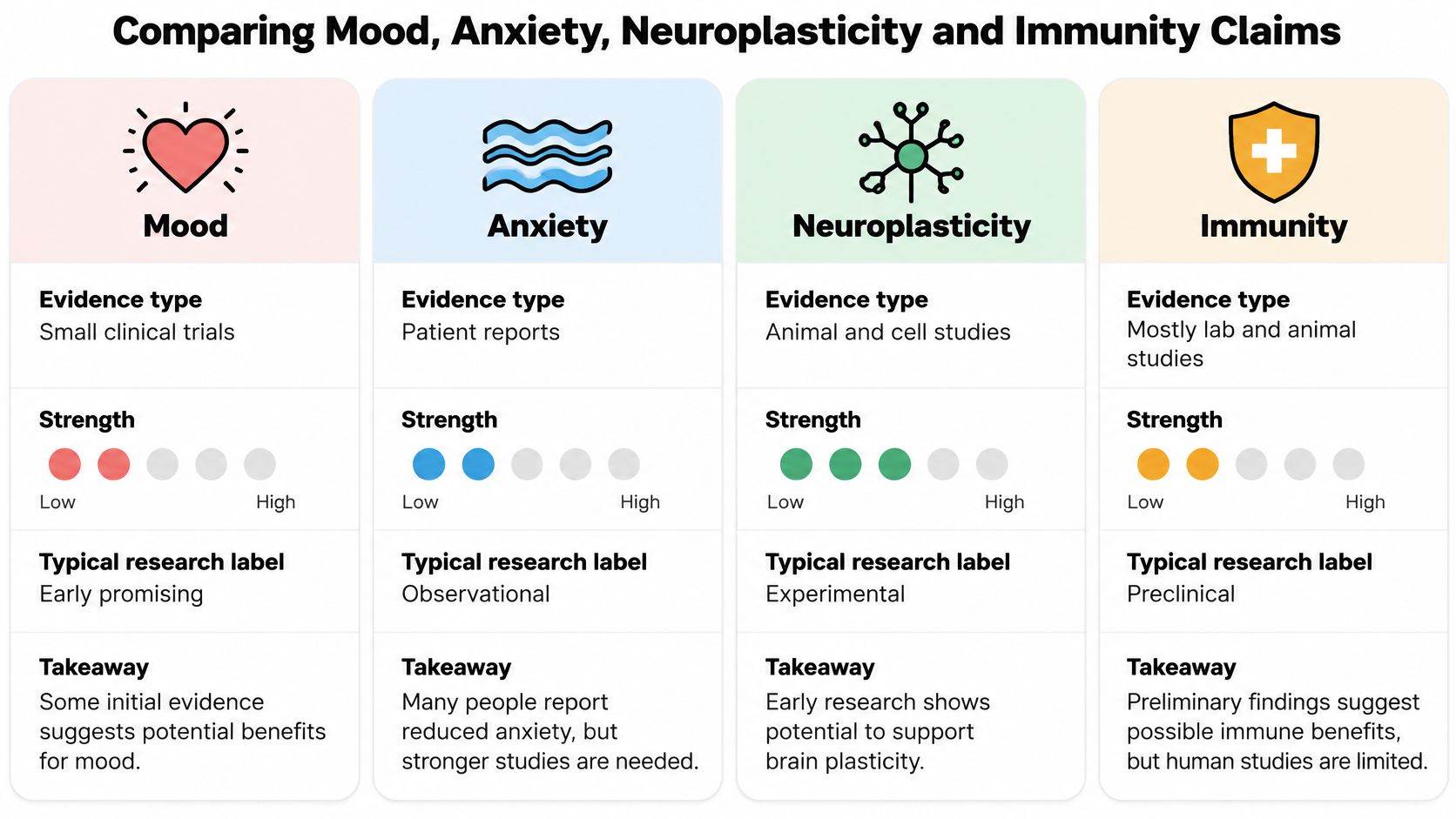
Evidence Map for Common Mushroom Wellness Claims
| Wellness theme | Most relevant evidence context | Key limitation |
|---|---|---|
| Mood | Supported psilocybin trials in diagnosed depression | Doesn't establish general mood enhancement in healthy adults |
| Anxiety | Supervised research, including cancer-related distress | Can't automatically be generalized to everyday stress or all anxiety disorders |
| Neuroplasticity | Proposed receptor and downstream signaling mechanisms | A mechanism isn't proof of better cognition or clinical recovery |
| Immunity | Separate ingredient-specific research would be needed | The depression evidence discussed here doesn't substantiate immune benefits |
| Convenience | Product format and purchasing considerations | Ease of use doesn't establish therapeutic effectiveness |
| Evidence quality | Controlled trials, reviews, and their methodological limitations | Stronger design still doesn't prove equivalence to a retail preparation |
Don't Let One Kind of Evidence Substitute for Another
The distinction between mechanism and outcome is especially important. A researcher might investigate a pathway relevant to neuronal change, while a consumer wants relief from distress. Connecting those questions requires clinical testing rather than persuasive wording.
Immunity claims need similar discipline. An assertion about supporting a biological function isn't equivalent to evidence of preventing infection or treating disease, and the clinical studies discussed above don't resolve that question.
Claim filter: Ask what changed, who experienced the change, how researchers measured it, and what they compared it with.
Functional-mushroom discussions should be evaluated independently rather than treated as a milder version of psilocybin-assisted therapy. Different intended uses require different evidence.
The less obvious conclusion is that a product can be accurately described yet still be supported by irrelevant research. Naming a real ingredient and citing a real study aren't enough if the study examined a different preparation, population, or outcome.
Using the Evidence as a Practical Decision Guide
Your starting point changes which questions deserve attention first. A curious newcomer, a wellness shopper, and an experienced enthusiast may encounter the same product but need different safeguards against mistaken assumptions.
The goal isn't to turn a label into a medical recommendation. It's to identify when the available information can't support the decision you're considering.
Different Readers Need Different Questions
For a first-time adult, begin with identification rather than expected benefits. Determine whether you're looking at a psilocybin product, a functional-mushroom preparation, or a blend whose ingredients aren't clear to you.
For a wellness seeker, define the desired outcome in ordinary language. Wanting to feel less overwhelmed doesn't by itself make research in treatment-resistant depression applicable to your situation.
For an experienced enthusiast, familiarity with an experience shouldn't substitute for evaluating a new preparation. Nor does personal confidence resolve questions about medicines, symptoms, or whether a health claim matches the evidence.
| Reader situation | Useful next action | Shortcut to avoid |
|---|---|---|
| You're unsure what the label means | Clarify the ingredients and preparation | Inferring composition from the product name |
| You're considering it for persistent symptoms | Discuss the symptoms with a qualified clinician | Treating shopping research as diagnosis |
| You're comparing wellness claims | Look for the studied outcome and comparison | Equating testimonials with clinical evidence |
| You already have experience | Reassess the current product and personal context | Assuming familiarity establishes suitability |
A Short Decision Checklist
- Identify the goal: Separate curiosity from an attempt to manage a health condition.
- Identify the substance: Record the ingredient, preparation, and available composition information.
- Check the research match: Ask whether the cited intervention resembles what you're considering.
- Review personal context: Consider current symptoms, medical history, and all medicines.
- Escalate uncertainty: Bring unresolved health questions to a qualified professional rather than filling gaps with marketing claims.
A useful decision can be to pause. If you can't identify the ingredient or explain why a study applies to your goal, you don't yet have a sound basis for expecting that study's benefits.
Risks Contraindications and Common Misconceptions
Natural doesn't mean low-risk. The relevant question is whether the safety evidence applies to your circumstances, not whether an ingredient originated in a mushroom.
A meta-analysis of six randomized trials involving 528 participants found headaches, nausea, anxiety, dizziness, and blood-pressure fluctuations more often with psilocybin than with comparators. The analysis also highlighted the need for longer-term monitoring of rare outcomes, including concerns such as suicidality, prolonged paranoia, and persistent visual-perceptual effects.
Screened Safety Isn't Universal Safety
A reassuring result in a monitored study doesn't answer every question about people whom researchers didn't enroll. This matters when someone has psychiatric vulnerabilities, cardiovascular concerns, or a complicated medication regimen.
People taking antidepressants or cardiovascular medicines shouldn't self-manage a decision from general online guidance. A history of psychosis, bipolar disorder, severe anxiety, or suicidality also calls for individualized professional assessment rather than reassurance based on a product's natural origin.
- Disclose all medicines: Include prescriptions, nonprescription products, and supplements when speaking with a clinician.
- Don't alter treatment independently: Stopping or changing prescribed medication to pursue a mushroom experience isn't a substitute for an agreed care plan.
- Treat uncertainty with care: Unresolved interaction questions aren't evidence that a combination is safe.
- Separate format from safety: Chocolate, gummies, capsules, and raw mushrooms shouldn't be assumed equivalent to standardized study material.
The distinction is particularly important when a consumer product's strength or composition isn't clearly established. A familiar serving format can't supply the controls that made a research protocol interpretable.
Challenge the Reassuring Shortcuts
A pleasant testimonial doesn't tell you whether a product is suitable for someone with your medical history. Conversely, a trial's lack of serious events doesn't mean unpleasant, severe, or persistent effects are impossible.
A broader explanation of magic mushroom risks can help organize questions, but it can't provide personalized clearance. The decision should account for why you're considering use, what symptoms are present, and whether a clinician needs to assess them first.
Safety assessment isn't pessimism about the research. It's how a promising finding is kept separate from an unsafe personal inference.
Seek urgent medical help for persistent confusion, dangerous behavior, severe agitation, chest symptoms, or suicidal thoughts. Don't treat those signs as an expected wellness experience to endure, and don't leave someone at immediate risk without assistance.
Key Takeaways for Curious Adults
The most defensible conclusion isn't that mushrooms are a cure, nor that the research is merely hype. Researchers have documented promising changes in selected mental-health outcomes, while important questions about durability, generalizability, and personal suitability remain.
The central analytical distinction is transferability. Evidence can be persuasive for the intervention researchers tested and still provide an inadequate basis for a different product, person, or purpose.
Match the Claim, the Intervention, and the Person
- Match the claim to the evidence: Depression, anxiety, cognitive flexibility, and immunity require separate support. A result in one area doesn't establish the others.
- Match the product to the studied intervention: An ingredient connection is weaker than a demonstrated match in preparation, administration, support, and outcome.
- Match the decision to personal safety: Your symptoms, medicines, and history matter more than how confidently a benefit is advertised.
For newcomers, that framework replaces a vague promise with questions you can answer. For experienced readers, it provides a reason to distinguish a personally meaningful experience from a clinically demonstrated health effect.
Wellness seekers can apply the same discipline to functional mushrooms without dismissing the category or borrowing evidence from psychedelic trials. The right question is whether the particular claim has relevant support, not whether mushrooms as a whole are beneficial.
A Better Bottom Line Than “It Works”
A statistically significant group result doesn't tell an individual what will happen. A plausible biological explanation doesn't establish a useful outcome, and a convenient retail format doesn't recreate a therapeutic protocol.
Those distinctions aren't technical footnotes. They're the difference between learning from research and asking research to support something it didn't test.
Before making a health-related decision, write down your intended outcome, the exact product you're considering, and any medicines or conditions that could complicate the choice. If your goal involves persistent symptoms or treatment changes, take that information to a qualified clinician rather than relying on a wellness claim.
The Magic Mushroom Delivery offers psilocybin and functional mushroom product categories alongside educational resources on effects and responsible use. Visit to compare clearly identified categories and review the educational material, while keeping retail information separate from evidence for supervised clinical treatment.