The most popular advice about the best psilocybin mushrooms starts with the wrong question: which strain is strongest? A name like Cree or Golden Teacher doesn't tell you enough to predict what's in a particular package, much less how you'll respond. My recommendation is simpler: prioritize documented composition, understandable serving information, and a realistic safety plan over a famous name.
That doesn't make every tested product appropriate for you. It makes the decision less dependent on guesswork. Treat this as a guide to evaluating evidence and risk, not a promise that you can purchase a particular experience.
What Best Actually Means for Psilocybin Mushrooms
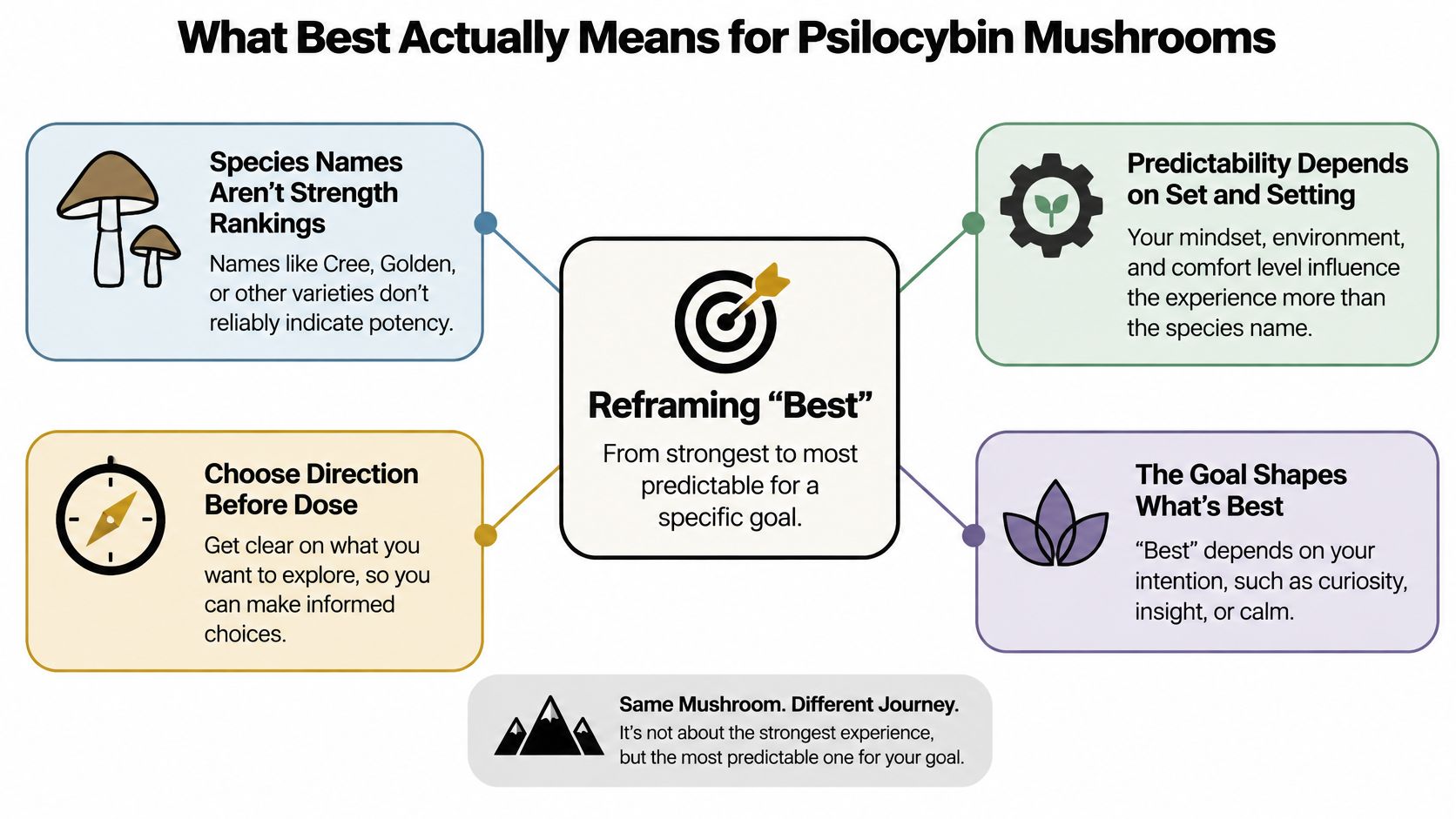
Best should mean the most manageable uncertainty for your goal, not the highest advertised potency. Someone considering microdosing has different questions from someone seeking therapeutic support or recreational exploration. None of those questions gets answered by a label that says premium, intense, or extra strong.
The chemistry makes the problem concrete. In a peer-reviewed analysis of cultivated Psilocybe cubensis, mean combined psilocybin and psilocin content varied from approximately 0.66% to 1.54% by dry weight across batches, a more than twofold spread, while a nominal 3 g dried amount could contain roughly 19.8 to 46.2 mg of those compounds. Those are chemical-content estimates, not recommended amounts.
Choose a criterion before choosing a format
My buying criterion would be traceability first, convenience second, advertised strength last. A batch-specific laboratory report gives you something you can examine. A strain name gives you a category that still needs verification.
| Reader goal | Most useful comparison | Weak substitute |
|---|---|---|
| Microdosing | Verified content in each unit | A microdose label without an assay |
| Therapeutic support | Qualified screening and structured care | A product described as therapeutic |
| Recreational exploration | Known composition and a support plan | A strongest-strain ranking |
| Comparing formats | Equivalent chemical-content information | Comparing mushroom weight alone |
Notice what isn't in that table: a universal winning mushroom. Raw material, capsules, gummies, and chocolates need different questions because their labels describe different things.
Predictable chemistry isn't a predictable experience
A laboratory can characterize a sample. It can't certify that you'll feel calm, gain insight, or have an enjoyable session. Treat your mindset, surroundings, available support, and reason for considering use as separate decision criteria.
Practical rule: If the only meaningful distinction between products is the strain name, you don't yet have enough information to make a chemistry-based comparison.
For curiosity, ask what uncertainty you're willing to accept. For emotional or therapeutic goals, ask whether professional care would better address what you're seeking. For routine use, don't mistake convenient packaging for evidence that a routine is beneficial.
The best decision may be a well-documented option. It may also be postponing use because the evidence, setting, or personal circumstances aren't adequate.
Common Psilocybin Species and Their General Profiles
Separate species identity from cultivar or strain labeling before comparing anything else. Psilocybe cubensis is a species designation. Names such as Cree and Golden Teacher belong to a different level of product description and shouldn't be treated as separate species or standardized effect categories.
You may encounter P. cubensis, P. semilanceata, P. cyanescens, P. azurescens, and P. zapotecorum in species guides or product descriptions. My recommendation is to use those names to organize questions about identity, not to choose an amount or predict a psychological outcome.
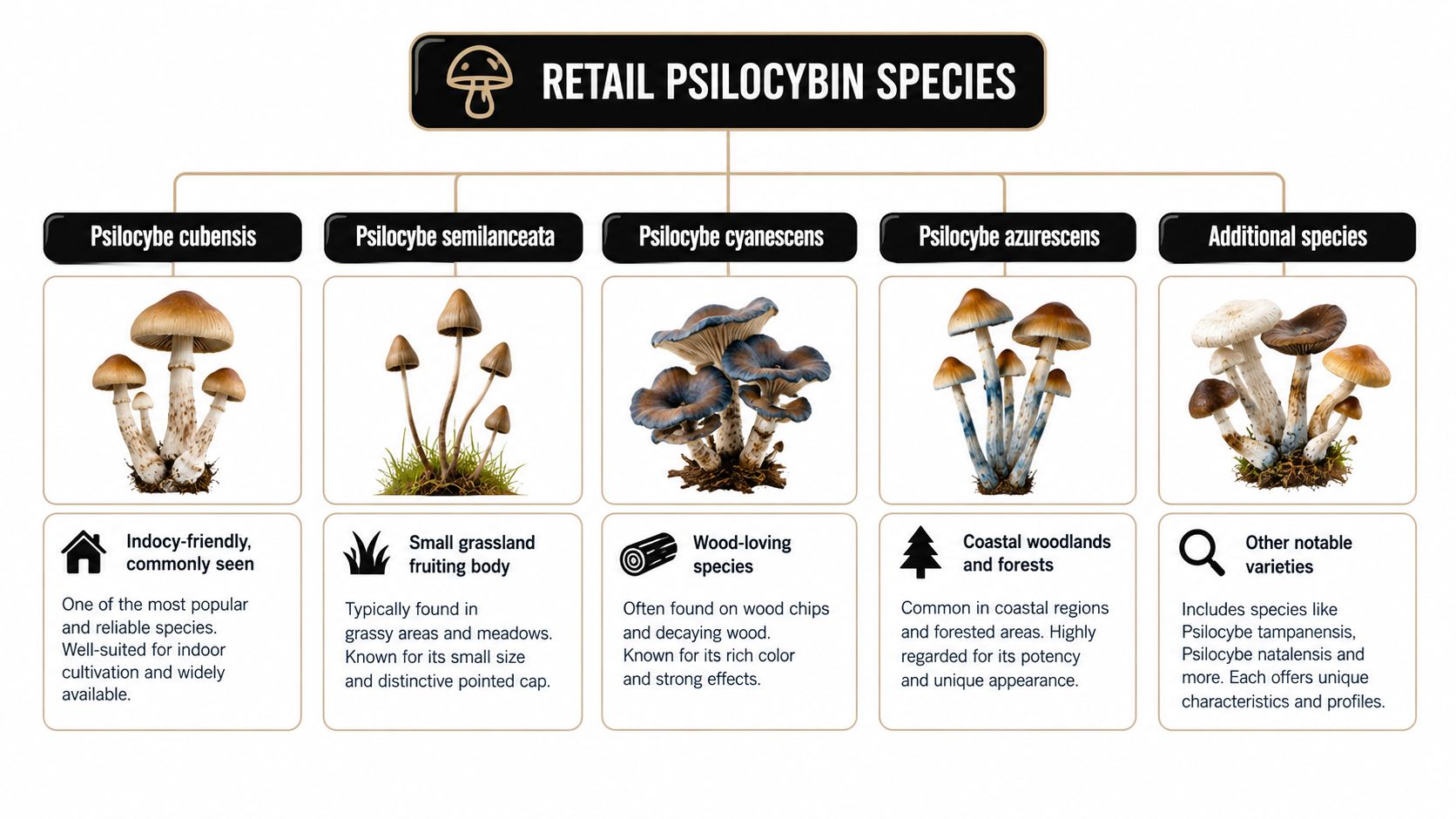
What the published ranking actually means
In published reference-material research comparing species, average psilocybin levels ranked highest in P. zapotecorum, followed by P. azurescens*, P. cyanescens, P. natalensis, and *P. subaeruginosa, with P. stuntzii lowest among the tested species; concentrations also generally decreased as mushrooms matured. The work also identifies developmental and handling considerations that complicate direct product comparisons.
Read that as a description of the tested material. It isn't a permanent leaderboard for every harvest, producer, or package. It also concerns average psilocybin concentration, which isn't interchangeable with every possible measure of total alkaloid content.
- For P. cubensis: Look for documentation tied to the cultivated batch rather than relying on its named variety.
- For P. azurescens or P. cyanescens: Don't turn a high-potency reputation into a serving assumption.
- For P. zapotecorum: A leading average in the cited dataset doesn't make it the best choice for every goal.
- For P. semilanceata: Don't assign it a numerical position from a ranking that doesn't establish one for it.
Keep identification separate from potency
A guide to types of Psilocybe can help you understand naming and compare descriptions. It shouldn't replace verified identity information for the actual material under consideration.
Don't use this overview or the accompanying illustration to identify wild mushrooms for consumption. A product-evaluation guide isn't a field-identification method.
My species-level recommendation is deliberately unglamorous: choose documentation over rarity. An unfamiliar species with dramatic marketing deserves more scrutiny, not automatic preference. If a supplier can't explain what was identified, what was tested, and how that sample relates to the package, the scientific name alone doesn't resolve the uncertainty.
Comparing Raw, Capsules, Gummies, and Chocolates
Format changes how you handle and interpret a product. It doesn't remove the need to know its contents. I wouldn't assume that raw mushrooms are more authentic, that capsules are precise, or that a professionally wrapped chocolate has been professionally tested.
Dose control begins with quantified chemistry, not a tidy shape. A capsule can contain a measured fill weight without having a verified alkaloid amount. Likewise, dividing a chocolate into equal-looking pieces doesn't establish equal active content.
Format Comparison at a Glance
| Format | Dose Control | Discretion | Onset | Best For |
|---|---|---|---|---|
| Dried mushrooms | Requires weight and batch-content information | Recognizable mushroom material | Don't infer from species name | Evaluating minimally formulated material |
| Capsules | Depends on verified content per capsule | Compact, supplement-style presentation | Don't assume faster or slower without evidence | Convenient unit handling |
| Gummies | Depends on per-piece testing and distribution | Resembles ordinary candy | Don't infer from texture or flavor | Pre-portioned handling with verified composition |
| Chocolates | Depends on tested serving distribution | Resembles ordinary confectionery | Don't assume a predictable schedule | Clearly divided servings with supporting assays |
Dried material is comparatively straightforward to describe, but weighing it answers only the mass question. It doesn't establish how much psilocybin or psilocin that mass contains. Buyers should also distinguish dried weight from fresh weight rather than treating them as equivalent labels.
Capsules remove some handling steps. That can be useful, but the capsule shell isn't evidence of uniformity. Ask whether testing describes the finished capsule or only a bulk ingredient used before filling.
Edibles need finished-product evidence
For gummies and chocolates, request information about the finished serving, not just the mushrooms that went into production. Formulation and homogenization matter when a manufacturer claims that each piece delivers consistent content. Without a per-serving assay, uniform appearance is a weak basis for that claim.
A neat square, capsule, or gummy is a packaging unit. It becomes an informative serving unit only when the supporting chemistry is clear.
For portability, consider practical handling rather than assuming one format is universally superior. Read storage instructions, inspect packaging, and ask whether the stated stability information applies to the finished product. Don't invent a shelf life from the format alone.
Discretion also has a downside: candy-like products need unmistakable labeling and secure storage away from children, pets, and anyone who might mistake them for ordinary food. Keep them in their original packaging.
My format recommendation is conditional: prefer the option with the clearest finished-product information. If the raw material has meaningful documentation and the edible doesn't, the edible's convenience isn't a quality advantage.
Matching Product Type to Your Goal
Start with what you're trying to accomplish, then decide whether a product is an appropriate tool at all. A label promising focus, healing, or a social experience doesn't establish that the product will deliver it.
The strain-comparison evidence doesn't justify assigning emotional personalities to names. A laboratory study published in 2024 comparing five named P. cubensis strains reported combined psilocybin and psilocin concentrations ranging from 0.85% to 1.45% by dry weight, with reported values of 1.36% for Cree, 1.221% for Blueie, 1.134% for Texas Yellow, and 0.879% for Thai. Those findings characterize tested samples, not guaranteed specifications for products carrying those names.
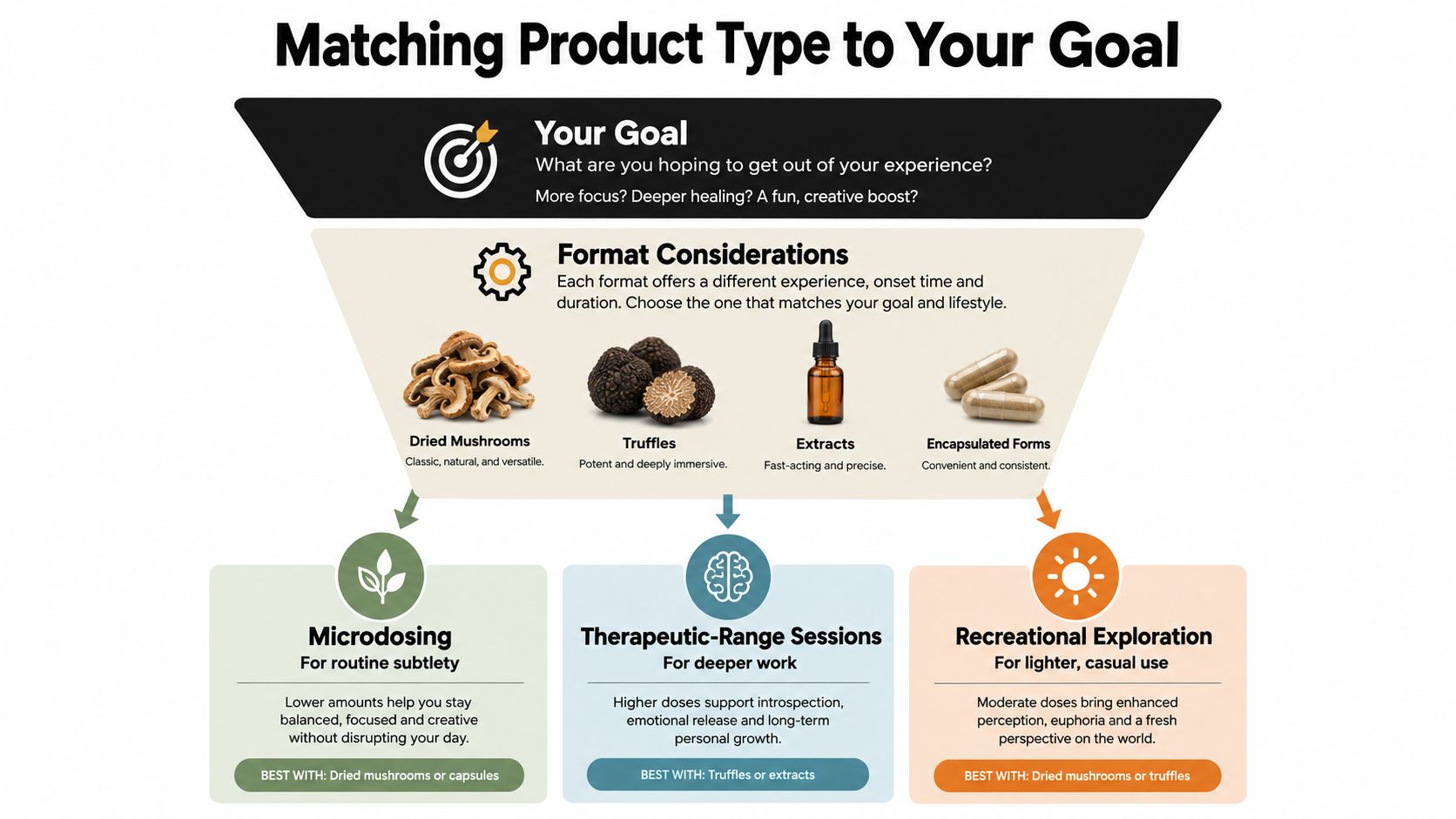
Microdosing and routine use
For someone evaluating microdosing, pre-portioned capsules or gummies are a handling convenience, not proof of benefit or a validated schedule. Compare verified content per unit, complete ingredients, and whether the label distinguishes mushroom mass from active-compound content.
I wouldn't recommend a daily, alternating-day, or other recurring regimen from the evidence discussed here. Nor would I choose a product just because its seller calls it a microdose.
Your concrete starting point is documentation: establish what each unit contains, then discuss the intended routine and medication considerations with a qualified clinician. Don't let an easy-to-follow calendar substitute for that conversation.
Therapeutic goals require a care decision
If you're seeking help with depression, distress, trauma, or another health concern, choose a clinical assessment before choosing a format. A labeled edible isn't a substitute for screening, preparation, professional support, or follow-up.
A systematic review of therapeutic psilocybin research discusses improvements observed within structured therapeutic research and follow-up. That evidence doesn't establish that an ordinary retail product reproduces those outcomes.
Don't select a chocolate or capsule for self-directed treatment because its packaging uses therapeutic language. The starting point is a conversation about care, not a stronger serving.
Recreational exploration isn't a strength contest
For recreational curiosity, don't equate greater immersion with a better result. A product that encourages you to chase maximum intensity isn't helping you assess your boundaries.
- Define your limits: Decide what would make you postpone, stop, or seek help.
- Arrange support: Identify a trusted sober person and a calm setting before considering use.
- Reject effect guarantees: Don't choose Cree for promised insight or Thai for promised relaxation without evidence supporting those claims.
My recommendation across goals is to avoid choosing dose or frequency from product identity. Different intentions require different safeguards, not just different packaging.
Reading Potency, Lab Reports, and Product Labels
A certificate of analysis, often shortened to COA, should help you connect a result to a specific product. A screenshot of a laboratory logo isn't enough. Neither is a report for an ingredient that can't be connected to the finished package.
Start by matching the product name, sample lot or batch number, and test date. Then identify what the laboratory measured and how the result is expressed. Percent dry weight, content per capsule, and content per edible serving answer different questions.
Common Named Strains and Reported Alkaloid Ranges
| Strain | Reported Range (% dry weight) | Notes |
|---|---|---|
| Cree | No general commercial range established here | The earlier comparison reports a study-specific value |
| Blueie | No general commercial range established here | Don't apply a tested sample's result to unrelated batches |
| Texas Yellow | No general commercial range established here | Request the actual package's batch report |
| Thai | No general commercial range established here | A study ranking isn't a permanent strength category |
| Golden Teacher | No verified range established here | Familiarity doesn't supply missing chemistry |
A table of supposedly typical ranges would look useful, but the evidence doesn't support assigning a dependable commercial range to each name. Sample results aren't product standards. Use the earlier comparison to understand why testing matters, not to fill in missing information on a label.
Read the report as a chain of evidence
Ask the supplier to walk you through these details:
- Identity: What material was identified, and does that identity match the product?
- Quantified compounds: Are psilocybin and psilocin reported separately, together, or both?
- Units and basis: Is the result for dried material, an extract, or a finished serving?
- Analytical method: Does the report identify the method used?
- Contaminant scope: What screening was performed, including relevant heavy-metal, microbial, and processing-related concerns?
- Traceability: Can the supplier connect the tested sample to the lot being offered?
For formulated products, ask whether residual-solvent testing is relevant to the extraction or manufacturing process. Don't assume every product requires the same panel, or that a generic pass statement tells you what was examined.
A guide to third-party laboratory testing can help frame these questions. Still, judge the actual report rather than treating the phrase third-party tested as a complete answer.
Before checkout, ask the supplier to explain any percentage-to-milligram conversion in the units used on the package. Don't accept a mushroom-weight claim as though it were an active-compound measurement.
Checkout test: If the supplier can't explain how the laboratory result connects to your labeled serving, leave that uncertainty unresolved rather than guessing.
Dose Bands, Onset, and Duration in Practice
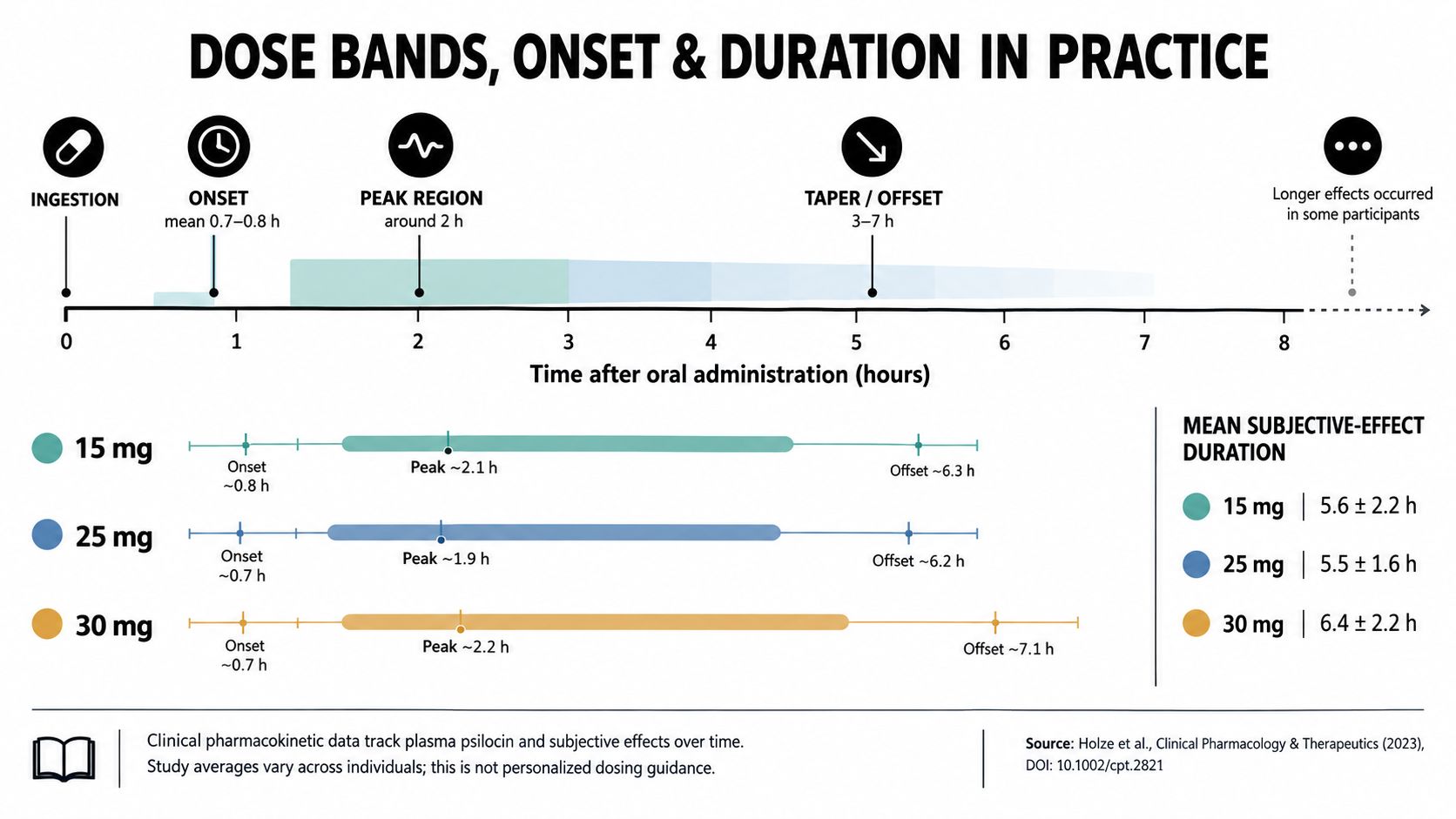
Research doses are reference points, not a personalized dosing ladder. Don't translate a clinical psilocybin amount directly into a quantity of an unverified mushroom product. Likewise, don't treat a combined psilocybin-plus-psilocin result as automatically interchangeable with a study using measured oral psilocybin.
In a pharmacokinetic study of oral psilocybin, mean subjective-effect duration was 5.6 hours at 15 mg, 5.5 hours at 25 mg, and 6.4 hours at 30 mg; the proportion reporting maximum-rated effects rose from 58% to 73% to 80%, respectively. Those group averages describe the study, not a timetable or intensity guarantee for an individual.
Use dose categories cautiously
Terms such as microdose, perceptual dose, and full immersion sound more standardized than product labeling often makes them. Treat them as descriptions of intended intensity, not verified chemical categories.
I wouldn't build a body-weight calculator or experience-based escalation plan from these findings. The cited results don't establish a personalized formula, and prior familiarity doesn't verify a new product's contents.
- For subtle-effect claims: Ask what quantified amount the label means.
- For perceptual-effect claims: Don't assume the advertised boundary will match your response.
- For immersive-effect claims: Recognize that stronger isn't a separate quality certification.
Don't make decisions against a countdown
The duration findings don't establish a universal onset time, peak window, or edible-versus-capsule schedule. Avoid treating an infographic, seller description, or someone else's experience as a precise clock.
My practical recommendation is not to add more because effects haven't arrived on an expected schedule. Don't stack products or mix formats to chase a target intensity.
Protect the surrounding time as well. Don't schedule driving, caregiving, work, or other safety-sensitive responsibilities around an average duration figure. Arrange support and allow for uncertainty rather than planning to become fully functional at a calculated deadline.
If your goal requires a reliably brief or tightly controllable experience, that requirement is a reason to reconsider use. A format choice can't provide control that the evidence doesn't establish.
Safety, Risk Profile, and Sourcing Decisions
Natural doesn't mean risk-free. A systematic review and meta-analysis of six randomized, double-blind trials involving 528 patients found that headache, nausea, anxiety, dizziness, and blood-pressure fluctuations occurred significantly more often after therapeutic psilocybin than after comparator treatments. These were controlled clinical trials, not evaluations of unsupervised retail use.
Don't turn clinical monitoring into reassurance about an unmonitored setting. A tested product can still be inappropriate for a particular person.
Make the personal decision before the supplier decision
My recommendation is to seek professional advice before considering use if you have a significant mental-health history, cardiovascular concerns, pregnancy-related questions, or take medications. Bring the full medication and supplement list. Don't stop prescribed treatment to accommodate a mushroom product.
Use a psilocybin risk overview to prepare questions, not to clear yourself medically. If you're currently distressed, feel pressured, or can't arrange reliable support, postpone.
- Personal readiness: Have you discussed relevant health and medication concerns with a qualified professional?
- Product evidence: Can you connect identity, chemistry, and serving information to the package?
- Support: Does a trusted sober person know the plan and how to get help?
- Emergency planning: Is there a clear route to urgent medical assistance if severe or alarming symptoms occur?
Separate service features from safety evidence
Age verification, discreet packaging, tracking, and clear shipping options are reasonable service criteria. They don't establish chemical quality. Neither do customer reviews or a polished educational blog.
Ask whether the supplier answers substantive questions without promising healing or dismissing adverse reactions. Look for clear storage instructions, identifiable packaging, accessible customer support, and honest explanations of testing limits.
The strongest sourcing decision isn't choosing the seller with the loudest claims. It's declining to proceed when personal suitability or product documentation remains unclear. Predictability is a risk-management goal, not a guarantee of safety.
The Magic Mushroom Delivery offers raw mushrooms, capsules, gummies, chocolates, and educational resources about mushroom products. Visit its educational pages to compare format descriptions and prepare questions about batch testing, ingredients, and serving information before making any decision.