
You're looking at a small bottle of mushroom capsules online, trying to decide whether it belongs beside your vitamins or needs more serious consideration. The packaging looks familiar. The ingredients and their effects may not be.
If you're searching for mushroom capsules side effects, start with what's inside, not the capsule count. Psilocybin, lion's mane, reishi, and Amanita products don't share one safety profile. My recommendation is straightforward: identify the product, check your medications, and verify the testing before deciding whether to take it.
Why Capsule Form Changes the Risk Equation
A first-time buyer might choose capsules because they look easier to manage than loose mushrooms. There's no preparation, no obvious mushroom taste, and no need to handle unfamiliar material. That convenience is useful, but it can also encourage an assumption that the manufacturer has already settled every safety question.
A capsule is a delivery format, not a safety grade. You can't inspect its contents the way you could examine an intact mushroom. Even an accurate weight on the label doesn't necessarily tell you how much active compound you're swallowing.
Weight isn't the same as potency
For psilocybin products, labeled mushroom mass doesn't necessarily indicate psilocybin content, and delayed gastrointestinal absorption can encourage premature redosing, a concern discussed in the clinical review and meta-analysis of acute psilocybin adverse effects. Don't interpret a quiet beginning as proof that a capsule is weak.
Suppose you take a capsule, notice little change, and decide another must be reasonable. That decision adds more uncertain material before you've established the effect of the original serving. The conservative response is to avoid chasing an effect through repeated dosing, not to guess at what your body has absorbed.
Practical rule: If you can't establish the active ingredient and its amount, don't try to solve the uncertainty by taking more.
Convenience needs boundaries
I'd also challenge the idea that discreet packaging makes a product appropriate for an ordinary workday or an unfamiliar social setting. Ease of swallowing isn't evidence that you can safely carry on with normal responsibilities. Decide what the product is before deciding where it fits into your routine.
Keep these categories separate:
- Psilocybin capsules require attention to psychoactive effects, cardiovascular stress, and medication compatibility.
- Functional mushroom supplements need species-specific assessment rather than a psychedelic side-effect checklist.
- Amanita-containing products require a separate safety assessment and shouldn't be treated as interchangeable with either category.
That distinction matters more than whether the bottle looks professional, minimalist, or reassuringly botanical.
What Lives Inside a Mushroom Capsule
Read the ingredient panel before reading the marketing promises. A phrase such as “mushroom blend” doesn't give you enough information to assess risk. You need to know which mushroom family you're dealing with and whether the label identifies every active ingredient.
Psilocybin products, functional supplements, and Amanita products are different categories. Their intended uses don't establish their safety, and a wellness-style presentation doesn't erase a psychoactive ingredient.
Three Mushroom Capsule Families at a Glance
| Capsule Family | Typical Active Compounds | Intended Use | Most Common Adverse Effects |
|---|---|---|---|
| Psilocybin-bearing mushrooms | Psilocybin and related constituents | Psychedelic experiences; investigated in supervised therapeutic settings | Headache, nausea, anxiety, dizziness, temporary blood-pressure changes |
| Functional mushrooms, including lion's mane and reishi | Species-specific mushroom constituents and concentrated extracts | Marketed for wellness support | Digestive upset or intolerance; risks differ by species |
| Amanita-containing products | Amanita constituents, which aren't interchangeable with psilocybin | Marketed for psychoactive effects | Reported effects include nausea, vomiting, sleepiness, and confusion; reliable “most common” rates aren't established here |
The adverse-effect evidence needs the same separation. The psilocybin trial findings discussed below don't describe lion's mane supplements, and reassuring lion's mane findings don't establish the safety of an Amanita blend.
Don't normalize severe Amanita reactions
The FDA's scientific memorandum on Amanita muscaria described 58 illness reports linked to recalled mushroom products as of July 9, 2024, including 30 hospitalizations and one potentially associated death under investigation. These reports concerned recalled products, not proof that Amanita alone caused every illness.
Reported symptoms included seizures, loss of consciousness, confusion, agitation, abnormal heart rates, blood-pressure changes, nausea, and vomiting. The FDA concluded that the available information was inadequate to demonstrate safe food use and that the mushroom and its known constituents could be harmful.
- Ask the retailer whether the product contains psilocybin, Amanita ingredients, functional mushrooms, or a combination.
- Ask the pharmacist to assess the actual ingredient list, not merely the phrase “mushroom supplement.”
- Decline an unclear product rather than accepting branding as an answer.
Short-Term Side Effects You Are Most Likely to Notice
With psilocybin, the reactions people want to understand are headache, nausea, anxiety, dizziness, and temporary blood-pressure changes. They can be short-lived, but common doesn't mean irrelevant, especially when symptoms interfere with communication, movement, or your ability to stay safe.
A meta-analysis described in the review of clinical psilocybin safety findings included six randomized trials involving 528 participants and reported headache in 2%–66%, nausea in 4%–48%, and anxiety in 4%–26% after dosing. Those wide ranges are more useful than pretending there's one dependable percentage for everyone.
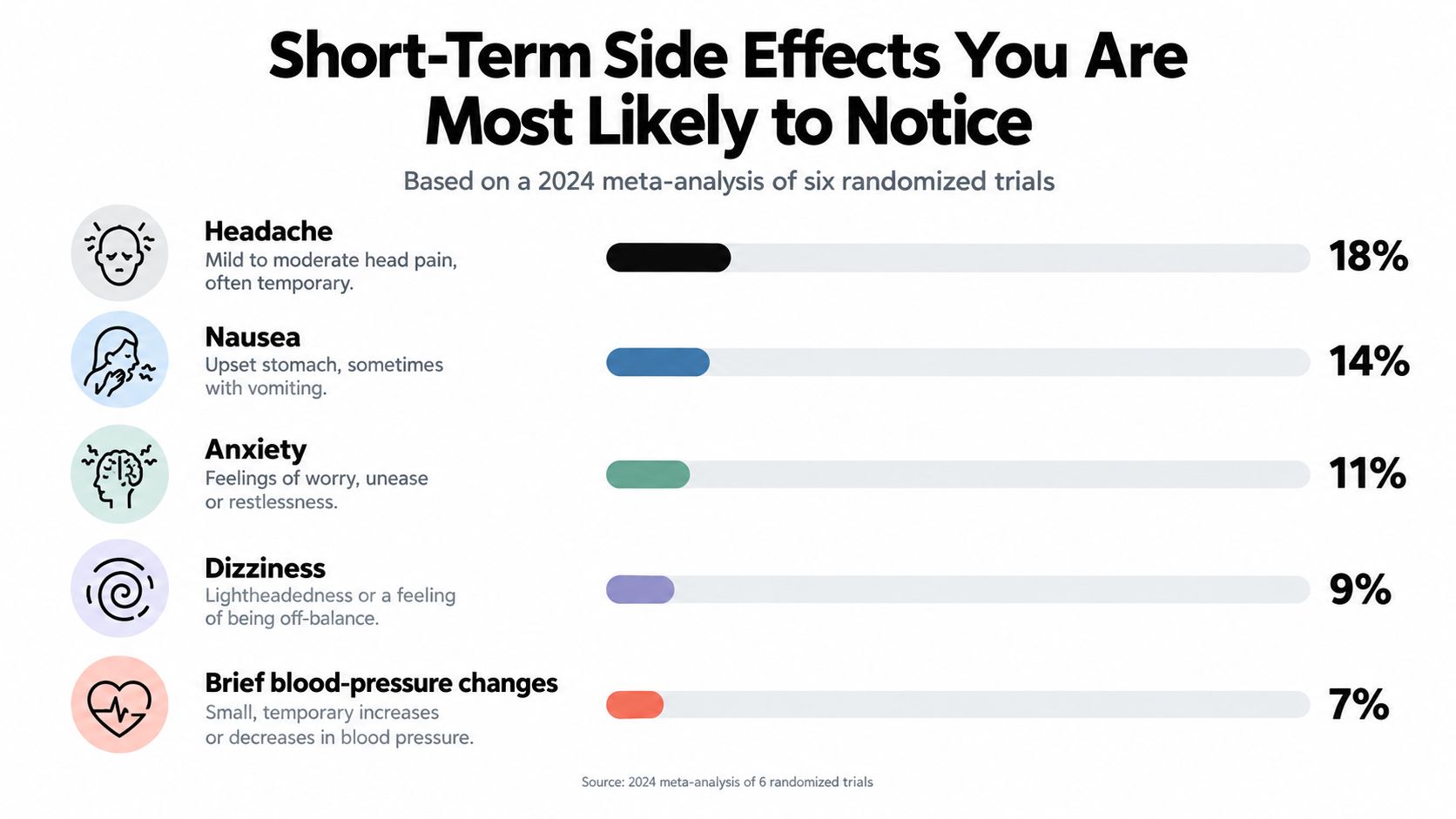
Use the cited ranges above, not the graphic's fixed percentages, when interpreting frequency. The available evidence doesn't establish a single universal rate for each symptom.
Judge the direction of symptoms
Don't make a decision from the symptom name alone. A mild headache and a headache accompanied by severe confusion are not the same situation. Likewise, feeling anxious while remaining oriented differs from escalating agitation that makes someone unsafe.
A conservative observation checklist looks like this:
- Mild and settling means the person remains responsive, can explain what they're experiencing, and isn't developing additional concerning symptoms.
- Getting worse means symptoms intensify, interfere with basic functioning, or stop resembling the expected reaction to the identified product.
- Unexpected effects deserve particular attention when a supposedly non-psychoactive capsule produces hallucinations or marked sedation.
For mild discomfort without warning signs, stop taking the product, reduce stimulation, and have someone stay available. Don't add another substance to counteract an unpleasant effect.
Trial results aren't retail guarantees
The figures above come from measured dosing in screened, monitored research participants. They aren't direct estimates for a retail bottle with uncertain potency, different added ingredients, or an unverified species.
My advice is to treat a familiar symptom as information, not permission to ignore it. The course of the reaction matters more than whether nausea or anxiety appears on a common-side-effects list.
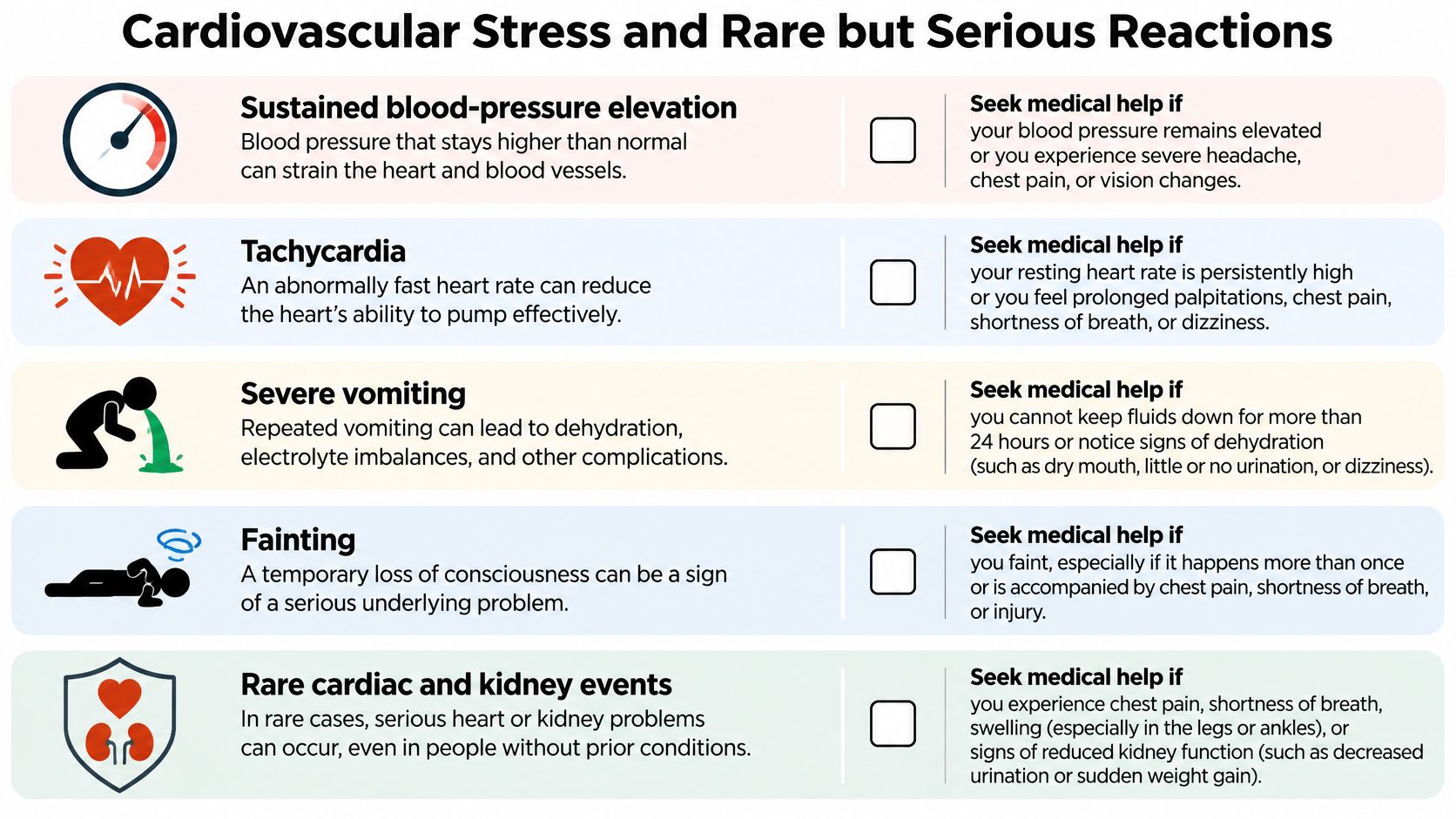
Cardiovascular Stress and Rare but Serious Reactions
A fast heartbeat or lightheadedness can be easy to dismiss during an intense experience. That's exactly why you need a plan before taking a psychoactive capsule. You shouldn't have to decide, while distressed, whether chest discomfort is “just part of it.”
In a treatment-resistant-depression trial, clinically important out-of-range vital-sign changes occurred in 19% of participants receiving 25 mg and 32% receiving 10 mg, as summarized in the clinical discussion of physiological adverse effects. Those findings don't establish a simple dose-response rule. They show why monitored vital signs and individual screening matter.
Put rare events in the right context
The review covering mushroom exposure surveillance and serious reported reactions reports 7,215 single-substance mushroom exposures overall in 2023, including 1,510 involving psilocybin or psilocin mushrooms. Exposure reports aren't a count of all users, so they can't tell you the probability that an individual will experience harm.
That same evidence summary includes rare published cases of cardiac dysrhythmia and myocardial infarction in an 18-year-old, and rhabdomyolysis with acute kidney injury in a 25-year-old. These are case reports, not typical outcomes, but they undermine the assumption that youth or a “natural” product guarantees protection.
You don't need to identify the exact complication before getting medical help. Serious symptoms are enough.
Recognize the point where observation stops
Treat the following as reasons for urgent evaluation rather than a home-management challenge:
- Chest pain or fainting, particularly with an abnormal heartbeat or marked weakness.
- Sustained blood-pressure elevation, especially with distressing physical symptoms.
- Persistent or severe vomiting, rather than brief nausea that is settling.
- Severe agitation or neurological deterioration, including inability to communicate normally or loss of coordination.
People with uncontrolled hypertension, significant cardiovascular disease, or a history of severe panic reactions shouldn't use psilocybin without professional assessment. A sober companion can help recognize deterioration, but companionship isn't medical monitoring.
When seeking care, bring the bottle or a photograph of its label. Tell clinicians what was taken, what else was used, and when symptoms began. Accurate information is more useful than trying to minimize an embarrassing detail.
How to Read the Label Before You Trust the Capsule
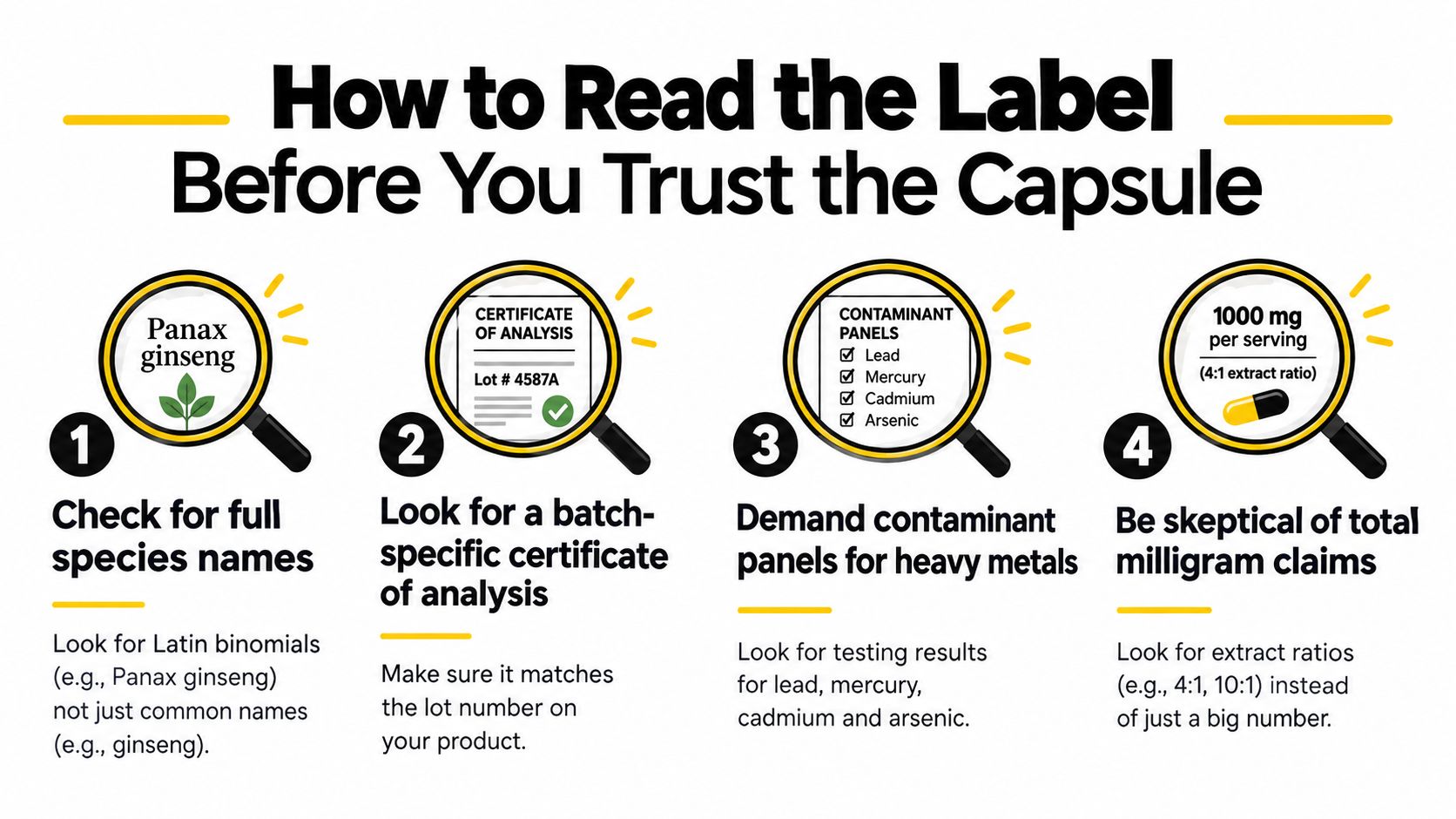
A label should help you answer a practical question: What evidence connects this bottle to the ingredients and testing the seller describes? Attractive packaging, organic language, and a large milligram figure don't answer it.
Use a buyer's checklist rather than judging the product by how reassuring its description sounds.
Ask for evidence tied to your bottle
- Identify the species. Look for full species names, not just “mushroom complex.” Ask the seller to resolve any mismatch between the product page and the bottle.
- Match the batch. Request a batch-specific certificate of analysis and check that its lot identifier matches the product you're considering.
- Read the tested categories. Look for identity, active-constituent information where relevant, and contaminant screening. A document showing only one favorable result isn't a complete safety assessment.
- Clarify the formulation. Check extract ratios, added ingredients, and whether the stated amount describes mushroom material, extract, or a measured active constituent.
For a practical reference when requesting documents, consult this third-party lab-testing guide. Use it to prepare questions, not as a substitute for the actual report attached to your batch.
Natural doesn't mean verified
Reporting on mushroom supplement quality and independent testing describes mushrooms' ability to accumulate arsenic, cadmium, mercury, and lead from contaminated growing environments, alongside species-label discrepancies in commercial supplements. These concerns are reasons to demand relevant testing, not evidence that every mushroom product is contaminated.
Buying standard: If the seller can't explain the species, formulation, and batch results clearly, leave the product unpurchased.
A certificate also has limits. It doesn't establish that the capsule is appropriate for your medications or medical history. Product verification and personal screening answer different questions, and you need both.
Functional Mushroom Capsules and Their Specific Risks
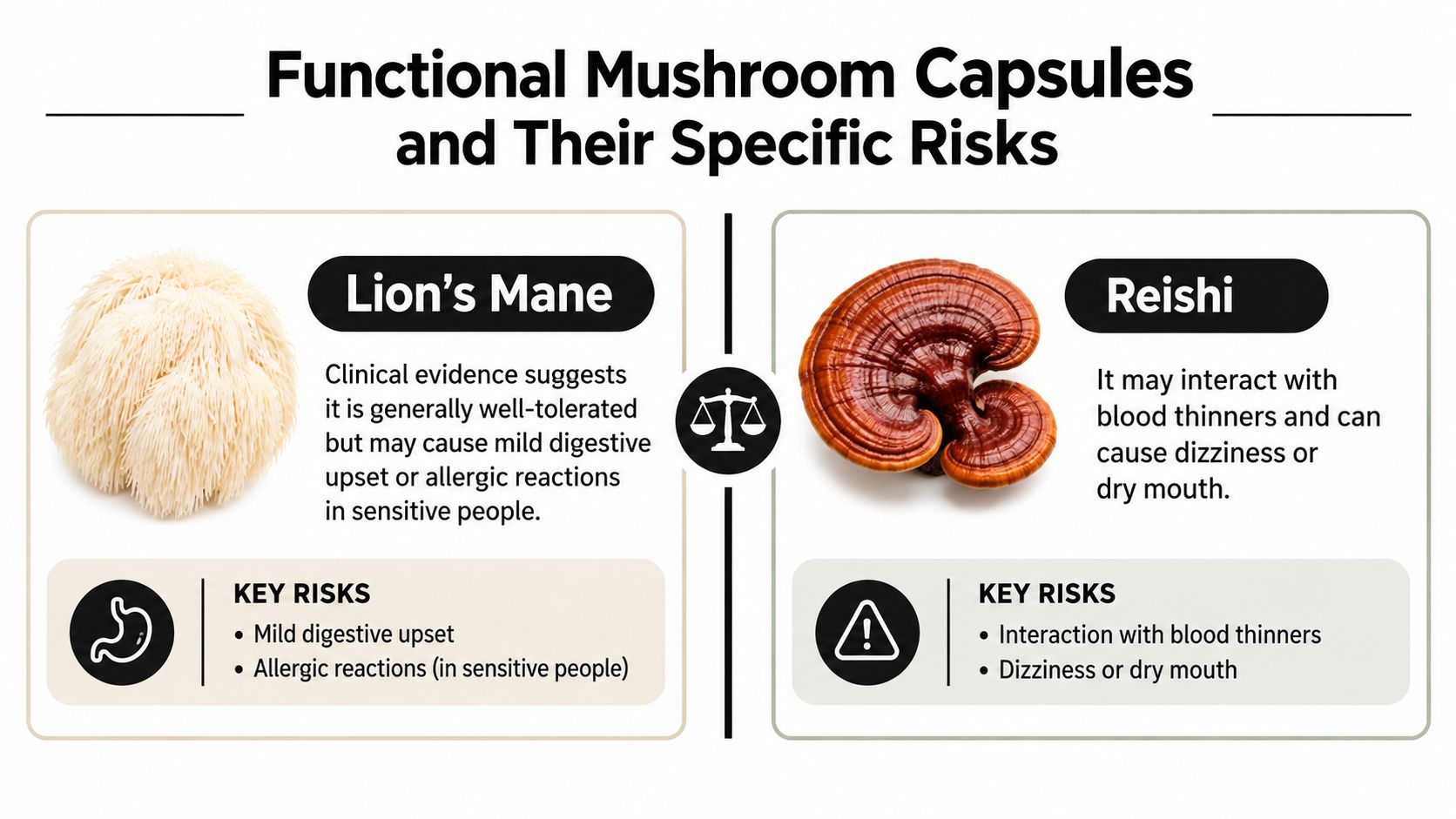
Lion's mane and reishi often appear beside each other in wellness stores, but their safety evidence shouldn't be blended together. Evaluate the specific mushroom and formulation rather than assuming all functional products are equally gentle.
Unlike a psilocybin capsule, a functional supplement should not be assessed primarily by whether you can manage a psychedelic experience. Your attention belongs on tolerability, new symptoms, underlying illness, and the ingredients listed.
Lion's mane has reassuring but limited evidence
The NIH LiverTox review of lion's mane describes generally good tolerability, with abdominal discomfort, nausea, or diarrhea in fewer than 10% of participants in prolonged-treatment trials. It reports no documented clinically apparent liver injury attributed to lion's mane and no meaningful association with elevated liver enzymes.
That's reassuring, but it isn't proof that every formulation is harmless. Large prospective safety trials remain lacking, and a capsule with additional ingredients isn't identical to the product examined in a trial.
Reishi deserves a different warning
The NIH LiverTox review of reishi documents rare clinically apparent liver injury, usually beginning after 1–2 months, with reported severity ranging from mild enzyme elevations to hepatic failure. Symptoms have included fatigue, nausea, abdominal pain, poor appetite, dark urine, and jaundice.
Don't keep taking reishi through persistent symptoms because you expect a supplement to require an adjustment period. Stop the product and seek medical evaluation if those warning signs appear.
- With lion's mane, take recurring digestive symptoms seriously instead of assuming you must push through them.
- With reishi, pay particular attention to unusual fatigue, dark urine, or yellowing of the eyes or skin.
- With either, review the full formulation and medication list with a clinician rather than relying on broad wellness claims.
If you're reviewing organic reishi mushroom capsules, apply those same checks. The word “organic” doesn't change the species-specific safety questions.
Medications and Substances That Change the Calculation
“I take a prescription, but it's only a mushroom capsule” is not a usable interaction assessment. The relevant questions are which mushroom, which active compounds, which medication, and what other substances are involved.
Lithium deserves particular caution. A review of 62 reports involving lithium and psychedelics found seizures in 47% and distressing psychedelic experiences in 18%, according to the clinical review of psychedelic medication interactions. These were self-reports, not a representative sample, so those percentages aren't population-level risk estimates.
Avoid blanket antidepressant advice
SSRIs require a more nuanced discussion. The interaction evidence is mixed, and concurrent use may reduce or alter psilocybin effects rather than uniformly increase toxicity.
That doesn't make compensating with additional capsules sensible. Nor does it justify stopping a prescribed antidepressant on your own to pursue a stronger effect.
Bring a complete list for professional review:
- Psychiatric medications, including lithium, SSRIs, other antidepressants, antipsychotics, and MAOIs.
- Other relevant prescriptions, including stimulants and tramadol, plus anything your clinician identifies as lowering seizure threshold.
- Nonprescription substances, including alcohol, cannabis, benzodiazepines, and other psychoactive products.
Ask a question someone can answer
Instead of asking whether mushrooms are safe with prescriptions generally, bring the bottle and ask your pharmacist to review this exact formulation against your medication list and health history. Include occasional medicines and substances, not just daily prescriptions.
You can use a psilocybin drug-interaction guide to prepare that conversation. Don't use an online compatibility list as clearance to proceed.
My recommendation is conservative: don't combine a psychoactive capsule with other psychoactive substances or potentially interacting medicines without qualified medical advice. Professional screening is more useful than comparing your situation with an anonymous account from someone taking a different product.
Practical Ways to Reduce and Manage Adverse Effects
The most useful safety routine starts before the bottle is opened. The FDA's dietary supplement safety guidance warns that supplements can cause bad reactions or unexpected symptoms and generally aren't approved for safety or effectiveness before reaching the market.
Retail availability isn't medical clearance. Neither is a friend's uneventful experience.
Make a conservative plan
If you choose to use a product after appropriate screening, agree on the lowest appropriate amount with a qualified professional rather than translating a marketing serving into a safety recommendation. If the active content can't be established, postponing use is the safer choice.
For a first psilocybin experience, I recommend a calm setting and a trusted sober adult who knows what was taken. Don't drive, operate machinery, or make the companion responsible for treating a medical emergency.
Keep this checklist available:
- Before use, confirm product identity, batch documentation, and medication review.
- During use, don't add capsules to chase an effect or combine substances to change an uncomfortable reaction.
- For mild symptoms, stop further use, reduce stimulation, and monitor whether the person is improving.
- For persistent digestive symptoms or unusual fatigue, contact a clinician rather than repeatedly restarting the supplement.
- For chest pain, fainting, severe agitation, persistent vomiting, seizures, trouble breathing, or loss of consciousness, seek emergency care rather than waiting.
Give responders useful information
Keep the packaging and record what was taken, when it was taken, and any other substances involved. If you contact a clinician, poison-control service, or emergency responder, share those details plainly.
Your goal isn't to prove you can tolerate a capsule. It's to make a decision with enough information, recognize when something is wrong, and get help without delay.
The Magic Mushroom Delivery offers psilocybin and functional mushroom products alongside educational resources on effects and responsible use. Visit to compare clearly identified product categories and prepare questions about ingredients, batch testing, and medication compatibility before deciding whether a capsule belongs in your routine.