
Raw oyster mushrooms provide approximately 33 kcal, 3.31 g protein, 2.3 g fiber and 0.41 g fat per 100 g. Roughly 89 g of that 100 g is water.
That water content changes how you should read almost every nutrition claim about them. A fresh mushroom, a dried mushroom powder and a cooked mushroom portion can have very different numbers without any of those numbers being wrong.
The useful question isn't just whether oyster mushrooms are nutritious. It's what was measured, on what weight basis, and under which growing or preparation conditions.
Oyster Mushroom Nutrition at a Glance
Three energy figures circulate for raw oyster mushrooms: 33 kcal, 31 kcal and 18.5 kcal per 100 g. They come from different datasets, so the first step is labeling which number belongs to which source.
For the macronutrient panel, the reference is the raw oyster mushroom nutrition entry: energy, water, protein, carbohydrate, fiber and fat all use its 33 kcal per 100 g basis. A cup of sliced raw mushrooms is treated as about 70 g, so serving values are calculated from that raw-weight entry rather than independently measured.
Energy values by dataset
| Dataset | Energy value |
|---|---|
| Raw oyster mushroom entry | 33 kcal per 100 g |
| 2014 summit summary | 31 kcal per 100 g |
| USDA FoodData Central-based composition analysis | 18.5 kcal per 100 g |
The summit value is an attribution correction: it belongs to a separate fresh-weight summary, not to the raw entry. The USDA-based analysis is lower still and is used only for the mineral rows, while 33 kcal governs calories, macronutrients and the calculated cup column.
Raw oyster mushroom nutrition per 100 g and per assumed cup
| Nutrient | Source dataset | Raw, 100 g | Raw, 1 cup sliced, assuming about 70 g | Cooked, 100 g, approximate |
|---|---|---|---|---|
| Energy | Raw entry | 33 kcal | 23 kcal | Requires a cooking-specific estimate |
| Water | Raw entry | 89.18 g | 62.43 g | Depends on moisture loss |
| Protein | Raw entry | 3.31 g | 2.3 g | More concentrated if water is lost |
| Carbohydrate | Raw entry | 6.1 g | 4.3 g | Depends on cooked yield |
| Dietary fiber | Raw entry | 2.3 g | 1.61 g | Depends on cooked yield |
| Total fat | Raw entry | 0.41 g | 0.29 g | Depends especially on added fat |
| Potassium | USDA-based analysis | 316 mg | 221.2 mg | Preparation-specific |
| Phosphorus | USDA-based analysis | 87.9 mg | 61.53 mg | Preparation-specific |
| Copper | USDA-based analysis | 0.31 mg | 0.22 mg | Preparation-specific |
This remains a composite reference, and batch-to-batch variation means two oyster mushroom packs may not match either dataset exactly. The labels matter more than the decimal places: fresh-weight values describe mushrooms as bought, dry-weight values describe solids after water removal, and cooked values need a yield and method.
Why the Cooked Column Needs Restraint
The cooked column is an estimate framework, not a measured nutrient panel. A defensible numerical estimate needs the starting weight, finished weight, cooking method and added ingredients.
Cooking can reduce water mass, leaving more mushroom solids in the same finished weight. It does not create extra protein, and oil changes the dish's fat and energy independently of the mushrooms.
Practical rule: Use the raw-weight column to compare ingredients and the calculated serving column to plan a portion. Use a preparation-specific entry for cooked food.
Why Protein Numbers Shift Between Fresh and Dry Weight
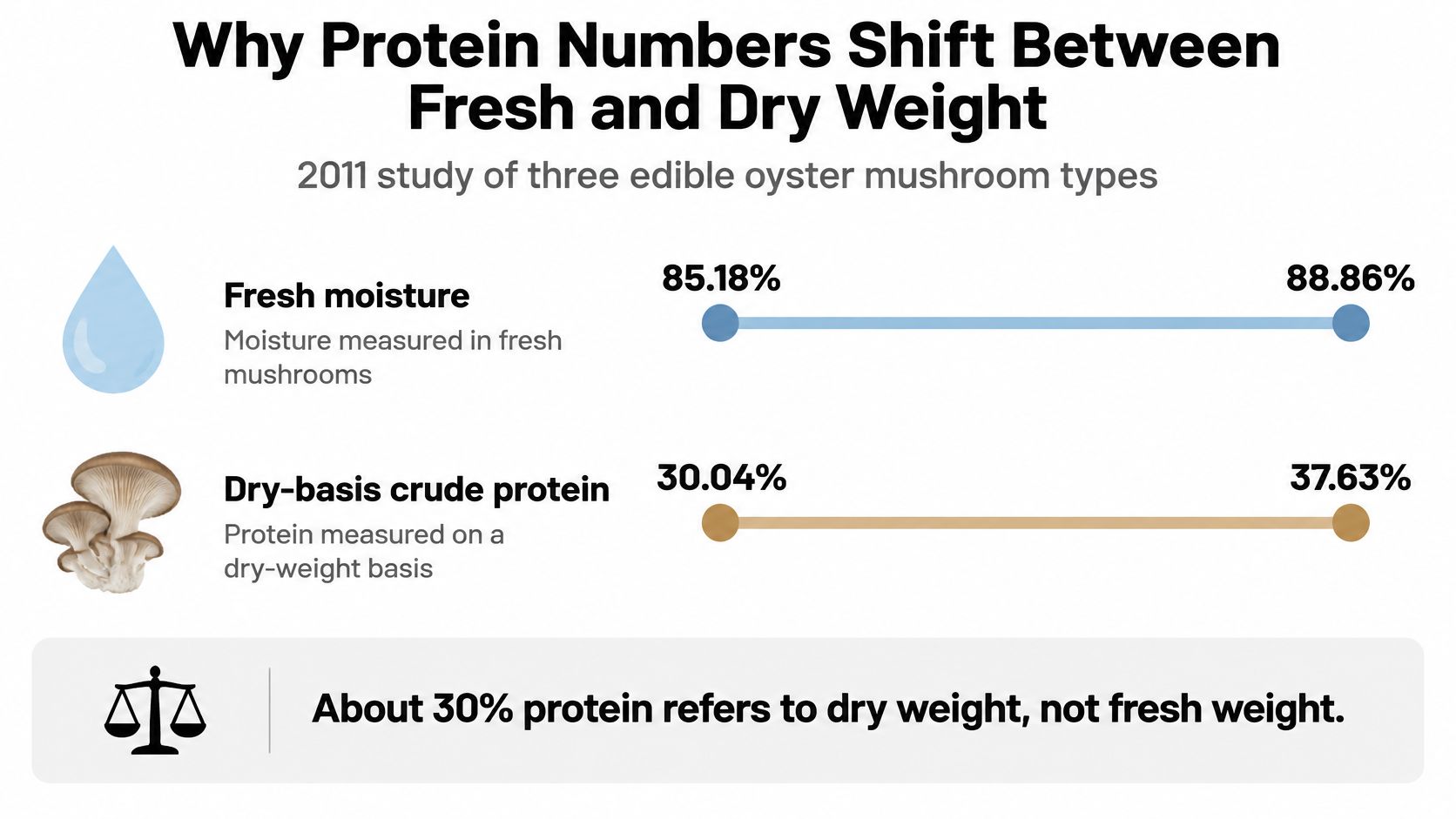
A claim that oyster mushrooms contain about 30% protein can be technically accurate and still mislead a grocery shopper. The missing words are often on a dry-weight basis.
A 2011 study of three edible oyster mushroom types reported 85.18% to 88.86% fresh moisture and 30.04% to 37.63% dry-basis crude protein. Those ranges describe different measurements, and their endpoints shouldn't be treated as paired samples.
The distinction is easier to see when the measurement bases are separated visually.
Fresh Weight and Dry Matter Aren't Interchangeable
The fresh-weight comparison below combines the earlier raw-food entry with the Mushrooms and Health Summit Proceedings nutrition summary, which reports 2.75 g protein, 0.33 g fat, 5.95 g carbohydrate and 2.10 g fiber per 100 g. The dry-basis protein range comes from the study identified above. That study does not publish dry-basis fat or fiber figures, so those cells stay blank rather than borrow numbers from an unnamed source.
Fresh-weight versus dry-weight oyster mushroom values
| Measure | Fresh weight, as bought | Dry weight, water removed |
|---|---|---|
| Moisture | 85.18% to 88.86% in the study | Not measured on a dry basis; dry figures count solids only |
| Protein | 2.75 to 3.31 g per 100 g across the cited fresh datasets | 30.04% to 37.63% |
| Fat | 0.33 to 0.41 g per 100 g | Not reported on a dry basis in the cited study |
| Dietary fiber | 2.10 to 2.3 g per 100 g | Not reported on a dry basis in the cited study |
| Carbohydrate | 5.95 to 6.10 g per 100 g | No directly comparable range established here |
These columns illustrate measurement basis, not a before-and-after drying experiment on the same mushrooms. Commercial dried mushrooms can also retain moisture, so “dry matter” shouldn't be mistaken for a guarantee of completely water-free food.
The arithmetic is straightforward. Subtract water from total weight, then divide protein by the remaining solids. Applied to the earlier raw-food values, that calculation puts protein near the lower end of the study's dry-basis range.
Batch Variation Adds Another Layer
Weight basis doesn't explain everything. A 2024 Bangladesh study of eight Pleurotus varieties reported 23.48 to 33.16 g protein and 42.87 to 52.31 g dietary fiber per 100 g of analyzed material, concentrations consistent with relatively low-moisture or dried samples.
Those results aren't universal raw-food label values. They show why identifying the cultivar and sample preparation matters even after you've identified the weight basis.
Drying concentrates nutrients per gram by removing water. It doesn't establish that a small spoonful of powder supplies the same total nutrients as a generous fresh portion.
How Much Vitamin D and Minerals Oyster Mushrooms Really Hold
Ordinary cultivated oyster mushrooms contain approximately 0.5 to 0.9 µg vitamin D per 100 g, according to USDA-linked vitamin D composition data. Read that as a fresh-food entry unless a label states dried or powder. Water loss would concentrate nutrients per gram, while the stated basis stays the same.
The decisive variable is exposure history. A cultivar name tells you little unless light, substrate and post-harvest handling are known.
Vitamin D Depends on Measured Exposure
| What is being compared | Evidence-backed reading | What it cannot prove |
|---|---|---|
| Ordinary cultivated oyster mushroom | The USDA-linked entry above is the figure to quote | It does not describe sun-dried, UV-treated or dried-powder products |
| Mushrooms exposed to ultraviolet light | UV can convert ergosterol into vitamin D2, raising vitamin D after exposure | A package without testing cannot be assigned a number |
| Ergosterol in mushroom tissue | A precursor measured in milligrams | Milligrams of precursor are not micrograms of vitamin D |
That unit gap matters because conversion is measured after exposure, not guessed from a precursor pool. A label that lists vitamin D and serving size is stronger evidence than a species name or a vague “UV” claim. Without product testing, storage and cooking changes remain uncertain.
Light, Mushroom Parts and Growing Substrate
A controlled study of light intensity in Pleurotus ostreatus found higher riboflavin under 200 lux than under lower light intensity. Thiamine decreased as light intensity declined, while stems contained less iron, magnesium and sodium than caps.
Two packages can therefore differ through anatomy alone. A box heavier in stems is not the same sample as a box dominated by caps, even under one species name.
A separate cultivation-substrate comparison reported magnesium up to 7.97 mg per 100 g and calcium up to 4.97 mg per 100 g in particular experimental samples. Treat those as batch-specific results, since substrate, moisture and variety can move mineral content.
A growing method can help explain a nutrient result. It doesn't turn that result into a promise about every mushroom grown under a similar name.
Bioactive Compounds and How They Work in the Body
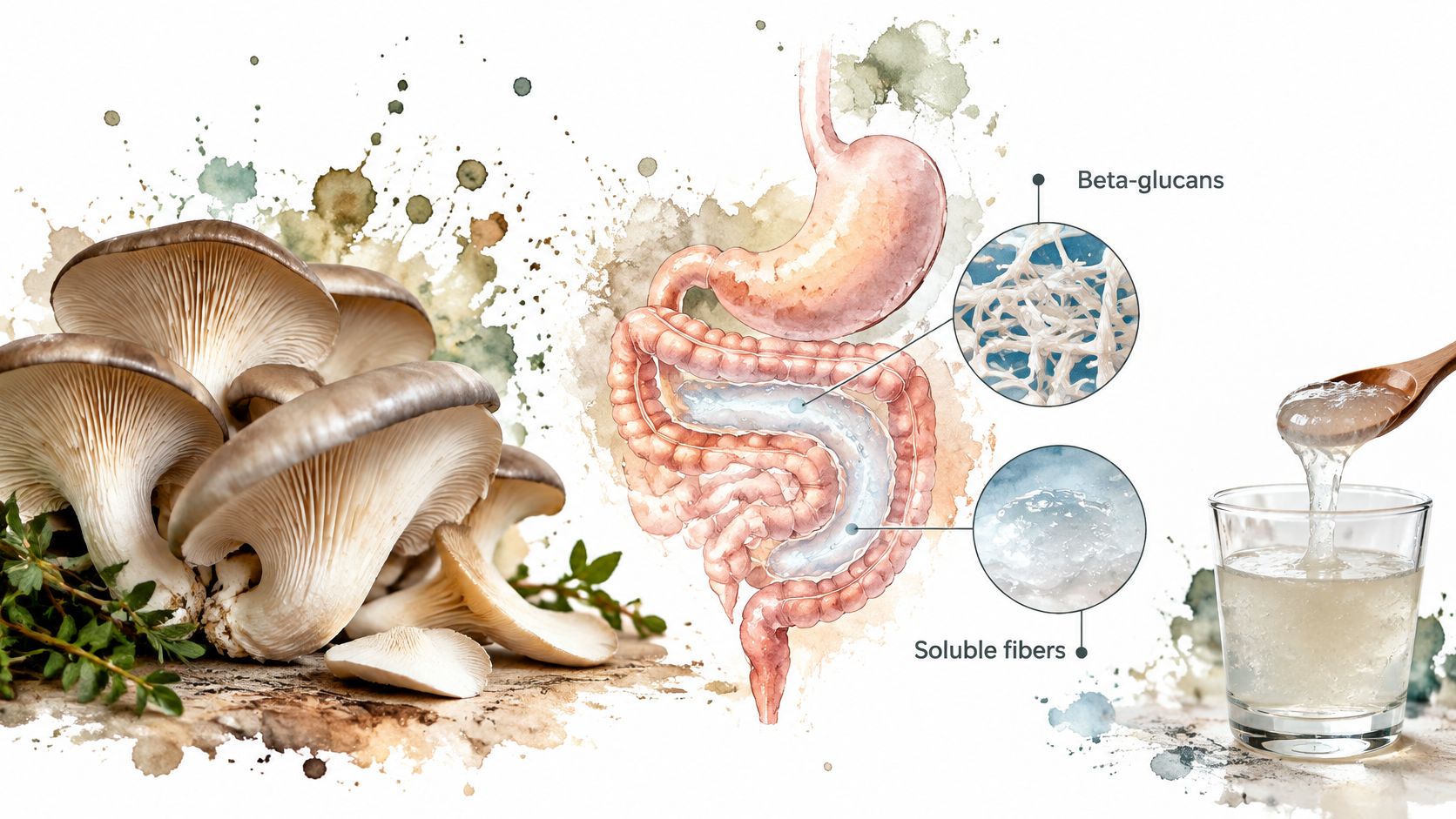
Beta-glucans, ergothioneine and lovastatin often appear in discussions of mushroom health effects. They raise different questions about fiber, antioxidant activity and cholesterol-related mechanisms, but naming a compound isn't enough to establish what a normal meal does.
For oyster mushroom nutritional value, the strongest starting point remains the measured food composition. The available evidence doesn't establish a dependable serving-level dose of each compound or a clinical outcome from eating an ordinary portion.
The illustration below is a conceptual aid, not a demonstration of a proven effect in humans.
Separate a Mechanism From a Meal Outcome
An oat-like gel is a familiar analogy for discussing soluble fiber. However, it shouldn't be used to assume that mushroom beta-glucans behave identically to oat beta-glucans, or that a sautéed portion produces a predictable change in cholesterol or glucose absorption.
The same restraint applies to immune claims. A proposed interaction with immune signaling is more specific than an “immune boost,” but even a specific mechanism needs evidence connecting the preparation, amount and human outcome.
The publisher's guide to 1,3-beta-D-glucan provides terminology for readers comparing ingredient claims. It shouldn't substitute for a clinical study of the product or food you're evaluating.
| Compound discussed | Useful question to ask | Conclusion to avoid |
|---|---|---|
| Beta-glucans | Was the research on whole food or an isolated preparation? | All mushroom fiber produces the same effect |
| Ergothioneine | Was the outcome measured in humans eating the food? | Antioxidant activity proves disease prevention |
| Lovastatin | Was the amount measured in this product? | A mushroom serving substitutes for medication |
| Ergosterol | Was vitamin D2 measured after exposure? | Precursor content equals vitamin D content |
What the Evidence Doesn't Establish
A detailed claim about ergothioneine transport through OCTN1, tissue accumulation or protection from oxidative stress requires evidence beyond a basic food-composition table. Without that evidence, it's more accurate to identify the research question than to present a mechanism as a demonstrated benefit of dinner.
Likewise, the available composition data don't establish a consistent lovastatin amount or a meaningful comparison with prescription dosing. Oyster mushrooms shouldn't be treated as a medication substitute.
Ergosterol belongs in a different category: it's the vitamin D precursor discussed above, not another reason to attach a broad wellness promise to a serving.
The most useful claim-reading habit is to identify the preparation first. An extract, isolated compound, dried powder and cooked fruiting body aren't automatically interchangeable, even when their labels share the same mushroom name.
Animal Digestibility Evidence and the Limits of Human Data
A nutrition panel records what a mushroom contains. It says nothing about how much of that material the body can reach, and for oyster mushrooms the available evidence stops well short of human health outcomes.
The evidence on offer here does not establish that routine oyster mushroom meals lower cholesterol, control blood sugar or improve immune outcomes in people. That narrows what can be claimed. It does not prove the food has no useful place in a diet.
What the Rat Study Actually Measured
In a rat study examining dried oyster mushroom and diet digestibility, adding the mushroom reduced overall diet digestibility, including protein and fat digestibility, and lowered apparent energy availability.
Two readings of that result are wrong. The first treats it as proof that the same effect occurs in humans, which the study does not show. The second treats it as evidence that mushroom fiber is harmful, which overreaches in the opposite direction: the finding describes one animal model, one preparation and one diet.
What the study also cannot settle is whether the result holds in a different food matrix. Digestibility depends on the whole diet, the dose and the preparation, so a dried powder mixed into feed says something about that particular mixture rather than about mushrooms as a category.
Weight Basis and Batch Still Apply
The rat diet used dried material. A dried ingredient concentrates its nutrients because the water is gone, while the fresh mushrooms a cook serves are water-rich. Any per-gram comparison between the two needs a fresh-versus-dry conversion before it means anything.
Batch matters too. A lab's dried sample and a produce-aisle pack are different measurements sharing one species name, which is why composition figures and digestibility figures should never be blended into a single promise about dinner.
Why Preparation Changes the Question
Grinding, drying, blending and cooking all change the food being evaluated. A dried ingredient folded into an experimental diet is a different test material than fresh mushrooms served with a meal, and a result should not be transferred without checking those details.
Readers weighing treatment-oriented claims can compare them against the publisher's overview of mushrooms and heart health. Any such claim still needs evidence for the specific preparation and outcome rather than an inference from species identity.
Evidence check: Ask whether researchers measured nutrient content, digestion, absorption or a health outcome. Those are four different findings.
For a home cook, the defensible conclusion is plain. Oyster mushrooms contribute a water-rich, low-energy ingredient with fiber and micronutrient variety, and the available evidence does not establish them as a treatment or a concentrated protein replacement.
A powder deserves its own assessment. Serving size, composition and processing history matter more than whether the front label shares a species name with a fresh package.
Oyster Mushrooms Against Other Protein and Vegetable Sources
Oyster mushrooms are best scored as a vegetable-like cooking ingredient with modest protein; their role is different from a concentrated protein food. On the raw-food basis used for the oyster figures, 100 g provides 33 kcal, 3.31 g protein, 2.3 g fiber and 0.41 g fat.
Those numbers are fresh-weight numbers. A 100 g dried-mushroom entry is a different food for comparison purposes because removing water concentrates each reported gram. Batch-to-batch variation adds another limit: two oyster samples can differ in growing conditions and still share the same name.
Compare Like With Like
A fair comparison needs the same basis across rows: raw with raw, cooked with cooked, dried with dried, and a named dataset or package panel for each food. The cited oyster values support that row only.
Missing for a defensible table are matched entries for raw white button, shiitake and portobello mushrooms; cooked lentils under a defined method; a specific firm tofu product; and roasted chicken breast with a stated preparation. Without those entries, the honest comparison is narrow: oyster mushrooms are low in energy and fat per raw 100 g, with protein present while density stays modest next to lentils, tofu or chicken.
Estimate Protein for the Meal
Use raw weight before cooking when the label or dataset is raw. For an example, 150 g raw oyster mushrooms carries 3.31 × 1.5 = 4.965 g protein on that basis; add it to the protein from lentils, tofu, eggs or meat rather than treating mushrooms as the anchor.
If the pan output is all you can weigh, do not apply the raw figure to cooked weight. Water loss shrinks the portion and changes grams per 100 g, so the same mushrooms can look more protein-dense after sautéing without gaining protein. When mushrooms replace a protein food, calculate the replacement's protein first, then decide whether mushrooms are a side component, a bulk ingredient, or part of a mixed source.
Judge oyster mushrooms by the job in the meal, then verify the protein and energy of the food they accompany or replace.
Choose, Store and Use Oyster Mushrooms Wisely
Buy oyster mushrooms with a clear plan for how you'll use them. If your priority is vitamin D, seek a product with a measured amount on the label. If you're planning dinner, focus on the portion and the other ingredients you'll add.
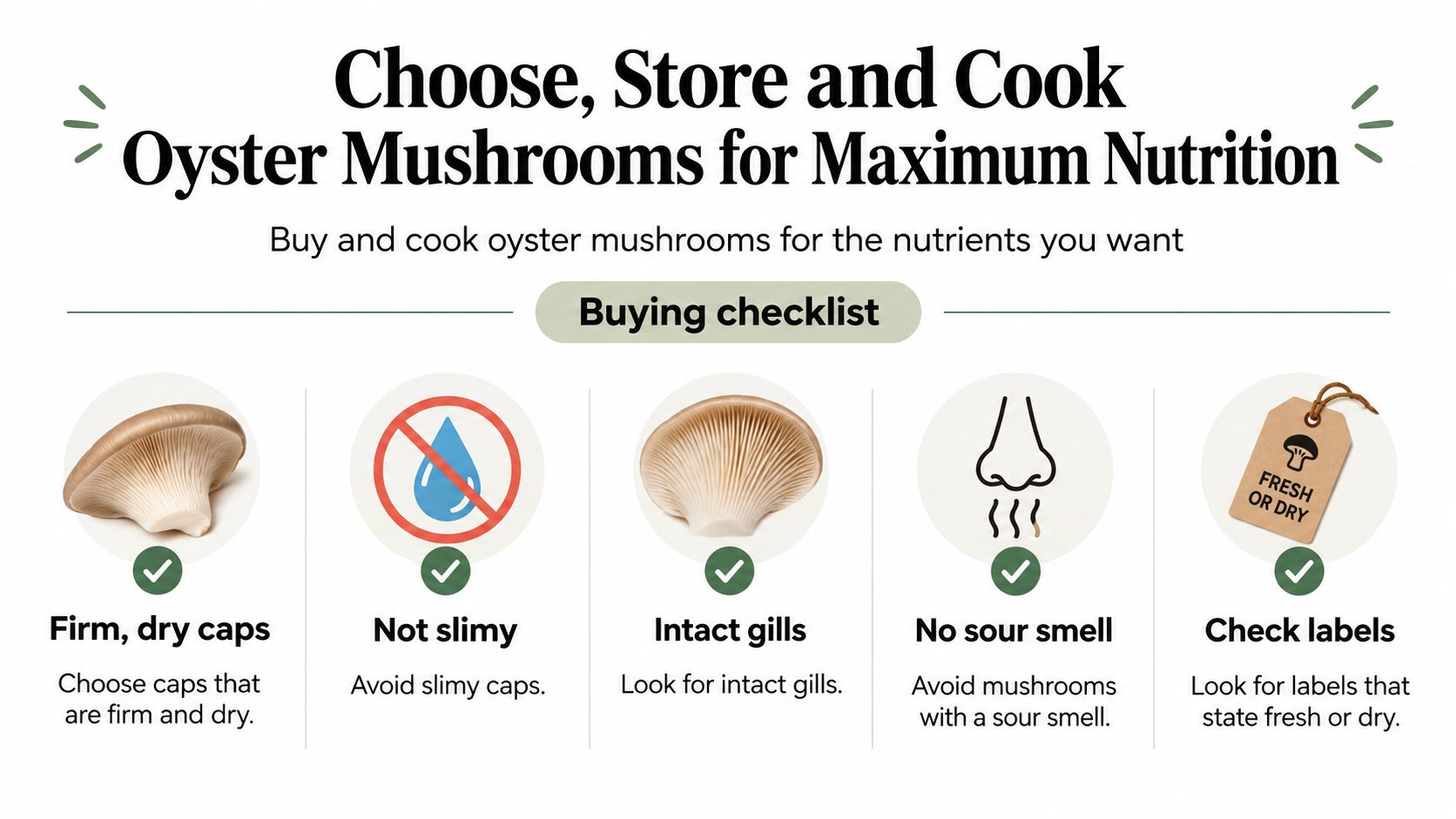
Freshness shows in a few visible ways. Look for caps that feel firm and dry rather than rubbery, edges that are smooth and intact instead of curled or split, and clusters free of slimy film or dark wet patches. These cues reflect age and handling, and they matter for flavor and texture. They do not reveal protein, mineral or vitamin D content, so read the label for that.
Read the Package Before Planning the Portion
The most useful nutrition information is usually on the back of the package. Look past broad terms such as "functional" or "nutrient-rich" and identify what the stated amounts describe.
- Food form: Check whether the product is fresh, dried, powdered or blended.
- Serving basis: Identify whether the panel describes the product as sold or after preparation.
- Vitamin D wording: Look for a measured amount and any statement about UV treatment.
- Added ingredients: Check whether oil, seasoning or other ingredients are included in the listed values.
At home, refrigerate the mushrooms soon after purchase and keep them in a breathable container such as a paper bag, which slows the surface moisture that speeds spoilage. Treat the package date as your ceiling and cook them while the caps still pass the freshness checks above. The composition studies discussed here don't establish a household shelf life or a validated freezing routine.
If you're comparing products online, the publisher's mushroom shopping guide is another place to examine product categories and descriptions before assuming a mushroom product works as a culinary substitute for fresh oyster mushrooms.
Track What Enters and Leaves the Pan
For a more accurate home estimate, weigh the raw mushrooms before cooking and the finished dish afterward. Record added oil and other ingredients separately.
That habit lets you distinguish concentration from addition. Water loss shifts the weight basis, so the same mushroom can read as denser in protein per gram after cooking. Added ingredients change the dish's nutrient totals outright.
The available evidence doesn't justify a universal ranking of cooking methods for nutrient retention, and it can't produce a precise cooked panel without knowing the recipe and yield. A generic cooked entry in a database describes someone else's pan. Use the cooking video as a reference for technique, then apply your own weights.
Build a Meal You Can Evaluate
Try mushrooms in a stir-fry with measured oil, alongside eggs at breakfast, or in a lentil bowl. These are meal ideas; their final values depend on the ingredients and portions you choose.
Keep the mushroom weight, added fat and accompanying protein food as separate entries. That gives you a record you can check against labels, which is more useful than assigning the whole plate the nutrition profile of raw mushrooms.
Choose oyster mushrooms for fiber, low calories and micronutrient variety. On your next shopping trip, pick a clearly labeled culinary product, check its serving basis and decide on the accompanying protein food before you cook.
The Magic Mushroom Delivery offers functional mushroom products and educational resources for adults exploring mushroom ingredients. Visit its product categories and guides to compare forms and labels, and keep fresh oyster mushroom nutrition separate from claims about powders, blends or other mushroom products.