
Mushroom coffee powder is a blend of real coffee and medicinal mushroom extracts, such as lion's mane or chaga, rather than a pure mushroom drink. It usually delivers the coffee ritual with less caffeine, typically 40 to 75 mg per serving versus roughly 95 mg or more in a standard 8-ounce cup, while the mushroom benefits remain more promising than proven in the finished beverage (independent mushroom coffee coverage).
You may be standing in the kitchen right now, holding a scoop of brown powder and wondering whether you've found a smarter morning ritual or just paid more for instant coffee with an earthy aftertaste. The label might promise focus, calm energy, immune support, and adaptogenic balance, yet the back panel may hide the actual mushroom quantities inside a proprietary blend.
That uncertainty is understandable. Mushroom coffee powder combines an old scarcity-era coffee substitute with modern extraction technology, but the useful questions are practical: How much caffeine is really in the cup? Which mushroom is present, and at what dose? Does the product disclose beta-glucans, extraction methods, and independent testing?
The Journey from Wartime Scarcity to Modern Superfood
During World War II, coffee beans were scarce and rationed across Europe. In Finland, people brewed chaga for a dark, coffee-like drink that helped extend limited supplies. It was a practical answer to an empty pantry and a desire for a warm, bitter morning beverage, not a wellness trend (historical and market background).
That history also helps explain the flavor of modern mushroom coffee powder. Chaga can add a dark, woody note, while coffee contributes roasted bitterness and its familiar aroma. The result is usually closer to a softened dark roast than mushroom broth, particularly when the formula uses an extract instead of coarse whole mushroom powder.

From substitute to branded blend
The modern format gained traction in the 2010s, when Finnish entrepreneur Tero Isokauppila helped popularize coffee blended with mushroom extracts. The concept then moved from Finnish traditions and niche wellness circles into mainstream retail and e-commerce. Finnish wartime chaga use and this later commercialization are both covered in the historical and market background.
Commercialization changed the drink in two practical ways. Manufacturers made it convenient, often selling an instant powder that dissolves in hot water. Brands also assigned functional identities to different mushrooms, including lion's mane for focus, chaga for immune-oriented positioning, and cordyceps for energy.
Strip away the branding and the product is a coffee and mushroom blend. Coffee supplies the roasted base and caffeine. Mushroom extracts may supply compounds such as beta-glucans or triterpenes, depending on the species and extraction process. A proprietary blend can obscure those details, so ingredient transparency matters when comparing products.
One industry estimate placed the global mushroom coffee market at USD 2.71 billion in 2022, projecting USD 4.12 billion by 2030 (Ken Research market estimate). Another estimated USD 1.25 billion in 2025, with projections of USD 1.40 billion in 2026 and USD 2.47 billion by 2031, plus a projected 12.02% CAGR from 2026 to 2031 (Mordor Intelligence market data). These figures are not directly comparable because the reports may define the category and measure its growth differently. They are directionally consistent, however, in showing how a scarcity-era substitute became a commercial functional beverage category.
Understanding the Big Three, Lion's Mane, Chaga, and Cordyceps
Choosing a mushroom coffee blend is like selecting a coffee tool for a particular job. The species name suggests the intended role, while the serving information shows whether the formula contains enough material to compare meaningfully.
Lion's mane for a mental-workday formula
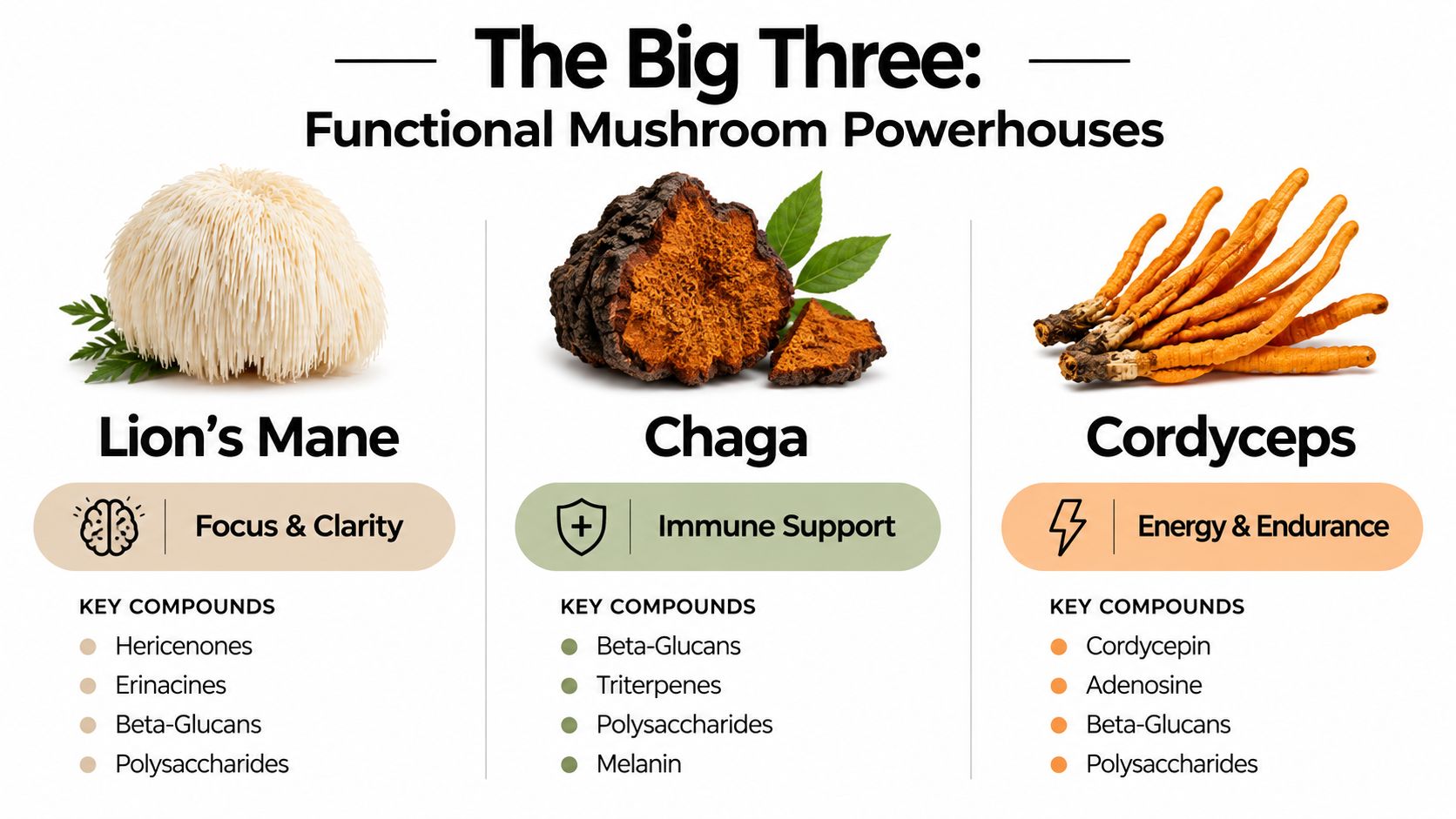
Lion's mane is commonly associated with focus and mental clarity. Its best-known compounds include hericenones and erinacines, which have been studied in relation to nerve growth factor pathways in preclinical and supplement research. That evidence does not mean a latte will produce a dramatic cognitive change. Human studies have generally examined structured lion's mane extracts rather than finished mushroom coffee, so the extract type and labeled serving amount deserve attention.
Lion's mane may suit someone seeking a steady workday ritual instead of a workout-focused stimulant. Check the species name, the form used, and the quantity per serving. A label that lists only “focus mushroom matrix” hides the amount of lion's mane, making comparison with another product difficult.
Chaga for earthy depth and immune-oriented positioning
Chaga has the strongest connection to the Finnish coffee-substitute story. It contains polysaccharides, polyphenols, and melanin, and its dark, earthy character can deepen a coffee blend. Brands commonly position chaga around immune support and antioxidant activity, while much of the encouraging evidence comes from laboratory or preclinical research rather than controlled trials of mushroom coffee.
The mushroom's name alone does not reveal how much extract the product contains, which compounds the process recovered, or whether contaminants were assessed. People with kidney conditions or a high risk of kidney stones should discuss chaga products with a clinician. Independent health coverage has raised concerns about chaga's oxalate content and described a case involving very high daily chaga powder intake (risk and evidence overview).
Cordyceps for an energy and endurance brief
Cordyceps is usually positioned for physical energy and endurance. Its compounds include nucleosides, polysaccharides, sterols, and D-mannitol, and research has examined possible links with immune function and athletic performance. The amount used in a research extract may differ substantially from the amount in an instant coffee sachet, so the product label remains the practical reference.
| Mushroom | Common product positioning | What to verify |
|---|---|---|
| Lion's mane | Focus and clarity | Extract identity and stated serving amount |
| Chaga | Immune and antioxidant support | Extract details, dose, and safety testing |
| Cordyceps | Energy and endurance | Species, extract type, and actual milligrams |
These descriptions are selection cues, not medical promises. Research on isolated mushroom extracts does not automatically establish the same effect for a finished coffee blend. To make a meaningful comparison, identify the mushroom species, the extraction form, and the disclosed amount. Transparency about beta-glucans, other compounds, and proprietary blends helps show what is in the cup.
How to Spot Quality, Beyond the Proprietary Blend
A proprietary blend can contain useful ingredients, yet it blocks meaningful comparison. If the label lists a broad “mushroom complex” without showing the amount of lion's mane, chaga, or cordyceps, you cannot tell whether the formula contains substantial extracts or only a token addition. Ingredient transparency guidance recommends giving more weight to disclosed amounts than to hidden blends (ingredient transparency guidance).
Use the back label as a quality-control checklist.
Start with the mushroom amount
Read the serving size, then check for quantities assigned to individual ingredients. One labeled formula provides a 5.9-gram serving, 30 servings per container, a 2-gram proprietary mushroom powder blend, a 150 mg adaptogen blend, and 120 mg of naturally occurring caffeine per serving. The label also reports 3,600 mg total caffeine per container (National Institutes of Health Dietary Supplement Label Database).
Those figures show why the total powder weight can mislead. A 2,000 mg blend might include different proportions of extract, coffee material, carriers, and low-activity mushroom powder. Compare the named species and their individual amounts instead of relying on the largest number printed on the front.
Look for beta-glucans and extraction details
Beta-glucans are water-soluble fungal polysaccharides. Hot-water extraction helps collect them. Dual extraction combines hot water with alcohol and may also target less water-soluble compounds, including triterpenes (commercial extraction and quality review).
A more informative label may identify the fruiting-body source, extraction solvent, extract ratio, beta-glucan percentage, and assay method. Commercial reviews commonly treat beta-glucan content above about 20% and extract ratios of 10:1 to 4:1 as useful potency markers, but those figures only mean something when the testing method is clear. For a fuller breakdown of what each ingredient contributes, see this mushroom coffee ingredients guide.
Label rule: A large mushroom weight without species, extraction, beta-glucan, or testing information says less than a smaller, fully documented ingredient.
Treat a certificate as stronger evidence
An independent certificate of analysis, or COA, can indicate whether the mushroom identity and measured compounds match the label. It may also document checks for microbial contamination and heavy metals. Without a COA or comparable testing disclosure, you can judge the product's transparency, but blend weight alone cannot establish biological activity.
Why It Tastes Different and How Much Caffeine You Get Per Serving
You take the first sip expecting ordinary coffee, but the cup feels rounder, earthier, and less sharp. The reason is usually caffeine dilution, not caffeine blocking. Manufacturers replace part of the coffee with caffeine-free mushroom powder or extract, reducing the total stimulant dose (caffeine comparison and formulation coverage).
Independent coverage places mushroom coffee at 40 to 75 mg of caffeine per serving, compared with roughly 95 mg or more in a standard 8-ounce cup of regular coffee (caffeine comparison). The coffee-to-mushroom ratio determines where a product sits in that range. A roughly 1:1 blend may provide about half the caffeine of conventional coffee, while a coffee-heavy formula can feel much closer to regular instant coffee.
That distinction matters if caffeine tends to cause jitters. A smaller dose often produces a gentler rise in stimulation and less of the tense, over-alert feeling associated with a stronger cup. You may notice less peak alertness, but the transition into the morning can feel calmer.
Read the caffeine line before the mushroom headline
Two product labels show why the blend name tells only part of the story. One 5-gram serving lists 120 mg caffeine, 30% mushroom polysaccharides in chaga extract, and 121 mg total polysaccharides per 5 grams (Sunday strong mushroom coffee label). Another 5-gram formula lists 17 mg caffeine, together with 1,000 mg green coffee powder, 55 mg green coffee extract, 200 mg chaga extract, and 122 mg polysaccharides per serving (Sunday mild mushroom coffee label).
Both products qualify as mushroom coffee, yet their stimulant effects can differ sharply. A prominent mushroom claim does not tell you whether the drink will resemble a mild coffee or a strong one. Check milligrams of caffeine per serving first, then examine the mushroom species, extract details, and testing information.
Expect a rounder cup
Regular coffee commonly highlights roasted bitterness, acidity, and aromas such as caramel, fruit, chocolate, or nuts. Mushroom coffee usually softens the acidity and adds earthy, woody, nutty, or savory notes. A well-made powder should not taste like soup, though its finish may be darker and less bright than a light roast.
Milk can soften these flavors, so judge the blend after trying it in the form you would typically drink. For more guidance on how earthy and roasted notes develop, consult this mushroom coffee taste guide.
Brewing the Perfect Cup, Dosing and Preparation Tips
You open a sachet before work, add hot water, and find a stubborn layer of powder at the bottom. Instant mushroom coffee is convenient, but the mixing method shapes its texture and flavor. Begin with the package serving size, since caffeine and extract amounts vary widely between blends.
A reliable kitchen method
Heat the water. Use water just below a full boil. Excessive heat can make the cup harsher, while cooler water may leave the powder partly undissolved.
Make a paste first. Add the powder to your mug with a small splash of hot water. Stir until smooth, then add the rest. This wets every particle and prevents dry clumps from floating on top.
Build the drink gradually. Pour in the remaining water while stirring. A small whisk or milk frother can improve the texture. Never shake very hot liquid in a sealed container.
Layer the flavor. Add milk, oat drink, or another creamer after the powder has dissolved. A little sweetness can soften earthy notes, while cinnamon or cocoa can support the roasted flavor.
The order matters because the powder needs contact with water before it meets a larger volume. The same principle applies to extract labels: a blend works more like a recipe than a single ingredient, so check whether it identifies mushroom species, extract quantities, and beta-glucan content rather than listing only a combined proprietary blend.
Introduce the drink gradually. Start with one serving earlier in the day, then observe sleep, digestion, anxiety, and energy before making it part of your routine. This can help separate a response to caffeine from one caused by the mushroom blend, sweetener, or another ingredient.
For a familiar instant-coffee routine, follow this guide to making mushroom coffee.
The visual walkthrough below shows mixing and texture so you can adapt the technique to your own kitchen.
Store the container closed, dry, and away from heat and direct light. Moisture encourages clumping, while repeated air exposure can weaken the coffee aroma before the package is finished.
Choosing Your Mushroom Coffee, What Matters Most
A rushed weekday morning often leaves little room for weighing separate coffee, extracts, and measuring spoons. Start with the job you want the product to do, then examine whether the label supports it. A curated blend offers a fixed serving, familiar preparation, and a planned combination of extracts. Plain coffee with a clearly labeled single-mushroom extract gives you more control over each ingredient and makes it easier to identify what you tolerate.
Compare the two approaches
| Option | Strength | Trade-off |
|---|---|---|
| Curated blend | Convenient, consistent, easy to prepare | You may have less control over each mushroom dose |
| DIY combination | Flexible, transparent, customizable | Requires separate products and careful measurement |
| Single-mushroom coffee | Easier to identify what you tolerate | May provide a narrower flavor and functional profile |
Ingredient transparency matters more than a crowded front label. Organic certification describes how ingredients were produced, not how concentrated the extract is. Check for named mushroom species, extract quantities, beta-glucan content, extraction details, and a current certificate of analysis, or COA. Third-party testing can also show whether the finished powder matches its label. A proprietary blend may be a useful recipe, but without individual amounts it is difficult to judge the dose of each mushroom.
The practical research question is dosage. Positive findings have often involved isolated extracts at 1.5 to 4 grams per day, so a sachet containing a few hundred milligrams of mushroom powder may sit well below the amounts studied. Regular coffee also has a larger human evidence base, while the finished mushroom coffee product has not been tested as a complete product in human trials (evidence overview). Treat those distinctions like the difference between testing one ingredient and tasting the finished cup: related, but not interchangeable.
Powder dominates the category because it fits a fast routine. Convenience is moving faster than finished-product evidence, which makes the format practical without making it a guaranteed therapeutic intervention.
Choose a product that states its caffeine amount, names its mushroom species, discloses milligrams, explains extraction, and provides accessible testing documents. If you have a medical condition, take medication, or react strongly to caffeine or mushroom ingredients, ask a qualified clinician before making it part of your daily routine.
The Magic Mushroom Delivery offers mushroom coffee, functional mushroom products, and educational resources for adults exploring mushroom-based routines. Visit The Magic Mushroom Delivery to review its coffee-format options and preparation guidance.