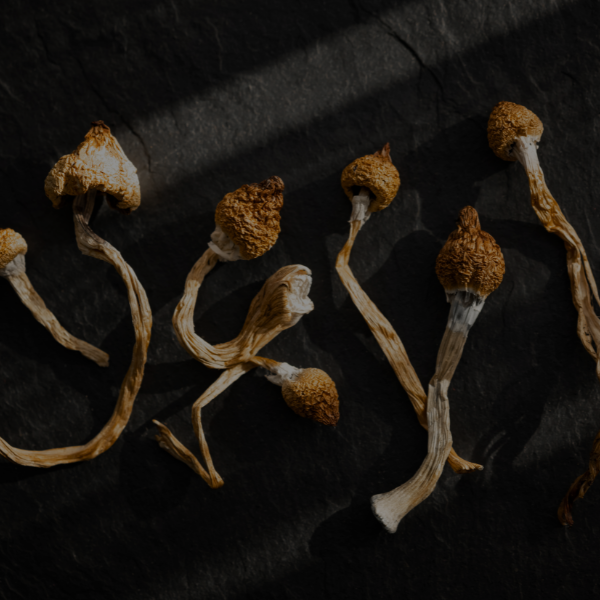

A grower opens a container and finds something that looks more like a cluster of rough little nuts than a mushroom. That surprise is usually the first lesson of philosopher's stone mushrooms. They don't fit the mental picture typically held when hearing the word "mushroom."
An Introduction to the Fabled Philosopher's Stone
Philosopher's stone mushrooms are one of the most misunderstood fungal products in the psychedelic world. The name sounds mythical, and the appearance adds to the confusion. People expect a cap, a stem, and gills. Instead, they find dense, irregular nuggets.
Those nuggets are sclerotia, not ordinary fruiting bodies. A sclerotium is a compact storage structure the fungus forms underground. Think of it as a survival organ packed with resources. It isn't a literal stone, and it isn't a culinary truffle either, even though many people casually call it a "magic truffle."
That difference matters because biology shapes the user experience. A delicate mushroom cap bruises, dries out, and degrades more easily. A dense sclerotium handles storage and transport differently, which is one reason philosopher's stones stand out for modern consumers who care about consistency and convenience.
People also get tripped up by the language. "Philosopher's stone mushrooms," "philosopher's stones," and "magic truffles" often point to the same general product category in conversation. The clearer term is Psilocybe tampanensis sclerotia.
Practical rule: If it looks like a small earthy nugget rather than a classic mushroom, you're probably looking at the storage structure, not the fruiting body.
The Story Behind the Stone Origins and Discovery
The origin story is unusually specific, which is part of what makes philosopher's stones so fascinating. Psilocybe tampanensis was first discovered in 1977 by mycologist Stephen H. Pollock near Tampa, Florida, and he cloned that original find. Its descendants stayed in wide circulation, forming the basis of virtually all philosopher's stones in psychedelic markets, because no further wild specimens were found in Florida for 44 years (GBIF species record).

That means the modern market has a rare kind of lineage story. Instead of many unrelated wild populations feeding supply, the known circulation traces back to a single discovered specimen and its cloned descendants. For readers who care about origin, that's a remarkable detail.
Why that discovery still matters
Most mushroom products are discussed as if they appear from a broad, anonymous natural pool. Philosopher's stones are different. Their history is much more concentrated, which helps explain why they developed such a distinct identity among experienced users and cultivators.
The story also explains the name tampanensis. It points back to Tampa, the region tied to the original discovery. That bit of taxonomy isn't trivia. It anchors the entire category in a real place and a documented event.
A rare fungus with an outsized reputation
Rarity in the wild often creates confusion in the market. People assume rarity means a product must be impractical or unavailable. With philosopher's stones, the opposite became true. Cloning and cultivation made the material accessible even though natural finds were extremely scarce.
That combination gives philosopher's stones their unusual reputation:
- Rare in nature means they weren't widely encountered in the wild.
- Recognizable in cultivation means growers could work with a known lineage.
- Stable in circulation means users came to know the product by a fairly consistent identity.
The "fabled" feeling around philosopher's stones doesn't come from marketing alone. It comes from a documented discovery story, an unusual lineage, and a form that doesn't look like ordinary mushrooms at all.
Recognizing Sclerotia How They Differ from Mushrooms
The simplest way to understand philosopher's stones is this. They are storage organs. According to VICE's explainer on philosopher's stones, philosopher's stones are sclerotia, underground storage organs rather than true mushrooms, and that structure helps them survive harsh conditions while making them suitable for controlled year-round harvesting.

A helpful analogy is a fungal battery pack. The fungus builds this compact mass to store nutrients and moisture. A fruiting body, by contrast, is more like a temporary reproductive structure. One is built to endure. The other is built to appear, release spores, and fade.
What they look and feel like
If you've only seen common mushroom photos, philosopher's stones can be surprising on first contact.
| Feature | Philosopher's stones | Typical mushroom fruiting body |
|---|---|---|
| Shape | Irregular nuggets or compact lumps | Cap-and-stem form |
| Texture | Dense and firm | More delicate, sometimes soft or fibrous |
| Where they form | Underground or within substrate | Above the substrate |
| Primary role | Survival and storage | Reproduction and spore release |
They've been described as truffle-like, and that comparison helps with appearance. But biologically, "truffle" can mislead people. A true truffle is a different thing. Sclerotia are their own structure.
Why consumers care about that difference
This isn't just a biology lesson. The structure affects handling. Dense sclerotia tend to be easier to package, simpler to portion, and less fragile than thin mushroom caps. That's one reason they're often discussed as a practical format for people who want something compact and easier to manage.
If you're trying to sort out the terminology, this guide on magic truffles vs mushrooms can help clarify how the categories overlap in consumer language.
A few signs people often notice first:
- Earthy appearance: They usually look like rough, natural nuggets rather than a fresh produce item.
- Compact size: They don't spread out visually the way caps and stems do.
- Dense feel: They seem more solid and less airy than standard mushrooms.
Many first-time buyers think they received the wrong product because they're expecting caps and stems. With philosopher's stones, the nugget-like form is the point.
The Mind's Journey Potency and Subjective Effects
When people ask about philosopher's stone mushrooms, they usually mean two things. How strong are they, and what does the experience feel like?
On the chemistry side, philosopher's stone sclerotia show psilocybin concentrations from 0.31% to 0.68% by dry weight. When ingested, psilocybin is converted to psilocin, which binds to serotonin receptors such as 5-HT2A and produces the characteristic psychedelic effects (Psilocybe tampanensis overview).

That controlled range is one reason people often describe philosopher's stones as a more predictable format than many fruiting bodies. "Predictable" doesn't mean identical every time. It means the product's biological form and cultivation style can support a steadier experience than loosely sourced mushrooms with wider variation.
What the chemistry means in plain language
Psilocybin is the precursor. Your body converts it into psilocin, the compound more directly tied to the altered state. So if you've heard both names and wondered which one "does the work," the simple answer is that one leads into the other.
That also helps explain why labeling and verification matter. The name on a package tells you very little by itself. What matters is whether the product contains the expected compounds and whether the source treats consistency seriously.
How people often describe the experience
Subjective effects vary with mindset, setting, preparation, and amount. Still, philosopher's stones have built a reputation for being especially appealing to people who want a more cerebral, inward, and reflective experience.
Common descriptions include:
- More inward than theatrical: Users often focus on thought patterns, insight, memory, and personal reflection.
- Visually rich but not always overwhelming: Visual changes may feel textured, symbolic, or dreamlike rather than purely flashy.
- Steadier in feel: The compact, cultivated format contributes to their reputation for a more even experience.
None of that guarantees a certain type of journey. Psychedelic experiences are personal. Two people can take the same product in the same room and still have very different experiences.
A useful way to think about philosopher's stones is that their biology supports consistency, but your mindset still shapes the meaning of the experience.
Navigating Your Experience Dosing and Responsible Use
Responsible use starts before anything is consumed. It starts with expectations, environment, and honesty about your own state of mind. Philosopher's stones are often described as manageable and consistent, but that doesn't remove the need for care.
The most reliable starting principle is simple. Start low, wait, and don't stack decisions too quickly. Without product-specific testing, exact dosing remains uncertain, even with a format known for steadier cultivation.
Start with context before quantity
People often want a number first. In practice, your setting matters just as much.
Ask yourself:
- How experienced are you really? Reading trip reports isn't the same as having personal experience.
- Where will you be? A quiet, familiar space is usually easier to handle than a noisy or unpredictable environment.
- Who is with you? A calm, trusted sitter can make a major difference, especially for first-time users.
- What emotional state are you bringing in? Anxiety, unresolved stress, or emotional overload can shape the experience.
Bring less certainty and more preparation. That mindset leads to better choices.
A safer way to think about dosing
Because product strength can vary and this article can't responsibly invent unsupported gram ranges, use a tiered mindset approach instead of copying random numbers from forums.
- Low exploratory amount: Best for first contact with philosopher's stones. The goal isn't intensity. It's learning how your body and mind respond.
- Moderate amount: Better suited to someone who already knows how they react and has a stable setting.
- Deep immersive amount: Not a casual decision. At this level, preparation, support, and post-experience integration matter much more.
If you want a broader framework for thinking through ranges and intentions, this psilocybin dosage guide is a useful companion resource.
Microdosing and practical caution
Microdosing interests many people because philosopher's stones are compact and easier to divide into repeatable portions. The challenge is the same one that applies to any product with active compounds. If you don't have verified testing, precision becomes guesswork.
A few practical habits help:
- Keep a simple log: Note amount, timing, sleep, food, and mood.
- Change one variable at a time: Don't combine a new product, new environment, and new intention all at once.
- Watch for interactions: If you take medications or have mental health concerns, talk with a qualified medical professional.
Two more habits matter more than most beginners expect.
- Don't redose impulsively. People often assume "not much is happening yet" and then overshoot.
- Protect the next day. Give yourself room to rest, reflect, and avoid obligations that require precision or emotional labor.
Sourcing Safely Buying and Storing Your Sclerotia
The biggest mistake buyers make isn't always choosing the wrong strain. It's assuming a label proves authenticity. It doesn't.
A 2024 Oregon State University study reported on by KCBY's coverage of the findings found that 100% of 12 retail "magic mushroom" edibles tested contained zero psilocybin and instead included undisclosed ingredients such as caffeine, hemp, kava extracts, and synthetic compounds. That's a sharp reminder that appearance, branding, and product names can be misleading.

What to look for when sourcing
You don't need a lab to ask better questions. You do need skepticism.
A careful buyer looks for:
- Clear product identity: The seller should say what the product is, not hide behind vague branding.
- Authenticity verification: Look for evidence of testing or other meaningful verification, not just polished design.
- Specific handling details: Storage guidance, freshness notes, and packaging information signal that the seller understands the product.
If a listing leans heavily on fantasy language and says little about identity or verification, that's a warning sign.
Red flags that deserve extra caution
Not every bad product looks bad. Some look highly professional.
Watch for these issues:
- Mystery blends: If the ingredients are fuzzy, the risk goes up.
- No testing discussion at all: Silence on authenticity is not reassuring.
- Confusing product terms: When a seller mixes mushrooms, truffles, extracts, and novelty language without clarity, buyers can easily misunderstand what they're getting.
Good sourcing starts with one question: can this seller clearly explain what the product is, how it was handled, and how authenticity is checked?
How to store philosopher's stones well
This is one place where the sclerotia format offers a practical advantage. Because philosopher's stones are compact and dense, they're generally easier to store than fragile fruiting bodies.
Good storage comes down to basics:
- Keep them cool: Heat speeds degradation.
- Keep them dry if stored dried: Moisture invites quality loss.
- Use an airtight container: Limit exposure to air and humidity.
- Avoid repeated handling: Open the container only when needed.
For short-term use, clean and simple storage usually works well. For longer-term storage, consistency matters more than gimmicks. Don't leave them in warm cars, sunny windows, or loosely sealed bags and expect quality to hold.
Understanding the Modern Regulatory Environment
The rules around philosopher's stones aren't uniform everywhere, and that's where many readers get confused. They hear one broad claim online and assume it applies in every place and to every product form.
A better way to think about it is classification plus jurisdiction. The same organism can be treated differently depending on how a law is written, what form is named, and where you are.
Why sclerotia create confusion
Historically, some jurisdictions created a gray area because sclerotia were not specifically named in laws focused on psychoactive fungi. As noted in this PubMed-indexed discussion of hallucinogenic fungi policy and taxonomy, "magic truffles" were sold in Amsterdam for years because they were not technically considered "mushrooms" under the prevailing law.
That doesn't mean every place treats them the same way. It means the biological difference between a fruiting body and a sclerotium can matter in legal language.
A practical framework for readers
If you're trying to understand your local environment, focus on these questions:
| Question | Why it matters |
|---|---|
| What form is named? | Some rules describe mushrooms broadly, while others are more specific. |
| What jurisdiction applies? | Country, state, county, and city rules can differ. |
| Is the rule current? | This area changes, so old forum advice can be outdated. |
That means you shouldn't rely on casual summaries from social media, old Reddit threads, or assumptions based on another region. If you want a starting point for reading more carefully, this guide to psilocybin mushroom legality is a helpful place to begin your own research.
The key lesson isn't that the rules are simple. It's that product form, wording, and location all matter.
How to stay informed without getting lost
Keep your research habits boring and methodical.
- Read current local rules directly when possible
- Check whether the language refers to mushrooms broadly or names specific forms
- Be cautious with international examples, because they may not map cleanly onto your location
Regulatory nuance doesn't make philosopher's stones mysterious. It just means readers need precision instead of shortcuts.
Your Journey with the Stone Final Thoughts
Philosopher's stone mushrooms stand out because their biology changes the whole conversation. They aren't famous for dramatic looks. They're famous because sclerotia turn a fungal survival strategy into a practical product format.
That compact structure explains a lot. It helps explain why people see philosopher's stones as easier to store, easier to package, and often easier to approach with a consistency-focused mindset. It also explains why newcomers are so often surprised when the product doesn't resemble a classic mushroom.
The deeper lesson is simple. Better choices come from better understanding. If you know what philosopher's stones are, how they differ from fruiting bodies, why verification matters, and how setting shapes experience, you're much better equipped to approach them responsibly.
Curiosity is useful here. So is restraint.
The best experiences usually begin with both.
If you're looking for a retailer that pairs discreet shopping with educational support, The Magic Mushroom Delivery offers a curated selection of mushroom products for adults 21+, along with resources on dosing, product formats, and responsible use so you can make more informed decisions.