

Does a birth-date box on a checkout page verify anything? On its own, no. It records a claim. The gap between recording a claim and checking one is where most confusion about age verification policy lives, and it runs in both directions: shoppers assume a real check happened, and stores assume their gate is working harder than it is.
Two questions get merged constantly. The first is how much assurance a method provides, meaning how hard it is to fake and what evidence it leaves behind. The second is whether that assurance keeps anyone out. A store can answer the first well and the second badly, and a strict-looking ID upload can deliver worse real-world protection than a lighter method that's implemented carefully.
This walkthrough separates those questions. It covers what each stage of a 21+ purchase really requires, which parts the law asks for, how the methods rank against each other, and what happens to the ID and personal information a customer hands over.
Age Verification Requirements at a Glance
Age checks on an adult-only store aren't one gate. They're a sequence of stages, each collecting a different amount of data and each with a defined outcome when it fails. The table below is the short version of a working policy, and everything after it explains why each row is built the way it is.
| Stage | Requirement | Data involved | If it fails |
|---|---|---|---|
| Account or browsing | Neutral age declaration before personal details | Age answer only | Access held until verified |
| Checkout | Stronger proof of being 21 or over | ID check or assurance result | Order held for retry or manual review |
| Payment and fulfilment | Verified customer matches the order | Shipping and payment details | Order not released |
| Delivery | Adult-signature or ID check at handoff | Recipient identity and age | Parcel not released to the recipient |
| Repeat purchase | Check repeated when account, device or payment changes | Stored pass result, not raw ID | Fresh check required before ordering |
| Unverifiable customer | Manual review or alternative route | Case notes only | Order held, declined if unresolved |
The first stage asks a question, not for a document. A neutral age declaration arrives before any personal details are collected, so the store learns one thing, whether you say you're 21 or over, and nothing else. That answer isn't proof, and no honest policy calls it verification. Its job is to sort visitors before the expensive and privacy-sensitive step that follows.
The second stage is where eligibility gets established. Before checkout completes, the store needs a stronger result: a government ID match through a verification vendor, or an assurance signal from a service that can independently confirm an adult. What matters is that the pass or fail binds to the account, the order and the recipient, not to a browser session that vanishes when the tab closes.
Why the failure column matters more than the requirement column
Anyone can write a requirement. The useful test of a policy is what happens when a stage doesn't clear.
Practical rule: a failed stage holds the order. It doesn't continue with a warning attached.
- Browsing failure: access stays suspended, so a visitor never reaches a checkout they'd fail anyway.
- Checkout failure: the order sits for a retry or moves to manual review, depending on the retry count the policy allows.
- Fulfilment failure: an address or cardholder that doesn't match the verified person stops release of the order.
- Delivery failure: the parcel doesn't transfer. The signature at the door is an extra control and never a substitute for the online check earlier in the chain.
- Repeat-purchase failure: a new device, account or payment method voids the stored pass and triggers a fresh check.
A store that leans on the driver alone has moved its entire age gate to the doorstep, where the person answering may not be the person who ordered. Each requirement below gets taken apart in turn, starting with the legal backdrop.
Legal Basis and Benchmarks for 21+ Limits
An adult-only store starts with a simple boundary: products are for adult use only, 21 and over, and should be used responsibly. ID is verified to confirm that age threshold. That check has a narrow job. It answers one question: is this customer old enough to order?
That question sits beside a second one the customer must handle personally. Buyers have to confirm for themselves that magic mushroom possession and use are lawful where they live. Rules shift from state to state. A retailer can set an age gate and follow shipment rules, but it cannot settle local legality on the customer's behalf.
The legal point is easier to understand with a speed limit analogy. One rule sets the limit, while another set of rules defines how compliance is measured. A 21+ policy works the same way. The age threshold is the limit. The verification method is the measuring tool.
The methods regulators accept have changed shape. The Congressional Research Service review of age-verification laws describes a recurring US pattern in which statutes name acceptable methods instead of mandating one technology: Louisiana accepts a digitized identification card or a commercial system using government-issued identification or transactional data, Utah accepts government identification, digitized identification or third-party services comparing user-supplied information with commercially available data, and Arkansas requires third-party vendors for "reasonable age verification." Those laws target social media and adult content rather than mushroom retail, so they work as method benchmarks, not as the retailer's own legal basis.
That distinction matters. A law written for adult content can still teach a retailer how lawmakers describe acceptable checks. It does not automatically authorize a product category or settle every local rule. The useful lesson is structural: define the age boundary, name acceptable evidence, and keep the check tied to the person placing the order.
European guidance adds two practical tests. The Commission's July 2025 guidance on age-assurance methods asks that methods be accurate, reliable, non-intrusive and non-discriminatory. Its 2025 age-verification framework separates the age restriction itself from the method used to assess age. That separation is useful because a store can have a clear 21+ rule and still choose a weak way to enforce it.
California's Assembly Bill 1043 is a 2025 to 2026 proposal for a device-level age model. It sketches a design where a limited age signal is shared with apps instead of every app collecting documents. The proposal should be read as a model for limited disclosure, not as a current operating rule.
| Framework | Scope | Key requirement | Relevance to a 21+ retailer |
|---|---|---|---|
| EU Digital Services Act, Article 28 | Online platforms accessible to minors | Proportionate measures for a high level of privacy, safety and security | Benchmark for proportionality |
| EU Commission DSA guidance, July 2025 | Adult-restricted material and minimum-age services | Methods must be accurate, reliable, robust, non-intrusive and non-discriminatory | Benchmark for method quality |
| EU 2025 age-verification framework | Proof of an 18+ threshold through an app | Separates the age restriction from the verification method | Shows threshold versus method |
| California AB 1043, 2025 to 2026 proposal | Operating-system age signal | Age collected once, with a limited age signal shared | Shows a limited age-signal model |
| FTC COPPA policy statement, 2026 | General and mixed-audience services | Age data used only for age determination and deleted promptly | Data-minimization model |
| US state laws, including Louisiana, Utah and Arkansas | Online age-verification duties | Accept digitized ID, government ID or commercial data checks | Lists methods states allow |
A retailer should be able to name the basis its own policy follows. That may be a state statute, a national design code, or an internal assurance standard modelled on one of these. If the policy page cannot name the basis, customers are left guessing whether the gate was designed with care or copied from a template. Stronger policies do more than announce an age limit. They explain what counts as proof, what happens when proof is missing, and what data the customer gives up to complete the check.
Verification Methods Compared by Assurance Strength
A 21+ gate works best as an assurance process, where each method produces a different kind of evidence. Ofcom's technical guidance on age assurance separates stronger checks from weak ones: photo-ID matching, digital identity services, facial age estimation, mobile-network checks, credit-card checks, open banking and email-based estimation can reach different levels of effective assurance, while self-declared age and payment methods that don't independently establish age fall short on their own.
| Method | How it works | Assurance level | Main trade-off |
|---|---|---|---|
| Self-declared birth date | Customer types a date of birth | Insufficient alone | Easily falsified |
| Payment method check | Card or payment holder checked | Insufficient unless it independently establishes age | Does not prove age by itself |
| Email-based age estimation | Age estimated from account signals | Potentially effective | Weaker for new or unused addresses |
| Mobile-network check | Carrier data confirms an adult account | Potentially highly effective | Depends on carrier data coverage |
| Digital identity service | Verified digital credential confirms age | Potentially highly effective | Depends on adoption of the credential |
| Photo-ID matching | Document image compared with the customer | Potentially highly effective | Needs an accepted ID and raises data-retention risk |
| Facial age estimation | Camera-based age estimate | Potentially highly effective | Accuracy and bias concerns for some groups |
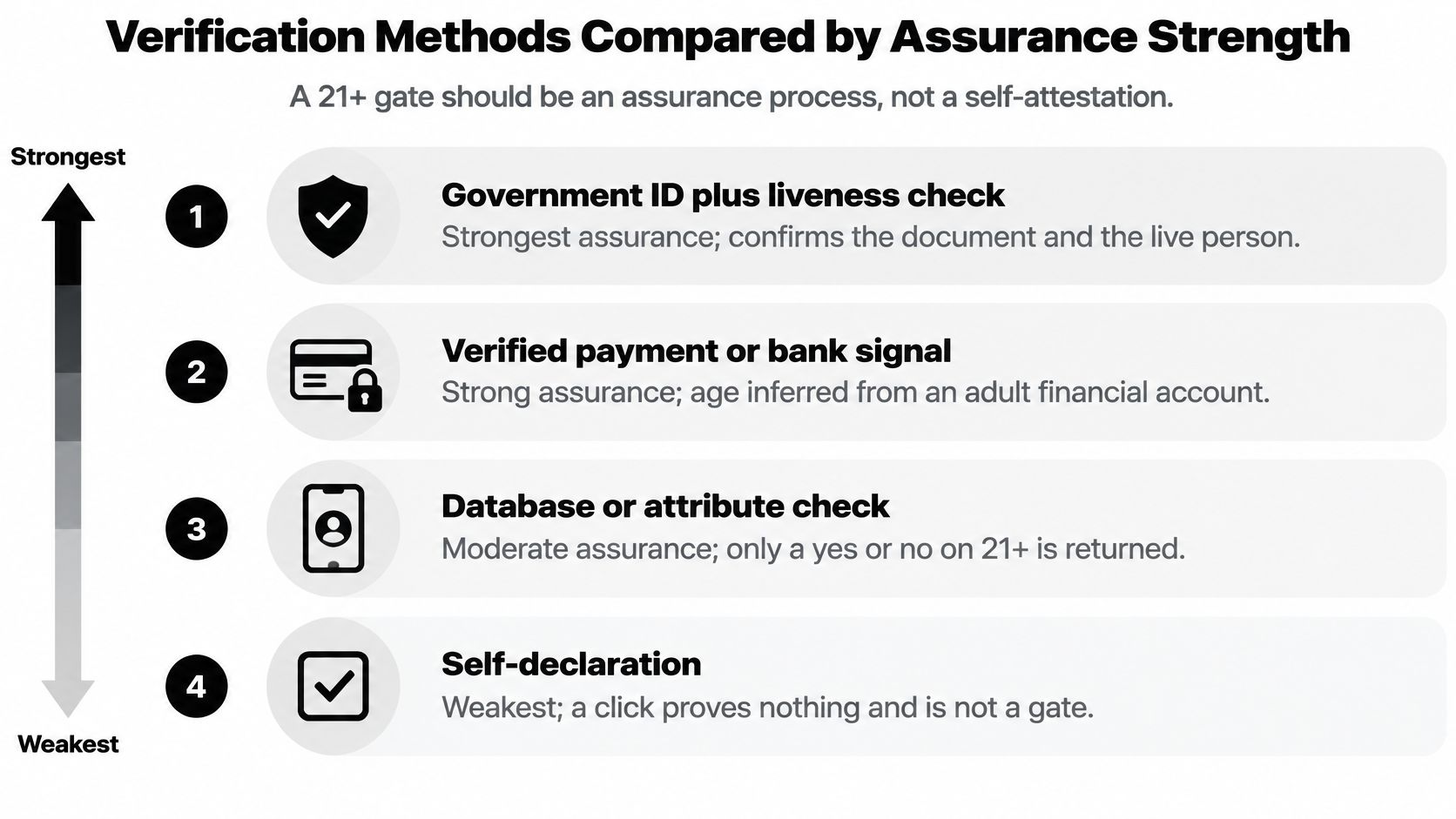
The first two rows cost the buyer almost nothing and give the store little evidence. A typed date is a claim. A card on file shows that a financial account exists, not that its holder clears 21. They work like a sign at the door asking people to state their age, useful for setting expectations and weak as proof.
The middle rows are where the practical differences bite. Email-based estimation leans on how long an address has existed and how it's used, which makes it only potentially effective for customers with new or unused addresses. Carrier and digital-identity checks are stronger, yet they inherit the coverage of the underlying data. An adult on a prepaid number, or one who never adopted the relevant digital credential, has nothing to present.
The last two rows carry the most weight and the most obligation. Photo-ID matching needs an accepted document in the customer's hands and creates a retention risk for the store, since a check that keeps a full scan has handed itself a breach exposure. Facial age estimation avoids documents entirely, yet its accuracy varies across demographic groups. A serious vendor reports performance by cohort rather than as a single average, because one overall score can hide weaker results for specific groups.
The criteria that decide whether a method is acceptable
Ask any vendor for these before choosing a check:
- False-accept and false-reject rates, reported separately, since the two failures hurt different people.
- Spoof resistance and liveness testing, so a printed photo or a screen replay doesn't pass.
- Demographic fairness data, broken out by age band, sex and skin tone.
- Uptime commitments and audit logs, so a failed check leaves a trace you can review.
Then apply the same bar everywhere. The check has to run in the same way across web, mobile, guest checkout, promotions and repeat purchases, or a shopper changes route to skip it. Strong assurance also depends on what data the customer hands over. A photo-ID check asks for a document image, a mobile-network check uses carrier data, a digital-identity check uses a credential, and facial estimation uses a camera-based estimate. None of those details make the method suitable by themselves. The question is whether the evidence matches the store's 21+ rule and whether the data exposed is worth that evidence.
On this store, government ID verification at checkout is the confirmed method, used only to confirm a customer is 21 or older. ID verification information is not stored or shared. Payment-signal and device-level signals are not confirmed in the policy pages, so they should be treated as unconfirmed. That distinction matters: a documented ID check proves more than a weak signal, while a weak signal may collect data without proving much in return.
Whether Verification Actually Keeps Minors Out
Does a stricter check stop more underage buyers? Most policies assume yes: collect more identity, get more protection. The evidence is more qualified, and the gap between a strong method and a proven one is where customers get misled.
Strength describes what a check can verify. Effectiveness describes what it prevents. A government-ID check produces a documented record of who was verified. A database check produces a match to an adult record, not a confirmed identity. An estimation tool produces a probability. Each asks the customer to surrender something different, from a full ID scan to nothing at all, and none of them alone demonstrates that minors were kept out.
What success would actually look like
A credible policy measures the outcomes that matter, not the strength of the technology:
- False acceptance of minors, meaning the check let through someone under 21.
- False rejection of adults, meaning a legitimate buyer was blocked.
- Abandonment at the check, since a gate that loses half its buyers is a business problem dressed as security.
- Repeat-verification frequency, which tells you how often customers are asked again.
- Privacy incidents, because identity data that's collected can leak.
The scale of the underlying problem explains why regulators stopped trusting stated birth dates. A European Parliament briefing on age assurance cites research finding that 94% of Danish children have social-media accounts before age 13, even though 13 is the common platform minimum, and reports that 55% of children aged 3 to 12 in a UK study used at least one social-media app or website.
The evidence gap nobody likes to name
Here's the uncomfortable part. The Congressional Research Service review of age-verification effectiveness notes that minors continue to access sites despite operators using different verification methods, and that how each method performs depends on implementation. No state has yet produced evidence that its age-assurance model works, largely because most laws are too new to evaluate and do not require operators to collect or publish outcome data.
A more intrusive method can raise nominal assurance without proving better real-world prevention.
That's the trade a buyer should watch. Stronger collection reduces anonymous adult access as a side effect, and the safety gain that justifies the loss is usually unmeasured.
A fair policy therefore describes verification as risk reduction, not proof that every purchaser is legally eligible. When you read one, look for the accountability evidence that outcome claims lack: stated retention periods, scheduled deletion, escalation routes and audit practices. A store that verifies ID only to confirm a customer is 21 or older, then doesn't store or share it, is making a bounded claim it can keep.
How the Verification Process Runs from Order to Delivery
Six steps carry an order from the cart to the doorstep, and each exists because the step before it leaves something unresolved.
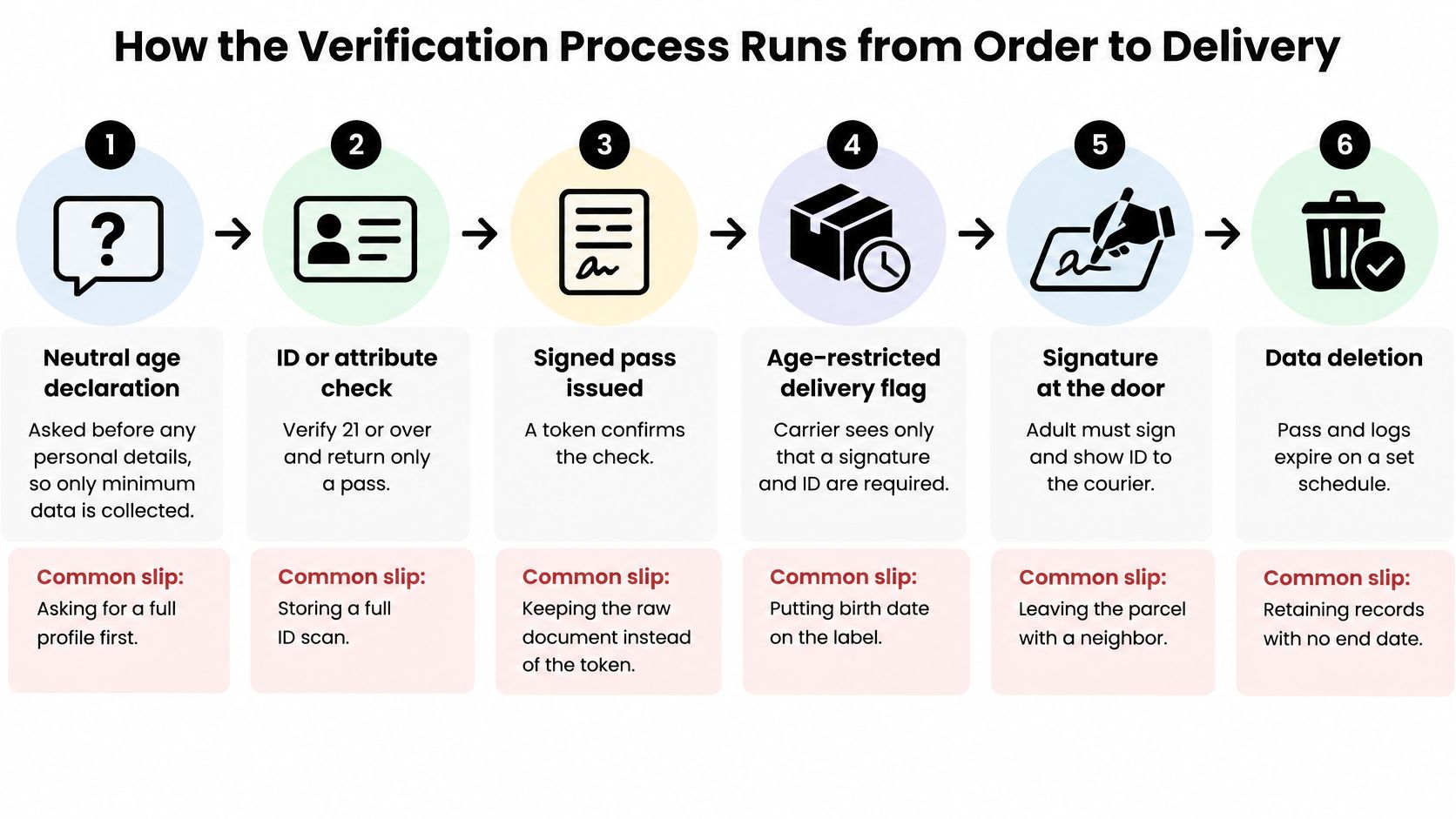
1. A neutral declaration comes first. The opening prompt asks whether you're 21 or over before it asks for a name, address or date of birth. The ordering is the point: if the answer is no, no personal data exists yet to protect. The common slip is requesting a full profile and checking age afterwards.
2. Proof of age comes next. The delivery process begins with verifying ID to confirm the customer is over 21, and the order can't progress on a failed result.
3. Items and a payment method follow the check. Nothing gets charged for a buyer who hasn't cleared step two.
4. The verified person has to match the order. After an order is placed, a team member follows up to confirm shipping information, ID verification and payment information together. A name or address that differs from the ID triggers a hold and a follow-up check, not an automatic refusal. People order to a work address or a partner's home, and the policy should absorb that without abandoning the control.
5. Dispatch runs with tracking. Once items and payment are set, shipping is fast and comes with a tracking number and an estimated arrival time.
6. The handoff is a second control. The recipient signs and shows ID at the door, so the parcel doesn't transfer to whoever happens to answer. It supports the online check; it never replaces it.
The sequence in practice:
Our shipping and tracking page covers how tracking numbers and arrival estimates reach you once an order clears verification.
Retries, Review and Alternatives
Most guidance explains how to pass a check. Rarely does it explain what happens to the adults who can't. A 2025 USENIX study on age-verification barriers reported people lacking the required identification or a working camera, and found many were reluctant to upload government IDs over identity-theft and data-security worries. The barriers are ordinary: no passport or driver's license, a disability that interferes with facial recognition, browser settings that block camera access, or a straightforward refusal to hand over more than a yes or no about age.
Australia's eSafety consultation made a related point, warning that biometric approaches can create inaccuracy and bias risks for diverse populations. None of that is an argument against checking age. It's an argument for building the exit route before anyone needs it.
The failure path a fair policy spells out
A policy that expects some legitimate adults to fail should say what happens next:
- Retry limits, stated as a number, so a customer knows how many attempts they get.
- A reason on screen, in plain words, rather than a generic rejection.
- An alternative route, such as a different document type or a manual check, where one is possible.
- Human review for disputed outcomes, with a real person and a timeframe.
- An exception process for customers who can't complete the check at all.
The answers a reader should be able to find without emailing anyone are the same four every time: what data is collected, who processes it, how long it's kept, and whether deletion can be requested.
Privacy-conscious buyers judge a retailer by its failure path more than its verification speed.
That's the trust signal first-time customers notice, because it's the moment they find out whether the business treats a hold as an accusation.
If your own check fails
Ask for the specific reason, request the alternative route rather than retrying the same document, and ask for deletion of anything already submitted. A store that can't name its reason or its alternative hasn't designed the process yet.
When a check indicates a buyer is under 21, the order is declined, the case record is kept only for the stated retention period, and nothing further is requested from that person.
How Customer ID and Personal Data Are Handled
The safest version of this process ends with a deleted record, not a stored document.
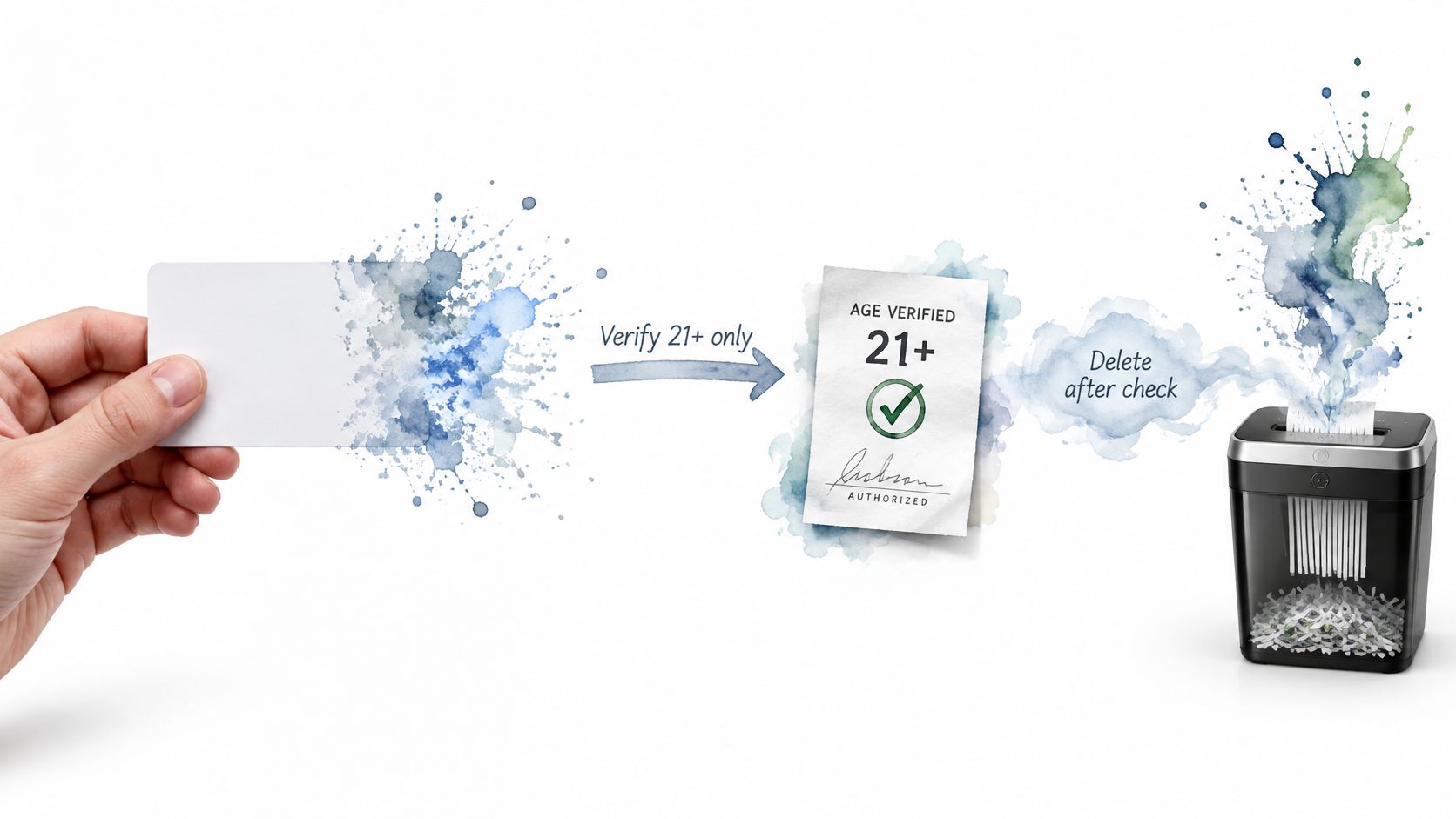
The design principle is minimization. Verify an attribute such as "21 or over," return a signed pass or fail carrying a verification timestamp and a provider reference, and stop there. NIST's identity proofing guidance frames privacy as a lifecycle problem spanning collection, storage, use and destruction, which is why a one-time consent screen isn't a control.
What a policy shouldn't keep
Four categories need a documented legal and security reason before a store holds them:
- Raw identity documents, meaning scans or photos of a license or passport.
- Facial images or biometric templates, since neither can be reissued if breached.
- Full dates of birth, when a simple over-21 flag carries the same decision.
- Verification records with no end date, which turn a check into a permanent file.
At this store, ID verification is used only to confirm a customer is 21 or older, and the ID isn't stored or shared. That's what the minimization principle looks like when it's written into a policy instead of implied by it.
The FTC conditions as a working checklist
The FTC's COPPA policy statement on age-verification technology lays out conditions worth adopting wholesale. Age information is used only for age determination, retained no longer than necessary and deleted promptly after the check, disclosed only to qualified parties, covered by clear notice, protected with reasonable security safeguards, and gathered through a method the operator has taken reasonable steps to confirm is reasonably accurate.
Because those conditions come from COPPA, which protects children under 13, they act as a practical benchmark for a 21+ retailer rather than a binding rule. The logic still transfers cleanly: verify eligibility, don't repurpose the data for marketing or profiling, restrict vendor access, secure it, and delete it once the check is done.
Vendor contracts deserve the same scrutiny. Ask for a ban on secondary use, breach notification terms, subprocessor disclosure and a secure destruction clause. On the delivery side, packaging is discreet to protect customer privacy, and a properly run operation extends that to the discreet shipping practices that keep an order from being legible to anyone handling the parcel.
Look for three things in any policy: a stated retention period, automated deletion rather than a manual cleanup promise, and a short list of roles with access.
Check a Retailer's Verification Policy Before You Order
An age gate tells you a store asks for a birthdate. A policy page tells you what the store does with the answer. Before you send a photo of your driver's license to any retailer, run this list against what the store puts in writing.
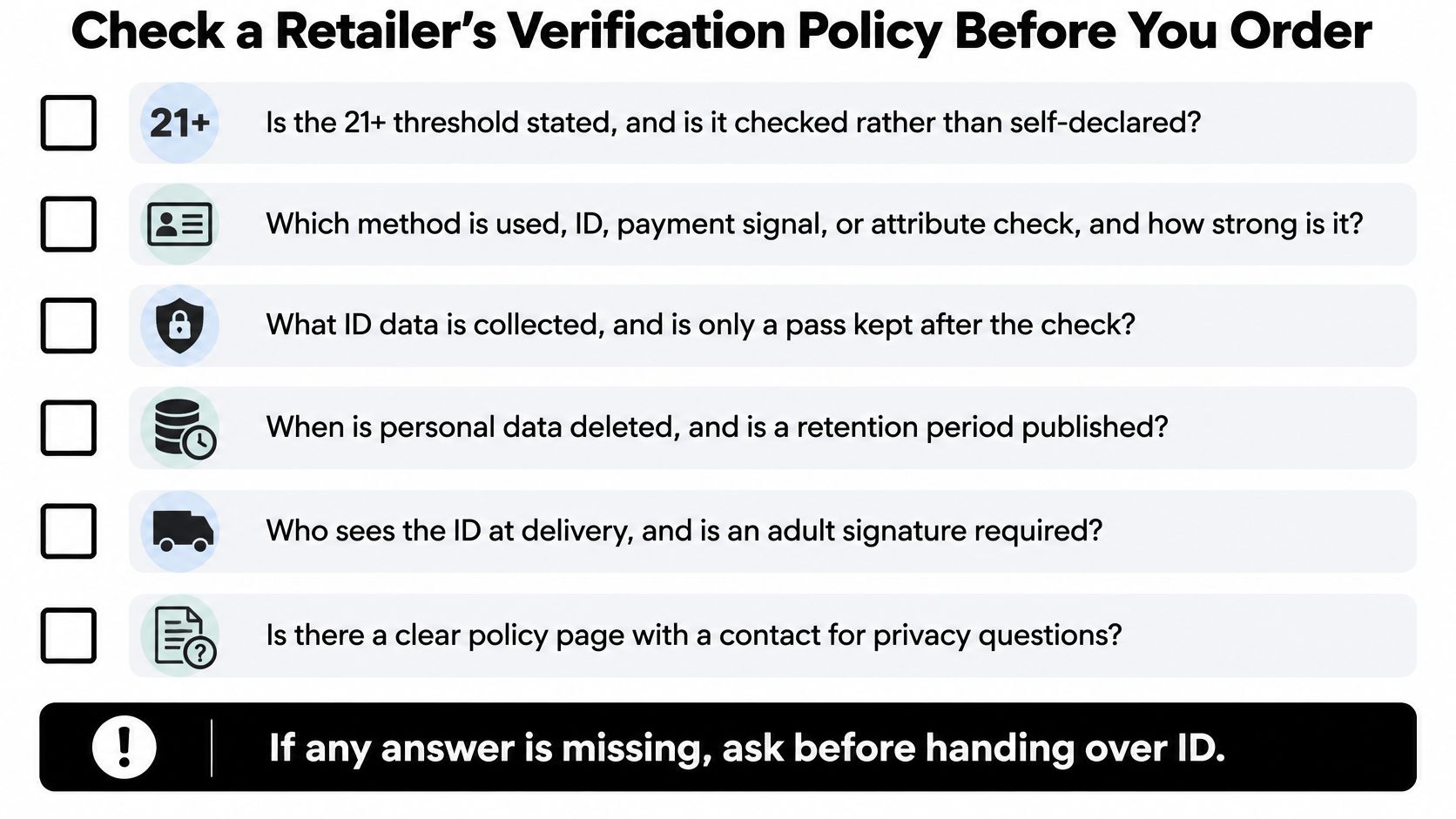
- Is the threshold stated and checked? Customers must be over 21 to order, and the policy should state that limit and describe the check behind it. A ticked box alone proves nothing.
- Which methods are named? A government ID check, a payment signal and an attribute check each carry a different level of assurance. The policy should say which one it uses and whether that method stands alone or backs up another.
- What data is kept, and for how long? A pass recorded with a timestamp is a different thing from a stored scan of your license.
- Who can see it? Role-based access and vendor terms that ban secondary use belong in writing.
- Is there a failure path? Retries, human review and an alternative route are the difference between a control and a wall.
- How does delivery work? Discreet packaging, a tracking number and an estimated arrival time tell you the safeguards continue past checkout.
Apply the list to this store by reading its policy pages rather than inferring answers from the age gate. The online ordering process is where verification runs, and each item above should be answerable in writing before you rely on it.
Be equally clear about what verification does and doesn't do. A strong check lowers the chance of an adult-only product reaching a minor. It does not prove every purchaser is legally eligible, and no honest policy claims otherwise. Part of eligibility sits with you: a retailer can confirm your age, but confirming that possession and use are legal where you live is the customer's own check to run before ordering.
The decision rule is simple. If a retailer can't answer most of these questions in writing, treat its age gate as a formality and either choose another supplier or ask for the missing details first.
The Magic Mushroom Delivery verifies that every customer is 21 or older, uses ID only to confirm age, and does not store or share it, so the privacy you would want from a 21+ gate is built into checkout rather than promised afterwards. Orders ship in discreet packaging nationwide with tracking and an estimated arrival time. If that's the standard you're looking for, visit The Magic Mushroom Delivery and read the policy pages before you order.