
The most popular advice you'll hear is to fill the chamber higher for cleaner, safer smoke. That's backwards. Extra water doesn't scrub smoke clean. It splashes into the mouthpiece and can make a draw feel smooth enough that you pull deeper than you intended. Learning how to use a bubbler pipe well starts with a simpler idea. Water is a cooling and hygiene feature, not a safety device, so every choice that follows is about controlling heat, airflow, and exposure.
Choosing a Bubbler Pipe Before You Buy or Use One
A good choice at the counter saves you from fighting a flawed piece later. I would check design before color or shape, because the details below decide whether you can fill, draw, and clean the piece without improvising.
What to Check Before You Pay
- Material: Choose borosilicate glass or ceramic instead of plastic, because heated plastic can release harmful chemicals and glass lets you see water level and residue clearly.
- Diffuser: Pick visible, unobstructed diffuser slits you can reach when cleaning, since residue in the slits restricts airflow and changes how evenly the piece bubbles.
- Bowl and downstem: A small bowl makes short, controlled draws easier than a deep bowl you feel pushed to finish. A fixed downstem that's reachable with a pipe cleaner is easier to maintain.
- Base: Set it down before buying. It must sit flat on a stable, nonflammable surface without rocking, so skip tall, narrow designs that tip when you release them.
- Mouthpiece: Plan on a personal mouthpiece or a piece with a smooth rim you can clean thoroughly, because saliva and respiratory secretions stay on shared mouth-contact surfaces.
- Condition: Reject any piece with cracks, chips, or a loose joint before it's ever loaded. Damaged glass can fail under heat and is harder to clean safely.
A well-chosen piece makes filling, packing, and cleaning repeatable. That control reduces avoidable mistakes, but it doesn't turn smoking into a safe activity.
How to Use a Bubbler Pipe Step by Step
Treat setup as part of use, not a rush to light the bowl. The CDC lung health guidance supports a risk reduction approach because smoked cannabis can damage lung tissue and is associated with bronchitis, cough, mucus production, and lung infections, even when smoke passes through water.
The Eight Step Sequence
- Set up first: Pick an outdoor spot or a room with a window open and an exhaust fan running, away from children, pregnant people, pets, and anyone with asthma or heart or lung disease.
- Inspect: Check the glass for cracks and confirm the bowl and downstem are clear of old resin. A cracked piece shouldn't be heated or handled under pressure from a hard draw.
- Add water: Fill with clean room temperature water until it just covers the diffuser slits. More water doesn't make the smoke safer, and a high level sends water toward your mouth.
- Test the draw: Take one gentle dry draw before lighting. If water splashes up or the pull feels tight, adjust the level or clear the airway first.
- Pack loosely: Add a small amount of dried material with space for air to move through it. A tight pack chars the top while the rest burns unevenly.
- Stabilize the piece: Place it on a stable, nonflammable surface out of reach of children, with the lighter and any loose material contained nearby.
- Light and draw gently: Hold a controlled flame just above the bowl edge and draw slowly. Use small intermittent draws instead of trying to clear a large bowl, and stop if you feel dizzy or uncomfortable.
- Finish completely: Extinguish the ember fully, empty the water, and air the room afterward. Don't leave a loaded or smoldering piece unattended.
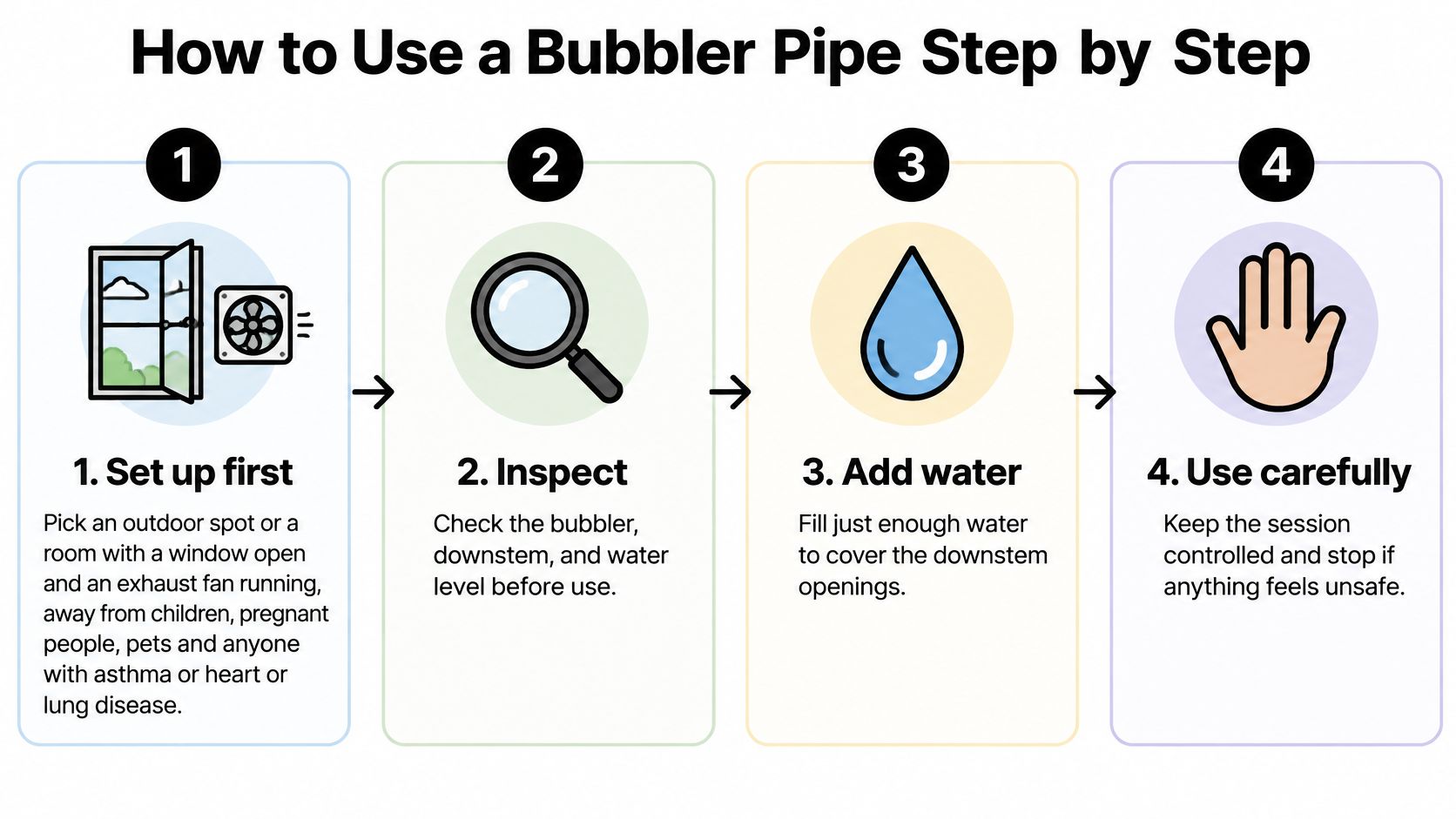
The reason to keep the fill line low is mechanical, not cosmetic. A controlled waterpipe study summarized by Cannabis Industry Journal found bubbling did not significantly reduce carbon monoxide, nitric oxide, polycyclic aromatic hydrocarbons, or dry particulate matter, although it reduced some other constituents. That study used tobacco rather than cannabis, so don't treat it as a direct cannabis risk estimate, but the filtration limits still explain why overfilling buys you splashback, not purification.
Practical rule: If you need a forceful pull to get bubbling, don't pull harder. Check the pack, the water level, and the diffuser first.
| Setting | Correct setting | Common mistake and result |
|---|---|---|
| Water level | Just covers the diffuser slits | Too high sends water into the mouthpiece |
| Bowl packing | Loose, airy pack | Packed tight blocks airflow and chars the top |
| Flame | Controlled, steady flame | Torch-style flame scorches the material and tastes harsh |
| Draw | Gentle, slow draw | Hard pulls drag ash and water toward the mouth |
| Water change | Fresh water after every session | Stagnant water collects residue and bacteria |
A working setup gives you steady bubbling, no gurgling into the mouthpiece, and no burnt taste from an overheated bowl. If any of those signs is missing, reset the piece instead of compensating with a stronger draw. These steps reduce avoidable harm. They don't make the session safe.
Why Water Does Not Make Smoke Safe
Many people assume cloudy water proves the harmful part stayed behind. It only proves some material entered the water. This close view shows the simple path smoke takes from bowl to mouthpiece.
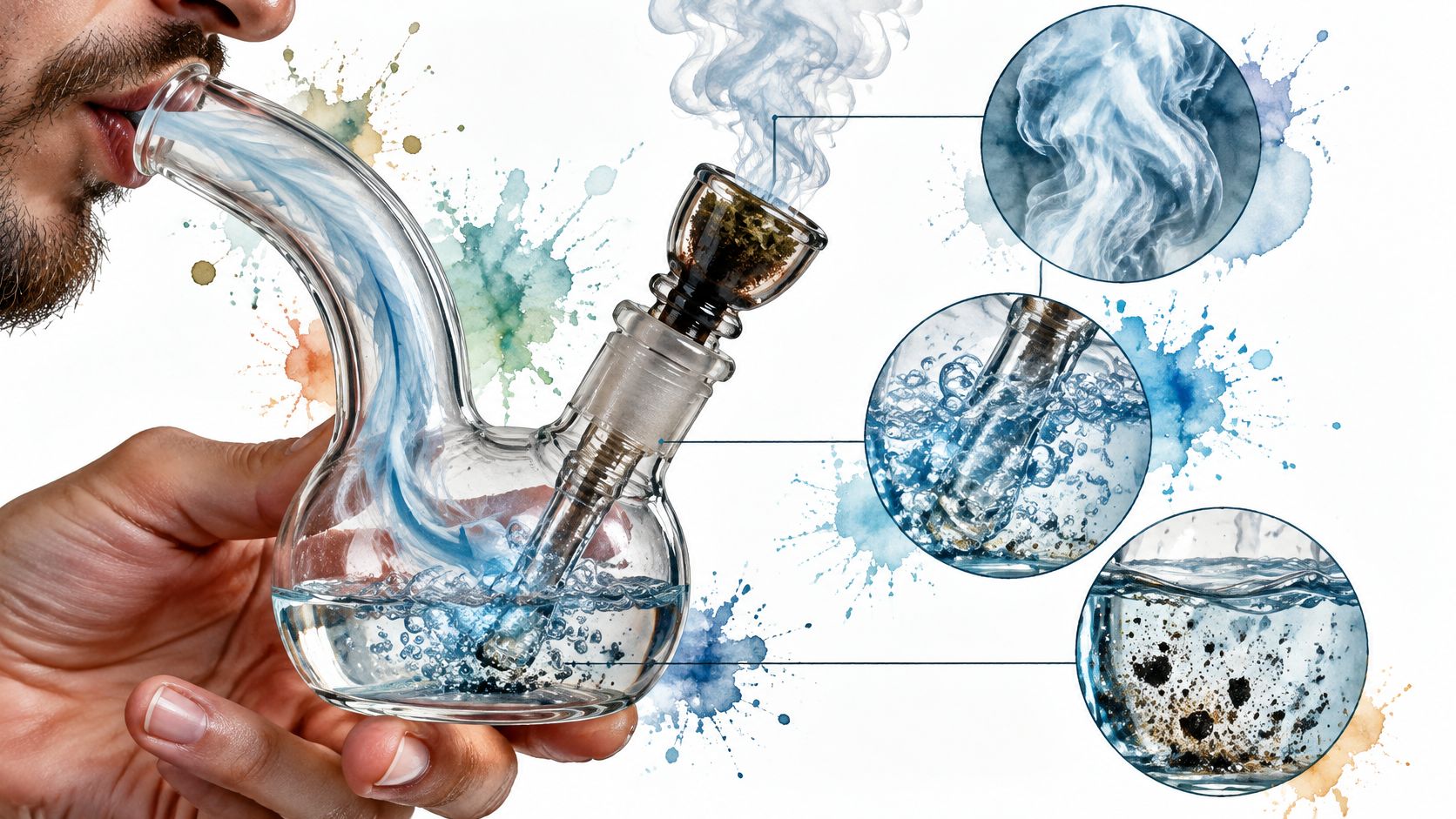
A bubbler works by diffusion. The downstem pulls smoke below the water surface and breaks the stream into bubbles, and smaller bubbles create more contact between smoke and water. The Treehouse bubbler buying guide explains that this helps cool the smoke and trap some heavier particles and ash, while most active smoke compounds do not dissolve meaningfully in water.
What Changes and What Does Not
- Temperature changes: Cooler smoke can feel less harsh on your throat.
- Some particles stay behind: Heavier particles and ash are more likely to be trapped.
- Intoxicating compounds remain: Water doesn't remove the main compounds that produce impairment.
- Combustion products remain: Cannabis smoke still carries many toxins, irritants, and carcinogens also found in tobacco smoke.
Say someone switches from a dry pipe to a bubbler because they believe it's the safer option. The first draw feels smoother, so they inhale longer and pack a second bowl sooner. Their throat gives them less warning, but their lungs still receive smoke linked to cough, mucus production, bronchitis, and damage to small blood vessels. That trade-off is the central trap, and it's also why effects such as dry mouth from weed shouldn't be judged by how gentle a draw felt.
Watch the bubbling action in the video below and notice how brief the water contact is.
The water changes how smoke feels. It doesn't change whether inhaled smoke is harmful.
Ventilation and Session Limits for Your Space
Smoke ignores the water in your chamber once it leaves the mouthpiece. A partner in the next chair, a pet asleep on the floor, a neighbor behind a shared wall: none of them chose the session, and the water does nothing for any of them. Controlled indoor measurements of bong sessions found fine particle levels climbing far above normal air and lingering long after the last draw.
Measurements reported in a CDC cannabis factsheet summary of indoor smoking research found average indoor PM2.5 concentrations of 1,300 micrograms per cubic meter during bong use, roughly 37 times the U.S. Environmental Protection Agency's 24-hour standard of 35 micrograms per cubic meter. A bubbler is smaller than most bongs, but it burns material the same way, and every exhaled draw adds to the room's load.
Devices differ widely in how much smoke escapes into the room while they burn. Indoor measurements ranked the common options roughly like this:
| Device | Smoke released into the room |
|---|---|
| Joint | Highest |
| Bong | High |
| Hand pipe | Moderate |
| Vape pen | Low |
| Tobacco cigarette | Lowest |
A bubbler sits in hand-pipe territory. The water changes nothing on this list.
Set Boundaries Before Lighting
Use the piece outdoors when you can, and treat every session as adults only, 21 and over. Indoors, run an exhaust fan pulling air out through an open window before the first draw, and keep children, pregnant people, pets, and anyone with asthma or heart or lung disease out of the space. Cars, shared hallways, and rooms adjoining someone else's living area are off limits entirely.
Keep the session itself short. Take a few small draws, stop rather than clearing a large bowl, extinguish the ember fully, and keep the fan running afterward. Never infer dose from a hit count, because potency, bowl size, temperature, draw volume, and inhalation depth each change what reaches your lungs. The broader principles behind psychedelic harm reduction apply here too: plan the setting, cap your intake, and protect the people nearby.
Ventilation is not what you add after the room fills with smoke. It has to be running before the first draw.
Vaporization may reduce carbon monoxide and exposure to several toxins relative to smoking, which is one reason vape pens sit low on the list above. It is not risk free, and it does not excuse exposing anyone nearby without their consent.
Cleaning, Water Changes and Sharing Rules
Resin is not just a flavor problem. It narrows air paths, changes bubbling, and makes you pull harder to get the same draw. Standing water adds a separate hygiene problem, so cleaning begins the moment the session ends.
Cleaning Sequence
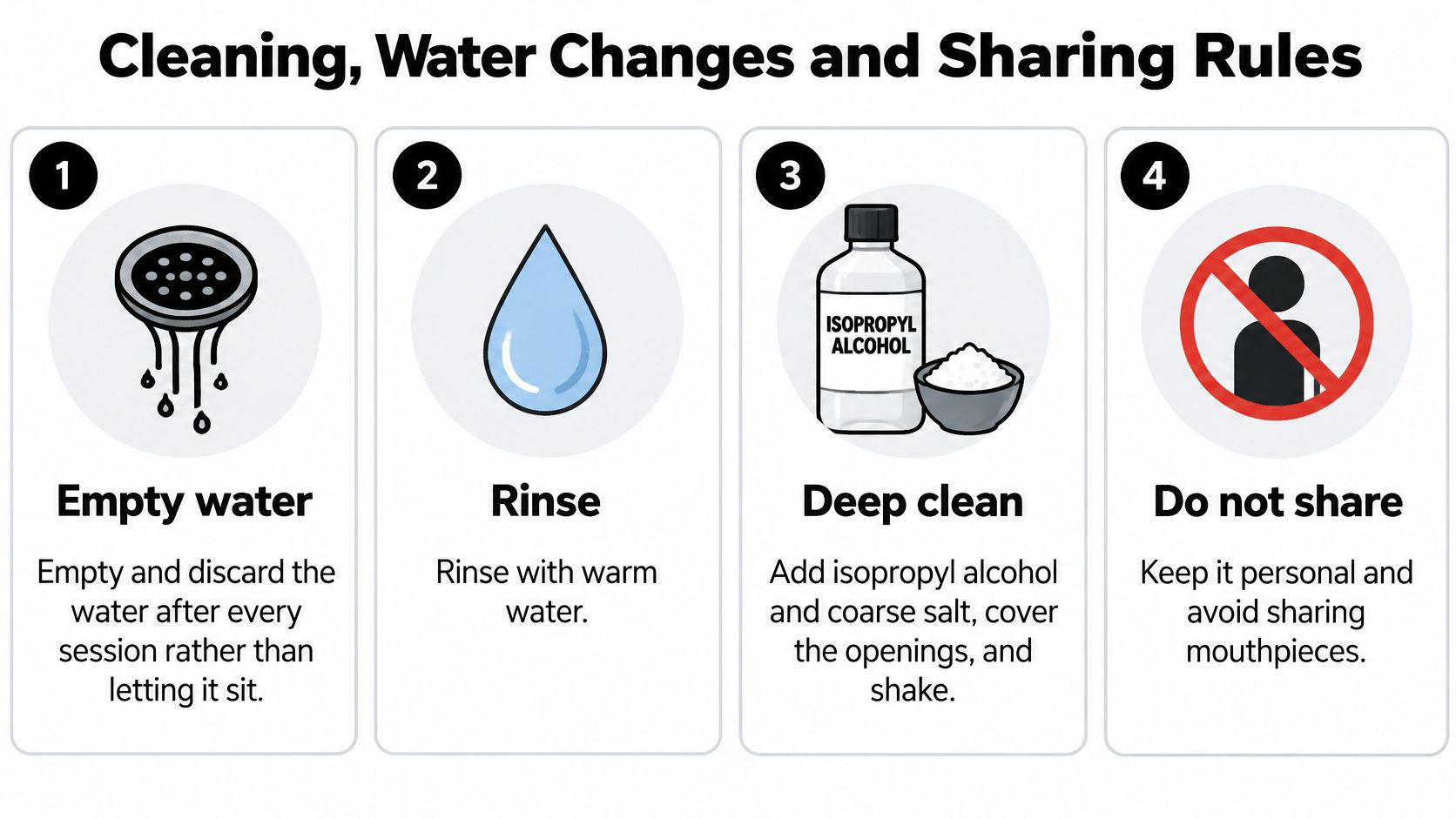
- Empty immediately: Discard the used water after every session rather than letting it sit in the chamber.
- Rinse warm: Rinse the bowl, chamber, and mouthpiece with warm water to loosen fresh residue.
- Soak and shake: Add isopropyl alcohol and coarse salt, cover the openings, and shake carefully over a sink.
- Wait and scrub: The GRAV cleaning guide recommends letting the solution sit for about 30 minutes before scrubbing remaining residue with a pipe cleaner or soft brush.
- Rinse and dry: Rinse thoroughly with distilled water and let the piece air dry before refilling it.
Pay special attention to the diffuser slits and tight corners. Residue there restricts airflow, creates uneven bubbles, and can make a correctly filled piece behave as if the water level is wrong.
Sharing needs a firmer rule than wiping the rim on your shirt. A peer reviewed harm reduction review identifies sharing paraphernalia for cannabis, tobacco, and crack use as a risk factor for respiratory bacterial and viral infections. Use a personal mouthpiece, clean mouth contact surfaces between users, and don't share at all while you are sick.
Material matters again during maintenance. Glass and ceramic tolerate routine cleaning and don't carry the same concern as heated plastic, which can release harmful chemicals.
After Cleaning Checklist
- Water discarded: No used water remains in the chamber.
- Airway clear: The bowl, downstem, and diffuser slits are visibly open.
- No cleaner left: The piece is fully rinsed and air dried.
- Mouthpiece ready: Your personal mouthpiece is clean and stored with the piece.
Confirm Your Setup Before Your First Session
A bubbler is a compact water pipe for adults who have already decided to use dried material responsibly. Adult use only, 21 and over, is the first go or no-go check, and that age rule settles the question before packing or water level ever come up.
Skip use entirely if you're pregnant, have asthma or heart or lung disease, or plan to drive or operate machinery afterward. Children and teens shouldn't use or be exposed to the device, and nobody nearby should receive second-hand smoke without consent. Combining cannabis with alcohol or other intoxicants makes impairment harder to judge, so keep the session to one substance.
The CDC cannabis FAQ reports that smoked cannabis can harm lung tissue and is associated with cough, mucus production, bronchitis, scarring, and damage to small blood vessels. Water in the chamber cools the draw and catches some ash. It does not remove what damages the lungs, and the people around you inhale what the water never touched. The setting matters as much as the packing technique.
Go or no-go test: If you can't use it outdoors or with strong ventilation, away from minors and nonconsenting people, with no driving afterward, postpone the session.
Before lighting, run the same pre-session steps from the step by step section until they become habit: fresh water at the right level, a lightly packed bowl, and a clear exit plan for the smoke. Afterward, store the piece and material locked away from minors. Damaged glass, stale water, a closed room, or a vulnerable person nearby each means no. Stopping is always an available choice.
If you're an adult 21 or over looking for mushroom products with clear education on responsible use, visit The Magic Mushroom Delivery to explore the range and read the guidance before you order. Choose discreet delivery, check the product details carefully, and make your setup and setting decisions before your first session.