Instant mushroom nootropic coffee generated an estimated USD 1.071 billion in 2025, according to DataIntelo's market analysis. That estimate describes a specific segment, not the entire mushroom-coffee category, but it reframes the buying decision: instant preparation isn't a fringe alternative to brewing. It's a major commercial format that deserves scrutiny on its own terms.
The useful question isn't whether instant, powder, brewed coffee, or capsules sound more functional. It's which product discloses enough information to compare mushroom milligrams, caffeine per serving, and extraction method. Preparation convenience matters, but it shouldn't substitute for knowing what you're drinking.
Instant, Powder, Brewed and Capsule Formats Compared
Mordor Intelligence estimated the global mushroom-coffee market at USD 1.25 billion in 2025, with projections of USD 1.40 billion in 2026 and USD 2.47 billion by 2031; instant formats represented 52.55% of 2025 sales, while North America accounted for 37.55%. Treat these as directional market estimates, not audited industry totals or evidence that any particular beverage works.
Mushroom coffee formats compared on preparation, solubility, caffeine and transparency
| Format | Preparation | Solubility | Caffeine per Serving | Ingredient Transparency |
|---|---|---|---|---|
| Instant mushroom coffee | Add hot water and stir | Soluble coffee dissolves; added ingredients may affect texture | Use the declared milligrams for the labeled serving | Look for mushroom extract milligrams and extraction method |
| Mushroom coffee powder | Stir the ground or powdered blend into hot water | Whole mushroom material can leave sediment | Coffee share alone doesn't establish caffeine content | Require separate amounts for coffee and mushroom material |
| Brewed mushroom coffee blend | Brew through a filter or press | Extracted liquid separates from grounds; a press can retain fines | Require a product-specific figure, not an ordinary-coffee assumption | A blend name without ingredient amounts leaves dose unclear |
| Mushroom coffee capsules | Run a single-serve pod through a compatible machine | Water extracts the contents; the pod doesn't necessarily contain soluble powder | Require a declared amount for the specified machine serving | Check extract amount, species, and form beyond the pod description |
The table is a buying checklist, not a laboratory ranking of unnamed products. An undisclosed value should remain unscored, rather than being replaced by an industry average.
Define the format before comparing it
Instant mushroom coffee combines soluble coffee with mushroom ingredients intended for direct mixing. Mushroom coffee powder is a broader description: a powder can contain extracts, finely ground material, or both. Check preparation directions rather than assuming every powder will dissolve.
A brewed mushroom coffee blend uses coffee grounds prepared through a filter or press. Capsules, in this comparison, means coffee-machine pods, not swallowed supplement capsules. Machine compatibility is part of the buying decision, not an incidental detail.
If you're comparing mushroom coffee powder with instant coffee, pay particular attention to whether the product is intended to dissolve or remain suspended. Stirring insoluble material more vigorously can disperse it, but it doesn't turn it into a soluble extract.
Rank disclosure before convenience
For measurable comparison, put products into an order:
- Most assessable: Individual mushroom milligrams, caffeine per serving, material form, and extraction details are disclosed.
- Partially assessable: Total mushroom material is stated, but individual amounts or processing details are absent.
- Least assessable: Only a blend name or total packet weight is available.
Any format can occupy any position. An informative pod label can outperform an opaque instant label, and a detailed powder label can be more useful than either.
Instant leads on equipment-free preparation. Brewed blends suit buyers seeking a conventional coffee ritual, capsules suit existing machine owners, and stirred powders suit people who accept sediment. The deciding criteria are preparation, solubility, caffeine, taste, ingredient transparency, and fit for your routine, not the format name alone.
Taste, Caffeine and Daily Convenience Compared
Taste and texture should be judged separately. A beverage can taste pleasantly roasted yet leave grit, or dissolve smoothly while tasting too sweet. Flavored instant lattes also aren't a fair sensory comparison with unsweetened brewed coffee.
For a useful home comparison, prepare each product at its labeled strength and taste it before adding milk or sweetener. Note roast character, earthy aftertaste, sweetness, and mouthfeel separately. Then add your usual milk and decide whether the drink still suits your routine.
Compare the finished cup
Instant formulations can taste lighter than brewed blends, while creamers and flavorings can make them feel fuller or obscure earthy notes. These are useful expectations to test, not dependable properties of every product. Brewed blends are the logical starting point if your priority is retaining the familiar character of ground coffee.
Solubility is easier to observe than flavor quality. Let the prepared drink stand briefly, then inspect the bottom of the cup. A layer of particles indicates suspended material, although the ingredient list is needed to identify what it is.
Paper filtration removes grounds more thoroughly than a press. Don't interpret a visually clear drink as proof of greater mushroom potency, or sediment as proof of a stronger dose.
Practical rule: Smoothness tells you about the drinking experience. It doesn't establish how much mushroom extract the serving contains.
Calculate caffeine from the actual product
The coffee component supplies caffeine; mushroom powder or extract doesn't cancel it. Coffee Studies' published comparison reports approximately 45–75 mg per serving, versus about 95 mg in an 8-ounce brewed coffee, with some higher-coffee formulations approaching 100 mg; using those figures, a hypothetical morning of three instant servings totals 135–225 mg, while three ordinary brewed-coffee baseline servings total about 285 mg.
That brewed baseline is not a measured value for brewed mushroom coffee. Substituting it for an undisclosed product figure would create false precision. Likewise, a larger mug doesn't necessarily mean more caffeine if you've merely added water to the same sachet.
A mushroom coffee caffeine guide is useful for distinguishing serving size from cup size. When tracking intake, record the amount of product used, not just the number of mugs.
For travel and offices, instant sachets remove the need for filters, grounds disposal, or a dedicated machine. Pods are convenient where a compatible machine is already available, but they're less portable across unfamiliar kitchens.
If caffeine limits matter most, choose the disclosed caffeine amount before choosing the format. Neither a mild taste nor a functional-mushroom claim is a reliable substitute.
How Instant Mushroom Coffee Is Made
Instant production separates extraction from the preparation you do at home. The manufacturer prepares the soluble components in advance, then removes water so the consumer can reconstitute them. However, not every ingredient in the finished blend necessarily follows the same processing route.
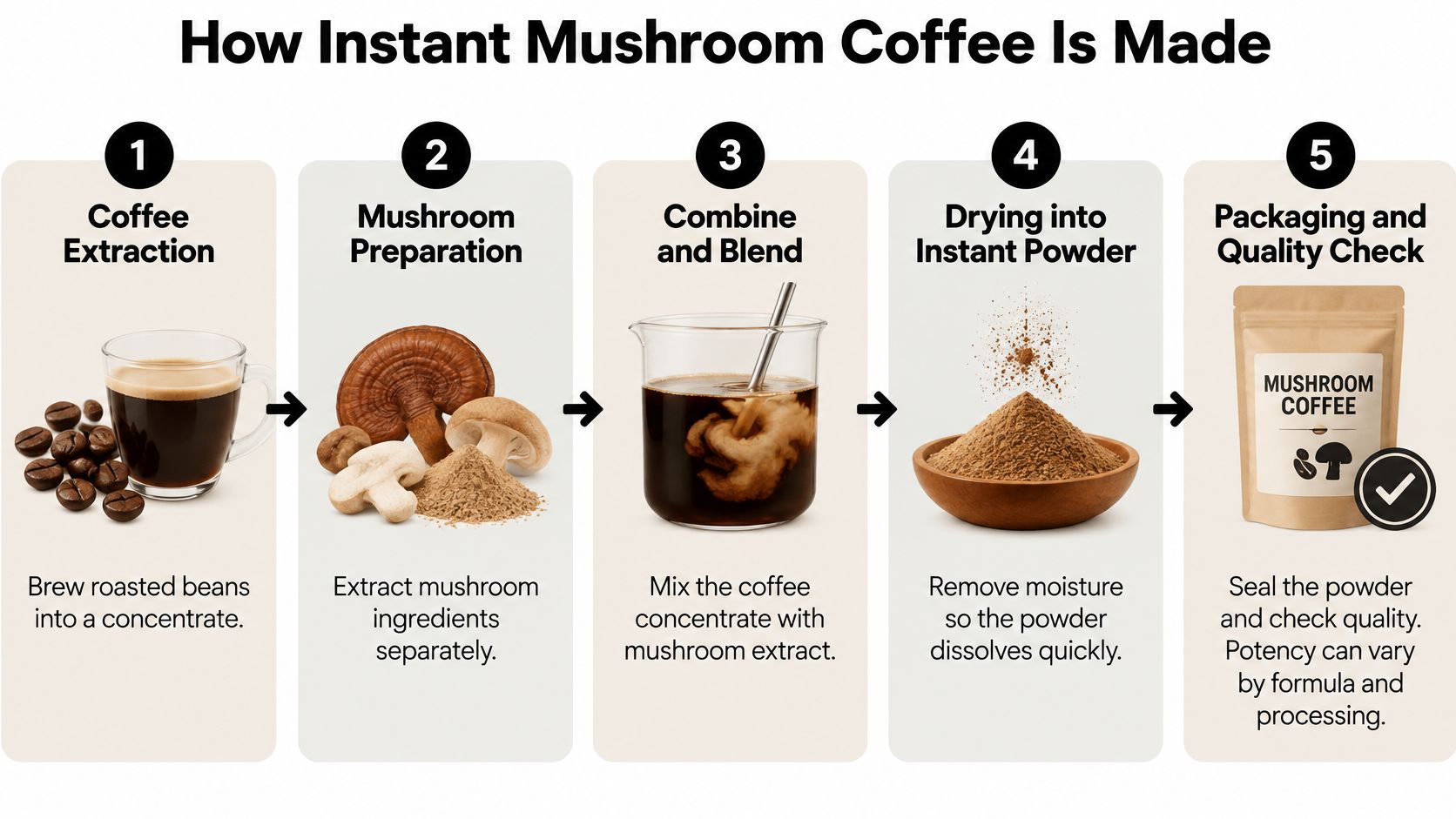
The production flow makes those distinctions easier to see.
From extraction to a dry blend
Extract the coffee. Roasted beans are brewed into a concentrated liquid, which is dried to produce soluble coffee. The manufacturer can use that dry coffee in a later blending stage rather than processing every ingredient together.
Prepare the mushroom ingredient separately. Mushroom material may be milled into powder or extracted using hot water or another solvent system. Those routes aren't interchangeable: whole-material powder and an extract have different compositions, even when the species name matches.
Combine the components. Coffee and mushroom ingredients are blended, sometimes with a carrier such as maltodextrin. Depending on the manufacturing route, blending can involve liquid concentrates before drying or already-dried ingredients afterward.
Remove moisture under controlled conditions. Drying affects powder handling and the measured retention of compounds. A manufacturer needs to select conditions for the particular formulation, rather than assuming that a drying method preserves every component equally.
Package and check the finished product. Sachets and jars provide a convenient delivery format, but their net weight includes the whole formulation. Coffee, carriers, creamers, and flavorings can all contribute to that weight.
What a drying benchmark actually establishes
A review of functional-mushroom food applications describes a Cordyceps militaris instant extract formulation containing 6% extract and 40% maltodextrin, convection-dried for 15 hours at 70°C, that achieved 97.274 micrograms per gram of cordycepin and a sensory score of 16.4/20.
That result is a development benchmark, not a specification every retail mushroom coffee should meet. Species, solvent, carrier, drying technology, and assay method can all change the result. Sensory acceptability also doesn't establish a human health benefit.
The distinction between extract weight and measured marker-compound content is especially important. A heavier serving doesn't automatically deliver more cordycepin, just as a larger amount of carrier doesn't represent a larger mushroom dose.
These manufacturing choices explain why drying conditions, carrier identity, and assay method are useful questions. Finished product weight alone can't reconstruct what happened during extraction and drying.
Reading the Label for Potency and Ingredients
A mushroom name is not a dose. The same name can describe different amounts, materials, and preparations. A label therefore needs to identify both what went into the beverage and how much the stated serving supplies.
Wellgard's assessment of mushroom coffee highlights the central problem: studies of individual ingredients use defined preparations and quantities, while proprietary blends can conceal the amounts needed to assess whether a beverage resembles those preparations.
Label fields that show whether a mushroom coffee has a real dose
| Label Field | Strong Label Shows | Red Flag |
|---|---|---|
| Mushroom species | Latin name for each species | Only the phrase mushroom blend |
| Form used | Fruiting body, mycelium, or extract stated | Form not disclosed |
| Amount per serving | Milligrams of mushroom material for each ingredient | Proprietary blend with no per-ingredient amounts |
| Extract ratio | Stated ratio alongside extraction details when applicable | Concentrated-extract claim without a ratio or method |
| Beta-glucan basis | Total or mushroom-derived content, with test method | General functional-mushroom claim without measurement |
| Caffeine per serving | Milligrams for the labeled serving | Caffeine not listed |
Audit the ingredient declaration
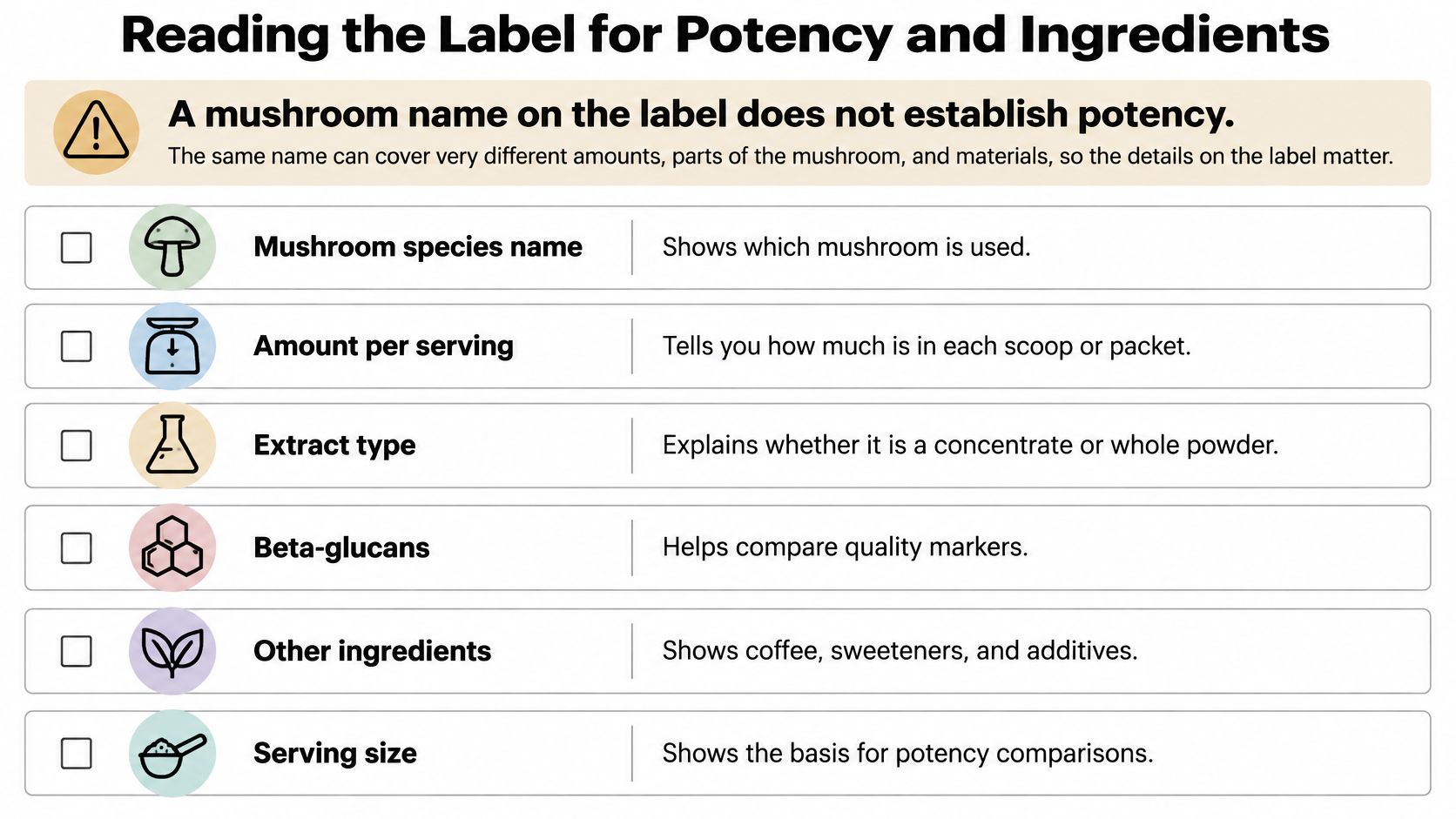
Identify each species by its Latin name. Common names are useful for shopping, but precise identification makes comparison with ingredient literature more defensible.
Find milligrams of mushroom material per serving, ideally separated by ingredient. Total beverage weight and total blend weight answer different questions. Neither tells you the contribution of an individual mushroom when the blend proportions are hidden.
Distinguish fruiting body from mycelium, then determine whether the ingredient is whole powder or extract. Record the extraction method and any stated ratio, but don't treat the ratio alone as a measurement of active compounds.
Check the beta-glucan basis and test method. Ask whether the figure describes the mushroom ingredient or the finished beverage, and whether it measures total or specifically mushroom-derived beta-glucans.
The label guide summarizes the fields to collect before comparing products.
Interpret measurements without overreading them
A review discussed by Dr. Ruscio reports mushroom beta-glucan content ranging from approximately 3.1% to 46.5%, depending on species, growing conditions, and maturity. That breadth makes a stated percentage and its analytical basis more useful than a generic functional-mushroom description.
Even a measured percentage needs context. The percentage of a mushroom ingredient isn't automatically the percentage of the finished coffee. A batch report should identify the tested material clearly enough that you can connect the result to the labeled serving.
A transparent label makes a product assessable. It doesn't, by itself, prove that the dose produces a clinical benefit.
Read the complete mushroom coffee ingredients declaration, including carriers, sweeteners, and creamers. For deeper evaluation, request drying conditions, carrier details, assay methods, and batch-level identity and marker-compound results.
Finally, keep evidence for lion's mane, reishi, cordyceps, and chaga separate. A finding about a defined preparation of an individual mushroom doesn't establish that a mixed coffee has the same effect.
Which Format Fits Travelers, Novices and Wellness Users
| Reader | Best Format | Why It Fits | What to Check |
|---|---|---|---|
| Travelers | Instant sachets | No brewing gear, mixes with hot water, packs light | Caffeine per serving and total daily intake |
| Novices | Single-serve instant sachet | Low-commitment way to evaluate taste and response | Caffeine figure, ingredient identity, and taste before a larger order |
| Wellness users | Brewed blend or coffee-machine capsules with disclosed extract | Can provide a defined mushroom input when documentation is complete | Species, form, and milligrams per serving |
Use the format comparison as a starting point, then let the individual label determine whether the product qualifies.
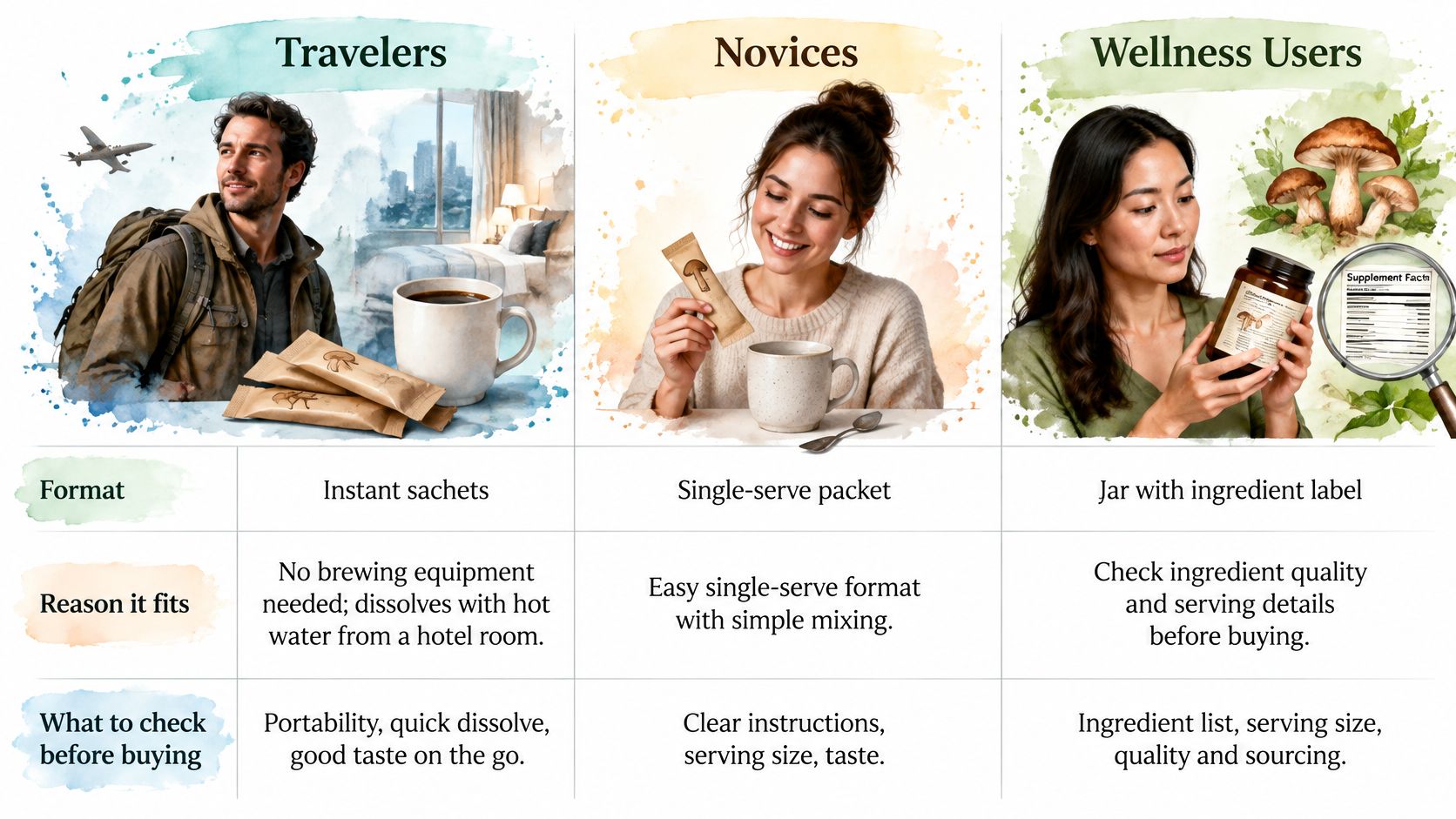
Match the recommendation to the situation
Travelers benefit most from equipment independence. A hotel kettle and mug are enough for a suitable instant formulation. Before packing, confirm that preparation requires only the equipment you'll have, rather than a blender or frother you plan to leave behind.
For novices, a small purchase reduces the commitment to an unfamiliar flavor or texture. Prepare only the labeled serving and avoid treating a stronger scoop as a better introduction. Don't introduce several new supplements at the same time if you want to understand which product you tolerate.
Wellness-focused buyers should prioritize documented input, not a preferred brewing ritual. A brewed blend or machine pod with disclosed extract can be a reasonable choice, but it does not automatically offer more control than an equally transparent instant product. For brewed products, distinguish the mushroom amount added to the grounds from the amount demonstrated to reach the cup.
That distinction prevents a misleading ranking: ingredient loading is measurable, but extraction into the final beverage may remain undocumented.
Set expectations at the beverage level
Yahoo's nutrition reporting notes that no large clinical-trial evidence has established that a particular multi-mushroom coffee blend improves cognition, immunity, or mood at typical sachet doses. Studies of isolated mushrooms or beta-glucans can't automatically establish the effects of a finished drink with a different species mix, extraction method, and coffee-to-mushroom ratio.
A sensible expectation is therefore a beverage that fits your taste and preparation preferences, with any wellness rationale remaining preliminary and ingredient-specific. Feeling alert after drinking coffee doesn't isolate an effect from the mushrooms.
For an additional perspective on mushroom coffee, the following video can supplement your reading without replacing product documentation.
If you take medication, are pregnant, or have heart-rhythm concerns, anxiety, or caffeine sensitivity, discuss the complete ingredient list with a clinician before use. The Consumer Trends food and wellness report underscores why product-specific caffeine disclosure matters when consumers combine these drinks with other caffeine sources.
A convenient format can simplify preparation. It can't resolve an interaction question or compensate for missing ingredient information.
Choose Your Format and Verify the Label
Make the purchase in a deliberate order: format first, documentation next, caffeine calculation after that, and price last. This prevents an appealing flavor, package, or discount from becoming a substitute for an assessable product.
A practical purchase sequence
Choose for the task you're solving. Use instant for equipment-free preparation, a brewed blend for a conventional coffee experience, and coffee-machine capsules for equipment you already own. Choose stirred powder only if you're comfortable with suspended particles. When browsing mushroom coffee instant options, read the preparation directions before assuming the product behaves like plain soluble coffee.
Apply the ingredient audit as a pass-or-fail screen. Record species, material form, mushroom milligrams, and extraction information on the same comparison sheet. Reject a product for dose-based comparison if it gives only a blend name, a broad functional claim, or no mushroom milligrams per serving. Missing information doesn't prove poor quality, but it prevents a defensible assessment.
Calculate the caffeine you plan to consume. Multiply the labeled caffeine per serving by your intended servings, then add other coffee, energy drinks, and pre-workout products. Keep serving size consistent with the manufacturer's declaration. If caffeine isn't disclosed, don't substitute the amount from another brand or assume that the mushroom addition makes it low-caffeine.
Keep health decisions separate from beverage preferences. Match any ingredient claim to the preparation studied, and consult a clinician when medication use or caffeine-sensitive conditions make the choice more consequential. Don't use a coffee purchase as a replacement for evaluating persistent fatigue, anxiety, or other symptoms.
Compare price only after the product qualifies
Our Magic Mushroom Instant Coffee 22 Grams – Vanilla Latte costs $65.00. That size and flavor identify the product, but package weight alone doesn't establish mushroom extract content, caffeine per serving, or the number of appropriate servings.
Use the same standard for every seller: compare cost only when the serving basis and relevant ingredient amounts are clear.
Buying standard: An inexpensive packet with an undisclosed dose isn't demonstrably better value than a documented product.
Keep the final shortlist small and evidence-led. Choose the drink you can prepare consistently, whose ingredients you can identify, and whose caffeine you can account for without guessing.
We offer mushroom coffee alongside other mushroom product categories, including the Vanilla Latte instant format. Visit The Magic Mushroom Delivery to review the coffee listing, then use the ingredient and caffeine checks above before deciding whether it fits your routine.