
You're halfway through a cup of mushroom coffee and still asking the same blunt question: does this solve the thing you wanted, or are you just drinking a trend in a mug? Many people don't need another wellness label. They need a better match for the problem they're trying to fix, whether that's less caffeine, calm focus, or functional mushroom support without the hype.
A smart mushroom coffee alternative starts with the goal, not the brand. If you want less stimulant load, you should be looking at chicory, dandelion, decaf, or grain-based drinks. If you want steady alertness, a low-jitter caffeine option like matcha may beat most mushroom blends. If you want the mushroom compounds themselves, then the label matters more than the flavor, because the evidence for the finished beverage is still limited compared with the research on individual ingredients Healthline's overview of mushroom coffee.
What You Actually Want from a Mushroom Coffee Alternative
The fastest way to waste money in this category is to shop by vibe. People say they want a mushroom coffee alternative, but they're usually chasing one of three different outcomes.
Less caffeine without giving up the morning cup
If your real issue is jitters, afternoon crashes, or sleeping badly after coffee, don't overcomplicate it. You need a drink that clearly lowers caffeine, and the cleanest answer is often decaf, chicory, dandelion, or barley-based coffee substitutes. Mushroom blends can still contain coffee, so “mushroom” doesn't automatically mean calmer.
Calm focus without feeling wired
If you still want to work, think, and stay sharp, but without that overcooked coffee feeling, you're in a different lane. That's where low-jitter choices like matcha or a careful mushroom routine with transparent dosing can make sense. The point isn't to chase the loudest energy claim. It's to get a steadier morning.
Practical rule: if you're buying something to feel calmer, start by checking whether the drink is actually coffee-free, not just marketed as functional.
Functional mushroom support in a usable format
Some shoppers don't care about replacing coffee at all. They want lion's mane, chaga, reishi, or cordyceps in a format that fits daily life. For that goal, the better choice may be a labeled powder, capsule, or tea rather than a sweetened ready-to-drink product that hides the dose.
That's the filter I'd use here. Don't ask which product is trending. Ask which goal you're trying to hit, then match the drink to that goal.
Where Mushroom Coffee Comes From and Why Alternatives Exist
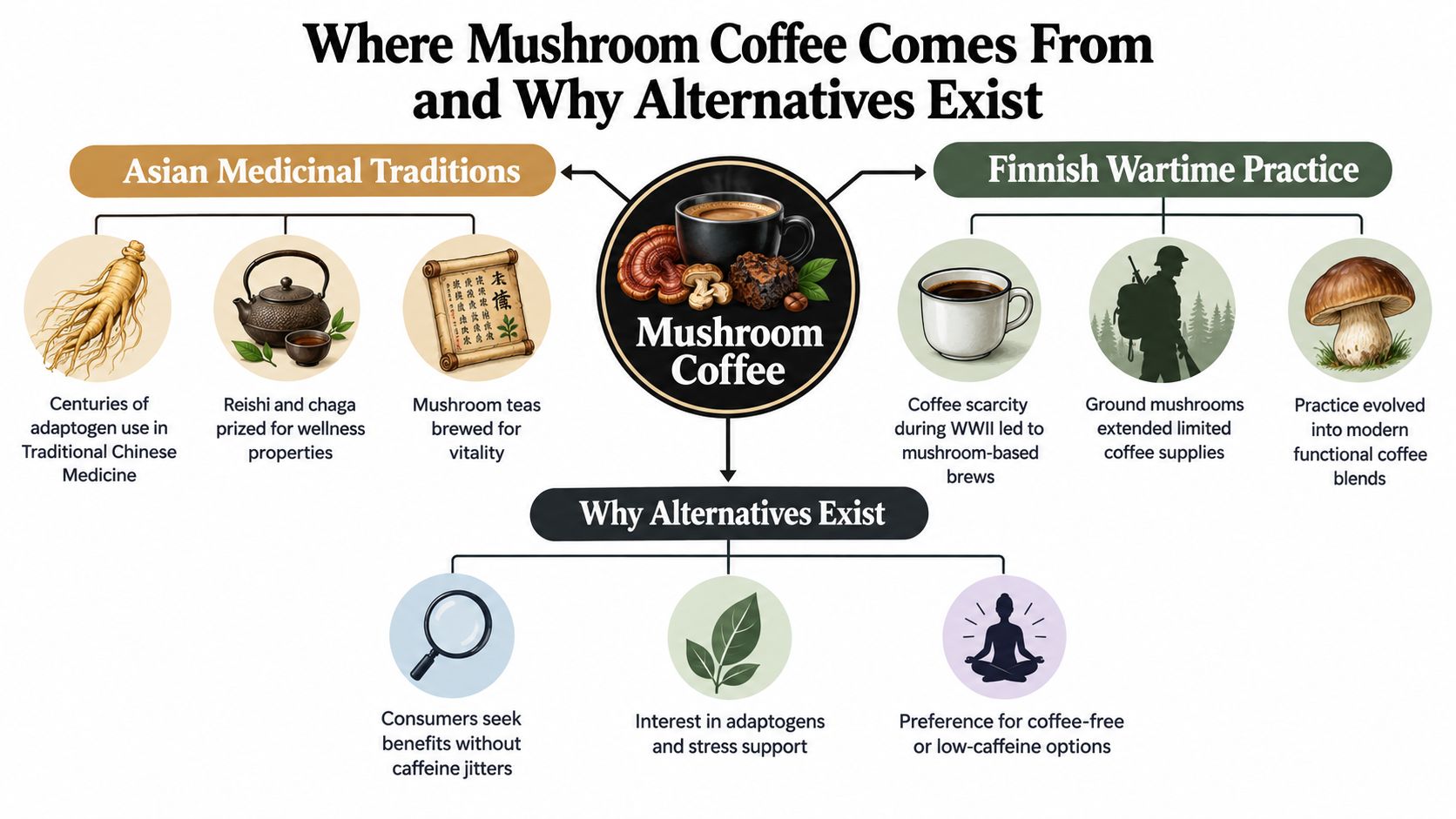
Mushroom coffee is not a brand-new wellness trend. Its roots go back to Asian culinary and medicinal mushroom traditions, especially within Chinese medicine, and to Finland during World War II, when mushrooms were used as a coffee substitute because beans were hard to get Healthline's history summary. That history explains why the category feels familiar even though the ingredients are unusual.
The modern version usually blends coffee with extracts or powders from lion's mane, chaga, reishi, or cordyceps. Those mushrooms do not all do the same thing, and they do not all have the same evidence behind them. A drink can borrow traditional language without delivering the same effect in a finished cup.
The coffee part still matters
Most mushroom coffee is still coffee. That means the stimulant question is still there. If a product keeps the beans in the formula, it may be a softer coffee, not a coffee-free swap. If you are trying to cut caffeine, that distinction matters.
A lot of buyers think they are choosing between coffee and mushrooms. The practical choice is usually between coffee plus something, mushroom support without coffee, or a completely different caffeine strategy.
That's why alternatives exist in the first place. Some people want the ritual of a warm mug. Some want the mushroom compounds. Others want a drink that feels like coffee without the buzz. Those are three different products wearing one category label, and the ingredient list usually tells you which one you are buying.
Functional Mushroom Formats Beyond Coffee
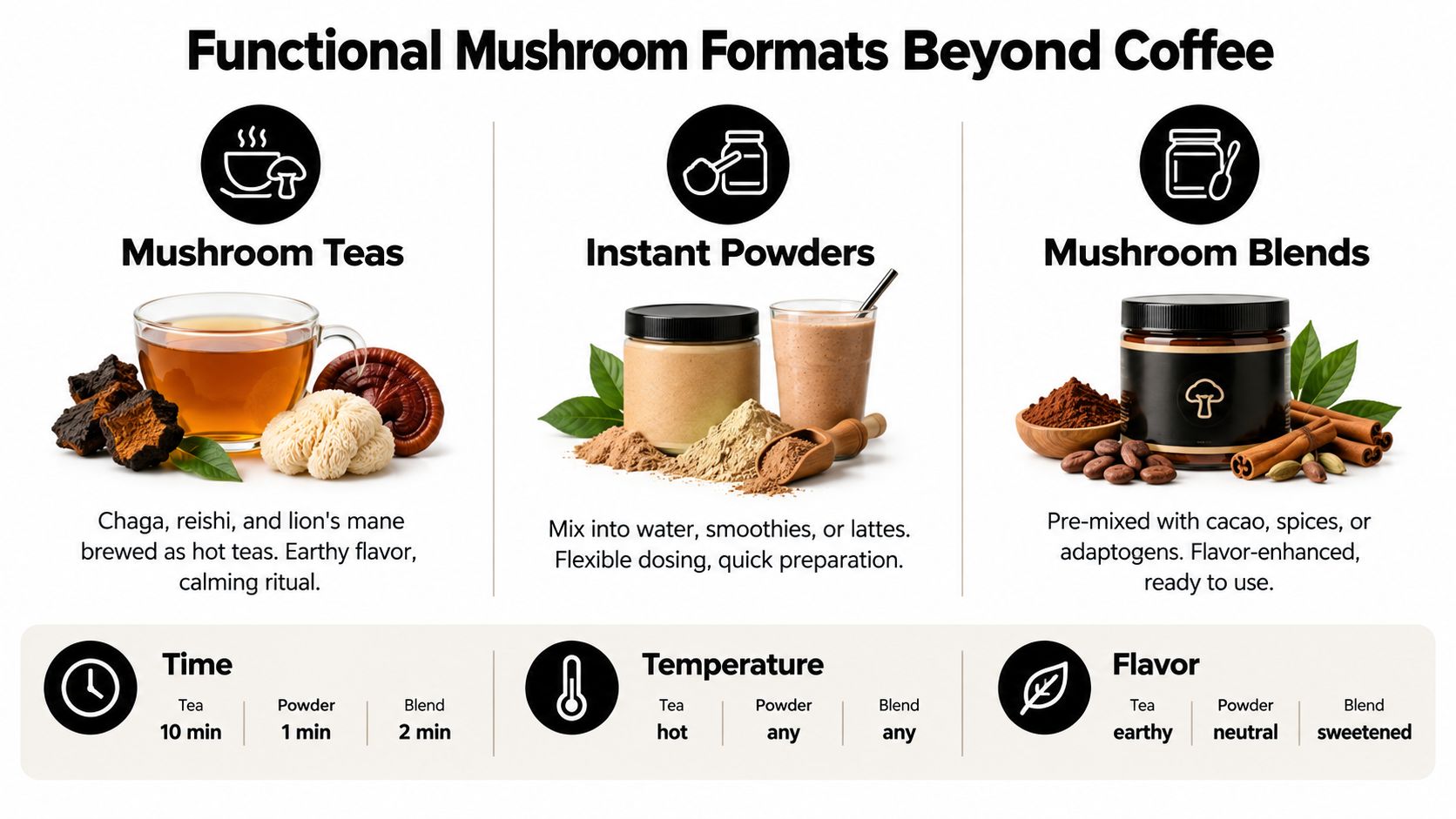
If you want the mushroom side of the category without the coffee base, the format matters as much as the species. Teas, powders, capsules, and tinctures all solve different problems, and none of them is automatically better than the others.
Tea for ritual, powders for convenience
Mushroom teas are the most obvious replacement for a morning cup. Chaga, reishi, and lion's mane teas tend to lean earthy and mellow, which makes them better for ritual than for speed. They're easy to sip, but they're not ideal if you want exact dose control.
Instant powders are the opposite. You can mix them into water, milk, or a latte base, and they're usually the most flexible option for busy mornings. If you want a format that behaves a little more like coffee, this is the one to start with.
Capsules and tinctures for precision
Capsules make the dosing simple. That's the main reason to use them. You give up the drink experience, but you get cleaner dose control and less guesswork, which is useful if you're comparing different products or trying to keep your routine consistent.
Tinctures sit in a different lane. They're less about replacing coffee and more about fast, small-format use. For people who don't care about taste, they're practical. For people who want a morning ritual, they're usually a miss.
This functional mushroom product page is a useful place to compare formats if you're deciding between powders and other mushroom-based options.
What to expect from the experience
Taste is the big trade-off. Teas feel grounded and slow. Powders are faster and usually easier to customize. Capsules are the most boring and the most precise. Tinctures are the most detached from the drinking ritual altogether.
If you want one clean rule, use this. Choose tea for mood, powder for flexibility, capsule for dose control, tincture for convenience. That's the format map most shoppers need.
Non-Coffee Adaptogen and Coffee-Style Drinks
The key question is what your 8 a.m. cup needs to do. If you want coffee flavor without the buzz, mushrooms are only one option, and they are not always the best match.
Matcha for low-jitter focus
Matcha is the cleanest pick when you want caffeine with a softer edge. It still contains stimulant effects, but the experience is usually smoother than coffee. That makes it a better choice for people who want alertness without feeling pushed around by it.
If you want a morning drink that feels intentional and steady, matcha fits.
Chicory and dandelion for true coffee substitutes
If you want a dark, roasted mug with no caffeine, chicory is the obvious place to start. Dandelion root blends sit in the same lane, though the flavor runs a little more herbal and less café-like. Both work well for people who want to leave caffeine behind instead of just trimming it back.
Chai and grain drinks for warmth and routine
Masala chai works when you want spice, warmth, and a familiar hot-drink ritual, even if it does not taste much like coffee. Grain coffees, including barley-based drinks, give you a toasty cup that feels close to coffee without relying on mushrooms at all. They are especially useful later in the day, when you want comfort without stimulant spillover.
The internal link adaptogenic mushroom benefits is worth checking if you want to separate real mushroom use from marketing language.
My blunt take: if the goal is lower caffeine, chicory, dandelion, or decaf usually beat mushroom coffee on clarity. If the goal is calmer energy, matcha usually beats it on consistency.
For an 8 a.m. cup, pick matcha for steady caffeine, chicory or dandelion for zero caffeine, and chai or barley drinks for ritual without mushrooms.
Dosing and Effects at a Glance
The category gets a lot easier once you stop treating every product like the same thing. Dose, caffeine, and caution all change depending on the ingredient, the format, and whether the product still contains coffee.
| Alternative | Typical Serving | Caffeine | Reported Effect | Main Caution |
|---|---|---|---|---|
| Lion's mane | Varies by product | None on its own | Often chosen for focus support | Human evidence is still limited for the finished beverage |
| Chaga | Varies by product | None on its own | Often used for a wellness routine | Oxalate content can matter for kidney concerns |
| Reishi | Varies by product | None on its own | Often chosen for evening calm | Can feel too sedating for some people |
| Cordyceps | Varies by product | None on its own | Often linked with energy support | Check the blend carefully, because combinations vary |
| Matcha | A tea serving | Contains caffeine | Steadier alertness than coffee for many people | Still a stimulant, so timing matters |
| Chicory | A mug of brewed chicory | Caffeine-free | Coffee-like roast without the buzz | Flavor is not identical to coffee |
| Dandelion | A mug of brewed root blend | Caffeine-free | Herbal, roasted substitute for a coffee habit | Can be more bitter than expected |
The biggest mistake is stacking products without thinking through the math. A reishi evening tea and a morning matcha can make sense if you want calm later and focus earlier. A mushroom coffee that still contains coffee plus a second stimulant drink can easily work against the exact thing you were trying to fix.
The other mistake is assuming ingredient research and beverage research are the same thing. They're not. A mushroom can be interesting on its own, but that doesn't automatically make a processed drink a proven daily tool.
Low dose feels subtle. Standard dose feels noticeable. If you're buying a new format, start there and don't expect a miracle from the first mug.
Reading the Label Before You Buy
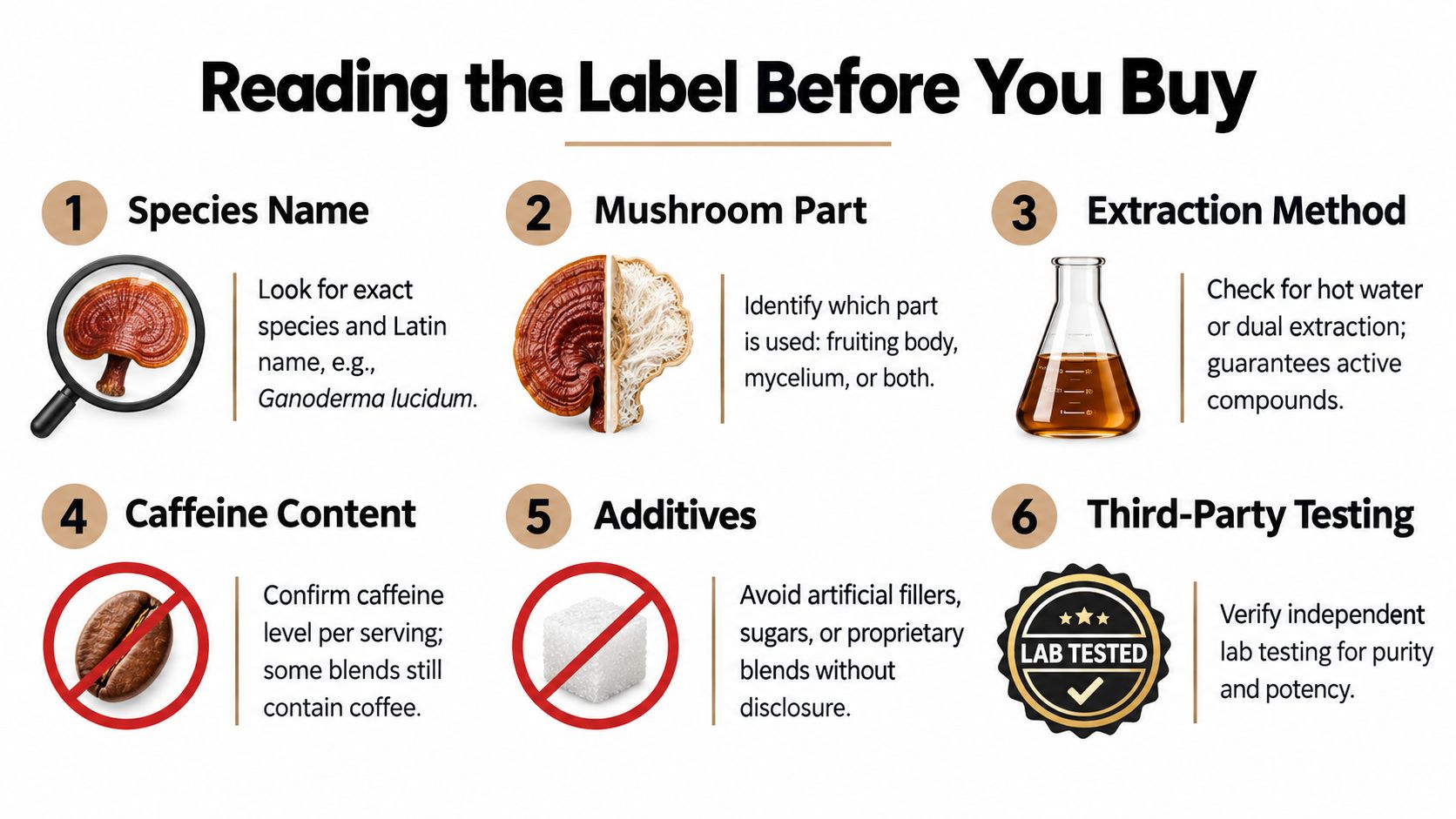
A pretty jar can still hide a weak formula. If the label does not name the species, the mushroom part, and the dose, you are guessing.
The six things that matter
- Exact species name: Look for the common name and the Latin name. “Mushroom blend” tells you almost nothing.
- Mushroom part used: Fruiting body and mycelium are not the same thing, and the label should say which one is inside.
- Extraction method: Hot water extract and dual extract are different. If the brand will not say, you are missing key information.
- Caffeine per serving: If it is a mushroom coffee alternative, you need the actual caffeine number, not a vague “low caffeine” promise.
- Additives and blends: Avoid products that hide everything inside a proprietary blend when they do not disclose individual amounts.
- Third-party testing: Independent testing is the clearest check on purity and potency.
If you want to compare a product quickly, start with the Supplement Facts panel and the ingredient list, not the front label. FDA dietary supplement labeling guidance explains why the burden is on the buyer to verify what is inside FDA dietary supplement labeling guidance.
What to watch for on mushroom labels
The fungus part matters because a label should distinguish mushroom and mycelium FDA fungal ingredient labeling material. If a seller names only a species and skips the part used, you still do not know what you are buying.
Proprietary blends create the next problem. FDA ingredient labeling guidance allows a blend to list one total amount without breaking out every ingredient separately FDA ingredient labeling guidance. That makes side-by-side comparison messy, especially when several mushrooms appear in one formula.
For a practical check, use this mushroom coffee ingredients guide before you buy and compare the dose, extract type, and caffeine disclosure against the label in front of you.
The Minnesota Department of Agriculture also says mushroom supplements do not get FDA premarket review and that labels should identify each mushroom type and the part used consumer guidance on mushroom product safety.
A label I trust answers five questions fast. For example, prefer “Lion's mane (Hericium erinaceus), fruiting body, hot-water extract, 500 mg per serving, 0 mg caffeine, third-party tested” over “mushroom blend, low caffeine.”
Matching the Alternative to Your Goal
Start with the outcome you want, because the right format depends on the job. A drink designed for a morning ritual will not necessarily deliver a meaningful mushroom dose, and a supplement may not satisfy a coffee habit.
For calm focus, choose matcha first if you tolerate caffeine. Its stimulant experience is more predictable than a vague mushroom-coffee blend. If you want mushroom support too, add a clearly labeled capsule or powder so you can assess that ingredient separately from a sweetened drink.
For the functional mushroom angle, choose a clearly labeled dual-extract powder or capsule. This format gives you better control over the serving and makes the product easier to compare with other options. Review the adaptogenic mushroom benefits guide for background, then check whether the product's stated purpose matches the mushroom and extract details on its label. The Magic Mushroom Delivery also sells a coffee-format mushroom product alongside other mushroom items.
If your priority is coffee flavor without the buzz, choose grain coffees or herbal chai. They preserve more of the roasted or spiced ritual than many mushroom drinks, without requiring you to accept an unclear caffeine trade-off.
For less caffeine, judge the replacement by how well it fits your existing routine. A familiar flavor, easy preparation, and transparent ingredients will make the switch easier to sustain than a trend-led drink with claims you cannot evaluate.
The recommendation is straightforward: match the format to the goal, not the trend to the label.
A Two-Week Plan to Test Your Switch
Write down the one thing you're trying to change, caffeine reduction, calm focus, functional mushroom support, or coffee flavor. Put that goal next to your kettle or coffee maker before you buy anything. Then choose one product that fits that goal and put it through the label audit.
For the next two weeks, replace one cup a day with the new option. Track sleep, energy, and digestion, because those are the signals that tell you whether the switch works for your body. Don't judge it on day one, and don't let marketing do the talking.
If the label is vague, skip it. If the goal is wrong, skip that too.
The Magic Mushroom Delivery carries a coffee-format mushroom product, plus a broader mix of mushroom items that fit different routines and tolerance levels. If you're comparing alternatives and want a place to browse mushroom drinks and related products in one spot, visit The Magic Mushroom Delivery and read the labels before you buy.