
Single-serve mushroom coffee K-cups usually deliver about 50–100 milligrams of caffeine and roughly 500–2,000 milligrams of combined mushroom ingredients per pod. They're a delivery format, not a clinical treatment, so the key question is how much mushroom content survives brewing, how the label describes it, and what happens after the cup is empty.
That matters the moment you're standing in your kitchen with a brewer already warm and a box of pods in hand. One product can look like a simple coffee swap and still hide a lot of moving parts, from dose to extraction to disposal.
| What to check | Why it matters |
|---|---|
| Mushroom species and form | Tells you whether you're buying an extract or just vague “mushroom blend” language |
| Brew volume | Changes concentration, so the same pod can taste stronger or weaker |
| Label type | Shows whether the product is being sold as a dietary supplement |
| Waste handling | Affects whether the used pod is actually recyclable or compostable in your area |
What Mushroom Coffee K-Cups Are

A mushroom coffee K-cup is single-serve coffee reformulated with functional mushroom ingredients. The format is built for convenience first, and it should not replace a clinically validated treatment. What makes it worth examining is the way it combines a fixed serving, a short brew cycle, and wellness-style labeling in one pod.
The pod format did not appear by accident. It fit an existing habit, because single-serve coffee had already become a large category, with pods taking 41.2% of U.S. ground-coffee dollar sales in 2014 and household ownership reaching 40% in 2020 coffee pod market data.
Why the pod format became the obvious container
Once households already had compatible brewers, brands did not need to teach buyers a new routine. They could place a mushroom blend into the same button-press ritual and keep the experience familiar.
That matters for label reading. A pod can be marketed like coffee, but the contents may still be closer to a supplement-style product, especially when the package describes extracts, blends, or other functional ingredients. A useful companion read on functional mushroom coffee products can help you compare how the category is presented.
Practical rule: If the package reads like a supplement, treat it like a supplement, even if it brews like coffee.
The installed base also explains the format's spread. By 2020, there were more than 25 million Keurig and K-Cup brewers installed in U.S. homes and offices coffee pod market data. That is why mushroom coffee companies keep targeting K-cups. They are meeting buyers where the brewer already sits on the counter.
Capsule Versus Pod Differences That Matter
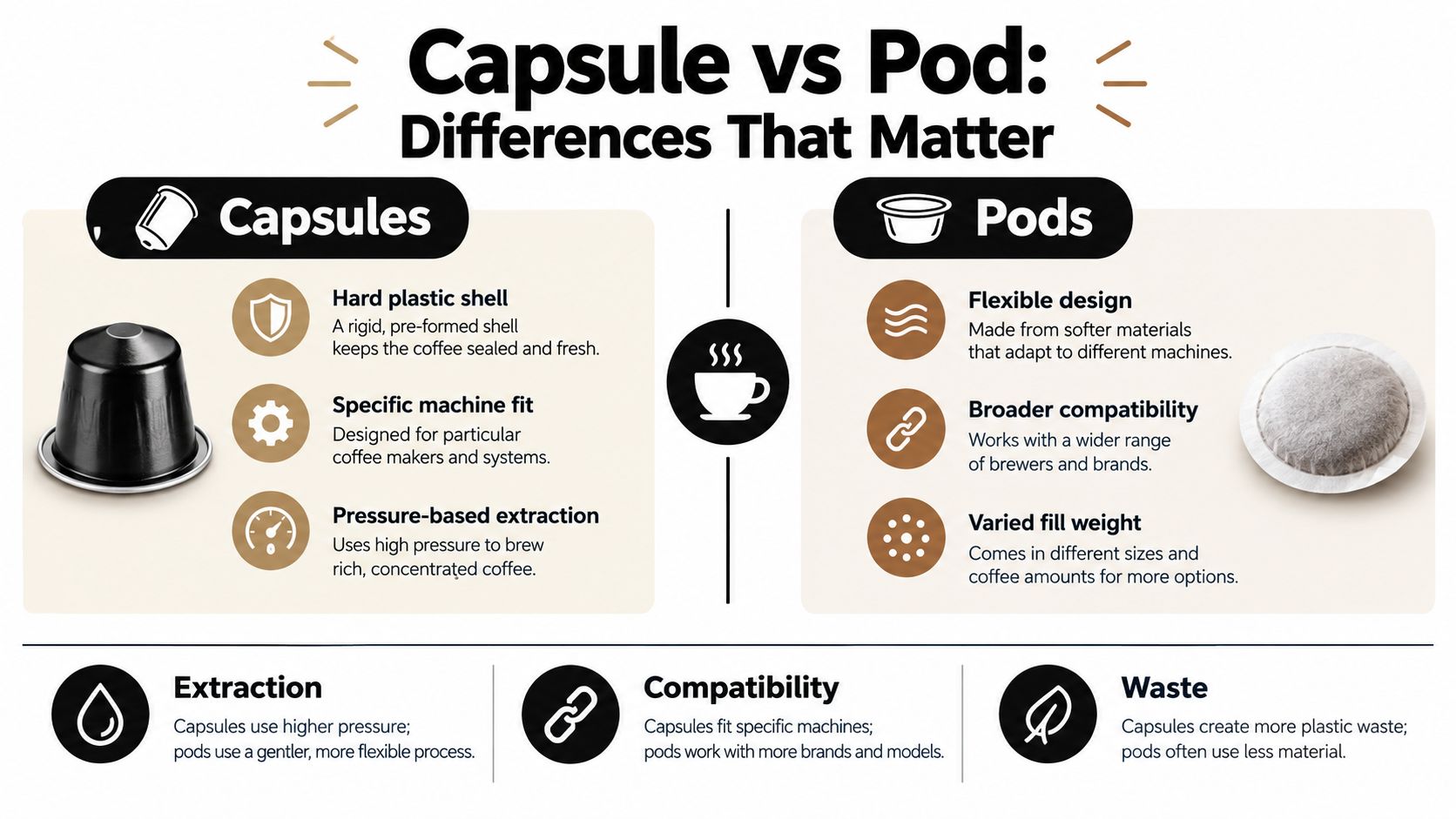
People often use “capsule” and “pod” as if they mean the same thing, but they don't behave the same in practice. A capsule is usually a sealed, machine-specific unit, while a pod is often a looser format built around filter material and broader compatibility. For mushroom coffee, that difference matters because the ingredient mix can include fine extracts, powders, and sometimes added sweeteners or adaptogens, all of which respond differently to filtration and pressure.
What changes in the cup
A harder shell can protect the contents and keep the brew path more controlled. A more flexible pod can be simpler to fill, but it can also leave more room for sediment if the material inside isn't finely processed.
That's where buyers get tripped up. They assume the packaging is just a container, when it's part of the extraction process. If the filter is loose, the grind is coarse, or the blend contains heavy particles, the result can taste thin or gritty rather than clean and balanced.
Compatibility is only half the story
Machine fit matters, but so does how evenly the pod handles hot water. A product that slides into the brewer easily can still underperform if the filling method wasn't designed for a fast, hot cycle.
A pod that fits the machine isn't automatically a pod that performs well.
For readers comparing product types, the distinction is easier to see in capsule-specific products like best mushroom capsules, which follow a very different logic from brew-through coffee pods. The takeaway is straightforward, packaging affects extraction, and extraction affects both taste and how much mushroom material ends up in the cup.
How Brewing Temperature and Volume Change Potency
A Keurig system manual specifies brew water around 187–192°F and selectable cup sizes of 5.25, 7.25, and 9.25 fluid ounces Keurig manual. The practical lesson is simple, the pod dose stays fixed while the water volume changes, so the drink gets more diluted as the cup size grows.
| Brew Size Impact on Concentration | Relative Concentration | Best For |
|---|---|---|
| 5.25 oz | Highest | Stronger flavor and the most concentrated serving |
| 7.25 oz | Moderate | Balanced everyday use |
| 9.25 oz | Lowest | Larger mug, lighter taste |
A larger cup is not weaker because the pod changed. It is weaker because the same material is spread through more water, the way one spoon of syrup tastes stronger in a small glass than in a large one.
Why the biggest cup can feel weak
If the dose inside the pod stays the same, a bigger brew size stretches the drink farther. Because the same dose disperses in 9.25 oz instead of 5.25 oz, concentration drops to roughly 57% of the small-cup serving. That is another way of saying the larger cup has about 43% less dissolved ingredient concentration.
That is the part many first-time buyers miss. They think they are choosing mug size, but they are also choosing strength. If the goal is a bolder cup and a denser serving, the smallest validated setting is usually the safer starting point.
What the grind inside the pod should look like
Fine, evenly dispersible extracts tend to work better than coarse mushroom powder in a fast brewing system. Coarse pieces need more time to release what they contain, while a well-processed extract is already closer to the form the water can carry through the brew.
The main point is not that every pod should taste identical. It is that brew setting and ingredient form both shape what reaches the cup, and ignoring either one makes the product harder to judge fairly.
What Happens Inside the Pod During Brewing
A mushroom coffee K-cup has a short brewing window, so the ingredients inside need to release what they can almost immediately. That matters because lab extraction for mushrooms usually happens under very different conditions. A peer-reviewed study reports hot-water extraction at 65–100°C for 1–6 hours, and an optimized process that combined 600 MPa pretreatment for 10 minutes with 60°C hot-water extraction for 2 hours increased measured beta-glucan content by roughly 15–20% versus hot-water extraction alone peer-reviewed study.
Why that doesn't map neatly to a coffee pod
A pod cycle exposes ingredients to hot water for only a brief period. That makes it closer to a quick rinse than a long extraction bath, so plain mushroom powder in a K-cup will not behave like a pre-extracted ingredient.
Manufacturers can still build a workable product, but the formula has to suit that reality. Ingredients that are already extract-ready can release compounds fast enough for a pod, while coarse biomass usually needs more time than the brewer gives it.
What a defensible formula should disclose
The label and supporting materials should identify the species, the mushroom material type, the extraction solvent, the extract ratio, the beta-glucan assay method, and the amount per serving. Without that detail, you are left guessing whether the pod contains meaningful extract or only a small amount of mushroom material wrapped in coffee branding.
Useful shortcut: “Contains mushroom extract” gives more information than vague wellness language, but it still is not enough without species and dose details.
For buyers, the practical lesson is simple. The brewer works in seconds, so the formulation has to arrive pre-extracted rather than rely on the machine to do the lab's work.
How to Read Labels and Verify Real Mushroom Content
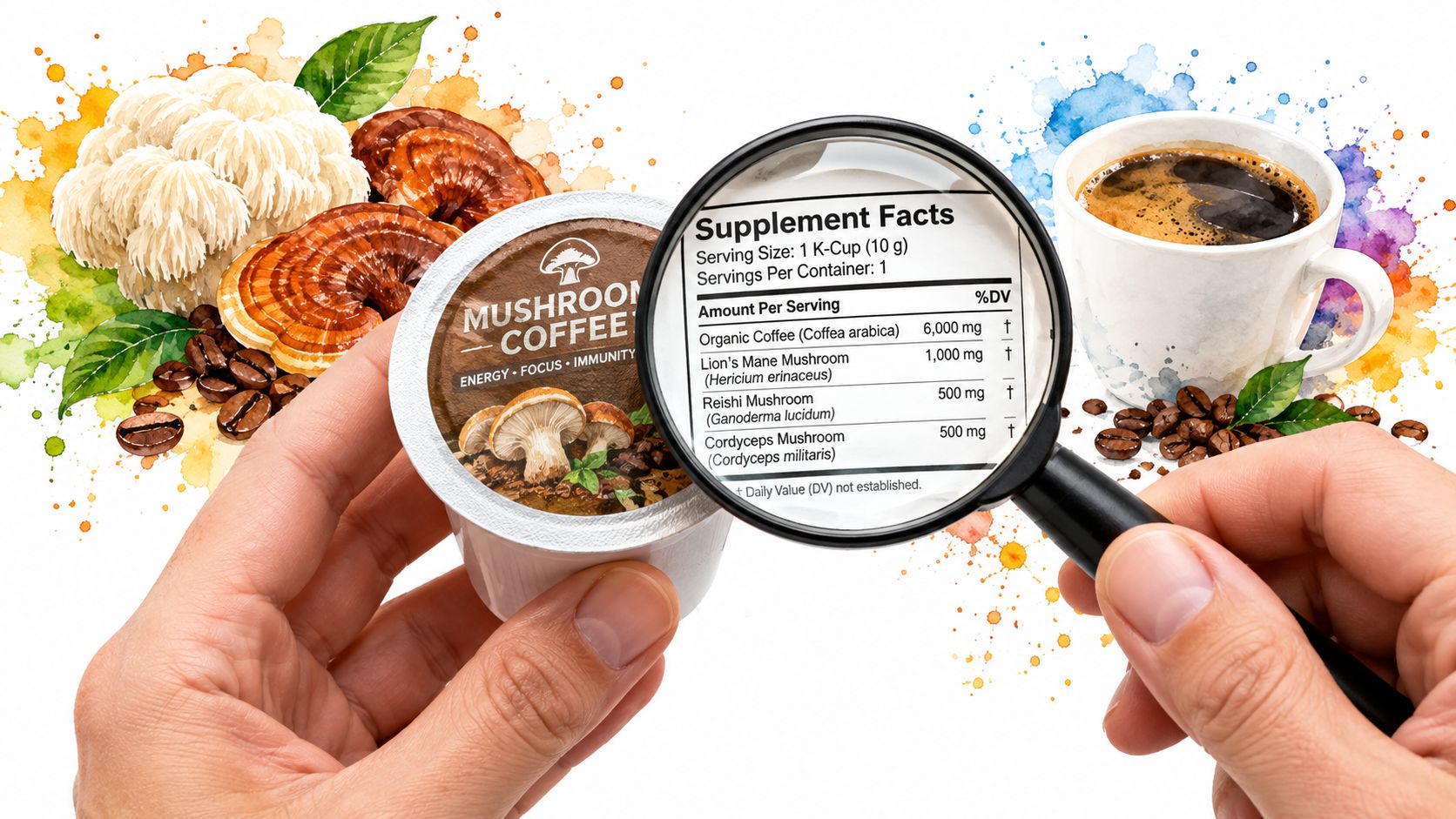
A mushroom coffee K-cup sold as a dietary supplement should read like a supplement, not a marketing wrapper. FDA labeling guidance says the package should identify the product as a dietary supplement, name the manufacturer, packer, or distributor, give the net quantity, list other ingredients, and include a Supplement Facts panel with serving size, servings per container, and the amount per serving of each dietary ingredient unless it is part of a proprietary blend FDA guidance.
What to look for first
Start with the wording. If the label only says “mushroom blend,” you still do not know which species are inside, how much is in the pod, or whether the material is an extract or plain powder. That distinction matters because a species name gives you identity, while the form tells you how the ingredient was prepared.
The label also needs context that a shopper can use. Mushroom-containing supplements are not subject to routine FDA premarket approval or safety review before sale, so the package has to do more of the explaining FDA guidance. If the wording stays broad, you are being asked to trust a product without enough detail.
A simple buyer checklist
- Look for species names: The label should name the mushroom species, not just a catchall blend.
- Check the form: Extract is more informative than raw powder because it shows the material was processed for concentration.
- Find the serving size: That tells you how much coffee and mushroom material you are getting in one pod.
- Look for a Supplement Facts panel: If it is missing, the product may not be framed as a dietary supplement at all.
- Ask for testing: A responsible seller should be able to provide contaminant, identity, and potency testing.
For a closer look at that last step, see this guide to third-party lab testing. In practice, label reading works like following a recipe, if the ingredient list is vague, the final result is hard to judge before you brew.
Taste, Environmental Impact, and Smart Ordering

A mushroom coffee K-cup can taste clean and consistent, yet the pod format also narrows what you are tasting. Water moves through quickly, and the machine fixes the brew volume, so the cup often reads lighter than a drip batch. If you want to judge flavor fairly, start with the smallest brew setting your machine allows, then decide whether the blend still feels balanced.
That same convenience creates the disposal problem. Reporting on single-serve coffee notes that many local recycling systems do not accept small pods, and compostable packaging still runs into limited industrial composting access sustainability reporting.
Why “recyclable” doesn't always mean recyclable at home
Used K-cups are often made from No. 5 polypropylene plastic, but the body, lid, filter, and spent grounds usually have to be separated before recycling K-cup recycling guidance. Consumer guidance also says the foil lid should be peeled off, the grounds and paper filter removed, and the pod rinsed before recycling pod material guidance. That turns a simple coffee habit into a small sorting task.
Environmental claims need that context. A pod can be recyclable in theory and still miss the mark in practice if your local facility will not take it or if the pieces were not separated correctly. Certification alone doesn't tell you what your municipality will accept.
For shoppers who care about convenience and quality, the best order is the one that matches taste, label clarity, and disposal reality together. If you want a retailer that focuses on fast discreet delivery, age verification for adults 21 and older, seasonal deals like Buy 3 Get 1 Free, and nationwide shipping from Oakland, California, visit The Magic Mushroom Delivery and compare options with the same label-first mindset used in this guide.