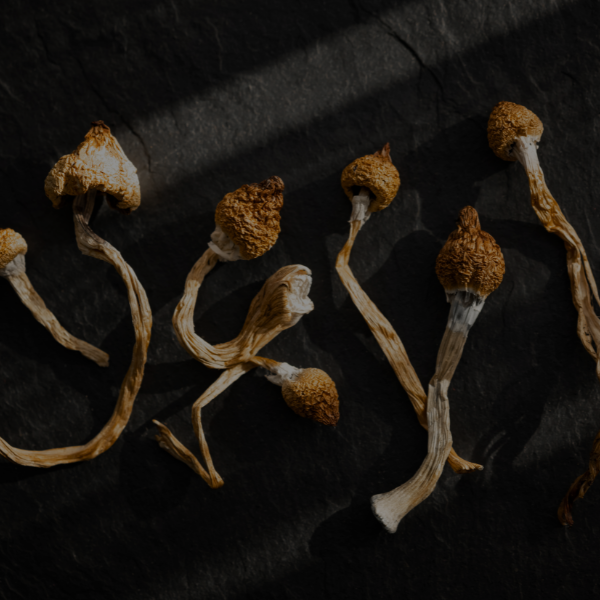

You're probably here because two names keep popping up and nobody seems to explain them clearly.
One person says Golden Teacher is “gentle.” Another says Liberty Caps are “way stronger.” Then you hear about Penis Envy, Wavy Caps, microdosing, body load, visuals, introspection, and suddenly a simple question turns into a fog of conflicting advice.
That confusion is normal. People often talk about mushrooms as if they're all interchangeable, but they're not. Different species, and even different varieties within a species, can lead to very different intensity levels and very different kinds of experiences. If you want to understand magic mushroom types and effects in a practical way, the first step is to stop thinking of them as one thing.
Navigating the World of Magic Mushrooms
A friend holds up two bags. One is labeled Golden Teacher. The other says Liberty Caps. Both are “magic mushrooms,” so the assumption is that they should feel roughly the same.
That's where many people get tripped up.

Current scientific estimates identify over 180 distinct psychedelic mushroom species, with the genus Psilocybe making up the majority, according to Technology Networks' overview of major magic mushroom species. That diversity matters because user experiences and required dosages are not uniform. They depend heavily on the specific mushroom type.
Why names matter
Think of mushrooms the way you'd think about grapes and wine. “Wine” is one broad category, but a pinot noir and a sauvignon blanc don't behave the same on the palate. Mushrooms are similar. The umbrella term hides meaningful differences in potency, feel, pacing, and overall character.
Some mushrooms are known for moderate, more familiar experiences. Others can feel sharper, faster, or much stronger gram for gram. That doesn't automatically make one “better.” It means matching the type to the experience you want.
A mushroom is not just a mushroom. The species is part of the experience.
The practical lens
When adults search for magic mushroom types and effects, they're usually trying to answer one of four questions:
What do I have
A species or strain name tells you more than a generic label ever will.How strong is it likely to be
Potency differences change what a sensible amount looks like.What kind of experience does it tend to invite
People often care whether a mushroom feels more visual, more inward, or more functional.What should I be careful about
Responsible use starts with respect for variation, not guesswork.
That's the map. Once you understand the basic chemistry, the differences between common species start making a lot more sense.
How Psilocybin Creates Its Effects
Psilocybin itself isn't the final actor. It's more like a packaged form that your body converts into the active compound that does the heavy lifting.

Research summarized in this review on psilocybin metabolism and action explains that psilocybin acts as a prodrug. The body converts it to psilocin, which is the primary psychoactive agonist of the 5-HT2A neuroreceptor. Psilocin crosses the blood-brain barrier, and the intensity of the experience correlates with psilocin bioavailability.
The key and lock model
The simplest way to picture this is a key and lock.
- Psilocybin is the packaged key blank.
- Your body reshapes it into psilocin.
- Psilocin fits into certain serotonin-related “locks,” especially 5-HT2A receptors.
- When enough of those locks are activated, perception, mood, and thought patterns can shift.
That's why people often describe colors looking more alive, music feeling unusually deep, or ordinary thoughts taking on a reflective, symbolic quality.
For a deeper plain-English breakdown of that process, this guide to psilocybin effects on the brain is a useful companion.
Why different mushrooms can feel different
Here's where readers often get confused. If psilocin is the main driver, why do people insist different species have different personalities?
Part of the answer is simple. Potency changes the experience. If one species delivers more active compounds from the same weight, the trip may feel stronger, more visual, or harder to steer.
The other part is the mushroom's alkaloid profile. Psilocybin and psilocin get most of the attention, but some discussions also point to compounds such as baeocystin and norbaeocystin when people talk about subtle differences between species. The species-specific impact of those compounds, especially in microdosing and functional settings, remains poorly documented, as noted in UCLA's lesson material on magic mushrooms.
A practical way to think about alkaloid profiles
Think of psilocybin as the lead singer. It's the clearest voice in the band. But the full sound may still depend on the rest of the group.
That doesn't mean every report about species differences is scientifically settled. It does mean the “same dose” on paper may not feel identical across different mushroom types. Potency, chemistry, and your own mindset all shape the final result.
Practical rule: Don't assume a gram of one mushroom type will behave like a gram of another.
A Profile of Common Mushroom Species
A common real-world mistake looks like this. Someone hears that a friend had a calm, reflective experience on “2 grams of mushrooms,” then assumes any 2 grams of any species will point in the same direction. Species knowledge helps prevent that kind of mismatch.
For practical use, three names show up again and again. Psilocybe cubensis, Psilocybe semilanceata, and Psilocybe cyanescens. They differ in typical potency, in the mix of alkaloids people discuss around them, and in the kind of caution they deserve.
Psilocybe cubensis
This is the species many adults meet first. It includes familiar names such as Golden Teacher and Penis Envy.
Cubensis often serves as the reference point because it is widely cultivated and more familiar to beginners. Subjective reports often describe standard cubensis as balanced and easier to read than stronger species. A useful comparison is table wine versus high-proof spirits. Both contain alcohol, but one usually gives people more room to notice the climb before they are in too deep.
That practical difference matters. Standard cubensis is often the species people use to learn how psilocybin affects their body, emotions, and pacing.
Golden Teacher and standard cubensis strains
Golden Teacher has a reputation as a classic all-rounder. Reports often describe it as introspective, emotionally open, and visual without feeling defined only by force. Many adults choose it because they want a recognizable psilocybin experience, not a potency contest.
Strain talk can still get exaggerated. Two cubensis strains may have slightly different reputations, but they remain under the same species umbrella, and set, setting, and actual potency still matter more than the marketing name.
Penis Envy
Penis Envy is the cubensis variety that regularly breaks people's assumptions. It is still cubensis, yet it is widely treated as a different dosing category in practice. Medical News Today notes that Penis Envy is widely documented as significantly more potent than standard Psilocybe cubensis, often leading users to reduce dosage by about 30% to 50% for equivalent effects, according to their review of Penis Envy mushrooms.
That shift in potency can change the whole feel of the experience. Adults who expected a familiar cubensis arc may find the onset stronger, the peak denser, and the margin for casual measuring much smaller. In everyday terms, Penis Envy often fits people who already know how standard cubensis affects them and want to proceed with much more care.
Psilocybe semilanceata
Psilocybe semilanceata, commonly called Liberty Caps, carries a reputation that surprises new learners. The mushrooms are small and delicate-looking, which can mislead people into assuming they are gentle.
Their reputation points the other way. Liberty Caps are commonly described as compact but powerful, with a clear need for careful dosing. Technology Networks places Psilocybe semilanceata among the more potent common species in their species overview.
Visual size is a poor guide here. A small mushroom can behave like a concentrated spice. You use less of it because the active material is packed more tightly.
People who discuss Liberty Caps often emphasize a strong, direct quality. Reports also suggest that casual eyeballing is a poor idea with this species. For adults trying to match a mushroom to a desired experience, Liberty Caps usually belong in the category of “respect the potency first.”
Small fruiting bodies can produce very large surprises.
Psilocybe cyanescens
Psilocybe cyanescens, often called Wavy Caps, usually enters the conversation with a more serious tone. People often bring them up when the discussion moves past beginner-friendly strain names and into species-level differences that can strongly affect intensity.
Subjective reports commonly associate Wavy Caps with vivid visuals, deeper immersion, and a faster sense that the experience has real momentum. That does not prove a unique “personality” in a strict scientific sense, but it does reflect a consistent pattern in how experienced users talk about them. In practical terms, this is not usually the species adults mention for casual experimentation.
The useful lesson is simple. Potent species can narrow your room for adjustment. If standard cubensis feels like learning to drive in an empty parking lot, Wavy Caps are closer to merging onto a busy highway. The basic mechanics are related, but the consequences of poor judgment arrive faster.
Why species profiles help
Species profiles are not guarantees. Two adults can take the same mushroom type and still describe different emotional tones, visuals, or body effects.
They still prevent category mistakes. Treating Liberty Caps like average cubensis can lead to an unexpectedly intense experience. Treating Penis Envy like just another catchy strain name can do the same.
If you want a wider taxonomy overview in plain language, this guide to types of Psilocybe is a helpful reference.
Common Magic Mushroom Species Comparison
| Species | Common Name | Relative Potency | Common Experiential Notes |
|---|---|---|---|
| Psilocybe cubensis | Cubensis, Golden Teacher | Moderate relative to the species listed below | Often described as balanced, introspective, and familiar |
| Psilocybe cubensis variety | Penis Envy | Significantly more potent than standard Psilocybe cubensis | Often described as stronger, heavier, and less forgiving of casual dosing |
| Psilocybe semilanceata | Liberty Caps | High | Often described as compact but powerful, with strong intensity for their size |
| Psilocybe cyanescens | Wavy Caps | High | Often described as immersive, visual, and better suited to careful dosing |
Choosing by desired experience
Choice gets easier when you start with the kind of experience you are trying to support.
For a familiar reference point
Standard Psilocybe cubensis is often the species people use to build baseline knowledge.For stronger intensity within a familiar species
Penis Envy is often discussed that way, but it asks for more caution and lower dosing.For naturally potent mushrooms with a compact form
Liberty Caps often stand out because appearance can hide strength.For a highly immersive reputation
Wavy Caps usually belong in conversations about careful preparation and dosage discipline.
A useful habit is to choose the species first, then consider amount, setting, and intention. That order helps align the mushroom with the experience you want.
Understanding Dose and Duration
Dose questions usually sound simple. “How much should someone take?” But the useful version of that question is narrower. How much of which mushroom, and what arc of experience are they trying to understand?

According to the European Union Drugs Agency profile on hallucinogenic mushrooms, effects typically begin within 30 minutes, peak at 2 to 3 hours, and last 4 to 6 hours overall. That same source states that recreational dosages generally range from 1 to 5 grams of dry mushrooms.
The basic timeline
A mushroom experience usually moves in phases rather than arriving all at once.
Onset
The onset is the runway. Perception starts shifting, the body may feel different, and thoughts can take on a slightly unusual texture. For some people this phase feels exciting. For others it's the most uneasy part, because they can tell something is changing but haven't settled into it yet.
Peak
At the peak, the experience is at full voice. Emotional intensity, sensory changes, introspection, and visual activity often gather here. If someone has taken a stronger species than they realized, the peak is usually where that misunderstanding becomes obvious.
Comedown and afterglow
The main intensity eases, but the experience doesn't switch off like a light. Many people feel thoughtful, open, tired, or reflective afterward. Some want conversation. Others want silence and a notebook.
For people comparing experience windows, this psilocybin dosage guide can help connect amount, form, and expected arc in more detail.
What counts as a microdose and a standard dose
The same EUDA source notes that a microdose is approximately 0.1 to 0.3 grams of dry mushrooms, defined as about 10% of a recreational dose, and is often taken up to three times per week. That's a very different goal from a full psychedelic experience.
A useful way to frame common categories is this:
Microdose
Sub-perceptual or near-subtle. People usually aren't seeking a full trip.Recreational or standard full experience
The range commonly understood when discussing taking mushrooms for an unmistakable psychoactive effect.High-intensity experience
More demanding, more immersive, and more likely to magnify both insight and difficulty.
Why species changes the math
Numbers alone can mislead. A listed gram amount doesn't tell the whole story if the species is much stronger than standard cubensis. The same dry weight can produce a very different level of intensity depending on what mushroom is in hand.
If you know the weight but don't know the species, you only know half the dosage story.
That's why responsible decisions start with identification and potency awareness, not just a scale reading.
Guidance for a Safe and Responsible Journey
A good mushroom experience rarely happens by accident. People shape it long before ingestion through preparation, environment, and the company they keep.

The biggest mistake beginners make is treating safety as a side note. It isn't. Safety is part of the experience itself.
Set matters
“Set” means your internal state. Mood, expectations, stress level, unresolved fear, and personal intention all travel with you.
If someone goes in scattered, defensive, or emotionally overloaded, mushrooms may amplify that. If they go in grounded and clear, the experience often has a steadier tone. That doesn't guarantee comfort, but it changes the terrain.
A simple pre-check helps:
Emotional weather
Ask whether you feel stable enough for amplified introspection.Intention
Curiosity, reflection, creativity, or rest are clearer starting points than vague recklessness.Mental health history
People with personal vulnerability to severe psychological distress should approach with extra caution and professional guidance where appropriate.
Setting matters just as much
“Setting” is the external container. The room, lighting, sounds, social energy, and trust level all matter.
A calm home with a trusted sober person nearby is very different from a chaotic party. One supports surrender. The other can turn ordinary uncertainty into panic.
Later in the decision process, it can help to hear a grounded overview in another format:
The risks are mostly psychological, not casual
Health Canada notes that psychological risks include bad trips characterized by paranoia, which are more frequent at high doses, and reports that more than 50% of respondents in a 2023 Canadian survey experienced a flashback weeks or months after use, according to Health Canada's fact sheet on magic mushrooms.
That doesn't mean panic is inevitable. It means respect is warranted.
What helps lower risk
Choose a calm environment
Familiar surroundings reduce unnecessary stimulation.Have a trusted sober sitter
A steady person can help if anxiety rises.Avoid stacking uncertainty
Don't combine a new species, unfamiliar setting, and emotionally rough timing.Keep the day clear
Rushing, interruptions, and social obligations work against psychological safety.
Hard experiences often begin as preventable mismatches between mindset, environment, and dose.
Challenging doesn't always mean harmful
Some experiences are difficult without being damaging. Fear, tears, or confrontation with uncomfortable material can still become meaningful later. The key difference is whether the person had enough support and preparation to move through it without getting overwhelmed.
Responsible use isn't about eliminating depth. It's about creating enough structure that depth doesn't become chaos.
Integrating Your Experience for Lasting Growth
The mushroom experience itself is only the visible part. The quieter part comes after, when you decide what to do with what you felt, noticed, or learned.
Different species can invite different kinds of journeys. Standard cubensis may feel like a broad doorway. Liberty Caps may feel more concentrated. Wavy Caps may feel more immersive. But the lasting value doesn't come from the species name alone. It comes from what you integrate afterward.
Simple integration practices
A few grounded habits help turn a powerful day into something usable:
Journal while details are fresh
Write images, emotions, questions, and any repeated insight before it fades.Talk with someone steady
A trusted friend, guide, or therapist can help separate insight from confusion.Return to ordinary rhythms gently
Sleep, hydration, quiet walks, and low stimulation help the experience settle.Look for one practical takeaway
Not ten. One change in how you relate to work, relationships, creativity, or self-care is often enough.
Integration keeps the experience from becoming just another intense memory. It turns a temporary altered state into a chance for better self-understanding.
A mature approach to magic mushroom types and effects always lands here. Know the species. Respect the chemistry. Prepare the setting. Then make meaning from the experience rather than chasing novelty for its own sake.
If you're looking for a reliable place to keep learning or to explore curated mushroom products, The Magic Mushroom Delivery offers educational resources alongside a wide selection for adults 21+ who want a more informed, thoughtful approach.