A mushroom gummy can pose a safety problem even when the mushroom advertised on its package isn't what makes it dangerous. The FDA's letter to food manufacturers describes serious adverse events involving Amanita ingredients, including seizures and hospitalization, while warning that these naturally occurring substances aren't established as safe food ingredients.
So, are mushroom gummies safe? There's no reliable category-wide answer. The useful questions are what's inside the gummy, how much is present, and whether the evidence applies to that particular product and person.
The Short Answer by Gummy Type
Mushroom gummies aren't one safety category, and an unverified label isn't enough to establish safety. A functional extract, a psilocybin-labelled edible, and an Amanita gummy require different assessments.
Mushroom gummy types and their main risks
| Gummy type | What it may contain | Main safety concern | Verification needed |
|---|---|---|---|
| Functional mushroom extracts (lion's mane, reishi, chaga) | Mushroom extracts, usually without psilocybin | Dose inconsistency and undisclosed additives | Full ingredient panel and batch test |
| Psilocybin-labelled gummies | Psilocybin or related compounds; some tested products contained none | Unpredictable dose, delayed onset and mislabeling | Quantified amount per gummy on a batch certificate |
| Amanita muscaria gummies | Muscimol, ibotenic acid, muscarine or an unspecified extract | Sedation, seizures, delirium and hospitalization | Avoid; no established safe dose for these retail gummies |
| Proprietary blend gummies | Undisclosed mushrooms, stimulants, sedatives or kratom | Unknown composition and unpredictable interactions | Not verifiable from the label; avoid |
| Products claiming synthetic psychedelic compounds | Synthetic psychedics with limited toxicology data | Poorly characterized acute and long-term effects | Treat as unknown risk; a potency result alone cannot establish safety |
Why the distinctions matter
Amanita products deserve the strongest avoidance recommendation here because their constituents have a documented severe-toxicity concern and an explicit FDA food-safety warning. That doesn't mean every Amanita gummy causes poisoning, or that other categories are safe. It means there's a stronger basis for advising against consumption than for trying to identify a tolerable retail serving.
A verified functional-only extract presents a different, generally lower acute-intoxication concern than a gummy containing psychoactive compounds. But the evidence discussed here doesn't establish comparative poisoning rates for lion's mane, reishi or chaga gummies, nor does it prove that daily use is safe for everyone.
Proprietary blends are particularly difficult to assess because the buyer may not know which pharmacology to evaluate. A familiar mushroom name doesn't establish the product's species identity, dose, purity or absence of added drugs.
Working verdict: Treat unverified gummies of any type as products of unknown composition, not as mild supplements by default.
Verification can reduce uncertainty about identity and dose. It cannot turn an inadequately studied compound into one with a demonstrated safety profile.
What the 2024 Diamond Shruumz Cases Reveal
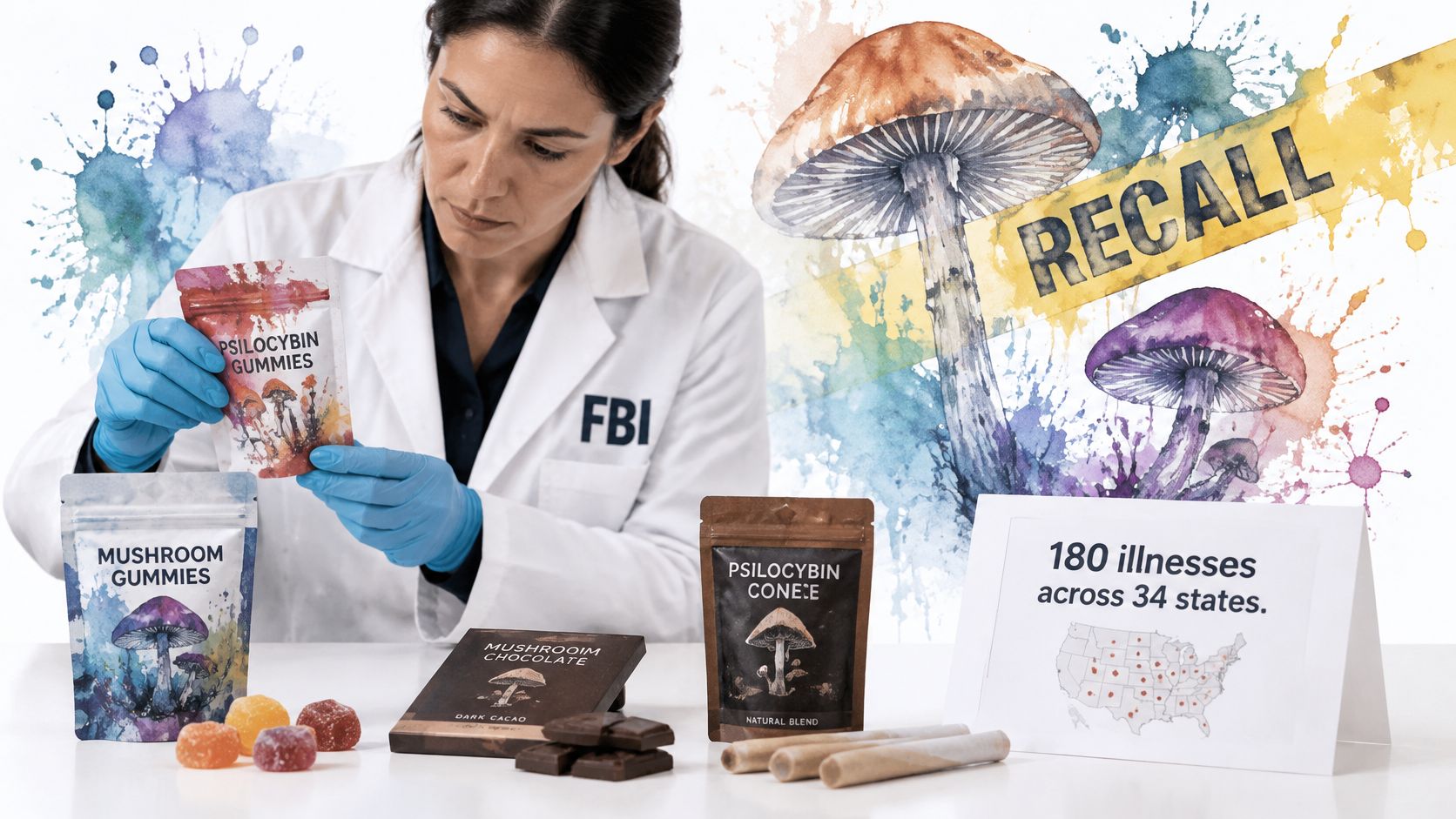
The Diamond Shruumz investigation shows why product identity matters more than reassuring packaging. By October 31, 2024, federal and state investigators had identified 180 illnesses across 34 states, including 73 hospitalizations and two associated deaths, linked to the brand's chocolate bars, cones and gummies, according to the FDA investigation.
The investigation involved products marketed with a proprietary mushroom blend. Its relevance isn't that every mushroom edible carries the same danger, but that consumers couldn't reliably infer exposure from the product category.
The recalled-product investigation illustrates the consequences of that uncertainty.
What laboratory testing changed
The CDC's outbreak investigation describes multiple compounds identified across tested samples, including psilocin, O-acetylpsilocin, kavalactones, pregabalin, muscimol and ibotenic acid. Muscimol appeared in tested products where it wasn't consistently disclosed on the ingredient label.
These weren't different names for the same mushroom ingredient. They represented substances with different effects, making a package-level serving recommendation an unreliable guide to the actual exposure.
A separate 2025 analysis of 12 recreational gummies and chocolates purchased in Portland found no detectable psilocybin while identifying undisclosed ingredients including caffeine, hemp and kava extracts, and synthetic psychedelic compounds, as described in the Medical Xpress account of the analysis. That small sample doesn't characterize the entire market, but it demonstrates that the advertised ingredient may not be the ingredient a buyer receives.
Severity without overstating the scope
Among 178 outbreak cases with available information, 150 involved emergency or urgent-care treatment; 38 required intensive-care admission and 29 required endotracheal intubation, according to the FDA investigation cited above. The hospitalization total reflects substantial clinical severity, not merely unpleasant psychedelic experiences.
These figures describe one commercial outbreak, not a population-wide risk rate. They can't tell an individual buyer the probability of poisoning from an unrelated gummy.
The practical conclusion is narrower and more useful: What is in this batch, and how can a buyer verify it? A mushroom reference on the package cannot answer either question.
What Psilocybin Trial Data Does and Does Not Show
| Outcome | Reported finding |
|---|---|
| Evidence base | Six randomized, double-blind trials involving 528 patients |
| Headache incidence | 2% to 66% |
| Nausea incidence | 4% to 48% |
| Anxiety incidence | 4% to 26% |
| Other adverse effects | Dizziness and blood-pressure fluctuations occurred more often than with comparators |
| Typical acute course | Therapeutic-dose adverse effects were generally tolerable and typically resolved within 24 to 48 hours |
These findings come from a 2024 systematic review and meta-analysis of therapeutic psilocybin trials. They describe supervised administration to screened patients, not independently purchased gummies.
In prose, the reported ranges were 2 to 66 percent for headache, 4 to 48 percent for nausea and 4 to 26 percent for anxiety. Those broad ranges shouldn't be converted into a single prediction for a retail product, and the review's conclusion that effects were generally tolerable doesn't mean participants experienced no adverse effects.
The intervention includes the setting
Clinical safety depends on more than the molecule. Investigators know what they administer, screen participants, monitor responses and have procedures for managing problems.
A retail gummy may differ in active ingredient, concentration, absorption, contaminants and labeling accuracy. At home, the buyer may also lack professional monitoring and may have medical conditions or medication combinations that would affect eligibility for a trial.
That creates a basic inference problem: even strong evidence about a known substance under controlled conditions cannot validate an unidentified commercial mixture.
A tolerable adverse-effect profile in screened trial participants is not a safety certificate for a gummy bought online.
Delayed effects complicate self-dosing
Oral psychoactive effects can develop gradually. If someone decides a gummy isn't working and eats more, they may increase exposure before the initial serving's effects are apparent.
The uncertainty becomes greater when the label's potency is inaccurate. A buyer then lacks both a reliable starting amount and a dependable way to interpret the apparent delay.
The trial findings also don't establish a universal driving interval. Resolution of reported adverse effects is not the same measure as recovery of judgment, coordination or fitness to operate machinery.
The defensible conclusion is conditional: controlled psilocybin administration may have a manageable acute safety profile for appropriately screened participants. Retail-gummy safety still depends on the actual product, dose, health conditions, medications and access to appropriate supervision, not on the words mushroom or natural.
Amanita Muscaria Gummies Carry a Different Risk
A supplement-style package doesn't make an Amanita gummy mild. These products require a different toxicological assessment from psilocybin products, even when sellers place them in the same mushroom-edible category.
The FDA's warning letter addressing Amanita ingredients states that Amanita muscaria, muscimol, ibotenic acid and muscarine don't meet the safety standard for conventional food ingredients. The agency's reviewed reports describe central-nervous-system depression, drowsiness, seizures, delirium, coma, respiratory depression, hospitalization and potentially death.
Sedation and excitation aren't interchangeable
Muscimol primarily acts through GABA-related signaling, which can produce sedation and impaired consciousness. Ibotenic acid has excitatory neuroactive effects.
Processing can change the mixture of constituents, so an extract isn't adequately characterized by its mushroom name alone. An unknown preparation may produce sedating effects, excitatory effects or an unpredictable combination.
This is why advice to treat Amanita products as ordinary psychedelic gummies is misleading. Reduced consciousness and respiratory depression require a different response from reassurance about an uncomfortable experience.
People and combinations requiring particular caution
The following groups shouldn't use these products without medical review, and clinician consultation doesn't override the FDA's general recommendation to avoid Amanita-containing foods:
- People with seizure disorders: Neurological toxicity is directly relevant to their underlying condition.
- Pregnant people: Don't assume that a naturally derived edible is appropriate during pregnancy.
- People with significant liver or kidney disease: Product uncertainty makes a personal risk assessment especially important.
- People taking opioids, benzodiazepines, sleep medicines or other sedatives: Don't combine these substances with Amanita products.
- People using interacting psychiatric medicines or alcohol: Seek professional advice rather than attempting to manage the combination yourself.
Avoidance rule: An unidentified Amanita extract isn't a lower-dose version of a known product. Its constituent profile is unknown.
Treat unspecified Amanita preparations and proprietary psychoactive blends as off-limits while their contents remain unidentified. Even after identification, the FDA recommends avoiding foods containing Amanita muscaria or its constituents; a laboratory certificate doesn't cancel that recommendation.
Interactions and Harm Reduction for Psilocybin and Functional Gummies
A gummy's ingredient list may not describe everything in it. Testing of some mushroom edibles has found undeclared substances; the CDC's Diamond Shruumz outbreak investigation reported findings that included kavalactones, pregabalin and muscimol. That uncertainty makes a complete medication review relevant even when the package names only mushrooms.
Bring the complete medication list
Before considering psilocybin, ask a clinician or pharmacist to review SSRIs, SNRIs, MAOIs, lithium, antipsychotics, stimulants and other psychiatric medicines. These drugs do not all interact in the same way, so a single risk claim cannot be applied to every combination.
Do not stop a prescribed medicine to make room for a gummy. A guide to psilocybin drug interactions can help organize questions, but it cannot replace a medication review for you.
Tell the clinician about a personal or family history of psychosis or bipolar disorder, heart disease, high blood pressure, pregnancy, or significant liver or kidney disease. Functional mushroom products also require review based on their ingredients; reassurance from psilocybin research does not establish their safety.
Reduce avoidable exposure
- Do not treat one gummy as a standard dose. Its size does not establish the amount or identity of active compounds. If composition is unknown, potency is unknown too.
- Avoid taking more the same day. A delayed or absent effect does not establish that a larger amount is safe.
- Avoid combining substances. Alcohol, cannabis, sedatives and other psychoactive substances can complicate impairment and assessment.
- Arrange support and a safe setting. If you proceed after medical review, stay somewhere familiar with a sober adult available.
- Do not drive or operate machinery. Wait until effects and impairment have fully resolved.
- Prevent accidental access. Keep gummies in their original labelled container, away from children and pets.
These steps can reduce avoidable exposure and complications. They cannot establish the safety of a gummy whose contents have not been verified.
Symptoms That Need Emergency Care
Symptoms that need emergency care
| Symptom | Urgency | Action |
|---|---|---|
| Seizure or convulsions | Emergency | Call emergency services now |
| Loss of consciousness or hard-to-wake sleepiness | Emergency | Call emergency services now |
| Slowed, irregular or difficult breathing | Emergency | Call emergency services now |
| Chest pain or dangerously fast heartbeat | Emergency | Call emergency services now |
| Suspected exposure in a child or pet | Emergency | Call poison control immediately; for pets, contact an emergency veterinarian or animal poison service |
| Severe confusion, agitation or psychosis-like distress | Urgent | Call poison control or a doctor promptly, the same day; escalate immediately if safety is threatened |
| Persistent vomiting | Urgent | Contact poison control or a doctor the same day |
| Mild nausea, headache or dizziness | Monitor | Rest, drink water if fully alert and able to swallow, and watch for worsening |
The FDA's Diamond Shruumz recall notice reported 39 illnesses and described seizures, loss of consciousness, abnormal heart rates, nausea and vomiting. That notice's tally differs from the broader investigation total, so its symptom list shouldn't be treated as an identical case group.
Respond to the person, not the package
Don't dismiss reduced consciousness as sleep, or severe agitation as an expected trip. If someone can't be kept safe, has trouble breathing or becomes difficult to wake, use emergency services rather than waiting for a routine appointment.
Gradual onset also means an initially quiet period isn't proof of safety. Don't give more gummies, alcohol or another drug to try to change the experience.
For a fully alert person with mild symptoms, offer a calm environment and small sips of water. Don't give anything by mouth to someone who's drowsy or having difficulty swallowing, and don't induce vomiting.
Our guide to a mushroom trip gone bad provides additional context, but emergency symptoms need medical assessment, not just reassurance.
Prepare information for responders
Keep the package and remaining product available. Tell poison control or clinicians:
- Product identification: Brand, product name, ingredient panel and lot number.
- Exposure details: Amount eaten and when it was consumed.
- Other substances: Medicines, supplements, alcohol or recreational drugs taken during the same period.
- Clinical changes: Symptoms, when they began and whether they're worsening.
Don't delay the call because you can't find every detail. A photograph of the packaging can help when the original container isn't immediately accessible.
Screen the Batch and Confirm Your Health Before You Buy
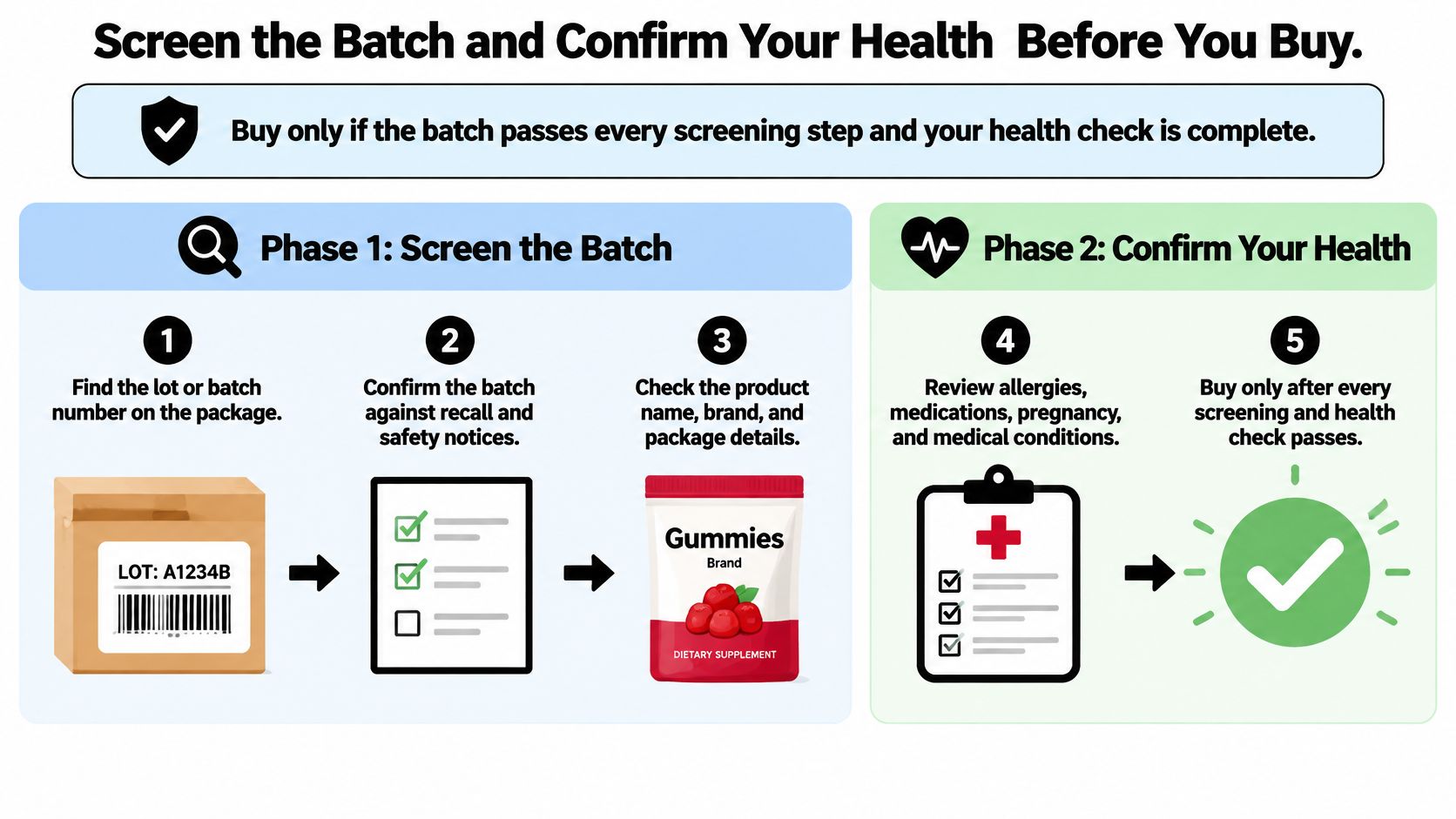
Consider buying only after the batch passes every screening step and the personal health review is complete. Passing those checks reduces uncertainty; it doesn't guarantee safety or establish that a product is medically appropriate.
Use this process to separate product verification from personal suitability.
Match the certificate to the product
A peer-reviewed quantitative analysis of recreational psychoactive mushroom gummies concluded that the tested products were overall inaccurately labeled. That finding makes documentation a prerequisite, not a finishing touch.
- Find the lot number. Match the package's batch identifier to the certificate of analysis. Check recall and safety notices for the exact brand and product.
- Inspect the laboratory report. Look for laboratory identity, testing date, named analytes and quantified results. A QR code alone proves nothing about what was tested.
- Read the entire ingredient panel. Treat proprietary blend and mushroom complex as unresolved descriptions, not chemical identities.
- Confirm species and compounds. Establish whether the product is functional, psilocybin-based or Amanita-based. Check whether the report identifies compounds omitted from the label.
- Reconcile the serving. Distinguish extract weight, package weight and active-compound amount per gummy. Don't assume they're equivalent.
- Complete the health review. Bring the ingredient panel, certificate and medication list to a healthcare professional.
- Stop if a check fails. Missing documentation isn't a reason to estimate.
We test our mushrooms to ensure they're free from DMT and other contaminants. Request the matching batch certificate rather than treating that statement as a substitute for evidence, and use our third-party lab testing guide to assess the report's scope.
A result applies to the substances the laboratory measured. It doesn't prove the absence of every possible contaminant or establish a compound's long-term safety.
The accompanying video offers additional context.
Choose an outcome
- Proceed cautiously: Only when composition is verified and a clinician has assessed suitability. Our recommendation for Magic Mushroom Gummies is to start with a small serving, follow the labelled serving size and adjust cautiously rather than redosing impulsively; they should be part of a balanced wellness routine with personalized professional guidance.
- Postpone: Wait when medication questions, medical conditions or documentation remain unresolved.
- Walk away: Avoid Amanita-based products and unverified psychoactive blends.
If symptoms develop, act on their severity rather than the seller's description. Product verification and medical review are separate safeguards, and neither should be skipped.
The Magic Mushroom Delivery offers mushroom gummies, chocolates, capsules, raw mushrooms and mushroom coffee, alongside educational guidance on responsible use. Visit The Magic Mushroom Delivery to review the product categories and safety resources, and request batch documentation before deciding whether any gummy is appropriate for you.