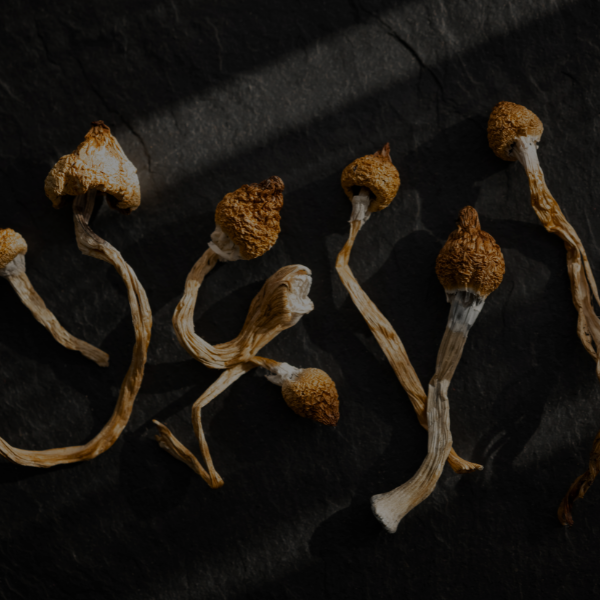
Psilocybin levels can differ widely even among mushrooms grown under similar conditions. A controlled study of 14 cultivated Psilocybe cubensis strains found total tryptamine concentrations ranging from 2.62 to 20.65 mg/g, a spread of more than 7.8-fold.
So if two people each eat three dried grams from packages bearing the same strain name, they may still take different amounts of active compounds. The number of grams measures mushroom weight, not potency. Strain names alone cannot show how much psilocybin a particular batch contains.
Three factors help explain the difference: how the body processes psilocybin, which mushroom species contain it, and how much compound is present in the mushroom tissue. Keeping those questions distinct makes it easier to understand why the same labeled amount can produce different effects.
What Psilocybin Is in Plain Terms
Psilocybin is the primary psychoactive compound in many species of fungi that people call magic mushrooms or shrooms. It belongs to the psychedelic category, drugs that can temporarily alter mood, thinking, sensory perception and the experience of time, as the National Institute on Drug Abuse explains. Nothing in that definition tells you how strong any given mushroom is, which is where confusion usually starts.
Think of psilocybin as a sealed package with a description printed on the outside. The label tells you roughly what's inside, but the package does nothing on its own. Your body opens it, and psilocin is what comes out and acts.
That two-step arrangement has a long history. NIDA reports that Aztec shamans used psilocybin in healing rituals, and archaeological and historical evidence places psychoactive fungi in ceremonial practice across parts of Mesoamerica. Modern research expanded in the 1990s, when brain-imaging technology let scientists study these compounds in controlled laboratory settings instead of speculating.
Interest is broad rather than fringe. In 2022, 11.3% of Americans aged 12 or older said they had ever used psilocybin, which the same overview describes as the most commonly consumed plant-based psychedelic in the United States. What that figure doesn't tell you is what any of those people swallowed.
Psilocybin is a natural compound, not a standardized medicine. What you feel depends on the product in front of you and on your own body.
One boundary to be clear about: psilocybin is not approved by the FDA as a treatment for any disease or condition, despite extensive clinical investigation. It's a research compound with a genuine evidence base and a genuine list of risks.
How Psilocybin Turns Into Psilocin in Your Body
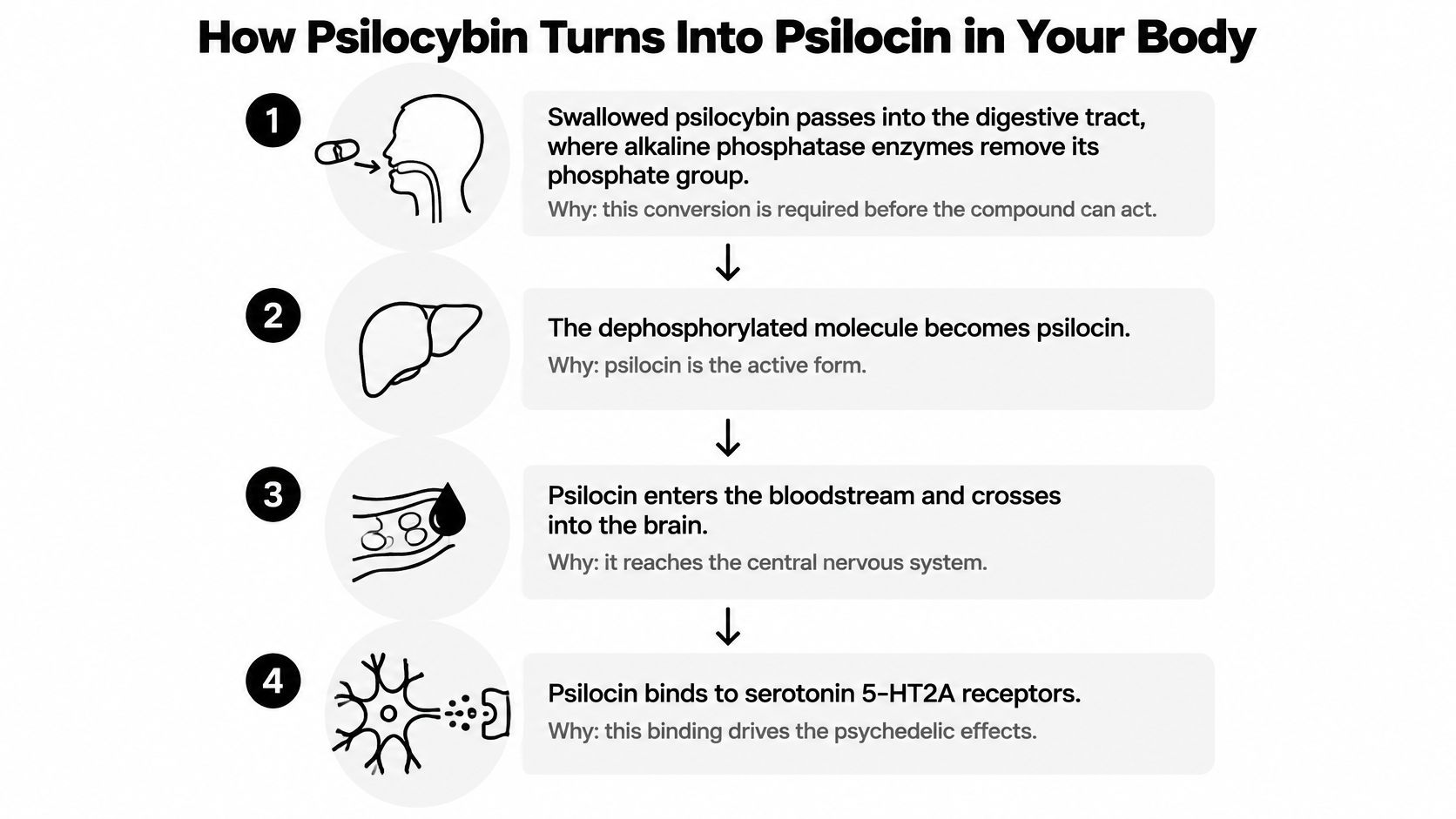
Psilocybin is what pharmacologists call a prodrug, meaning the molecule you swallow isn't the molecule that acts. The NIDA page on psilocybin and magic mushrooms lays out the sequence, and it's worth knowing in order because every later question about timing and intensity depends on it.
- Swallowed psilocybin reaches the digestive tract. Alkaline phosphatase enzymes rapidly remove its phosphate group. The phosphate is the reason psilocybin can't do the job itself, since it keeps the molecule from crossing into the brain.
- Psilocin crosses the blood-brain barrier. What's left after dephosphorylation is psilocin, and psilocin is the version that reaches the central nervous system.
- Psilocin binds serotonin receptors. It acts mainly as a partial agonist at the 5-HT2A receptor, with additional activity at 5-HT2C, 5-HT2B and several other serotonergic subtypes.
- Receptor activation reshapes network signaling. 5-HT2A activation changes signaling in cortical networks involved in perception and self-referential processing, which is why colors, sounds, time and the sense of self can shift at once.
The lock-and-key image helps here. Psilocin is structurally related to serotonin, close enough to fit some of the same locks. It doesn't open the door, though; as a partial agonist it changes how the door behaves.
Drop the assumption that the mushroom is the active drug. Psilocin is active, and how much psilocin your body produces depends on how much psilocybin was in the tissue you ate. That's a measurement rather than a name, and standardized chemical analysis tells you more than nominal "grams" ever will.
Which Mushrooms Contain Psilocybin and Why Potency Varies
Which mushroom contains psilocybin is only part of the question. The amount can vary between species, strains, batches, and even individual mushrooms, so a name or weight alone cannot tell you the actual potency.
| Species | Common name | Notable trait |
|---|---|---|
| Psilocybe cubensis | Gold Caps | Commonly cultivated species |
| Psilocybe semilanceata | Liberty Caps | Grows wild in grassland |
| Psilocybe baeocystis | Blue Bells | Smaller species with a distinct cap shape |
| Psilocybe cyanescens | Wavy Caps | Bruises blue when handled |
| Psilocybe azurescens | Azurescens | Strong blue bruising |
| Psilocybe mexicana | Mexicana | Traditional Mesoamerican species linked to ceremonial use |
| Panaeolus cyanescens | Blue Meanie | Psilocybin-containing species outside the Psilocybe genus |
Amanita muscaria, the red-capped fly agaric, belongs to a different category. It contains different compounds, so it should not be treated as a psilocybin mushroom.
Where the dose actually gets lost
Even within one species, potency can vary considerably. A controlled study of 14 cultivated Psilocybe cubensis strains measured total tryptamine concentrations from 2.62 to 20.65 mg/g, a difference of more than 7.8-fold under standardized conditions, according to this analysis of potency variation in cultivated cubensis.
The differences do not stop at strain level. Individual mushrooms within a strain can also vary measurably in psilocybin content. A label stating a mushroom's weight describes how much material there is, not how much psilocybin it contains. It is like weighing fruit without knowing how concentrated its juice is: the same mass does not guarantee the same active amount.
Six levels that change what you get
- Species: P. cubensis and P. semilanceata are different species, and their potency can differ.
- Strain: Strains within the same species can have different measured tryptamine content.
- Batch: Growing conditions and handling can affect the amount from one batch to another.
- Individual mushroom: Mushrooms from the same strain may still differ in psilocybin content.
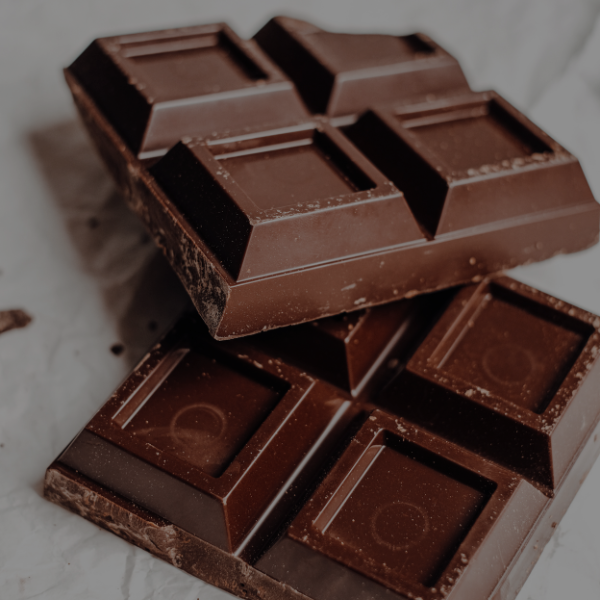
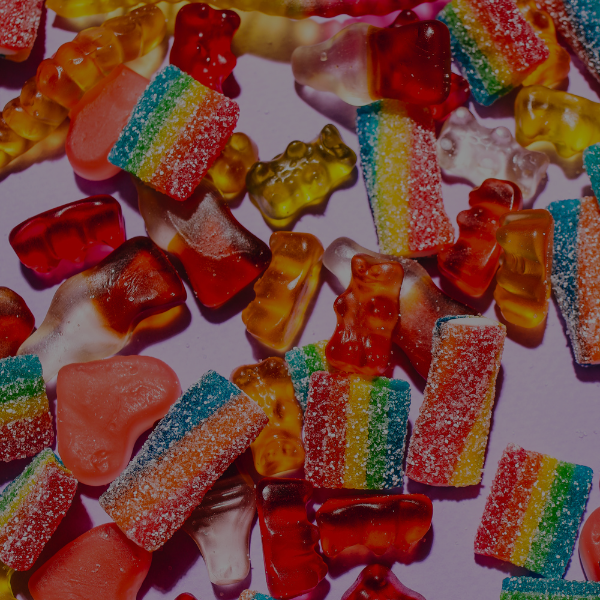
- Preparation: Chocolate, gummies, and capsules may combine mushroom material, but the product's form alone does not establish its psilocybin content.
- Measured content: Chemical analysis is needed to establish how much psilocybin a sample contains.
The rule of thumb: a strain name describes a variety, not a dose.
For that reason, grams of raw mushrooms and grams of a prepared product are not interchangeable measures of psilocybin. A guide to magic mushroom types and their effects offers more context on the different types.
How Long Psilocybin Effects Last, Hour by Hour
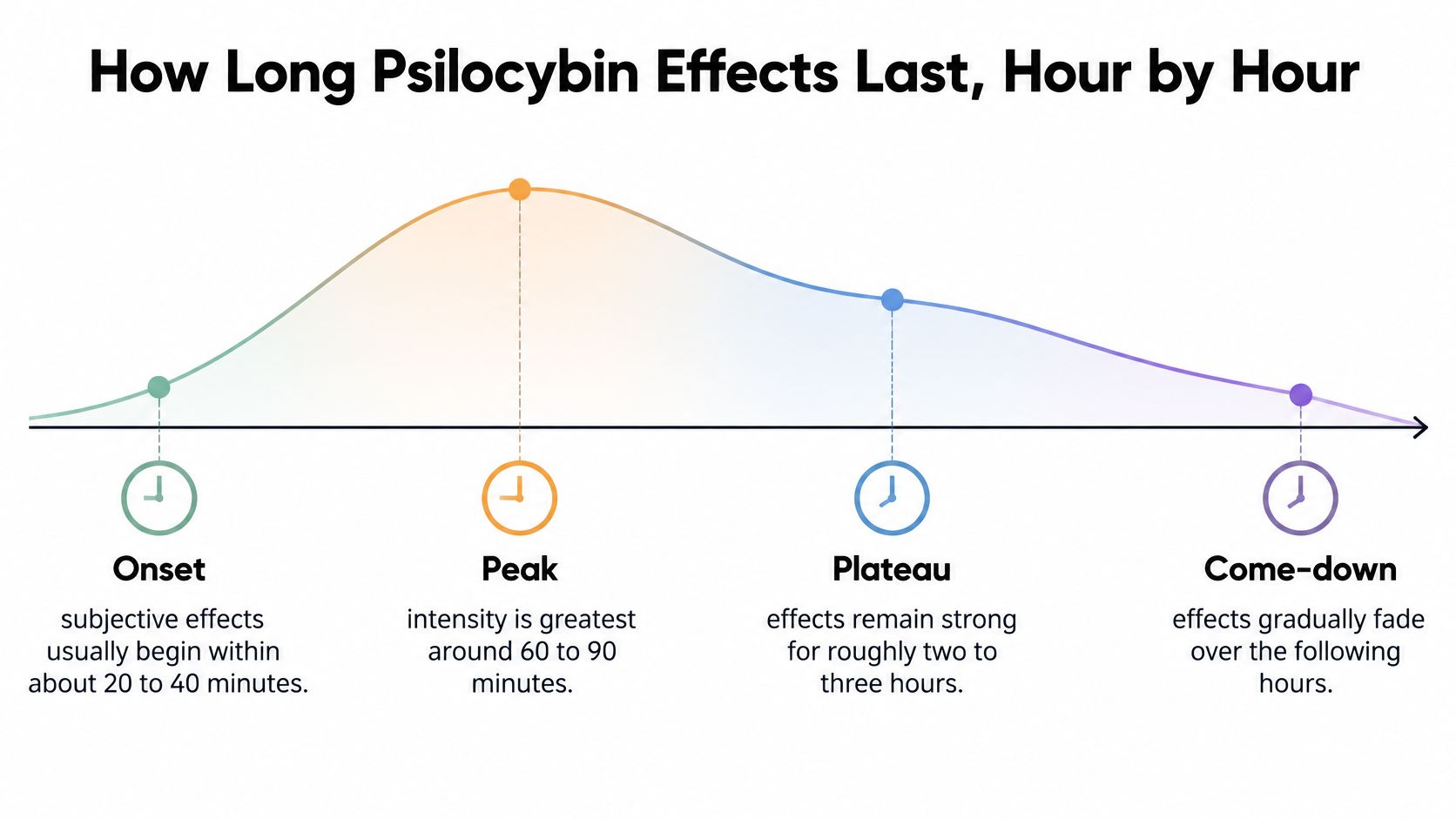
The clock isn't set by how long psilocybin sits in your blood. Conversion to psilocin, distribution into tissue, metabolism and renal elimination all shape the curve, which is why no single half-life figure explains an experience, as this review of human psilocybin pharmacokinetics sets out.
| Phase | Typical timing | What to expect |
|---|---|---|
| Onset of subjective effects | 20 to 40 minutes | First mood and perceptual changes begin |
| Peak intensity | 60 to 90 minutes | Effects are at their strongest |
| Full experience | About 4 to 6 hours | Effects fade gradually toward baseline |
| Psilocin peak in blood | 1.8 to 4 hours after oral dosing | Blood concentration peaks; this is not the same as the experience |
| Brain connectivity change | Acute change; most activity returns within days | Reduced default mode network and hippocampus connectivity lasted at least three weeks |
The blood peak that confuses everyone
Here's the mismatch worth understanding. The concentration of psilocin in blood reaches its high point well after the felt peak. So people watching for a chemical signal to tell them what's happening next are watching the wrong instrument. The experience and the plasma curve run on different schedules.
Distribution explains part of it. The apparent volume of distribution has been reported at roughly 505 to 1,267 litres, meaning the compound spreads widely into tissue rather than staying in circulation. Reported elimination half-lives span about 1.2 to 4.8 hours, and they shift with dose, assay, sampling schedule and route, so treat them as a range rather than a personal timetable.
Four things move your own curve: how fast your stomach empties, whether you ate, your individual metabolism, and the actual psilocybin content of what you took. The last one is the variable nobody can eyeball.
The re-dosing trap: taking more before the first dose has fully developed is the most common route to a delayed, unexpectedly strong experience. Let the curve declare itself first.
Brain-level effects outlast the subjective ones. Imaging research summarized in NIH research on how psychedelic drugs alter the brain found that activity in normally coordinated networks becomes less synchronized during the acute experience, while most brain activity returns toward baseline within days. One connection between the default mode network and part of the hippocampus stayed reduced for at least three weeks.
What Clinical Trials Have Found So Far
The FDA granted psilocybin Breakthrough Therapy designation for treatment-resistant depression in 2018 and for major depressive disorder in 2019, according to NIDA's overview of psychedelic medicines in development. That label identifies therapies that may offer substantial improvement over existing options and allows eligible development programs accelerated interaction with regulators.
It is not an approval. Psilocybin remains an investigational compound, and every result below comes from a supervised protocol with screening, preparation and psychological support built in.

The best-known dose-finding study was a phase 2b randomized, double-blind trial of 233 people at 12 sites in North America and Europe. Participants received different single doses, with symptom severity scored on the Montgomery-Åsberg Depression Rating Scale three weeks later. The 25-milligram group improved significantly compared with the 1-milligram control, while the 10-milligram group did not reach the same result.
| Dose group | Change at week 3 | Result |
|---|---|---|
| 25 mg psilocybin | -12.0 | Better than lower-dose groups on the principal measure |
| 10 mg psilocybin | -7.9 | Not statistically significant |
| Control condition | -5.4 | Reference group |
Those numbers come from a review of dose-response findings in treatment-resistant depression, and the ordering matters less than the verdict: only the higher dose separated from control on the primary measure. The same review reported that 75% of participants met both response and remission criteria at week 1, while by week 3, 66.7% met response criteria and 41.7% met remission criteria.
A separate randomized, placebo-controlled six-week trial followed 104 adults with major depressive disorder. A single 25-milligram dose given with psychological support was associated with a rapid and sustained reduction in symptoms compared with an active placebo, with improvement observed as early as day 2, as reported in this six-week psilocybin depression trial.
Adverse events occurred in 66% to 84% of participants across the reported dose groups. That single figure explains the structure of every trial here: screening, psychological support and monitoring aren't decoration, they're load-bearing. For how this research is being applied to mood disorders, see this overview of psilocybin for depression.
Dosing Basics and Harm Reduction
No safe unsupervised dose can be reverse-engineered from the research. The 10 mg and 25 mg amounts in those trials were measured synthetic psilocybin given inside supervised protocols. They describe what was tested, not what's sensible in a living room.
- Find the measured content first. Strain names and gram weights don't predict potency. A batch-specific lab report is the only thing that does, and if nobody can produce one, you don't know what you have.
- Start smaller than you think you need. The dose that surprises people is rarely the one they planned.
- Let the curve finish before adding anything. The full arc runs for hours and the peak arrives well after the first sensations, so an impatient second dose stacks on top of a first one that hasn't finished arriving.
- Keep the chemical guest list short. Alcohol, cannabis, stimulants and other drugs blur the picture and make a difficult experience harder to interpret. Don't stop or change prescribed medication without medical advice.
- Choose the room and the person. A calm, familiar setting and one sober companion who can drive and call for help cover more risk than any other single step.
Caution applies even to experienced users, because the batch in front of you isn't the batch you had last time. The same label can produce a different experience across products and across people.
These steps lower risk. None of them makes the experience predictable, and none of them makes it safe for everyone.
Safety Checks and Your Next Step
A psilocybin experience can bring anxiety, confusion, nausea, vomiting, agitation, a faster heart rate, or raised blood pressure. Some people also have a psychologically distressing experience, sometimes called a bad trip, involving fear, distorted thinking, or behavior that puts them or others at risk.
Signs that need medical help now
- Chest pain, fainting, or a racing heartbeat that will not settle.
- Severe agitation or confusion that persists as the effects fade.
- Thoughts of harming yourself or someone else.
A personal or family history of psychosis or bipolar disorder, or a heart condition, may affect the risks. Discuss these concerns with a clinician before considering use.
Who should talk to a clinician first
Set and setting can shape how an experience feels, but they do not remove physical risks. Do not drive or operate machinery. Avoid combining substances without medical advice, and have a trusted, sober person nearby. If you are considering psilocybin because of depression or another health condition, ask a licensed clinician about supervised research or approved options.
For personal use, a batch-specific test reporting measured psilocybin content and contaminants can help clarify what a product contains. The Magic Mushroom Delivery says it tests its mushrooms to ensure they are free from DMT and other contaminants. Before making plans, read this guide to psychedelic harm reduction, review your health history and medications with a clinician, and arrange for a trusted person to be present.
The Magic Mushroom Delivery sells raw magic mushrooms, infused chocolates, gummies, capsules, and mushroom coffee. Visit The Magic Mushroom Delivery to see its offerings and shipping information.