
In a 2021 NEJM trial, 70% of participants receiving psilocybin-assisted treatment met response criteria on the QIDS-SR-16 scale, compared with 48% in the escitalopram group, a 22-point difference. That is the number that pulled psilocybin back into serious depression conversations, but it only makes sense if you keep one distinction in view, clinical trial treatment is not the same thing as retail mushroom products.
The trials use screened participants, measured doses, trained therapists, and follow-up care. That package matters as much as the compound itself, and it is the main reason psilocybin for depression should be discussed carefully rather than casually.
Why Psilocybin Is Back in the Depression Conversation
The modern interest in psilocybin for depression didn't come from hype, it came from controlled research that produced results clinicians had to take seriously. In the 2021 NEJM comparison with escitalopram, the response gap was large enough to force a broader question, what exactly is driving the improvement, the drug, the setting, or both? The answer matters because people often hear about “magic mushrooms” and assume the retail experience maps onto the trial data. It doesn't.
What readers should watch for
The strongest studies do not test loose, unsupervised use. They test a treatment package with screening, preparation, a supervised dosing session, and integration afterward. That's why the rest of this article keeps separating regulated clinical protocols from consumer products, even when both use the word psilocybin.
Practical rule: If a claim about psilocybin leaves out screening, support, and follow-up, it's probably describing a different intervention than the one studied in trials.
The clinical question isn't whether some people feel better after psilocybin. They do. The harder questions are who benefits, how much supervision they needed, how durable the change is, and who should not try to copy the trial experience on their own.
The Landmark Trials and What They Measured
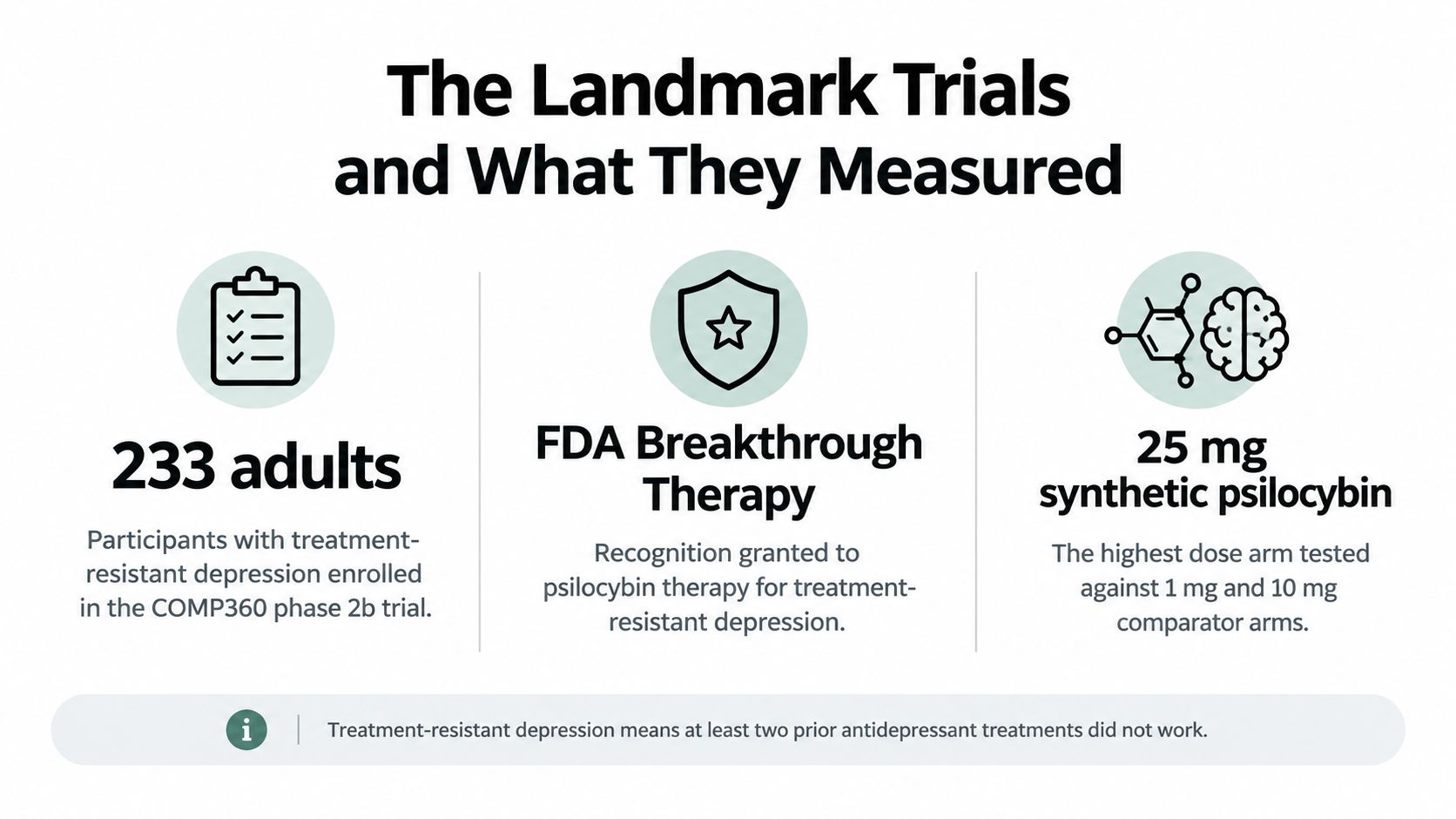
The modern milestone came in 2018, when the U.S. Food and Drug Administration granted Breakthrough Therapy designation to COMPASS Pathways' investigational psilocybin therapy for treatment-resistant depression. That designation reflected early clinical evidence suggesting the treatment could meaningfully outperform available options and deserved a faster development path. It didn't mean the therapy was approved, it meant regulators saw enough promise to accelerate research.
Reading the numbers in plain language
The phase 2b COMP360 trial enrolled 233 adults with treatment-resistant depression and gave them a single 1 mg, 10 mg, or 25 mg dose of synthetic psilocybin with psychological support. At three weeks, the 25 mg group showed a 6.6-point greater reduction on the Montgomery–Åsberg Depression Rating Scale than the 1 mg group, with P<0.001. That scale is basically a clinician's yardstick for how severe depression is, so a lower score means fewer symptoms.
The dose-response pattern was clear. Response occurred in 37% of participants receiving 25 mg, compared with 19% receiving 10 mg and 18% receiving 1 mg. Remission occurred in 29%, 9%, and 8% of the respective groups. The point many readers miss is that the low-dose arm was not empty space, it was an active control that could still produce expectancy and support effects.
Read a deeper overview of psilocybin and treatment-resistant depression
The cleanest signal in the trial came from the highest dose, but the result still belonged to a supervised protocol, not to psilocybin alone.
Why that matters
The trial's structure tells you what the numbers mean. Every participant received psychological support, so the study measured a guided intervention, not a molecule floating in isolation. That's why people who compare these results to casual mushroom use are usually comparing two very different experiences.
How Psilocybin Compares to Standard Antidepressants
The head-to-head comparison with escitalopram is what made many people pay attention. In that 2021 NEJM study, 70% of participants in the psilocybin-assisted group met response criteria versus 48% in the escitalopram group, and remission was 57% versus 28%. Those gaps are meaningful, but they don't prove one treatment wins for everyone, or that a single session is a replacement for routine depression care.
What the meta-analysis adds
A broader BMJ systematic review and meta-analysis found psilocybin interventions were associated with about twice the likelihood of response compared with placebo or non-psychoactive controls, with a risk ratio of 2.02. The likelihood of remission was nearly three times higher, with a risk ratio of 2.71. Risk ratios sound technical, but in plain English they mean the psilocybin groups were more likely to improve than the comparison groups in the trials that fit the review.
Here's the catch. Those results came from controlled dosing, screening, professional supervision, and structured follow-up. They don't tell you that retail mushrooms are equivalent, and they don't tell you which part of the treatment package did the heavy lifting. They do tell you that psilocybin deserves serious study, not dismissal.
| Study | Population | Response Rate | Remission Rate | Comparator |
|---|---|---|---|---|
| 2021 NEJM trial | Adults with major depressive disorder | 70% | 57% | Escitalopram, 48% response and 28% remission |
| COMP360 phase 2b trial | Adults with treatment-resistant depression | 37% in the 25 mg group | 29% in the 25 mg group | 1 mg control |
| JAMA Psychiatry trial | Adults with major depressive disorder | 71% | 58% | Supportive psychotherapy plus psilocybin |
Bottom line: the comparison is promising, but it's a comparison between treatment packages, not a verdict on mushrooms by themselves.
Why the Treatment Package Matters as Much as the Dose
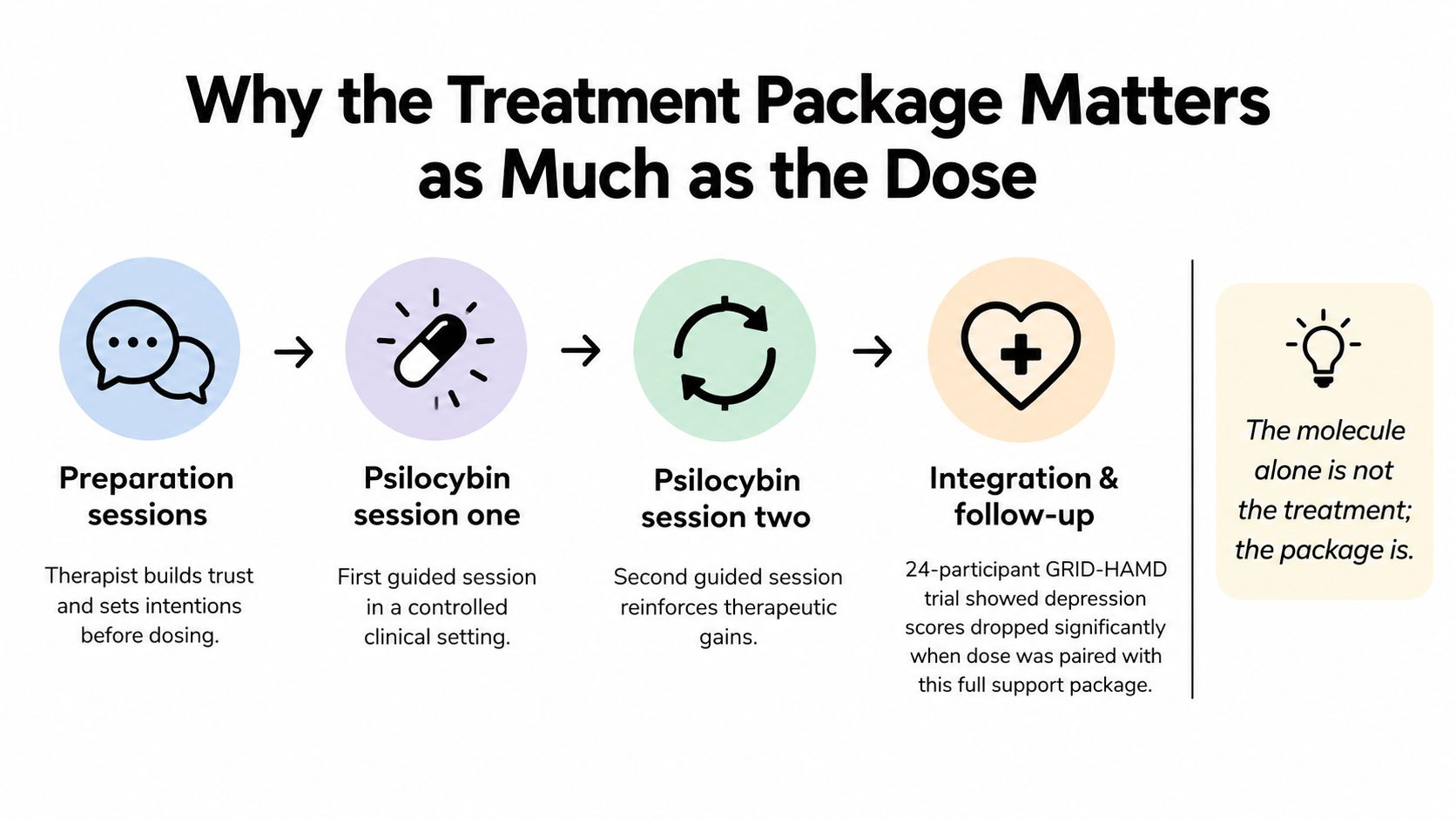
The most overlooked fact in this field is simple, the molecule is not the whole treatment. The 24-person JAMA Psychiatry trial used two psilocybin sessions plus preparatory and supportive psychotherapy, and 71% met response criteria while 58% met remission criteria at one week on the GRID-HAMD scale. Those outcomes weren't produced by a capsule alone, they came from a structured clinical process.
What the protocol actually looks like
A patient first goes through screening, and that's where clinicians look for bipolar-spectrum illness, psychosis risk, medication conflicts, and other reasons to avoid treatment. Preparation sessions then build trust, set intentions, and reduce uncertainty before dosing. On the dosing day, the patient is monitored in a controlled room, usually with two therapists present, and afterward the work continues in integration sessions that try to turn insights into daily behavior change.
That sequence matters because a high-intensity psychological experience can be either therapeutic or destabilizing depending on the environment around it. A retail product doesn't provide therapist preparation, live monitoring, or structured integration, so its results can't be assumed to match trial outcomes.
Why the context changes the meaning
Think of the session like a medical procedure with pre-op and post-op care. The acute experience may be the visible center, but the safety and the benefit depend on everything surrounding it. That is why the phrase psilocybin-assisted therapy is more accurate than “taking mushrooms for depression.”
How Long the Antidepressant Effect Actually Lasts
A lot of popular coverage implies that one session can clear depression for months or even end it. The trial record is more cautious. In the phase 2b study, sustained response at week 12 was 20% in the 25 mg group versus 10% in the 1 mg group, which is a much smaller gap than the three-week result suggests.
What follow-up can and cannot tell us
A 2025 systematic review reported antidepressant effects lasting weeks to months, with some studies suggesting benefit for up to 12 months, while also flagging relapse and multi-year safety as under-researched questions. That combination is important. It tells you the signal can last, but it also tells you the field still doesn't know how durable the effect is for different people over time.
The longer follow-up from treatment-resistant depression adds another cautious note. In a post hoc 52-week analysis, the median time to a depressive event was 189 days after 25 mg, versus 43 days after 10 mg and 21 days after 1 mg. Because the analysis was post hoc and based on a limited trial population, it should be read as suggestive, not definitive.
See a longer discussion of durability and follow-up questions
If depression returns, the real question isn't whether psilocybin “failed.” It's what evidence supports therapy, medication adjustment, another supervised session, or ordinary clinical follow-up for that person.
For adults considering retail products, this matters even more. The trial literature doesn't justify assuming one experience will last, or that repeat use has the same benefit-risk profile as the original supervised session.
Dosing Context, Setting, and What Clinical Sessions Look Like
The research dose range is not a guessing game. Trials have used 10 mg and 25 mg of synthetic psilocybin, with 1 mg serving as a control in some studies. That matters because pharmaceutical-grade material gives researchers consistent exposure, while mushrooms can vary in potency, species, and preparation.
What happens in the room
A clinical session is usually calm, private, and carefully prepared. Patients often wear eye shades, listen to curated music, and spend the session with trained therapists who stay present without directing the experience. The acute phase can last for hours, but the therapeutic work extends beyond that window.
Why the environment is part of the medicine
Integration sessions help patients translate the experience into concrete changes, such as how they handle avoidance, self-criticism, or isolation. Without that follow-up, insight can fade into memory without changing behavior. That's one reason trial protocols are not a template for self-dosing.
Learn more about psilocybin drug interactions before considering any self-directed approach
The safest way to think about clinical psilocybin is as screening plus preparation plus dosing plus integration. Leave out one of those pieces, and you're no longer talking about the treatment that produced the published results.
Who Should Not Self-Treat and How to Read the Safety Signals
Average trial results can hide individual risk. A 2025 randomized trial in treatment-resistant depression reported suicidal ideation on dosing days in 4% of the 25 mg group versus 1% to 2% in comparator groups, and one serious adverse reaction involved hallucinogen-persisting perception disorder. That doesn't prove psilocybin causes those outcomes in every case, but it does show why “natural” is not the same thing as harmless.
Who needs extra caution
People with bipolar-spectrum disorders, psychotic disorders, or a current suicidal crisis should not treat this as a self-experiment. Caution also applies to certain psychiatric medications, cardiovascular conditions, and pregnancy, because the trial safety profile depended on screening and supervision. A clinician can also help judge whether a medication combination raises the risk of a bad interaction or an unstable response.
How to interpret a warning sign
If someone reports worsening mood, persistent perceptual changes, intense anxiety, chest pain, or new suicidal thinking, the right move is urgent professional help, not more self-treatment. In supervised studies, the team can respond to acute distress. In unsupervised use, there's no built-in safety net.
Practical rule: if the experience stops feeling like a guided clinical process and starts feeling medically unstable, stop and seek help.
The retail-versus-clinic gap matters here too. Clinical trials used screening, trained support, and monitoring, while consumer products can't guarantee those safeguards. That difference is central, not incidental.
A Practical Roadmap for Patients and Curious Adults
If you're thinking about psilocybin for depression, start with a licensed mental health professional, not a dosing forum or a product page. Ask whether the clinician has experience with psychedelic research, how they screen for bipolar or psychotic risk, and how they handle medication review. Bring a full list of current prescriptions, supplements, and medical conditions, especially anything cardiovascular or pregnancy-related.
A few questions are worth asking in any consultation:
- Screening: What symptoms or diagnoses would rule me out right now?
- Medication review: Which of my current drugs could make this unsafe or harder to interpret?
- Support plan: If I worsen during or after treatment, who follows up and how fast?
- Durability: What would we do if my depression returns after initial improvement?
If you're already trying to self-direct anything and notice persistent perceptual changes, chest pain, severe anxiety that doesn't ease, or any suicidal thinking, stop and seek urgent care. Those aren't signs to push through.
The evidence so far supports cautious optimism about psilocybin as a supervised intervention. It does not validate unsupervised use, and it doesn't replace ordinary depression care when symptoms return.
The Magic Mushroom Delivery publishes education that helps adults understand mushroom products, effects, and responsible use in context. If you want a clearer, science-first way to keep learning about psilocybin, visit The Magic Mushroom Delivery and read their broader guidance before making any decisions about your next step.