
A mushroom coffee drink is regular coffee blended with powdered or extracted functional mushrooms such as lion's mane, reishi, chaga, or cordyceps. One market assessment valued the category at approximately USD 3.1 billion in 2025 and projected it to reach USD 5.1 billion by 2033.
But what are you holding when a shelf label says “mushroom coffee”? Is it coffee with a meaningful mushroom extract, a lower-caffeine instant mix, or just a wellness-flavored version of your usual morning cup?
The answer depends on the formulation. This guide treats mushroom coffee as a product to understand, not a miracle to believe in or a trend to dismiss. You'll learn how the drink is made, what the major functional mushrooms are associated with, how the evidence should shape your expectations, and how caffeine and mushroom-specific risks fit into the same decision.
You'll also get a practical way to read labels. Species, extract form, serving size, extract ratio, and caffeine milligrams tell you much more than a front-of-pack promise about “focus” or “calm energy.”
Introduction to the Mushroom Coffee Trend
You spot a mushroom coffee drink beside familiar ground coffee. The packaging shows earthy colors, a steaming mug, and names such as lion's mane or reishi. The natural question is simple: is this a different kind of coffee, or a mushroom supplement wearing a coffee costume?
Usually, it's both in a limited sense. The coffee remains the base, while powdered or extracted functional mushrooms act more like seasoning. Some products use conventional coffee with mushroom extracts. Others replace part or all of the coffee with mushroom ingredients, creating a drink that may be closer to an instant wellness beverage than a standard brew.
The category has attracted attention because it combines two existing habits. People already understand the ritual of coffee, while functional ingredients give brands a way to position the same ritual around focus, energy, stress, or general wellness. Global coffee consumption reached 175.1 million 60-kilogram bags in the 2024/25 season, creating a large established beverage base for new coffee formulations, as described in the market assessment of mushroom coffee.
That commercial momentum doesn't prove that a mushroom coffee drink improves health. Market estimates also vary widely because analysts may include different combinations of instant mixes, ready-to-drink products, supplements, foodservice sales, and adjacent functional coffee products.
A category with blurry edges
One assessment valued the global category at approximately USD 3.1 billion in 2025, projected USD 5.1 billion by 2033, with North America representing 29.0% of global revenue in 2025. Those figures describe market activity, not clinical effectiveness.
A better way to approach the category is to ask precise questions. What kind of coffee is in the product? Which mushroom species are present? Is the mushroom powdered, extracted, or both? How much does one serving contain? How much caffeine remains?
Practical rule: Treat the front label as an invitation to investigate, not as evidence that every health claim applies to the drink in your hand.
The rest of the buying decision follows from that habit. Once you understand the formulation, you can compare a full-caffeine blend with a half-caf mix, distinguish a clearly dosed extract from an unnamed “mushroom blend,” and decide whether the product fits your body and routine.
What a Mushroom Coffee Drink Actually Is
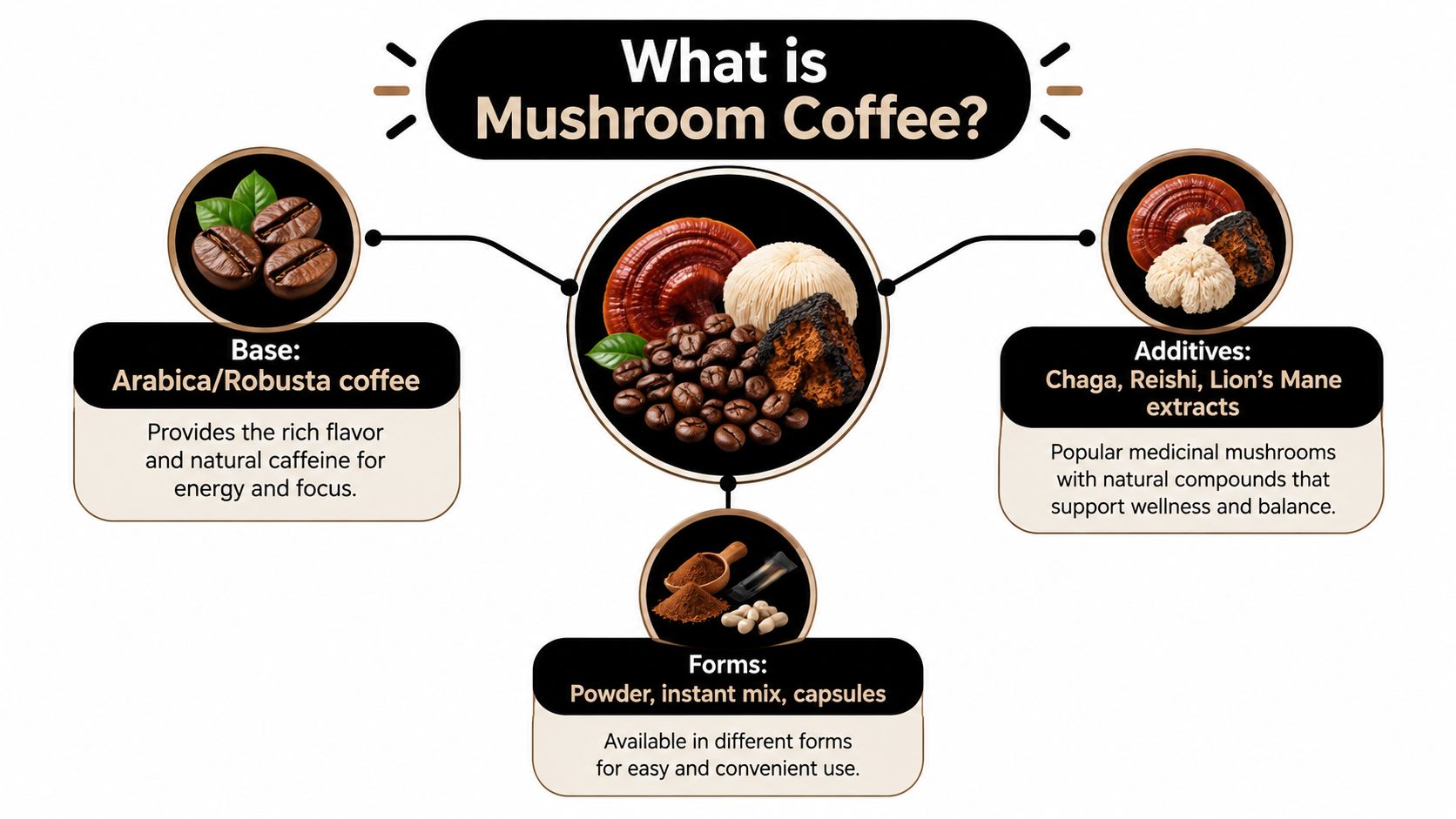
Mushroom coffee isn't a single standardized product category. The phrase can describe conventional coffee mixed with powdered or extracted mushrooms, or a mushroom-based drink that replaces some or all of the coffee.
Think of coffee as the base and mushroom extract as the seasoning. Two soups can both contain mushrooms yet taste and function differently because one uses a small amount of powdered mushroom and the other uses a concentrated extract. Mushroom coffee works the same way. The species, extraction method, amount, and coffee content can change the product substantially.
Start with the base
A 2025 peer-reviewed review describes production as extracting bioactive compounds from mushrooms and combining them with coffee beans or instant coffee while preserving a familiar coffee flavor. The review discusses caffeine, mushroom-derived beta-glucans, and compounds such as cordycepin in functional formulations, but it also emphasizes that scientific research usually examines mushroom extracts separately from the finished beverage. You can read that distinction in the peer-reviewed review of mushroom coffee production and composition.
A label detective therefore checks whether the product contains:
- Full coffee: The drink may have a caffeine profile closer to ordinary coffee.
- Partial coffee: A half-caf or mixed base may provide less caffeine, but the label should say so.
- No conventional coffee: The product may be a mushroom-based drink rather than coffee in the usual sense.
- Instant or ground coffee: Preparation method affects convenience, taste, and how consistently you measure a serving.
Then inspect the mushroom side
Look for the common and scientific name, the extract or powder designation, the amount per serving, and any stated extraction ratio. “Mushroom blend” tells you very little if it doesn't identify the species or quantities.
That variance matters because evidence from a concentrated lion's-mane preparation can't automatically be transferred to a lightly flavored coffee mix. A brewed cup may contain a different species, a different dose, and a different extraction profile.
The useful takeaway isn't a perfect definition. It's a repeatable habit: identify the coffee base, identify every mushroom, find the amount, and separate the product facts from the marketing language.
Functional Mushrooms Found in These Blends
The four names most often encountered in mushroom coffee are lion's mane, reishi, chaga, and cordyceps. Their popular associations differ, but the word “functional” doesn't mean that a finished coffee has a clinically established effect.
| Mushroom | Popular Association | Notable Compounds |
|---|---|---|
| Lion's mane | Focus and cognition | Mushroom polysaccharides and other extract compounds |
| Reishi | Calm, stress support, and immune-related wellness | Beta-glucans and polysaccharides |
| Chaga | Immune-related wellness and antioxidant positioning | Beta-glucans and other mushroom compounds |
| Cordyceps | Energy and exercise support | Cordycepin and other extract compounds |
Lion's mane
Lion's mane is commonly marketed around focus and cognitive performance. A small randomized pilot trial provides a useful example of cautious interpretation. It enrolled 41 healthy adults aged 18 to 45, who received 1.8 grams of Hericium erinaceus and completed testing after a single dose and after 28 days. The single-dose group completed a Stroop task more quickly at 60 minutes, with p = 0.005, while the reduction in subjective stress after 28 days was only a trend, with p = 0.051. The published lion's-mane pilot trial tested a defined preparation, not every mushroom coffee drink.
Reishi
Reishi is often positioned as a calming or adaptogenic ingredient. Those labels describe a wellness association, not a guarantee that a reishi coffee will make you calm. Reishi also deserves more medication scrutiny than a casual product page may suggest, particularly when the blend doesn't disclose extract quantity.
Chaga
Chaga commonly appears in immune and antioxidant-oriented formulations. Its presence isn't automatically suitable for everyone, especially people with kidney concerns or a history of oxalate kidney stones. Species identification matters because “mushroom” is too broad a category for a safety decision.
Cordyceps
Cordyceps is frequently associated with energy, stamina, and exercise. Those associations shouldn't be confused with the stimulant effect of caffeine. A cordyceps-containing coffee can still feel stimulating because of its coffee base, regardless of what the mushroom extract contributes.
These functional species shouldn't be confused with psilocybin-containing mushrooms. Functional coffee blends use ingredients such as lion's mane, reishi, chaga, and cordyceps. For a broader explanation of how functional mushrooms are categorized, see what functional mushrooms are.
Mushroom Coffee Versus Regular Coffee
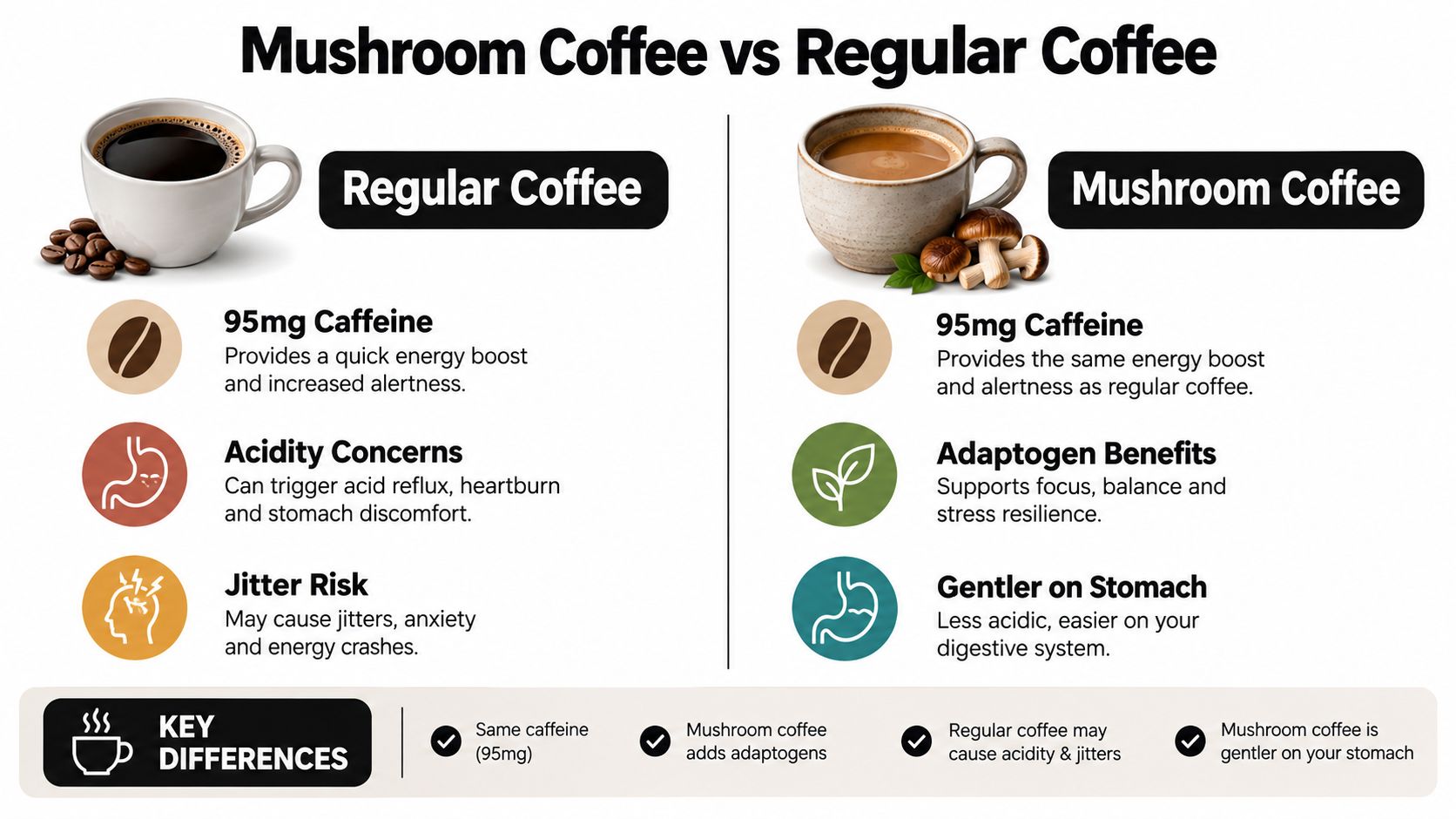
The clearest difference between regular coffee and a mushroom coffee drink isn't automatically the mushroom. It's the formulation of the coffee base.
Adding mushroom extract doesn't remove caffeine. A product made with full coffee can remain strongly caffeinated, while a half-caf or caffeine-free base changes the experience. That makes the phrase “gentler than coffee” unreliable unless the label gives you the caffeine amount and serving size.
| Question | Regular coffee | Mushroom coffee |
|---|---|---|
| What creates the coffee flavor? | Coffee beans or instant coffee | Coffee, unless the product replaces some or all of it |
| What determines caffeine? | Bean, brewing method, and serving size | The same factors, plus whether the blend is full-caf, half-caf, or caffeine-free |
| What adds the functional positioning? | Usually no mushroom extract | One or more identified mushroom species |
| What does the evidence directly test? | Coffee products and coffee constituents | Often mushroom extracts separately, rather than the finished beverage |
Reading the lion's-mane example
The pilot trial described above is valuable because it shows how easily a careful result can become an exaggerated advertisement. Participants received a defined 1.8-gram dose, and the study found faster Stroop performance after a single dose, with p = 0.005. The 28-day stress result did not reach conventional statistical significance, with p = 0.051.
That doesn't establish that an ordinary cup improves focus. The coffee may contain less mushroom material, a different extract, several species mixed together, or no disclosed dose at all. It also doesn't show that mushroom coffee produces steadier energy or fewer jitters for every drinker.
What deserves skepticism
Claims of immune boosting, guaranteed calm, dramatic cognitive enhancement, or freedom from caffeine side effects go beyond what the finished beverage evidence can support. The more specific the claim, the more specific the label and research should be.
Reasonable expectations are narrower. You might enjoy the taste, prefer a lower-caffeine formulation, or find that a particular product fits your morning ritual. Those are practical reasons to explore the category without pretending that a mushroom extract turns coffee into a clinically validated therapy.
Brewing Methods and Dosing Considerations
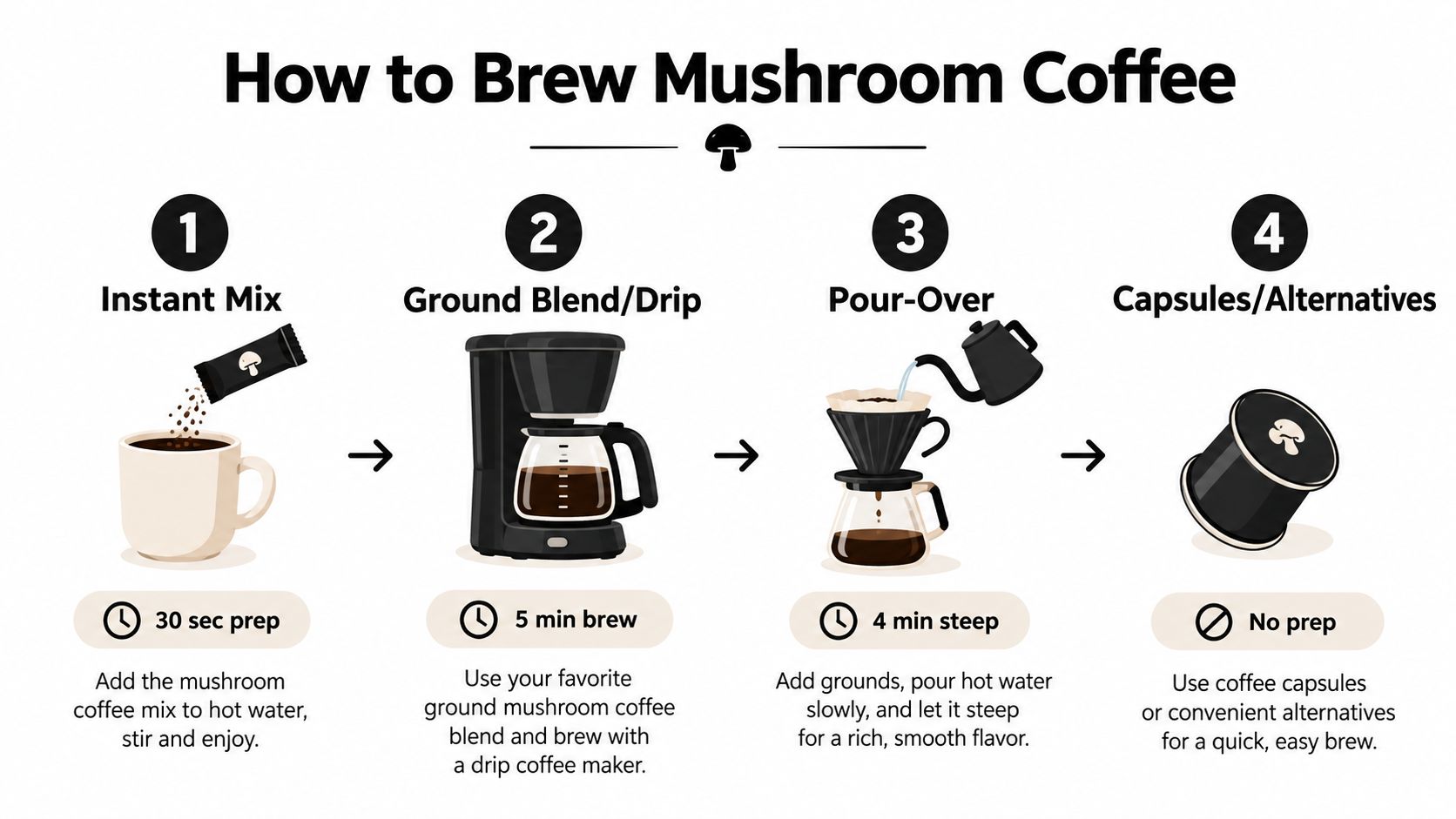
Preparation should match the product rather than force every mushroom coffee into the same routine. An instant mix is built for speed. A ground blend belongs in a drip machine or pour-over setup. A mushroom-based alternative may work more like a tea or latte and may not behave like ordinary coffee grounds.
Choose a preparation that reveals the serving
Instant mixes are convenient because the manufacturer has already combined the ingredients. Stir the stated serving into hot water or milk, then pay attention to whether the label defines one serving as a full packet, a scoop, or something else.
Ground blends can be prepared in a drip machine or pour-over. The coffee-making process determines the beverage, but it doesn't solve an unclear mushroom dose. If the package lists only a proprietary blend without amounts, you still won't know how much of each species reaches the cup.
Alternative formats may include capsules or mushroom drinks intended to be mixed into another beverage. These can suit people who want to control the coffee separately, but they also make it easier to combine multiple products without noticing overlapping ingredients or caffeine.
For a practical preparation walkthrough, use this guide to making mushroom coffee.
Let the label set the dose
There is no universally validated clinical dose for mushroom coffee. Human research often uses a defined extract or supplement, while commercial drinks can vary in species, concentration, and serving size. Use the product label as a measurement tool, not as a promise of a research-equivalent dose.
Check four details:
- Caffeine per serving: Record the milligrams, then count coffee, tea, energy drinks, and pre-workout products consumed that day.
- Mushroom species: Know whether the blend contains lion's mane, reishi, chaga, cordyceps, or several species.
- Extract amount: Look for milligrams or grams per serving and whether the ingredient is a powder or extract.
- Serving size: Don't assume a heaped scoop equals the labeled serving.
The U.S. Food and Drug Administration says up to 400 milligrams of caffeine per day, roughly two to three 12-fluid-ounce cups of coffee, isn't generally associated with negative effects for most adults, although sensitivity varies. The FDA caffeine guidance is a population-level reference, not a personal guarantee.
Start with a small serving, use it earlier in the day, and reduce or stop if you notice sleep disruption, anxiety, palpitations, reflux, or digestive discomfort.
Safety Notes and Who Should Be Careful
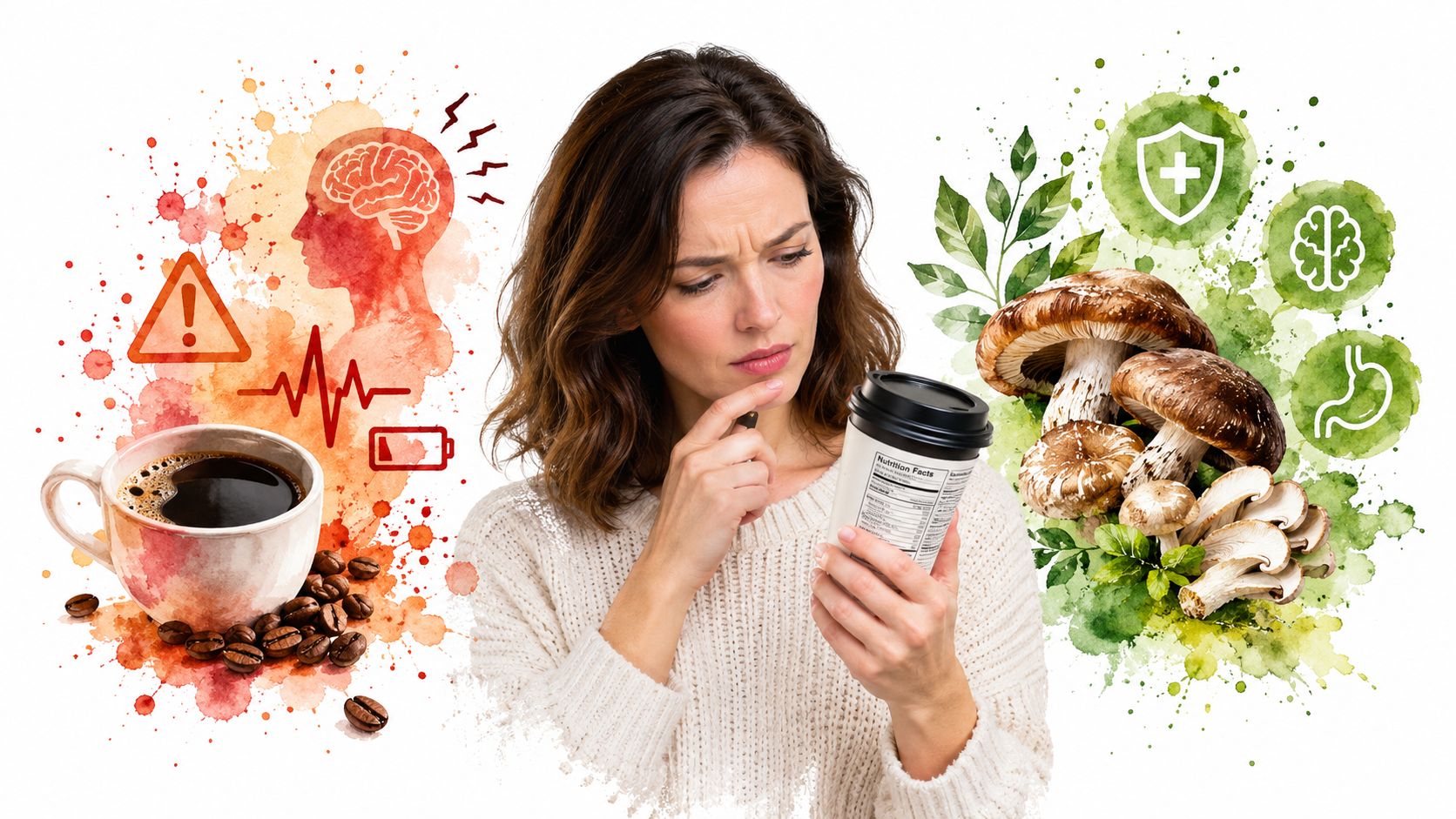
A lower-caffeine mushroom coffee drink isn't automatically risk-free. Safety has two separate layers: the caffeine layer and the mushroom layer.
Caffeine can contribute to alertness, but it can also worsen anxiety, palpitations, insomnia, or gastrointestinal symptoms. These effects may occur at amounts below a general population reference point, especially for people who are sensitive or who combine coffee with tea, energy drinks, or other stimulant products.
The mushroom ingredients bring different questions. Chaga-containing products warrant caution for people with kidney impairment or a history of oxalate kidney stones. Reishi may matter for people taking anticoagulant or antiplatelet medicines, and extracts can cause digestive symptoms or allergic reactions.
Medication questions deserve specific answers
Memorial Sloan Kettering Cancer Center advises people taking blood thinners such as warfarin to consult a healthcare professional because reishi may increase bleeding risk. It also cautions that reishi may not be safe with immunosuppressants and reports laboratory evidence that reishi polysaccharides inhibited CYP2E1, CYP1A2, and CYP3A enzymes in vitro. The Memorial Sloan Kettering reishi information makes an important distinction: laboratory findings create a plausible interaction concern, but they don't prove that an ordinary beverage serving causes a clinical interaction.
Ask a clinician or pharmacist before using a blend if you:
- Take anticoagulant or antiplatelet medicine: Reishi may be especially relevant.
- Use immunosuppressants: The mushroom extract may not be appropriate without medical review.
- Manage kidney disease or kidney-stone risk: Chaga and oxalates deserve particular attention.
- Are pregnant or breastfeeding: Product-specific safety information may be limited.
- Have caffeine sensitivity, anxiety, reflux, or sleep problems: The coffee base may still be the main source of symptoms.
- Have allergies or serious illness: A concentrated extract may not behave like an ordinary food ingredient.
Long-term daily use of concentrated mushroom extracts in beverage form for months or years hasn't been adequately studied. Read the species and caffeine information, start cautiously, and treat new symptoms as useful information rather than something to push through.
How to Buy a Quality Mushroom Coffee Drink
A quality purchase begins with transparency, not a dramatic promise. The best label for your needs may be a simple one that tells you exactly what the coffee contains.
Use a formulation checklist
Look for these details before ordering:
- Named species: The label should identify lion's mane, reishi, chaga, cordyceps, or each species included in the blend.
- Extract form: Check whether the product uses a powder, extract, or combination.
- Extract ratio: A disclosed ratio gives more context than a vague proprietary blend.
- Mushroom quantity: Look for the amount of each mushroom per serving.
- Caffeine milligrams: This is essential if you're managing sleep, anxiety, reflux, or total daily caffeine.
- Third-party testing: Testing for contaminants and identity gives you a stronger basis for evaluating product quality.
- Responsible language: Be wary of disease-treatment claims or promises that a blend will eliminate stimulant effects.
A product can taste excellent and still be poorly documented. Conversely, a clearly labeled product lets you compare it with regular coffee, half-caf coffee, tea, or a single-ingredient mushroom supplement without guessing.
Consider the retailer and the product format
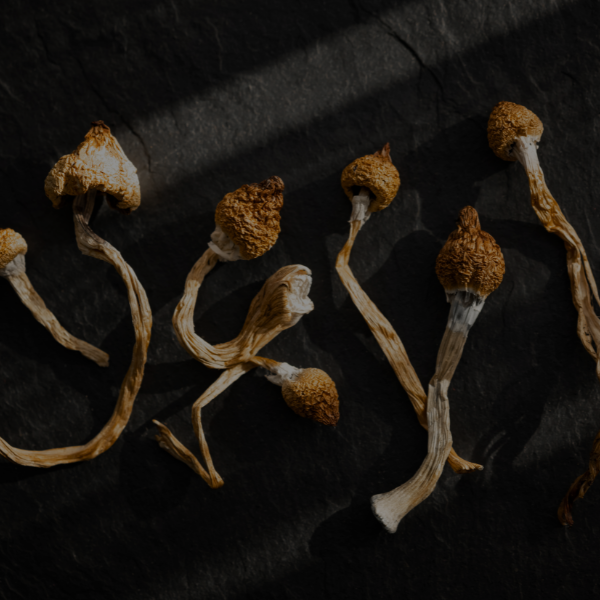
The Magic Mushroom Delivery is a U.S.-based shop in Oakland, California, offering mushroom coffee alongside chocolates, gummies, and capsules. Its product range includes instant coffee infused with functional mushroom extracts, and the site describes organic, non-synthetic ingredients, age verification for customers 21+, discreet nationwide delivery, and next-day and 2-day shipping options. Its educational resources, FAQs, and blog also address dosing and responsible use, while seasonal offers can include Buy 3, Get 1 Free.
You can compare available options through The Magic Mushroom Delivery's mushroom coffee selection. Regardless of which retailer you choose, apply the same test: can you identify the coffee base, caffeine amount, mushroom species, extract quantity, and relevant cautions?
A mushroom coffee drink can be an enjoyable change to your routine, especially when you choose it for a clear reason such as flavor, convenience, or caffeine control. Read the label as if you're checking a recipe, begin with a modest serving, and let transparent formulation guide your expectations.
The Magic Mushroom Delivery offers functional mushroom coffee in convenient formats, along with educational resources that can help you evaluate serving information and responsible use. Visit The Magic Mushroom Delivery to explore its coffee selection and choose a product with the label details that fit your routine.