

The most popular advice about mushroom coffee is also the least useful: pick a famous brand, choose a blend with several mushrooms, and assume the gut benefits come with the label. They don't. A mushroom printed on the front of a coffee bag tells you almost nothing about how much beta-glucan reaches your cup, whether the product uses a meaningful extract, or whether processing stripped away the compounds you care about.
The best mushroom coffee for gut health is the one with a verifiable formulation. Look for named species, disclosed beta-glucan content, clear extract details, sensible caffeine information, and independent testing. If a product offers none of that, you're buying a story, not a well-defined gut-health beverage.
| What to compare | Stronger choice | Weak signal |
|---|---|---|
| Mushroom source | Clearly identified fruiting body or extract | “Mushroom blend” with no source |
| Gut-relevant compounds | Beta-glucan or total-glucan assay | Mushroom weight alone |
| Formula transparency | Each species and amount listed | Proprietary blend |
| Added fiber | Named prebiotic with a disclosed amount | “Digestive support” claim |
| Quality control | Third-party certificate of analysis | No testing information |
| Coffee format | A brew or instant product that clearly explains processing | Unclear powder and substrate details |
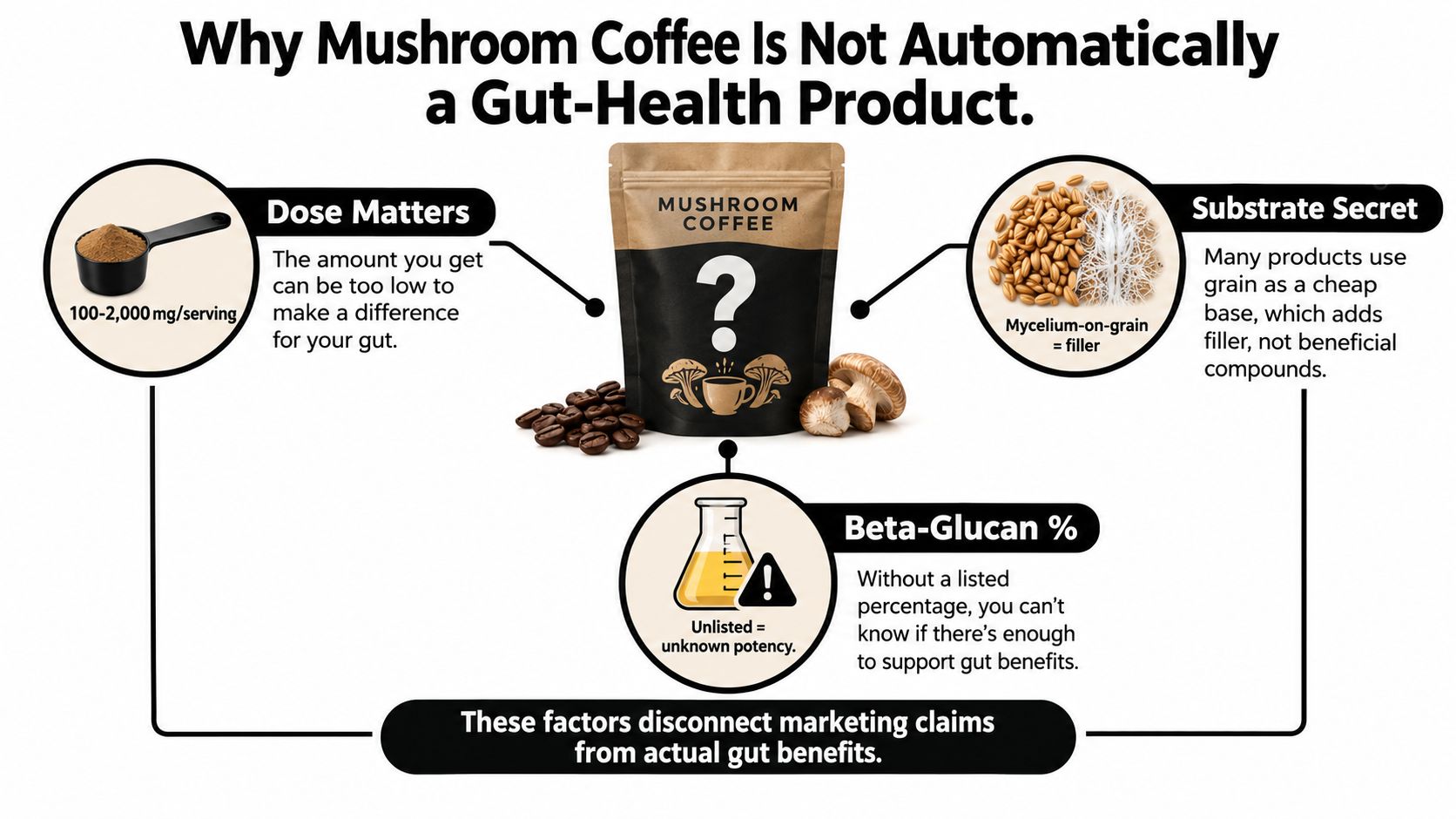
Why Mushroom Coffee Is Not Automatically a Gut-Health Product
A mushroom on a coffee label proves only that a mushroom ingredient was added. It does not prove that meaningful beta-glucans survive extraction, blending, or brewing. The useful question is which compounds reach the cup, in what amount, and in what form after processing?
Beta-glucans explain much of the interest in mushroom coffee. A review of fungal bioactive compounds describes beta-glucans as potentially supporting intestinal barrier function, immune homeostasis, and short-chain fatty acid production through changes in the gut microbiota. That evidence establishes biological plausibility, not proof that a finished coffee improves human digestion. (Nature review of fungal bioactives and gut function)
The coffee matrix matters too. A powder may combine mushroom material with roasted coffee, carriers, sweeteners, or other ingredients, while an extract may concentrate some compounds and lose others during processing. Brewing then determines what dissolves into the serving. A label that names only several mushrooms gives you no way to judge that delivery.
The category is expanding, so weak label claims deserve more scrutiny. An independent mushroom coffee market report reflects that commercial growth, but popularity says nothing about beta-glucan content or gut value.
The number that matters most
A peer-reviewed analysis shows why source-mushroom claims are insufficient. Raw medicinal mushrooms in that analysis contained 3.79% beta-glucan for Cordyceps, 7.06% for Phellinus, and 8.57% for Chaga. The finished Cordyceps coffee blend measured only 2.03% beta-glucan and 3.11% total glucan, showing that processing and blending can materially change what reaches the cup. (Peer-reviewed analysis of glucans in mushrooms and coffee blends)
Use that finding as a buying rule: Mushroom weight is not the same as gut-active fiber. Choose a product with a disclosed beta-glucan or total-glucan assay, named species, stated extract or powder format, and enough processing detail to assess the finished brew. Skip proprietary blends that offer mushroom names without measured glucan content.
The Ingredients That Actually Influence Gut Health
Start with the compounds, not the mushroom names. Beta-glucans are complex carbohydrates found in mushrooms and other fungi. A major review says mushroom beta-glucans aren't digested in the human gastrointestinal tract and may increase fecal bulk and frequency while serving as fermentable material in the colon. That makes them the most relevant ingredient class to investigate when your goal is gut support. (Review of mushroom beta-glucan biology)
Chaga, lion's mane, turkey tail, reishi, and maitake may all appear in functional coffee formulas, but their presence doesn't prove equal gut value. The useful question is whether the label identifies the species, the extract or powder format, and the measured glucan content. Chaga's polyphenols and turkey tail compounds such as PSP and PSK may attract marketing attention, yet a buyer still needs product-specific testing rather than assuming every named compound survives into the beverage.
Read the supporting ingredients carefully
Prebiotic fibers such as inulin, acacia, and chicory root can change the formula's digestive effect. They may provide fermentable material for gut microbes, but they can also be poorly tolerated by people who react to particular fibers. A product that adds a prebiotic should name it clearly and disclose the amount. “Gut support blend” is not enough.
Some products also add probiotic strains. That can sound impressive, but strain identity, viable count at the end of shelf life, and storage conditions matter. Warm brewing raises another question: whether the probiotic remains viable after contact with hot liquid. Unless the manufacturer provides stability information, treat the probiotic claim as unverified.
| Ingredient | Source | Gut mechanism |
|---|---|---|
| Beta-glucans | Mushroom extracts or powders | May provide fermentable polysaccharides and support microbial activity |
| Chaga | Chaga mushroom material | Supplies fungal compounds, including beta-glucans and polyphenols |
| Lion's mane | Lion's mane mushroom material | Relevant mainly when the label discloses its form and dose |
| Turkey tail | Turkey tail mushroom material | Contains beta-glucans and other polysaccharide compounds |
| Inulin or chicory root | Added plant fiber | Fermentable prebiotic fiber, but may cause discomfort in sensitive users |
| Acacia fiber | Added plant fiber | Prebiotic ingredient that may be gentler for some people |
| Probiotic strains | Added live cultures | Potentially useful only if strain, viability, and heat handling are clear |
For a plain-language overview of what may appear in these formulas, see this guide to mushroom coffee ingredients. Use it to decode the label, not to skip the label.
What the Evidence Actually Says About Mushroom Coffee and Digestion
The evidence supports a narrower conclusion than most marketing suggests. Edible mushrooms have been connected with digestive benefits, and researchers increasingly point to gut microbiota regulation as one possible pathway. A Frontiers in Nutrition editorial says mushroom consumption has been linked with a reduced risk of digestive ailments, while also emphasizing that many proposed benefits are tied to microbiota regulation and that the evidence for supplement-style claims isn't conclusive in humans. (Frontiers editorial on mushrooms and nutrition)
That distinction matters because whole edible mushrooms aren't the same as a small amount of processed extract in coffee. A University of Utah health article notes that whole mushrooms provide fiber supporting diverse gut microbes, while more human research is needed for processed mushroom supplements. The evidence can't be transferred automatically from a plate of mushrooms to an instant drink.
Coffee itself has a real microbiome signal
The coffee portion of the beverage isn't biologically neutral. A 2024 Nature study found that coffee drinkers had gut microbiomes distinguishable from those of non-drinkers, identified 115 bacterial species associated with coffee intake, and reported one species with median abundance 4.5 to 8 times higher among coffee drinkers. (2024 Nature study of coffee and the gut microbiome)
A separate review reported that moderate coffee consumption, defined as less than 4 cups per day, was associated with higher microbiota diversity, changes in the relative abundance of several bacterial groups, and a human volunteer result in which 3 cups of coffee daily for 3 weeks changed gut microbiota composition and increased Bifidobacterium species. (Review of coffee, microbiota, and health)
Those findings don't prove that mushroom coffee is better than ordinary coffee. They do show that the coffee matrix already affects the gut, which makes it difficult to isolate the contribution of the mushroom material.
What remains unproven
A 2024 narrative review concluded that coffee generally changes human gut microbiota and may increase Bifidobacterium, but studies don't fully agree and more research is needed before firm health claims are made. (Narrative review of coffee and gut microbiota)
Finished mushroom coffee beverages have an even thinner evidence base. There isn't enough product-specific human research to claim that brewing reliably preserves a clinically meaningful dose of beta-glucans, or that a blend improves constipation, IBS symptoms, SIBO, reflux, or diagnosed dysbiosis. The defensible position is simple: the biology is plausible, coffee has its own microbiome associations, but the beverage-specific outcome remains uncertain.
For a closer look at turkey tail claims and the difference between ingredient research and finished-product evidence, consult this overview of turkey tail mushroom health benefits.
Comparing Formulations That Reach Your Gut
Formulation determines whether the label's promise survives the journey from mushroom to mug. Fruiting body extracts are generally easier to evaluate because the manufacturer can identify the source material and test the resulting compounds. Mycelium grown on grain requires more scrutiny because the final material may include substrate starches, and the product may not disclose how much of the listed weight comes from fungal material.
That doesn't mean every mycelium product is automatically worthless. It means you need an assay, especially when the product relies on a proprietary blend. Without beta-glucan or total-glucan testing, you can't tell whether a large mushroom claim represents active polysaccharides or mostly carrier material.
Brewed coffee versus dissolved powder
Ground mushroom coffee passes through a brewing process that exposes the ingredients to hot water. Instant coffee dissolves directly, which can make the final composition more predictable if the product is manufactured and tested properly. Neither format earns a gut-health advantage by default. The relevant questions are water solubility, extraction method, heat handling, and the compounds measured in the finished serving.
Added prebiotic fiber changes the decision. Inulin and chicory root may make a formula more fermentable, but they can also aggravate bloating in people sensitive to fermentable carbohydrates. Acacia may suit some users better, but individual tolerance still matters. Added probiotics create a separate quality issue, because a live culture needs documented viability and appropriate handling.
| Formulation type | Beta-glucan potential | Gut relevance | Practical trade-offs |
|---|---|---|---|
| Fruiting body extract | Easier to verify when assay data is published | Strongest label basis for judging fungal polysaccharides | May cost more and still needs finished-product testing |
| Mycelium-on-grain material | Highly variable | Difficult to assess without substrate and glucan disclosure | Potential filler starch and vague sourcing |
| Ground coffee with extract | Depends on extraction and brewing | Useful if the finished blend is tested | Requires brewing equipment and consistent preparation |
| Instant coffee with extract | Depends on soluble compounds and processing | Convenient, but testing must cover the dissolved product | Fast preparation, less control over preparation |
| Blend with added prebiotic fiber | Adds a separate fermentable substrate | May help some users and upset others | Fiber type and amount should be disclosed |
| Blend with live probiotics | Potentially relevant if cultures remain viable | Only meaningful with strain and stability data | Hot water may create a viability problem |
Treat a mushroom coffee powder as a formulation category, not proof of quality. Before buying, check whether the powder is an extract, whether it contains a substrate, and whether the manufacturer reports the compounds in the finished serving.
Practical rule: Choose the product with the clearest assay, not the product with the longest mushroom list.
A Practical Buyer's Checklist for Gut-Friendly Blends
A good label should let you answer basic questions without contacting customer service. If it doesn't, skip the product. Gut-focused buying is less about finding a magical ingredient and more about removing uncertainty.
First, look for beta-glucan disclosure. The label or certificate of analysis should provide a beta-glucan percentage or milligram amount per serving. Total mushroom weight is secondary. As the processing analysis above demonstrates, the source mushroom's glucan level can differ materially from the finished coffee blend.
Next, demand individual species and amounts. “Six-mushroom complex” doesn't tell you whether one species dominates or whether each appears at a useful level. You should see names such as lion's mane, reishi, chaga, turkey tail, or maitake listed separately, with their amounts where possible.
Then identify the material. Fruiting body, mycelium, extract, powder, and grain substrate aren't interchangeable terms. A label that hides all of them behind “mushroom blend” gives you no meaningful way to judge potency.
Check the parts that marketers often ignore
Added fiber deserves its own inspection. Look for the exact prebiotic, such as inulin, chicory root, or acacia, and check whether the amount is provided. If you already know that certain fibers trigger bloating, don't assume a mushroom coffee will be gentler just because the front label uses wellness language.
Third-party testing should cover contaminants and confirm the stated composition. A certificate of analysis is more useful than a badge with no accessible documentation. Also check allergen statements, especially if the formula contains dairy-derived creamers, coconut, soy, or other flavoring and texture ingredients.
Caffeine belongs on the checklist because caffeine can affect digestion, sleep, and bathroom urgency. Choose a product that discloses caffeine per serving, particularly if you're sensitive or plan to drink it later in the day. “Low caffeine” without a measured amount is just another marketing phrase.
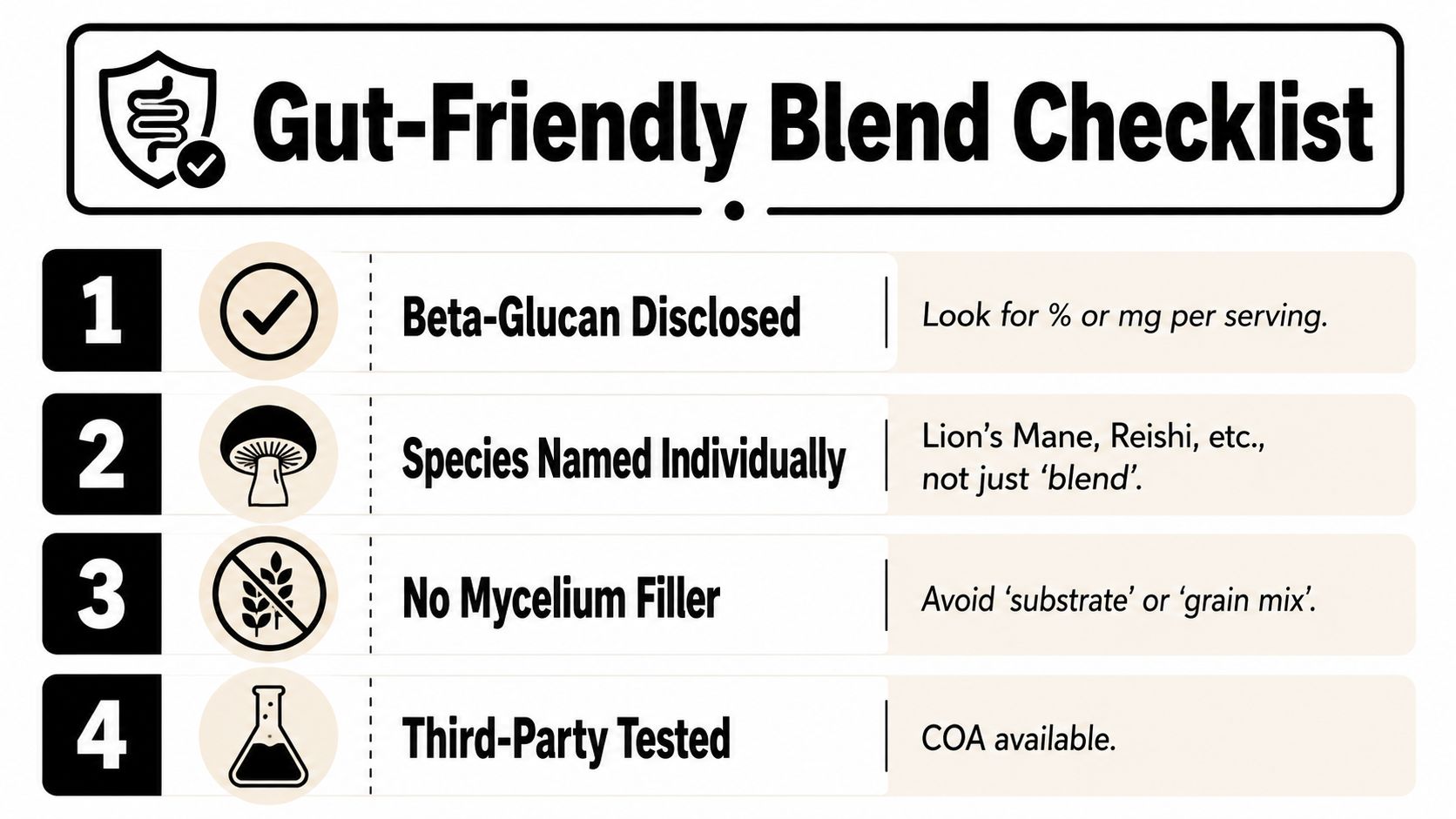
Use this short version while shopping:
- Beta-glucan data: Find a percentage or amount per serving.
- Named species: Reject an unexplained proprietary blend.
- Material disclosed: Confirm extract, powder, fruiting body, and substrate details.
- Prebiotic identified: Check the fiber type and amount.
- Caffeine stated: Don't guess from the serving size.
- Testing available: Look for a certificate of analysis.
- Allergens listed: Avoid vague flavor and creamer disclosures.
Matching the Right Blend to Your Routine
There isn't one perfect formula for every digestive system. The smart choice depends on how you respond to caffeine, fermentable fibers, dairy or coconut ingredients, and the practical demands of your morning.
| Use case | Key formulation features | Caffeine range | Watch for |
|---|---|---|---|
| Sensitive stomach | Simple ingredient list, lower-acidity coffee, no unnecessary gums or sweeteners | Choose a clearly disclosed lower-caffeine option | Added fibers and creamers may trigger symptoms |
| FODMAP-sensitive routine | No inulin or chicory root unless you already tolerate them | Select based on personal tolerance | “Prebiotic” can mean a poorly tolerated fermentable fiber |
| Low-caffeine morning | Reduced-caffeine or decaffeinated coffee base | Verify the exact amount on the label | Mushroom extracts don't make caffeine disappear |
| Caffeine-free routine | A genuinely caffeine-free mushroom drink | None, only if the label confirms it | Coffee flavor doesn't guarantee caffeine-free |
| Office or travel use | Tested instant format with simple preparation | Match the serving to your daily limit | Dissolved powder may hide unclear blend details |
| Post-meal use | Mild formula without aggressive additives | Avoid late-day caffeine if sleep is sensitive | Don't treat it as therapy for persistent symptoms |
| Existing fiber routine | Minimal added fiber so you can control total intake | Keep the coffee dose consistent | Combining multiple fibers may increase discomfort |
If your stomach is reactive
Choose the shortest ingredient list you can find. Skip formulas that stack mushroom extracts with inulin, chicory, sugar alcohols, heavy creamers, and multiple gums. Start with a small amount and track bloating, stool changes, reflux, and sleep rather than assuming every reaction is a sign of “detox.”
People with IBS-style triggers should be especially careful with added prebiotics. A mushroom coffee without inulin or chicory may be easier to evaluate because it lets you separate the coffee and mushroom response from the fiber response.
If caffeine is the problem
Pick by measured caffeine, not by the word “calm.” Reishi or other mushrooms don't cancel caffeine's effects, and a reduced-caffeine product may still be unsuitable for someone who reacts strongly. For afternoon use, choose a caffeine-free option or move the drink earlier rather than relying on adaptogenic marketing.
If convenience matters most, instant coffee can fit an office or travel routine. Just don't trade convenience for opacity. The ideal product remains one with species, glucan, caffeine, and testing information that you can verify before opening the packet.
My Recommendation and Realistic Expectations
My pick is a simple coffee-based blend built around clearly identified fruiting-body extracts, published beta-glucan testing, third-party quality documentation, moderate or disclosed caffeine, and no unnecessary digestive irritants. I wouldn't choose a product because it contains six or more mushrooms. I would choose the product that tells me exactly what is in one serving and proves the finished blend contains the compounds it advertises.
For gut health, beta-glucan transparency outranks brand recognition. A single-species formula with a credible assay is more useful than a crowded proprietary blend with no individual amounts. Added prebiotic fiber can be worthwhile, but only when the type is disclosed and your own tolerance supports it.
The best product is the one whose label you can actually verify.
Keep expectations realistic. Mushroom coffee is a daily delivery vehicle for small amounts of functional mushroom compounds and, in some formulas, prebiotic fibers. It isn't a treatment for IBS, SIBO, reflux, diagnosed dysbiosis, or any other gut condition. Coffee itself may influence the microbiome and bowel habits, but that doesn't turn a mushroom blend into medical care.
You may notice a more predictable morning routine, a different response to caffeine, or fewer afternoon slumps over time. You shouldn't expect an overnight microbiome transformation. The evidence for commercial mushroom coffee remains limited, and the finished beverage may deliver less gut-relevant material than the source mushroom suggests.
Trial cautiously if you have histamine intolerance, an active gut condition, significant caffeine sensitivity, or a history of reacting to mushroom products. Introduce one formula at a time, keep the serving consistent, and stop if symptoms worsen. If a digestive problem persists, get an appropriate clinical evaluation instead of trying to solve it with a premium coffee powder.
The Magic Mushroom Delivery offers mushroom coffee and other mushroom formats through an online storefront, with product information and educational resources to help you compare options. Visit The Magic Mushroom Delivery to review the available coffee products, ingredient details, and ordering information before choosing your blend.