
A 2025 meta-analysis pooled response rates and found psilocybin and SSRIs landing almost side by side. That near-tie is why "shrooms replace antidepressants" overstates the evidence. It is also nowhere near a reason to mix the two without a clinician.
Do not stop an antidepressant to try psilocybin, and do not combine the two on your own.
Two worries get folded into one question, and they pull in opposite directions. Safety asks whether stacking a psychedelic on a serotonergic pill creates a dangerous interaction. Effectiveness asks whether the pill will flatten the experience. Picture two doors in the same hallway: one labeled "too much serotonin signal," the other "not enough of the trip." Advice online picks a door and speaks as if the other one is not there. That is why the tips contradict each other with so much confidence.
The tip that needs the hardest look is the suggestion to come off an antidepressant for a couple of weeks first. In clinical trials, a washout is an entrance rule. Researchers use it so they can study psilocybin in people who are not also taking a serotonergic medicine. A rule for getting into a study is not proof that quitting is safer, and it is not proof that quitting makes psilocybin work better.
For someone steady on the same dose for years, stopping can cost far more than it buys. Withdrawal, a return of symptoms, and a gap with no plan are real costs. A clinician-supervised decision to continue, adjust, or taper is a different decision from copying a trial's entry criteria at home.
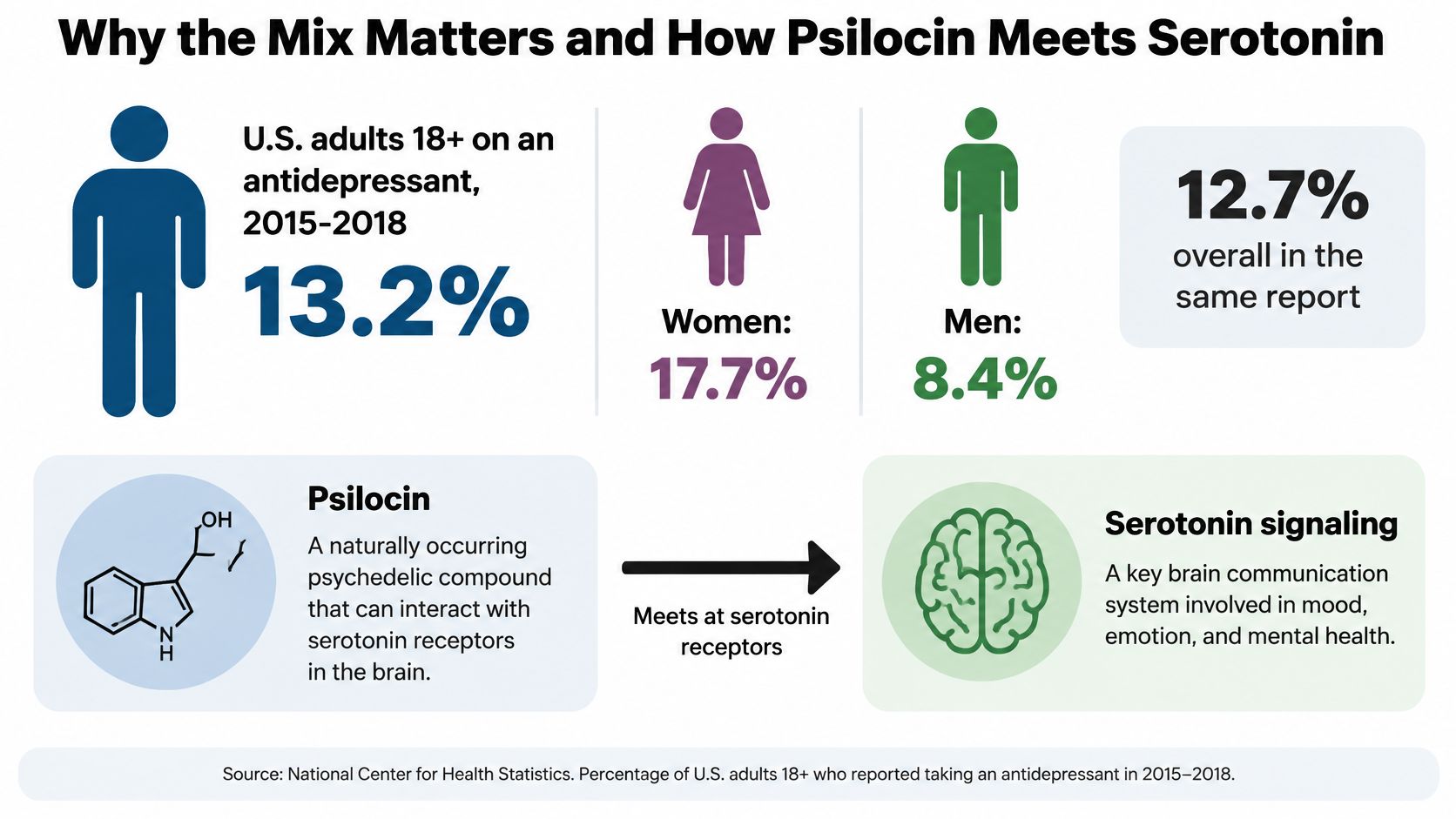
Why the Mix Matters and How Psilocin Meets Serotonin
In 2015–2018, 13.2% of U.S. adults aged 18 and older reported using antidepressant medication in the previous 30 days. The figure was 17.7% of adult women and 8.4% of adult men, according to CDC National Health and Nutrition Examination Survey data. Earlier CDC figures put use at 12.7% of people aged 12 and older in 2011–2014.
Many people take antidepressants for years. That means questions about combining them with psychedelics may involve a long-standing treatment, not a medicine someone can casually pause. Yet direct trial evidence on combining the two remains limited.
Consider someone who has taken 10 mg of escitalopram each morning since 2019. A friend offers mushrooms on a Saturday, and the person wonders whether to skip that day's pill. A missed dose is not a reliable way to predict how the medicines might interact. The prescriber, who knows the person's treatment history, is better placed to discuss the risks and options.
What psilocin does to a serotonin receptor
Psilocybin is a prodrug: the body converts it into the active molecule, psilocin, which mainly stimulates serotonin 5-HT2A receptors. These receptors work like volume knobs on a mixing desk: psilocin's interaction with them helps shape the psychedelic experience.
A review of psilocybin's pharmacology in CNS Spectrums reports that single oral doses of 3 to 30 milligrams produced dose-dependent occupancy of up to 72% of 5-HT2A receptors. The review also describes roughly 50% to 70% occupancy as associated with an intense psychedelic experience.
SSRIs work differently. They block serotonin reuptake, leaving more serotonin between neurons. Over time, the brain can adapt to that change by reducing receptor sensitivity. Understanding the difference between psilocin and psilocybin clarifies the chemistry, but a person's response may also reflect long-term medication use and individual sensitivity.
A short experiment cannot fully represent years of treatment. Dose, duration, the specific medication, and individual differences may all matter.
An antidepressant may reshape a psilocybin experience rather than switch it off. That altered response is hard to predict, and unpredictability does not establish safety.
What happens when people stay on their medicine
A small, open-label 2023 phase II exploratory study examined psilocybin for treatment-resistant depression in participants continuing an SSRI. 19 participants received 25 mg of psilocybin. At week three, eight participants, 42.1%, met response and remission criteria, and the mean Montgomery-Asberg Depression Rating Scale score fell 14.9 points. The investigators reported acceptable tolerability.
Those results cannot establish general safety or effectiveness. The study was exploratory and small, so its findings do not settle what happens across different antidepressants, doses, or patients. They do show why “the medicine makes psilocybin pointless” is too broad a conclusion.
A trial's medication washout or continuation rules are entry conditions for that study, not proof that stopping treatment is safer or more effective than following a clinician-supervised plan to continue.
Antidepressant Classes and What Changes
| Class | Examples | Main action | What evidence suggests | Practical caution |
|---|---|---|---|---|
| SSRI | Escitalopram, sertraline, fluoxetine | Raises extracellular serotonin; may desensitize 5-HT2A receptors | About half of surveyed concurrent users reported weaker subjective effects; short pretreatment can blunt unpleasant effects without erasing the experience | Do not skip or stop doses to chase a stronger experience |
| SNRI | Venlafaxine, duloxetine | Serotonin plus norepinephrine reuptake blockade | Direct combination trials are thin; norepinephrine effects matter for heart rate and blood pressure | Ask a prescriber before any change; do not self-test a stack |
| MAOI | Phenelzine, tranylcypromine | Blocks breakdown of serotonin and other monoamines | Highest theoretical concern for excess serotonin; psilocybin studies usually exclude MAOIs | Do not combine without specialist supervision |
| TCA | Amitriptyline, nortriptyline | Mixed serotonin and norepinephrine effects, plus sedation | Human psilocybin combination data are sparse | Review sedation, heart, and blood-pressure overlap with a clinician |
Find your row before reading further. Each class creates a different reason for caution, and for three of the four the human combination data are thin enough that confidence would be misplaced.
SSRIs, the partial dimmer
The strongest signal for a dulled experience comes from surveys, not trials. A prospective survey study in the Journal of Psychopharmacology reported that concurrent serotonin-reuptake-inhibitor use weakened the subjective psychedelic effects in approximately half of respondents. The proposed mechanism is chronic antidepressant-related adaptation of the serotonin system, including possible down-regulation or desensitization of cortical 5-HT2A receptors, the main receptor behind psilocin's effects.
Controlled data complicate that picture. In a randomized, placebo-controlled study of 23 healthy adults, 14 days of escitalopram (10 mg per day for 7 days, then 20 mg per day for 7 days) was followed by a 25 mg psilocybin dose. Escitalopram reduced several acute negative effects, including anxiety, subjective "bad drug" effects, anxious ego dissolution, and low-mood "nadir" effects, without eliminating the psychedelic experience.
That points to a pharmacodynamic interaction that may blunt or reshape the session rather than predictably block it. Two weeks of pretreatment in healthy volunteers is not the same experiment as ten years of daily prescribing in someone with a history of depression, and the study can't establish safety for unsupervised use or apply equally to every antidepressant.
When the drug does more than serotonin
SNRIs such as venlafaxine and duloxetine raise norepinephrine alongside serotonin, so heart rate and blood pressure during an intense experience belong in the same conversation as mood. Direct combination trials are thin enough that nobody can hand you a clean risk figure.
MAOIs sit in their own category. Phenelzine and tranylcypromine slow the breakdown of serotonin and other monoamines, and stacking another serotonergic substance on top is the pairing clinicians treat most cautiously. Research programs usually exclude these medicines outright, so there's no consumer safety margin to point to.
Tricyclics such as amitriptyline and nortriptyline mix serotonin and norepinephrine effects with sedation and anticholinergic action. Dedicated human combination data are sparse, which means the overlap has to be reviewed rather than guessed at.
What blunting does not mean: a softer experience is still a real pharmacological event happening in a body with a heart and a blood pressure. Less intensity isn't less risk.
Treat that table as a list of evidence gaps to carry into a prescriber's office. It is not a chart for choosing a combination or picking a dose.
Depression Trials Side by Side
| Study | Who | Comparison | Main result |
|---|---|---|---|
| 2025 meta-analysis of 17 acute trials | 373 psilocybin, 573 esketamine, and 4,014 SSRI participants | Active treatment versus control | Response 48% psilocybin, 52% esketamine, 46% SSRIs; controls 19%, 42%, and 33% |
| Escitalopram head-to-head | 59 adults with major depression | Two psilocybin doses three weeks apart versus daily escitalopram for six weeks | Both improved; no statistically significant difference on the primary depression outcome |
| 2023 major depression remission trial | 104 adults | Psilocybin versus niacin | Six-week remission in 12 of 48 (25%) versus 4 of 44 (9.1%); adjusted difference 15.9 points, P = .05 |
The 2025 meta-analysis examined 17 acute-phase randomized clinical trials. Pooled response rates were 48% for active psilocybin treatment, 52% for esketamine, and 46% for SSRIs, against control-group response rates of 19%, 42%, and 33% respectively. Every active treatment beat its control, and the size of that edge varied enormously depending on what the comparison arm received.
The most direct test of the replacement question is the head-to-head. In a randomized trial, 59 adults with major depression received either two psilocybin doses three weeks apart or daily escitalopram for six weeks. Both groups improved substantially, and the study did not find a statistically significant difference in the primary depression outcome. Comparable is the finding. Superior is not.
Then there's the remission trial, which is easy to misread. Among 104 adults with major depressive disorder, sustained remission at six weeks occurred in 12 of 48 participants receiving psilocybin, or 25%, compared with 4 of 44 receiving niacin, or 9.1%. The adjusted absolute difference was 15.9 percentage points, with P = .05.
Read that P value carefully. It sits exactly on the conventional cutoff for statistical significance, so the result is suggestive rather than decisive. The comparison group also took niacin, not an antidepressant, which means this trial speaks to whether psilocybin outperforms a placebo-like vitamin, not whether it outperforms your prescription.
A trial showing psilocybin can relieve depression is not a trial showing it beats your medication. It's certainly not a trial showing that dried mushrooms bought from a stranger perform the same way.
What these studies share is a controlled setting: screening, a measured dose, trained facilitators, and psychological support around the session. That is the part headlines drop. If you want the fuller picture of where psilocybin sits in mood research, the evidence on psilocybin for depression is worth reading with those limits in hand.
None of it covers unsupervised products, a medicine cabinet holding three prescriptions, or a reader who stops treatment to copy a study protocol. Those are exactly the situations the trials screened out.
Why a Washout Is Not Automatically Safer
The most confidently repeated tip in this space is that you should stop your antidepressant two weeks before a psilocybin session so it "works." The confidence traces back to trial protocols, not to evidence that stopping helps a real patient.

Most psilocybin trials require a two-to-four-week antidepressant washout, while the patients who take these medicines commonly stay on them for years. A PubMed-indexed clinical review identifies that mismatch as a major translational gap, and the same body of work contains a finding that cuts against the folklore: participants who discontinued an SSRI or SNRI before psilocybin showed reduced treatment effects across outcome measures compared with participants who were unmedicated when they entered the trial.
That analysis did not test continuation against discontinuation, so it can't prove that stopping caused the weaker response. It still complicates the story that quitting sharpens the medicine. A washout is how a study standardizes who walks through the door. It is not a safety rule you can run on yourself at home.
What stopping costs before the session even starts
Antidepressant discontinuation isn't a neutral act. Someone who tapers can meet withdrawal symptoms, a return of the depression or anxiety the medicine was holding back, and a stretch of unstable mood right before an emotionally demanding experience. Sequencing matters here. Destabilizing first and taking a high-dose psychedelic second is the arrangement with the worst risk profile, and it's the one a casual two-week rule produces.
Three questions with no calendar answer
Does the drug's half-life change the timeline? Fluoxetine lingers in the body very differently from sertraline or escitalopram, so a single washout window can't fit every prescription.
Would a taper unsettle someone who has been well for years? That's a clinical judgment about one person's history, not a generic interval.
Could a supervised continuation plan be safer than stopping? For some people it may be, and that's a conversation to have with the prescriber rather than a decision to trial at home.
Washout is a trial-design convention. It decides who gets into a study, and it is not an evidence-free safety default for someone with a decade-long prescription.
Don't cut, skip, or stretch doses on your own, and don't let a forum timeline override the clinician who knows your history.
Side Effects That Do Not Disappear
Staying on an antidepressant changes the texture of a psilocybin experience. It does not delete the physical effects. A meta-analysis of six randomized, double-blind clinical trials involving 528 participants found that therapeutic psilocybin was associated with significantly more headache, nausea, anxiety, dizziness, and blood-pressure fluctuations than comparator treatments.
The size of those effects is worth seeing plainly. In one included trial, headache occurred in 43% of participants after high-dose psilocybin versus 17% with low-dose psilocybin plus escitalopram, while nausea occurred in 13% versus 0%. Those numbers come from monitored clinical settings, not from a living room with no one checking a blood pressure cuff.
The part a clinic provides and a sofa doesn't
A research site has screening, a measured dose, staff watching for distress, and equipment to check vitals when something feels wrong. Recreation can't copy that setup, which is why the harm-reduction basics matter more than the trip report.
- Keep the medicine cabinet boring: don't add other serotonergic supplements or extra serotonergic medicines on the night, and don't stack alcohol on top of a high dose.
- Have a sober, informed person present: someone who knows what you took, when, and what would make them call for help.
- Postpone entirely during instability: unstable depression, mania, psychosis risk, pregnancy, or unstable heart disease all argue for waiting rather than experimenting.
- Write down every prescription before the day arrives: including blood-pressure medicine and anything bought over the counter.
Signs that mean emergency care, not patience
Severe agitation or confusion, muscle rigidity, fever, seizures, chest pain, fainting, or a blood-pressure crisis need medical help immediately. Those are not passages to sit through with ambient music, and no one should be talked out of calling for help by a facilitator's reassurance.
Treat the percentages above as group data, not a personal risk score, and don't read them as clearance for MAOIs or multi-drug combinations. The wider harm reduction guidance for psychedelics covers preparation and support in more depth.
A calmer trip report is not a safety finding. Feeling less anxious in one setting leaves the physical and psychological risks exactly where they were.
Questions to Take to Your Prescriber
The useful next step isn't another article. It's a medication review, scheduled before any psilocybin exposure lands on the calendar.
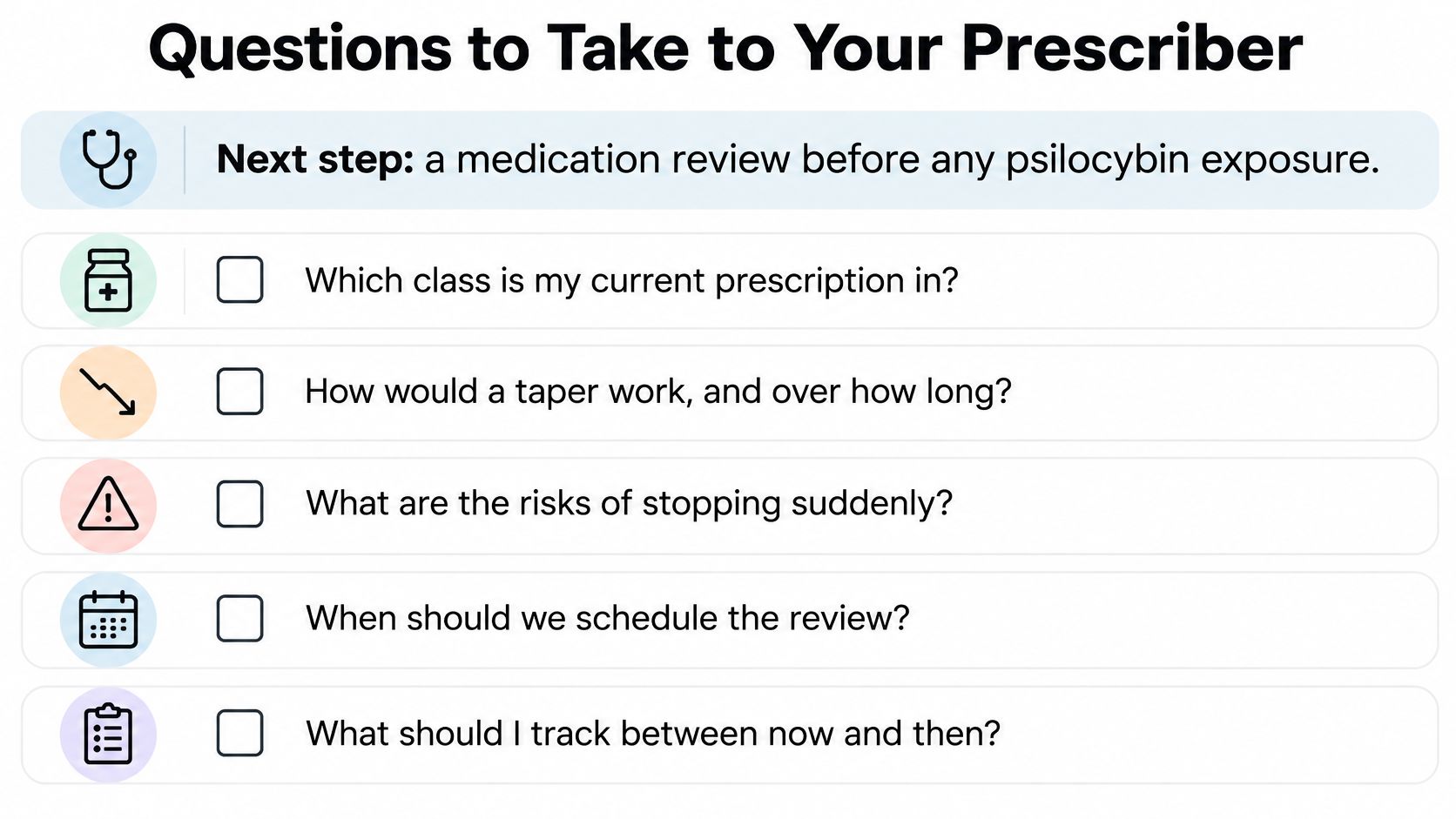
Which class is my current prescription in, and does my dose change the answer? Bring the bottle, not the memory of the bottle.
Is anything else I take serotonergic? That includes a second psychiatric medicine, a supplement marketed for mood, and anything bought without a prescription.
If I stopped, what would withdrawal and relapse look like for me specifically? Ask about your own history with dose changes, not the average patient's.
Would a long-acting drug like fluoxetine need a different timeline than sertraline or escitalopram, and who sets it? The answer belongs to a prescriber, not to a forum thread.
What's the plan if my mood destabilizes? Name the contact, the timeline, and the warning signs before anything is scheduled.
Until a prescriber or pharmacist says otherwise, keep taking the prescribed dose. Don't cut, skip, or stretch it to shape an experience. A pharmacist is often the fastest route to a full interaction check across everything in the cabinet, including over-the-counter products that never come up in a psychiatric appointment.
The same caution applies to what we sell. If you're combining Magic Mushroom Capsules with any medication or supplement, we'd tell you to consult your healthcare provider first, and the same goes for our raw mushrooms and gummies.
Clinicians who know your history, your heart health, and your mood pattern are the only people positioned to judge whether a combination is reasonable at all. No article, survey, trial summary, or product label can individualize this decision for you.
The Magic Mushroom Delivery pairs its catalog of raw mushrooms, chocolates, gummies, and capsules with plain-language education on effects, duration, and responsible use, which is exactly the background worth having before a conversation about shrooms and antidepressants. If you take an antidepressant, put the prescriber conversation first and product questions second, and we're glad to handle the second part when you get there. Visit The Magic Mushroom Delivery to browse the range and read the guides before you decide anything.