The most repeated advice on functional mushrooms for anxiety treats a calm-sounding label as if it were a treatment result. Reishi gets called the mushroom of calm. Lion's mane gets sold as mental steadiness in a cup. A blend gets marketed as if every species inside it had been shown to treat an anxiety disorder. Human trials did not measure that. They measured stress, mood, sleep, and self-rated anxiety scores in small groups, usually over a few weeks, and usually in people who did not have a formal anxiety diagnosis. Species mix, daily dose, and how long someone takes the product change what those scores can even mean.
Where the Evidence Stands on Mushrooms and Anxiety
Human studies of functional mushrooms have generally measured stress, mood, sleep, or self-rated anxiety. Those outcomes can inform research, but they do not establish that mushrooms treat an anxiety disorder.
A 2024 scoping review of mushrooms and fungi in mental-health research identified 50 relevant published studies. It also found that human research covered only several species, with findings too limited to establish mushrooms as treatments for anxiety disorders. Lab and animal studies can suggest possible biological pathways, but they cannot show whether people feel calmer.
Early human trials offer signals, not settled conclusions. A 2010 placebo-controlled study tested lion's mane powder in cookies over four weeks and reported lower self-rated anxiety and depression scores than placebo. The small, narrow study cannot establish a treatment effect. Separately, the Oncology Nursing Society's summary of a lion's mane extract study describes a trial in adults with mixed mood, sleep, or eating-related symptoms. Anxiety scores fell from participants' own baselines, a result that does not demonstrate efficacy for generalized anxiety disorder.
| Mushroom or formula | Population studied | Main finding | Evidence strength |
|---|---|---|---|
| Lion's mane powder, stress trial | Healthy adults | Subjective stress reduction; the reported result was a trend rather than a clear difference | Preliminary |
| Lion's mane powder, cookie study | Women | Lower self-rated anxiety and depression scores than placebo | Preliminary |
| Lion's mane extract | Adults with mixed symptoms | Anxiety scores decreased from participants' own baselines | Preliminary |
| Lion's mane and reishi blend | Young women | Lower GAD-7 scores than lion's mane alone | Preliminary |
| Reishi extract | Female students | Anxiety and depression measures improved relative to placebo at tested doses | Low-certainty |
| Five-mushroom blend | Adults with moderate to severe stress | STAI-S and HAM-A scores fell more than with placebo | Early randomized trial |
The evidence remains limited by small trials, varied formulations, and measures that often sit beside a clinical diagnosis rather than assessing one. A product label may promise calm, but that wording is not equivalent to a trial showing treatment of an anxiety disorder.
Practical rule: Treat mushroom products as wellness supplements under investigation, not as substitutes for mental-health care or prescribed treatment.
Persistent worry that disrupts work, sleep, or relationships warrants assessment by a qualified professional.
Doses and Durations Used in Human Trials
The human trials used repeated daily doses over weeks. Their results cannot be translated directly to a product with a different species, preparation, dose, or duration.
| Product tested | Daily dose | Duration | Form |
|---|---|---|---|
| Lion's mane powder (stress trial) | 1.8 g | 28 days | Powder |
| Lion's mane cookies (2010 study) | 2 g (four 0.5 g cookies) | 4 weeks | Cookies with fruiting-body powder |
| Lion's mane and reishi blend | 1.8 g | 28 days | Capsules |
| Five-mushroom blend | 1,000 mg (two 500 mg capsules) | 12 weeks | Capsules |
| Mushroom coffee (typical product) | About 500 mg mushroom material | No clinical duration tested | Beverage |
What each row actually tested
The lion's mane stress trial used 1.8 g daily for 28 days. A 2010 cookie study used about 2 g daily, delivered as four 0.5 g cookies over four weeks. A separate lion's mane and reishi blend trial also used 1.8 g daily for 28 days. These doses and formats are not interchangeable: the studies tested specific preparations, not every product containing the same mushroom name.
The five-mushroom blend used two 500 mg capsules daily for 12 weeks. That is a lower daily mass than 1.8 g, taken over a longer period. Dose alone therefore cannot explain differences in outcomes across trials; species, preparation, population, and duration also matter.
How to use the table
A typical mushroom coffee serving may contain about 500 mg of mushroom material, but the table includes no clinical duration for that product type. Its amount cannot be treated as equivalent to a trial dose without knowing whether the species and preparation match.
The studies measured outcomes such as stress, mood, and anxiety-scale scores in particular groups. They do not establish that a different blend, dose, or preparation will produce the same result. For context on how mushroom products are presented for cognitive support, see this guide to mushroom nootropics.
Why Blends and Single Species Give Different Results
Put two capsules side by side. In a 28-day trial, 84 women aged 18 to 26 took 1.8 g a day of powdered lion's mane, 1.8 g of a lion's mane and reishi blend, or placebo. Anxiety was scored with the seven-item Generalized Anxiety Disorder scale, GAD-7. The blend produced lower GAD-7 scores than lion's mane alone. Across the study the comparison reached p = 0.018, and the day-28 difference reached p = 0.003, as reported in the Frontiers in Nutrition trial.
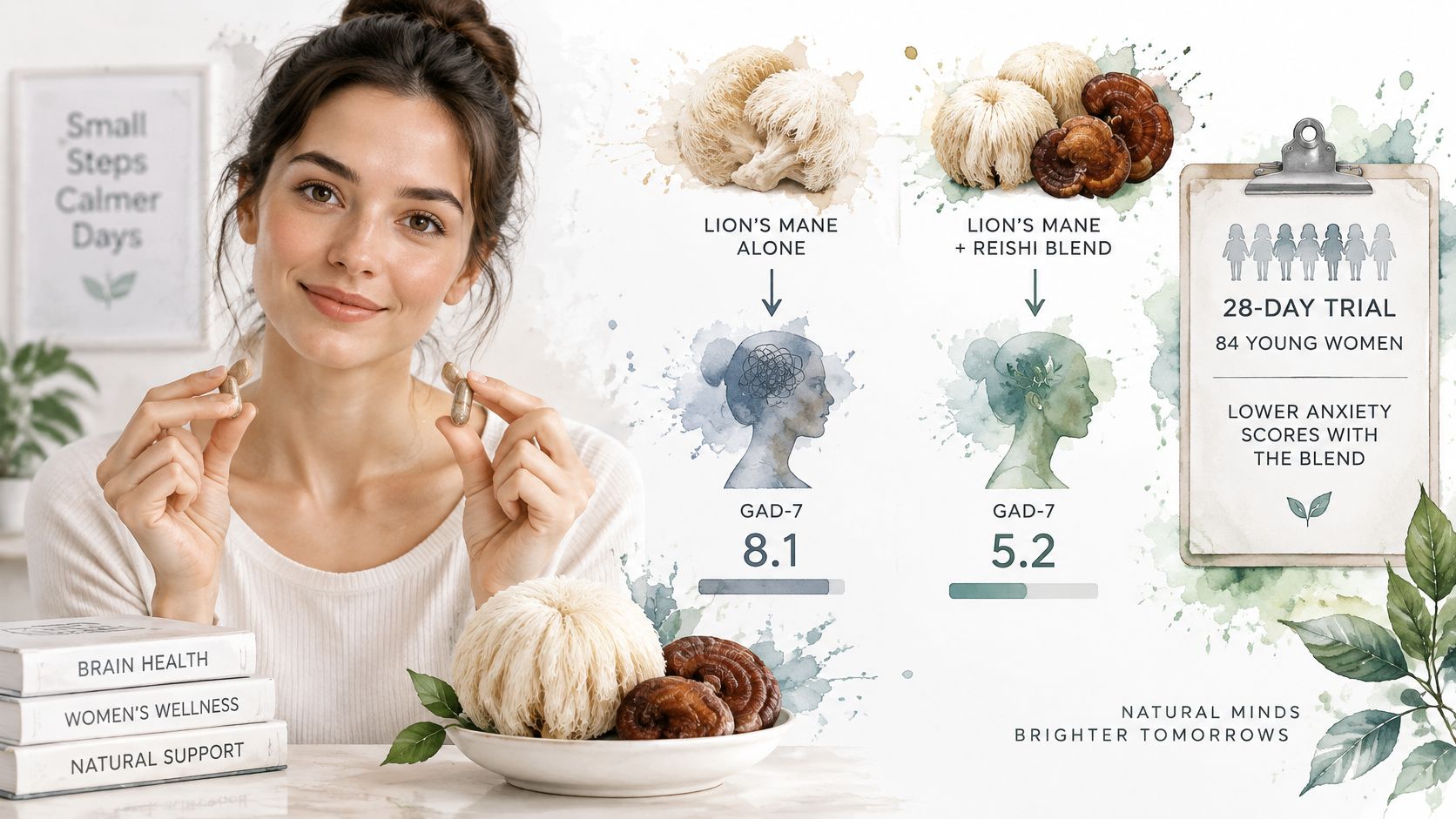
Formulation changed the score. Combining species produced a different anxiety result than lion's mane by itself. The design still cannot say how much of that gap came from reishi, from the ratio, or from the fact that these were young women with heightened but subclinical symptoms. It does not show that reishi alone works, and it does not cover men, older adults, diagnosed anxiety disorders, or a different extract.
A second blend makes the same limit louder. A 2026 randomized, double-blind trial assigned 50 moderately to severely stressed adults to a five-mushroom formula (lion's mane, cordyceps, reishi, shiitake, and maitake) or placebo for 12 weeks. On the published trial record, the mushroom group had larger anxiety drops than placebo at six weeks on STAI-S (p = 0.025) and HAM-A (p = 0.002), and at 12 weeks on STAI-S (p = 0.011) and HAM-A (p = 0.002). Depression, fatigue domains, and sleep quality also moved. Fifty people cannot set a population effect, and 12 weeks cannot prove long-term safety. Because five species shared one capsule, no single mushroom owns the result.
A result for a blend does not transfer to a single-species bottle, and a single-species result does not transfer to a blend.
Proprietary blend labeling blocks the comparison. If the panel gives one total weight and hides the split, you cannot tell whether the formula matches either trial.
Ask three questions before you buy any mix:
- Which species carries the dose? Name every mushroom, not a house blend title.
- How much of each? Grams or milligrams per species, per day.
- Does that match a tested formula? Same species list, a daily total near 1.8 g or 1,000 mg, and a plan measured in weeks.
How Functional Mushrooms Might Calm the Stress Response
Think of a tuning crew, not a light switch. A functional mushroom, if it does anything for stress, is closer to a crew retuning a system over days of repeated use than to an effect you should feel within an hour.
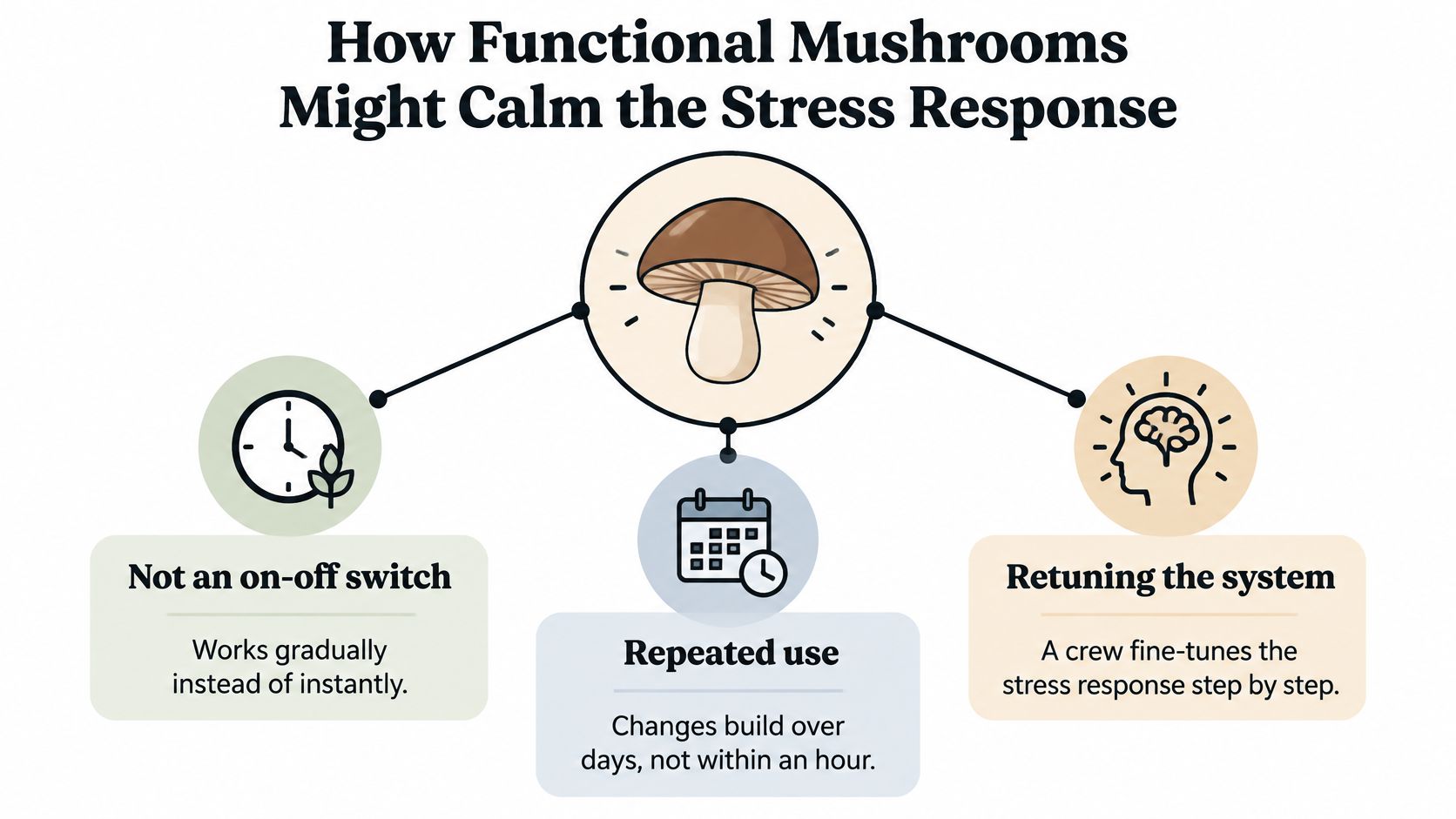
Three routes get discussed. Each one has a different kind of support, and none of them has been shown to cause anxiety relief in people.
Nerve-growth signaling, mostly preclinical. Lion's mane compounds, particularly hericenones and erinacines, are linked in lab work to neurotrophin signaling, including nerve-growth-factor pathways. Human trials in this area generally scored symptoms. They did not measure those markers in a way that proves the pathway is why a score moved. Evidence level: hypothesis, not a clinical mechanism.
Immune and inflammatory tone, still a hypothesis. Reishi (Ganoderma lucidum) is discussed for immunomodulatory and anti-inflammatory activity that might complement that neurotrophin story. The blend trials did not separate reishi's constituents from the rest of the capsule, so this route stays hypothesis-generating. Evidence level: low.
A stress-hormone number from one blend. In a 12-week trial in Malaysia, 50 adults aged 22 to 55 with stress, anxiety, and sleep-related symptoms took two daily capsules of a five-mushroom formulation, 500 mg each, 1,000 mg total, or placebo. NutraIngredients' account of that trial reports that serum cortisol in the mushroom group fell 4.4% after six weeks and 5.5% after 12 weeks. Self-reported anxiety on the State-Trait Anxiety Inventory declined 8.7%, against 4.9% on placebo. A shared capsule still cannot assign cortisol, or the score, to reishi, lion's mane, cordyceps, or any other single species. Evidence level: one small human signal, blend only.
Symptom scales and a few blood measures are not the same thing as proof that a pathway causes calmer days. Adaptogens get talked about as if the biology were settled. Our overview of adaptogenic mushroom benefits is a better place to separate traditional use from what a blood test showed.
The crew metaphor still holds at the end of the shift. Judge any change after several weeks of the same daily dose. A single serving is the wrong test.
Reading a Label Before You Buy
A label can list a mushroom and a milligram amount without showing that its product matches a human trial. Check the species, form, dose, duration, and what the research measured.
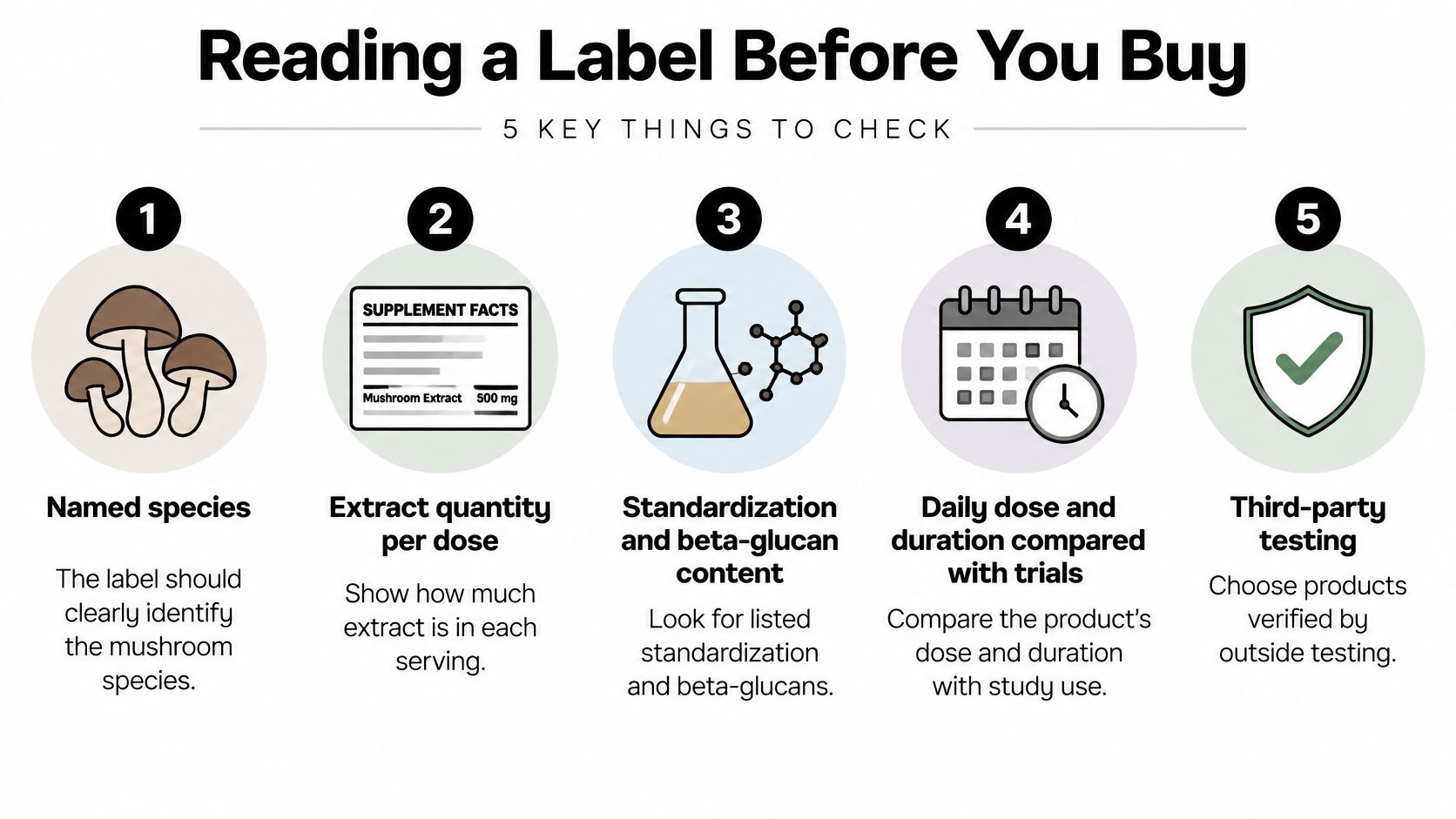
| Label item | Why it matters | Red flag |
|---|---|---|
| Exact species named | Results from a blend cannot identify which mushroom contributed to the outcome | "Proprietary blend" with no species list |
| Extract quantity per dose | Trials report amounts in milligrams or grams, so form and quantity matter | Only a total blend weight is shown |
| Standardization and beta-glucan content | These details help characterize the material behind the stated weight | No standard or beta-glucan figure given |
| Daily dose and trial duration | They show whether the product resembles the amount and schedule studied | Dose far below the tested range, such as mushroom coffee at about 500 mg |
| Contaminant testing | Testing can address whether mushrooms are free from contaminants | No information about testing |
Species and form come first. A result from a multi-mushroom blend is not evidence for one species alone, and powder is not interchangeable with extract just because both are measured by weight. Standardization and beta-glucan content provide further information about the material in a serving; without them, the listed weight does not describe its composition.
Mushroom coffee compared with a powder trial
A typical mushroom coffee holds about 500 mg of mushroom material. In a trial, 41 healthy adults took 1.8 g of lion's mane powder daily for 28 days. Participants performed better on a Stroop cognitive task 60 minutes after one dose. After 28 days, the change in subjective stress reached p = 0.051, just above the usual p < 0.05 threshold. Your Health Magazine's report on mushroom coffee and the research describes the dose comparison. The trial measured cognition and subjective stress, not anxiety, and its stress result was not statistically significant. A lower-dose coffee therefore cannot be assumed to produce the same result.
Compare a product's daily amount and duration with those used in the relevant trial. If matching a tested daily amount would require several servings, the product does not mirror that study's schedule.
The Magic Mushroom Delivery tests its mushrooms to ensure they are free from DMT and other contaminants. Its information on mushroom testing for contaminants addresses testing, while a label's species, form, and amount help you judge whether the product resembles the material studied. Check those details before comparing any anxiety claim with trial results.
Side Effects, Cautions and a Decision Path
Short-term reports from mushroom trials include gastrointestinal upset, dry mouth, and occasional skin reactions, usually mild. Most of those trials lasted weeks. A 12-week study cannot tell you what happens in month six, and nobody in this set followed people after they stopped. Long-term safety is unknown.
Who should talk to a clinician first
Interaction data for reishi are not well resolved. People taking anticoagulants or immunosuppressants should get clinician advice before any reishi-containing product. The same caution covers pregnancy, breastfeeding, children, and anyone with surgery planned, because evidence in those groups is thin.
A diagnosed anxiety disorder, or symptoms that keep returning, is a different decision. A capsule can sit beside care. It is not a stand-in for psychotherapy or prescribed treatment.
Our own products follow the same boundary. Magic Mushroom Gummies belong in a balanced wellness routine, and a healthcare professional should set the recommendation for you. We also advise checking with a healthcare provider before Raw Magic Mushrooms are taken with any medication or supplement. Separately, we test mushrooms so they are free from DMT and other contaminants. Testing speaks to identity and purity. It does not turn a supplement into anxiety treatment.
A short routine if you still want to try a non-psychoactive formula
- List every medication and supplement you already take, including sleep aids and blood thinners.
- Ask a clinician about reishi specifically if that species is on the label, even when the rest of the blend looks familiar.
- Start at a tested dose, such as the 500 to 1,000 mg reishi window or the 1.8 g lion's mane window, rather than stacking extra servings.
- Stop and get advice if stomach upset, dry mouth, or a skin reaction persists or gets worse.
A decision path that matches the evidence
- Temporary stress, the kind that tracks a hard month rather than a lasting pattern, can be a setting where a supplement is discussed as an exploratory option. Set the clock in weeks, not days, and keep sleep and clinical care in the plan if stress is already disrupting them.
- Symptoms that persist or that affect work, sleep, or relationships call for a clinical assessment for generalized anxiety disorder before you rely on a jar.
- If you buy, pick named species, a stated daily dose, and third-party testing. Commit to a 4 to 12 week trial and put a review date on the calendar. That window matches how long the human studies ran.
Check with a clinician before you start any product. Functional mushrooms for anxiety are a label-versus-trial problem, and the safer reading is always the trial. Small scores can move. A diagnosis does not get treated by a trend at p = 0.051 or by a blend that cannot name its own dose.
The Magic Mushroom Delivery carries functional mushroom products alongside clear guidance on dose, duration, and when to talk with a clinician. If you are comparing species, labels, and lab checks before you buy, start with the product details and testing notes on The Magic Mushroom Delivery. Browse the range, then match any daily amount to the trial windows above rather than to a calm-sounding claim on the front of the jar.